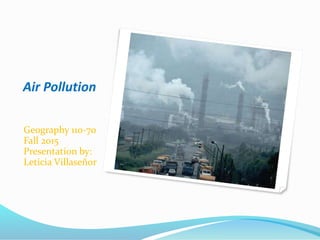
Air Pollution
Geography 110-70
Fall 2015
Presentation by:
Leticia Villaseñor
Air Pollution-What is it?
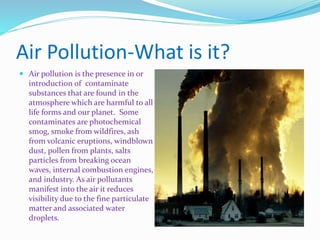
 Air pollution is the presence in or
introduction of contaminate
substances that are found in the
atmosphere which are harmful to all
life forms and our planet. Some
contaminates are photochemical
smog, smoke from wildfires, ash
from volcanic eruptions, windblown
dust, pollen from plants, salts
particles from breaking ocean
waves, internal combustion engines,
and industry. As air pollutants
manifest into the air it reduces
visibility due to the fine particulate
matter and associated water
droplets.
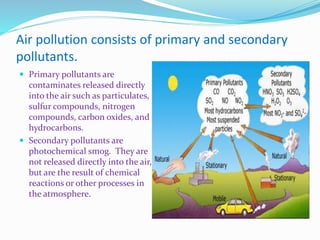
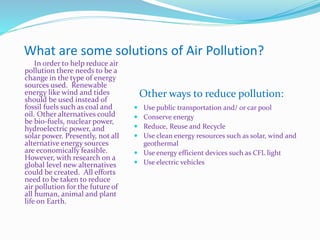
Air pollution consists of primary and secondary
pollutants.
 Primary pollutants are
contaminates released directly
into the air such as particulates,
sulfur compounds, nitrogen
compounds, carbon oxides, and
hydrocarbons.
 Secondary pollutants are
photochemical smog. They are
not released directly into the air,
but are the result of chemical
reactions or other processes in
the atmosphere.
Where is Air Pollution happening?
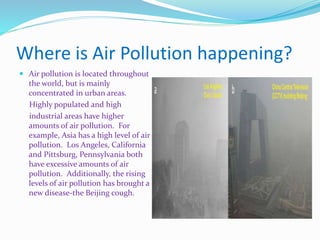
 Air pollution is located throughout
the world, but is mainly
concentrated in urban areas.
Highly populated and high
industrial areas have higher
amounts of air pollution. For
example, Asia has a high level of air
pollution. Los Angeles, California
and Pittsburg, Pennsylvania both
have excessive amounts of air
pollution. Additionally, the rising
levels of air pollution has brought a
new disease-the Beijing cough.
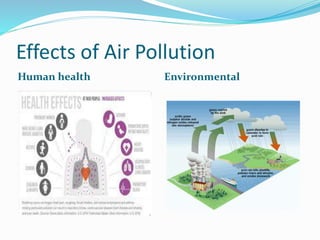
Effects of Air Pollution
Human health Environmental
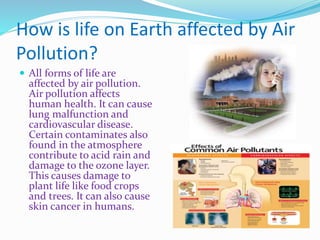
How is life on Earth affected by Air
Pollution?
 All forms of life are
affected by air pollution.
Air pollution affects
human health. It can cause
lung malfunction and
cardiovascular disease.
Certain contaminates also
found in the atmosphere
contribute to acid rain and
damage to the ozone layer.
This causes damage to
plant life like food crops
and trees. It can also cause
skin cancer in humans.
Air Pollution has impacted our atmosphere since the Roman Empire. Methane gas was produced
from the Roman domesticated livestock such as cows, sheep, and goats. As the Han Dynasty in
China expanded its rice fields, they harbored methane producing bacteria. Also, blacksmiths in
both empires produced methane gas when they burned wood to make their metal weapons.
With the beginning of the Industrial Revolution in the 1700’s, pollution became more
widespread and intense. By the twentieth century, air pollution caused many deaths. Including 63
people killed over a five-day period in Belgium’s Meuse Valley in 1930; 6,000 illnesses and 20
deaths in Donora, Pennsylvania, during a five day period. Due to being enveloped in a lethal haze,
residents experienced severe respiratory and cardiovascular problems. This was a harsh
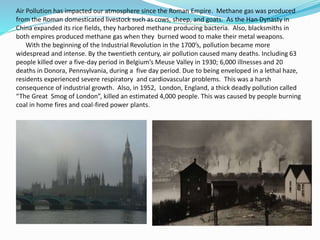
consequence of industrial growth. Also, in 1952, London, England, a thick deadly pollution called
“The Great Smog of London”, killed an estimated 4,000 people. This was caused by people burning
coal in home fires and coal-fired power plants.
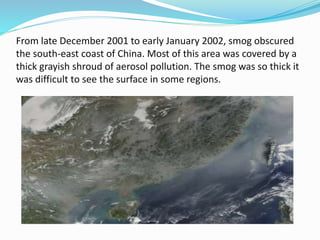
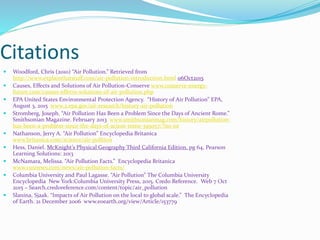
From late December 2001 to early January 2002, smog obscured
the south-east coast of China. Most of this area was covered by a
thick grayish shroud of aerosol pollution. The smog was so thick it
was difficult to see the surface in some regions.
Is there some problem or issue with Air
Pollution?
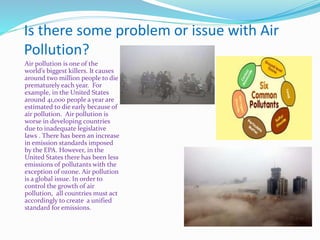
Air pollution is one of the
world’s biggest killers. It causes
around two million people to die
prematurely each year. For
example, in the United States
around 41,000 people a year are
estimated to die early because of
air pollution. Air pollution is
worse in developing countries
due to inadequate legislative
laws . There has been an increase
in emission standards imposed
by the EPA. However, in the
United States there has been less
emissions of pollutants with the
exception of ozone. Air pollution
is a global issue. In order to
control the growth of air
pollution, all countries must act
accordingly to create a unified
standard for emissions.
What are some solutions of Air Pollution?
In order to help reduce air
pollution there needs to be a
change in the type of energy
sources used. Renewable
energy like wind and tides
should be used instead of
fossil fuels such as coal and
oil. Other alternatives could
be bio-fuels, nuclear power,
hydroelectric power, and
solar power. Presently, not all
alternative energy sources
are economically feasible.
However, with research on a
global level new alternatives
could be created. All efforts
need to be taken to reduce
air pollution for the future of
all human, animal and plant
life on Earth.
 Use public transportation and/ or car pool
 Conserve energy
 Reduce, Reuse and Recycle
 Use clean energy resources such as solar, wind and
geothermal
 Use energy efficient devices such as CFL light
 Use electric vehicles
Other ways to reduce pollution:
Citations
 Woodford, Chris (2010) “Air Pollution.” Retrieved from
http://www.explainthatstuff.com/air-pollution-introduction.html 06Oct2015
 Causes, Effects and Solutions of Air Pollution-Conserve www.conserve-energy-
future.com/causes-effects-solutions-of-air-pollution.php
 EPA United States Environmental Protection Agency. “History of Air Pollution” EPA,
August 3, 2015 www.2.epa.gov/air-research/history-air-pollution
 Stromberg, Joseph. “Air Pollution Has Been a Problem Since the Days of Ancient Rome.”
Smithsonian Magazine. February 2013 www.smithsonianmag.com/history/airpollution-
has-been-a-problem-since-the-days-of-acient-rome-395057/?no-ist
 Nathanson, Jerry A. “Air Pollution” Encyclopedia Britanica
www.britanica.com/science/air-polltion
 Hess, Daniel. McKnight’s Physical Geography Third California Edition. pg 64, Pearson
Learning Solutions: 2013
 McNamara, Melissa. “Air Pollution Facts.” Encyclopedia Britanica
www.cusnews.com/news/air-pollution-facts/
 Columbia University and Paul Lagasse. “Air Pollution” The Columbia University
Encyclopedia New York:Columbia University Press, 2015. Credo Reference. Web 7 Oct
2015 – Search.credoreference.com/content/topic/air_pollution
 Slanina, Sjaak. “Impacts of Air Pollution on the local to global scale.” The Encyclopedia
of Earth. 21 December 2006 www.eoearth.org/view/Article/153779

Air pollution

  • 1.
    Air Pollution Geography 110-70 Fall2015 Presentation by: Leticia Villaseñor
  • 2.
    Air Pollution-What isit?  Air pollution is the presence in or introduction of contaminate substances that are found in the atmosphere which are harmful to all life forms and our planet. Some contaminates are photochemical smog, smoke from wildfires, ash from volcanic eruptions, windblown dust, pollen from plants, salts particles from breaking ocean waves, internal combustion engines, and industry. As air pollutants manifest into the air it reduces visibility due to the fine particulate matter and associated water droplets.
  • 3.
    Air pollution consistsof primary and secondary pollutants.  Primary pollutants are contaminates released directly into the air such as particulates, sulfur compounds, nitrogen compounds, carbon oxides, and hydrocarbons.  Secondary pollutants are photochemical smog. They are not released directly into the air, but are the result of chemical reactions or other processes in the atmosphere.
  • 4.
    Where is AirPollution happening?  Air pollution is located throughout the world, but is mainly concentrated in urban areas. Highly populated and high industrial areas have higher amounts of air pollution. For example, Asia has a high level of air pollution. Los Angeles, California and Pittsburg, Pennsylvania both have excessive amounts of air pollution. Additionally, the rising levels of air pollution has brought a new disease-the Beijing cough.
  • 5.
    Effects of AirPollution Human health Environmental
  • 6.
    How is lifeon Earth affected by Air Pollution?  All forms of life are affected by air pollution. Air pollution affects human health. It can cause lung malfunction and cardiovascular disease. Certain contaminates also found in the atmosphere contribute to acid rain and damage to the ozone layer. This causes damage to plant life like food crops and trees. It can also cause skin cancer in humans.
  • 7.
    Air Pollution hasimpacted our atmosphere since the Roman Empire. Methane gas was produced from the Roman domesticated livestock such as cows, sheep, and goats. As the Han Dynasty in China expanded its rice fields, they harbored methane producing bacteria. Also, blacksmiths in both empires produced methane gas when they burned wood to make their metal weapons. With the beginning of the Industrial Revolution in the 1700’s, pollution became more widespread and intense. By the twentieth century, air pollution caused many deaths. Including 63 people killed over a five-day period in Belgium’s Meuse Valley in 1930; 6,000 illnesses and 20 deaths in Donora, Pennsylvania, during a five day period. Due to being enveloped in a lethal haze, residents experienced severe respiratory and cardiovascular problems. This was a harsh consequence of industrial growth. Also, in 1952, London, England, a thick deadly pollution called “The Great Smog of London”, killed an estimated 4,000 people. This was caused by people burning coal in home fires and coal-fired power plants.
  • 8.
    From late December2001 to early January 2002, smog obscured the south-east coast of China. Most of this area was covered by a thick grayish shroud of aerosol pollution. The smog was so thick it was difficult to see the surface in some regions.
  • 9.
    Is there someproblem or issue with Air Pollution? Air pollution is one of the world’s biggest killers. It causes around two million people to die prematurely each year. For example, in the United States around 41,000 people a year are estimated to die early because of air pollution. Air pollution is worse in developing countries due to inadequate legislative laws . There has been an increase in emission standards imposed by the EPA. However, in the United States there has been less emissions of pollutants with the exception of ozone. Air pollution is a global issue. In order to control the growth of air pollution, all countries must act accordingly to create a unified standard for emissions.
  • 10.
    What are somesolutions of Air Pollution? In order to help reduce air pollution there needs to be a change in the type of energy sources used. Renewable energy like wind and tides should be used instead of fossil fuels such as coal and oil. Other alternatives could be bio-fuels, nuclear power, hydroelectric power, and solar power. Presently, not all alternative energy sources are economically feasible. However, with research on a global level new alternatives could be created. All efforts need to be taken to reduce air pollution for the future of all human, animal and plant life on Earth.  Use public transportation and/ or car pool  Conserve energy  Reduce, Reuse and Recycle  Use clean energy resources such as solar, wind and geothermal  Use energy efficient devices such as CFL light  Use electric vehicles Other ways to reduce pollution:
  • 11.
    Citations  Woodford, Chris(2010) “Air Pollution.” Retrieved from http://www.explainthatstuff.com/air-pollution-introduction.html 06Oct2015  Causes, Effects and Solutions of Air Pollution-Conserve www.conserve-energy- future.com/causes-effects-solutions-of-air-pollution.php  EPA United States Environmental Protection Agency. “History of Air Pollution” EPA, August 3, 2015 www.2.epa.gov/air-research/history-air-pollution  Stromberg, Joseph. “Air Pollution Has Been a Problem Since the Days of Ancient Rome.” Smithsonian Magazine. February 2013 www.smithsonianmag.com/history/airpollution- has-been-a-problem-since-the-days-of-acient-rome-395057/?no-ist  Nathanson, Jerry A. “Air Pollution” Encyclopedia Britanica www.britanica.com/science/air-polltion  Hess, Daniel. McKnight’s Physical Geography Third California Edition. pg 64, Pearson Learning Solutions: 2013  McNamara, Melissa. “Air Pollution Facts.” Encyclopedia Britanica www.cusnews.com/news/air-pollution-facts/  Columbia University and Paul Lagasse. “Air Pollution” The Columbia University Encyclopedia New York:Columbia University Press, 2015. Credo Reference. Web 7 Oct 2015 – Search.credoreference.com/content/topic/air_pollution  Slanina, Sjaak. “Impacts of Air Pollution on the local to global scale.” The Encyclopedia of Earth. 21 December 2006 www.eoearth.org/view/Article/153779