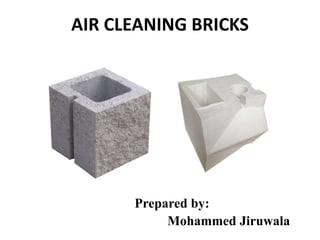
AIR CLEANING BRICKS
Prepared by:
Mohammed Jiruwala
POLLUTION FREE BRICK
• This Innovative Brick Sucks Pollution From the Air Like a
Vacuum Cleaner
• These days air pollution in some cities is a big problem, and as
a result, buildings that help alleviate that problem are all the
rage.
• New technologies have been using chemical, only affecting
the air that physically comes into contact with them. What if
buildings could take a more active role in pulling in pollutants
from the sky?
• What if they could work a little more like a vacuum cleaner?
• This was exactly the inspiration behind the Breathe Brick
developed by Carmen Trudell, an assistant professor at Cal
Poly San Luis Obispo's school of architecture and founder
of Both Landscape and Architecture.
WORKING
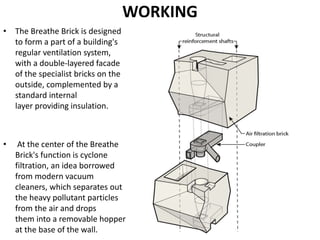
• The Breathe Brick is designed
to form a part of a building's
regular ventilation system,
with a double-layered facade
of the specialist bricks on the
outside, complemented by a
standard internal
layer providing insulation.
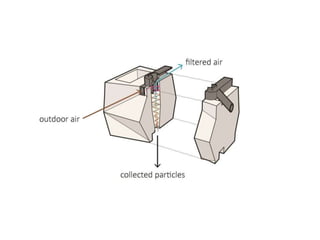
• At the center of the Breathe
Brick's function is cyclone
filtration, an idea borrowed
from modern vacuum
cleaners, which separates out
the heavy pollutant particles
from the air and drops
them into a removable hopper
at the base of the wall.
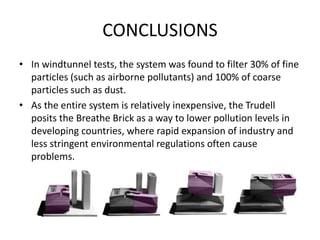
• The system is composed of
two key parts: concrete
bricks, and a recycled
plastic coupler, which both
helps to align bricks
and creates a route from
the outside into the
brick's hollow center.
• The concrete bricks
themselves feature a
faceted surface which
helps to direct airflow into
the system, and a separate
cavity for inserting steel
structure.
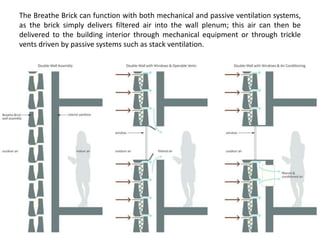
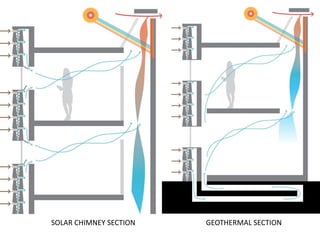
The Breathe Brick can function with both mechanical and passive ventilation systems,
as the brick simply delivers filtered air into the wall plenum; this air can then be
delivered to the building interior through mechanical equipment or through trickle
vents driven by passive systems such as stack ventilation.
SOLAR CHIMNEY SECTION GEOTHERMAL SECTION
CONCLUSIONS
• In windtunnel tests, the system was found to filter 30% of fine
particles (such as airborne pollutants) and 100% of coarse
particles such as dust.
• As the entire system is relatively inexpensive, the Trudell
posits the Breathe Brick as a way to lower pollution levels in
developing countries, where rapid expansion of industry and
less stringent environmental regulations often cause
problems.

Air cleaning bricks

  • 1.
    AIR CLEANING BRICKS Preparedby: Mohammed Jiruwala
  • 2.
    POLLUTION FREE BRICK •This Innovative Brick Sucks Pollution From the Air Like a Vacuum Cleaner • These days air pollution in some cities is a big problem, and as a result, buildings that help alleviate that problem are all the rage. • New technologies have been using chemical, only affecting the air that physically comes into contact with them. What if buildings could take a more active role in pulling in pollutants from the sky? • What if they could work a little more like a vacuum cleaner? • This was exactly the inspiration behind the Breathe Brick developed by Carmen Trudell, an assistant professor at Cal Poly San Luis Obispo's school of architecture and founder of Both Landscape and Architecture.
  • 4.
    WORKING • The BreatheBrick is designed to form a part of a building's regular ventilation system, with a double-layered facade of the specialist bricks on the outside, complemented by a standard internal layer providing insulation. • At the center of the Breathe Brick's function is cyclone filtration, an idea borrowed from modern vacuum cleaners, which separates out the heavy pollutant particles from the air and drops them into a removable hopper at the base of the wall.
  • 5.
    • The systemis composed of two key parts: concrete bricks, and a recycled plastic coupler, which both helps to align bricks and creates a route from the outside into the brick's hollow center. • The concrete bricks themselves feature a faceted surface which helps to direct airflow into the system, and a separate cavity for inserting steel structure.
  • 6.
    The Breathe Brickcan function with both mechanical and passive ventilation systems, as the brick simply delivers filtered air into the wall plenum; this air can then be delivered to the building interior through mechanical equipment or through trickle vents driven by passive systems such as stack ventilation.
  • 7.
    SOLAR CHIMNEY SECTIONGEOTHERMAL SECTION
  • 8.
    CONCLUSIONS • In windtunneltests, the system was found to filter 30% of fine particles (such as airborne pollutants) and 100% of coarse particles such as dust. • As the entire system is relatively inexpensive, the Trudell posits the Breathe Brick as a way to lower pollution levels in developing countries, where rapid expansion of industry and less stringent environmental regulations often cause problems.