Human immune deficincy virus(HIV)
Prepared by
Sima siyamand Hussein.
Near east university –clinical pharmacy
department -master
Outline
 classification
 diagnosis
 Clinical
presentation
 Management
 introduction
 Epidemiology
 Etiology
 Pathogenesis
 pathophysiology
2
Introduction
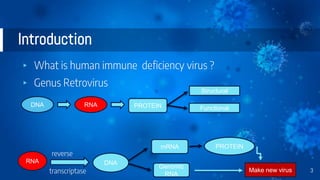
▸ What is human immune deficiency virus ?
▸ Genus Retrovirus
reverse
transcriptase 3
DNA RNA PROTEIN
Structural
Functional
RNA DNA
mRNA
Genomic
RNA
PROTEIN
Make new virus
Introduction
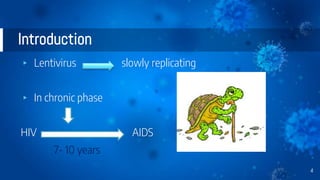
▸ Lentivirus slowly replicating
▸ In chronic phase
HIV AIDS
7- 10 years
4
Introduction
▸ This virus attacks the immune system
▸ There are two strains – HIV 1 & HIV 2
▸ The virus infects and destroys the CD4 lymphocytes
which are critical to the body’s immune response.
5
Epidemiology
Epidemiology
▸ The epidemiologic characteristics of HIV infection differ
according to geographic region and depend upon the
mode of transmission, governmental prevention efforts
and resources, and cultural factors.
7
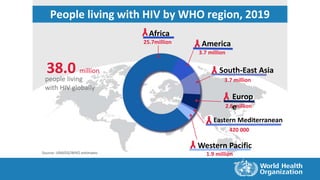
People living with HIV by WHO region, 2019
Source: UNAIDS/WHO estimates
38.0 million
people living
with HIV globally
25.7million
Africa
3.7 million
America
3.7 million
South-East Asia
2.6 million
Europ
e
Eastern Mediterranean
420 000
1.9 million
Western Pacific
Source: UNAIDS/WHO estimates
0.7millionHIV-related deaths
[0.5 million –1.0 million]
1.7million
people newly infected
[1.2 million – 2.2 million]
38.0million
people living with HIV
[31.6 million – 44.5 million]
2019
Summary of the global HIV epidemic, 2019
38.0 million
[31.6 million – 44.5 million]
36.2 million
[30.2 million – 42.5 million]
19.2 million
[16.4 million – 22.2 million]
17.0 million
[13.8 million – 20.4 million]
1.8 million
[1.3 million – 2.2 million]
1.7 million
[1.2 million – 2.2 million]
150 000
[94 000 – 240 000]
1.5 million
[1.1 million – 2.0 million]
690 000
[500 000 – 970 000 million]
600 000
[430 000 – 840 000]
95 000
[61 000 – 150 000]
Source: UNAIDS/WHO estimates
People living with
HIV in 2019
People newly
infected with HIV in
2019
HIV-related
deaths 2019
870 000
630 000 – 1.2 million]
790 000
590 000 – 1.1 million]
390 000
[280 000 – 560 000]
300 000
[220 000 – 420 000]
Epidemiology
11
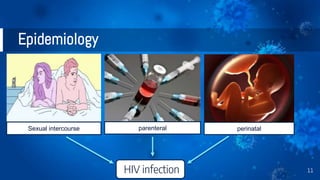
Sexual intercourse parenteral perinatal
HIV infection
Epidemiology
▸ The highest risk appears to be from receptive
anorectal intercourse at about 1.4 transmissions per
100 sexual acts.
▸ Individuals with genital ulcers or sexually
transmitted diseases are at greater risk for
contracting HIV
12
Epidemiology
▸ HIV incidence and prevalence are lower in cultures
that advocate male circumcision, which is estimated
to reduce risk of male acquisition of HIV
approximately 50%
▸ Casual contact with patients with AIDS or HIV
infection is not a significant risk factor for HIV
transmission
13
Etiology
Etiology
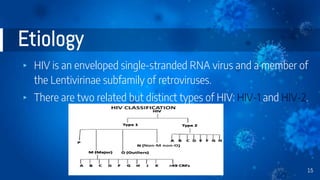
▸ HIV is an enveloped single-stranded RNA virus and a member of
the Lentivirinae subfamily of retroviruses.
▸ There are two related but distinct types of HIV: HIV-1 and HIV-2.
15
Etiology
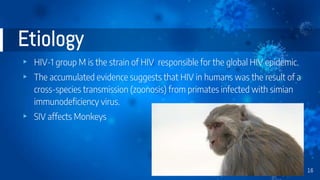
▸ HIV-1 group M is the strain of HIV responsible for the global HIV epidemic.
▸ The accumulated evidence suggests that HIV in humans was the result of a
cross-species transmission (zoonosis) from primates infected with simian
immunodeficiency virus.
▸ SIV affects Monkeys
16
Pathogenesis
Pathogenesis
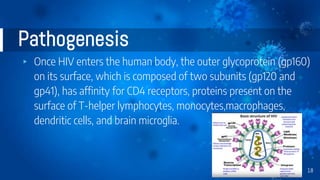
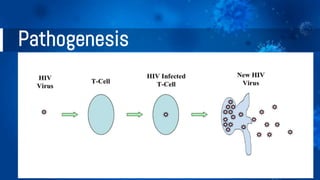
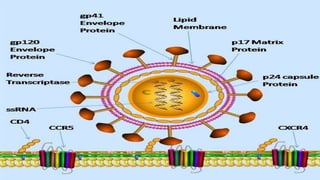
▸ Once HIV enters the human body, the outer glycoprotein (gp160)
on its surface, which is composed of two subunits (gp120 and
gp41), has affinity for CD4 receptors, proteins present on the
surface of T-helper lymphocytes, monocytes,macrophages,
dendritic cells, and brain microglia.
18
Pathogenesis
19
Pathogenesis
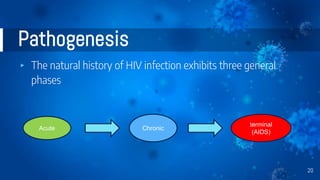
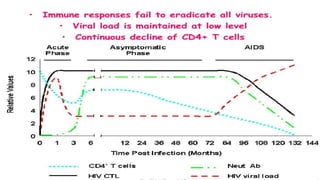
▸ The natural history of HIV infection exhibits three general
phases
20
Acute Chronic
terminal
(AIDS)
21
HIV classification
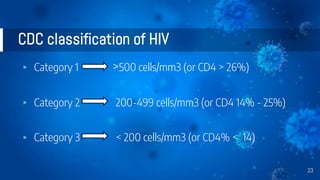
CDC classification of HIV
▸ Category 1 >500 cells/mm3 (or CD4 > 26%)
▸ Category 2 200-499 cells/mm3 (or CD4 14% - 25%)
▸ Category 3 < 200 cells/mm3 (or CD4% < 14)
23
Diagnosiss
Diagnosiss
▸ The presence of HIV infection is screened with an enzyme-
linked immunosorbent assay (ELISA), which detects antibodies
against HIV-1.
▸ Positive screening tests are confirmed with another enzyme
immunoassay to specify if the antibodies are to HIV- 1 versus
HIV-2.
▸ HIV disease is monitored primarily by two surrogate
biomarkers, viral load and CD4 cell count. 25
Diagnosiss
▸ reverse transcriptase–coupled polymerase chain reaction, branched DNA,
transcription-mediated amplification, and nucleic acid sequence–based
assay tests used for determining the amount of HIV RNA.
▸ The number of CD4 lymphocytes in the blood is a surrogate marker of
disease progression.
▸ The normal adult CD4 lymphocyte count ranges between 500 and 1600
cells/mm3 (500 and 1600 × 106/L), or 40% to 70% of all lymphocytes.
26
Clinical presentations
Signs and symptoms
▸ Most children born with HIV are asymptomatic.
▸ On physical examination, they often present with unexplained physical signs
such as lymphadenopathy, hepatomegaly, splenomegaly, failure to thrive,
weight loss or unexplained low birth weight, and fever of unknown origin.
▸ Laboratory findings include anemia, hypergammaglobulinemia, altered
mononuclear cell function, and altered T-cell subset ratios.
▸ The normal range for CD4 cell counts in children is much different than for
adults.
28
Signs and symptoms
29
Treatment
Goal of Treatment
▸ The central goal of antiretroviral therapy is to decrease
morbidity and mortality
▸ improve quality of life, restore and preserve immune
function.
▸ prevent further transmission through maximum suppression
of HIV replication.
▸ RNA level that is less than the lower limit of usually <50
copies/mL
31
General approach
▸ Regular, periodic measurement of plasma HIV RNA levels and CD4 cell
counts.
▸ potent combination antiretroviral .
▸ Women should receive optimal antiretroviral therapy regardless of
pregnancy status.
▸ The same principles of antiretroviral therapy apply to both HIV-infected
children and adults.
32
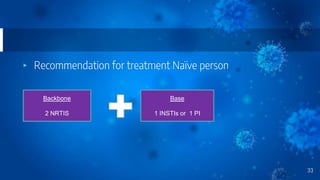
▸ Recommendation for treatment Naïve person
33
Backbone
2 NRTIS
Base
1 INSTIs or 1 PI
34
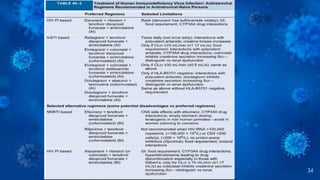
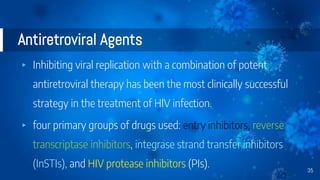
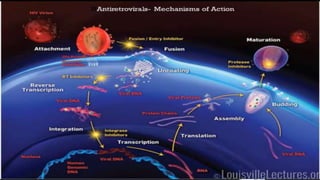
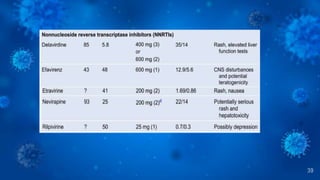
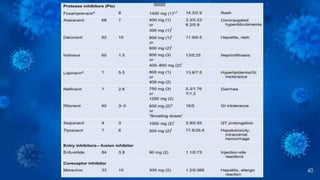
Antiretroviral Agents
▸ Inhibiting viral replication with a combination of potent
antiretroviral therapy has been the most clinically successful
strategy in the treatment of HIV infection.
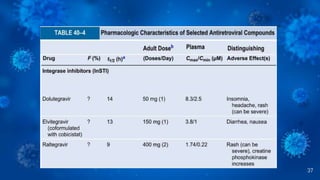
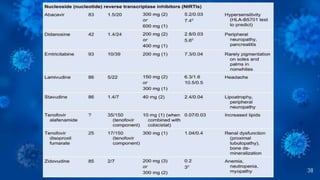
▸ four primary groups of drugs used: entry inhibitors, reverse
transcriptase inhibitors, integrase strand transfer inhibitors
(InSTIs), and HIV protease inhibitors (PIs). 35
36
37
38
39
40
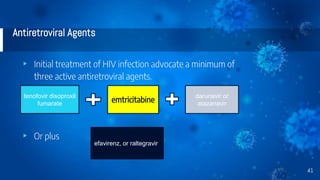
Antiretroviral Agents
▸ Initial treatment of HIV infection advocate a minimum of
three active antiretroviral agents.
▸ Or plus
41
tenofovir disoproxil
fumarate emtricitabine
darunavir or
atazanavir
efavirenz, or raltegravir
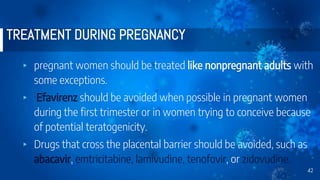
TREATMENT DURING PREGNANCY
▸ pregnant women should be treated like nonpregnant adults with
some exceptions.
▸ Efavirenz should be avoided when possible in pregnant women
during the first trimester or in women trying to conceive because
of potential teratogenicity.
▸ Drugs that cross the placental barrier should be avoided, such as
abacavir, emtricitabine, lamivudine, tenofovir, or zidovudine.
42
TREATMENT DURING PREGNANCY
▸ Intravenous (IV) zidovudine is recommended
intrapartum depending on the mother’s viral
load.
▸ Infants also receive zidovudine (± several doses
of nevirapine) prophylaxis for 6 weeks after
birth.
43
POSTEXPOSURE PROPHYLAXIS
▸ prophylaxis with a triple-drug regimen consisting of two NRTIs and
aboosted PI is recommended for percutaneous blood exposure.
▸ Two NRTIs may be offered to healthcare workers with lower risk
of exposure.
▸ Treatment is not necessary if the source of exposure is urine or
saliva.
▸ Ideally, treatment should be initiated within 1 to 2 hours of
exposure, but treatment is recommended for up to 72 hours
postexposure. 44
EVALUATION OF THERAPEUTIC OUTCOMES
▸ Following the initiation of therapy, patients are usually
monitored at 3-monthintervals with immunologic (ie, CD4 count),
virologic (HIV RNA), and clinical assessments.
▸ There are two general indications to change therapy: significant
toxicity and treatment failure.
46
▸ following events should prompt consideration for changing
therapy
▸ failure to achieve HIV RNA less than 200 copies/mL (<200 ×
103/L) by 24 weeks OR
less than 50 copies/mL (<50 × 103/L) by 48 weeks.
▸ After HIV RNA suppression, repeated detection of HIV-RNA.
47
THERAPEUTIC FAILURE
▸ Therapeutic failure may be the result of
1. nonadherence to medication
2. development of drug resistance
3. intolerance to one or more medications
4. adverse drug–drug interactions
5. pharmacokinetic–pharmacodynamic variability
48
Pneumocystis carinii (Pneumocystis jiroveci)
▸ the most common life-threatening opportunistic infection in
patients with AIDS.
▸ The taxonomy of the organism is unclear, having been classified
as both protozoan and fungal.
49
Clinical presentation of (Pneumocystis jiroveci)
▸ Symptoms fever and dyspnea
▸ clinical signs are tachypnea, with or without rales or rhonchi, and a
nonproductive or mildly productive cough.
▸ Arterial blood gases
▸ may show minimal hypoxia (partial pressure of oxygen [PaO2] 80 to 95
mm Hg
▸ [10.6–12.6 kPa]) but in more advanced disease may be markedly abnormal.
50
Treatment of (Pneumocystis jiroveci)
▸ Treatment with trimethoprim–sulfamethoxazole or parenteral pentamidine is
associated with a 60% to 100% response rate.
▸ Trimethoprim–sulfamethoxazole is the regimen of choice for treatment and
subsequent prophylaxis of PCP in patients with and without HIV.
▸ Trimethoprim–sulfamethoxazole is given in doses of 15 to 20 mg/kg/day
(based on the trimethoprim component) as three or four divided doses for the
treatment of PCP.
▸ Treatment duration is typically 21 days but must be based on clinical response.
51
52
Referencess
▸ WHO statistic data of HIV 2019
▸ Pharmacotherapy hand book dipiro 10th edition
▸ Pharmacotherapy_ A Pathophysiologic
Approach dipiro 10th edition
▸ CDC classification of HIV.
53
54

Hiv infection

  • 1.
    Human immune deficincyvirus(HIV) Prepared by Sima siyamand Hussein. Near east university –clinical pharmacy department -master
  • 2.
    Outline  classification  diagnosis Clinical presentation  Management  introduction  Epidemiology  Etiology  Pathogenesis  pathophysiology 2
  • 3.
    Introduction ▸ What ishuman immune deficiency virus ? ▸ Genus Retrovirus reverse transcriptase 3 DNA RNA PROTEIN Structural Functional RNA DNA mRNA Genomic RNA PROTEIN Make new virus
  • 4.
    Introduction ▸ Lentivirus slowlyreplicating ▸ In chronic phase HIV AIDS 7- 10 years 4
  • 5.
    Introduction ▸ This virusattacks the immune system ▸ There are two strains – HIV 1 & HIV 2 ▸ The virus infects and destroys the CD4 lymphocytes which are critical to the body’s immune response. 5
  • 6.
  • 7.
    Epidemiology ▸ The epidemiologiccharacteristics of HIV infection differ according to geographic region and depend upon the mode of transmission, governmental prevention efforts and resources, and cultural factors. 7
  • 8.
    People living withHIV by WHO region, 2019 Source: UNAIDS/WHO estimates 38.0 million people living with HIV globally 25.7million Africa 3.7 million America 3.7 million South-East Asia 2.6 million Europ e Eastern Mediterranean 420 000 1.9 million Western Pacific
  • 9.
    Source: UNAIDS/WHO estimates 0.7millionHIV-relateddeaths [0.5 million –1.0 million] 1.7million people newly infected [1.2 million – 2.2 million] 38.0million people living with HIV [31.6 million – 44.5 million] 2019 Summary of the global HIV epidemic, 2019
  • 10.
    Summary of theglobal HIV epidemic, 2019 38.0 million [31.6 million – 44.5 million] 36.2 million [30.2 million – 42.5 million] 19.2 million [16.4 million – 22.2 million] 17.0 million [13.8 million – 20.4 million] 1.8 million [1.3 million – 2.2 million] 1.7 million [1.2 million – 2.2 million] 150 000 [94 000 – 240 000] 1.5 million [1.1 million – 2.0 million] 690 000 [500 000 – 970 000 million] 600 000 [430 000 – 840 000] 95 000 [61 000 – 150 000] Source: UNAIDS/WHO estimates People living with HIV in 2019 People newly infected with HIV in 2019 HIV-related deaths 2019 870 000 630 000 – 1.2 million] 790 000 590 000 – 1.1 million] 390 000 [280 000 – 560 000] 300 000 [220 000 – 420 000]
  • 11.
  • 12.
    Epidemiology ▸ The highestrisk appears to be from receptive anorectal intercourse at about 1.4 transmissions per 100 sexual acts. ▸ Individuals with genital ulcers or sexually transmitted diseases are at greater risk for contracting HIV 12
  • 13.
    Epidemiology ▸ HIV incidenceand prevalence are lower in cultures that advocate male circumcision, which is estimated to reduce risk of male acquisition of HIV approximately 50% ▸ Casual contact with patients with AIDS or HIV infection is not a significant risk factor for HIV transmission 13
  • 14.
  • 15.
    Etiology ▸ HIV isan enveloped single-stranded RNA virus and a member of the Lentivirinae subfamily of retroviruses. ▸ There are two related but distinct types of HIV: HIV-1 and HIV-2. 15
  • 16.
    Etiology ▸ HIV-1 groupM is the strain of HIV responsible for the global HIV epidemic. ▸ The accumulated evidence suggests that HIV in humans was the result of a cross-species transmission (zoonosis) from primates infected with simian immunodeficiency virus. ▸ SIV affects Monkeys 16
  • 17.
  • 18.
    Pathogenesis ▸ Once HIVenters the human body, the outer glycoprotein (gp160) on its surface, which is composed of two subunits (gp120 and gp41), has affinity for CD4 receptors, proteins present on the surface of T-helper lymphocytes, monocytes,macrophages, dendritic cells, and brain microglia. 18
  • 19.
  • 20.
    Pathogenesis ▸ The naturalhistory of HIV infection exhibits three general phases 20 Acute Chronic terminal (AIDS)
  • 21.
  • 22.
  • 23.
    CDC classification ofHIV ▸ Category 1 >500 cells/mm3 (or CD4 > 26%) ▸ Category 2 200-499 cells/mm3 (or CD4 14% - 25%) ▸ Category 3 < 200 cells/mm3 (or CD4% < 14) 23
  • 24.
  • 25.
    Diagnosiss ▸ The presenceof HIV infection is screened with an enzyme- linked immunosorbent assay (ELISA), which detects antibodies against HIV-1. ▸ Positive screening tests are confirmed with another enzyme immunoassay to specify if the antibodies are to HIV- 1 versus HIV-2. ▸ HIV disease is monitored primarily by two surrogate biomarkers, viral load and CD4 cell count. 25
  • 26.
    Diagnosiss ▸ reverse transcriptase–coupledpolymerase chain reaction, branched DNA, transcription-mediated amplification, and nucleic acid sequence–based assay tests used for determining the amount of HIV RNA. ▸ The number of CD4 lymphocytes in the blood is a surrogate marker of disease progression. ▸ The normal adult CD4 lymphocyte count ranges between 500 and 1600 cells/mm3 (500 and 1600 × 106/L), or 40% to 70% of all lymphocytes. 26
  • 27.
  • 28.
    Signs and symptoms ▸Most children born with HIV are asymptomatic. ▸ On physical examination, they often present with unexplained physical signs such as lymphadenopathy, hepatomegaly, splenomegaly, failure to thrive, weight loss or unexplained low birth weight, and fever of unknown origin. ▸ Laboratory findings include anemia, hypergammaglobulinemia, altered mononuclear cell function, and altered T-cell subset ratios. ▸ The normal range for CD4 cell counts in children is much different than for adults. 28
  • 29.
  • 30.
  • 31.
    Goal of Treatment ▸The central goal of antiretroviral therapy is to decrease morbidity and mortality ▸ improve quality of life, restore and preserve immune function. ▸ prevent further transmission through maximum suppression of HIV replication. ▸ RNA level that is less than the lower limit of usually <50 copies/mL 31
  • 32.
    General approach ▸ Regular,periodic measurement of plasma HIV RNA levels and CD4 cell counts. ▸ potent combination antiretroviral . ▸ Women should receive optimal antiretroviral therapy regardless of pregnancy status. ▸ The same principles of antiretroviral therapy apply to both HIV-infected children and adults. 32
  • 33.
    ▸ Recommendation fortreatment Naïve person 33 Backbone 2 NRTIS Base 1 INSTIs or 1 PI
  • 34.
  • 35.
    Antiretroviral Agents ▸ Inhibitingviral replication with a combination of potent antiretroviral therapy has been the most clinically successful strategy in the treatment of HIV infection. ▸ four primary groups of drugs used: entry inhibitors, reverse transcriptase inhibitors, integrase strand transfer inhibitors (InSTIs), and HIV protease inhibitors (PIs). 35
  • 36.
  • 37.
  • 38.
  • 39.
  • 40.
  • 41.
    Antiretroviral Agents ▸ Initialtreatment of HIV infection advocate a minimum of three active antiretroviral agents. ▸ Or plus 41 tenofovir disoproxil fumarate emtricitabine darunavir or atazanavir efavirenz, or raltegravir
  • 42.
    TREATMENT DURING PREGNANCY ▸pregnant women should be treated like nonpregnant adults with some exceptions. ▸ Efavirenz should be avoided when possible in pregnant women during the first trimester or in women trying to conceive because of potential teratogenicity. ▸ Drugs that cross the placental barrier should be avoided, such as abacavir, emtricitabine, lamivudine, tenofovir, or zidovudine. 42
  • 43.
    TREATMENT DURING PREGNANCY ▸Intravenous (IV) zidovudine is recommended intrapartum depending on the mother’s viral load. ▸ Infants also receive zidovudine (± several doses of nevirapine) prophylaxis for 6 weeks after birth. 43
  • 44.
    POSTEXPOSURE PROPHYLAXIS ▸ prophylaxiswith a triple-drug regimen consisting of two NRTIs and aboosted PI is recommended for percutaneous blood exposure. ▸ Two NRTIs may be offered to healthcare workers with lower risk of exposure. ▸ Treatment is not necessary if the source of exposure is urine or saliva. ▸ Ideally, treatment should be initiated within 1 to 2 hours of exposure, but treatment is recommended for up to 72 hours postexposure. 44
  • 45.
  • 46.
    ▸ Following theinitiation of therapy, patients are usually monitored at 3-monthintervals with immunologic (ie, CD4 count), virologic (HIV RNA), and clinical assessments. ▸ There are two general indications to change therapy: significant toxicity and treatment failure. 46
  • 47.
    ▸ following eventsshould prompt consideration for changing therapy ▸ failure to achieve HIV RNA less than 200 copies/mL (<200 × 103/L) by 24 weeks OR less than 50 copies/mL (<50 × 103/L) by 48 weeks. ▸ After HIV RNA suppression, repeated detection of HIV-RNA. 47
  • 48.
    THERAPEUTIC FAILURE ▸ Therapeuticfailure may be the result of 1. nonadherence to medication 2. development of drug resistance 3. intolerance to one or more medications 4. adverse drug–drug interactions 5. pharmacokinetic–pharmacodynamic variability 48
  • 49.
    Pneumocystis carinii (Pneumocystisjiroveci) ▸ the most common life-threatening opportunistic infection in patients with AIDS. ▸ The taxonomy of the organism is unclear, having been classified as both protozoan and fungal. 49
  • 50.
    Clinical presentation of(Pneumocystis jiroveci) ▸ Symptoms fever and dyspnea ▸ clinical signs are tachypnea, with or without rales or rhonchi, and a nonproductive or mildly productive cough. ▸ Arterial blood gases ▸ may show minimal hypoxia (partial pressure of oxygen [PaO2] 80 to 95 mm Hg ▸ [10.6–12.6 kPa]) but in more advanced disease may be markedly abnormal. 50
  • 51.
    Treatment of (Pneumocystisjiroveci) ▸ Treatment with trimethoprim–sulfamethoxazole or parenteral pentamidine is associated with a 60% to 100% response rate. ▸ Trimethoprim–sulfamethoxazole is the regimen of choice for treatment and subsequent prophylaxis of PCP in patients with and without HIV. ▸ Trimethoprim–sulfamethoxazole is given in doses of 15 to 20 mg/kg/day (based on the trimethoprim component) as three or four divided doses for the treatment of PCP. ▸ Treatment duration is typically 21 days but must be based on clinical response. 51
  • 52.
  • 53.
    Referencess ▸ WHO statisticdata of HIV 2019 ▸ Pharmacotherapy hand book dipiro 10th edition ▸ Pharmacotherapy_ A Pathophysiologic Approach dipiro 10th edition ▸ CDC classification of HIV. 53
  • 54.