AI for Disabled
By Prabhant Singh
Bachelors in computer science
Ram Lal Anand College
Some stats about disables
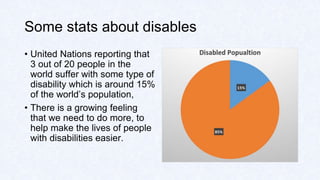
• United Nations reporting that
3 out of 20 people in the
world suffer with some type of
disability which is around 15%
of the world’s population,
• There is a growing feeling
that we need to do more, to
help make the lives of people
with disabilities easier.
•Not Just ROBOTS
•Typically machine is fed with data and
commit changes according to that data
•Various branches: Machine Learning,
Neural networks, Deep learning,
Cognitive systems
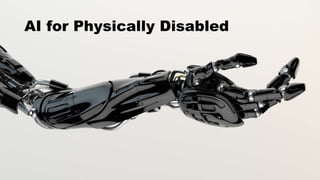
AI for Physically Disabled
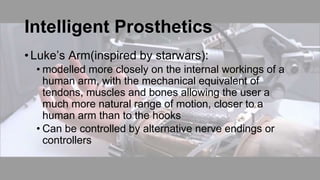
Intelligent Prosthetics
•Luke’s Arm(inspired by starwars):
• modelled more closely on the internal workings of a
human arm, with the mechanical equivalent of
tendons, muscles and bones allowing the user a
much more natural range of motion, closer to a
human arm than to the hooks
• Can be controlled by alternative nerve endings or
controllers
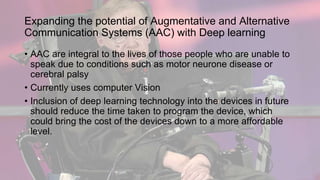
Expanding the potential of Augmentative and Alternative
Communication Systems (AAC) with Deep learning
• AAC are integral to the lives of those people who are unable to
speak due to conditions such as motor neurone disease or
cerebral palsy
• Currently uses computer Vision
• Inclusion of deep learning technology into the devices in future
should reduce the time taken to program the device, which
could bring the cost of the devices down to a more affordable
level.
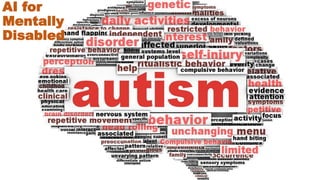
AI for
Mentally
Disabled
Machine learning in ASD (Andy and Milo)
• Autism Spectrum Disorder (ASD):
• Incurable
• Suffered by one in hundred, where men are more likely to be
diagnosed
• Causes child having difficulty in processing or engaging in human
interaction or emotion.
• ANDY:
• Developed by London Knowledge Lab, uses Machine Learning
• the children interacted readily with him, asking and answering
questions far more freely than if it had been a human adult.
• MILO:
• An AI based robot rolled out in 50 schools in US
• Generated exceptional results like physical contact, which was
unthinkable in ASD
Some other recent Developments
• Google provides support for braille script in smartphones
with brailleback
• Virginia Tech University’s RoMeLa Robotics and
Mechanisms Laboratory, pioneered a car that was
designed for blind or partially-sighted people to be able to
drive independently
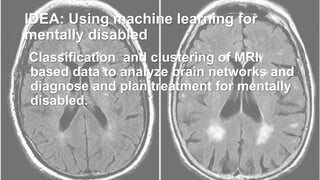
IDEA: Using machine learning for
mentally disabled
Classification and clustering of MRI
based data to analyze brain networks and
diagnose and plan treatment for mentally
disabled.
TOOLBOX Required
Why tensorflow:
•Pre-trained models
•GPU support
•Fast training
•Huge community support
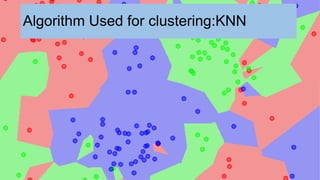
Algorithm Used for clustering:KNN
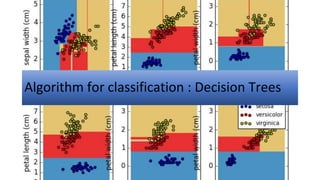
Algorithm for classification : Decision Trees
How to Implement this
•The same idea has been used by Google
brain team in identifying the severity of
diabetic retinopathy retinal imaging using
tensorflow.
1. Getting the MRI data.
2. Clustering it and classifying it.
3. Cross validating it with other psychiatrists.
4. Training it over a long period.
Advantages of this idea
•India lacks the number of psychiatrists.
•Around 33% children of India are mentally disabled in some
way or another
•These children can be prevented from being affected by severe
mental disorders by early diagnosis
AI for disabled

AI for disabled

  • 1.
    AI for Disabled ByPrabhant Singh Bachelors in computer science Ram Lal Anand College
  • 2.
    Some stats aboutdisables • United Nations reporting that 3 out of 20 people in the world suffer with some type of disability which is around 15% of the world’s population, • There is a growing feeling that we need to do more, to help make the lives of people with disabilities easier.
  • 4.
    •Not Just ROBOTS •Typicallymachine is fed with data and commit changes according to that data •Various branches: Machine Learning, Neural networks, Deep learning, Cognitive systems
  • 5.
  • 6.
    Intelligent Prosthetics •Luke’s Arm(inspiredby starwars): • modelled more closely on the internal workings of a human arm, with the mechanical equivalent of tendons, muscles and bones allowing the user a much more natural range of motion, closer to a human arm than to the hooks • Can be controlled by alternative nerve endings or controllers
  • 7.
    Expanding the potentialof Augmentative and Alternative Communication Systems (AAC) with Deep learning • AAC are integral to the lives of those people who are unable to speak due to conditions such as motor neurone disease or cerebral palsy • Currently uses computer Vision • Inclusion of deep learning technology into the devices in future should reduce the time taken to program the device, which could bring the cost of the devices down to a more affordable level.
  • 8.
  • 9.
    Machine learning inASD (Andy and Milo) • Autism Spectrum Disorder (ASD): • Incurable • Suffered by one in hundred, where men are more likely to be diagnosed • Causes child having difficulty in processing or engaging in human interaction or emotion. • ANDY: • Developed by London Knowledge Lab, uses Machine Learning • the children interacted readily with him, asking and answering questions far more freely than if it had been a human adult. • MILO: • An AI based robot rolled out in 50 schools in US • Generated exceptional results like physical contact, which was unthinkable in ASD
  • 10.
    Some other recentDevelopments • Google provides support for braille script in smartphones with brailleback • Virginia Tech University’s RoMeLa Robotics and Mechanisms Laboratory, pioneered a car that was designed for blind or partially-sighted people to be able to drive independently
  • 11.
    IDEA: Using machinelearning for mentally disabled Classification and clustering of MRI based data to analyze brain networks and diagnose and plan treatment for mentally disabled.
  • 12.
    TOOLBOX Required Why tensorflow: •Pre-trainedmodels •GPU support •Fast training •Huge community support
  • 13.
    Algorithm Used forclustering:KNN
  • 14.
  • 15.
    How to Implementthis •The same idea has been used by Google brain team in identifying the severity of diabetic retinopathy retinal imaging using tensorflow. 1. Getting the MRI data. 2. Clustering it and classifying it. 3. Cross validating it with other psychiatrists. 4. Training it over a long period.
  • 16.
    Advantages of thisidea •India lacks the number of psychiatrists. •Around 33% children of India are mentally disabled in some way or another •These children can be prevented from being affected by severe mental disorders by early diagnosis