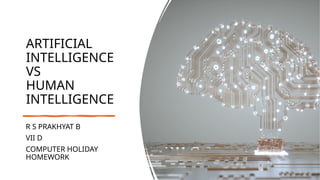
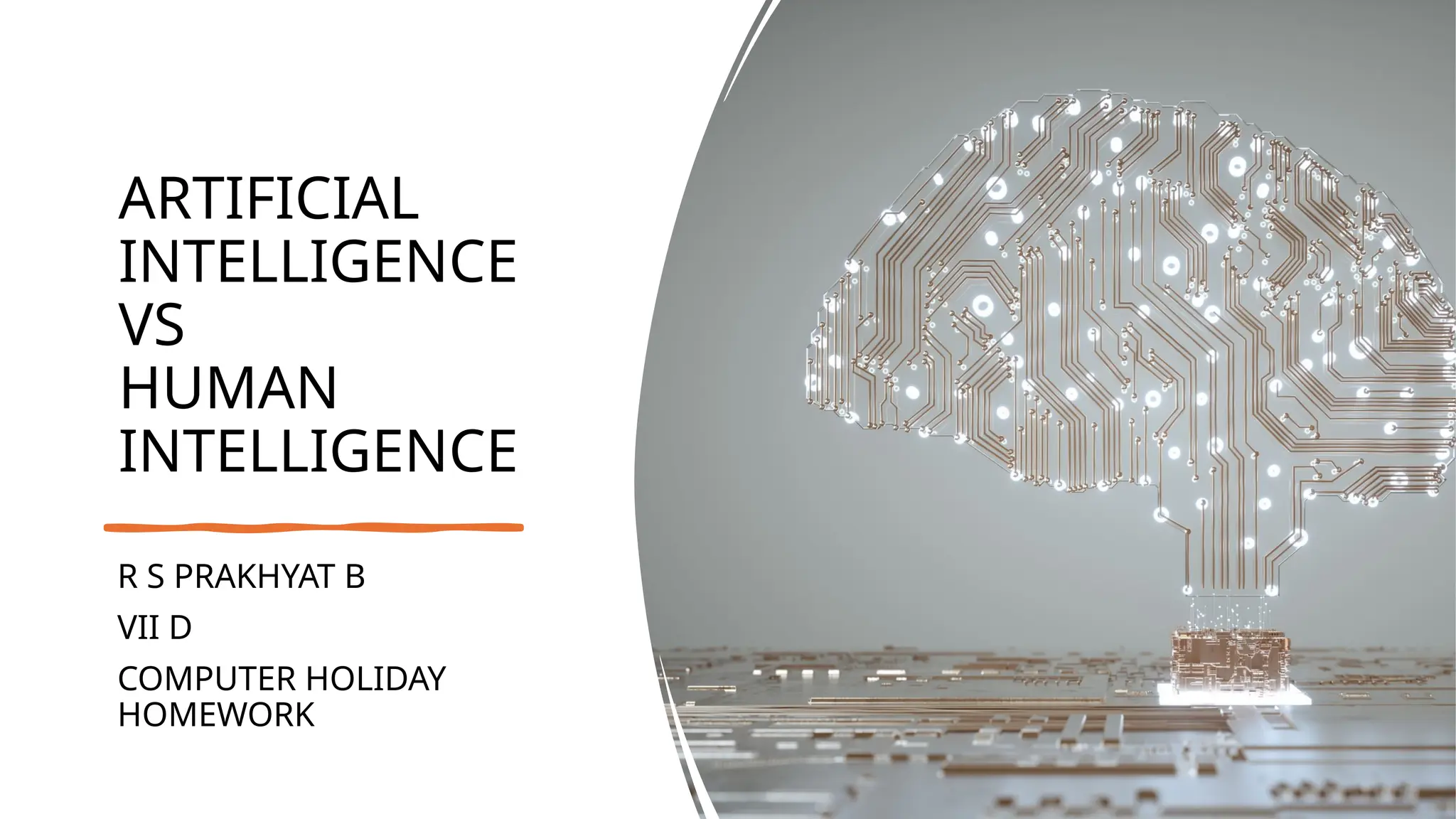
ARTIFICIAL
INTELLIGENCE
VS
HUMAN
INTELLIGENCE
R S PRAKHYAT B
VII D
COMPUTER HOLIDAY
HOMEWORK
INTRODUCTIO
N
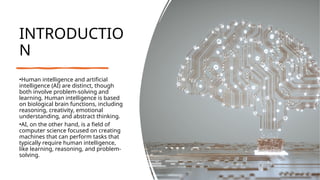
•Human intelligence and artificial
intelligence (AI) are distinct, though
both involve problem-solving and
learning. Human intelligence is based
on biological brain functions, including
reasoning, creativity, emotional
understanding, and abstract thinking.
•AI, on the other hand, is a field of
computer science focused on creating
machines that can perform tasks that
typically require human intelligence,
like learning, reasoning, and problem-
solving.
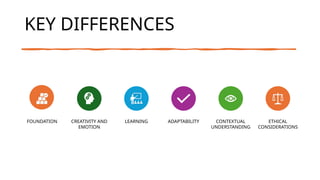
KEY DIFFERENCES
FOUNDATION CREATIVITY AND
EMOTION
LEARNING ADAPTABILITY CONTEXTUAL
UNDERSTANDING
ETHICAL
CONSIDERATIONS
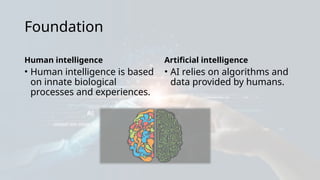
Foundation
Human intelligence
• Human intelligence is based
on innate biological
processes and experiences.
Artificial intelligence
• AI relies on algorithms and
data provided by humans.
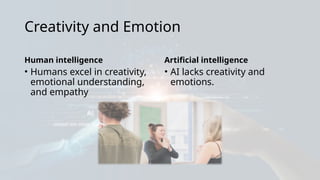
Creativity and Emotion
Human intelligence
• Humans excel in creativity,
emotional understanding,
and empathy
Artificial intelligence
• AI lacks creativity and
emotions.
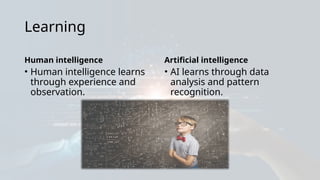
Learning
Human intelligence
• Human intelligence learns
through experience and
observation.
Artificial intelligence
• AI learns through data
analysis and pattern
recognition.
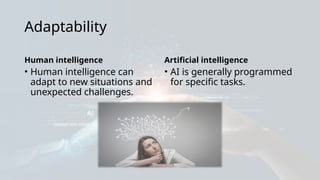
Adaptability
Human intelligence
• Human intelligence can
adapt to new situations and
unexpected challenges.
Artificial intelligence
• AI is generally programmed
for specific tasks.
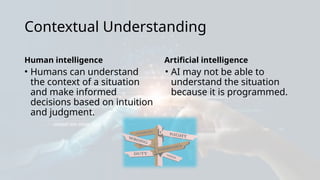
Contextual Understanding
Human intelligence
• Humans can understand
the context of a situation
and make informed
decisions based on intuition
and judgment.
Artificial intelligence
• AI may not be able to
understand the situation
because it is programmed.
Strengths
Human intelligence
• Creativity and innovation
• Emotional intelligence
• empathy
• Abstract thinking and
complex decision-making
• Adaptability to unforeseen
situations.
Artificial intelligence
• Speed and efficiency in data
processing and calculations
• Accuracy in repetitive tasks
• Ability to analyze vast
amounts of data
• Objective decision-making
in specific domains
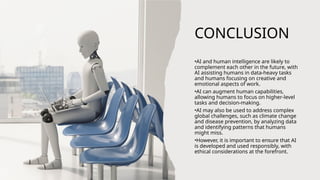
CONCLUSION
•AI and human intelligence are likely to
complement each other in the future, with
AI assisting humans in data-heavy tasks
and humans focusing on creative and
emotional aspects of work.
•AI can augment human capabilities,
allowing humans to focus on higher-level
tasks and decision-making.
•AI may also be used to address complex
global challenges, such as climate change
and disease prevention, by analyzing data
and identifying patterns that humans
might miss.
•However, it is important to ensure that AI
is developed and used responsibly, with
ethical considerations at the forefront.
Thank
You

Artificial Intelligence vs Human intelligence

  • 1.
  • 2.
    INTRODUCTIO N •Human intelligence andartificial intelligence (AI) are distinct, though both involve problem-solving and learning. Human intelligence is based on biological brain functions, including reasoning, creativity, emotional understanding, and abstract thinking. •AI, on the other hand, is a field of computer science focused on creating machines that can perform tasks that typically require human intelligence, like learning, reasoning, and problem- solving.
  • 3.
    KEY DIFFERENCES FOUNDATION CREATIVITYAND EMOTION LEARNING ADAPTABILITY CONTEXTUAL UNDERSTANDING ETHICAL CONSIDERATIONS
  • 4.
    Foundation Human intelligence • Humanintelligence is based on innate biological processes and experiences. Artificial intelligence • AI relies on algorithms and data provided by humans.
  • 5.
    Creativity and Emotion Humanintelligence • Humans excel in creativity, emotional understanding, and empathy Artificial intelligence • AI lacks creativity and emotions.
  • 6.
    Learning Human intelligence • Humanintelligence learns through experience and observation. Artificial intelligence • AI learns through data analysis and pattern recognition.
  • 7.
    Adaptability Human intelligence • Humanintelligence can adapt to new situations and unexpected challenges. Artificial intelligence • AI is generally programmed for specific tasks.
  • 8.
    Contextual Understanding Human intelligence •Humans can understand the context of a situation and make informed decisions based on intuition and judgment. Artificial intelligence • AI may not be able to understand the situation because it is programmed.
  • 9.
    Strengths Human intelligence • Creativityand innovation • Emotional intelligence • empathy • Abstract thinking and complex decision-making • Adaptability to unforeseen situations. Artificial intelligence • Speed and efficiency in data processing and calculations • Accuracy in repetitive tasks • Ability to analyze vast amounts of data • Objective decision-making in specific domains
  • 10.
    CONCLUSION •AI and humanintelligence are likely to complement each other in the future, with AI assisting humans in data-heavy tasks and humans focusing on creative and emotional aspects of work. •AI can augment human capabilities, allowing humans to focus on higher-level tasks and decision-making. •AI may also be used to address complex global challenges, such as climate change and disease prevention, by analyzing data and identifying patterns that humans might miss. •However, it is important to ensure that AI is developed and used responsibly, with ethical considerations at the forefront.
  • 11.