3 October 2024
Exploring Agentic AI
The Future Beyond LLMs
Raphaël Semeteys
You want to know the future of Generative AI?
Draw four cards!
Raphaël Semeteys
Head of TechSquad
Senior Architect, Open Source Expert
• Since 1999
• Based in Paris, France
• raphiki.github.io
Get in touch
@RaphaelSemeteys
dev.to/raphiki/
linkedin.com/in/raphaelsemeteys/
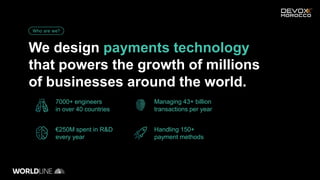
We design payments technology
that powers the growth of millions
of businesses around the world.
7000+ engineers
in over 40 countries
Managing 43+ billion
transactions per year
€250M spent in R&D
every year
Handling 150+
payment methods
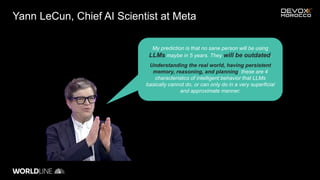
My prediction is that no sane person will be using
LLMs maybe in 5 years. They will be outdated.
Understanding the real world, having persistent
memory, reasoning, and planning: these are 4
characteristics of intelligent behavior that LLMs
basically cannot do, or can only do in a very superficial
and approximate manner.
Yann LeCun, Chief AI Scientist at Meta
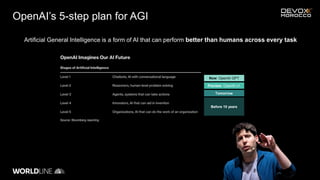
OpenAI’s 5-step plan for AGI
Artificial General Intelligence is a form of AI that can perform better than humans across every task
Now: OpenAI GPT
Preview: OpenAI o1
Tomorrow
Before 10 years
Before the doom of AGI… let’s focus on Agents
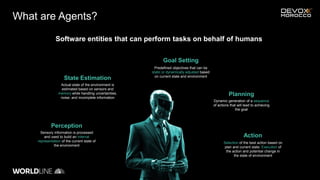
What are Agents?
Perception
Sensory information is processed
and used to build an internal
representation of the current state of
the environment
Software entities that can perform tasks on behalf of humans
State Estimation
Actual state of the environment is
estimated based on sensors and
memory while handling uncertainties,
noise, and incomplete information
Goal Setting
Predefined objectives that can be
static or dynamically adjusted based
on current state and environment
Planning
Dynamic generation of a sequence
of actions that will lead to achieving
the goal
Action
Selection of the best action based on
plan and current state. Execution of
the action and potential change in
the state of environment
Perception
State Estimation
Action
Goal Setting
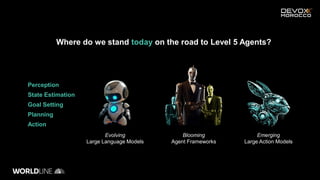
Where do we stand today on the road to Level 5 Agents?
Planning
Evolving
Large Language Models
Blooming
Agent Frameworks
Emerging
Large Action Models
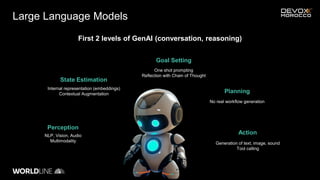
Large Language Models
Perception
State Estimation
Action
Goal Setting
NLP, Vision, Audio
Multimodality
First 2 levels of GenAI (conversation, reasoning)
Planning
Internal representation (embeddings)
Contextual Augmentation
One shot prompting
Reflection with Chain of Thought
No real workflow generation
Generation of text, image, sound
Tool calling
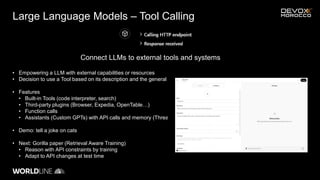
Large Language Models – Tool Calling
• Empowering a LLM with external capabilities or resources
• Decision to use a Tool based on its description and the general context
• Features
• Built-in Tools (code interpreter, search)
• Third-party plugins (Browser, Expedia, OpenTable…)
• Function calls
• Assistants (Custom GPTs) with API calls and memory (Threads)
• Demo: tell a joke on cats
• Next: Gorilla paper (Retrieval Aware Training)
• Reason with API constraints by training
• Adapt to API changes at test time
Connect LLMs to external tools and systems
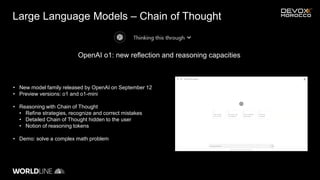
Large Language Models – Chain of Thought
• New model family released by OpenAI on September 12
• Preview versions: o1 and o1-mini
• Reasoning with Chain of Thought
• Refine strategies, recognize and correct mistakes
• Detailed Chain of Thought hidden to the user
• Notion of reasoning tokens
• Demo: solve a complex math problem
OpenAI o1: new reflection and reasoning capacities
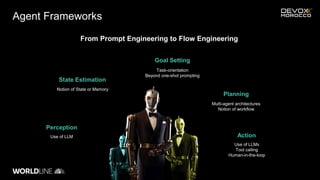
Agent Frameworks
Perception
State Estimation
Action
Goal Setting
Use of LLM
From Prompt Engineering to Flow Engineering
Planning
Notion of State or Memory
Task-orientation
Beyond one-shot prompting
Multi-agent architectures
Notion of workflow
Use of LLMs
Tool calling
Human-in-the-loop
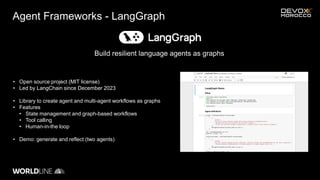
Agent Frameworks - LangGraph
• Open source project (MIT license)
• Led by LangChain since December 2023
• Library to create agent and multi-agent workflows as graphs
• Features
• State management and graph-based workflows
• Tool calling
• Human-in-the loop
• Demo: generate and reflect (two agents)
Build resilient language agents as graphs
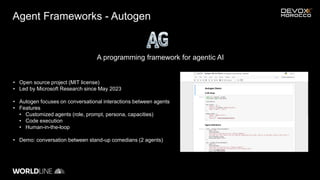
Agent Frameworks - Autogen
A programming framework for agentic AI
• Open source project (MIT license)
• Led by Microsoft Research since May 2023
• Autogen focuses on conversational interactions between agents
• Features
• Customized agents (role, prompt, persona, capacities)
• Code execution
• Human-in-the-loop
• Demo: conversation between stand-up comedians (2 agents)
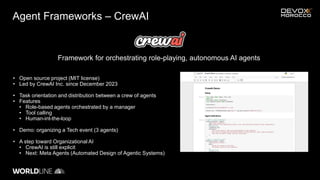
Agent Frameworks – CrewAI
Framework for orchestrating role-playing, autonomous AI agents
• Open source project (MIT license)
• Led by CrewAI Inc. since December 2023
• Task orientation and distribution between a crew of agents
• Features
• Role-based agents orchestrated by a manager
• Tool calling
• Human-int-the-loop
• Demo: organizing a Tech event (3 agents)
• A step toward Organizational AI
• CrewAI is still explicit
• Next: Meta Agents (Automated Design of Agentic Systems)
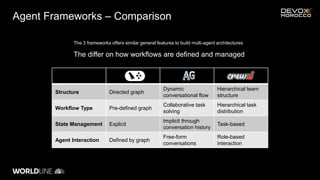
Agent Frameworks – Comparison
Structure Directed graph
Dynamic
conversational flow
Hierarchical team
structure
Workflow Type Pre-defined graph
Collaborative task
solving
Hierarchical task
distribution
State Management Explicit
Implicit through
conversation history
Task-based
Agent Interaction Defined by graph
Free-form
conversations
Role-based
interaction
The 3 frameworks offers similar general features to build multi-agent architectures
The differ on how workflows are defined and managed
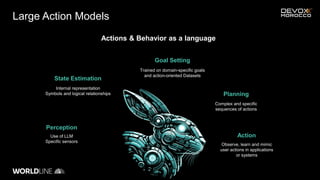
Large Action Models
Perception
State Estimation
Action
Goal Setting
Use of LLM
Specific sensors
Actions & Behavior as a language
Planning
Internal representation
Symbols and logical relationships
Trained on domain-specific goals
and action-oriented Datasets
Complex and specific
sequences of actions
Observe, learn and mimic
user actions in applications
or systems
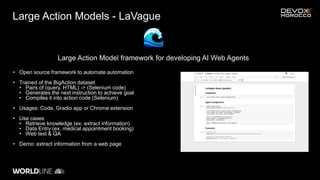
Large Action Models - LaVague
• Open source framework to automate automation
• Trained of the BigAction dataset
• Pairs of (query, HTML) -> (Selenium code)
• Generates the next instruction to achieve goal
• Compiles it into action code (Selenium)
• Usages: Code, Gradio app or Chrome extension
• Use cases
• Retrieve knowledge (ex. extract information)
• Data Entry (ex. medical appointment booking)
• Web test & QA
• Demo: extract information from a web page
Large Action Model framework for developing AI Web Agents
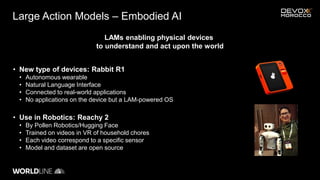
Large Action Models – Embodied AI
• New type of devices: Rabbit R1
• Autonomous wearable
• Natural Language Interface
• Connected to real-world applications
• No applications on the device but a LAM-powered OS
• Use in Robotics: Reachy 2
• By Pollen Robotics/Hugging Face
• Trained on videos in VR of household chores
• Each video correspond to a specific sensor
• Model and dataset are open source
LAMs enabling physical devices
to understand and act upon the world
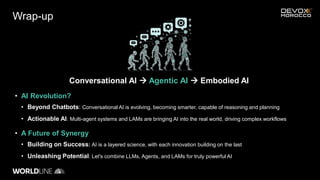
Wrap-up
• AI Revolution?
• Beyond Chatbots: Conversational AI is evolving, becoming smarter, capable of reasoning and planning
• Actionable AI: Multi-agent systems and LAMs are bringing AI into the real world, driving complex workflows
• A Future of Synergy
• Building on Success: AI is a layered science, with each innovation building on the last
• Unleashing Potential: Let's combine LLMs, Agents, and LAMs for truly powerful AI
Conversational AI → Agentic AI → Embodied AI
Raphaël Semeteys
raphiki.github.io
Thanks You