Manthan Topic : Sowing Prosperity
Boosting Agricultural Productivity
New techniques and models to enhance agricultural productivity
Team details :-
Members:
 Doyal Shaji
 Jal Desai
 Kartik Singh
 Siddhesh kokje
 Sushree Mohanty
College name:
 Nirma Unviersity
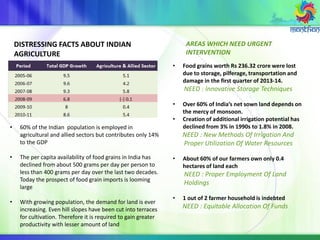
• 60% of the Indian population is employed in
agricultural and allied sectors but contributes only 14%
to the GDP
• The per capita availability of food grains in India has
declined from about 500 grams per day per person to
less than 400 grams per day over the last two decades.
Today the prospect of food grain imports is looming
large
• With growing population, the demand for land is ever
increasing. Even hill slopes have been cut into terraces
for cultivation. Therefore it is required to gain greater
productivity with lesser amount of land
• Food grains worth Rs 236.32 crore were lost
due to storage, pilferage, transportation and
damage in the first quarter of 2013-14.
NEED : Innovative Storage Techniques
• Over 60% of India’s net sown land depends on
the mercy of monsoon.
• Creation of additional irrigation potential has
declined from 3% in 1990s to 1.8% in 2008.
NEED : New Methods Of Irrigation And
Proper Utilization Of Water Resources
• About 60% of our farmers own only 0.4
hectares of land each
NEED : Proper Employment Of Land
Holdings
• 1 out of 2 farmer household is indebted
NEED : Equitable Allocation Of Funds
DISTRESSING FACTS ABOUT INDIAN
AGRICULTURE
AREAS WHICH NEED URGENT
INTERVENTION
Proposed solutions:
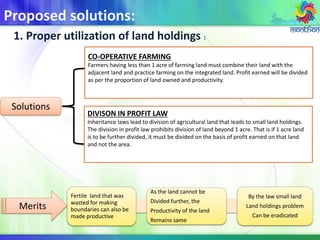
1. Proper utilization of land holdings :
Solutions
CO-OPERATIVE FARMING
Farmers having less than 1 acre of farming land must combine their land with the
adjacent land and practice farming on the integrated land. Profit earned will be divided
as per the proportion of land owned and productivity.
DIVISON IN PROFIT LAW
Inheritance laws lead to division of agricultural land that leads to small land holdings.
The division in profit law prohibits division of land beyond 1 acre. That is if 1 acre land
is to be further divided, it must be divided on the basis of profit earned on that land
and not the area.
Fertile land that was
wasted for making
boundaries can also be
made productive
As the land cannot be
Divided further, the
Productivity of the land
Remains same
By the law small land
Land holdings problem
Can be eradicated
Merits
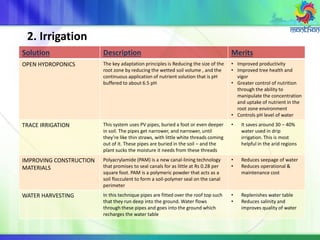
2. Irrigation
Solution Description Merits
OPEN HYDROPONICS The key adaptation principles is Reducing the size of the
root zone by reducing the wetted soil volume , and the
continuous application of nutrient solution that is pH
buffered to about 6.5 pH
• Improved productivity
• Improved tree health and
vigor
• Greater control of nutrition
through the ability to
manipulate the concentration
and uptake of nutrient in the
root zone environment
• Controls pH level of water
TRACE IRRIGATION This system uses PV pipes, buried a foot or even deeper
in soil. The pipes get narrower, and narrower, until
they’re like thin straws, with little white threads coming
out of it. These pipes are buried in the soil – and the
plant sucks the moisture it needs from these threads
• It saves around 30 – 40%
water used in drip
irrigation. This is most
helpful in the arid regions
IMPROVING CONSTRUCTION
MATERIALS
Polyacrylamide (PAM) is a new canal-lining technology
that promises to seal canals for as little at Rs 0.28 per
square foot. PAM is a polymeric powder that acts as a
soil flocculent to form a soil-polymer seal on the canal
perimeter
• Reduces seepage of water
• Reduces operational &
maintenance cost
WATER HARVESTING In this technique pipes are fitted over the roof top such
that they run deep into the ground. Water flows
through these pipes and goes into the ground which
recharges the water table
• Replenishes water table
• Reduces salinity and
improves quality of water
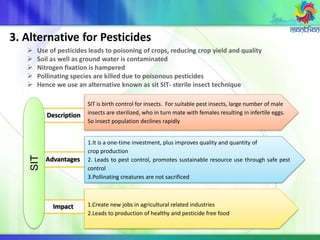
3. Alternative for Pesticides
 Use of pesticides leads to poisoning of crops, reducing crop yield and quality
 Soil as well as ground water is contaminated
 Nitrogen fixation is hampered
 Pollinating species are killed due to poisonous pesticides
 Hence we use an alternative known as sit SIT- sterile insect technique
Description
Advantages
Impact
SIT
SIT is birth control for insects. For suitable pest insects, large number of male
insects are sterilized, who in turn mate with females resulting in infertile eggs.
So insect population declines rapidly
1.It is a one-time investment, plus improves quality and quantity of
crop production
2. Leads to pest control, promotes sustainable resource use through safe pest
control
3.Pollinating creatures are not sacrificed
1.Create new jobs in agricultural related industries
2.Leads to production of healthy and pesticide free food
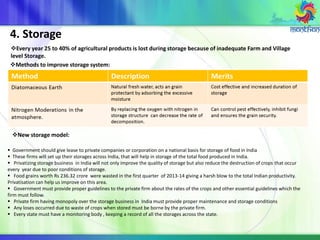
4. Storage
New storage model:
Every year 25 to 40% of agricultural products is lost during storage because of inadequate Farm and Village
level Storage.
Methods to improve storage system:
 Government should give lease to private companies or corporation on a national basis for storage of food in India
 These firms will set up their storages across India, that will help in storage of the total food produced in India.
 Privatizing storage business in India will not only improve the quality of storage but also reduce the destruction of crops that occur
every year due to poor conditions of storage.
 Food grains worth Rs 236.32 crore were wasted in the first quarter of 2013-14 giving a harsh blow to the total Indian productivity.
Privatisation can help us improve on this area.
 Government must provide proper guidelines to the private firm about the rates of the crops and other essential guidelines which the
firm must follow.
 Private firm having monopoly over the storage business in India must provide proper maintenance and storage conditions
 Any loses occurred due to waste of crops when stored must be borne by the private firm.
 Every state must have a monitoring body , keeping a record of all the storages across the state.
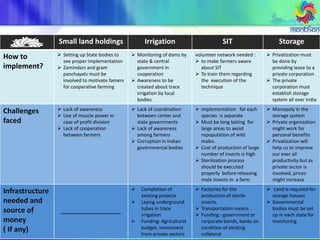
Small land holdings Irrigation SIT Storage
How to
implement?
 Setting up State bodies to
see proper implementation
 Zamindars and gram
panchayats must be
involved to motivate famers
for cooperative farming
 Monitoring of dams by
state & central
government in
cooperation
 Awareness to be
created about trace
irrigation by local
bodies
volunteer network needed :
 to make farmers aware
about SIT
 To train them regarding
the execution of the
technique
 Privatization must
be done by
providing lease to a
private corporation
 The private
corporation must
establish storage
system all over India
Challenges
faced
 Lack of awareness
 Use of muscle power in
case of profit division
 Lack of cooperation
between farmers
 Lack of coordination
between center and
state governments
 Lack of awareness
among farmers
 Corruption in Indian
governmental bodies
 implementation for each
species is separate
 Must be long lasting for
large areas to avoid
repopulation of wild
males.
 Cost of production of large
number of insects is high
 Sterilization process
should be executed
properly before releasing
male insects in a farm
 Monopoly in the
storage system
 Private organization
might work for
personal benefits
 Privatization will
help us to improve
our over all
productivity but as
private sector is
involved, prices
might increase
Infrastructure
needed and
source of
money
( If any)
_______________
 Completion of
existing projects
 Laying underground
tubes in trace
irrigation
 Funding: Agricultural
budget, investment
from private sectors
 Factories for the
production of sterile
insects.
 Transportation means .
 Funding:- government or
corporate bonds, banks on
condition of existing
collateral
 Land is required for
storage houses
 Governmental
bodies must be set
up in each state for
monitoring
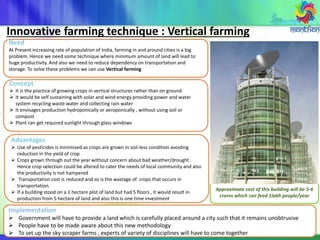
Innovative farming technique : Vertical farming
Concept
 It is the practice of growing crops in vertical structures rather than on ground
 It would be self sustaining with solar and wind energy providing power and water
system recycling waste water and collecting rain water
 It envisages production hydroponically or aeroponically , without using soil or
compost
 Plant can get required sunlight through glass windows
Need
At Present increasing rate of population of India, farming in and around cities is a big
problem. Hence we need some technique where minimum amount of land will lead to
huge productivity. And also we need to reduce dependency on transportation and
storage. To solve these problems we can use Vertical farming
Advantages
 Use of pesticides is minimized as crops are grown in soil-less condition avoiding
reduction in the yield of crop
 Crops grown through out the year without concern about bad weather/drought .
Hence crop selection could be altered to cater the needs of local community and also
the productivity is not hampered
 Transportation cost is reduced and so is the wastage of crops that occurs in
transportation.
 If a building stood on a 1 hectare plot of land but had 5 floors , it would result in
production from 5 hectare of land and also this is one time investment
Approximate cost of this building will be 5-6
crores which can feed 1lakh people/year
Implementation
 Government will have to provide a land which is carefully placed around a city such that it remains unobtrusive
 People have to be made aware about this new methodology
 To set up the sky scraper farms , experts of variety of disciplines will have to come together
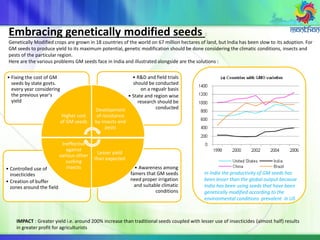
Embracing genetically modified seeds :
Genetically Modified crops are grown in 18 countries of the world on 67 million hectares of land, but India has been slow to its adoption. For
GM seeds to produce yield to its maximum potential, genetic modification should be done considering the climatic conditions, insects and
pests of the particular region.
Here are the various problems GM seeds face in India and illustrated alongside are the solutions :
• Awareness among
famers that GM seeds
need proper irrigation
and suitable climatic
conditions
• Controlled use of
insecticides
• Creation of buffer
zones around the field
• R&D and field trials
should be conducted
on a regualr basis
• State and region wise
research should be
conducted
• Fixing the cost of GM
seeds by state govts.
every year considering
the previous year's
yield
Higher cost
of GM seeds
Development
of resistance
by insects and
pests
Lesser yield
than expected
Ineffective
against
various other
sucking
insects
IMPACT : Greater yield i.e. around 200% increase than traditional seeds coupled with lesser use of insecticides (almost half) results
in greater profit for agriculturists
In India the productivity of GM seeds has
been lesser than the global output because
India has been using seeds that have been
genetically modified according to the
environmental conditions prevalent in US
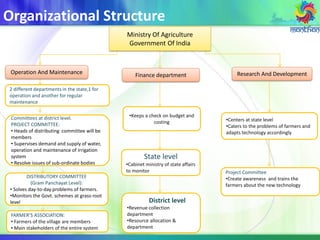
Research And DevelopmentFinance department
2 different departments in the state,1 for
operation and another for regular
maintenance
•Keeps a check on budget and
costing
District level
•Revenue collection
department
•Resource allocation &
department
Operation And Maintenance
Ministry Of Agriculture
Government Of India
Committees at district level.
PROJECT COMMITTEE:
• Heads of distributing committee will be
members
• Supervises demand and supply of water,
operation and maintenance of irrigation
system
• Resolve issues of sub-ordinate bodies
DISTRIBUTORY COMMITTEE
(Gram Panchayat Level):
• Solves day-to-day problems of farmers.
•Monitors the Govt. schemes at grass-root
level
•Centers at state level
•Caters to the problems of farmers and
adapts technology accordingly
P
Project Committee
•Create awareness and trains the
farmers about the new technology
State level
•Cabinet ministry of state affairs
to monitor
FARMER’S ASSOCIATION:
• Farmers of the village are members
• Main stakeholders of the entire system
Organizational Structure
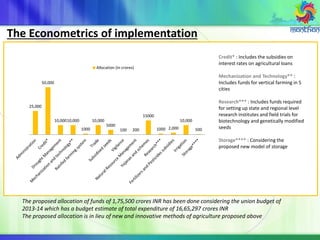
25,000
50,000
10,00010,000
1000
10,000
5000
100 200
15000
1000 2,000
10,000
500
Allocation (in crores)
The Econometrics of implementation
The proposed allocation of funds of 1,75,500 crores INR has been done considering the union budget of
2013-14 which has a budget estimate of total expenditure of 16,65,297 crores INR
The proposed allocation is in lieu of new and innovative methods of agriculture proposed above
Credit* : Includes the subsidies on
interest rates on agricultural loans
Mechanization and Technology** :
Includes funds for vertical farming in 5
cities
Research*** : Includes funds required
for setting up state and regional level
research institutes and field trials for
biotechnology and genetically modified
seeds
Storage**** : Considering the
proposed new model of storage
Appendix
References
 http://economictimes.indiatimes.com/opinion/special-report/how-to-solve-the-problems-of-indias-rain-
dependent-agricultural-land/articleshow/8845170.cms?curpg=3
 http://agbioforum.org/v7n12/v7n12a16-huesing.htm
http://www.biotecharticles.com/Agriculture-Article/Transgenic-Bt-Cotton-Boon-or-Bane-to-the-Indian-
Farmers-1873.html
http://fieldquestions.com/2013/02/09/bt-cotton-is-failing-blame-the-farmers/
 http://www.dallasnews.com/lifestyles/home-and-gardening/headlines/20121107-learn-better-irrigation-
methods-without-replacing-system.ece
http://www.arapahocitrus.com/files/OHS_Stage_Publications.pdf
http://www.irrigationfutures.org.au/projects.asp?ID=25
ftp://ftp.ecn.purdue.edu/vmerwade/class/GDT/Reports_Books/assessment%20of%20irrigation%20in%20I
ndia.pdf
 http://www.theworld.org/2013/07/low-water-lunch-china/
www.agriculture.com
 www.Indiastats.com
Final forest agricultural report by Directorate of Agriculture.
Water and Agricultural Sustainability Strategies

Progen

  • 1.
    Manthan Topic :Sowing Prosperity Boosting Agricultural Productivity New techniques and models to enhance agricultural productivity Team details :- Members:  Doyal Shaji  Jal Desai  Kartik Singh  Siddhesh kokje  Sushree Mohanty College name:  Nirma Unviersity
  • 2.
    • 60% ofthe Indian population is employed in agricultural and allied sectors but contributes only 14% to the GDP • The per capita availability of food grains in India has declined from about 500 grams per day per person to less than 400 grams per day over the last two decades. Today the prospect of food grain imports is looming large • With growing population, the demand for land is ever increasing. Even hill slopes have been cut into terraces for cultivation. Therefore it is required to gain greater productivity with lesser amount of land • Food grains worth Rs 236.32 crore were lost due to storage, pilferage, transportation and damage in the first quarter of 2013-14. NEED : Innovative Storage Techniques • Over 60% of India’s net sown land depends on the mercy of monsoon. • Creation of additional irrigation potential has declined from 3% in 1990s to 1.8% in 2008. NEED : New Methods Of Irrigation And Proper Utilization Of Water Resources • About 60% of our farmers own only 0.4 hectares of land each NEED : Proper Employment Of Land Holdings • 1 out of 2 farmer household is indebted NEED : Equitable Allocation Of Funds DISTRESSING FACTS ABOUT INDIAN AGRICULTURE AREAS WHICH NEED URGENT INTERVENTION
  • 3.
    Proposed solutions: 1. Properutilization of land holdings : Solutions CO-OPERATIVE FARMING Farmers having less than 1 acre of farming land must combine their land with the adjacent land and practice farming on the integrated land. Profit earned will be divided as per the proportion of land owned and productivity. DIVISON IN PROFIT LAW Inheritance laws lead to division of agricultural land that leads to small land holdings. The division in profit law prohibits division of land beyond 1 acre. That is if 1 acre land is to be further divided, it must be divided on the basis of profit earned on that land and not the area. Fertile land that was wasted for making boundaries can also be made productive As the land cannot be Divided further, the Productivity of the land Remains same By the law small land Land holdings problem Can be eradicated Merits
  • 4.
    2. Irrigation Solution DescriptionMerits OPEN HYDROPONICS The key adaptation principles is Reducing the size of the root zone by reducing the wetted soil volume , and the continuous application of nutrient solution that is pH buffered to about 6.5 pH • Improved productivity • Improved tree health and vigor • Greater control of nutrition through the ability to manipulate the concentration and uptake of nutrient in the root zone environment • Controls pH level of water TRACE IRRIGATION This system uses PV pipes, buried a foot or even deeper in soil. The pipes get narrower, and narrower, until they’re like thin straws, with little white threads coming out of it. These pipes are buried in the soil – and the plant sucks the moisture it needs from these threads • It saves around 30 – 40% water used in drip irrigation. This is most helpful in the arid regions IMPROVING CONSTRUCTION MATERIALS Polyacrylamide (PAM) is a new canal-lining technology that promises to seal canals for as little at Rs 0.28 per square foot. PAM is a polymeric powder that acts as a soil flocculent to form a soil-polymer seal on the canal perimeter • Reduces seepage of water • Reduces operational & maintenance cost WATER HARVESTING In this technique pipes are fitted over the roof top such that they run deep into the ground. Water flows through these pipes and goes into the ground which recharges the water table • Replenishes water table • Reduces salinity and improves quality of water
  • 5.
    3. Alternative forPesticides  Use of pesticides leads to poisoning of crops, reducing crop yield and quality  Soil as well as ground water is contaminated  Nitrogen fixation is hampered  Pollinating species are killed due to poisonous pesticides  Hence we use an alternative known as sit SIT- sterile insect technique Description Advantages Impact SIT SIT is birth control for insects. For suitable pest insects, large number of male insects are sterilized, who in turn mate with females resulting in infertile eggs. So insect population declines rapidly 1.It is a one-time investment, plus improves quality and quantity of crop production 2. Leads to pest control, promotes sustainable resource use through safe pest control 3.Pollinating creatures are not sacrificed 1.Create new jobs in agricultural related industries 2.Leads to production of healthy and pesticide free food
  • 6.
    4. Storage New storagemodel: Every year 25 to 40% of agricultural products is lost during storage because of inadequate Farm and Village level Storage. Methods to improve storage system:  Government should give lease to private companies or corporation on a national basis for storage of food in India  These firms will set up their storages across India, that will help in storage of the total food produced in India.  Privatizing storage business in India will not only improve the quality of storage but also reduce the destruction of crops that occur every year due to poor conditions of storage.  Food grains worth Rs 236.32 crore were wasted in the first quarter of 2013-14 giving a harsh blow to the total Indian productivity. Privatisation can help us improve on this area.  Government must provide proper guidelines to the private firm about the rates of the crops and other essential guidelines which the firm must follow.  Private firm having monopoly over the storage business in India must provide proper maintenance and storage conditions  Any loses occurred due to waste of crops when stored must be borne by the private firm.  Every state must have a monitoring body , keeping a record of all the storages across the state.
  • 7.
    Small land holdingsIrrigation SIT Storage How to implement?  Setting up State bodies to see proper implementation  Zamindars and gram panchayats must be involved to motivate famers for cooperative farming  Monitoring of dams by state & central government in cooperation  Awareness to be created about trace irrigation by local bodies volunteer network needed :  to make farmers aware about SIT  To train them regarding the execution of the technique  Privatization must be done by providing lease to a private corporation  The private corporation must establish storage system all over India Challenges faced  Lack of awareness  Use of muscle power in case of profit division  Lack of cooperation between farmers  Lack of coordination between center and state governments  Lack of awareness among farmers  Corruption in Indian governmental bodies  implementation for each species is separate  Must be long lasting for large areas to avoid repopulation of wild males.  Cost of production of large number of insects is high  Sterilization process should be executed properly before releasing male insects in a farm  Monopoly in the storage system  Private organization might work for personal benefits  Privatization will help us to improve our over all productivity but as private sector is involved, prices might increase Infrastructure needed and source of money ( If any) _______________  Completion of existing projects  Laying underground tubes in trace irrigation  Funding: Agricultural budget, investment from private sectors  Factories for the production of sterile insects.  Transportation means .  Funding:- government or corporate bonds, banks on condition of existing collateral  Land is required for storage houses  Governmental bodies must be set up in each state for monitoring
  • 8.
    Innovative farming technique: Vertical farming Concept  It is the practice of growing crops in vertical structures rather than on ground  It would be self sustaining with solar and wind energy providing power and water system recycling waste water and collecting rain water  It envisages production hydroponically or aeroponically , without using soil or compost  Plant can get required sunlight through glass windows Need At Present increasing rate of population of India, farming in and around cities is a big problem. Hence we need some technique where minimum amount of land will lead to huge productivity. And also we need to reduce dependency on transportation and storage. To solve these problems we can use Vertical farming Advantages  Use of pesticides is minimized as crops are grown in soil-less condition avoiding reduction in the yield of crop  Crops grown through out the year without concern about bad weather/drought . Hence crop selection could be altered to cater the needs of local community and also the productivity is not hampered  Transportation cost is reduced and so is the wastage of crops that occurs in transportation.  If a building stood on a 1 hectare plot of land but had 5 floors , it would result in production from 5 hectare of land and also this is one time investment Approximate cost of this building will be 5-6 crores which can feed 1lakh people/year Implementation  Government will have to provide a land which is carefully placed around a city such that it remains unobtrusive  People have to be made aware about this new methodology  To set up the sky scraper farms , experts of variety of disciplines will have to come together
  • 9.
    Embracing genetically modifiedseeds : Genetically Modified crops are grown in 18 countries of the world on 67 million hectares of land, but India has been slow to its adoption. For GM seeds to produce yield to its maximum potential, genetic modification should be done considering the climatic conditions, insects and pests of the particular region. Here are the various problems GM seeds face in India and illustrated alongside are the solutions : • Awareness among famers that GM seeds need proper irrigation and suitable climatic conditions • Controlled use of insecticides • Creation of buffer zones around the field • R&D and field trials should be conducted on a regualr basis • State and region wise research should be conducted • Fixing the cost of GM seeds by state govts. every year considering the previous year's yield Higher cost of GM seeds Development of resistance by insects and pests Lesser yield than expected Ineffective against various other sucking insects IMPACT : Greater yield i.e. around 200% increase than traditional seeds coupled with lesser use of insecticides (almost half) results in greater profit for agriculturists In India the productivity of GM seeds has been lesser than the global output because India has been using seeds that have been genetically modified according to the environmental conditions prevalent in US
  • 10.
    Research And DevelopmentFinancedepartment 2 different departments in the state,1 for operation and another for regular maintenance •Keeps a check on budget and costing District level •Revenue collection department •Resource allocation & department Operation And Maintenance Ministry Of Agriculture Government Of India Committees at district level. PROJECT COMMITTEE: • Heads of distributing committee will be members • Supervises demand and supply of water, operation and maintenance of irrigation system • Resolve issues of sub-ordinate bodies DISTRIBUTORY COMMITTEE (Gram Panchayat Level): • Solves day-to-day problems of farmers. •Monitors the Govt. schemes at grass-root level •Centers at state level •Caters to the problems of farmers and adapts technology accordingly P Project Committee •Create awareness and trains the farmers about the new technology State level •Cabinet ministry of state affairs to monitor FARMER’S ASSOCIATION: • Farmers of the village are members • Main stakeholders of the entire system Organizational Structure
  • 11.
    25,000 50,000 10,00010,000 1000 10,000 5000 100 200 15000 1000 2,000 10,000 500 Allocation(in crores) The Econometrics of implementation The proposed allocation of funds of 1,75,500 crores INR has been done considering the union budget of 2013-14 which has a budget estimate of total expenditure of 16,65,297 crores INR The proposed allocation is in lieu of new and innovative methods of agriculture proposed above Credit* : Includes the subsidies on interest rates on agricultural loans Mechanization and Technology** : Includes funds for vertical farming in 5 cities Research*** : Includes funds required for setting up state and regional level research institutes and field trials for biotechnology and genetically modified seeds Storage**** : Considering the proposed new model of storage
  • 12.
    Appendix References  http://economictimes.indiatimes.com/opinion/special-report/how-to-solve-the-problems-of-indias-rain- dependent-agricultural-land/articleshow/8845170.cms?curpg=3  http://agbioforum.org/v7n12/v7n12a16-huesing.htm http://www.biotecharticles.com/Agriculture-Article/Transgenic-Bt-Cotton-Boon-or-Bane-to-the-Indian- Farmers-1873.html http://fieldquestions.com/2013/02/09/bt-cotton-is-failing-blame-the-farmers/ http://www.dallasnews.com/lifestyles/home-and-gardening/headlines/20121107-learn-better-irrigation- methods-without-replacing-system.ece http://www.arapahocitrus.com/files/OHS_Stage_Publications.pdf http://www.irrigationfutures.org.au/projects.asp?ID=25 ftp://ftp.ecn.purdue.edu/vmerwade/class/GDT/Reports_Books/assessment%20of%20irrigation%20in%20I ndia.pdf  http://www.theworld.org/2013/07/low-water-lunch-china/ www.agriculture.com  www.Indiastats.com Final forest agricultural report by Directorate of Agriculture. Water and Agricultural Sustainability Strategies