AGRICULTURE WATER POLLUTION
ATHIRA RAJAN
athirarajanmt@gmail.com
AGRICULTURE WATER POLLUTION
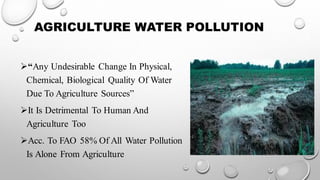
➢“Any Undesirable Change In Physical,
Chemical, Biological Quality Of Water
Due To Agriculture Sources”
➢It Is Detrimental To Human And
Agriculture Too
➢Acc. To FAO 58% Of All Water Pollution
Is Alone From Agriculture
AGRICULTURE AS A CAUSE
➢It Is A Cause Through Its Discharge Of Pollutants And Sediment To
Surface And/Or Groundwater, Through Net Loss Of Soil By Poor
Agricultural Practices, And Through Salinization And Waterlogging Of
Irrigated Land
SOURCES OF AGRICULTURE WATER
POLLUTION
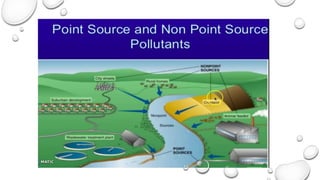
❑Point Source
From A Single Discharge Point
❑Non Point Source
To More Diffuse, Landscape-level Causes
❑ POINT SOURCES
• Refers To Contaminants That Enter A Waterway From A Single,
Identifiable Source, Such As A Pipe Or Ditch
• A Way To Remember What Point Source Pollution Is That You Can
Point To Where The Pollution Came From
NON POINT SOURCES
➢Arises From A Broad Group Of Human Activities For Which The Pollutants
Have No Obvious Point Of Entry Into Receiving Watercourses
➢Called As Diffuse Source Of AWP
➢Non-point Source Pollution Is Much More Difficult To Identify, Measure
And Control Than Point Sources
PESTICIDES
➢PESTICIDES And HERBICIDES Are Applied to agricultural land
to control pests that disrupt crop Production
PESTICIDE LEACHING
• Occurs when pesticides mix with water and move through the soil,
ultimately contaminating groundwater
• The amount of leaching is correlated with particular soil and pesticide
characteristics and the degree of rainfall and irrigation
FERTILIZERS
❑LEACHING, RUNOFF, AND EUTROPHICATION
• The nitrogen (N) and phosphorus (P) applied to agricultural land (via
synthetic fertilizers, composts, manures, biosolids, etc.) Can provide
valuable plant nutrients
• Excess N supplied by both synthetic fertilizers and organic sources
such as manures can lead to groundwater contamination of nitrate.
➢Nitratecontaminated drinking water can cause blue baby syndrome
➢Together with excess p from these same fertilizer sources, eutrophication
can occur downstream due to excess nutrient supply, leading to anoxic
areas called dead zones
❑ HEAVY METALS
• The major inputs of heavy metals (e.G. Lead, cadmium, arsenic, mercury)
into agricultural systems are fertilizers, organic wastes such as manures,
and industrial byproduct wastes
• Some farming techniques, such as irrigation, can lead to accumulation of
selenium (se) that occurs naturally in the soil
• This can result in downstream water reservoirs containing concentrations
of selenium that are toxic to wildlife, livestock, and humans
AGRICULTURE IMPACT ON WATER QUALITY
❑TILLAGE/PLOUGHING
✓SEDIMENT/TURBIDITY: Sediments carry phosphorus and pesticides
adsorbed to sediment particles
✓SILTATION of river beds and loss of habitat, spawning ground, etc
❑ FERTILIZING
✓SURFACE WATER
Runoff of nutrients,especially phosphorus,leading to eutrophication causing taste
and odour in public water supply, excess algae growth leading to deoxygenating of
water and fish kills
✓GROUND WATER
Leaching of nitrate to groundwater;excessive levels are a threat to public health.
❑ MANURE SPREADING
✓SURFACE WATER
Carried out as a fertilizer activity; spreading on frozen ground results in high levels of
contamination of receiving waters by pathogens, metals, phosphorus and nitrogen leading to
eutrophication and potential contamination
✓GROUND WATER
Contamination of ground-water, especially by nitrogen
❑ IRRIGATION
✓SURFACE WATER
Runoff of salts leading to salinization of surface waters; runoff of fertilizers and
pesticides to surface waters with ecological damage, bioaccumulation in edible fish
species, etc. High levels of trace elements such as selenium can occur with serious
ecological damage and potential human health impacts.
✓GROUND WATER
Enrichment of groundwater with salts, nutrients
PUBLIC HEALTH IMPACT
ECOLOGICAL IMPACT
➢Contamination of water supplies primarily by pesticides and fertilizers
➢Disease outbreak
➢Microbiological contamination of food crops
➢Contamination of food crops with toxic chemicals
➢Major decline and extinctions of animal, fish and vegetation species
➢Destruction of major ecosystems
SOLUTIONS
➢NUTRIENT MANAGEMENT: Applying fertilizers in the proper
amount, at the right time of year and with the right method can
significantly reduce the potential for pollution.
➢COVER CROPS: Planting certain grasses, grains or clovers can
help keep nutrients out of the water by recycling excess nitrogen and
reducing soil erosion
➢BUFFERS: Planting trees, shrubs and grass around fields, especially those that
border water bodies, can help by absorbing or filtering out nutrients before they
reach a water body
➢CONSERVATION TILLAGE: Reducing how often fields are tilled reduces
erosion and soil compaction, builds soil organic matter, and reduces runoff
➢DRAINAGE WATER MANAGEMENT: Reducing nutrient loadings that drain
from agricultural fields helps prevent degradation of the water in local streams
and lakes
THANK YOU

AGRICULTURE WATER POLLUTION.pdf

  • 1.
    AGRICULTURE WATER POLLUTION ATHIRARAJAN athirarajanmt@gmail.com
  • 2.
    AGRICULTURE WATER POLLUTION ➢“AnyUndesirable Change In Physical, Chemical, Biological Quality Of Water Due To Agriculture Sources” ➢It Is Detrimental To Human And Agriculture Too ➢Acc. To FAO 58% Of All Water Pollution Is Alone From Agriculture
  • 3.
    AGRICULTURE AS ACAUSE ➢It Is A Cause Through Its Discharge Of Pollutants And Sediment To Surface And/Or Groundwater, Through Net Loss Of Soil By Poor Agricultural Practices, And Through Salinization And Waterlogging Of Irrigated Land
  • 4.
    SOURCES OF AGRICULTUREWATER POLLUTION ❑Point Source From A Single Discharge Point ❑Non Point Source To More Diffuse, Landscape-level Causes
  • 5.
    ❑ POINT SOURCES •Refers To Contaminants That Enter A Waterway From A Single, Identifiable Source, Such As A Pipe Or Ditch • A Way To Remember What Point Source Pollution Is That You Can Point To Where The Pollution Came From
  • 6.
    NON POINT SOURCES ➢ArisesFrom A Broad Group Of Human Activities For Which The Pollutants Have No Obvious Point Of Entry Into Receiving Watercourses ➢Called As Diffuse Source Of AWP ➢Non-point Source Pollution Is Much More Difficult To Identify, Measure And Control Than Point Sources
  • 8.
    PESTICIDES ➢PESTICIDES And HERBICIDESAre Applied to agricultural land to control pests that disrupt crop Production
  • 9.
    PESTICIDE LEACHING • Occurswhen pesticides mix with water and move through the soil, ultimately contaminating groundwater • The amount of leaching is correlated with particular soil and pesticide characteristics and the degree of rainfall and irrigation
  • 10.
    FERTILIZERS ❑LEACHING, RUNOFF, ANDEUTROPHICATION • The nitrogen (N) and phosphorus (P) applied to agricultural land (via synthetic fertilizers, composts, manures, biosolids, etc.) Can provide valuable plant nutrients • Excess N supplied by both synthetic fertilizers and organic sources such as manures can lead to groundwater contamination of nitrate.
  • 11.
    ➢Nitratecontaminated drinking watercan cause blue baby syndrome ➢Together with excess p from these same fertilizer sources, eutrophication can occur downstream due to excess nutrient supply, leading to anoxic areas called dead zones
  • 12.
    ❑ HEAVY METALS •The major inputs of heavy metals (e.G. Lead, cadmium, arsenic, mercury) into agricultural systems are fertilizers, organic wastes such as manures, and industrial byproduct wastes • Some farming techniques, such as irrigation, can lead to accumulation of selenium (se) that occurs naturally in the soil • This can result in downstream water reservoirs containing concentrations of selenium that are toxic to wildlife, livestock, and humans
  • 13.
    AGRICULTURE IMPACT ONWATER QUALITY ❑TILLAGE/PLOUGHING ✓SEDIMENT/TURBIDITY: Sediments carry phosphorus and pesticides adsorbed to sediment particles ✓SILTATION of river beds and loss of habitat, spawning ground, etc
  • 14.
    ❑ FERTILIZING ✓SURFACE WATER Runoffof nutrients,especially phosphorus,leading to eutrophication causing taste and odour in public water supply, excess algae growth leading to deoxygenating of water and fish kills ✓GROUND WATER Leaching of nitrate to groundwater;excessive levels are a threat to public health.
  • 15.
    ❑ MANURE SPREADING ✓SURFACEWATER Carried out as a fertilizer activity; spreading on frozen ground results in high levels of contamination of receiving waters by pathogens, metals, phosphorus and nitrogen leading to eutrophication and potential contamination ✓GROUND WATER Contamination of ground-water, especially by nitrogen
  • 16.
    ❑ IRRIGATION ✓SURFACE WATER Runoffof salts leading to salinization of surface waters; runoff of fertilizers and pesticides to surface waters with ecological damage, bioaccumulation in edible fish species, etc. High levels of trace elements such as selenium can occur with serious ecological damage and potential human health impacts. ✓GROUND WATER Enrichment of groundwater with salts, nutrients
  • 17.
    PUBLIC HEALTH IMPACT ECOLOGICALIMPACT ➢Contamination of water supplies primarily by pesticides and fertilizers ➢Disease outbreak ➢Microbiological contamination of food crops ➢Contamination of food crops with toxic chemicals ➢Major decline and extinctions of animal, fish and vegetation species ➢Destruction of major ecosystems
  • 18.
    SOLUTIONS ➢NUTRIENT MANAGEMENT: Applyingfertilizers in the proper amount, at the right time of year and with the right method can significantly reduce the potential for pollution. ➢COVER CROPS: Planting certain grasses, grains or clovers can help keep nutrients out of the water by recycling excess nitrogen and reducing soil erosion
  • 19.
    ➢BUFFERS: Planting trees,shrubs and grass around fields, especially those that border water bodies, can help by absorbing or filtering out nutrients before they reach a water body ➢CONSERVATION TILLAGE: Reducing how often fields are tilled reduces erosion and soil compaction, builds soil organic matter, and reduces runoff ➢DRAINAGE WATER MANAGEMENT: Reducing nutrient loadings that drain from agricultural fields helps prevent degradation of the water in local streams and lakes
  • 20.