
Dr. U. Ramesh
UNIT III: Agricultural Prices and Finance (18 Hours)
Agricultural Prices-Minimum Support Price - Buffer Stocks- Commission for Agriculture
Cost and Prices: objectives, functions and role in stabilization of Agriculture Prices-
Commodity Markets-Agricultural Finance: Meaning, Types, Sources- and Commercial Banks
and NABARD- Farm Capital - Meaning, Types, and Marginal Efficiency of Farm Capital
and Capital formation in Agriculture
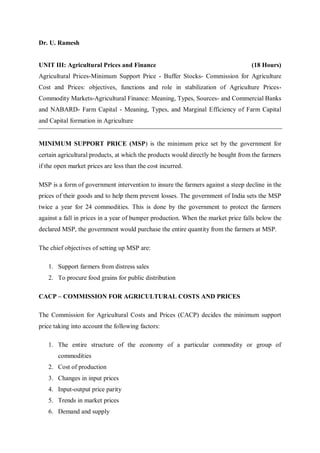
MINIMUM SUPPORT PRICE (MSP) is the minimum price set by the government for
certain agricultural products, at which the products would directly be bought from the farmers
if the open market prices are less than the cost incurred.
MSP is a form of government intervention to insure the farmers against a steep decline in the
prices of their goods and to help them prevent losses. The government of India sets the MSP
twice a year for 24 commodities. This is done by the government to protect the farmers
against a fall in prices in a year of bumper production. When the market price falls below the
declared MSP, the government would purchase the entire quantity from the farmers at MSP.
The chief objectives of setting up MSP are:
1. Support farmers from distress sales
2. To procure food grains for public distribution
CACP – COMMISSION FOR AGRICULTURAL COSTS AND PRICES
The Commission for Agricultural Costs and Prices (CACP) decides the minimum support
price taking into account the following factors:
1. The entire structure of the economy of a particular commodity or group of
commodities
2. Cost of production
3. Changes in input prices
4. Input-output price parity
5. Trends in market prices
6. Demand and supply
7. Inter-crop price parity
8. Effect on industrial cost structure
9. Effect on the cost of living
10. Effect on the general price level
11. International price situation
12. Parity between prices paid and prices received by the farmers
13. Effect on issue prices and implications for subsidy
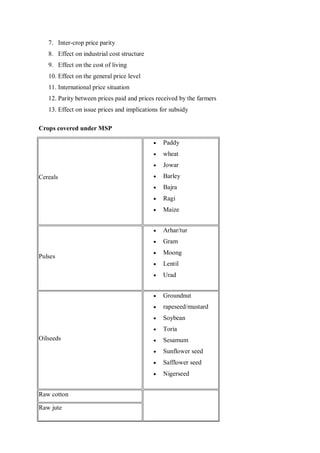
Crops covered under MSP
Cereals
 Paddy
 wheat
 Jowar
 Barley
 Bajra
 Ragi
 Maize
Pulses
 Arhar/tur
 Gram
 Moong
 Lentil
 Urad
Oilseeds
 Groundnut
 rapeseed/mustard
 Soybean
 Toria
 Sesamum
 Sunflower seed
 Safflower seed
 Nigerseed
Raw cotton
Raw jute
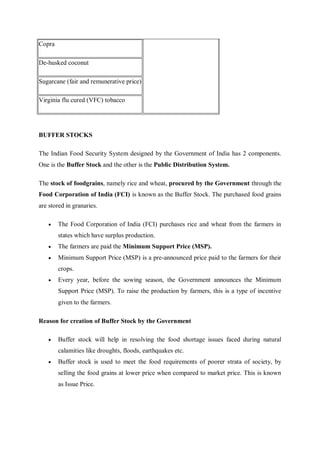
Copra
De-husked coconut
Sugarcane (fair and remunerative price)
Virginia flu cured (VFC) tobacco
BUFFER STOCKS
The Indian Food Security System designed by the Government of India has 2 components.
One is the Buffer Stock and the other is the Public Distribution System.
The stock of foodgrains, namely rice and wheat, procured by the Government through the
Food Corporation of India (FCI) is known as the Buffer Stock. The purchased food grains
are stored in granaries.
 The Food Corporation of India (FCI) purchases rice and wheat from the farmers in
states which have surplus production.
 The farmers are paid the Minimum Support Price (MSP).
 Minimum Support Price (MSP) is a pre-announced price paid to the farmers for their
crops.
 Every year, before the sowing season, the Government announces the Minimum
Support Price (MSP). To raise the production by farmers, this is a type of incentive
given to the farmers.
Reason for creation of Buffer Stock by the Government
 Buffer stock will help in resolving the food shortage issues faced during natural
calamities like droughts, floods, earthquakes etc.
 Buffer stock is used to meet the food requirements of poorer strata of society, by
selling the food grains at lower price when compared to market price. This is known
as Issue Price.
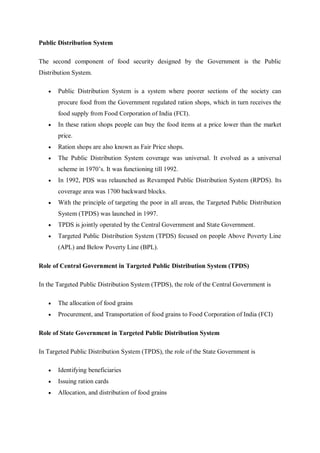
Public Distribution System
The second component of food security designed by the Government is the Public
Distribution System.
 Public Distribution System is a system where poorer sections of the society can
procure food from the Government regulated ration shops, which in turn receives the
food supply from Food Corporation of India (FCI).
 In these ration shops people can buy the food items at a price lower than the market
price.
 Ration shops are also known as Fair Price shops.
 The Public Distribution System coverage was universal. It evolved as a universal
scheme in 1970’s. It was functioning till 1992.
 In 1992, PDS was relaunched as Revamped Public Distribution System (RPDS). Its
coverage area was 1700 backward blocks.
 With the principle of targeting the poor in all areas, the Targeted Public Distribution
System (TPDS) was launched in 1997.
 TPDS is jointly operated by the Central Government and State Government.
 Targeted Public Distribution System (TPDS) focused on people Above Poverty Line
(APL) and Below Poverty Line (BPL).
Role of Central Government in Targeted Public Distribution System (TPDS)
In the Targeted Public Distribution System (TPDS), the role of the Central Government is
 The allocation of food grains
 Procurement, and Transportation of food grains to Food Corporation of India (FCI)
Role of State Government in Targeted Public Distribution System
In Targeted Public Distribution System (TPDS), the role of the State Government is
 Identifying beneficiaries
 Issuing ration cards
 Allocation, and distribution of food grains
COMMISSION FOR AGRICULTURAL COSTS AND PRICES (CACP)
The Commission for Agricultural Costs and Prices (CACP), set up in 1965, is a decentralized
agency of the Government of India (GoI). It is an expert body that recommends the Minimum
Support Prices (MSPs) by taking into consideration various factors.
he Commission for Agricultural Costs and Prices (CACP) was initially known as the
Agricultural Prices Commission. It was renamed the Commission for Agricultural Costs and
Prices in 1985.
 It is a statutory panel under the Ministry of Agriculture & Farmers’ Welfare,
Government of India.
 The CACP is an expert body that recommends the MSPs of the notified Kharif and
Rabi crops to the Cabinet Committee on Economic Affairs (CCEA).
The objective of the Commission: The Commission was established to recommend
Minimum Support Prices (MSPs), to motivate cultivators and farmers to adopt the latest
technology in order to optimize the use of resources and increase productivity.
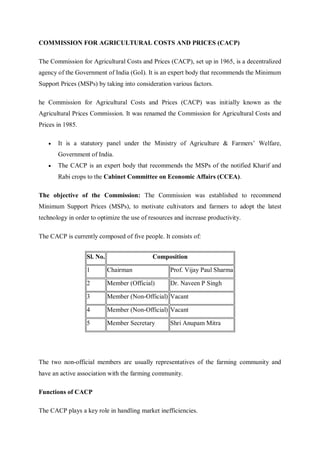
The CACP is currently composed of five people. It consists of:
Sl. No. Composition
1 Chairman Prof. Vijay Paul Sharma
2 Member (Official) Dr. Naveen P Singh
3 Member (Non-Official) Vacant
4 Member (Non-Official) Vacant
5 Member Secretary Shri Anupam Mitra
The two non-official members are usually representatives of the farming community and
have an active association with the farming community.
Functions of CACP
The CACP plays a key role in handling market inefficiencies.
 It provides an assurance of a remunerative and stable price environment. This is
important for enhancing agricultural production and productivity since the
marketplace for agricultural produce tends to be inherently volatile.
 It helps the farmers obtain a fair price for their crops, even if the market situation is
unstable, thereby preventing the farmers from falling into the vicious cycle of debt.
 The Government sets the MSPs on the basis of the recommendations given by the
committee. The CACP currently recommends the MSPs for 23 commodities, which
include seven grains, five pulses, seven oilseeds, and four commercial crops.
Roles and Responsibilities of the Commission for Agricultural Costs and Prices
 The Commission recommends measures to make the price policy effective. This
includes providing incentives to farmers:
 to adopt improved technologies and
 to develop a production pattern that meets national economic requirements.
 The Commission ensures the rational use of land, water, and other production
resources.
 The Commission keeps the developing price situation under review. It makes
appropriate suggestions as needed.
 The Commission undertakes studies on different crops. It keeps information on
agricultural prices and other related data.
 The Commission advises the government on any problems relating to agricultural
prices and products.
 The Commission integrates non-price measures with price recommendations to ensure
competitive agriculture.
 The Commission takes into account the changes in terms of trade between the
agricultural and non-agricultural sectors.
COMMODITY MARKET
If you thought that the equity market was the only financial market in the world, then you’re
in for a surprise. There are a couple of other financial markets that are as popular as the stock
market viz the currency market and the commodities market. Let’s delve a little deeper into
the specifics of the commodities market and try to understand the basics.
Basic of commodities market
Similar to how the shares of a company are traded in the stock market, commodities are
bought and sold in the commodities market. This financial market is widely utilized by
producers, manufacturers, and wholesale traders as a price discovery mechanism for various
goods and commodities.
Just like the stock market, there are dedicated commodity exchanges that enable the market
participants to easily buy and sell commodities online. Three primary commodity exchanges
are currently operational in India - the Multi Commodity Exchange (MCX), National
Commodity and Derivatives Exchange (NCDEX),and Indian Commodity Exchange (ICEX).
What are the different commodities that are traded?
Most traders and investors simply classify the different commodities into agricultural and
non-agricultural commodities. The non-agricultural commodities can be further sub-classified
into three different categories - bullion, energy, and base metals. Here’s a brief list of the
different types of commodities under each category that is regularly bought and sold in the
exchanges.
 Bullion - Gold and silver
 Energy - Crude oil and natural gas
 Agriculture - Black pepper, cardamom, castor seed, cotton, palm oil, kapas, wheat,
paddy, chana, bajra, barley, and sugar, among others
 Base Metals - Aluminum, copper, lead, nickel, and zinc
AGRICULTURAL FINANCE:
Agricultural Finance Meaning & Definition
Agricultural Finance refers to the study and management of financial resources in farming. It
involves analyzing how farmers obtain and use funds, as well as the functioning of
agricultural lending institutions.
Murray (1953) described Agricultural Finance as the financial analysis of borrowing funds
and managing reserves by farmers and the operations of farm lending organizations. Tandon
and Dhondyal (1962) defined it as a part of agricultural economics that deals with financial
resources connected to farming.
Agricultural Finance is essential for farmers, enabling them to obtain loans from banks and
financial institutions to purchase farming equipment, seeds, fertilizers, and livestock and
make improvements on their land. It covers all financial aspects related to the production and
marketing of agricultural products, crucial for the core agricultural sector in India.
Agricultural Finance: Types of Loan in India
In India, farmers have access to various types of loans to support their agricultural activities.
These loans cover a range of needs, including storage, production expansion, marketing, day-
to-day operations, land purchase, and acquiring farming equipment like tractors and
harvesters. Let’s explore the different types of agricultural loans available:
1. Crop Loan: Farmers can obtain crop loans through institutions like the National
Bank for Agriculture and Rural Development (NABARD) and commercial banks to
finance their crop cultivation activities.
2. Kisan Credit Card (KCC): Introduced in 1998, the KCC allows farmers to borrow
funds at a low interest rate, typically around 7% per annum, with credit limits
extending up to Rs. 3 lahks.
3. Combine Harvester Loan: Specifically tailored to assist farmers in purchasing
combine harvesters, this loan helps improve harvesting efficiency.
4. Multipurpose Gold Loan: Farmers can use their gold assets to secure loans for
various agricultural purposes.
5. Drip Irrigation Loan: Designed to promote water-efficient irrigation methods, this
loan assists farmers in setting up drip irrigation systems.
6. Tractor Loan: Farmers can finance the purchase of tractors through this type of loan,
which is crucial for mechanizing farming operations.
7. Poultry Loan: Aimed at supporting poultry farming ventures, this loan helps farmers
establish and expand poultry operations.
8. Dairy Loan: Intended for dairy farmers, this loan provides financial assistance for
activities related to dairy farming, such as purchasing cattle and setting up dairy
infrastructure.
The National Bank for Agriculture and Rural Development (NABARD) stands out as a
premier institution offering financial support to farmers. Additionally, loans are available
through nationalized banks, private sector banks, and the State Bank of India. These diverse
options cater to the varied needs of farmers across the agricultural sector in India, enabling
them to access necessary funds for their agricultural endeavors.
Benefits of Agricultural Finance
The demand for Agricultural Finance is greater now than ever before. Farmers rely on this
financial support to meet their production needs and purchase essential farming equipment.
Here are some key benefits of Agricultural Finance:
 Production Needs: It helps farmers buy seeds, fertilizers, and other inputs necessary
for crop production.
 Farming Equipment: Farmers can purchase machinery like tractors and harvesters,
which are crucial for modern farming.
 Agricultural Marketing: Funds can be used to market agricultural products
effectively, ensuring better prices and wider reach.
 Post-Harvest Storage: Agricultural Finance provides resources for building storage
facilities, helping farmers store their produce safely and reduce post-harvest losses.
 Transport: It supports the transportation of agricultural products to markets, ensuring
timely delivery and reduced spoilage.
 Power Supply: Farmers can use the funds to ensure a reliable power supply for their
farming operations, enhancing productivity.
 Quality Seeds: Access to finance allows farmers to procure high-quality seeds, which
are essential for good yields.
 Fertilizers: Agricultural Finance enables farmers to buy the necessary fertilizers to
improve soil fertility and crop production.
 Risk Management: It helps farmers manage risks related to low rainfall, pest
damage, and diseases, ensuring they can sustain their farming activities despite
challenges.
Moreover, Agricultural Finance is vital for supporting farmers in various aspects of their
operations, from production to marketing and risk management, ensuring the overall
sustainability and growth of the agricultural sector.
Sources of Agricultural Finance:
This can be divided into two categories:
(i) Non-institutional sources.
(ii) Institutional sources
(i) Non-Institutional sources are the following:
(a) Moneylenders
(b) Relatives
(c) Traders
(d) Commission agents
(e) Landlords
(ii) Institutional sources:
(a) Cooperatives
(b) Scheduled Commercial Banks
(c) Regional Rural Banks (RRBs)
(a) Cooperatives:
(i) Primary Agricultural Cooperative Societies (PACSs) provide short and medium term
loans.
(ii) Primary Cooperative Agricultural and Rural Development Banks (PCARDBS) provide
long term loan for agriculture.
(b) Commercial banks, including RRBs, provide both short and medium term loans for
agriculture and allied activities.
The National Bank for Agriculture and Rural Development (NABARD) is the apex
institution at the national level for agriculture credit and provides assistance to the agencies
mentioned above. The Reserve Bank of India plays a crucial role in this sphere by giving
overall direction to rural credit and financial support to NABARD for its operations.
At the time of Independence the most important source of agricultural credit were the
moneylenders. In 1951 (the year when planning was initiated in the country) moneylenders
accounted for as much as 71.6 per cent of rural credit.
This was because there was no other source from which the farmers could borrow money.
Hence the moneylenders exploited the poor farmers. Thus, they used to charge exorbitant
interest for their loans. The moneylenders used to manipulate their accounts and force the
farmers to sell their produce to them at low price. The government has therefore undertaken
various steps to regulate the activities of the moneylenders.
The most important move was to free the agriculturists from the clutches of the money
lenders and the expansion of institutional credit to agriculture.
The Government has helped the cooperatives in a number of ways to expand their
operations:
a. 14 major commercial banks were nationalised in 1969.
b. 6 more banks were nationalised in 1980.
c. In 1975 an institution was established by the government to meet the
requirements of rural credit – Regional Rural Bank (RRBs).
d. In July 1982 National Bank for Agriculture and Rural Development
(NABARD) was set up.
e. India now has a wide network of rural finance institution (RFI).
As a result of this massive expansion of RFIs their participation in rural credit has increased
significantly while that of moneylenders has declined. Non- institutional sources of
agriculture credit still remain and they offer credit at high rates of interest especially in case
of unproductive purposes.
Cooperative Credit Societies:
The rural co-operative credit institutions in India have been organised into short-term and
long-term structures. The short-term co-operative structure is based on three-tier structures,
except the states in the northeast region. At the lowest tier are the Primary Agricultural Credit
Societies (PACSs). These are organised at the village level. At the second tier and District
Central Cooperative Banks (DCCBs) organised at the district level. At the third and
uppermost tier are the State Co-operative Banks (STCBs) organised at the state level state
Co-operative Banks (state level).
To cater to long-term loans long-term credit cooperatives have been set up. These are
organised at two levels and categorized into four types:
(i) The unitary structure in which Stat Cooperative Agricultural and Rural
Development Banks (SCARDBs) operate at the state level.
(ii) The federal structure in which Primary Cooperative
Agricultural and Rural Developments Banks (PCARDBs) operate
as independent units at the primary level and federate themselves
into SCARDBS at the state level.
(iii) The mixed structure wherein both the unitary and federal types
operate in one form or another.
(iv) The integrated structure where no separate Agricultural and
rural development banks exist and the long-term credit business is
undertaken bythe long-term section of the StCBs concerned.
Commercial Banks:
In fact up to 1970 the government policy was to depend entirely on thecooperative banks as a
major source of institutional credit in rural areas. Government felt that Cooperative Bank
alone cannot meet the growing demand. Therefore Govt. policy changed and a number of
institutions were developed to give rural credit. In 1969, 14 major banks were nationalised. In
1980, six more banks were nationalised. In 2004, the number of total branches had shot up to
67062, of this 32,200 in rural areas. Despite the chievement of the commercial banks in the
field of rural credit mentioned above, their performance and operations have invited a lot of
criticism.
Regional Rural Banks:
The Working Group on Rural Banks (1975) recommended the establishment of Regional
Rural Bank (RRBs) to supplement the efforts of the commercial banks and the cooperatives
in extending credit to weaker sections of the rural community, small and marginal farmers,
landless labourers, artisans and other rural residents of small means.
The intention in having these new banks was that there should, in the Indian context, be an
institutional device which combined the local feel and familiarity with the rural problems
which the cooperatives possessed and the degree of business organisation and modernised
outlook which the commercial banks had, with a view to reaching the rural poor more
extensively. Consequent upon the recommendations of the Working Group, 5 RRBs were
initially set up in 1975. Their number later rose to 196. In 2003-04, RRBs provided Rs. 7,581
crores as credit to the agricultural sector. This was 8.7% of total institutional credit to
agriculture in that year.
NABARD AND COMMERCIAL BANKS
Commercial banks play a role in credit creation, which increases production, employment,
and consumer spending, thereby boosting the economy. These banks are heavily regulated by
the central bank of that country, the RBI, in India. For example, central banks impose reserve
requirements on commercial banks, which means that they would need to hold a certain
percentage of their consumer deposits at the central bank in case of a rush to withdraw funds
from the general public. These entities help markets thrive and, if their influence is used well,
can foster development so that more people can access essential services and consumer
goods.
National Bank for Agriculture and Rural Development (NABARD):
The most important development in the field of rural credit has been the setting up of the
National Bank for Agriculture and Rural Development (NABARD) in July 1982. It took over
from Reserve Bank of India all the functions that the latter performed in the field of rural
credit.
Commercial Banks
 Organised under the Banking Companies Act, 1956
 They operate on a commercial basis and its main objective is profit.
 They have a unified structure and are owned by the government, state, or any private
entity.
 They tend to all sectors ranging from rural to urban
 These banks do not charge concessional interest rates unless instructed by the RBI
 Public deposits are the main source of funds for these banks
The commercial banks can be further divided into three categories:
1. Public sector Banks – A bank where the majority stakes are owned by the
Government or the central bank of the country.
2. Private sector Banks – A bank where the majority stakes are owned by a private
organization or an individual or a group of people
3. Foreign Banks – The banks with their headquarters in foreign countries and branches
in our country, fall under this type of bank
FARM CAPITAL
The capital employed in farming is traditionally defined as the difference between the sale
value of an operating farm and the sale value of the land in its natural state. Capital is thus the
value of the resources that have to be invested to take land from its natural state and
transform it into a complete farm operation. Farm capital in this definition includes
investments in land clearing, fencing, draining, and roads and buildings, as well as
investments in tools, animals, animal feed, seed, and wages embodied in growing crops and
animals.
What are the types of farm capital?
Capital used in agriculture can broadly be classified into two categories: (i) fixed capital and
(ii) working capital.
Fixed capital
Fixed capital is that capital which lasts for more than one year. It includes the investment
in farm machines such as tractor, pump-sets, and other assets like tube-wells, land
development, farm building, etc.
Working capital
During volatile times in agriculture due to changes in crop prices and costs, working capital,
“cash”, is your friend. Working capital is the result of subtracting current liabilities from
current assets. Current assets are bank accounts, crop inventories, prepaids, stock and
hedging accounts, and other current items.
Marginal Efficiency of Farm Capital and Capital Formation in Agriculture – Seminar Topic
https://theintactone.com/2020/11/30/capital-formation-in-agriculture-
industry/#google_vignette