Ref for Food Security, Food Procurement and PDS
 FCI accumulated over 60 million of foodgrains—three
times the requirement for PDS
 26% of people is below poverty line
 There is availability of foodgrains, still lack of
purchasing power
 Effective food security implies both physical and
economic access of food
 Food security is not foodgrain security– the food
basket is comprised of several non-foodgrain item–
sugar, edible oil, milk, meat, eggs, vegetables and fruits
Causes of food surpluses with FCI
 Steep rise in procurement– possible decline in net
exports and a steep rise in the minimum support price
(MSP)◊
 But net exports picked up recently– so important
reason is steep rise in MSP– which is crowding out
private trade in foodgrains
◊Minimum Support Price is a floor price below which
farming becomes unviable, and farmers need to be
supported through purchases by the Government at this
price.
 There is fall in foodgrain consumption– mostly from
developed regions and from upper and middle income
groups in the rural sectors (implying that this is not
driven by distress condition)
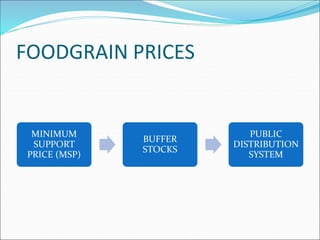
FOODGRAIN PRICES
MINIMUM
SUPPORT
PRICE (MSP)
BUFFER
STOCKS
PUBLIC
DISTRIBUTION
SYSTEM
 Paddy
 Wheat
 Jowar
 Bajra
 Maize
 Ragi
 Pulses oil seeds
 Copra
 Cotton
 Jute
 Sugarcane
 Tobacco
 The CACP ( Commission on Agricultural Costs and
Prices) takes into account a number of factors, apart
from the cost of production, such as emerging balance
between domestic supply and demand for food grains,
the prospects of technological change, the need to
ensure efficiency of resource use in agriculture, the
need to keep in check the rate of inflation in consumer’s
interest
 MSP is supposed to be fixed on ‘cost-plus’ formula
But there are non-economic factors, like
 Demands from Chief Ministers of grain-surplus states
 Rising expectations from rich farmers represented by
politically strong lobbies
Some issues
 Even when world prices declined procurement prices
were increasing in India in the late 1990s
 The MSP was supposed to include average variable cost
, but due to pressure of different lobbies MSP covers
total cost
 The support price is benefitting only a few states like
Punjab, Haryana, UP, Andhra Pradesh and crops like
wheat and rice.
 state-level taxes and marketing committee fees
(mandi fees) on procurement operations inPunjab and
Haryana inflate the economic cost of foodgrains
 The system of levy is an indirect tax on rice mills
 Inter-year and intra-year price fluctuations cause
concern for producers and consumers. Price-
stabilization is big issue
 Price policy does not consider the changing
consumption pattern of India
 The Department of Agriculture and Cooperation,
Government of India, suggests total marketisation of
foodgrain trade by disbanding purchases by the
Food Corporation of India at minimum support
prices
certain variant of the existing crop insurance scheme
for protecting the farmers in the event of a fall in
incomes due to variations in yields and market prices
An Agricultural Insurance Scheme
Policy framework for foodgrain
sector
 To consolidate the food security achieved so far in
the country and strengthen it further
 To encourage diversification of cropping pattern so
as to ensure efficiency of resource allocation
 To enhance our competitiveness in the export
market
 To allow a rise in domestic foodgrain consumption
among the poor
 To reduce the subsidy bill
 To reduce the costs of distribution

FOODGRAIN SURPLUSES.ppt

  • 1.
    Ref for FoodSecurity, Food Procurement and PDS
  • 2.
     FCI accumulatedover 60 million of foodgrains—three times the requirement for PDS  26% of people is below poverty line  There is availability of foodgrains, still lack of purchasing power
  • 3.
     Effective foodsecurity implies both physical and economic access of food  Food security is not foodgrain security– the food basket is comprised of several non-foodgrain item– sugar, edible oil, milk, meat, eggs, vegetables and fruits
  • 4.
    Causes of foodsurpluses with FCI  Steep rise in procurement– possible decline in net exports and a steep rise in the minimum support price (MSP)◊  But net exports picked up recently– so important reason is steep rise in MSP– which is crowding out private trade in foodgrains ◊Minimum Support Price is a floor price below which farming becomes unviable, and farmers need to be supported through purchases by the Government at this price.
  • 5.
     There isfall in foodgrain consumption– mostly from developed regions and from upper and middle income groups in the rural sectors (implying that this is not driven by distress condition)
  • 6.
  • 7.
     Paddy  Wheat Jowar  Bajra  Maize  Ragi  Pulses oil seeds  Copra  Cotton  Jute  Sugarcane  Tobacco
  • 8.
     The CACP( Commission on Agricultural Costs and Prices) takes into account a number of factors, apart from the cost of production, such as emerging balance between domestic supply and demand for food grains, the prospects of technological change, the need to ensure efficiency of resource use in agriculture, the need to keep in check the rate of inflation in consumer’s interest
  • 9.
     MSP issupposed to be fixed on ‘cost-plus’ formula But there are non-economic factors, like  Demands from Chief Ministers of grain-surplus states  Rising expectations from rich farmers represented by politically strong lobbies
  • 10.
    Some issues  Evenwhen world prices declined procurement prices were increasing in India in the late 1990s  The MSP was supposed to include average variable cost , but due to pressure of different lobbies MSP covers total cost  The support price is benefitting only a few states like Punjab, Haryana, UP, Andhra Pradesh and crops like wheat and rice.  state-level taxes and marketing committee fees (mandi fees) on procurement operations inPunjab and Haryana inflate the economic cost of foodgrains
  • 11.
     The systemof levy is an indirect tax on rice mills  Inter-year and intra-year price fluctuations cause concern for producers and consumers. Price- stabilization is big issue  Price policy does not consider the changing consumption pattern of India
  • 12.
     The Departmentof Agriculture and Cooperation, Government of India, suggests total marketisation of foodgrain trade by disbanding purchases by the Food Corporation of India at minimum support prices
  • 13.
    certain variant ofthe existing crop insurance scheme for protecting the farmers in the event of a fall in incomes due to variations in yields and market prices An Agricultural Insurance Scheme
  • 14.
    Policy framework forfoodgrain sector  To consolidate the food security achieved so far in the country and strengthen it further  To encourage diversification of cropping pattern so as to ensure efficiency of resource allocation  To enhance our competitiveness in the export market  To allow a rise in domestic foodgrain consumption among the poor  To reduce the subsidy bill  To reduce the costs of distribution