Agile: In teaching learning process V. V. Kamat Goa University [email_address]
Agenda Why agile in Education? Motivation for Agile framework in Education Best practices in teaching-learning process  Proposed Agile Manifesto in education Conclusion Q & A
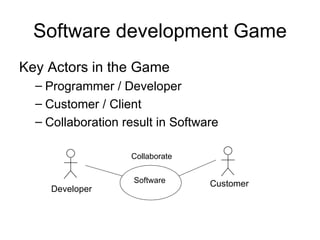
Software development Game Key Actors in the Game Programmer / Developer  Customer / Client Collaboration result in Software Developer Customer Software Collaborate
Some Familiar Questions? Has developer understood what the real requirement of the client is? Is there a collaboration between developer and client?  What is the quality of the software? How reliable is the software quality? What is the feedback mechanism? How often bugs are fixed?
Game teacher-teacher Key Actors in the Game (All casts chosen are from software industry) Teacher Cast: “programmer / developer”  Student Cast: “software service / product” Employer Cast: “customer / client”
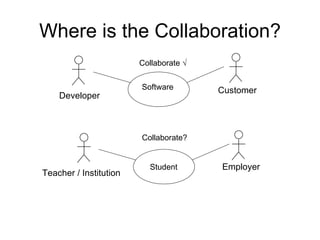
Where is the Collaboration? Developer Teacher / Institution Employer Customer Software Student Collaborate  √ Collaborate?
Ask similar Questions in new Role Has teacher/institution understood what the real requirement of the industry is? What is the quality of the student? How reliable is the student quality? What is the feedback mechanism? How often changes are made to course content?  Is there a collaboration between institution and industry?
Present Scenario In curriculum design, industry inputs are often missing  Academic programs are rigid and uses waterfall process model in delivery Most academic programs are fixed time, fixed cost and fixed scope projects  Change is a bureaucratic process and on an average cycle time is 3-4 years
Present Scenario cont… Students graduate with little practical skills, no idea of industry expectations There is over emphasis on what can be taught than what need to be taught There is over compartmentalization of education and no time for integration  Instead, industry has found its own quick fix solutions
Frustration! Industry They don’t understand what we want Academia They don’t know what our problems are Student Confused, eager to join industry only to get more confused There is lot of duplication of efforts, waste of time & resources, is anybody listening?
Blame Game Industry Institutions teach things that are not relevant Marks in the exam is no proof of actual skills Institutions teach as if all students are going to be researchers Institutions are bureaucratic, they are tightly controlled bodies and averse to change . . .
Blame Game cont… Academia We teach fundamentals, platform specific skills is not our forte We expect industry participation if they want better output We are paid peanuts, what better can you expect Our environments are not inspiring, come and work here then talk
Blame doesn’t fix the bug Understand the process of education Three key processes in education are Teaching (Teacher and Support staff ) Evaluation (Examination and Marking) Administration (Infrastructure and systems) IT can play a major role in managing these processes, but that’s a different topic… The quality of the education product is directly related to quality of these 3 processes
… where have we come from and where we want to go… Its important to understand the current practices if you want to improve Are these proverbs making sense? If you don’t know where you are going, any road will do - Chinese proverb If you don’t know where you are, map won’t help - Humphrey’s corollary
Current Evaluation Practices Focus is on scoring marks then knowing Essay type questions lack application Lack of trust in teacher and the system  External examiner adds agony to process Lack of transparency adds air of suspicion Rule based then student friendly Everybody suffers but afraid to change
Current Teaching Practices Engaging class is important but what is taught, how it is taught only students know Accountability is often limited to attendance Lot of teacher time is spent on mundane jobs, leaving little time to learn new things  There is no incentive for good teaching or to learn new things Chalk & talk has no scope for reusability
Current Status of a Teacher Teacher is costly but neglected resource Teaching career often opted not by choice  Teacher lacks motivation and suffers from low self-esteem Current contract appointments lacks vision Good teachers are hard to come by Stereo type teacher fails to enthuse Lack of opportunities lead to obsolescence
Current Administrative Woes Procedures are more important then outcome  Excessive worry about misuse before use All assumed guilty till proved innocent Accountability at times confused to accounts To administration all teachers look the same Control mindset disabling than enabling Compliance scores over Competence System encourages/propagates mediocrity System converts assets into liability
Current Trend in Education Cost of education is rising Classroom size is becoming bigger Education is being looked as an investment Higher education is getting privatized Student has become a customer Knowledge and skills becoming important Quality certification is gaining importance Education has become a serious business
Current Trend in Business Continuous quality improvement  Better quality at cheaper price Life time of a product cycle is shrinking Focus is on productivity Leaner the better Concentrate on core competence and Outsource the rest
Lessons for Educationist Continuously add value to programs Balance quality, quantity and cost  Life time of a degree is shrinking Teacher / Student productivity is important Establish a niche in specific areas Hire few good teachers and admin staff Outsource the rest through contracts
Is Education going ISO way ? Many academic institutions are vying for ISO 2001: 9000 certification Many processes (more paper work) are getting introduced into institutions Mindless adoption of processes may prove expensive and may not serve the purpose Accountability of a teacher is important but it needs to be defined properly
Agile Framework  Can be applied in each of these areas Teaching Evaluation Administration What are the best practices?
Do not reinvent the wheel Use internet resources judiciously Download – Modify – Reuse the content but acknowledge the source Content has its own life cycle and it needs to be improved over deliveries  Overhead projectors are better but LCD projectors are the best
Manage classroom time effectively   Offline preparation of slides gives more time for student interaction Distribute slides but avoid dictating notes Give teaching & evaluation plan in advance but keep it agile Internet based assignment can bring excitement and curiosity to learn the latest Changing teacher role – from sage on the stage to guide by the side
Take feedback often Student is evaluated once in a while, teacher is evaluated everyday Written feedback acts as a deterrent and can be used constructively to build peer pressure Simple eye contact often does the magic Evaluation itself could be a good feedback  There is no one way to teach, each student learns differently
Interact with Local Industry Benefits Practical problems Project ideas Technology trends Give student project based on open source Projects from scratch are often scraped Adopt 80-20 rule in teaching a course 80% academic - 20% industry inputs “ Pappu” story
Best practices in Evaluation? Evaluate objectively & subjectively  Each objective question is like Unit Test Each Unit Test can identify potential bug  Test paper to cover the syllabus Grading to be flexible to accommodate difficulty level of question paper
Evaluate often Evaluation is the only way to know how much student has understood or misunderstood Earlier you detect misunderstanding, easier it is to fix it “Stitch in time saves nine” Evaluation only determines what student doesn't know and not what student knows
Evaluate objectively & subjectively Objective evaluation takes more effort than subjective evaluation Subjective evaluation takes more time than objective evaluation Evaluation & certification are two different things and each has its own merit Evaluation is best done by the teacher and certification is best done by the third party
Relative grading is the best Integrity of the teacher is utmost important Handles difficulty level of the question paper Empowers the teacher in the classroom Brings in transparency & accountability Trust the teacher and they become trustworthy Academic audit is the best deterrent
Food for thought! Each student learns differently than why all students should pass in same time? What is the competence of a student who has scored 40% marks in an exam? How much does a student learn in the class? How do we move from just-in-case to just-in-time delivery model?
Case Study: Our MCA Experience 100% internal evaluation except the labs External lab component helps in peer review  Projects are qualitatively graded CPI provides continuous feedback on student performance  Students provide mid-semester and end-semester feedback
MCA Examination Low ceremony process No appointment of  Chairman  examination, Paper setter, Supervisor,  Block supervisor, Attendant, Understudy… No 3 manuscript submission business No coding – decoding of answer papers No numbering on the benches Students get see all evaluated papers
Agile Agenda in Education Agile manifesto in Education Teachers and Students over Administration and Infrastructure Competence and Collaboration over Compliance and Competition Employability and Responding to market demands over syllabus and marks Attitude and Learning skills over Aptitude and formal degree
Conclusion There is an urgent need to apply agile framework to education system before it goes ISO way Lightweight process framework like Agile is recommended to educational setup Our experience shows that it is very much possible to put these practices in use provided there is will and commitment
Questions? Thank You!

Agileinteachinglearningprocess 1225221263076276-9

  • 1.
    Agile: In teachinglearning process V. V. Kamat Goa University [email_address]
  • 2.
    Agenda Why agilein Education? Motivation for Agile framework in Education Best practices in teaching-learning process Proposed Agile Manifesto in education Conclusion Q & A
  • 3.
    Software development GameKey Actors in the Game Programmer / Developer Customer / Client Collaboration result in Software Developer Customer Software Collaborate
  • 4.
    Some Familiar Questions?Has developer understood what the real requirement of the client is? Is there a collaboration between developer and client? What is the quality of the software? How reliable is the software quality? What is the feedback mechanism? How often bugs are fixed?
  • 5.
    Game teacher-teacher KeyActors in the Game (All casts chosen are from software industry) Teacher Cast: “programmer / developer” Student Cast: “software service / product” Employer Cast: “customer / client”
  • 6.
    Where is theCollaboration? Developer Teacher / Institution Employer Customer Software Student Collaborate √ Collaborate?
  • 7.
    Ask similar Questionsin new Role Has teacher/institution understood what the real requirement of the industry is? What is the quality of the student? How reliable is the student quality? What is the feedback mechanism? How often changes are made to course content? Is there a collaboration between institution and industry?
  • 8.
    Present Scenario Incurriculum design, industry inputs are often missing Academic programs are rigid and uses waterfall process model in delivery Most academic programs are fixed time, fixed cost and fixed scope projects Change is a bureaucratic process and on an average cycle time is 3-4 years
  • 9.
    Present Scenario cont…Students graduate with little practical skills, no idea of industry expectations There is over emphasis on what can be taught than what need to be taught There is over compartmentalization of education and no time for integration Instead, industry has found its own quick fix solutions
  • 10.
    Frustration! Industry Theydon’t understand what we want Academia They don’t know what our problems are Student Confused, eager to join industry only to get more confused There is lot of duplication of efforts, waste of time & resources, is anybody listening?
  • 11.
    Blame Game IndustryInstitutions teach things that are not relevant Marks in the exam is no proof of actual skills Institutions teach as if all students are going to be researchers Institutions are bureaucratic, they are tightly controlled bodies and averse to change . . .
  • 12.
    Blame Game cont…Academia We teach fundamentals, platform specific skills is not our forte We expect industry participation if they want better output We are paid peanuts, what better can you expect Our environments are not inspiring, come and work here then talk
  • 13.
    Blame doesn’t fixthe bug Understand the process of education Three key processes in education are Teaching (Teacher and Support staff ) Evaluation (Examination and Marking) Administration (Infrastructure and systems) IT can play a major role in managing these processes, but that’s a different topic… The quality of the education product is directly related to quality of these 3 processes
  • 14.
    … where havewe come from and where we want to go… Its important to understand the current practices if you want to improve Are these proverbs making sense? If you don’t know where you are going, any road will do - Chinese proverb If you don’t know where you are, map won’t help - Humphrey’s corollary
  • 15.
    Current Evaluation PracticesFocus is on scoring marks then knowing Essay type questions lack application Lack of trust in teacher and the system External examiner adds agony to process Lack of transparency adds air of suspicion Rule based then student friendly Everybody suffers but afraid to change
  • 16.
    Current Teaching PracticesEngaging class is important but what is taught, how it is taught only students know Accountability is often limited to attendance Lot of teacher time is spent on mundane jobs, leaving little time to learn new things There is no incentive for good teaching or to learn new things Chalk & talk has no scope for reusability
  • 17.
    Current Status ofa Teacher Teacher is costly but neglected resource Teaching career often opted not by choice Teacher lacks motivation and suffers from low self-esteem Current contract appointments lacks vision Good teachers are hard to come by Stereo type teacher fails to enthuse Lack of opportunities lead to obsolescence
  • 18.
    Current Administrative WoesProcedures are more important then outcome Excessive worry about misuse before use All assumed guilty till proved innocent Accountability at times confused to accounts To administration all teachers look the same Control mindset disabling than enabling Compliance scores over Competence System encourages/propagates mediocrity System converts assets into liability
  • 19.
    Current Trend inEducation Cost of education is rising Classroom size is becoming bigger Education is being looked as an investment Higher education is getting privatized Student has become a customer Knowledge and skills becoming important Quality certification is gaining importance Education has become a serious business
  • 20.
    Current Trend inBusiness Continuous quality improvement Better quality at cheaper price Life time of a product cycle is shrinking Focus is on productivity Leaner the better Concentrate on core competence and Outsource the rest
  • 21.
    Lessons for EducationistContinuously add value to programs Balance quality, quantity and cost Life time of a degree is shrinking Teacher / Student productivity is important Establish a niche in specific areas Hire few good teachers and admin staff Outsource the rest through contracts
  • 22.
    Is Education goingISO way ? Many academic institutions are vying for ISO 2001: 9000 certification Many processes (more paper work) are getting introduced into institutions Mindless adoption of processes may prove expensive and may not serve the purpose Accountability of a teacher is important but it needs to be defined properly
  • 23.
    Agile Framework Can be applied in each of these areas Teaching Evaluation Administration What are the best practices?
  • 24.
    Do not reinventthe wheel Use internet resources judiciously Download – Modify – Reuse the content but acknowledge the source Content has its own life cycle and it needs to be improved over deliveries Overhead projectors are better but LCD projectors are the best
  • 25.
    Manage classroom timeeffectively Offline preparation of slides gives more time for student interaction Distribute slides but avoid dictating notes Give teaching & evaluation plan in advance but keep it agile Internet based assignment can bring excitement and curiosity to learn the latest Changing teacher role – from sage on the stage to guide by the side
  • 26.
    Take feedback oftenStudent is evaluated once in a while, teacher is evaluated everyday Written feedback acts as a deterrent and can be used constructively to build peer pressure Simple eye contact often does the magic Evaluation itself could be a good feedback There is no one way to teach, each student learns differently
  • 27.
    Interact with LocalIndustry Benefits Practical problems Project ideas Technology trends Give student project based on open source Projects from scratch are often scraped Adopt 80-20 rule in teaching a course 80% academic - 20% industry inputs “ Pappu” story
  • 28.
    Best practices inEvaluation? Evaluate objectively & subjectively Each objective question is like Unit Test Each Unit Test can identify potential bug Test paper to cover the syllabus Grading to be flexible to accommodate difficulty level of question paper
  • 29.
    Evaluate often Evaluationis the only way to know how much student has understood or misunderstood Earlier you detect misunderstanding, easier it is to fix it “Stitch in time saves nine” Evaluation only determines what student doesn't know and not what student knows
  • 30.
    Evaluate objectively &subjectively Objective evaluation takes more effort than subjective evaluation Subjective evaluation takes more time than objective evaluation Evaluation & certification are two different things and each has its own merit Evaluation is best done by the teacher and certification is best done by the third party
  • 31.
    Relative grading isthe best Integrity of the teacher is utmost important Handles difficulty level of the question paper Empowers the teacher in the classroom Brings in transparency & accountability Trust the teacher and they become trustworthy Academic audit is the best deterrent
  • 32.
    Food for thought!Each student learns differently than why all students should pass in same time? What is the competence of a student who has scored 40% marks in an exam? How much does a student learn in the class? How do we move from just-in-case to just-in-time delivery model?
  • 33.
    Case Study: OurMCA Experience 100% internal evaluation except the labs External lab component helps in peer review Projects are qualitatively graded CPI provides continuous feedback on student performance Students provide mid-semester and end-semester feedback
  • 34.
    MCA Examination Lowceremony process No appointment of Chairman examination, Paper setter, Supervisor, Block supervisor, Attendant, Understudy… No 3 manuscript submission business No coding – decoding of answer papers No numbering on the benches Students get see all evaluated papers
  • 35.
    Agile Agenda inEducation Agile manifesto in Education Teachers and Students over Administration and Infrastructure Competence and Collaboration over Compliance and Competition Employability and Responding to market demands over syllabus and marks Attitude and Learning skills over Aptitude and formal degree
  • 36.
    Conclusion There isan urgent need to apply agile framework to education system before it goes ISO way Lightweight process framework like Agile is recommended to educational setup Our experience shows that it is very much possible to put these practices in use provided there is will and commitment
  • 37.