AGILE SOFTWARE
DEVELOPMENT METHODS
Presenters Names:
Mobeen
Xyz..
We are going to explain...
• Abstraction
• Introduction
• Background
• The Agile Manifesto
• Terminology
• Some Agile Methodologies
• Comparison
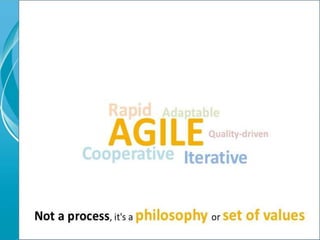
• What’s Agility?
Being agile
• What’s Agile?
“marked by ready ability to move
with quick easy grace”
“having a quick resourceful and
adaptable character”
• What does that
mean?
– Process has to be
lightweight and
sufficient
– Lightweight helps us
adapt and move
– Sufficient recognizes
our ineffectiveness to be
complete and relies on
strong communication
Background
• European wide research initiative on agile methods
• Agile-ITEA project conducted between 2004 and 2006
• methods in embedded software development in Europe
Survey study design.
the industrial participant
organizations of Agile-ITEA provided a sample of
organizations that were known to be interested in agile
methods,
and known to have access and involvement in the ongoing
research on agile software development methods in
Europe.
Goal; adoption of XP and scrum methods
• „Late 1990 several methodologies began to get increasing
public attention. Each had a different combination of old ideas,
new ideas, and transmuted old ideas. But they all emphasized
close collaboration between the programmer team and
business experts;
• face-to-face communication (as more efficient than written
documentation);
• frequent delivery of new deployable business value; tight,
self-organizing teams; and ways to craft the code and the team
such that the inevitable requirements churn was not a crisis.”
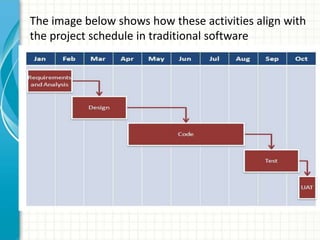
The image below shows how these activities align with
the project schedule in traditional software
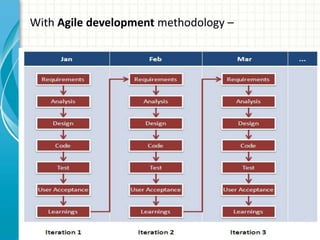
With Agile development methodology –
BRIEF OVERVIEW OF
AGILE
METHODOLOGY
Who’s Who
Methodology
• Agile software development methodology is
an process for developing software (like other
software development methodologies
Working Toward Mastery
Doing Your Best Work
COMPARISON OF
AGILE AND NON-
AGILE
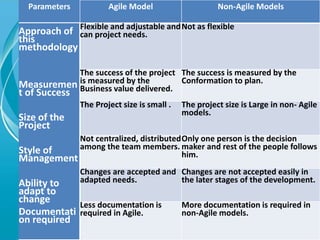
Parameters
Approach of
this
methodology
Measuremen
t of Success
Size of the
Project
Style of
Management
Ability to
adapt to
change
Documentati
on required
Agile Model Non-Agile Models
Flexible and adjustable and
can project needs.
Not as flexible
The success of the project
is measured by the
Business value delivered.
The success is measured by the
Conformation to plan.
The Project size is small . The project size is Large in non- Agile
models.
Not centralized, distributed
among the team members.
Only one person is the decision
maker and rest of the people follows
him.
Changes are accepted and
adapted needs.
Changes are not accepted easily in
the later stages of the development.
Less documentation is
required in Agile.
More documentation is required in
non-Agile models.
Parameters Agile Model Non-Agile Models
Importance
of
Cycles or
iterations
Planning in
Advance
Revenue
Size of the
team
More emphasis is given to the
People- Oriented.
More importance is given to the
process .
Has many cycles or iterations. But, in Non-Agile methodology the
cycles are limited.
There is minimal upfront
planning in Agile methodology.
Planning should be complete
before the development starts.
The return on investment is
early in the project cycle.
The return on investment is at the
end of the project.
The size of the team in Agile
methodology is usually small
and creative.
But in Non-Agile models the team
size is large.
Resources
• <Intranet site text here>
http://www.slideshare.net/hareshkarkar/overvi
ew-of-agile-methodology
• <Additional reading material text here>
<hyperlink here>
• This slide deck and related resources:
<hyperlink here>
ANY QUESTIONS?
QUESTION SESSION
QUESTIONS HANDLER:
MOBEEN KHAN
THANKS FOR APPRECIATING

Agile software development process

  • 1.
  • 2.
    We are goingto explain... • Abstraction • Introduction • Background • The Agile Manifesto • Terminology • Some Agile Methodologies • Comparison
  • 3.
  • 4.
    • What’s Agile? “markedby ready ability to move with quick easy grace” “having a quick resourceful and adaptable character”
  • 5.
    • What doesthat mean? – Process has to be lightweight and sufficient
  • 6.
    – Lightweight helpsus adapt and move – Sufficient recognizes our ineffectiveness to be complete and relies on strong communication
  • 7.
    Background • European wideresearch initiative on agile methods • Agile-ITEA project conducted between 2004 and 2006 • methods in embedded software development in Europe Survey study design. the industrial participant organizations of Agile-ITEA provided a sample of organizations that were known to be interested in agile methods, and known to have access and involvement in the ongoing research on agile software development methods in Europe. Goal; adoption of XP and scrum methods
  • 8.
    • „Late 1990several methodologies began to get increasing public attention. Each had a different combination of old ideas, new ideas, and transmuted old ideas. But they all emphasized close collaboration between the programmer team and business experts; • face-to-face communication (as more efficient than written documentation); • frequent delivery of new deployable business value; tight, self-organizing teams; and ways to craft the code and the team such that the inevitable requirements churn was not a crisis.”
  • 9.
    The image belowshows how these activities align with the project schedule in traditional software
  • 10.
    With Agile developmentmethodology –
  • 11.
  • 12.
  • 13.
    Methodology • Agile softwaredevelopment methodology is an process for developing software (like other software development methodologies
  • 16.
  • 18.
  • 25.
  • 26.
    Parameters Approach of this methodology Measuremen t ofSuccess Size of the Project Style of Management Ability to adapt to change Documentati on required Agile Model Non-Agile Models Flexible and adjustable and can project needs. Not as flexible The success of the project is measured by the Business value delivered. The success is measured by the Conformation to plan. The Project size is small . The project size is Large in non- Agile models. Not centralized, distributed among the team members. Only one person is the decision maker and rest of the people follows him. Changes are accepted and adapted needs. Changes are not accepted easily in the later stages of the development. Less documentation is required in Agile. More documentation is required in non-Agile models.
  • 27.
    Parameters Agile ModelNon-Agile Models Importance of Cycles or iterations Planning in Advance Revenue Size of the team More emphasis is given to the People- Oriented. More importance is given to the process . Has many cycles or iterations. But, in Non-Agile methodology the cycles are limited. There is minimal upfront planning in Agile methodology. Planning should be complete before the development starts. The return on investment is early in the project cycle. The return on investment is at the end of the project. The size of the team in Agile methodology is usually small and creative. But in Non-Agile models the team size is large.
  • 28.
    Resources • <Intranet sitetext here> http://www.slideshare.net/hareshkarkar/overvi ew-of-agile-methodology • <Additional reading material text here> <hyperlink here> • This slide deck and related resources: <hyperlink here>
  • 29.
  • 30.