

thi ng?
                   at a ltant
               s th Consu
          s! I
     Sale Managing
Agile e – Sr.
      rt a      12
Kurt Sol     th May
                    20
       d
       say 30
 W edne
Agenda


         1   Description of the team and environment


              2    Description of principles and process


              3    Benefits achieved & view of the dashboards


         4   Questions


2                                                          © 2012 IBM Corporation
The Team
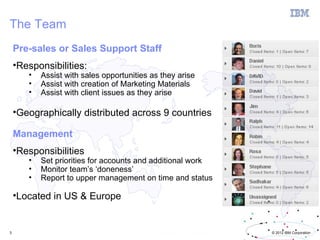
    Pre-sales or Sales Support Staff
    •Responsibilities:
       •   Assist with sales opportunities as they arise
       •   Assist with creation of Marketing Materials
       •   Assist with client issues as they arise

    •Geographically distributed across 9 countries

    Management
    •Responsibilities
       •   Set priorities for accounts and additional work
       •   Monitor team’s ‘doneness’
       •   Report to upper management on time and status

    •Located in US & Europe


3                                                            © 2012 IBM Corporation
The Customers
    Marketing
    •Who in marketing?:
       •    World Wide Marketing Organisation for the brand
       •    Local country or geo marketing groups
       •    Industry or sector marketing leads

    •Geographically distributed in over 60 countries

    Sales
    •Who in sales?
       •    World Wide Sales Executives
       •    Local Sales Executives
       •    Local sales and pre-sales teams

    •Sales presence in over 130 countries


4                                                             © 2012 IBM Corporation
The Original Environment / Issues
    •   Team was ‘slave to many masters’
        •   Inability to properly understand priority or scope
        •   ‘Biggest Fish’ prioritisation the largest account or opportunity always won
        •   Inability to change priorities fast enough

    •   Management spent too many hours attempting to get ‘status’
        •   Attempting to call/email status across time zones
        •   Attempting to manage dependencies across the team & time zones

    •   Inability to efficiently plan and manage different types of work
        •   Forecasted long range work like marketing materials (ie blogs & articles)
        •   Immediate reactive work like client issues and sales opportunities


5                                                                              © 2012 IBM Corporation
Agenda


         1    Description of team and environment


              2   Description of principles and process


              3    Benefits achieved & view of the dashboards


         4   Questions


6                                                         © 2012 IBM Corporation
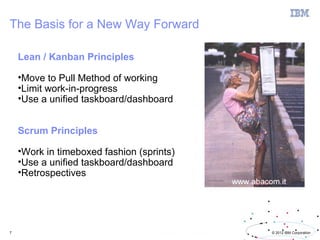
The Basis for a New Way Forward

    Lean / Kanban Principles

    •Move to Pull Method of working
    •Limit work-in-progress
    •Use a unified taskboard/dashboard


    Scrum Principles

    •Work in timeboxed fashion (sprints)
    •Use a unified taskboard/dashboard
    •Retrospectives


7                                          © 2012 IBM Corporation
The New Process
    The Backlogs
    •Three tiers of backlogs are kept:
        •   The ‘Team backlog’ functions similar to a product backlog
        •   The ‘Quarterly backlog’ functions similar to a release backlog
        •   The ‘Monthly backlog’ functions as the sprint backlog

    •Managing the backlogs:
        •   Planned & Prioritised using virtual planning meetings across global team
        •   Worked using Scrum of Scrums across distributed teams

    Work on the backlogs
    •Epics &Stories used for ‘Visioned’ work:
        •   Epics used for Market Themes
        •   Stories used for enablement actions (blog posts, articles, whitepapers, etc)

    •Sales Opps & Tasks used for ‘Reactive’ work(similar to defects):
        •   Sales Opps used for special sales opportunities that arise and need work
        •   Tasks are used to decompose a Sales Opps across team members

8                                                                            © 2012 IBM Corporation
Agenda


         1    Description of team and environment


              2    Description of principles and process


              3    Benefits achieved & view of the dashboards


         4   Questions


9                                                          © 2012 IBM Corporation
End-User Customer Benefits
     Giving a Method to the Madness
     •Customers become part of the planning:
        •   Instead of just logging a request and waiting to see what happens.
        •   Forces customers to see the impact of their request on the greater team.

     •All ‘Customers’ understand rank and progress :
        •   Helps foster understanding of why/when work gets done.
        •   Keeps politicing and ‘horse-trading’ out in the open, obvious to everyone.

     Ability to ‘BE’ agile
     •Ability to change and respond to market:
        •   Seeing what is WIP, allows customers to more ‘logically’ change their
            mind.
        •   Looking over backlogs and completed items helps identify market trends.

     •Ability to see understand change impacts in real-time:
        •   Highlights the impacts between marketing changes and sales requests.
        •   Instant understanding of impact a reactive item has on planned items.

10                                                                           © 2012 IBM Corporation
Team Member Benefits
     Giving a Method to the Madness
     •True understanding of priority:
        •   No matter how urgent or how important one customer makes it sound…..
        •   Offers cover to team when politics enter the mix.

     •The Ability to work and organise across a global team:
        •   Streamlines collaboration and teaming across shared tasks.
        •   Allows grouping and trending of tasks, world wide.

     Reduction of Reporting Overhead
     •Better view of Doneness:
        •   Ability to link and create dependencies on related tasks.
        •   A more complete view of all related tasks, and their completeness.

     •Running off of real-time live data:
        •   Complete removal of data collection activities (took over 24 hrs across time
            zones).
        •   Complete removal of report creation, validation, and emailing.

11                                                                                © 2012 IBM Corporation
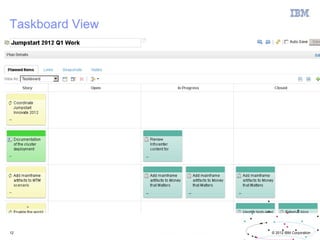
Taskboard View


12               © 2012 IBM Corporation
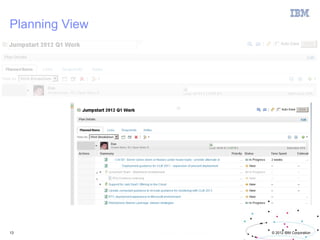
Planning View


13              © 2012 IBM Corporation
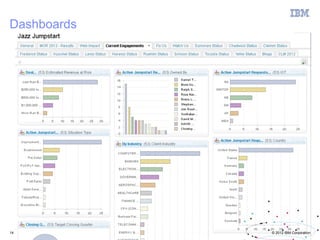
Dashboards


14           © 2012 IBM Corporation
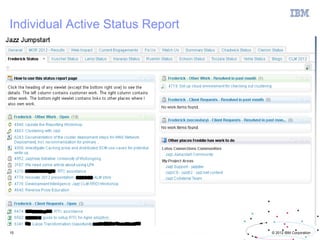
Individual Active Status Report


15                                © 2012 IBM Corporation
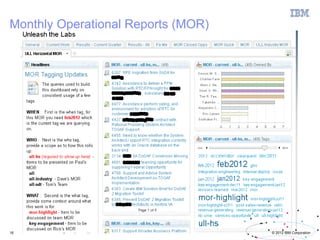
Monthly Operational Reports (MOR)


16                                  © 2012 IBM Corporation
17   © 2012 IBM Corporation
Agile Sales! Is that a Thing?

Agile Sales! Is that a Thing?

  • 1.
    thi ng? at a ltant s th Consu s! I Sale Managing Agile e – Sr. rt a 12 Kurt Sol th May 20 d say 30 W edne
  • 2.
    Agenda 1 Description of the team and environment 2 Description of principles and process 3 Benefits achieved & view of the dashboards 4 Questions 2 © 2012 IBM Corporation
  • 3.
    The Team Pre-sales or Sales Support Staff •Responsibilities: • Assist with sales opportunities as they arise • Assist with creation of Marketing Materials • Assist with client issues as they arise •Geographically distributed across 9 countries Management •Responsibilities • Set priorities for accounts and additional work • Monitor team’s ‘doneness’ • Report to upper management on time and status •Located in US & Europe 3 © 2012 IBM Corporation
  • 4.
    The Customers Marketing •Who in marketing?: • World Wide Marketing Organisation for the brand • Local country or geo marketing groups • Industry or sector marketing leads •Geographically distributed in over 60 countries Sales •Who in sales? • World Wide Sales Executives • Local Sales Executives • Local sales and pre-sales teams •Sales presence in over 130 countries 4 © 2012 IBM Corporation
  • 5.
    The Original Environment/ Issues • Team was ‘slave to many masters’ • Inability to properly understand priority or scope • ‘Biggest Fish’ prioritisation the largest account or opportunity always won • Inability to change priorities fast enough • Management spent too many hours attempting to get ‘status’ • Attempting to call/email status across time zones • Attempting to manage dependencies across the team & time zones • Inability to efficiently plan and manage different types of work • Forecasted long range work like marketing materials (ie blogs & articles) • Immediate reactive work like client issues and sales opportunities 5 © 2012 IBM Corporation
  • 6.
    Agenda 1 Description of team and environment 2 Description of principles and process 3 Benefits achieved & view of the dashboards 4 Questions 6 © 2012 IBM Corporation
  • 7.
    The Basis fora New Way Forward Lean / Kanban Principles •Move to Pull Method of working •Limit work-in-progress •Use a unified taskboard/dashboard Scrum Principles •Work in timeboxed fashion (sprints) •Use a unified taskboard/dashboard •Retrospectives 7 © 2012 IBM Corporation
  • 8.
    The New Process The Backlogs •Three tiers of backlogs are kept: • The ‘Team backlog’ functions similar to a product backlog • The ‘Quarterly backlog’ functions similar to a release backlog • The ‘Monthly backlog’ functions as the sprint backlog •Managing the backlogs: • Planned & Prioritised using virtual planning meetings across global team • Worked using Scrum of Scrums across distributed teams Work on the backlogs •Epics &Stories used for ‘Visioned’ work: • Epics used for Market Themes • Stories used for enablement actions (blog posts, articles, whitepapers, etc) •Sales Opps & Tasks used for ‘Reactive’ work(similar to defects): • Sales Opps used for special sales opportunities that arise and need work • Tasks are used to decompose a Sales Opps across team members 8 © 2012 IBM Corporation
  • 9.
    Agenda 1 Description of team and environment 2 Description of principles and process 3 Benefits achieved & view of the dashboards 4 Questions 9 © 2012 IBM Corporation
  • 10.
    End-User Customer Benefits Giving a Method to the Madness •Customers become part of the planning: • Instead of just logging a request and waiting to see what happens. • Forces customers to see the impact of their request on the greater team. •All ‘Customers’ understand rank and progress : • Helps foster understanding of why/when work gets done. • Keeps politicing and ‘horse-trading’ out in the open, obvious to everyone. Ability to ‘BE’ agile •Ability to change and respond to market: • Seeing what is WIP, allows customers to more ‘logically’ change their mind. • Looking over backlogs and completed items helps identify market trends. •Ability to see understand change impacts in real-time: • Highlights the impacts between marketing changes and sales requests. • Instant understanding of impact a reactive item has on planned items. 10 © 2012 IBM Corporation
  • 11.
    Team Member Benefits Giving a Method to the Madness •True understanding of priority: • No matter how urgent or how important one customer makes it sound….. • Offers cover to team when politics enter the mix. •The Ability to work and organise across a global team: • Streamlines collaboration and teaming across shared tasks. • Allows grouping and trending of tasks, world wide. Reduction of Reporting Overhead •Better view of Doneness: • Ability to link and create dependencies on related tasks. • A more complete view of all related tasks, and their completeness. •Running off of real-time live data: • Complete removal of data collection activities (took over 24 hrs across time zones). • Complete removal of report creation, validation, and emailing. 11 © 2012 IBM Corporation
  • 12.
    Taskboard View 12 © 2012 IBM Corporation
  • 13.
    Planning View 13 © 2012 IBM Corporation
  • 14.
    Dashboards 14 © 2012 IBM Corporation
  • 15.
    Individual Active StatusReport 15 © 2012 IBM Corporation
  • 16.
    Monthly Operational Reports(MOR) 16 © 2012 IBM Corporation
  • 17.
    17 © 2012 IBM Corporation

Editor's Notes

  • #3 5 mins: Intro and description of the team and environment. 5 mins: Description of process and principles, including how they were adopted by the sales team. 5 mins: How dashboards, reports, and prioritisation are managed & Outlay of the benefits achieved and how they were measured (and reported to management). 5 mins: Questions
  • #6 Team is very reactive to the loudest screamers Always sucked into Large Sales opps, neglecting marketing and enablement
  • #9 Reactive: Presales Request Large opps Forcasting: Iteration monthly based on MORs (Monthly Operational Reports) Release Quarterly Epic/Stories on Market enablement (blog posts, enblement material, aticles, trainings) Backlogs: Team Monthly Quarterly
  • #11 Scrum of Scrums, distributed Tags used to reports from granular to highlevel - replaced Powerpoint Actual running live data,
  • #12 Scrum of Scrums, distributed Tags used to reports from granular to highlevel - replaced Powerpoint Actual running live data,