


Agile Requirements Discovery
Version May 13th
Mario Cardinal
Agile Coach & Software Architect
www.mariocardinal.com
• Agile Coach & Software architect
• Leading independent consultant
• www.mariocardinal.com
Who am I ?
"The real voyage of discovery consists, not in seeking new landscapes, but in
having new eyes.”
Marcel Proust
A. Collaboration with a Slingboard
B. Backlog Grooming with Scrum
C. Backlog Grooming with a Slingboard
Why are we here?
Agenda
Agile Requirements Discovery
Section A
Collaboration with a Slingboard
Slingboard
Definition
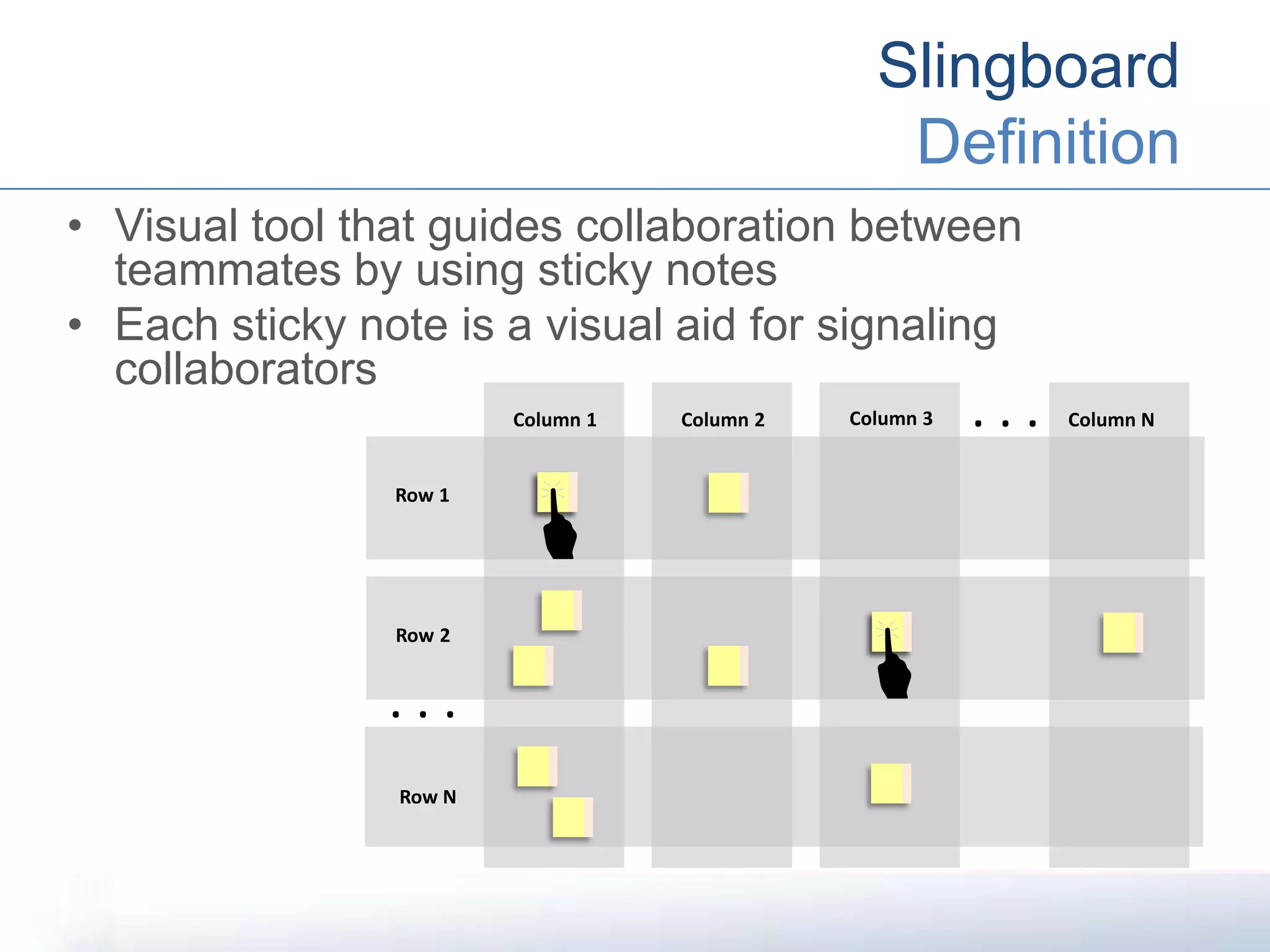
• Visual tool that guides collaboration between
teammates by using sticky notes
• Each sticky note is a visual aid for signaling
collaborators
Column 1 Column 2 Column 3 Column N
Row 1
Row 2
Row N
Slingboard
Two-Dimensional Grid
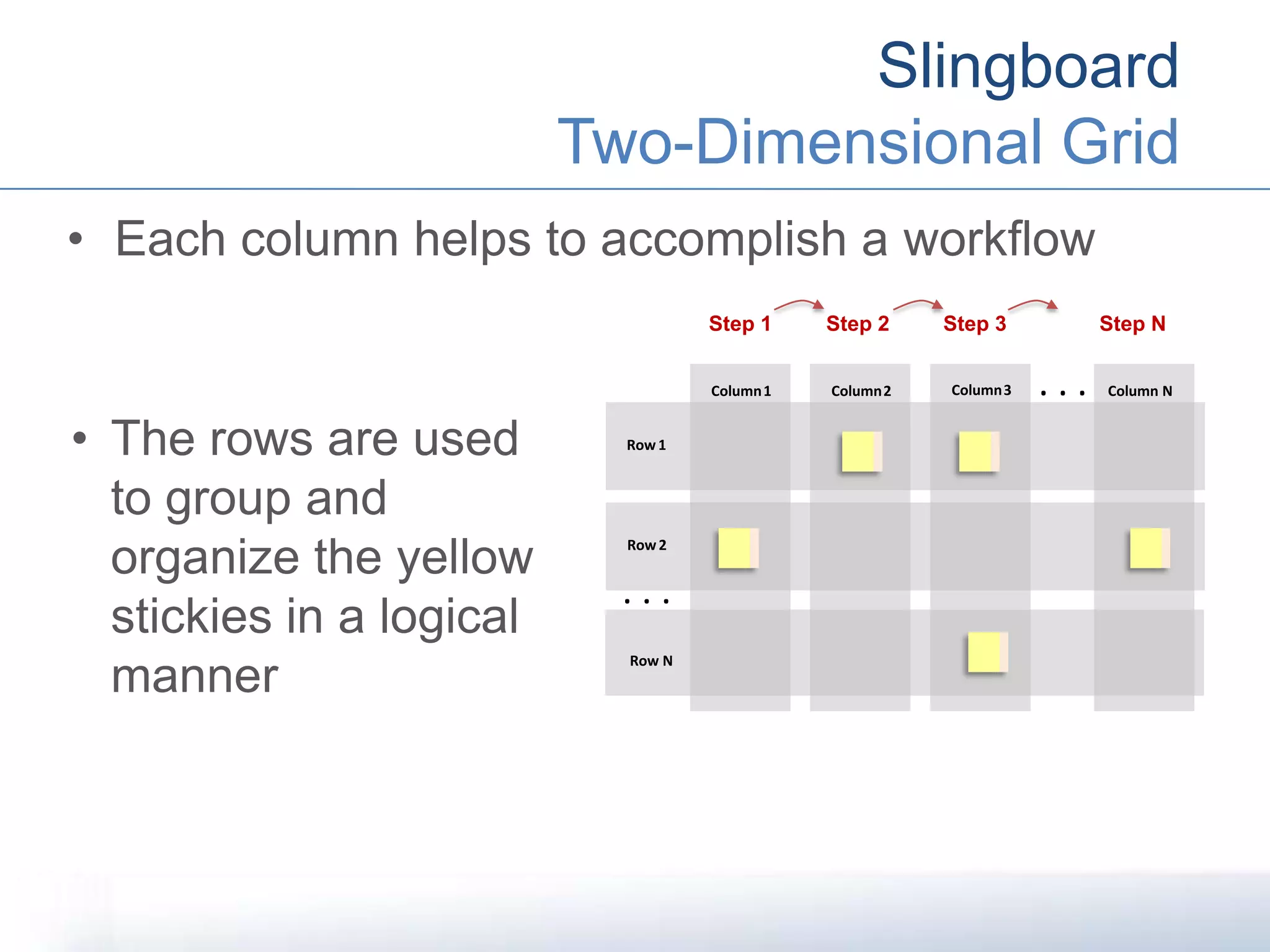
• Each column helps to accomplish a workflow
• The rows are used
to group and
organize the yellow
stickies in a logical
manner
Step 1 Step 2 Step 3 Step N
Column1 Column2 Column3 Column N
Row1
Row2
Row N
Slingboard
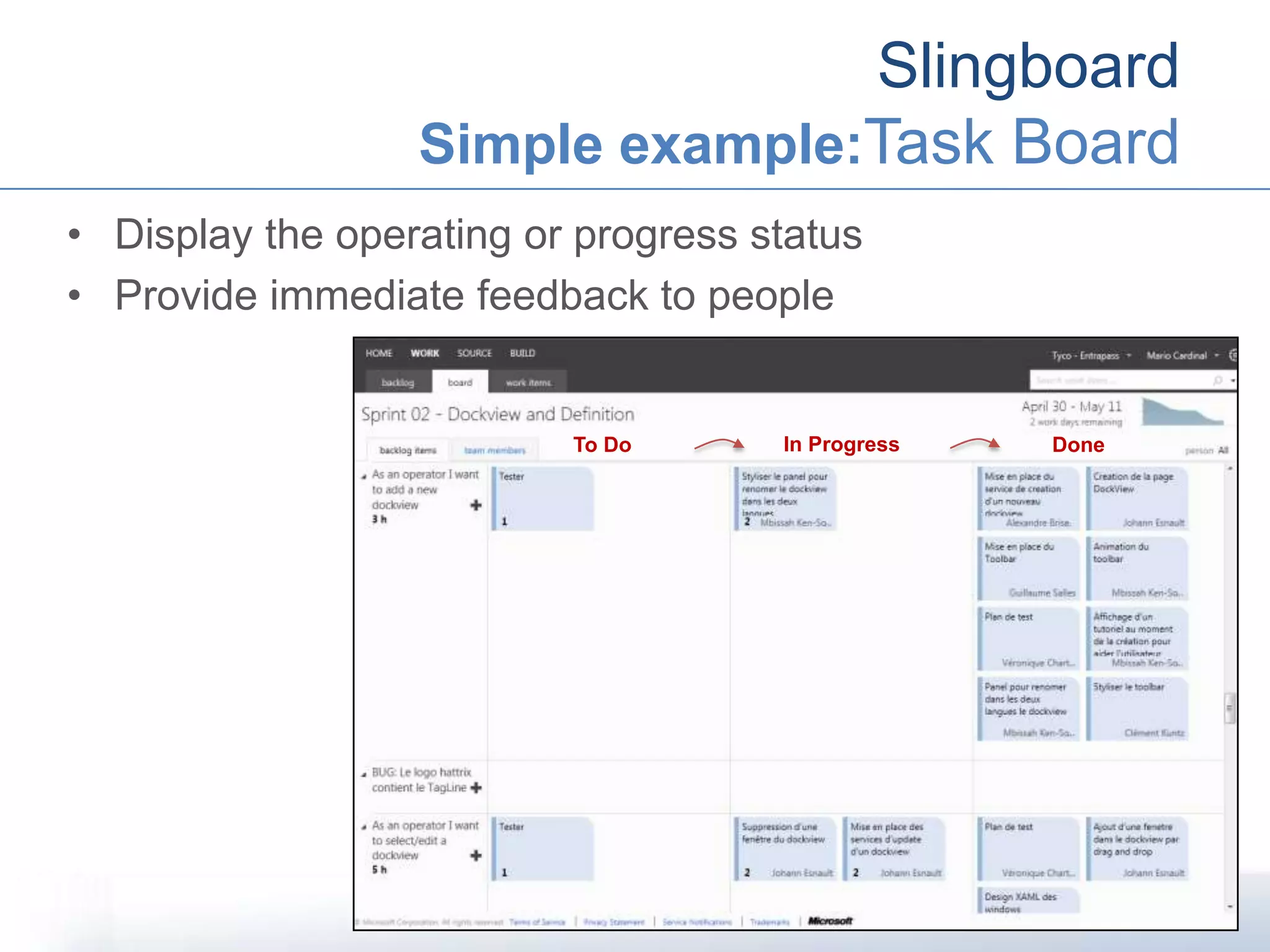
Simple example:Task Board
• Display the operating or progress status
• Provide immediate feedback to people
To Do In Progress Done
Slingboard
Why?
• Helps TEAMMATES who are dissatisfied with
outcomes from SHARED ACCOUNTABILITY
– Get better results for your team
– Get more commitment from your teammates
• Provides teams with VISUAL RULES to improve
COLLABORATION between TEAMMATES
– Get individual responsibility aligned with teamwork
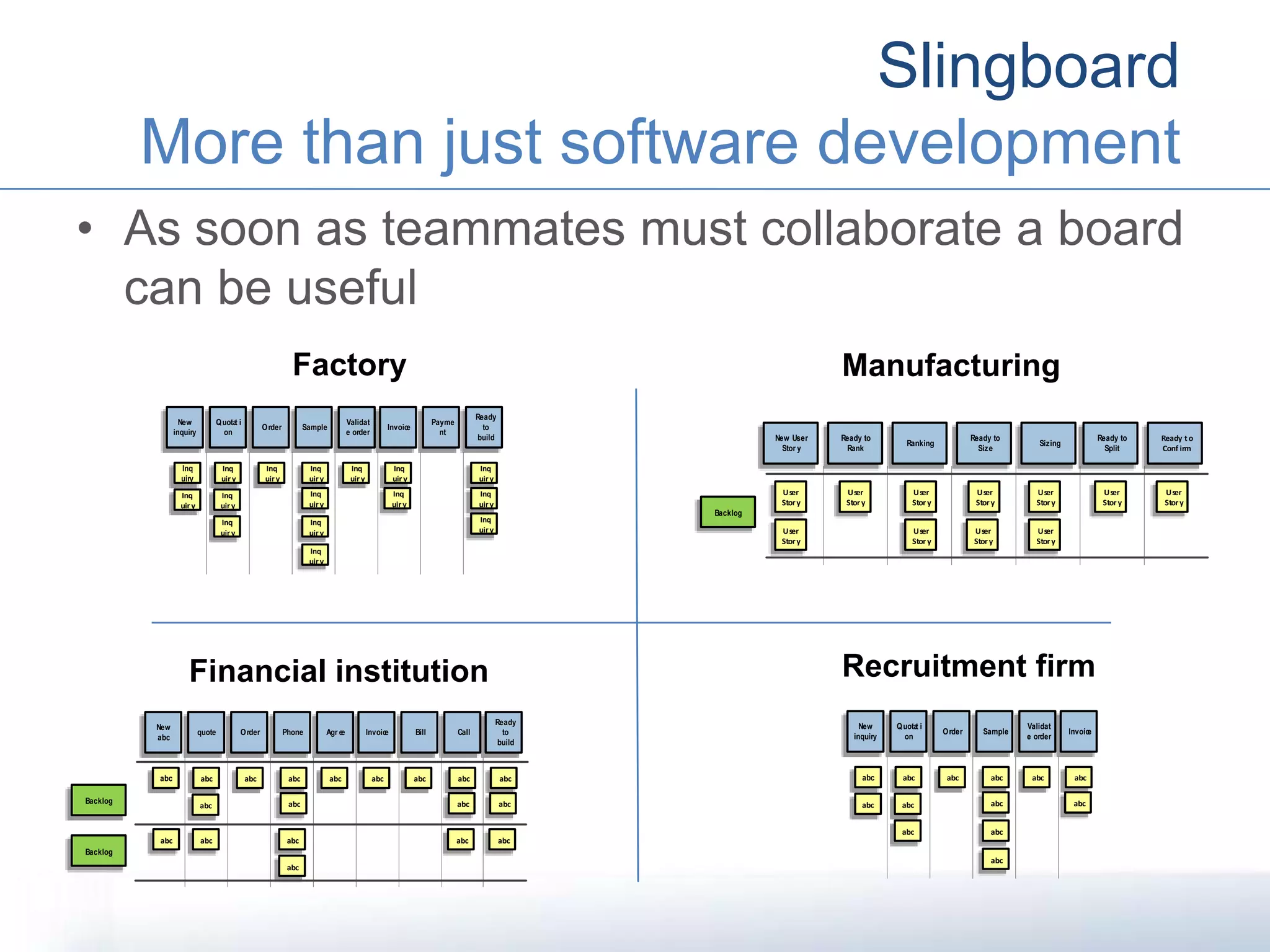
• As soon as teammates must collaborate a board
can be useful
Slingboard
More than just software development
Factory
Inq
uiry
Inq
uiry
New
inquiry
Quotat i
on
Order Sample
Validat
e order
Payme
nt
Ready
to
build
Invoice
Inq
uir y
Inq
uiry
Inq
uiry
Inq
uiry
Inq
uir y
Inq
uiry
Inq
uiry
Inq
uiry
Inq
uiry
Inq
uiry
Inq
uiry
Inq
uiry
Inq
uiry
Inq
uiry
Manufacturing
User
Story
User
Story
User
Story
User
Story
User
Story
User
Story
User
Story
Backlog
New User
Stor y
Ready to
Rank
Ranking
Ready to
Size
Sizing
Ready to
Conf irm
Ready to
Split
User
Story
User
Story
User
Story
User
Story
Financial institution
abc
abc
New
abc
quote Order Phone Agr ee Bill CallInvoice
abcabc
abc
abc abc abc
abc
abc
abc
abc
abc
abc
abc
abc
Ready
to
build
abc
abc
abcBacklog
Backlog
Recruitment firm
abc
abc
New
inquiry
Quotat i
on
Order Sample
Validat
e order
Invoice
abcabc
abc
abc
abc
abc
abc
abc
abc
abc abc
Slingboard
Visual Management
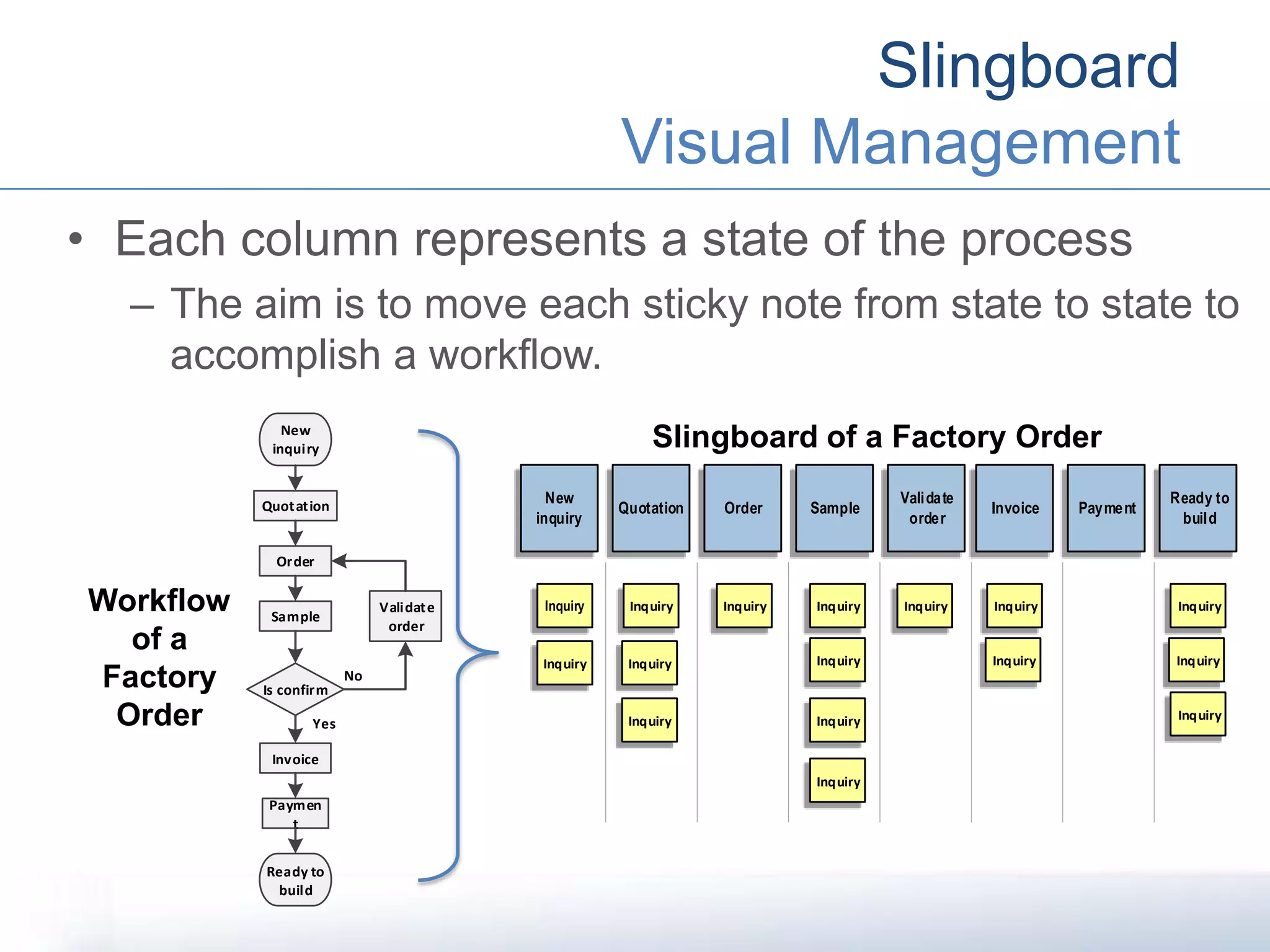
• Each column represents a state of the process
– The aim is to move each sticky note from state to state to
accomplish a workflow.
Inquiry
Inquiry
New
inquiry
Quotation Order Sample
Validate
order
Payment
Ready to
build
Invoice
InquiryInquiry
Inquiry
Inquiry
Inquiry
Inquiry
Inquiry
Inquiry
Inquiry
Inquiry
Inquiry
Inquiry
Inquiry
Inquiry
New
inquiry
Ready to
build
Quotation
Order
Sample
Validate
order
Is confirm
No
Yes
Invoice
Paymen
t
Workflow
of a
Factory
Order
Slingboard of a Factory Order
Slingboard
Visual Rules
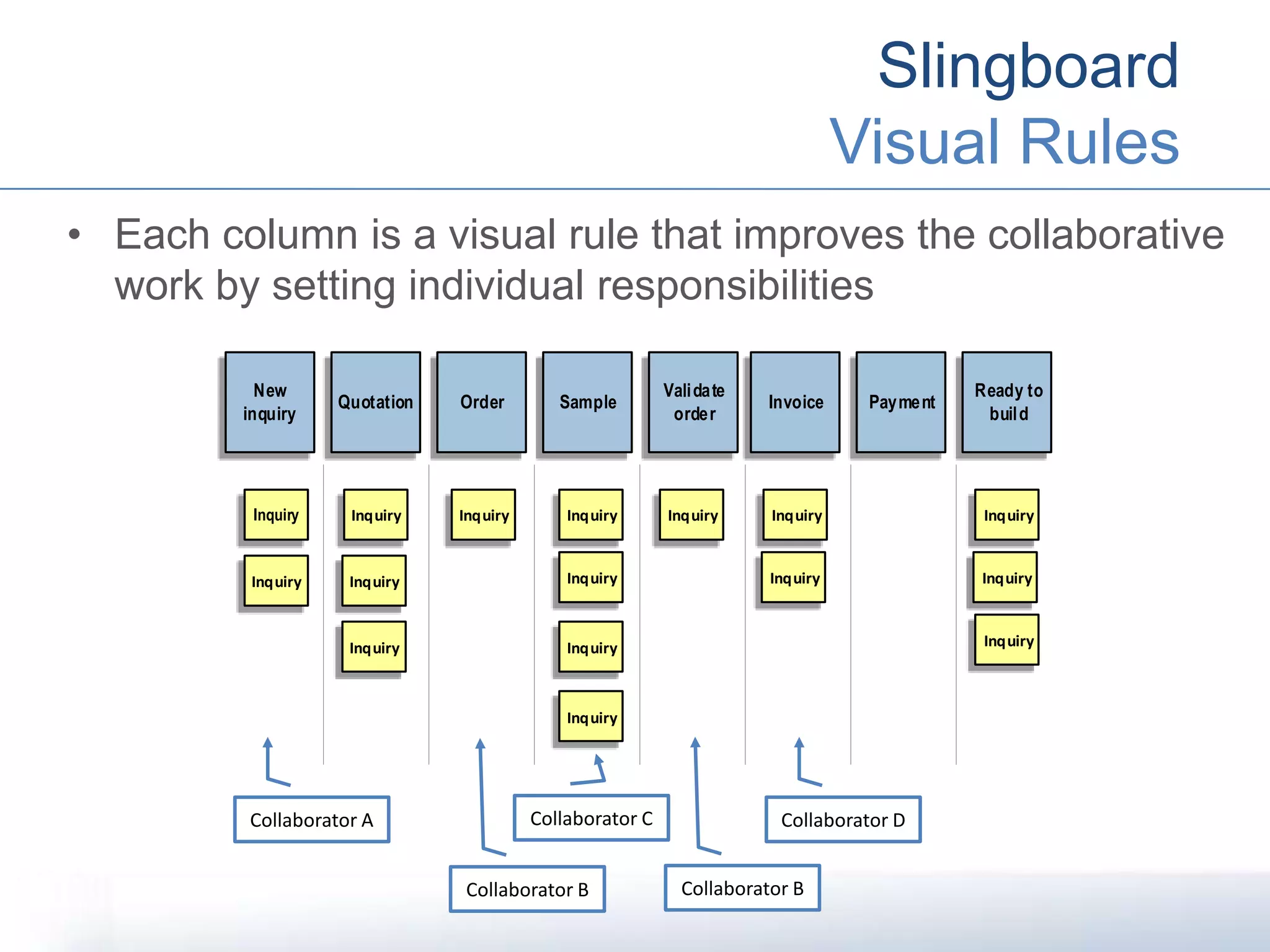
• Each column is a visual rule that improves the collaborative
work by setting individual responsibilities
Inquiry
Inquiry
New
inquiry
Quotation Order Sample
Validate
order
Payment
Ready to
build
Invoice
InquiryInquiry
Inquiry
Inquiry
Inquiry
Inquiry
Inquiry
Inquiry
Inquiry
Inquiry
Inquiry
Inquiry
Inquiry
Inquiry
Collaborator A
Collaborator B
Collaborator C
Collaborator B
Collaborator D
Slingboard
Pinning a Status Tag
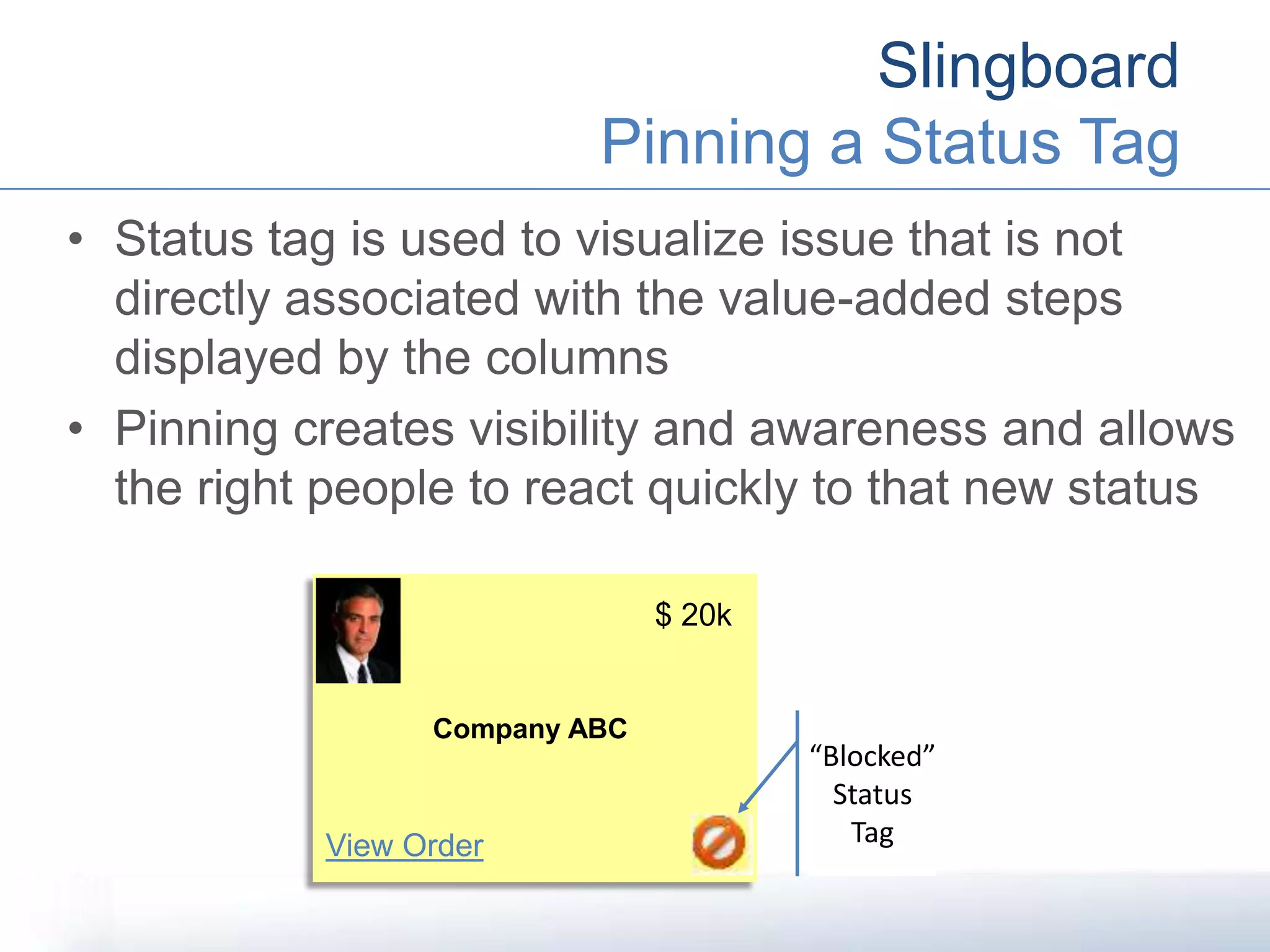
• Status tag is used to visualize issue that is not
directly associated with the value-added steps
displayed by the columns
• Pinning creates visibility and awareness and allows
the right people to react quickly to that new status
$ 20k
Company ABC
View Order
“Blocked”
Status
Tag
Agile Requirements Discovery
Section B
Backlog Grooming with Scrum
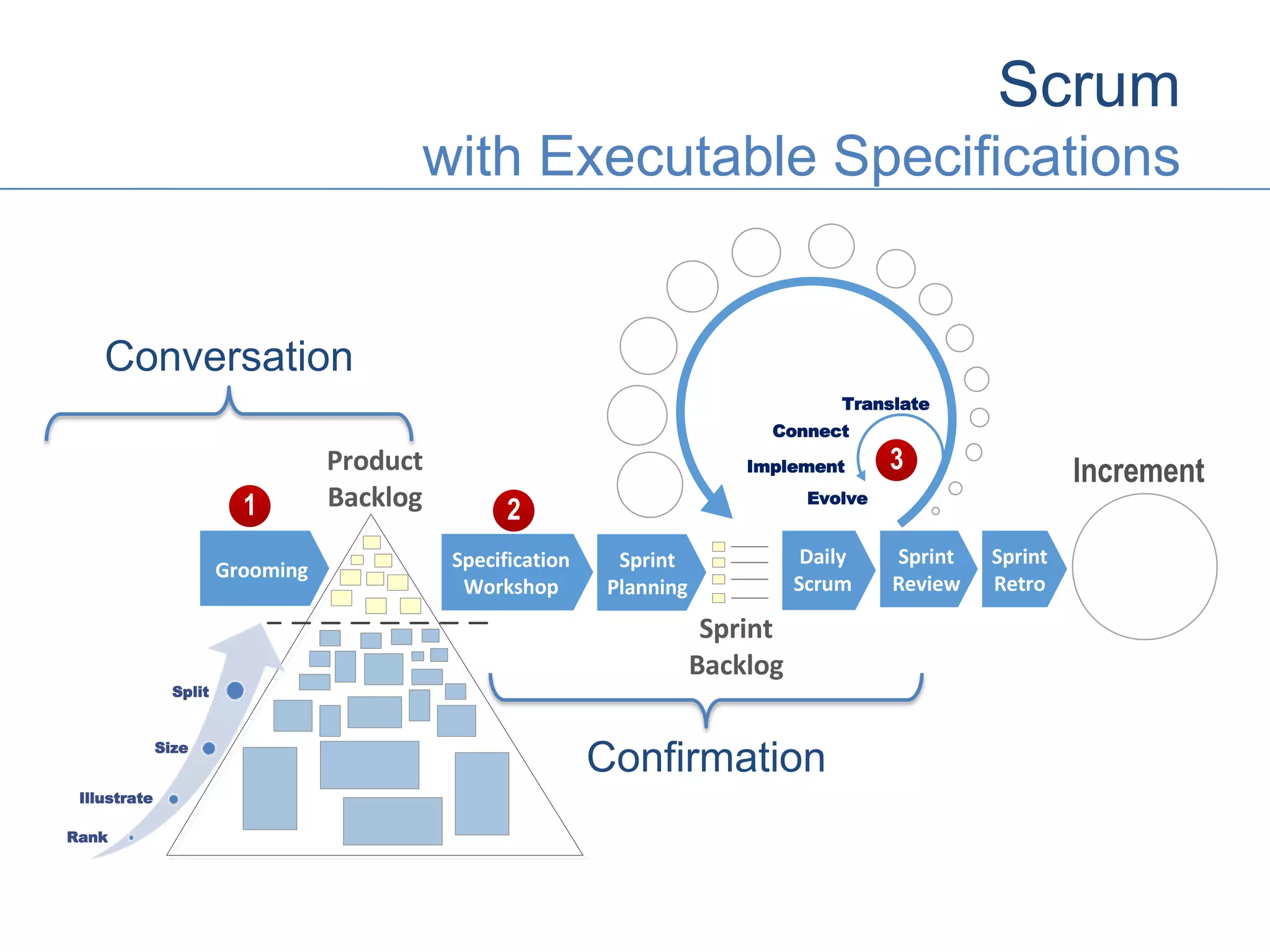
Scrum
Product
Backlog
Rank
Illustrate
Size
Split
Sprint
Planning
Increment
Grooming
Sprint
Backlog
Daily
Scrum
Sprint
Review
Sprint
Retro
Backlog Grooming with TFS 2012
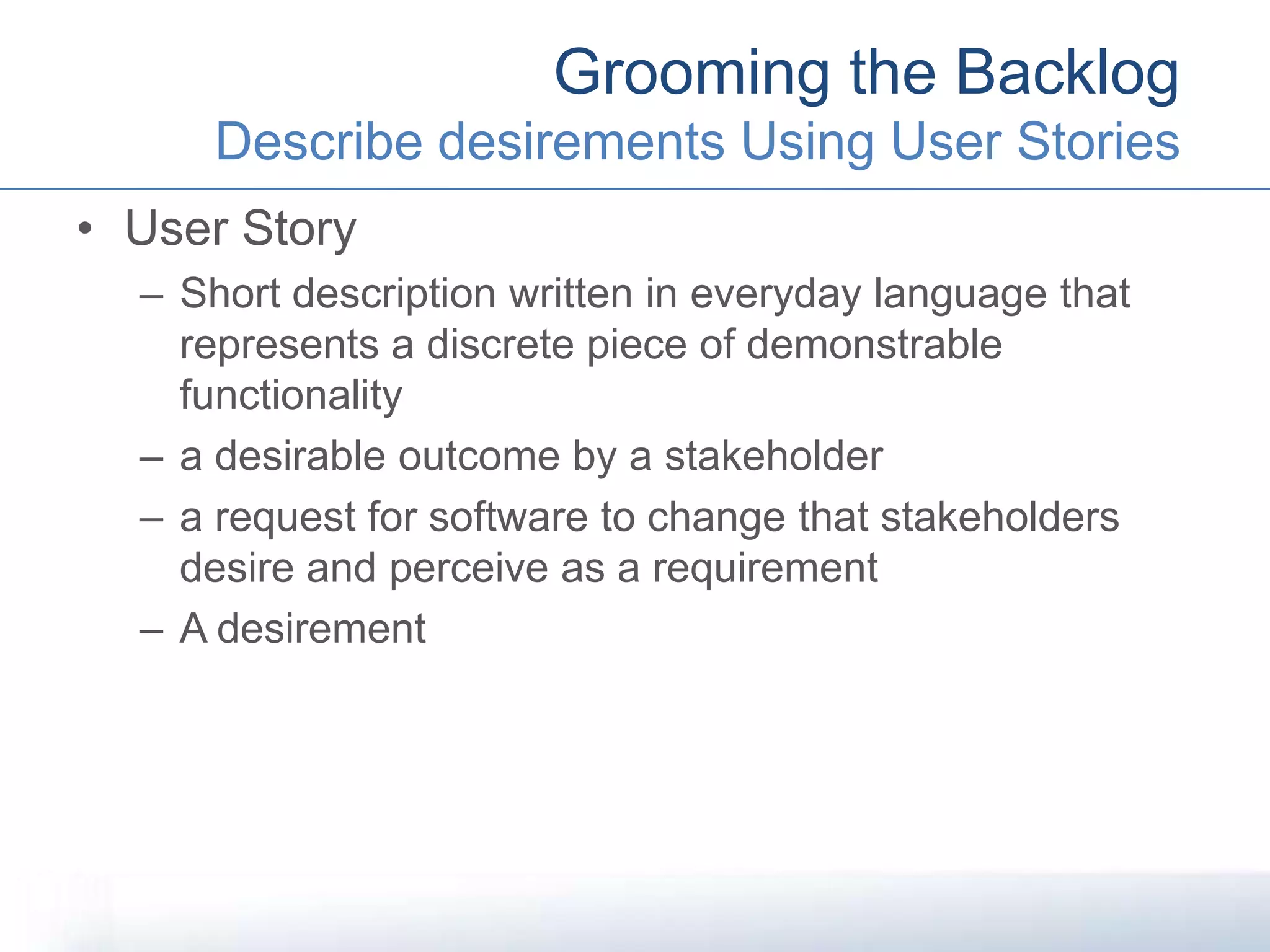
• User Story
– Short description written in everyday language that
represents a discrete piece of demonstrable
functionality
– a desirable outcome by a stakeholder
– a request for software to change that stakeholders
desire and perceive as a requirement
– A desirement
Grooming the Backlog
Describe desirements Using User Stories
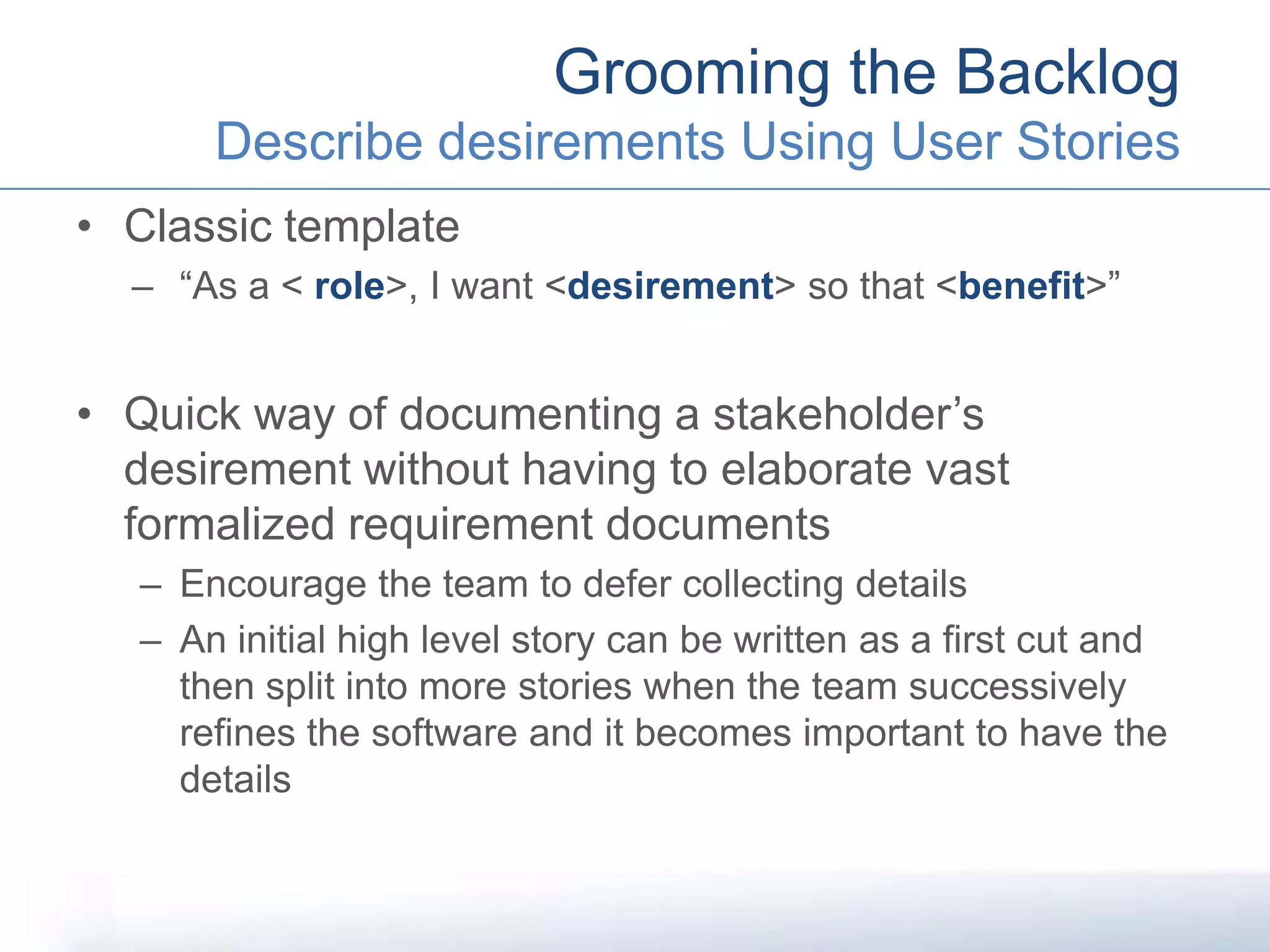
• Classic template
– “As a < role>, I want <desirement> so that <benefit>”
• Quick way of documenting a stakeholder’s
desirement without having to elaborate vast
formalized requirement documents
– Encourage the team to defer collecting details
– An initial high level story can be written as a first cut and
then split into more stories when the team successively
refines the software and it becomes important to have the
details
Grooming the Backlog
Describe desirements Using User Stories
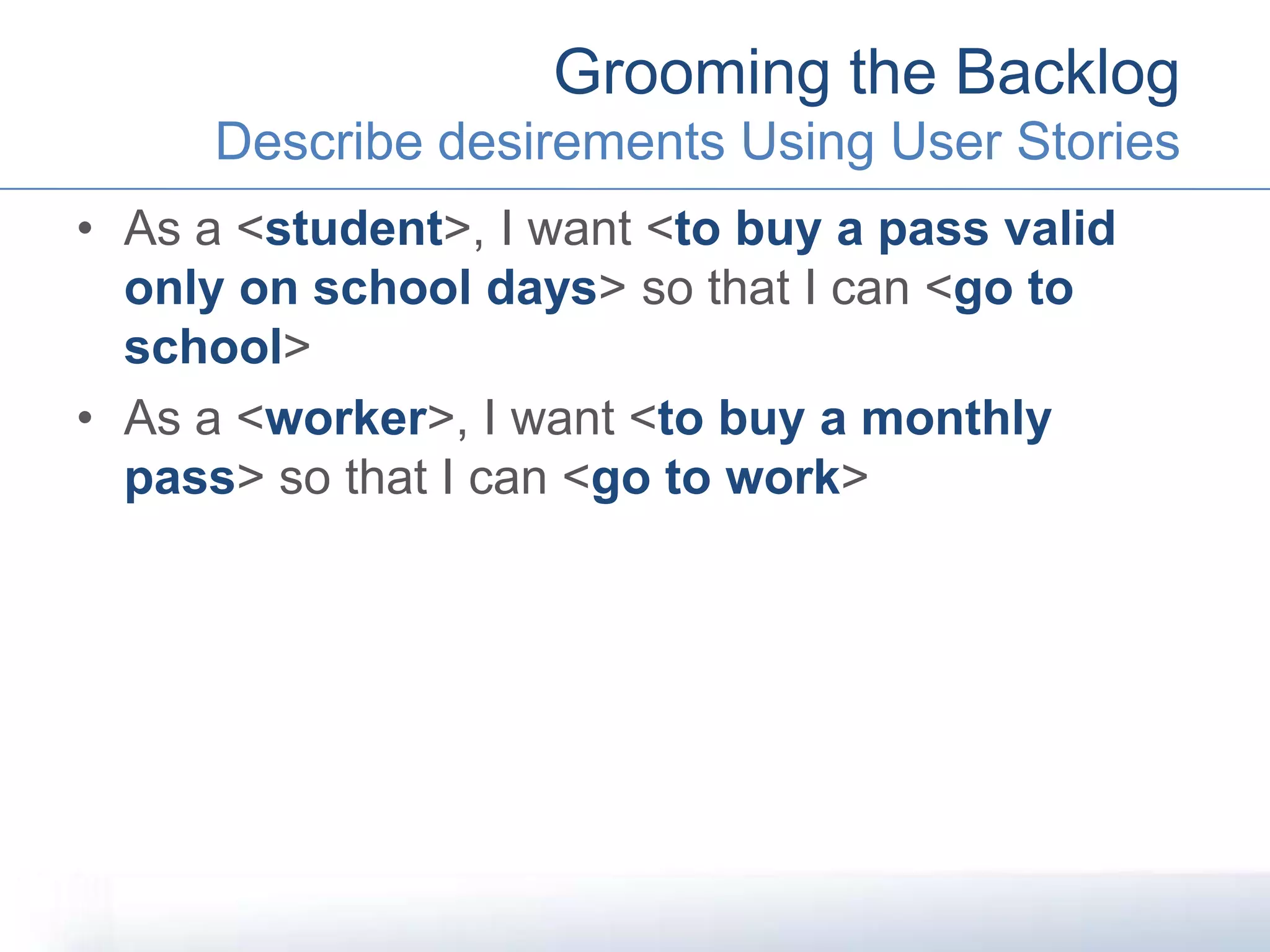
• As a <student>, I want <to buy a pass valid
only on school days> so that I can <go to
school>
• As a <worker>, I want <to buy a monthly
pass> so that I can <go to work>
Grooming the Backlog
Describe desirements Using User Stories
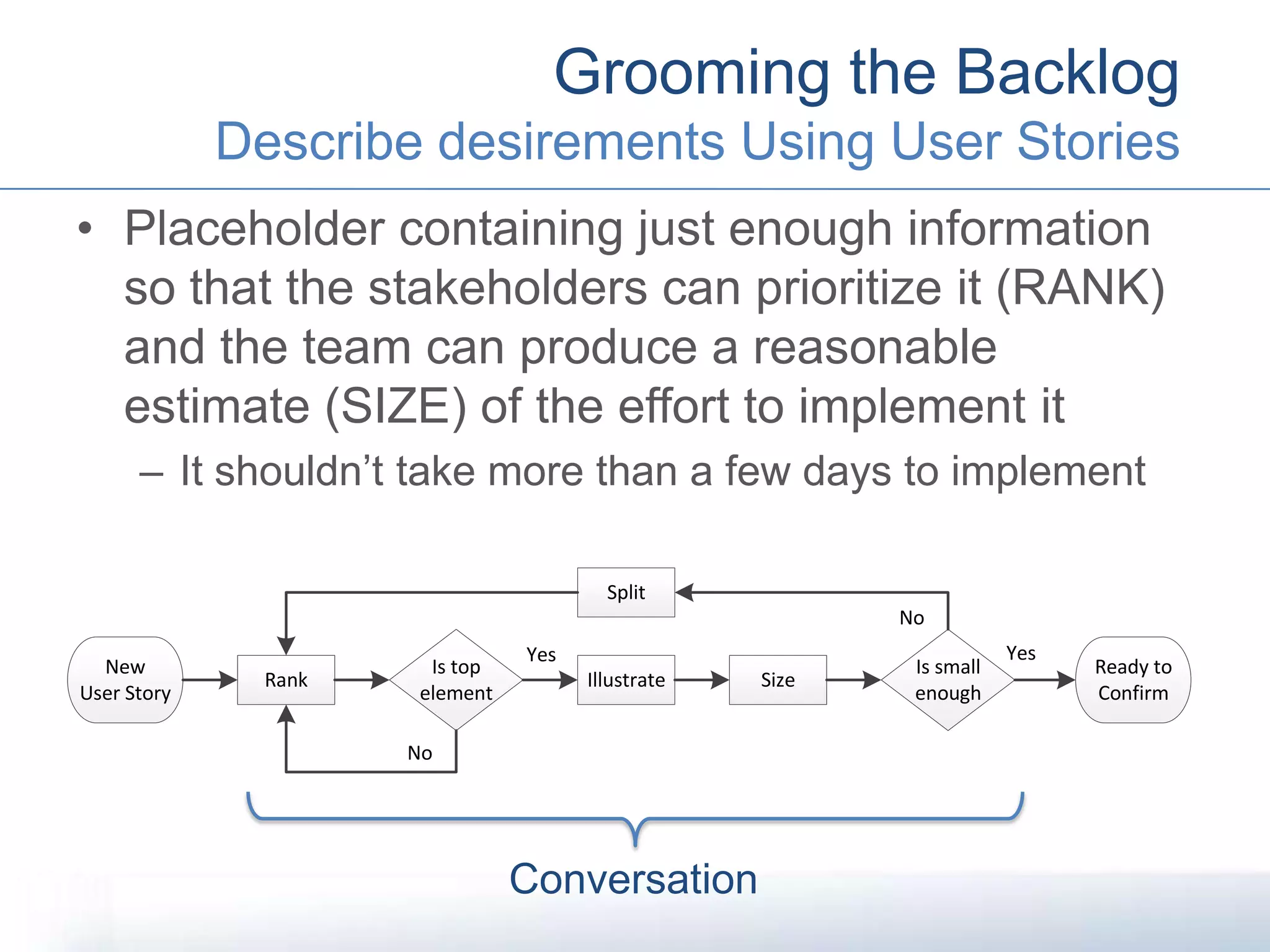
• Placeholder containing just enough information
so that the stakeholders can prioritize it (RANK)
and the team can produce a reasonable
estimate (SIZE) of the effort to implement it
– It shouldn’t take more than a few days to implement
Grooming the Backlog
Describe desirements Using User Stories
New
User Story
Ready to
Confirm
Rank Illustrate Size
Split
Is small
enough
No
Yes
Is top
element
Yes
No
Conversation
Scrum
with Executable Specifications
Connect
Translate
Implement
Evolve
Specification
Workshop
Sprint
Planning
Increment
Daily
Scrum
Sprint
Review
Sprint
Retro
Product
Backlog
Rank
Illustrate
Size
Split
1 2
3
Grooming
Sprint
Backlog
Confirmation
Conversation
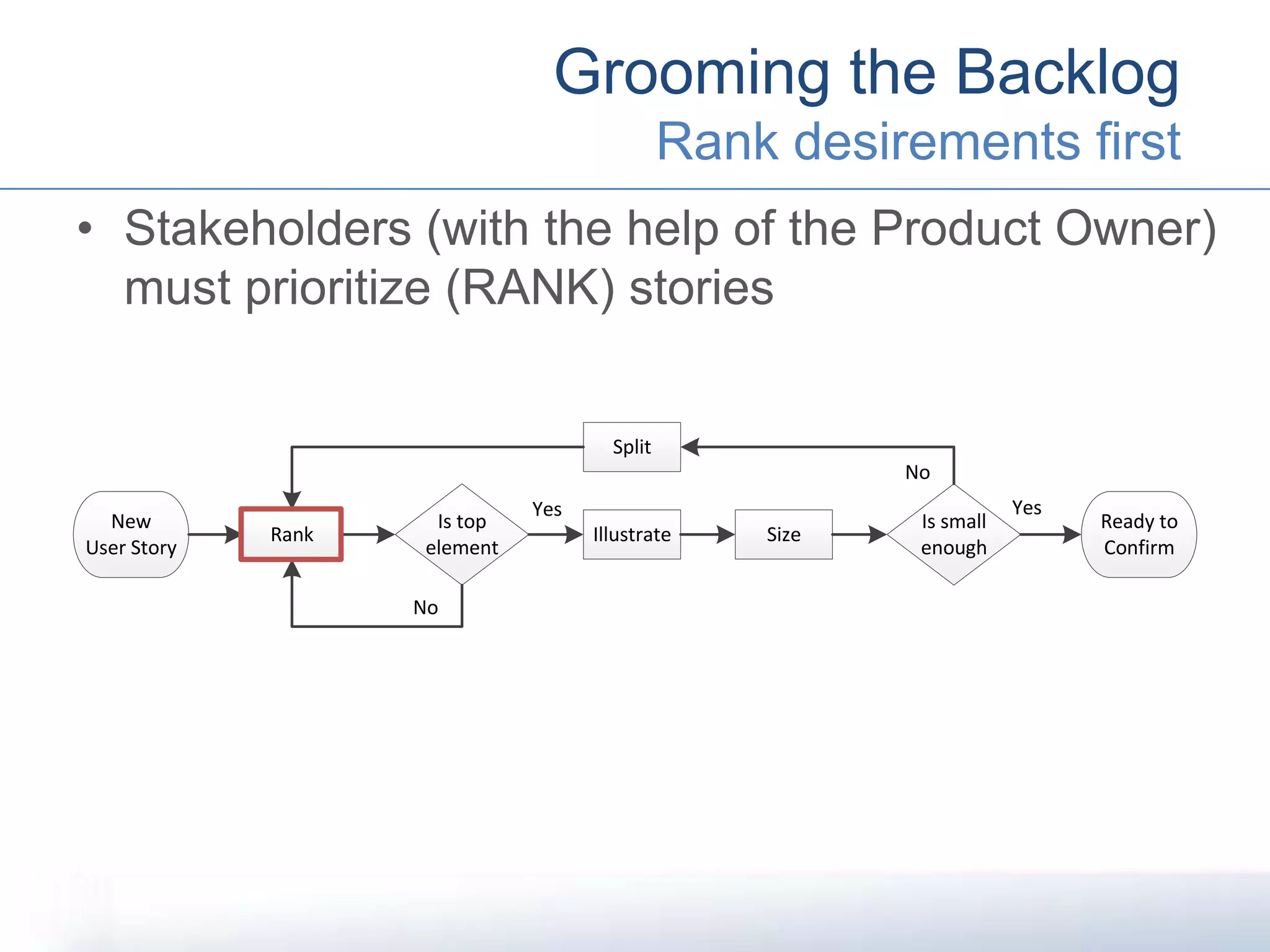
• Stakeholders (with the help of the Product Owner)
must prioritize (RANK) stories
Grooming the Backlog
Rank desirements first
New
User Story
Ready to
Confirm
Rank Illustrate Size
Split
Is small
enough
No
Yes
Is top
element
Yes
No
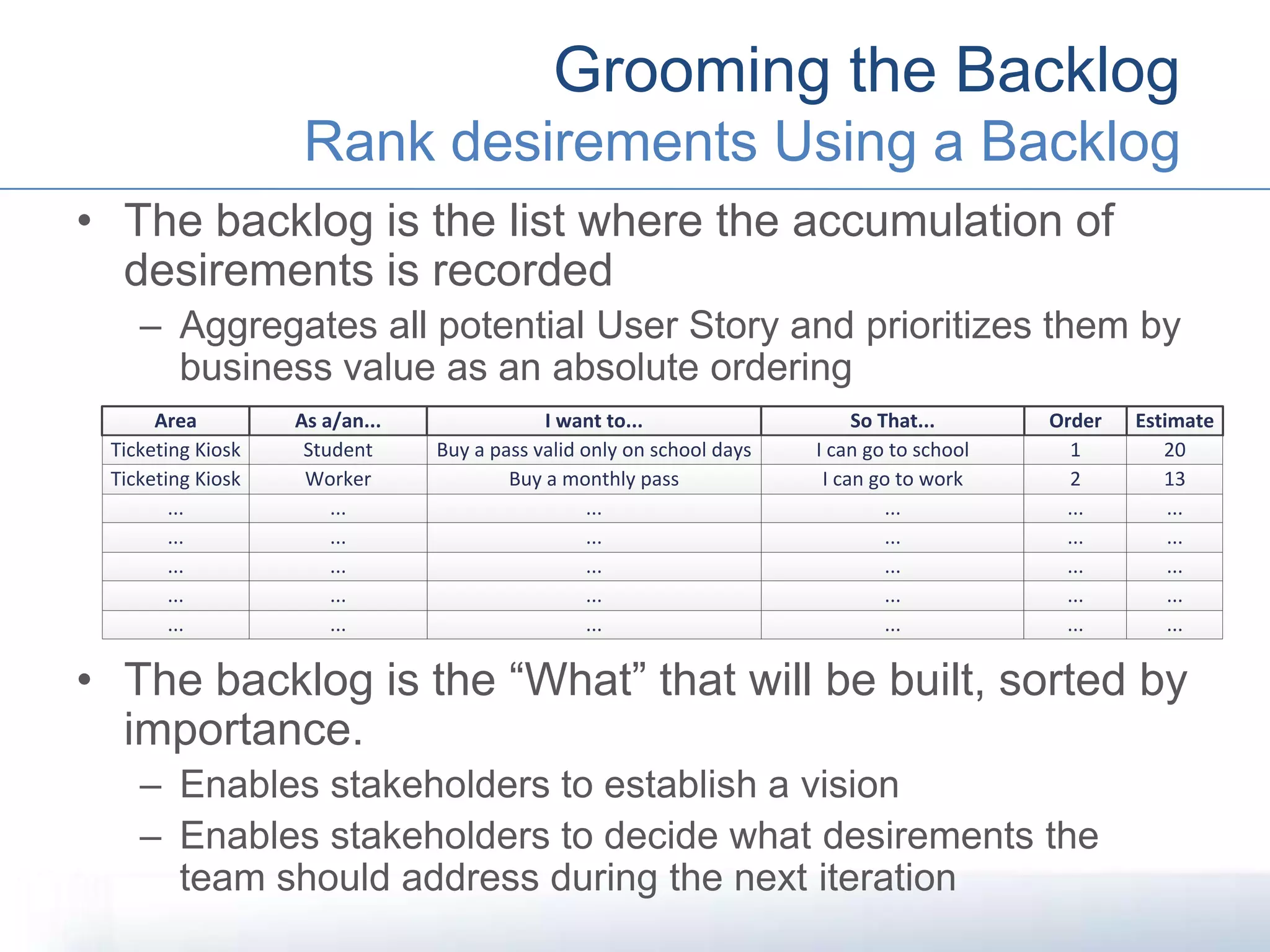
• The backlog is the list where the accumulation of
desirements is recorded
– Aggregates all potential User Story and prioritizes them by
business value as an absolute ordering
• The backlog is the “What” that will be built, sorted by
importance.
– Enables stakeholders to establish a vision
– Enables stakeholders to decide what desirements the
team should address during the next iteration
Grooming the Backlog
Rank desirements Using a Backlog
Area As a/an... I want to... So That... Order Estimate
Ticketing Kiosk Student Buy a pass valid only on school days I can go to school 1 20
Ticketing Kiosk Worker Buy a monthly pass I can go to work 2 13
... ... ... ... ... ...
... ... ... ... ... ...
... ... ... ... ... ...
... ... ... ... ... ...
... ... ... ... ... ...
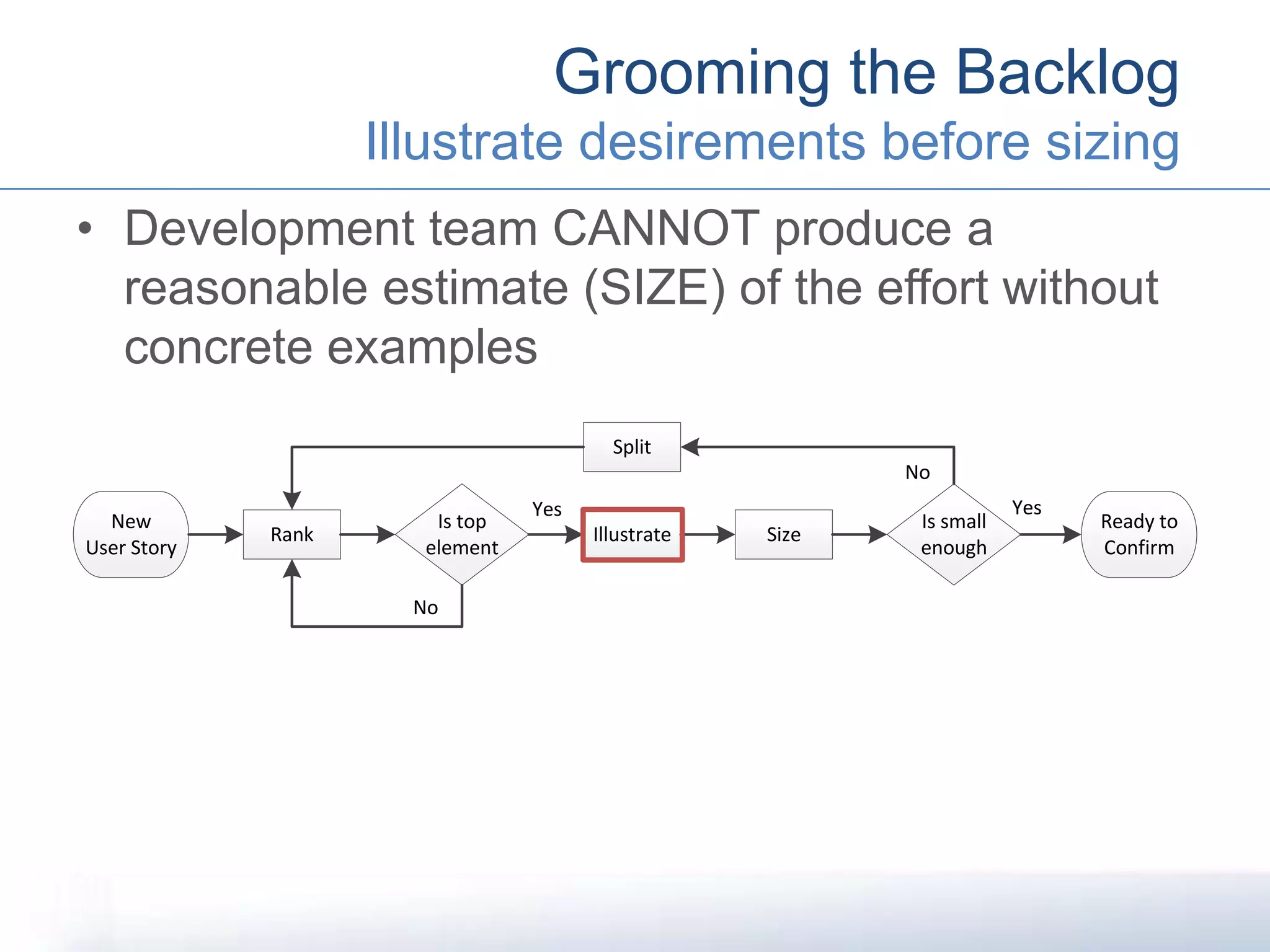
• Development team CANNOT produce a
reasonable estimate (SIZE) of the effort without
concrete examples
Grooming the Backlog
Illustrate desirements before sizing
New
User Story
Ready to
Confirm
Rank Illustrate Size
Split
Is small
enough
No
Yes
Is top
element
Yes
No
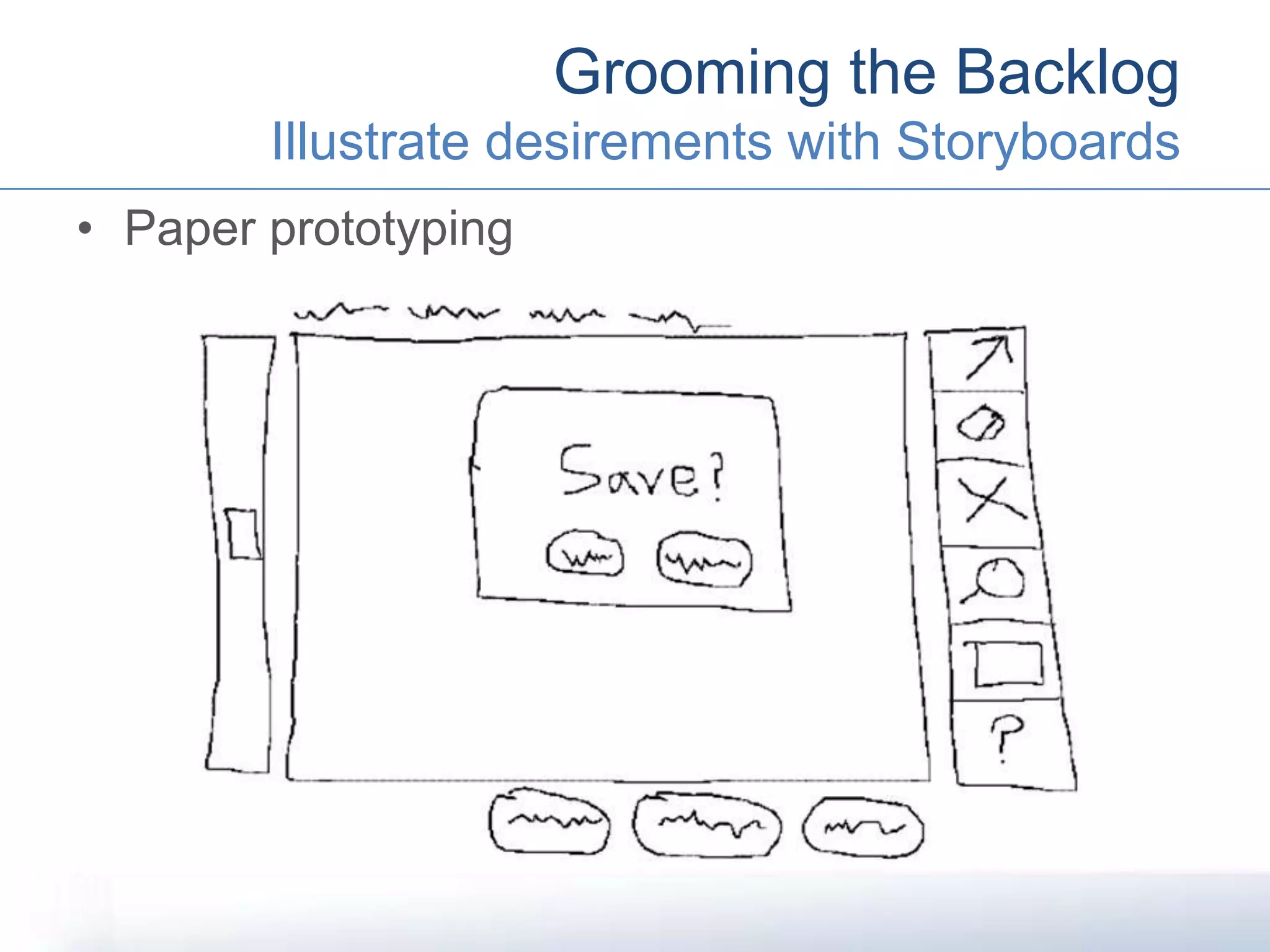
• Paper prototyping
Grooming the Backlog
Illustrate desirements with Storyboards
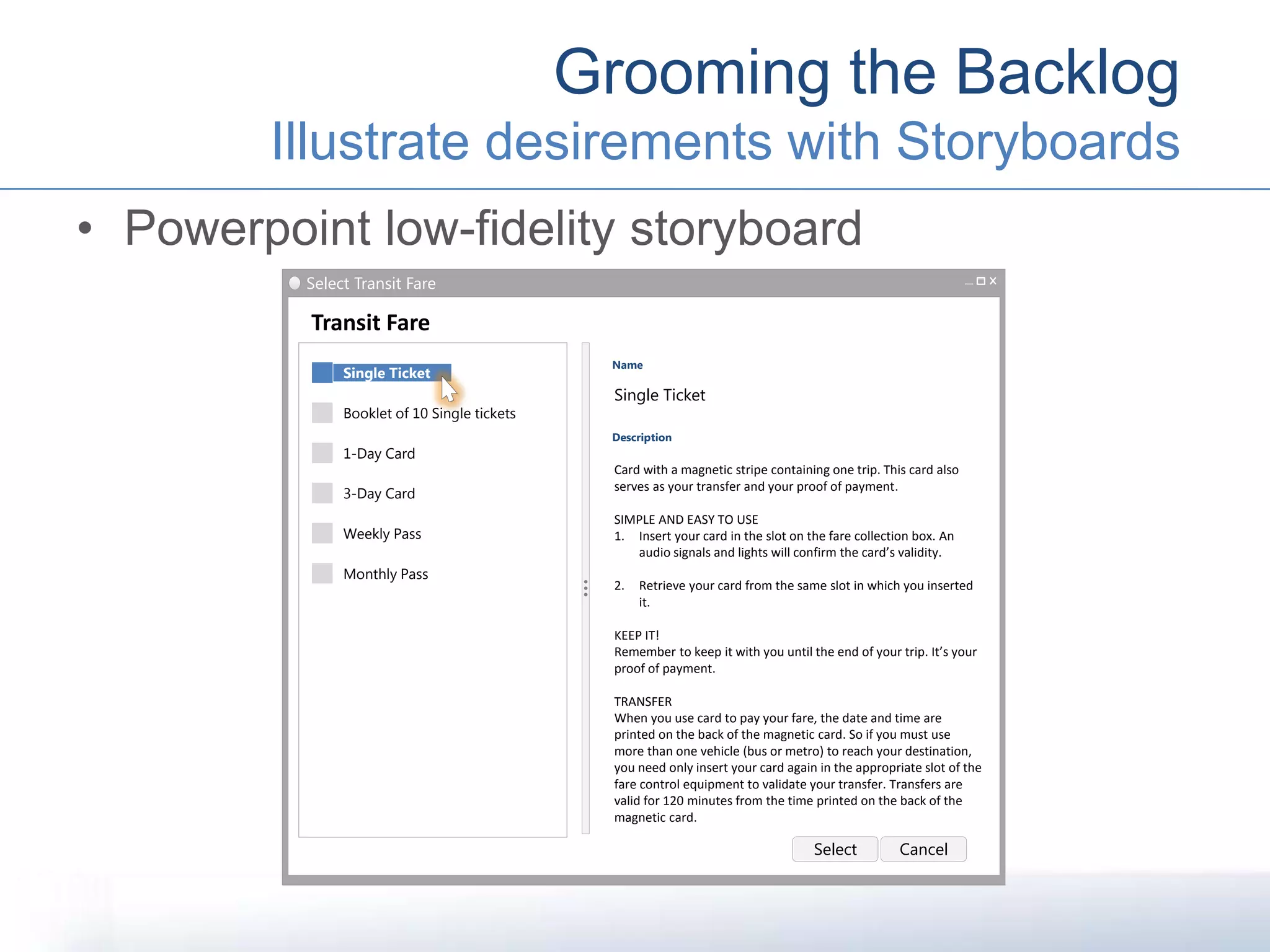
• Powerpoint low-fidelity storyboard
Grooming the Backlog
Illustrate desirements with Storyboards
Select Transit Fare
Transit Fare
Name
Single Ticket
Single Ticket
1-Day Card
Monthly Pass
3-Day Card
Weekly Pass
Description
Booklet of 10 Single tickets
Card with a magnetic stripe containing one trip. This card also
serves as your transfer and your proof of payment.
SIMPLE AND EASY TO USE
1. Insert your card in the slot on the fare collection box. An
audio signals and lights will confirm the card’s validity.
2. Retrieve your card from the same slot in which you inserted
it.
KEEP IT!
Remember to keep it with you until the end of your trip. It’s your
proof of payment.
TRANSFER
When you use card to pay your fare, the date and time are
printed on the back of the magnetic card. So if you must use
more than one vehicle (bus or metro) to reach your destination,
you need only insert your card again in the appropriate slot of the
fare control equipment to validate your transfer. Transfers are
valid for 120 minutes from the time printed on the back of the
magnetic card.
Select Cancel
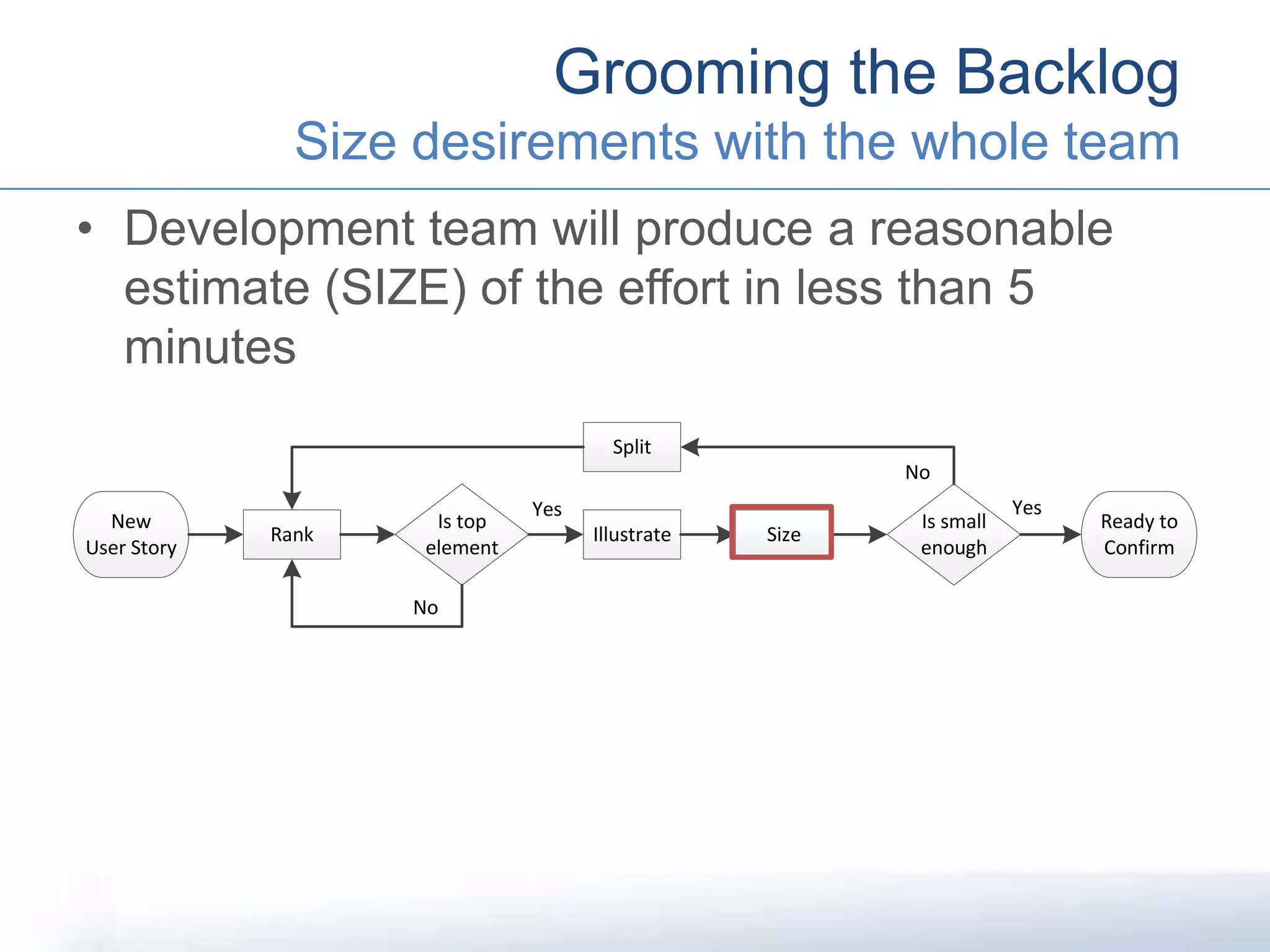
• Development team will produce a reasonable
estimate (SIZE) of the effort in less than 5
minutes
Grooming the Backlog
Size desirements with the whole team
New
User Story
Ready to
Confirm
Rank Illustrate Size
Split
Is small
enough
No
Yes
Is top
element
Yes
No
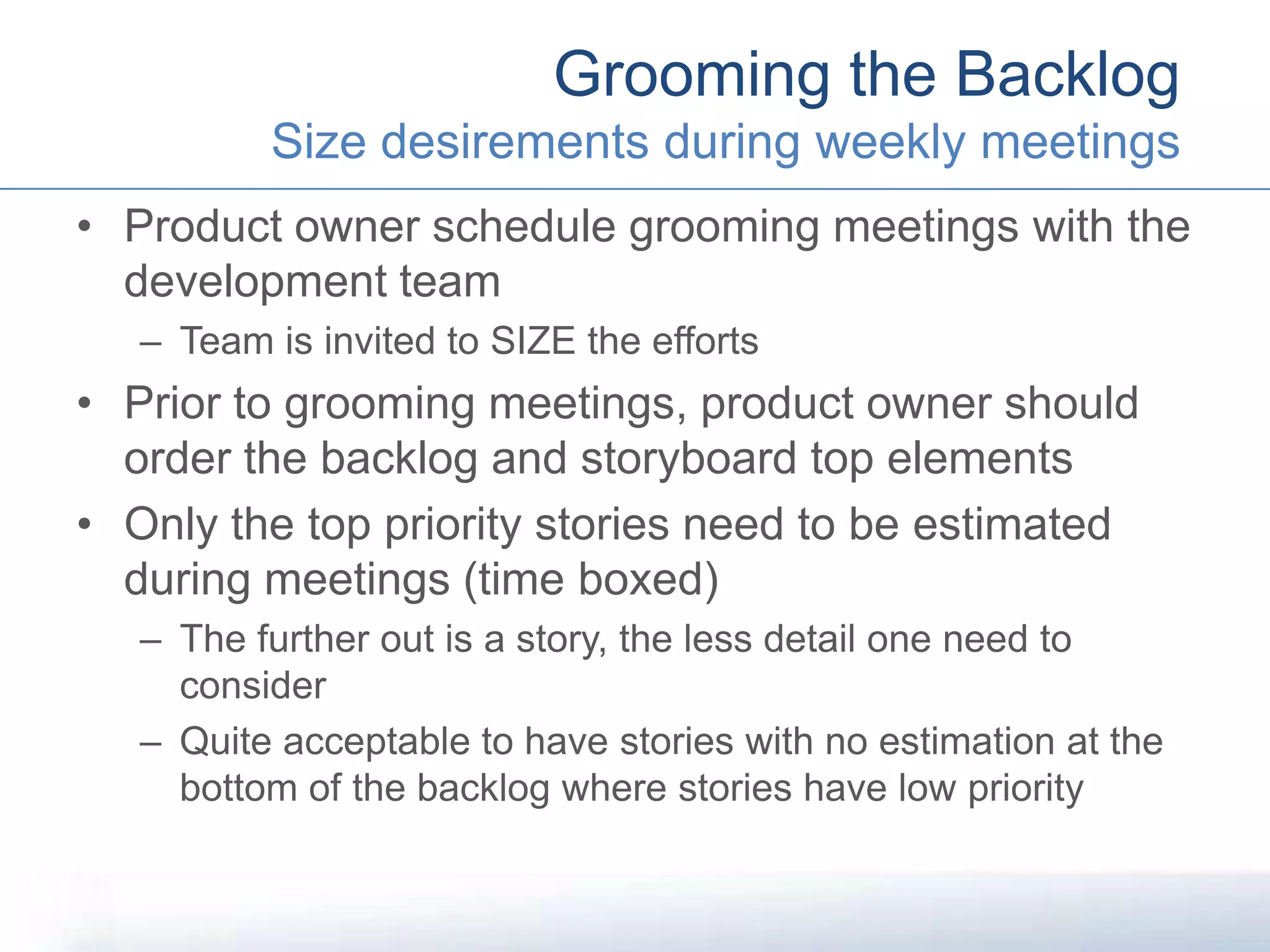
• Product owner schedule grooming meetings with the
development team
– Team is invited to SIZE the efforts
• Prior to grooming meetings, product owner should
order the backlog and storyboard top elements
• Only the top priority stories need to be estimated
during meetings (time boxed)
– The further out is a story, the less detail one need to
consider
– Quite acceptable to have stories with no estimation at the
bottom of the backlog where stories have low priority
Grooming the Backlog
Size desirements during weekly meetings
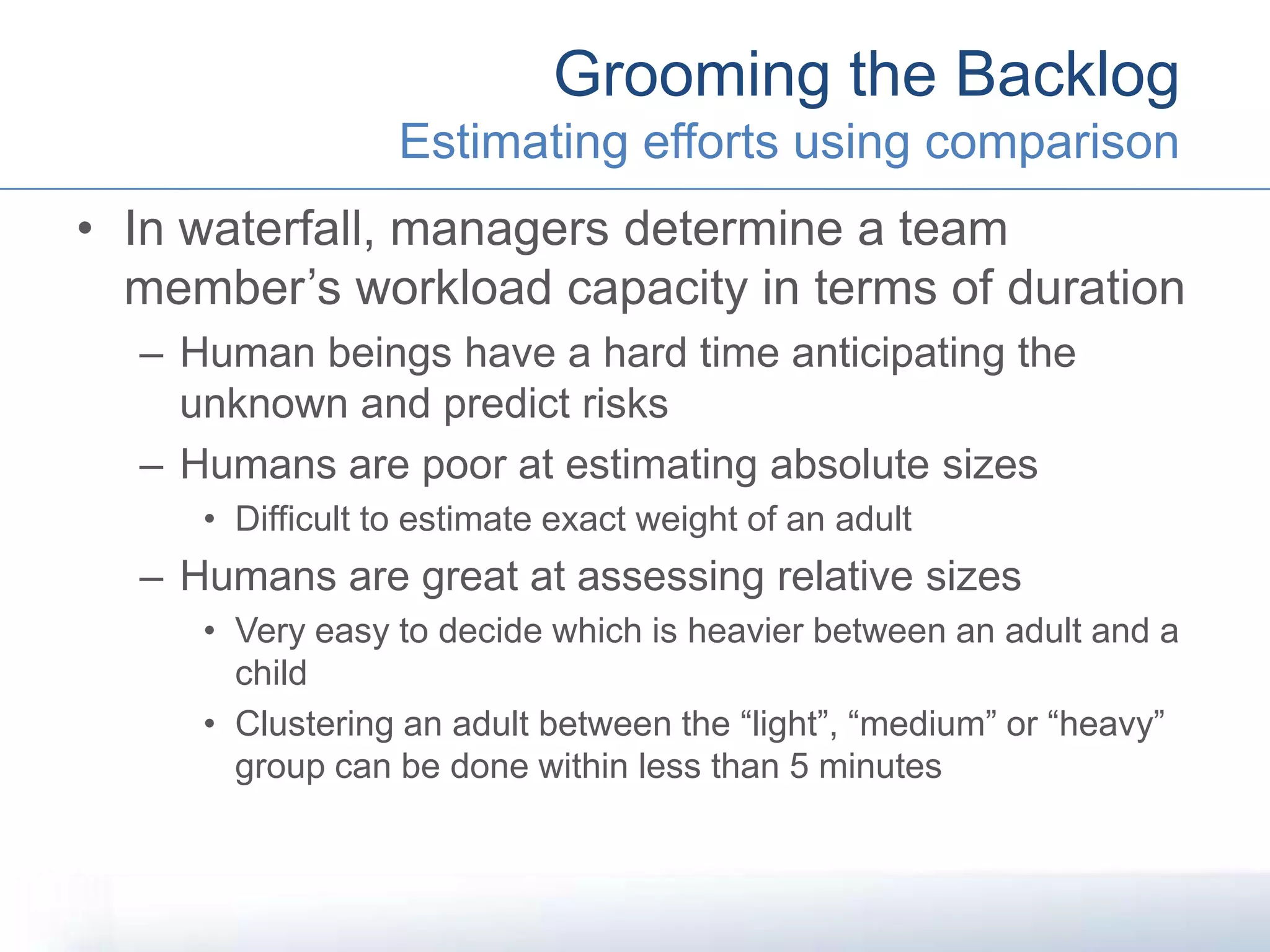
• In waterfall, managers determine a team
member’s workload capacity in terms of duration
– Human beings have a hard time anticipating the
unknown and predict risks
– Humans are poor at estimating absolute sizes
• Difficult to estimate exact weight of an adult
– Humans are great at assessing relative sizes
• Very easy to decide which is heavier between an adult and a
child
• Clustering an adult between the “light”, “medium” or “heavy”
group can be done within less than 5 minutes
Grooming the Backlog
Estimating efforts using comparison
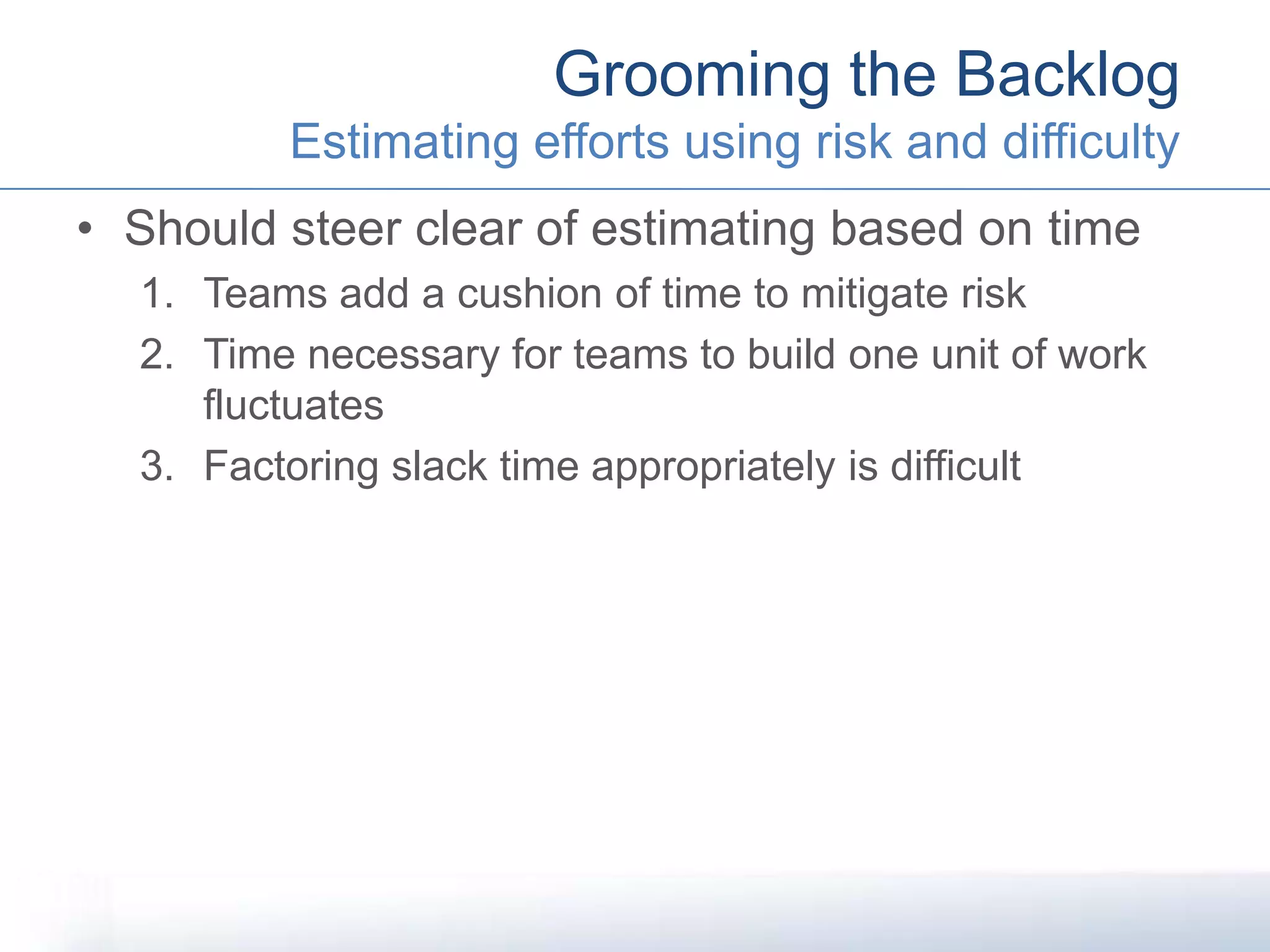
• Should steer clear of estimating based on time
1. Teams add a cushion of time to mitigate risk
2. Time necessary for teams to build one unit of work
fluctuates
3. Factoring slack time appropriately is difficult
Grooming the Backlog
Estimating efforts using risk and difficulty
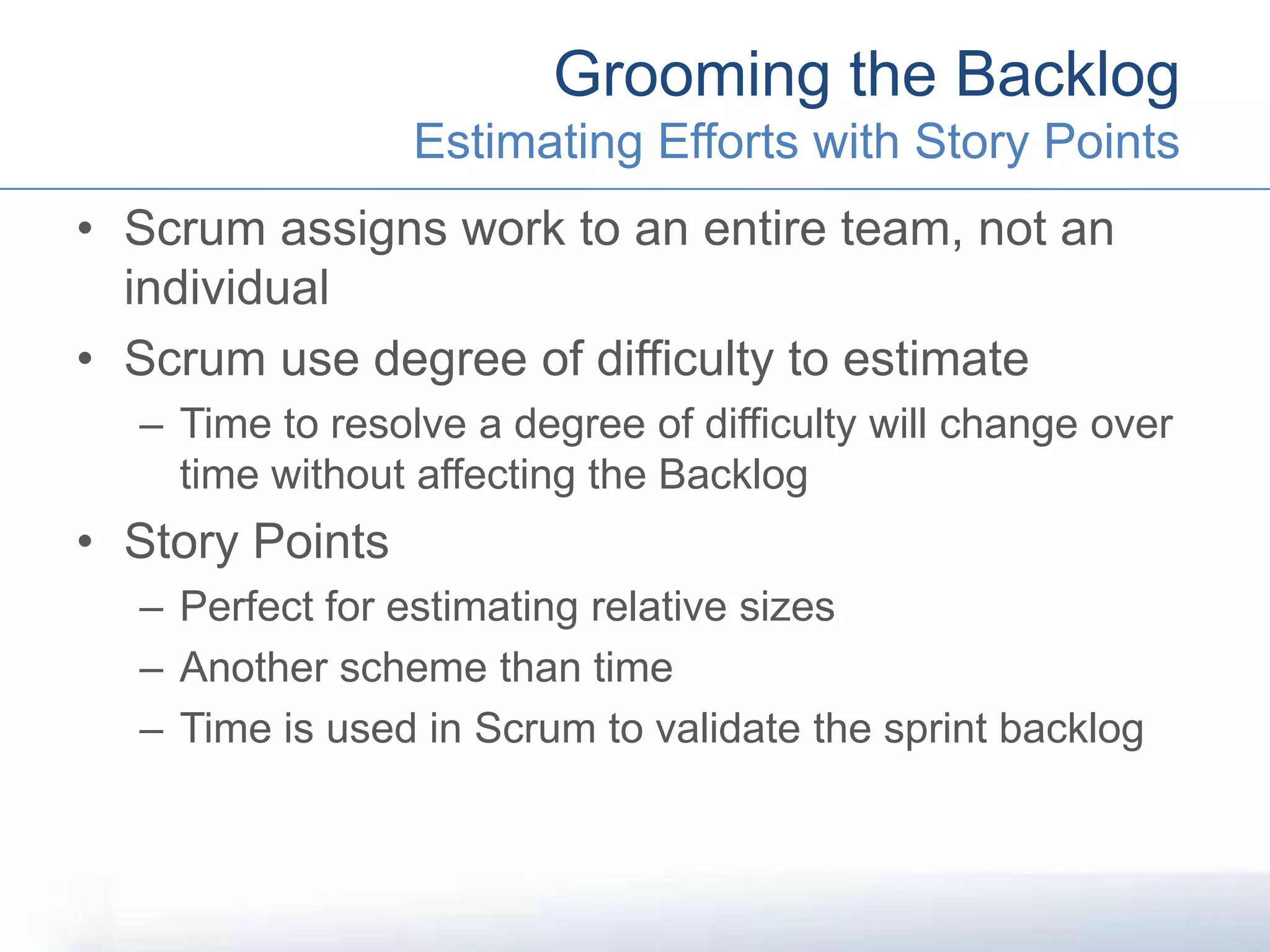
• Scrum assigns work to an entire team, not an
individual
• Scrum use degree of difficulty to estimate
– Time to resolve a degree of difficulty will change over
time without affecting the Backlog
• Story Points
– Perfect for estimating relative sizes
– Another scheme than time
– Time is used in Scrum to validate the sprint backlog
Grooming the Backlog
Estimating Efforts with Story Points
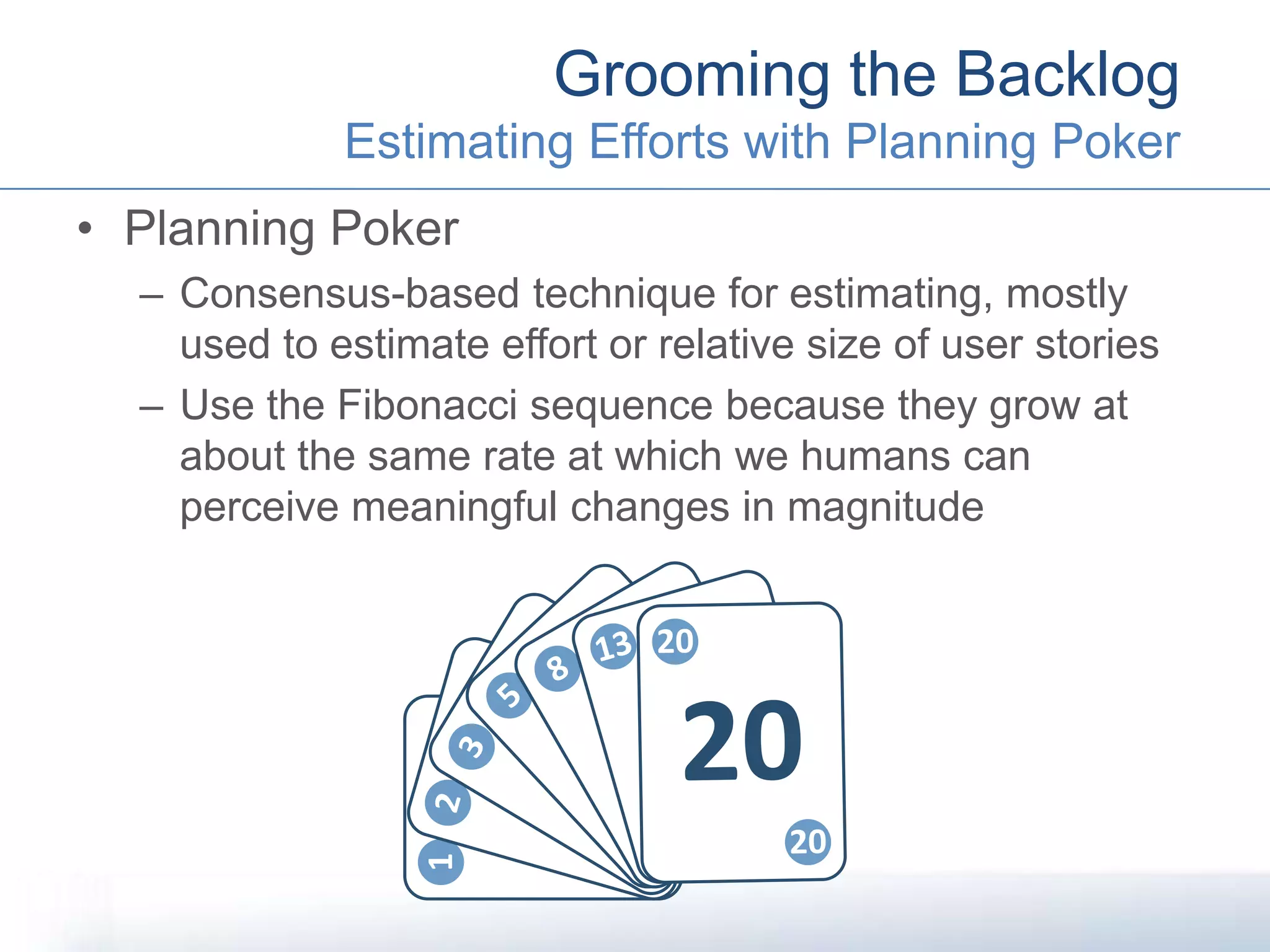
• Planning Poker
– Consensus-based technique for estimating, mostly
used to estimate effort or relative size of user stories
– Use the Fibonacci sequence because they grow at
about the same rate at which we humans can
perceive meaningful changes in magnitude
Grooming the Backlog
Estimating Efforts with Planning Poker
1
1
1
2
2
2
3
3
35
5 5
8
8 8
13
1313
20
20
20
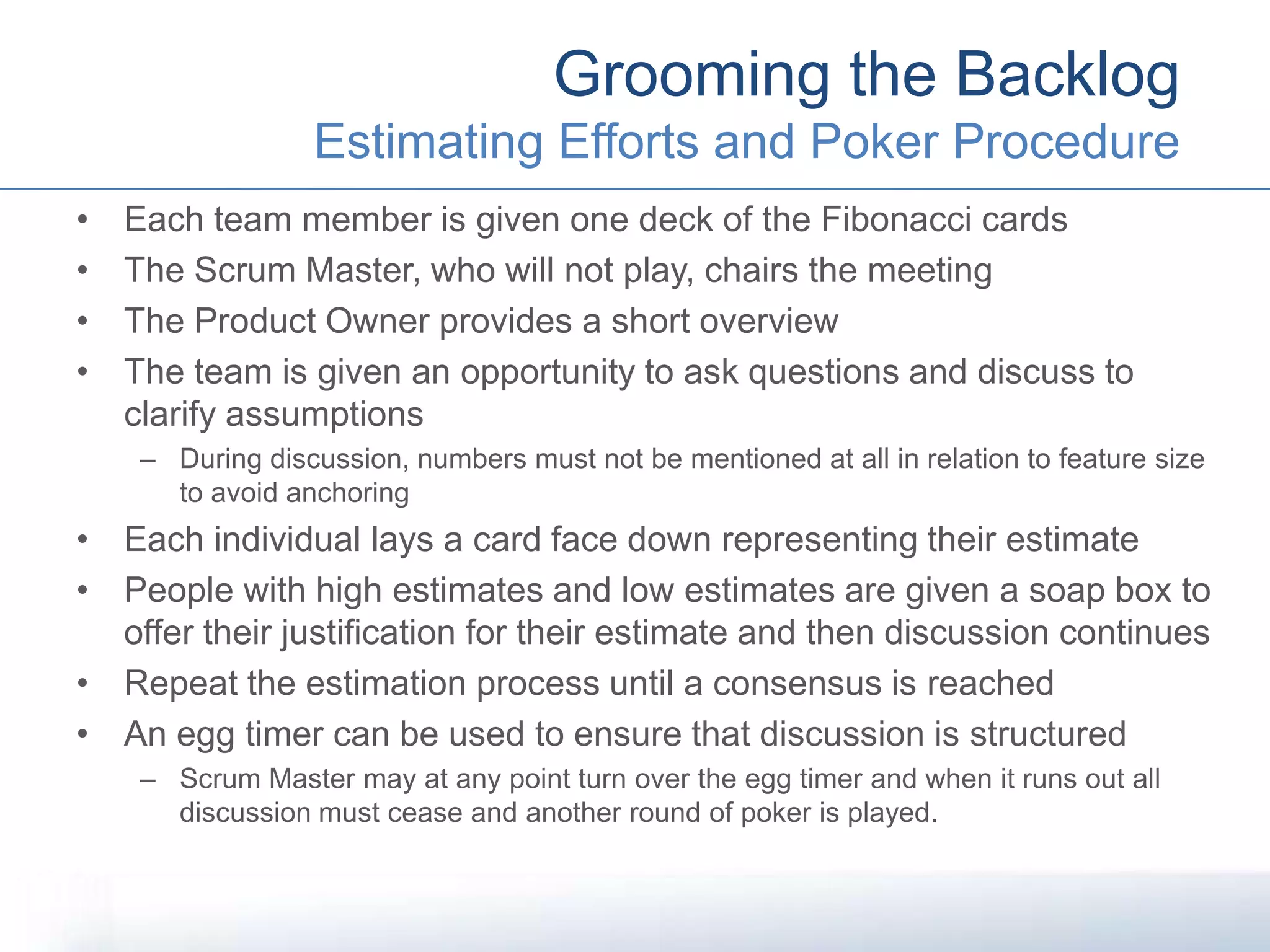
• Each team member is given one deck of the Fibonacci cards
• The Scrum Master, who will not play, chairs the meeting
• The Product Owner provides a short overview
• The team is given an opportunity to ask questions and discuss to
clarify assumptions
– During discussion, numbers must not be mentioned at all in relation to feature size
to avoid anchoring
• Each individual lays a card face down representing their estimate
• People with high estimates and low estimates are given a soap box to
offer their justification for their estimate and then discussion continues
• Repeat the estimation process until a consensus is reached
• An egg timer can be used to ensure that discussion is structured
– Scrum Master may at any point turn over the egg timer and when it runs out all
discussion must cease and another round of poker is played.
Grooming the Backlog
Estimating Efforts and Poker Procedure
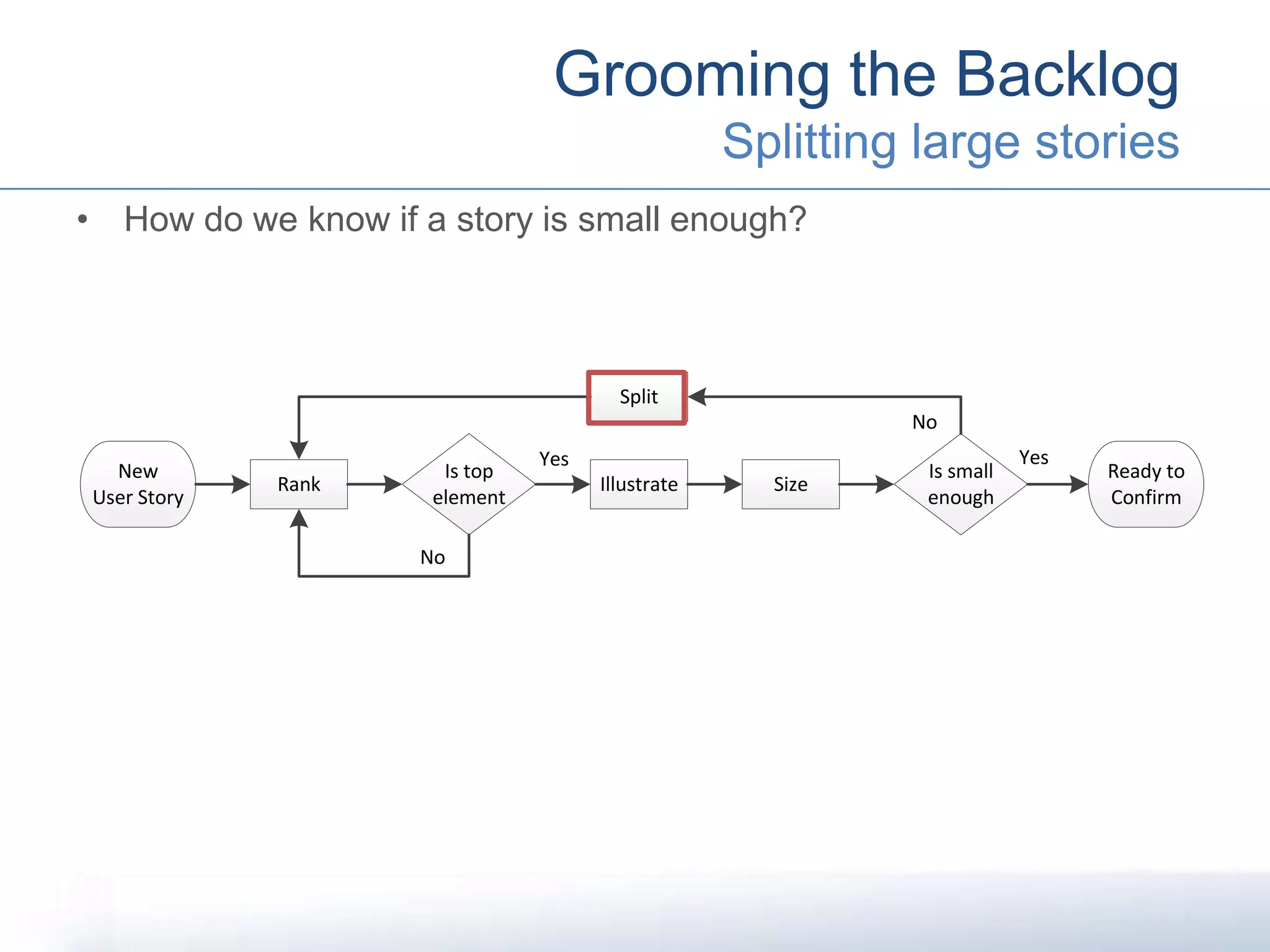
• How do we know if a story is small enough?
Grooming the Backlog
Splitting large stories
New
User Story
Ready to
Confirm
Rank Illustrate Size
Split
Is small
enough
No
Yes
Is top
element
Yes
No
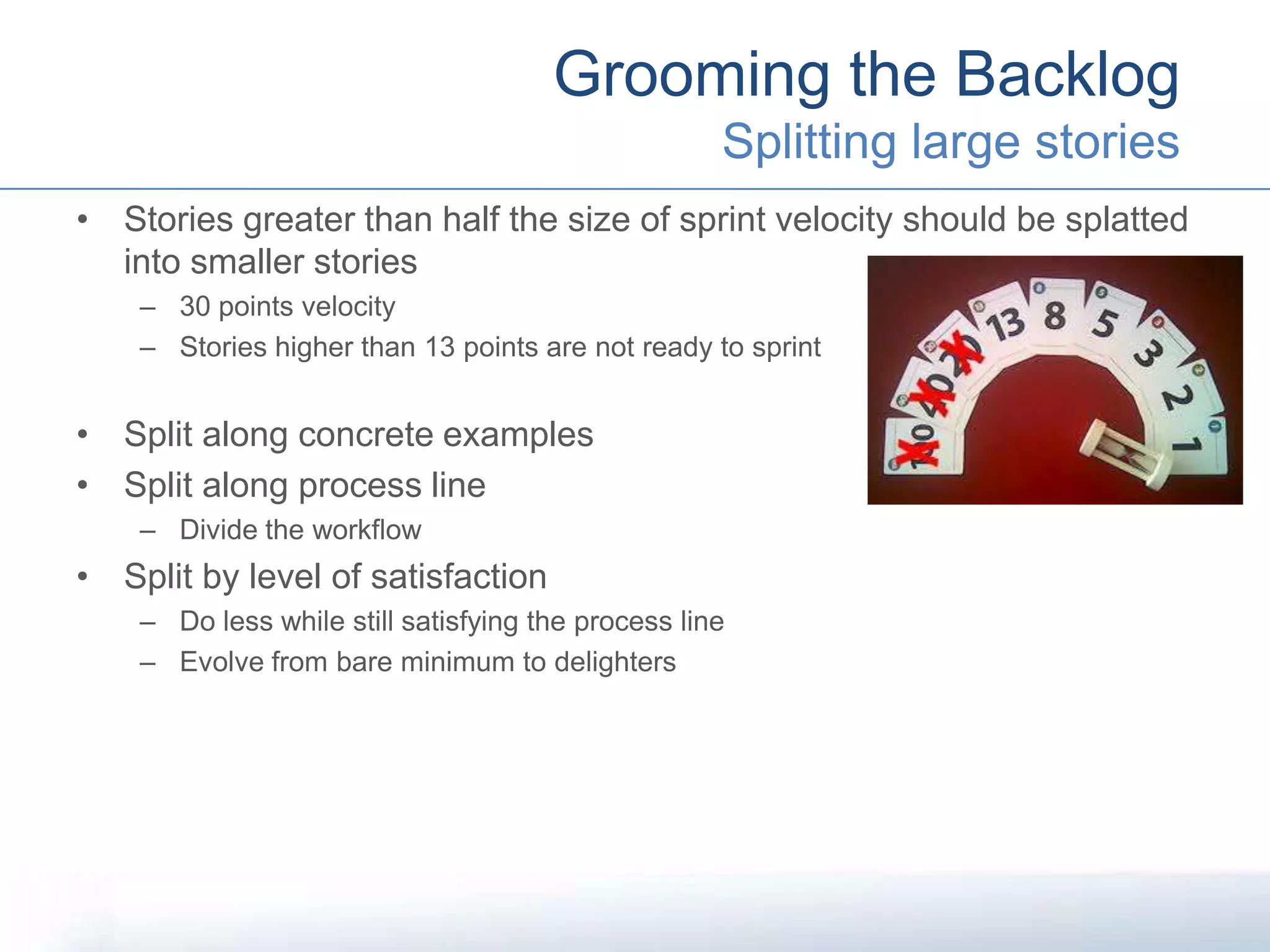
• Stories greater than half the size of sprint velocity should be splatted
into smaller stories
– 30 points velocity
– Stories higher than 13 points are not ready to sprint
• Split along concrete examples
• Split along process line
– Divide the workflow
• Split by level of satisfaction
– Do less while still satisfying the process line
– Evolve from bare minimum to delighters
Grooming the Backlog
Splitting large stories
Agile Requirements Discovery
Section C
Backlog Grooming with a
Slingboard
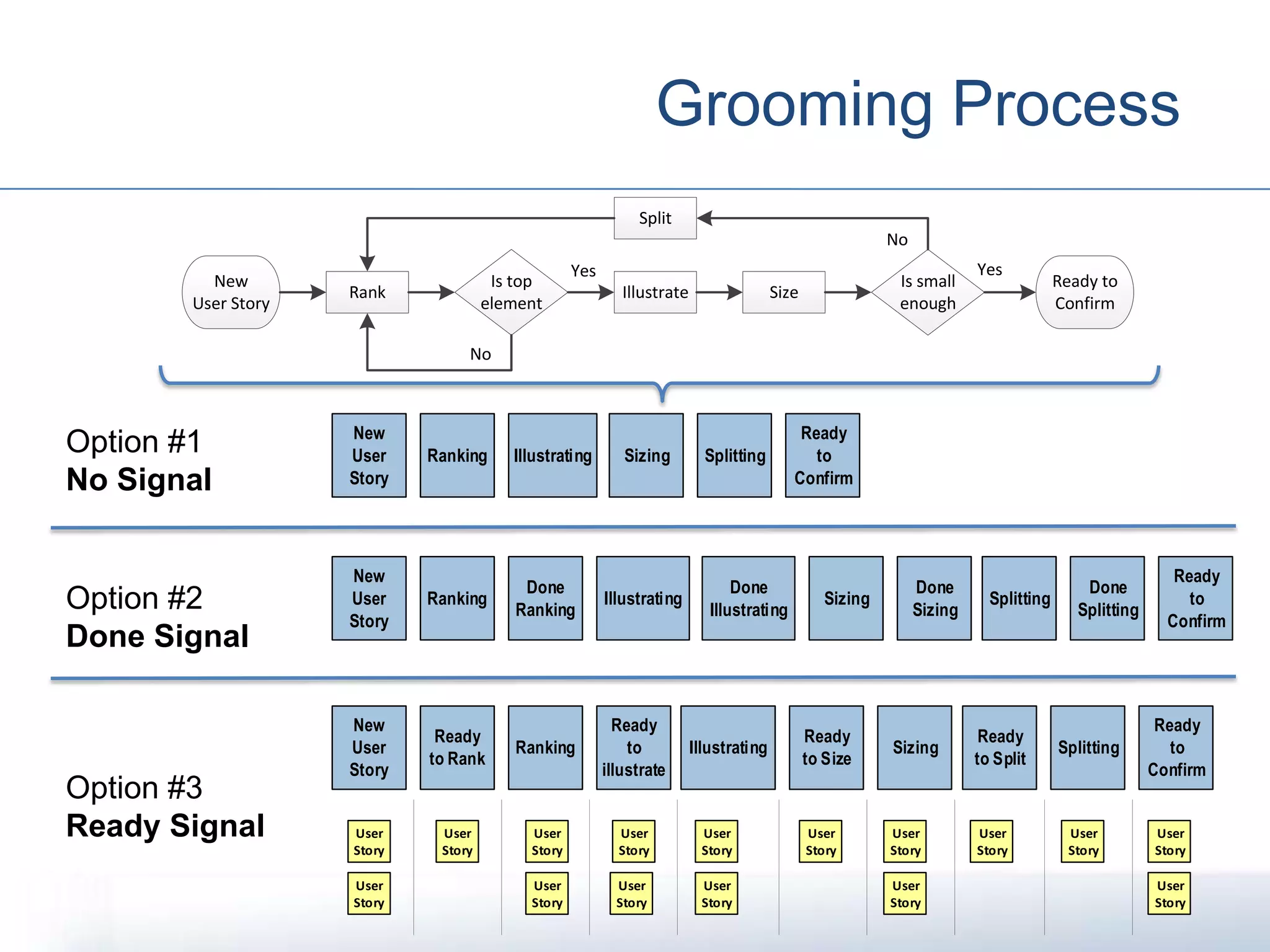
Grooming Process
New
User Story
Ready to
Confirm
Rank Illustrate Size
Split
Is small
enough
No
Yes
Is top
element
Yes
No
Option #1
No Signal
Option #2
Done Signal
Option #3
Ready Signal
New
User
Story
Ranking Sizing Splitting
Ready
to
Confirm
Illustrating
New
User
Story
Ranking
Done
Ranking
Sizing
Done
Sizing
Done
Splitting
Ready
to
Confirm
SplittingIllustrating
Done
Illustrating
User
Story
User
Story
User
Story
User
Story
User
Story
User
Story
User
Story
User
Story
New
User
Story
Ready
to Rank
Ranking
Ready
to Size
Sizing Splitting
Ready
to
Confirm
Ready
to Split
User
Story
User
Story
User
Story
User
Story
User
Story
Illustrating
Ready
to
illustrate
User
Story
User
Story
User
Story
Slingboard with TFS 2012
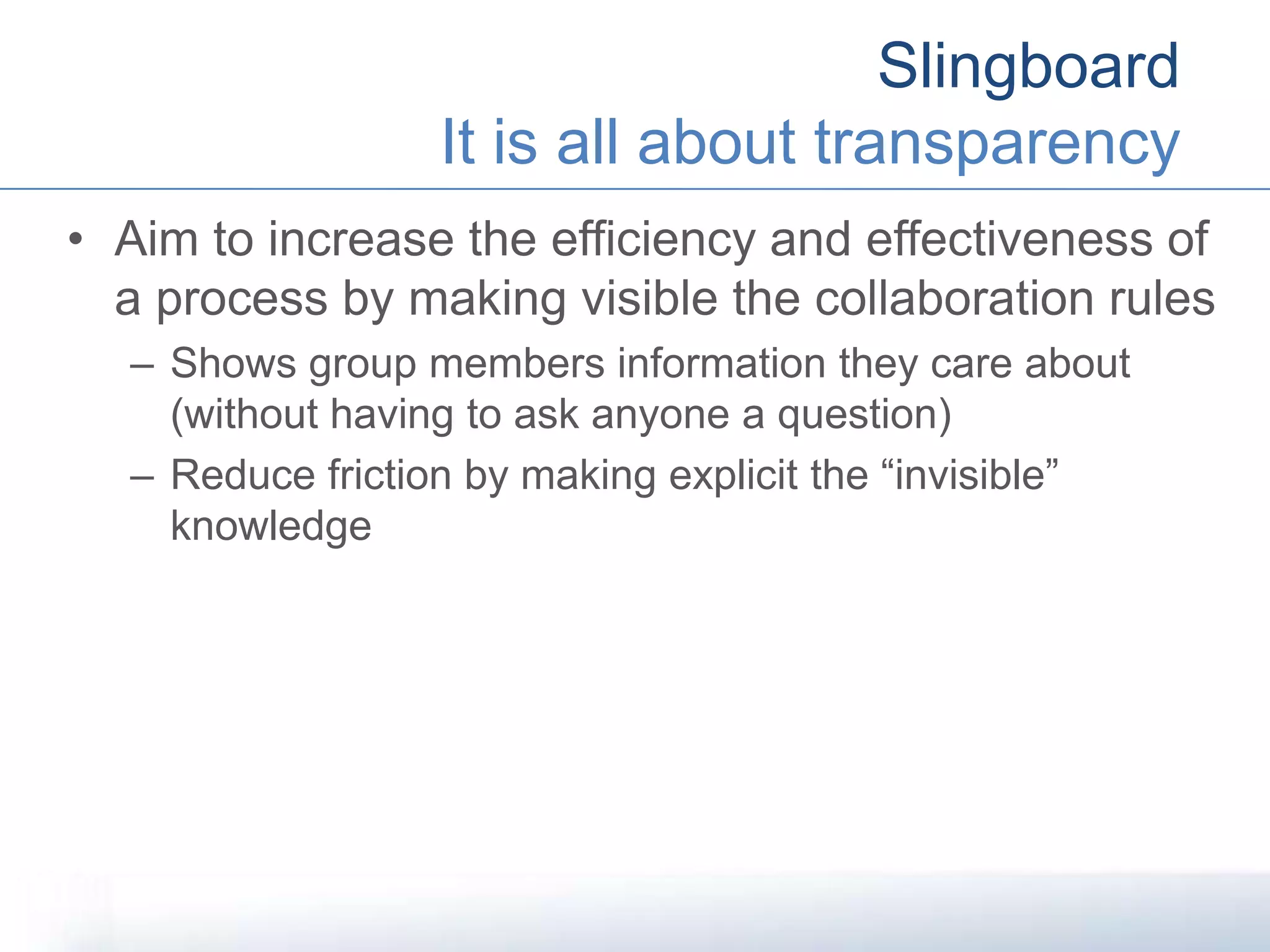
Slingboard
It is all about transparency
• Aim to increase the efficiency and effectiveness of
a process by making visible the collaboration rules
– Shows group members information they care about
(without having to ask anyone a question)
– Reduce friction by making explicit the “invisible”
knowledge
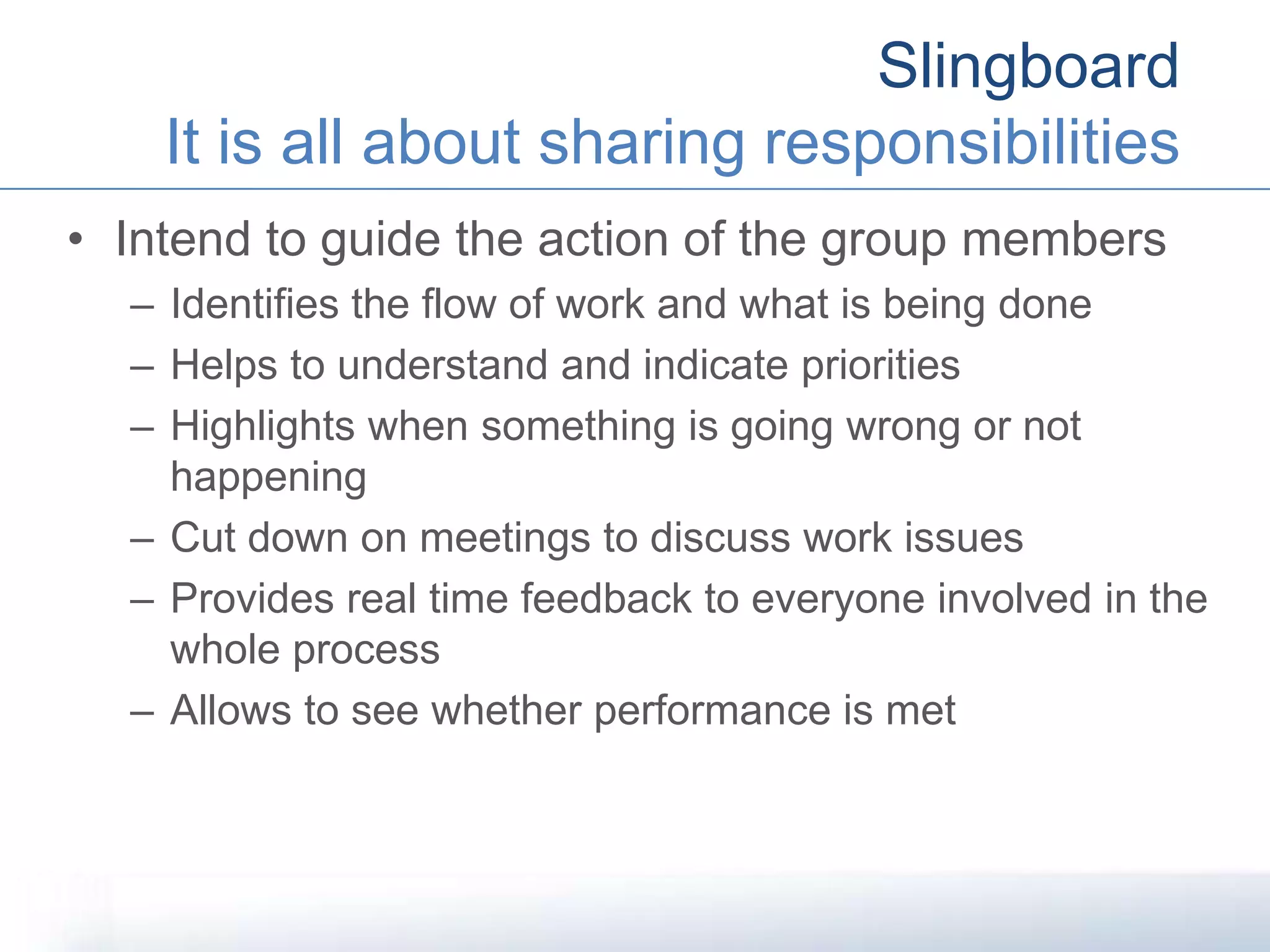
Slingboard
It is all about sharing responsibilities
• Intend to guide the action of the group members
– Identifies the flow of work and what is being done
– Helps to understand and indicate priorities
– Highlights when something is going wrong or not
happening
– Cut down on meetings to discuss work issues
– Provides real time feedback to everyone involved in the
whole process
– Allows to see whether performance is met
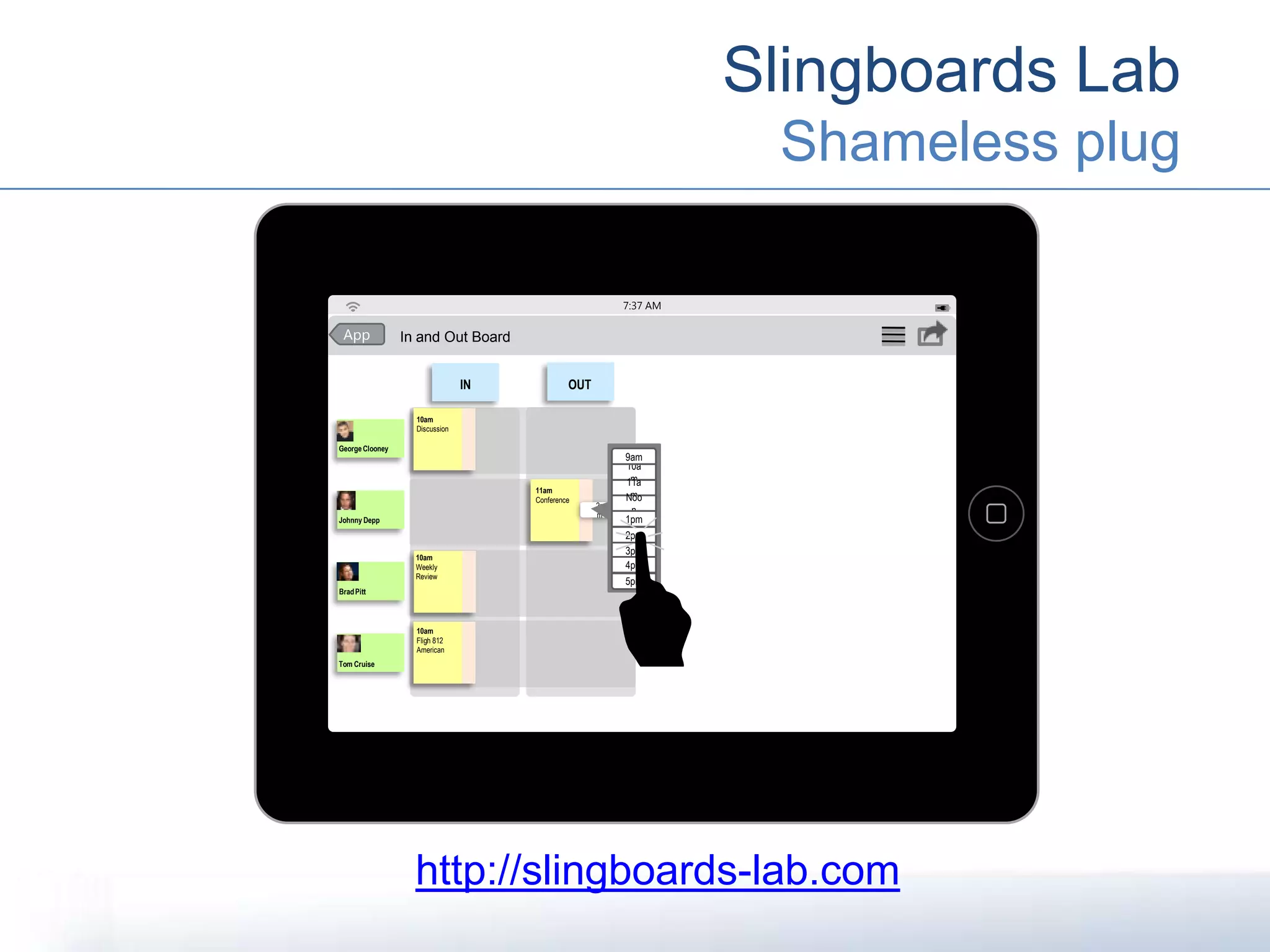
Slingboards Lab
Shameless plug
7:37 AM
In and Out BoardApp
IN OUT
Johnny Depp
GeorgeClooney
Tom Cruise
BradPitt
10am
Discussion
11am
Conference
10am
Weekly
Review
10am
Fligh 812
American
2p
m
10a
m
9am
5pm
11a
mNoo
n
1pm
2pm
3pm
4pm
http://slingboards-lab.com

Agile requirements discovery

  • 1.
    Agile Requirements Discovery VersionMay 13th Mario Cardinal Agile Coach & Software Architect www.mariocardinal.com
  • 2.
    • Agile Coach& Software architect • Leading independent consultant • www.mariocardinal.com Who am I ?
  • 3.
    "The real voyageof discovery consists, not in seeking new landscapes, but in having new eyes.” Marcel Proust A. Collaboration with a Slingboard B. Backlog Grooming with Scrum C. Backlog Grooming with a Slingboard Why are we here? Agenda
  • 4.
    Agile Requirements Discovery SectionA Collaboration with a Slingboard
  • 5.
    Slingboard Definition • Visual toolthat guides collaboration between teammates by using sticky notes • Each sticky note is a visual aid for signaling collaborators Column 1 Column 2 Column 3 Column N Row 1 Row 2 Row N
  • 6.
    Slingboard Two-Dimensional Grid • Eachcolumn helps to accomplish a workflow • The rows are used to group and organize the yellow stickies in a logical manner Step 1 Step 2 Step 3 Step N Column1 Column2 Column3 Column N Row1 Row2 Row N
  • 7.
    Slingboard Simple example:Task Board •Display the operating or progress status • Provide immediate feedback to people To Do In Progress Done
  • 8.
    Slingboard Why? • Helps TEAMMATESwho are dissatisfied with outcomes from SHARED ACCOUNTABILITY – Get better results for your team – Get more commitment from your teammates • Provides teams with VISUAL RULES to improve COLLABORATION between TEAMMATES – Get individual responsibility aligned with teamwork
  • 9.
    • As soonas teammates must collaborate a board can be useful Slingboard More than just software development Factory Inq uiry Inq uiry New inquiry Quotat i on Order Sample Validat e order Payme nt Ready to build Invoice Inq uir y Inq uiry Inq uiry Inq uiry Inq uir y Inq uiry Inq uiry Inq uiry Inq uiry Inq uiry Inq uiry Inq uiry Inq uiry Inq uiry Manufacturing User Story User Story User Story User Story User Story User Story User Story Backlog New User Stor y Ready to Rank Ranking Ready to Size Sizing Ready to Conf irm Ready to Split User Story User Story User Story User Story Financial institution abc abc New abc quote Order Phone Agr ee Bill CallInvoice abcabc abc abc abc abc abc abc abc abc abc abc abc abc Ready to build abc abc abcBacklog Backlog Recruitment firm abc abc New inquiry Quotat i on Order Sample Validat e order Invoice abcabc abc abc abc abc abc abc abc abc abc
  • 10.
    Slingboard Visual Management • Eachcolumn represents a state of the process – The aim is to move each sticky note from state to state to accomplish a workflow. Inquiry Inquiry New inquiry Quotation Order Sample Validate order Payment Ready to build Invoice InquiryInquiry Inquiry Inquiry Inquiry Inquiry Inquiry Inquiry Inquiry Inquiry Inquiry Inquiry Inquiry Inquiry New inquiry Ready to build Quotation Order Sample Validate order Is confirm No Yes Invoice Paymen t Workflow of a Factory Order Slingboard of a Factory Order
  • 11.
    Slingboard Visual Rules • Eachcolumn is a visual rule that improves the collaborative work by setting individual responsibilities Inquiry Inquiry New inquiry Quotation Order Sample Validate order Payment Ready to build Invoice InquiryInquiry Inquiry Inquiry Inquiry Inquiry Inquiry Inquiry Inquiry Inquiry Inquiry Inquiry Inquiry Inquiry Collaborator A Collaborator B Collaborator C Collaborator B Collaborator D
  • 12.
    Slingboard Pinning a StatusTag • Status tag is used to visualize issue that is not directly associated with the value-added steps displayed by the columns • Pinning creates visibility and awareness and allows the right people to react quickly to that new status $ 20k Company ABC View Order “Blocked” Status Tag
  • 13.
    Agile Requirements Discovery SectionB Backlog Grooming with Scrum
  • 14.
  • 15.
  • 16.
    • User Story –Short description written in everyday language that represents a discrete piece of demonstrable functionality – a desirable outcome by a stakeholder – a request for software to change that stakeholders desire and perceive as a requirement – A desirement Grooming the Backlog Describe desirements Using User Stories
  • 17.
    • Classic template –“As a < role>, I want <desirement> so that <benefit>” • Quick way of documenting a stakeholder’s desirement without having to elaborate vast formalized requirement documents – Encourage the team to defer collecting details – An initial high level story can be written as a first cut and then split into more stories when the team successively refines the software and it becomes important to have the details Grooming the Backlog Describe desirements Using User Stories
  • 18.
    • As a<student>, I want <to buy a pass valid only on school days> so that I can <go to school> • As a <worker>, I want <to buy a monthly pass> so that I can <go to work> Grooming the Backlog Describe desirements Using User Stories
  • 19.
    • Placeholder containingjust enough information so that the stakeholders can prioritize it (RANK) and the team can produce a reasonable estimate (SIZE) of the effort to implement it – It shouldn’t take more than a few days to implement Grooming the Backlog Describe desirements Using User Stories New User Story Ready to Confirm Rank Illustrate Size Split Is small enough No Yes Is top element Yes No Conversation
  • 20.
  • 21.
    • Stakeholders (withthe help of the Product Owner) must prioritize (RANK) stories Grooming the Backlog Rank desirements first New User Story Ready to Confirm Rank Illustrate Size Split Is small enough No Yes Is top element Yes No
  • 22.
    • The backlogis the list where the accumulation of desirements is recorded – Aggregates all potential User Story and prioritizes them by business value as an absolute ordering • The backlog is the “What” that will be built, sorted by importance. – Enables stakeholders to establish a vision – Enables stakeholders to decide what desirements the team should address during the next iteration Grooming the Backlog Rank desirements Using a Backlog Area As a/an... I want to... So That... Order Estimate Ticketing Kiosk Student Buy a pass valid only on school days I can go to school 1 20 Ticketing Kiosk Worker Buy a monthly pass I can go to work 2 13 ... ... ... ... ... ... ... ... ... ... ... ... ... ... ... ... ... ... ... ... ... ... ... ... ... ... ... ... ... ...
  • 23.
    • Development teamCANNOT produce a reasonable estimate (SIZE) of the effort without concrete examples Grooming the Backlog Illustrate desirements before sizing New User Story Ready to Confirm Rank Illustrate Size Split Is small enough No Yes Is top element Yes No
  • 24.
    • Paper prototyping Groomingthe Backlog Illustrate desirements with Storyboards
  • 25.
    • Powerpoint low-fidelitystoryboard Grooming the Backlog Illustrate desirements with Storyboards Select Transit Fare Transit Fare Name Single Ticket Single Ticket 1-Day Card Monthly Pass 3-Day Card Weekly Pass Description Booklet of 10 Single tickets Card with a magnetic stripe containing one trip. This card also serves as your transfer and your proof of payment. SIMPLE AND EASY TO USE 1. Insert your card in the slot on the fare collection box. An audio signals and lights will confirm the card’s validity. 2. Retrieve your card from the same slot in which you inserted it. KEEP IT! Remember to keep it with you until the end of your trip. It’s your proof of payment. TRANSFER When you use card to pay your fare, the date and time are printed on the back of the magnetic card. So if you must use more than one vehicle (bus or metro) to reach your destination, you need only insert your card again in the appropriate slot of the fare control equipment to validate your transfer. Transfers are valid for 120 minutes from the time printed on the back of the magnetic card. Select Cancel
  • 26.
    • Development teamwill produce a reasonable estimate (SIZE) of the effort in less than 5 minutes Grooming the Backlog Size desirements with the whole team New User Story Ready to Confirm Rank Illustrate Size Split Is small enough No Yes Is top element Yes No
  • 27.
    • Product ownerschedule grooming meetings with the development team – Team is invited to SIZE the efforts • Prior to grooming meetings, product owner should order the backlog and storyboard top elements • Only the top priority stories need to be estimated during meetings (time boxed) – The further out is a story, the less detail one need to consider – Quite acceptable to have stories with no estimation at the bottom of the backlog where stories have low priority Grooming the Backlog Size desirements during weekly meetings
  • 28.
    • In waterfall,managers determine a team member’s workload capacity in terms of duration – Human beings have a hard time anticipating the unknown and predict risks – Humans are poor at estimating absolute sizes • Difficult to estimate exact weight of an adult – Humans are great at assessing relative sizes • Very easy to decide which is heavier between an adult and a child • Clustering an adult between the “light”, “medium” or “heavy” group can be done within less than 5 minutes Grooming the Backlog Estimating efforts using comparison
  • 29.
    • Should steerclear of estimating based on time 1. Teams add a cushion of time to mitigate risk 2. Time necessary for teams to build one unit of work fluctuates 3. Factoring slack time appropriately is difficult Grooming the Backlog Estimating efforts using risk and difficulty
  • 30.
    • Scrum assignswork to an entire team, not an individual • Scrum use degree of difficulty to estimate – Time to resolve a degree of difficulty will change over time without affecting the Backlog • Story Points – Perfect for estimating relative sizes – Another scheme than time – Time is used in Scrum to validate the sprint backlog Grooming the Backlog Estimating Efforts with Story Points
  • 31.
    • Planning Poker –Consensus-based technique for estimating, mostly used to estimate effort or relative size of user stories – Use the Fibonacci sequence because they grow at about the same rate at which we humans can perceive meaningful changes in magnitude Grooming the Backlog Estimating Efforts with Planning Poker 1 1 1 2 2 2 3 3 35 5 5 8 8 8 13 1313 20 20 20
  • 32.
    • Each teammember is given one deck of the Fibonacci cards • The Scrum Master, who will not play, chairs the meeting • The Product Owner provides a short overview • The team is given an opportunity to ask questions and discuss to clarify assumptions – During discussion, numbers must not be mentioned at all in relation to feature size to avoid anchoring • Each individual lays a card face down representing their estimate • People with high estimates and low estimates are given a soap box to offer their justification for their estimate and then discussion continues • Repeat the estimation process until a consensus is reached • An egg timer can be used to ensure that discussion is structured – Scrum Master may at any point turn over the egg timer and when it runs out all discussion must cease and another round of poker is played. Grooming the Backlog Estimating Efforts and Poker Procedure
  • 33.
    • How dowe know if a story is small enough? Grooming the Backlog Splitting large stories New User Story Ready to Confirm Rank Illustrate Size Split Is small enough No Yes Is top element Yes No
  • 34.
    • Stories greaterthan half the size of sprint velocity should be splatted into smaller stories – 30 points velocity – Stories higher than 13 points are not ready to sprint • Split along concrete examples • Split along process line – Divide the workflow • Split by level of satisfaction – Do less while still satisfying the process line – Evolve from bare minimum to delighters Grooming the Backlog Splitting large stories
  • 35.
    Agile Requirements Discovery SectionC Backlog Grooming with a Slingboard
  • 36.
    Grooming Process New User Story Readyto Confirm Rank Illustrate Size Split Is small enough No Yes Is top element Yes No Option #1 No Signal Option #2 Done Signal Option #3 Ready Signal New User Story Ranking Sizing Splitting Ready to Confirm Illustrating New User Story Ranking Done Ranking Sizing Done Sizing Done Splitting Ready to Confirm SplittingIllustrating Done Illustrating User Story User Story User Story User Story User Story User Story User Story User Story New User Story Ready to Rank Ranking Ready to Size Sizing Splitting Ready to Confirm Ready to Split User Story User Story User Story User Story User Story Illustrating Ready to illustrate User Story User Story User Story
  • 37.
  • 38.
    Slingboard It is allabout transparency • Aim to increase the efficiency and effectiveness of a process by making visible the collaboration rules – Shows group members information they care about (without having to ask anyone a question) – Reduce friction by making explicit the “invisible” knowledge
  • 39.
    Slingboard It is allabout sharing responsibilities • Intend to guide the action of the group members – Identifies the flow of work and what is being done – Helps to understand and indicate priorities – Highlights when something is going wrong or not happening – Cut down on meetings to discuss work issues – Provides real time feedback to everyone involved in the whole process – Allows to see whether performance is met
  • 40.
    Slingboards Lab Shameless plug 7:37AM In and Out BoardApp IN OUT Johnny Depp GeorgeClooney Tom Cruise BradPitt 10am Discussion 11am Conference 10am Weekly Review 10am Fligh 812 American 2p m 10a m 9am 5pm 11a mNoo n 1pm 2pm 3pm 4pm http://slingboards-lab.com

Editor's Notes

  • #41 In and Out boardMove stickerSignal sticker