Backlog / Story Grooming
NK Shrivastava, PMP, RMP, ACP, CSP, SPC4
CEO/Consultant/Enterprise Agile Coach
RefineM Project Management Consulting
www.refinem.com
January 9, 2019
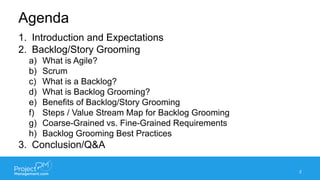
Agenda
1. Introduction and Expectations
2. Backlog/Story Grooming
a) What is Agile?
b) Scrum
c) What is a Backlog?
d) What is Backlog Grooming?
e) Benefits of Backlog/Story Grooming
f) Steps / Value Stream Map for Backlog Grooming
g) Coarse-Grained vs. Fine-Grained Requirements
h) Backlog Grooming Best Practices
3. Conclusion/Q&A
2
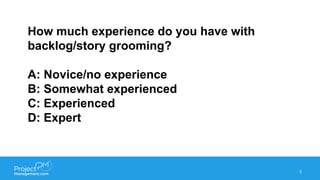
How much experience do you have with
backlog/story grooming?
A: Novice/no experience
B: Somewhat experienced
C: Experienced
D: Expert
3
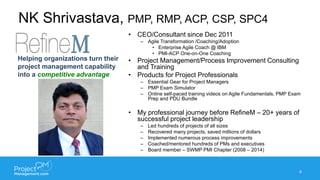
NK Shrivastava, PMP, RMP, ACP, CSP, SPC4
• CEO/Consultant since Dec 2011
– Agile Transformation /Coaching/Adoption
• Enterprise Agile Coach @ IBM
• PMI-ACP One-on-One Coaching
• Project Management/Process Improvement Consulting
and Training
• Products for Project Professionals
– Essential Gear for Project Managers
– PMP Exam Simulator
– Online self-paced training videos on Agile Fundamentals, PMP Exam
Prep and PDU Bundle
• My professional journey before RefineM – 20+ years of
successful project leadership
– Led hundreds of projects of all sizes
– Recovered many projects, saved millions of dollars
– Implemented numerous process improvements
– Coached/mentored hundreds of PMs and executives
– Board member – SWMP PMI Chapter (2008 – 2014)
4
Helping organizations turn their
project management capability
into a competitive advantage
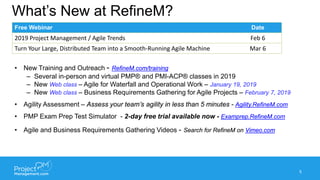
What’s New at RefineM?
5
• New Training and Outreach - RefineM.com/training
– Several in-person and virtual PMP® and PMI-ACP® classes in 2019
– New Web class – Agile for Waterfall and Operational Work – January 19, 2019
– New Web class – Business Requirements Gathering for Agile Projects – February 7, 2019
• Agility Assessment – Assess your team’s agility in less than 5 minutes - Agility.RefineM.com
• PMP Exam Prep Test Simulator - 2-day free trial available now - Examprep.RefineM.com
• Agile and Business Requirements Gathering Videos - Search for RefineM on Vimeo.com
Free Webinar Date
2019 Project Management / Agile Trends Feb 6
Turn Your Large, Distributed Team into a Smooth-Running Agile Machine Mar 6
What is Agile?
6
Agile is a capability to respond to change in today’s fast-paced
business environment.
Agile is based on the four values in the Agile Manifesto and the
Twelve Principles.
Scrum, XP, Lean, and Kanban are different Agile methodologies
based on Agile values and principles.
Manifesto for Agile Software Development
We are uncovering better ways of developing software by doing it and
helping others do it. Through this work we have come to value:
Individuals and interactions over processes and tools
Working software over comprehensive documentation
Customer collaboration over contract negotiation
Responding to change over following a plan
That is, while there is value in the items on the right, we value the
items on the left more.
7
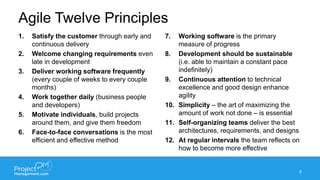
Agile Twelve Principles
1. Satisfy the customer through early and
continuous delivery
2. Welcome changing requirements even
late in development
3. Deliver working software frequently
(every couple of weeks to every couple
months)
4. Work together daily (business people
and developers)
5. Motivate individuals, build projects
around them, and give them freedom
6. Face-to-face conversations is the most
efficient and effective method
7. Working software is the primary
measure of progress
8. Development should be sustainable
(i.e. able to maintain a constant pace
indefinitely)
9. Continuous attention to technical
excellence and good design enhance
agility
10. Simplicity – the art of maximizing the
amount of work not done – is essential
11. Self-organizing teams deliver the best
architectures, requirements, and designs
12. At regular intervals the team reflects on
how to become more effective
8
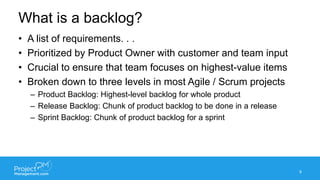
What is a backlog?
• A list of requirements. . .
• Prioritized by Product Owner with customer and team input
• Crucial to ensure that team focuses on highest-value items
• Broken down to three levels in most Agile / Scrum projects
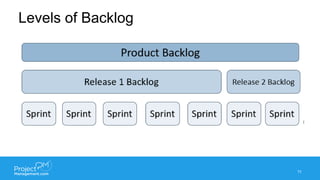
– Product Backlog: Highest-level backlog for whole product
– Release Backlog: Chunk of product backlog to be done in a release
– Sprint Backlog: Chunk of product backlog for a sprint
9
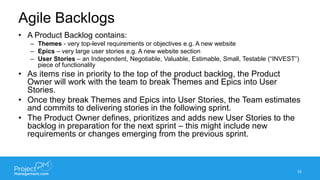
Agile Backlogs
• A Product Backlog contains:
– Themes - very top-level requirements or objectives e.g. A new website
– Epics – very large user stories e.g. A new website section
– User Stories – an Independent, Negotiable, Valuable, Estimable, Small, Testable (“INVEST”)
piece of functionality
• As items rise in priority to the top of the product backlog, the Product
Owner will work with the team to break Themes and Epics into User
Stories.
• Once they break Themes and Epics into User Stories, the Team estimates
and commits to delivering stories in the following sprint.
• The Product Owner defines, prioritizes and adds new User Stories to the
backlog in preparation for the next sprint – this might include new
requirements or changes emerging from the previous sprint.
10
Levels of Backlog
11
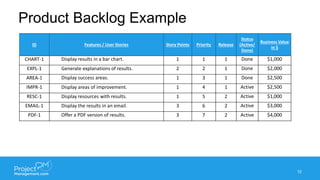
Product Backlog Example
12
ID Features / User Stories Story Points Priority Release
Status
(Active/
Done)
Business Value
in $
CHART-1 Display results in a bar chart. 1 1 1 Done $1,000
EXPL-1 Generate explanations of results. 2 2 1 Done $2,000
AREA-1 Display success areas. 1 3 1 Done $2,500
IMPR-1 Display areas of improvement. 1 4 1 Active $2,500
RESC-1 Display resources with results. 1 5 2 Active $1,000
EMAIL-1 Display the results in an email. 3 6 2 Active $3,000
PDF-1 Offer a PDF version of results. 3 7 2 Active $4,000
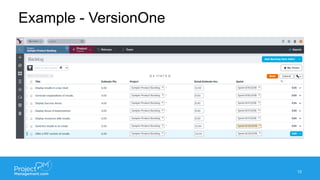
Example - VersionOne
13
Sprint Backlog
• The Sprint Backlog is the list of stories included in the sprint.
• The Scrum team plans to complete this list during the sprint to
turn backlog items into deliverable functional increments.
• Sprint Backlog items are estimated in story points or hours.
• The development team updates the Sprint Backlog as items
are completed or when new tasks are discovered or adjusted.
• The Sprint Burndown is shown during daily standup meetings
so the team has visibility on what is remaining.
14
What is backlog grooming?
15
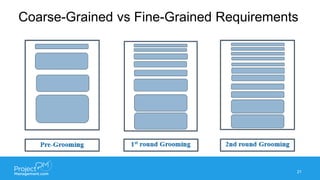
• Backlog Grooming is the practice of revisiting high-level or
“coarse-grained” requirements in the product backlog and
adding details so they are ready for the development team.
• The resulting groomed requirements/stories are known as
“fine-grained” because they have enough detail for the team
to move forward.
• The product owner typically grooms the backlog.
Who else can groom the backlog?
Why is backlog grooming essential?
16
• Without backlog grooming, the team might get stuck
during the sprint more often because they have to spend
time refining requirements instead of implementing them.
– They may have to spend more time with the customer in order to
understand the requirements.
– Lack of timely backlog grooming at an appropriate level may skew velocity
metrics, making it difficult for the team to gauge their progress toward
meeting the sprint goal.
– Lack of backlog grooming can be a sign of an inexperienced product
owner and/or team.
Benefits of Backlog Grooming/Refinement
• Helps the team stay on top of sprint goals
• Improves productivity by reducing rework
• Keeps velocity tracking consistent for better visibility
• Improves the experience for development team and
customer
– Developers can prepare to build a better product
– Customers have more flexibility to get their needs fulfilled
Any others?
17
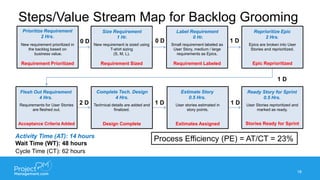
Steps/Value Stream Map for Backlog Grooming
New requirement prioritized in
the backlog based on
business value.
Requirement Prioritized
New requirement is sized using
T-shirt sizing
(S, M, L).
Requirement Sized
Small requirement labeled as
User Story, medium / large
requirements as Epics.
Requirement Labeled
Epics are broken into User
Stories and reprioritized.
Epic Reprioritized
Requirements for User Stories
are fleshed out.
Acceptance Criteria Added
Technical details are added and
finalized.
Design Complete
User stories estimated in
story points.
Estimates Assigned
User Stories reprioritized and
marked as ready.
Stories Ready for Sprint
18
Activity Time (AT): 14 hours
Wait Time (WT): 48 hours
Cycle Time (CT): 62 hours
0 D 0 D 1 D
1 D
2 D 1 D 1 D
Process Efficiency (PE) = AT/CT = 23%
Prioritize Requirement
2 Hrs.
Size Requirement
1 Hr.
Label Requirement
0 Hr.
Reprioritize Epic
2 Hrs.
Flesh Out Requirement
4 Hrs.
Complete Tech. Design
4 Hrs.
Estimate Story
0.5 Hrs.
Ready Story for Sprint
0.5 Hrs.
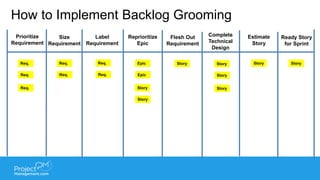
How to Implement Backlog Grooming
Prioritize
Requirement
Size
Requirement
Label
Requirement
Reprioritize
Epic
Flesh Out
Requirement
Complete
Technical
Design
Estimate
Story
Ready Story
for Sprint
Req.
Req.
Req.
Req.
Req.
Req.
Req.
Epic
Epic
Story
Story
Story Story
Story
Story
Story Story
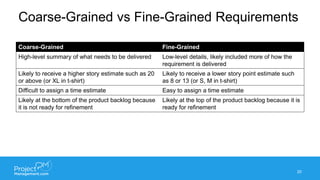
Coarse-Grained vs Fine-Grained Requirements
Coarse-Grained Fine-Grained
High-level summary of what needs to be delivered Low-level details, likely included more of how the
requirement is delivered
Likely to receive a higher story estimate such as 20
or above (or XL in t-shirt)
Likely to receive a lower story point estimate such
as 8 or 13 (or S, M in t-shirt)
Difficult to assign a time estimate Easy to assign a time estimate
Likely at the bottom of the product backlog because
it is not ready for refinement
Likely at the top of the product backlog because it is
ready for refinement
20
Coarse-Grained vs Fine-Grained Requirements
21
Grooming/Refinement Best Practices
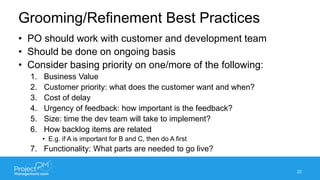
• PO should work with customer and development team
• Should be done on ongoing basis
• Consider basing priority on one/more of the following:
1. Business Value
2. Customer priority: what does the customer want and when?
3. Cost of delay
4. Urgency of feedback: how important is the feedback?
5. Size: time the dev team will take to implement?
6. How backlog items are related
• E.g. if A is important for B and C, then do A first
7. Functionality: What parts are needed to go live?
22
How frequently backlog should be groomed?
A: Continuously/Ongoing
B: Before Sprint Planning
C: During the Sprint
D: Never
23
Conclusion
• Grooming/refinement gives your team greater clarity
• It should be done frequently with customer in mind
• Aim for 2 sprints’ worth of groomed stories
Enable your team’s success with Backlog Grooming
On-demand recording will be available at ProjectManagement.com in 7-10 days.
Download a copy of the slide deck from bit.ly/backlog-grooming-slides
24
Questions?
25
NK Shrivastava, MBA, PMP, RMP, ACP, CSP, SPC4
CEO/Consultant, RefineM
nks@refinem.com
www.refinem.com
https://www.linkedin.com/in/nkshrivastava/
https://twitter.com/justrightpm
https://www.facebook.com/gorefinem

backlogStroyGrooming.pdf

  • 1.
    Backlog / StoryGrooming NK Shrivastava, PMP, RMP, ACP, CSP, SPC4 CEO/Consultant/Enterprise Agile Coach RefineM Project Management Consulting www.refinem.com January 9, 2019
  • 2.
    Agenda 1. Introduction andExpectations 2. Backlog/Story Grooming a) What is Agile? b) Scrum c) What is a Backlog? d) What is Backlog Grooming? e) Benefits of Backlog/Story Grooming f) Steps / Value Stream Map for Backlog Grooming g) Coarse-Grained vs. Fine-Grained Requirements h) Backlog Grooming Best Practices 3. Conclusion/Q&A 2
  • 3.
    How much experiencedo you have with backlog/story grooming? A: Novice/no experience B: Somewhat experienced C: Experienced D: Expert 3
  • 4.
    NK Shrivastava, PMP,RMP, ACP, CSP, SPC4 • CEO/Consultant since Dec 2011 – Agile Transformation /Coaching/Adoption • Enterprise Agile Coach @ IBM • PMI-ACP One-on-One Coaching • Project Management/Process Improvement Consulting and Training • Products for Project Professionals – Essential Gear for Project Managers – PMP Exam Simulator – Online self-paced training videos on Agile Fundamentals, PMP Exam Prep and PDU Bundle • My professional journey before RefineM – 20+ years of successful project leadership – Led hundreds of projects of all sizes – Recovered many projects, saved millions of dollars – Implemented numerous process improvements – Coached/mentored hundreds of PMs and executives – Board member – SWMP PMI Chapter (2008 – 2014) 4 Helping organizations turn their project management capability into a competitive advantage
  • 5.
    What’s New atRefineM? 5 • New Training and Outreach - RefineM.com/training – Several in-person and virtual PMP® and PMI-ACP® classes in 2019 – New Web class – Agile for Waterfall and Operational Work – January 19, 2019 – New Web class – Business Requirements Gathering for Agile Projects – February 7, 2019 • Agility Assessment – Assess your team’s agility in less than 5 minutes - Agility.RefineM.com • PMP Exam Prep Test Simulator - 2-day free trial available now - Examprep.RefineM.com • Agile and Business Requirements Gathering Videos - Search for RefineM on Vimeo.com Free Webinar Date 2019 Project Management / Agile Trends Feb 6 Turn Your Large, Distributed Team into a Smooth-Running Agile Machine Mar 6
  • 6.
    What is Agile? 6 Agileis a capability to respond to change in today’s fast-paced business environment. Agile is based on the four values in the Agile Manifesto and the Twelve Principles. Scrum, XP, Lean, and Kanban are different Agile methodologies based on Agile values and principles.
  • 7.
    Manifesto for AgileSoftware Development We are uncovering better ways of developing software by doing it and helping others do it. Through this work we have come to value: Individuals and interactions over processes and tools Working software over comprehensive documentation Customer collaboration over contract negotiation Responding to change over following a plan That is, while there is value in the items on the right, we value the items on the left more. 7
  • 8.
    Agile Twelve Principles 1.Satisfy the customer through early and continuous delivery 2. Welcome changing requirements even late in development 3. Deliver working software frequently (every couple of weeks to every couple months) 4. Work together daily (business people and developers) 5. Motivate individuals, build projects around them, and give them freedom 6. Face-to-face conversations is the most efficient and effective method 7. Working software is the primary measure of progress 8. Development should be sustainable (i.e. able to maintain a constant pace indefinitely) 9. Continuous attention to technical excellence and good design enhance agility 10. Simplicity – the art of maximizing the amount of work not done – is essential 11. Self-organizing teams deliver the best architectures, requirements, and designs 12. At regular intervals the team reflects on how to become more effective 8
  • 9.
    What is abacklog? • A list of requirements. . . • Prioritized by Product Owner with customer and team input • Crucial to ensure that team focuses on highest-value items • Broken down to three levels in most Agile / Scrum projects – Product Backlog: Highest-level backlog for whole product – Release Backlog: Chunk of product backlog to be done in a release – Sprint Backlog: Chunk of product backlog for a sprint 9
  • 10.
    Agile Backlogs • AProduct Backlog contains: – Themes - very top-level requirements or objectives e.g. A new website – Epics – very large user stories e.g. A new website section – User Stories – an Independent, Negotiable, Valuable, Estimable, Small, Testable (“INVEST”) piece of functionality • As items rise in priority to the top of the product backlog, the Product Owner will work with the team to break Themes and Epics into User Stories. • Once they break Themes and Epics into User Stories, the Team estimates and commits to delivering stories in the following sprint. • The Product Owner defines, prioritizes and adds new User Stories to the backlog in preparation for the next sprint – this might include new requirements or changes emerging from the previous sprint. 10
  • 11.
  • 12.
    Product Backlog Example 12 IDFeatures / User Stories Story Points Priority Release Status (Active/ Done) Business Value in $ CHART-1 Display results in a bar chart. 1 1 1 Done $1,000 EXPL-1 Generate explanations of results. 2 2 1 Done $2,000 AREA-1 Display success areas. 1 3 1 Done $2,500 IMPR-1 Display areas of improvement. 1 4 1 Active $2,500 RESC-1 Display resources with results. 1 5 2 Active $1,000 EMAIL-1 Display the results in an email. 3 6 2 Active $3,000 PDF-1 Offer a PDF version of results. 3 7 2 Active $4,000
  • 13.
  • 14.
    Sprint Backlog • TheSprint Backlog is the list of stories included in the sprint. • The Scrum team plans to complete this list during the sprint to turn backlog items into deliverable functional increments. • Sprint Backlog items are estimated in story points or hours. • The development team updates the Sprint Backlog as items are completed or when new tasks are discovered or adjusted. • The Sprint Burndown is shown during daily standup meetings so the team has visibility on what is remaining. 14
  • 15.
    What is backloggrooming? 15 • Backlog Grooming is the practice of revisiting high-level or “coarse-grained” requirements in the product backlog and adding details so they are ready for the development team. • The resulting groomed requirements/stories are known as “fine-grained” because they have enough detail for the team to move forward. • The product owner typically grooms the backlog. Who else can groom the backlog?
  • 16.
    Why is backloggrooming essential? 16 • Without backlog grooming, the team might get stuck during the sprint more often because they have to spend time refining requirements instead of implementing them. – They may have to spend more time with the customer in order to understand the requirements. – Lack of timely backlog grooming at an appropriate level may skew velocity metrics, making it difficult for the team to gauge their progress toward meeting the sprint goal. – Lack of backlog grooming can be a sign of an inexperienced product owner and/or team.
  • 17.
    Benefits of BacklogGrooming/Refinement • Helps the team stay on top of sprint goals • Improves productivity by reducing rework • Keeps velocity tracking consistent for better visibility • Improves the experience for development team and customer – Developers can prepare to build a better product – Customers have more flexibility to get their needs fulfilled Any others? 17
  • 18.
    Steps/Value Stream Mapfor Backlog Grooming New requirement prioritized in the backlog based on business value. Requirement Prioritized New requirement is sized using T-shirt sizing (S, M, L). Requirement Sized Small requirement labeled as User Story, medium / large requirements as Epics. Requirement Labeled Epics are broken into User Stories and reprioritized. Epic Reprioritized Requirements for User Stories are fleshed out. Acceptance Criteria Added Technical details are added and finalized. Design Complete User stories estimated in story points. Estimates Assigned User Stories reprioritized and marked as ready. Stories Ready for Sprint 18 Activity Time (AT): 14 hours Wait Time (WT): 48 hours Cycle Time (CT): 62 hours 0 D 0 D 1 D 1 D 2 D 1 D 1 D Process Efficiency (PE) = AT/CT = 23% Prioritize Requirement 2 Hrs. Size Requirement 1 Hr. Label Requirement 0 Hr. Reprioritize Epic 2 Hrs. Flesh Out Requirement 4 Hrs. Complete Tech. Design 4 Hrs. Estimate Story 0.5 Hrs. Ready Story for Sprint 0.5 Hrs.
  • 19.
    How to ImplementBacklog Grooming Prioritize Requirement Size Requirement Label Requirement Reprioritize Epic Flesh Out Requirement Complete Technical Design Estimate Story Ready Story for Sprint Req. Req. Req. Req. Req. Req. Req. Epic Epic Story Story Story Story Story Story Story Story
  • 20.
    Coarse-Grained vs Fine-GrainedRequirements Coarse-Grained Fine-Grained High-level summary of what needs to be delivered Low-level details, likely included more of how the requirement is delivered Likely to receive a higher story estimate such as 20 or above (or XL in t-shirt) Likely to receive a lower story point estimate such as 8 or 13 (or S, M in t-shirt) Difficult to assign a time estimate Easy to assign a time estimate Likely at the bottom of the product backlog because it is not ready for refinement Likely at the top of the product backlog because it is ready for refinement 20
  • 21.
  • 22.
    Grooming/Refinement Best Practices •PO should work with customer and development team • Should be done on ongoing basis • Consider basing priority on one/more of the following: 1. Business Value 2. Customer priority: what does the customer want and when? 3. Cost of delay 4. Urgency of feedback: how important is the feedback? 5. Size: time the dev team will take to implement? 6. How backlog items are related • E.g. if A is important for B and C, then do A first 7. Functionality: What parts are needed to go live? 22
  • 23.
    How frequently backlogshould be groomed? A: Continuously/Ongoing B: Before Sprint Planning C: During the Sprint D: Never 23
  • 24.
    Conclusion • Grooming/refinement givesyour team greater clarity • It should be done frequently with customer in mind • Aim for 2 sprints’ worth of groomed stories Enable your team’s success with Backlog Grooming On-demand recording will be available at ProjectManagement.com in 7-10 days. Download a copy of the slide deck from bit.ly/backlog-grooming-slides 24
  • 25.
    Questions? 25 NK Shrivastava, MBA,PMP, RMP, ACP, CSP, SPC4 CEO/Consultant, RefineM nks@refinem.com www.refinem.com https://www.linkedin.com/in/nkshrivastava/ https://twitter.com/justrightpm https://www.facebook.com/gorefinem