Agility beyond
Implementing Agile
Frameworks
© Benzne. All rights reserved
2
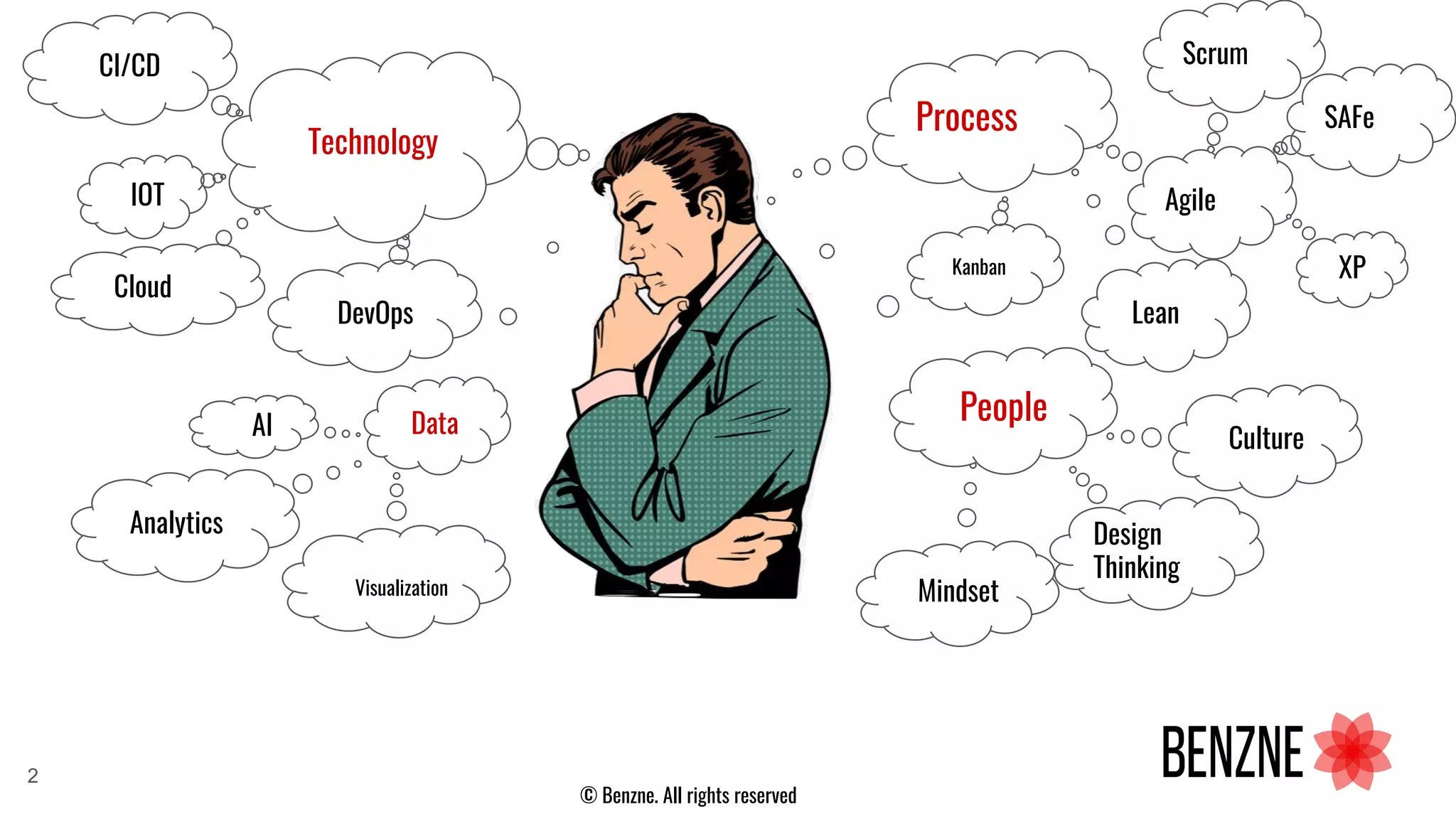
AgileIOT
AI
Design
Thinking
Culture
Lean
Kanban
Visualization
DevOps
CI/CD Scrum
SAFe
XP
Cloud
Analytics
Mindset
People
Process
Technology
Data
3
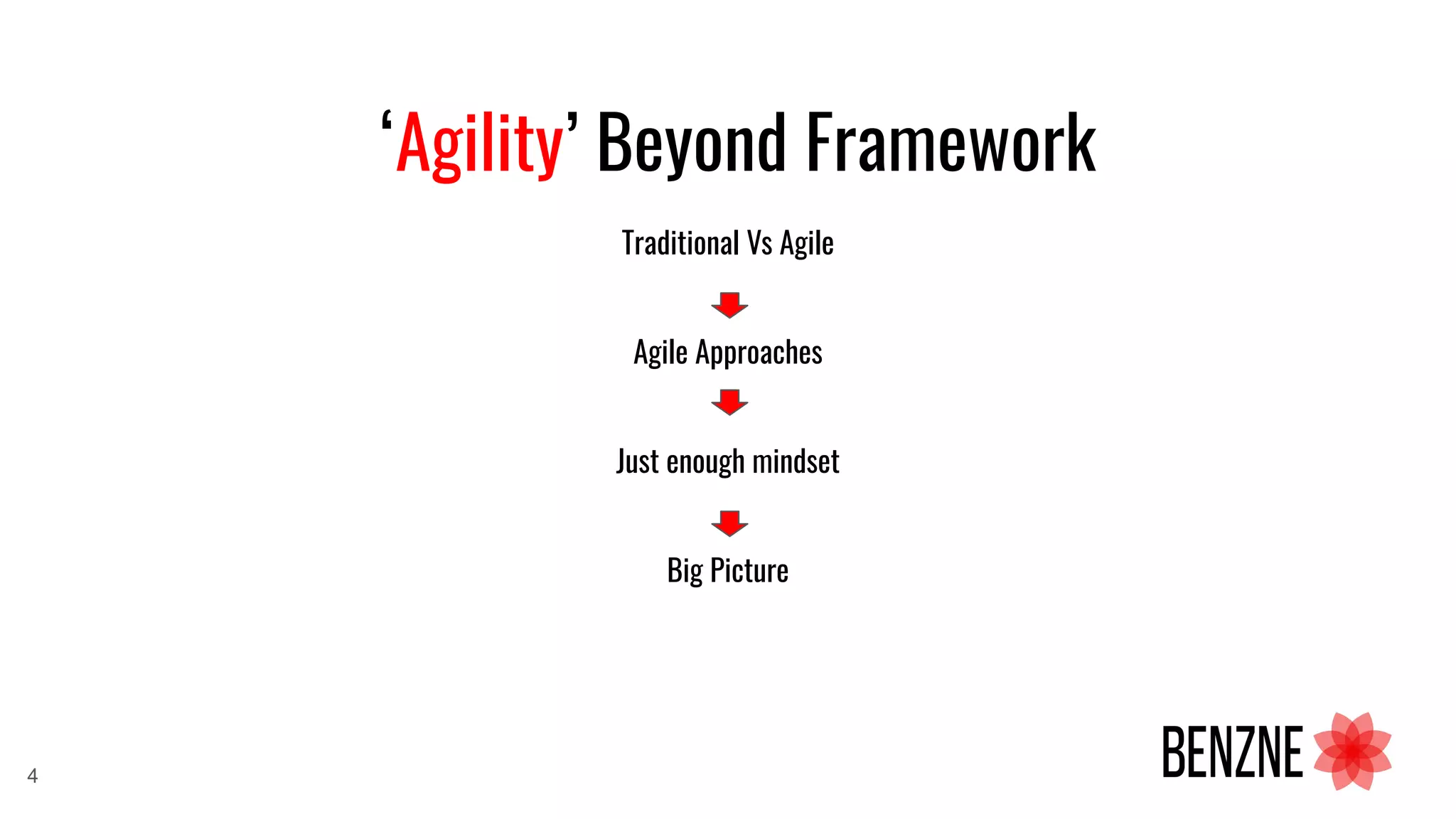
‘Agility’ Beyond Framework
Traditional Vs Agile
Agile Approaches
Just enough mindset
Big Picture
4
© Benzne. All rights reserved
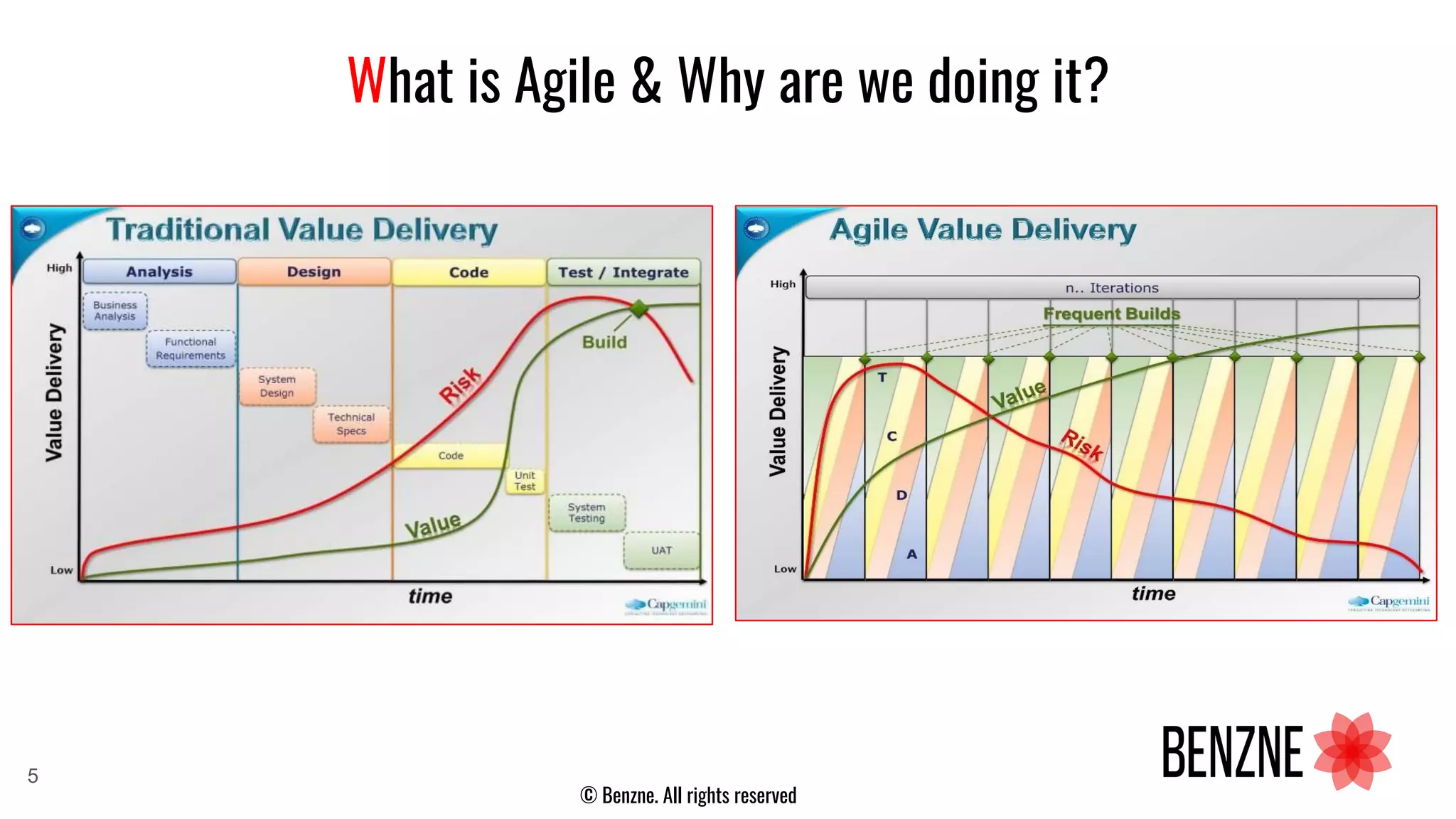
What is Agile & Why are we doing it?
5
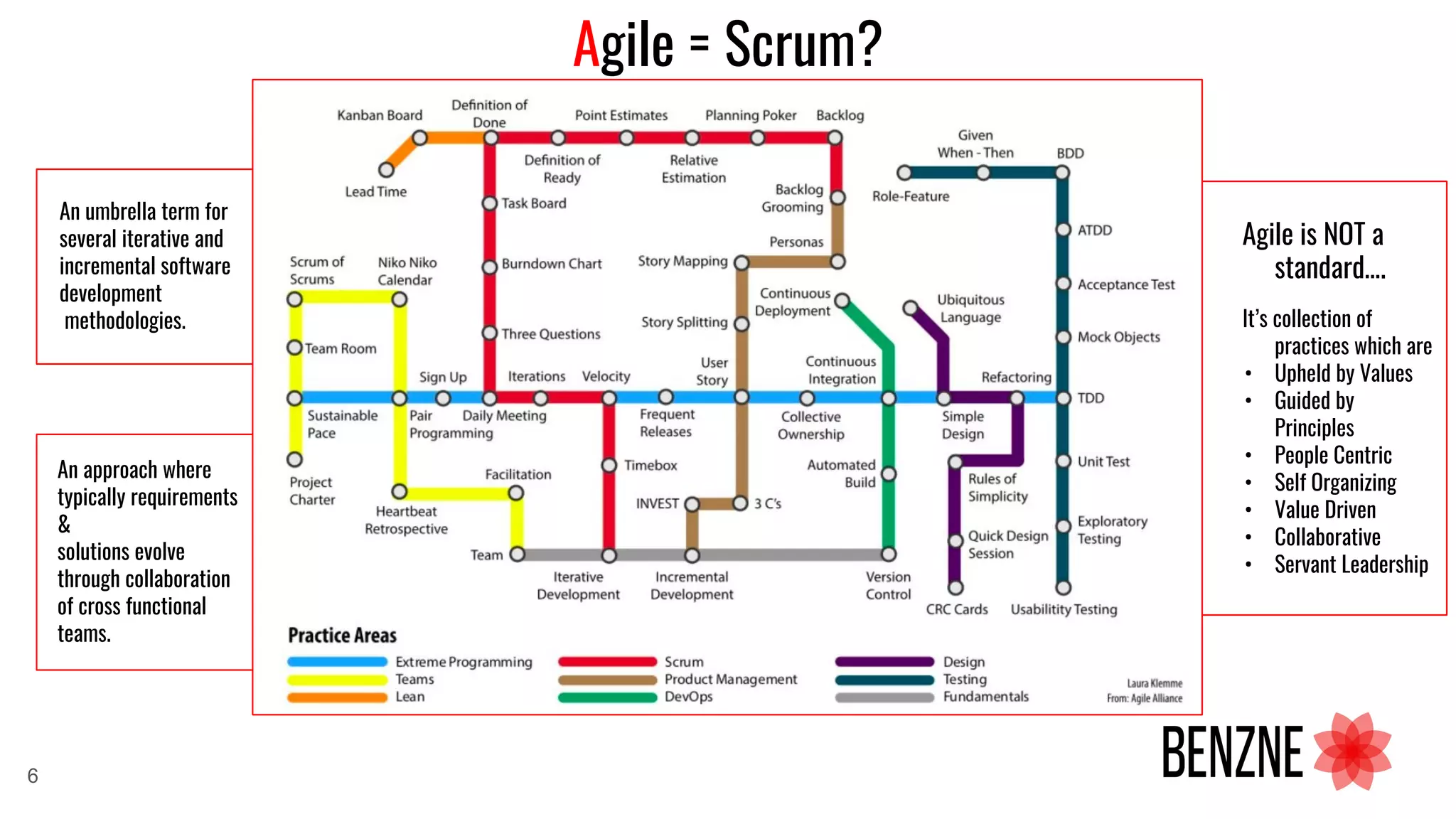
Agile = Scrum?
Agile is NOT a
standard….
It’s collection of
practices which are
• Upheld by Values
• Guided by
Principles
• People Centric
• Self Organizing
• Value Driven
• Collaborative
• Servant Leadership
An approach where
typically requirements
&
solutions evolve
through collaboration
of cross functional
teams.
An umbrella term for
several iterative and
incremental software
development
methodologies.
6
7
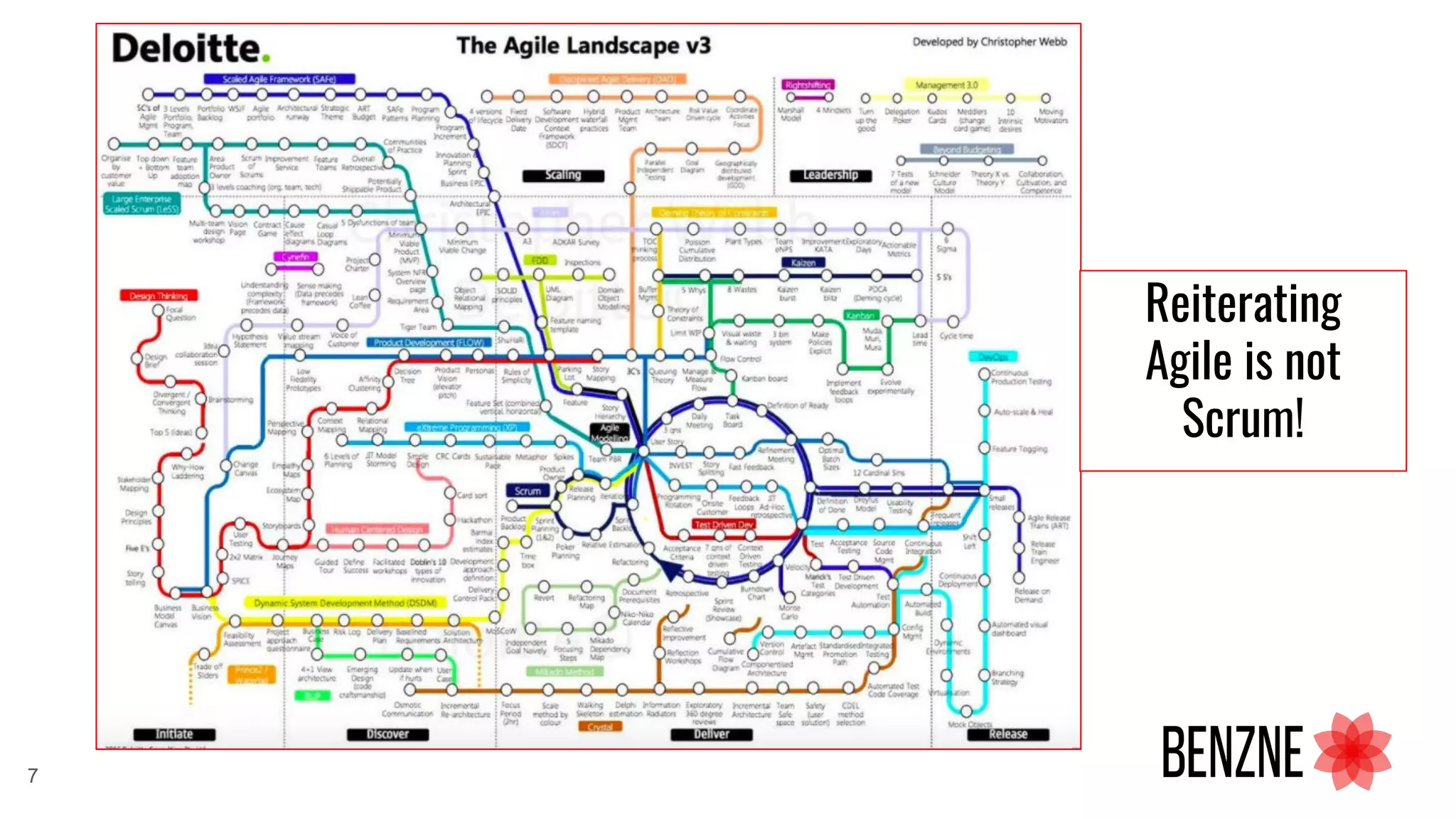
Reiterating
Agile is not
Scrum!
© Benzne. All rights reserved
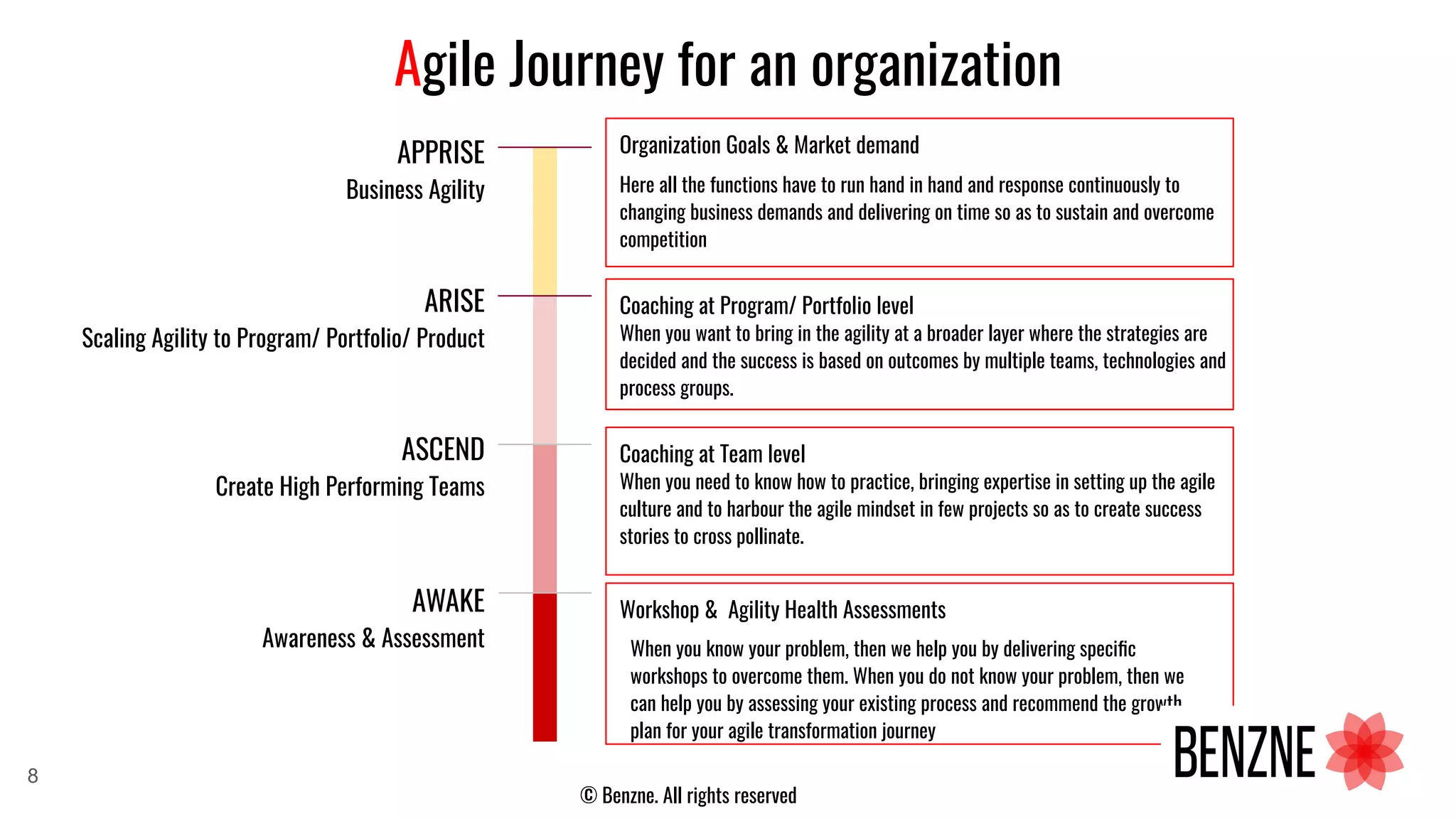
Agile Journey for an organization
APPRISE
Business Agility
Organization Goals & Market demand
Here all the functions have to run hand in hand and response continuously to
changing business demands and delivering on time so as to sustain and overcome
competition
ARISE
Scaling Agility to Program/ Portfolio/ Product
Coaching at Program/ Portfolio level
When you want to bring in the agility at a broader layer where the strategies are
decided and the success is based on outcomes by multiple teams, technologies and
process groups.
ASCEND
Create High Performing Teams
Coaching at Team level
When you need to know how to practice, bringing expertise in setting up the agile
culture and to harbour the agile mindset in few projects so as to create success
stories to cross pollinate.
Workshop & Agility Health AssessmentsAWAKE
Awareness & Assessment When you know your problem, then we help you by delivering specific
workshops to overcome them. When you do not know your problem, then we
can help you by assessing your existing process and recommend the growth
plan for your agile transformation journey
8
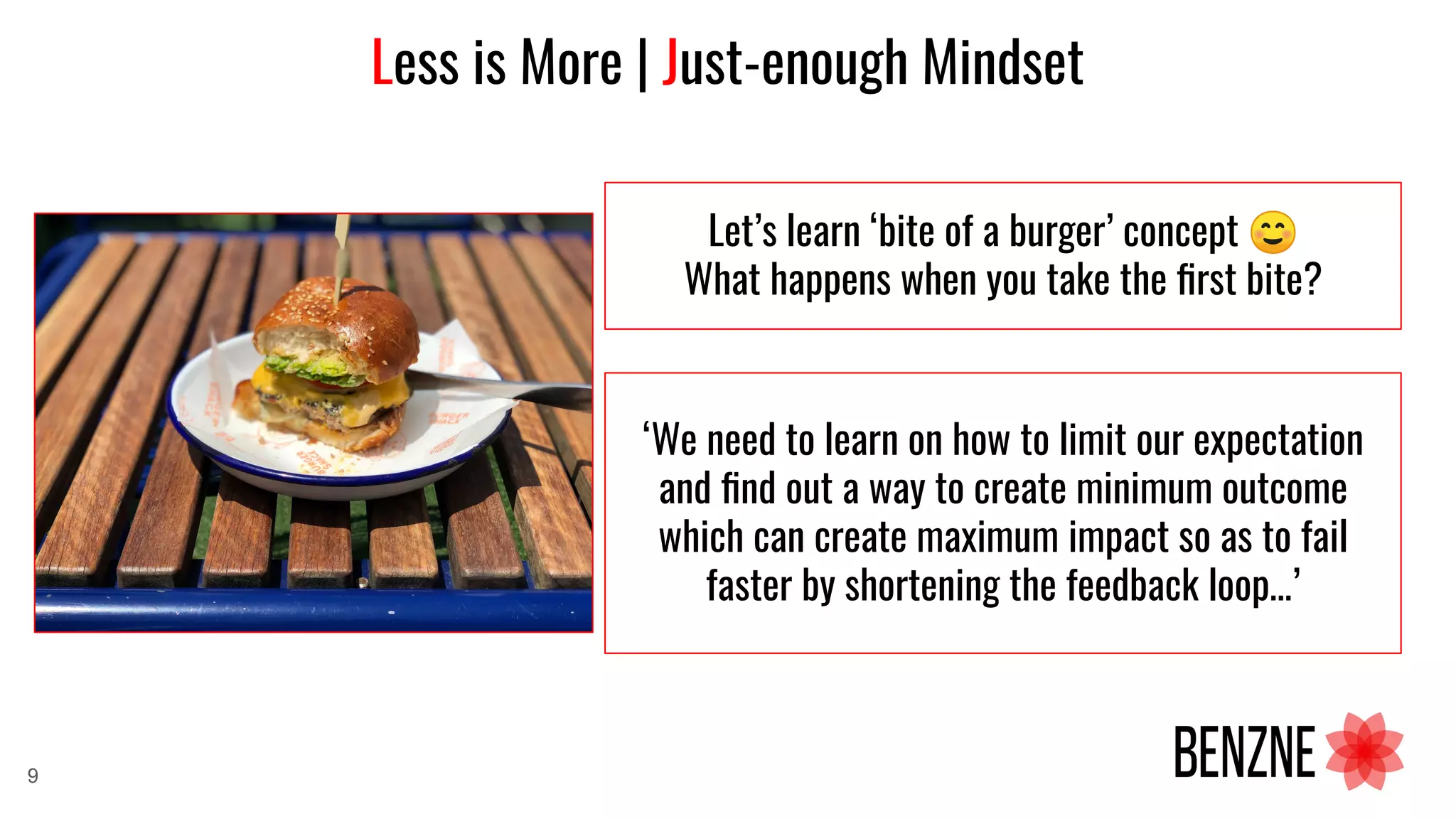
Less is More | Just-enough Mindset
Let’s learn ‘bite of a burger’ concept ☺
What happens when you take the first bite?
‘We need to learn on how to limit our expectation
and find out a way to create minimum outcome
which can create maximum impact so as to fail
faster by shortening the feedback loop…’
9
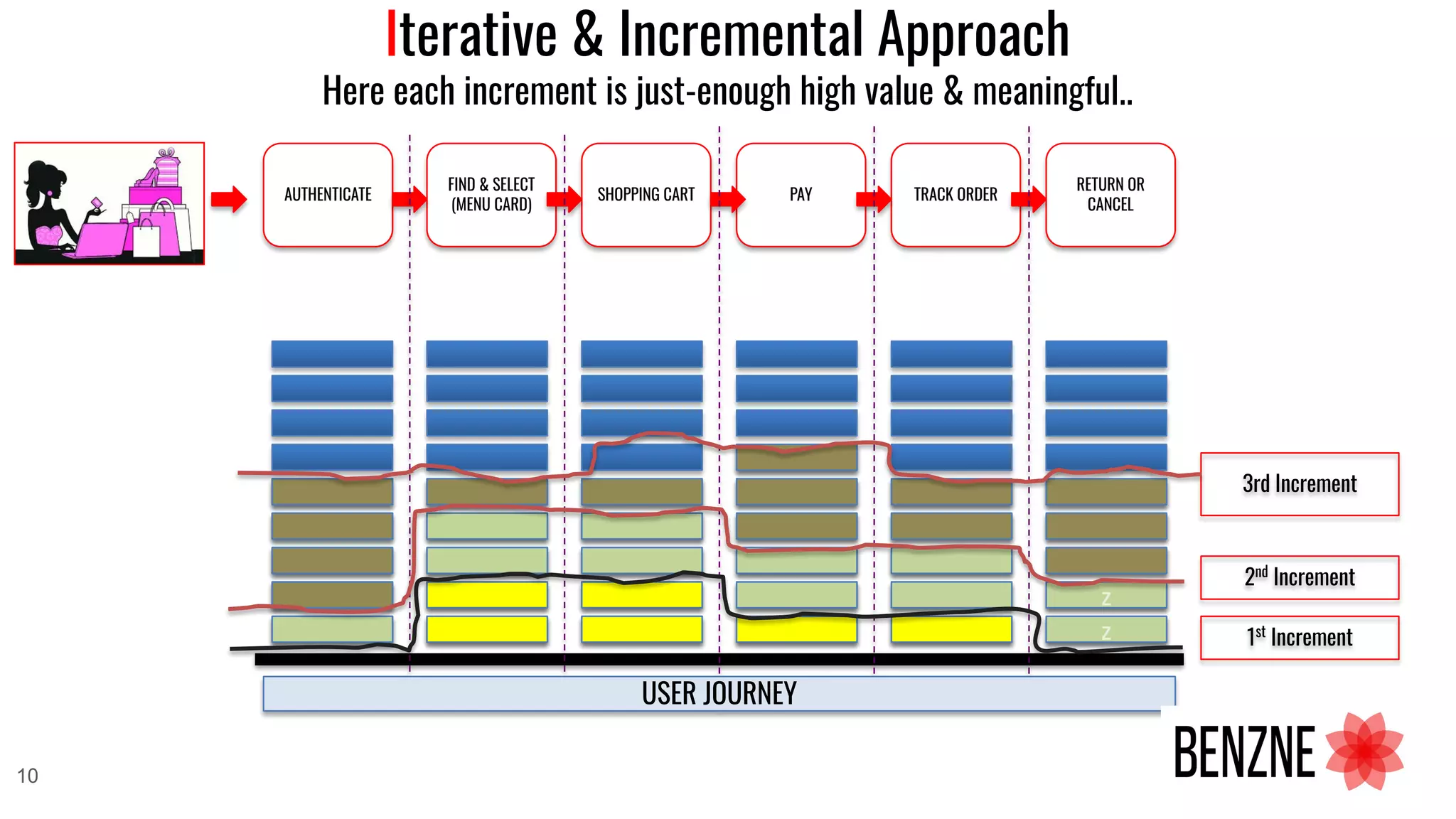
Iterative & Incremental Approach
Here each increment is just-enough high value & meaningful..
AUTHENTICATE
FIND & SELECT
(MENU CARD)
SHOPPING CART PAY TRACK ORDER
RETURN OR
CANCEL
1st
Increment
2nd
Increment
3rd Increment
USER JOURNEY
z
z
10
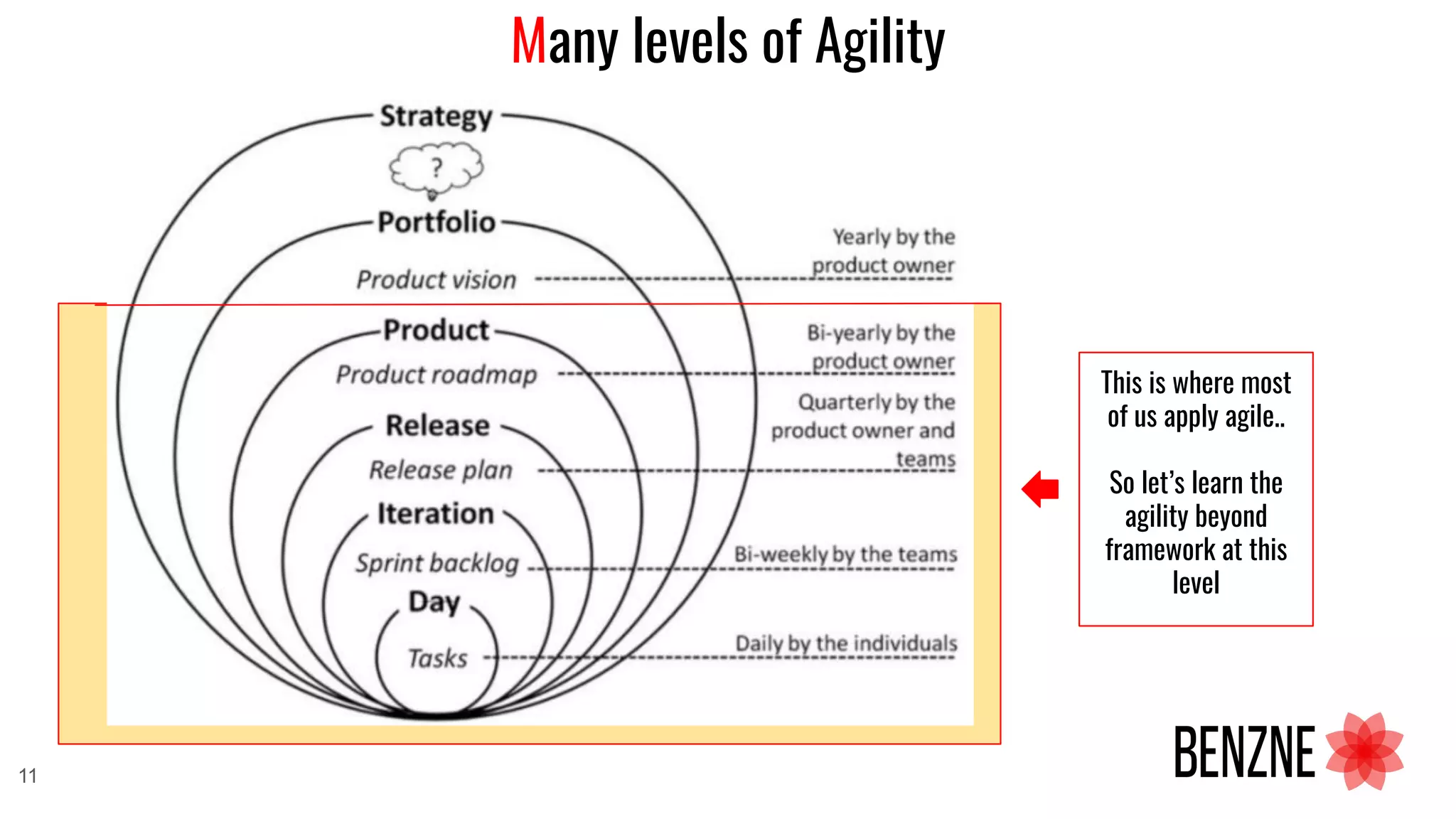
Many levels of Agility
11
This is where most
of us apply agile..
So let’s learn the
agility beyond
framework at this
level
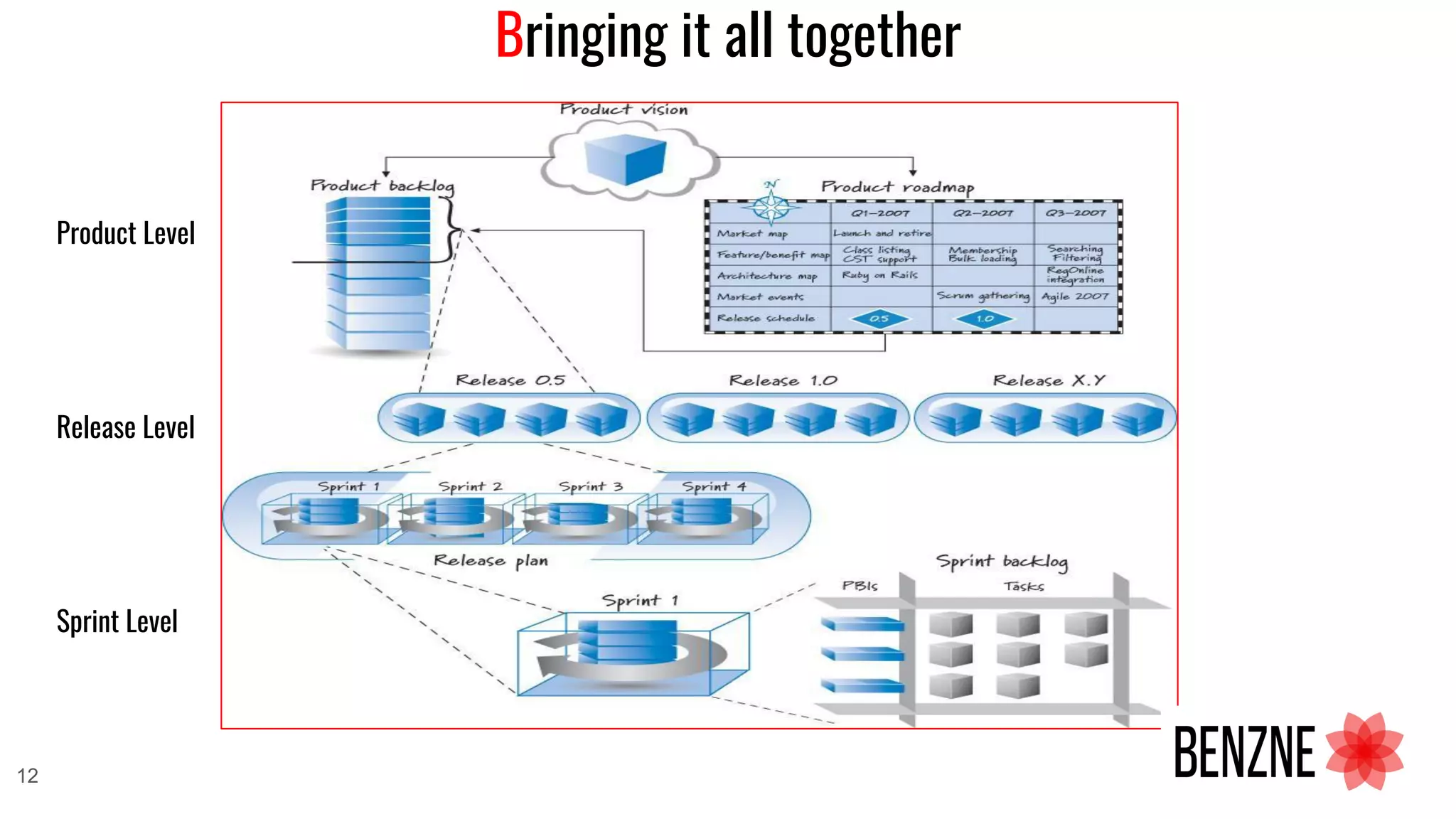
Bringing it all together
Product Level
Release Level
Sprint Level
12
‘Questions’
13
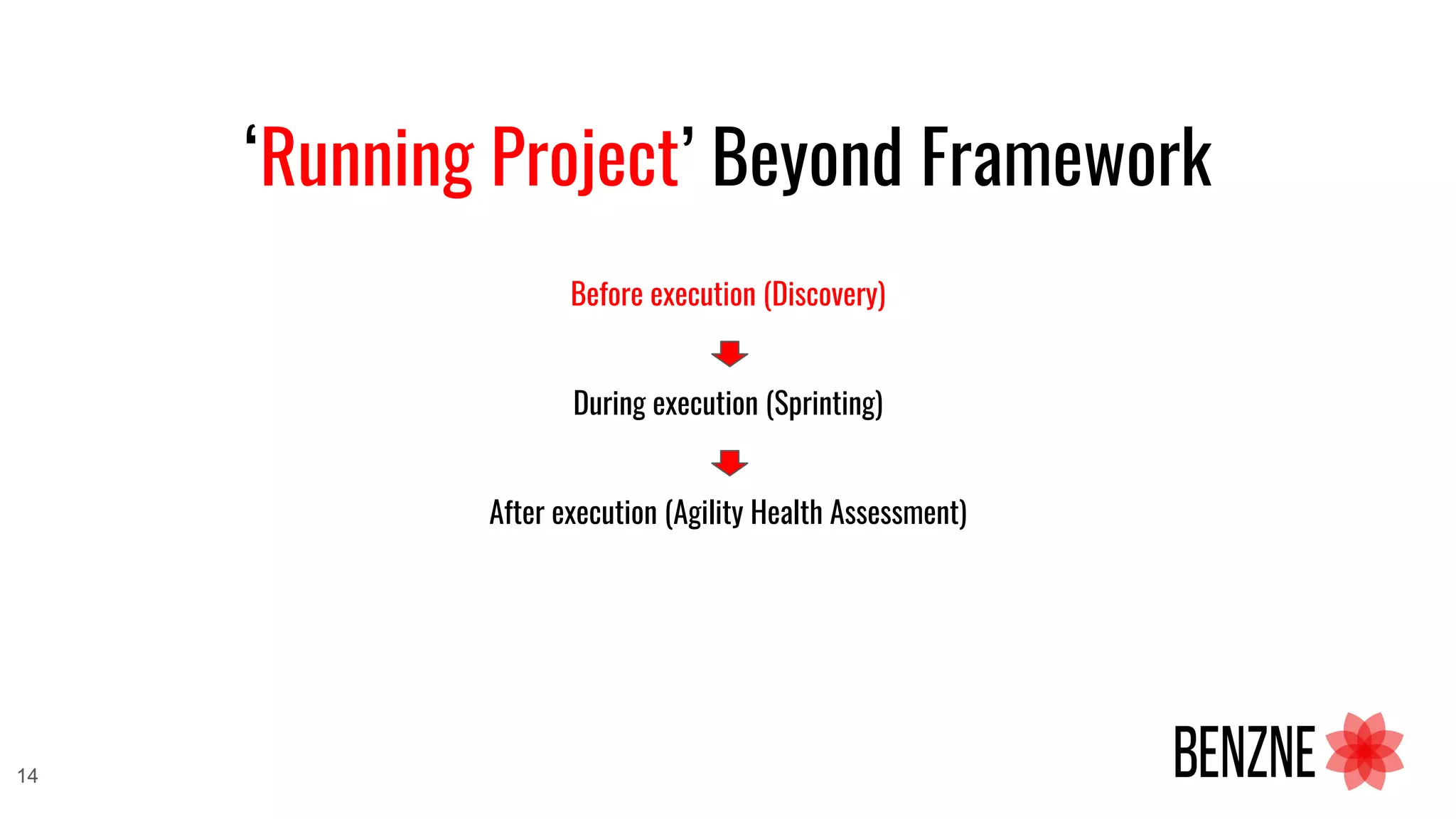
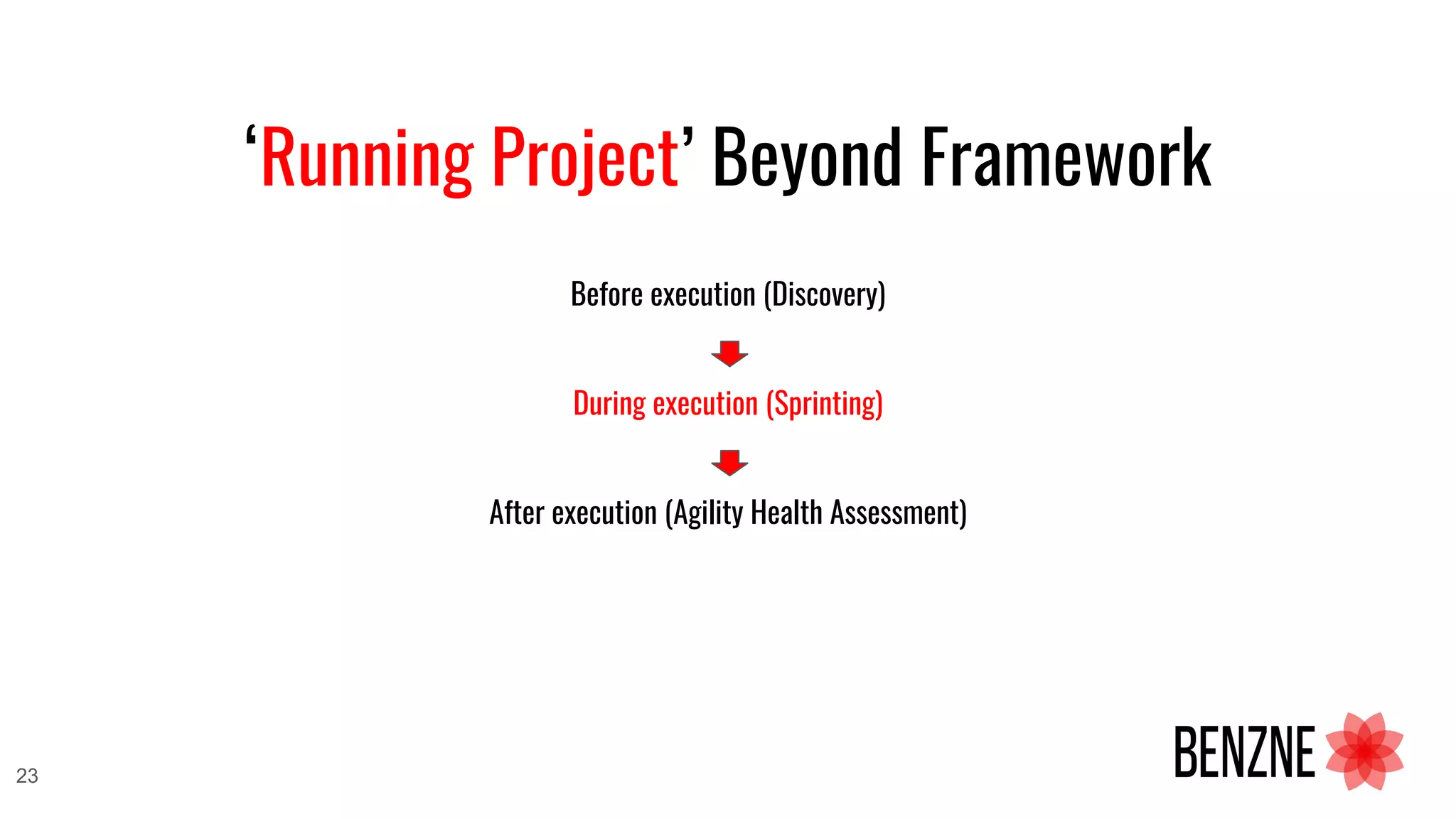
‘Running Project’ Beyond Framework
Before execution (Discovery)
During execution (Sprinting)
After execution (Agility Health Assessment)
14
© Benzne. All rights reserved
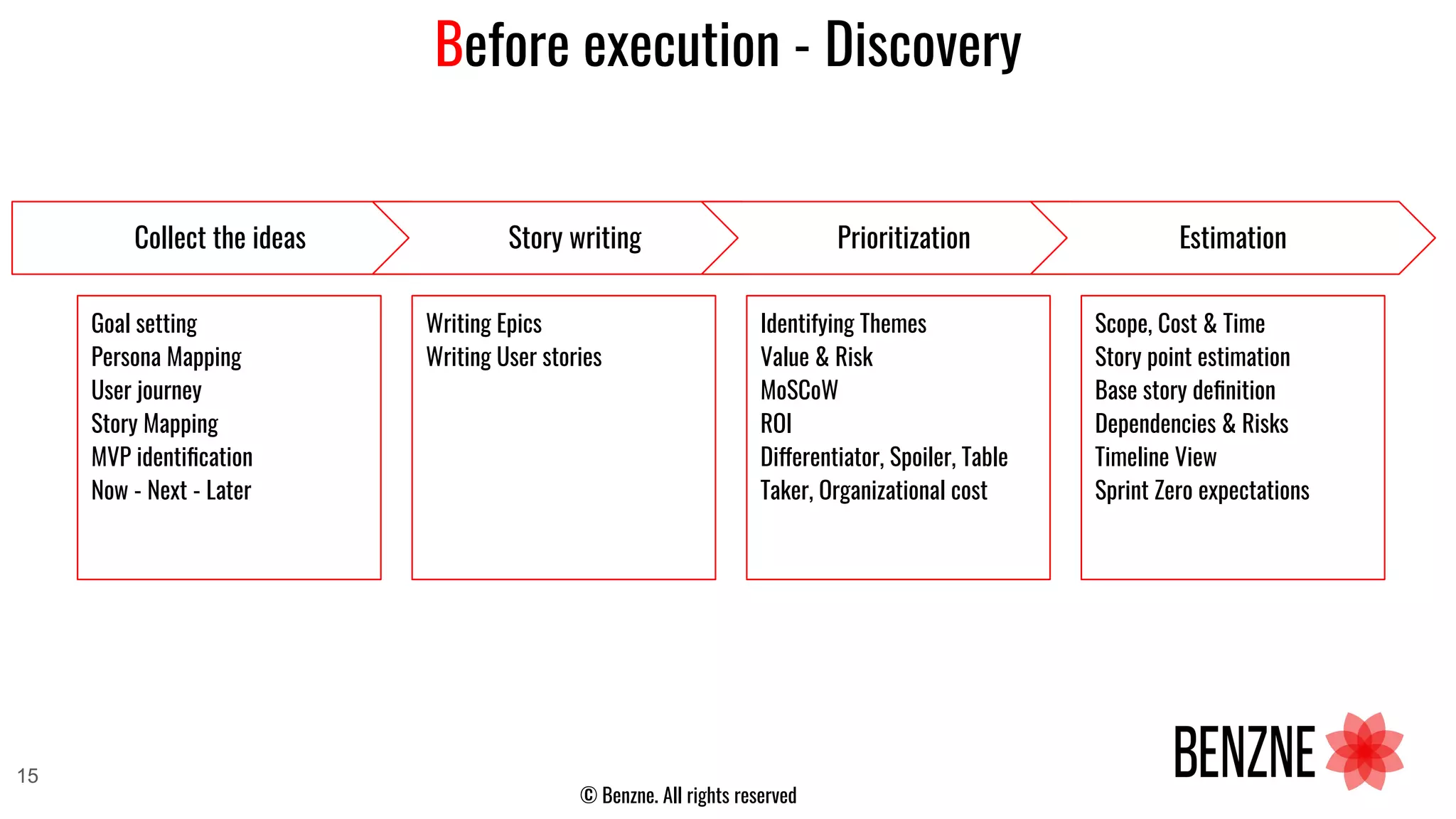
Before execution - Discovery
Collect the ideas
Goal setting
Persona Mapping
User journey
Story Mapping
MVP identification
Now - Next - Later
Story writing
Writing Epics
Writing User stories
Prioritization
Identifying Themes
Value & Risk
MoSCoW
ROI
Differentiator, Spoiler, Table
Taker, Organizational cost
Estimation
Scope, Cost & Time
Story point estimation
Base story definition
Dependencies & Risks
Timeline View
Sprint Zero expectations
15
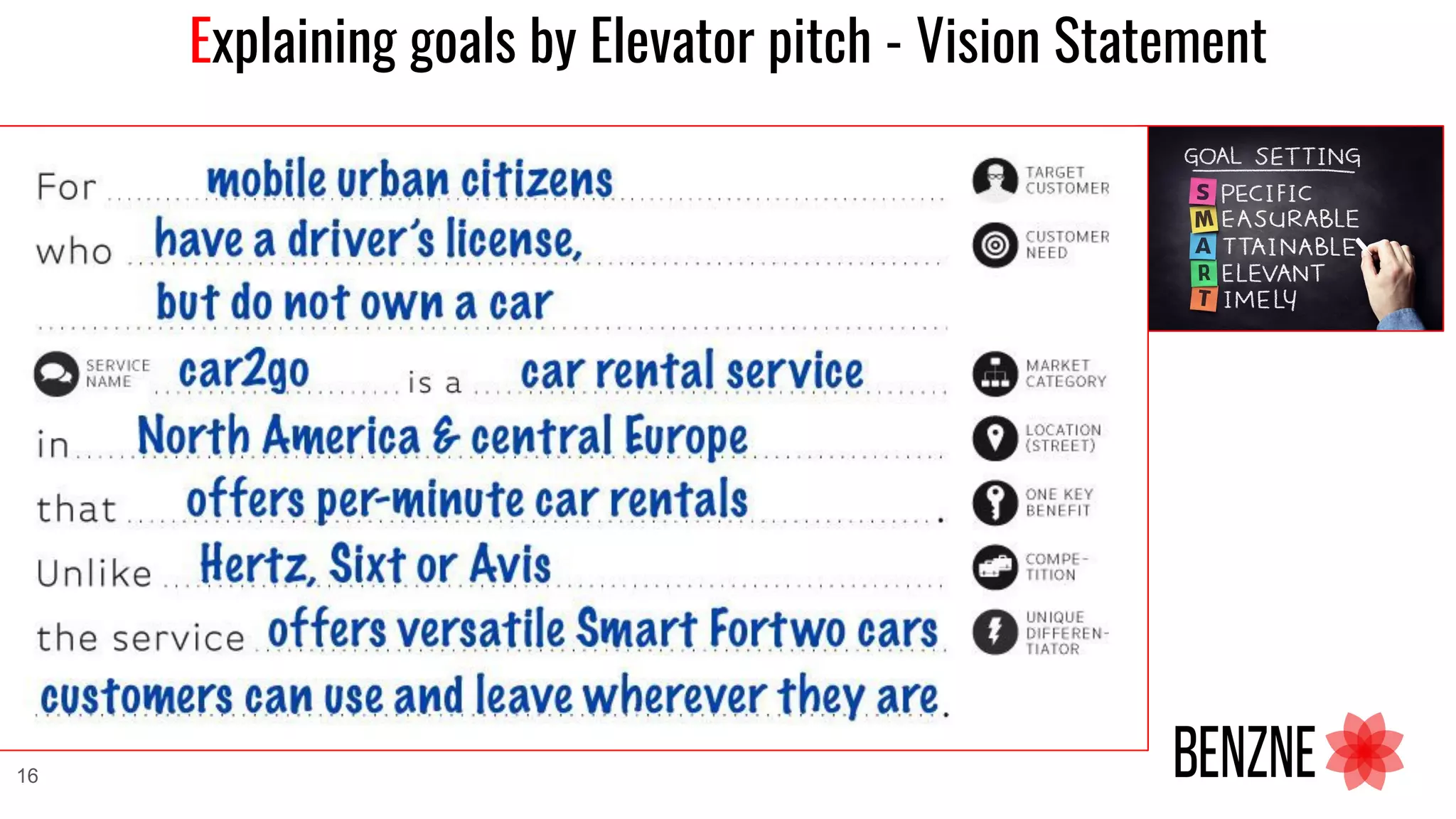
Explaining goals by Elevator pitch - Vision Statement
16
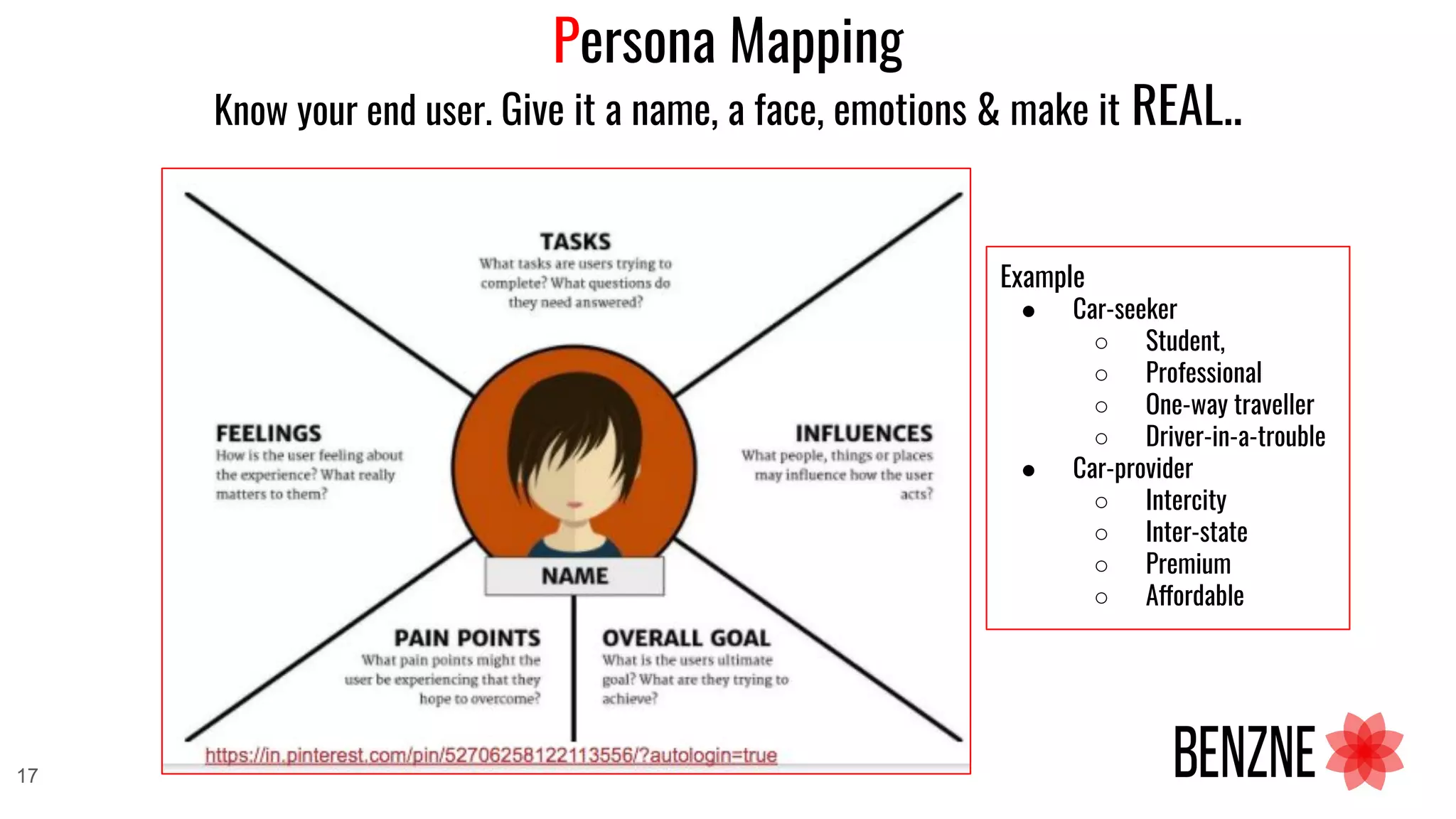
Persona Mapping
Know your end user. Give it a name, a face, emotions & make it REAL..
Example
● Car-seeker
○ Student,
○ Professional
○ One-way traveller
○ Driver-in-a-trouble
● Car-provider
○ Intercity
○ Inter-state
○ Premium
○ Affordable
17
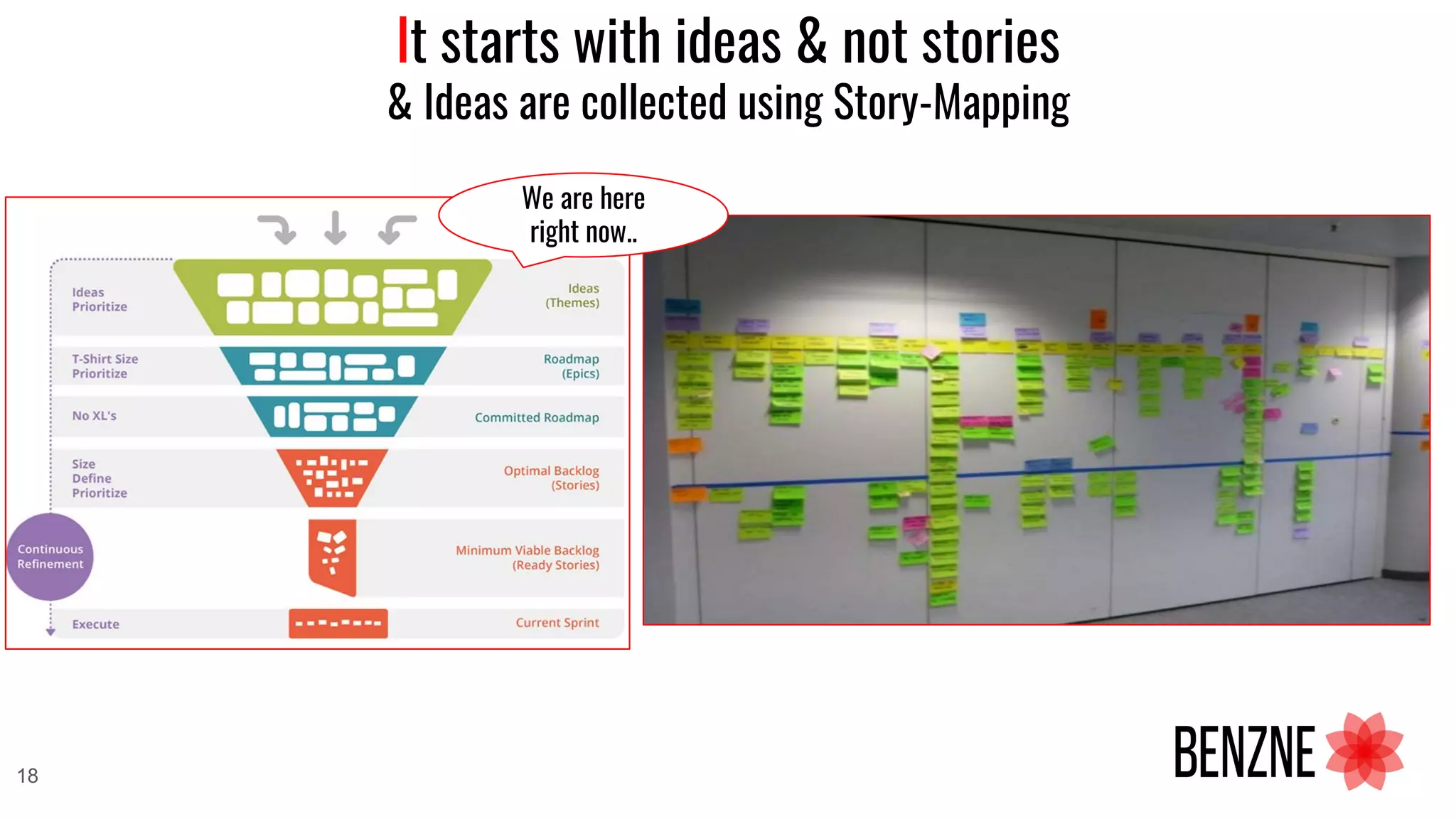
It starts with ideas & not stories
& Ideas are collected using Story-Mapping
We are here
right now..
18
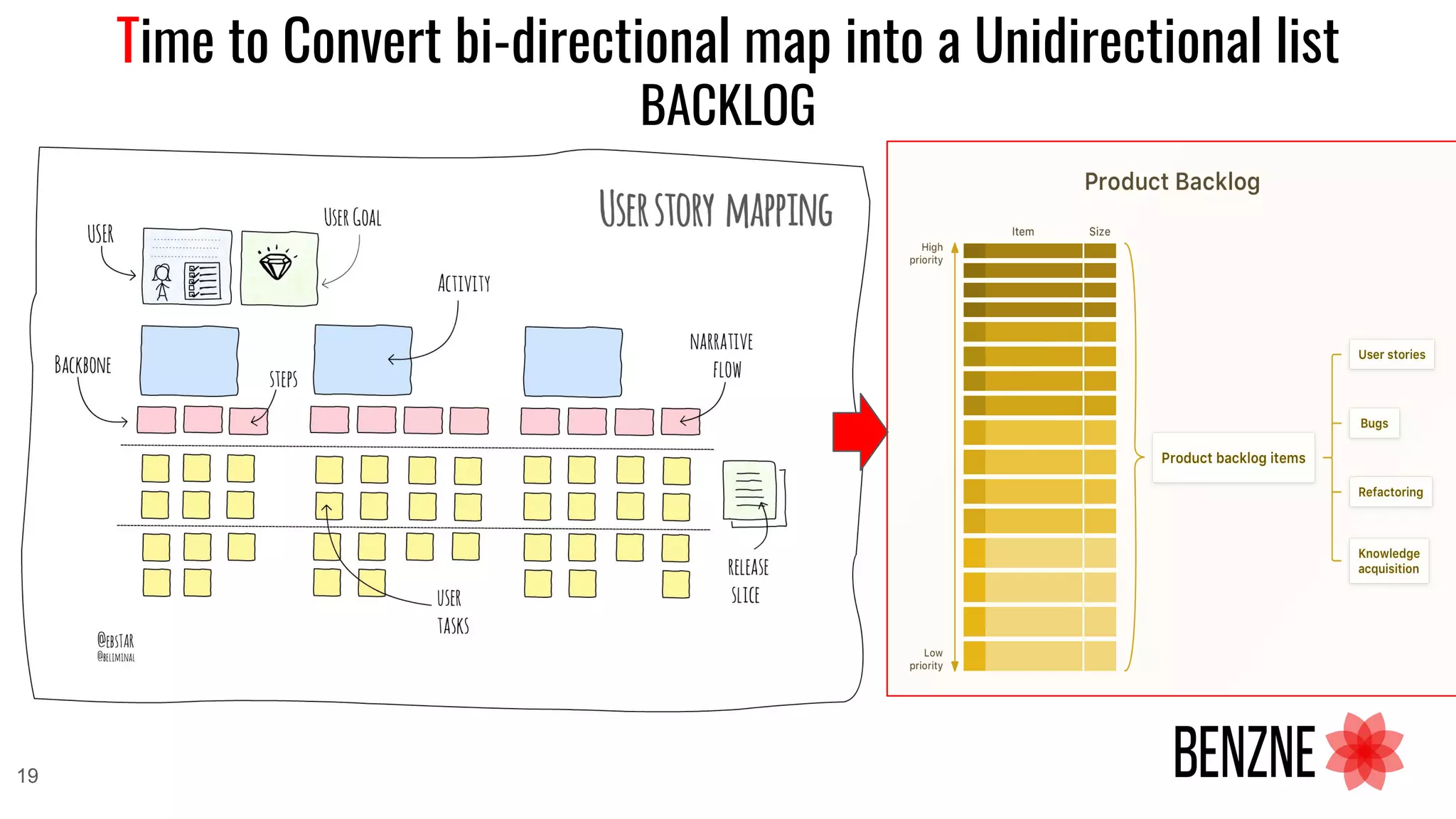
Time to Convert bi-directional map into a Unidirectional list
BACKLOG
19
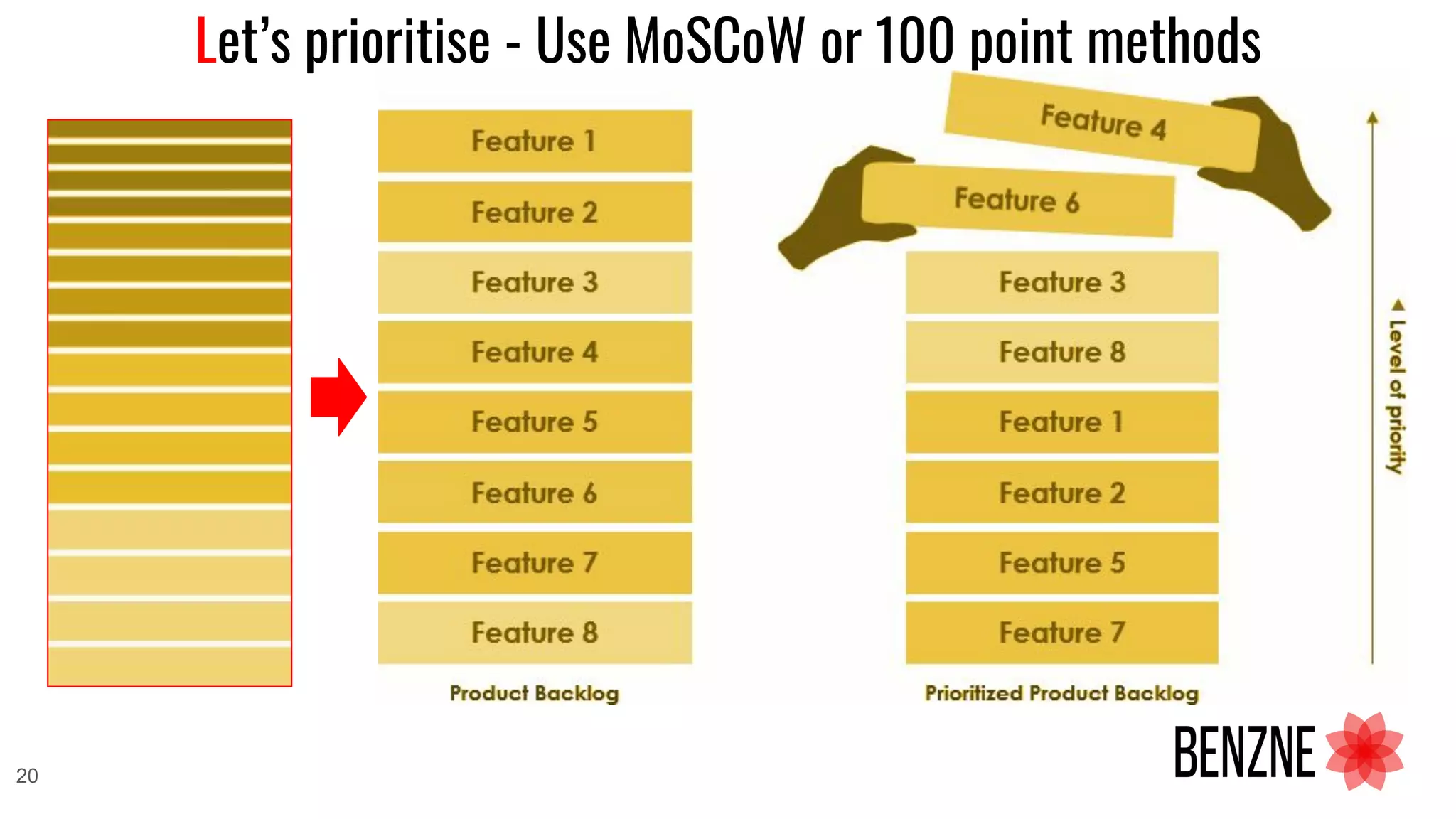
Let’s prioritise - Use MoSCoW or 100 point methods
20
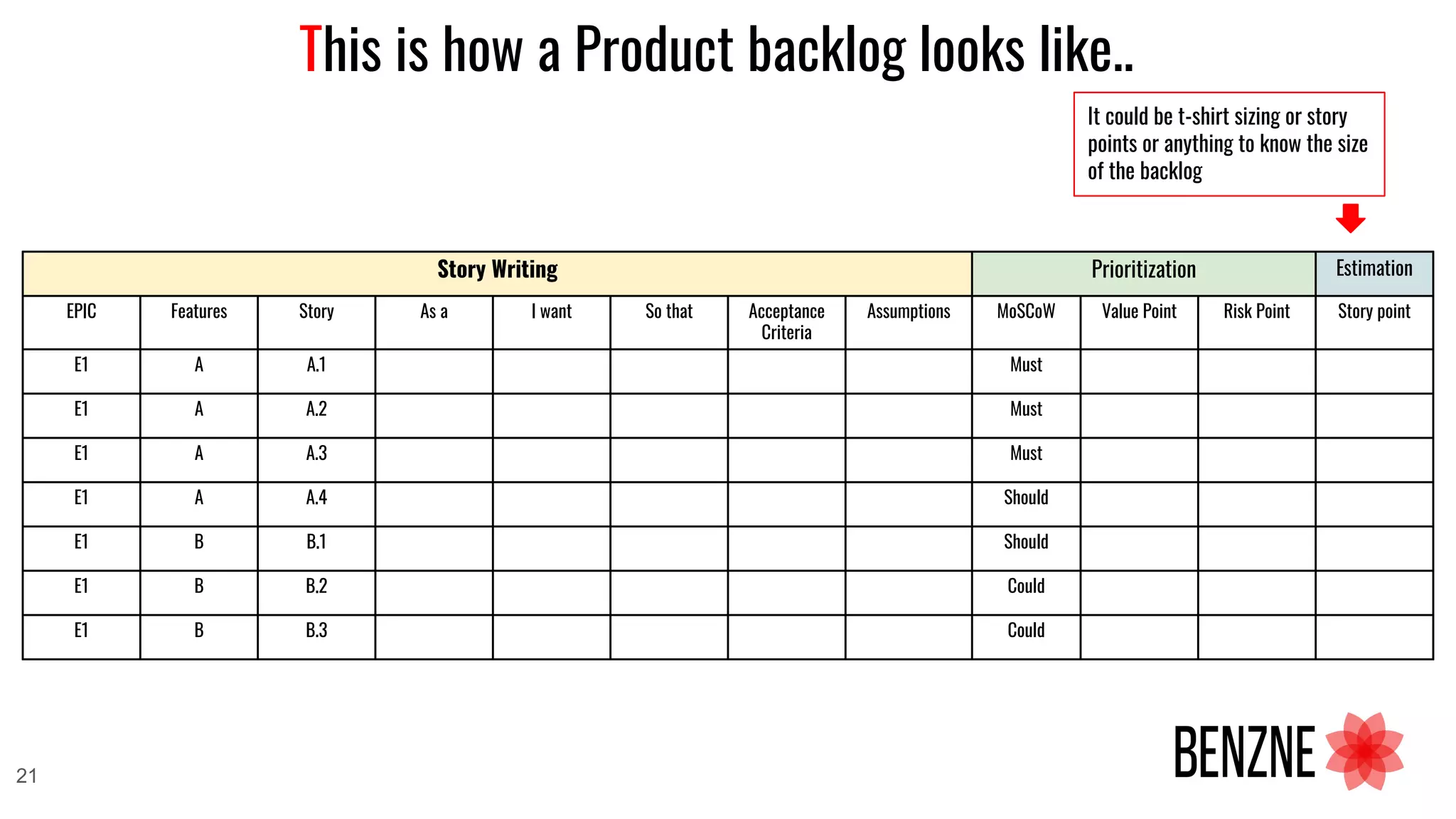
This is how a Product backlog looks like..
Story Writing Prioritization Estimation
EPIC Features Story As a I want So that Acceptance
Criteria
Assumptions MoSCoW Value Point Risk Point Story point
E1 A A.1 Must
E1 A A.2 Must
E1 A A.3 Must
E1 A A.4 Should
E1 B B.1 Should
E1 B B.2 Could
E1 B B.3 Could
It could be t-shirt sizing or story
points or anything to know the size
of the backlog
21
‘Questions’
22
‘Running Project’ Beyond Framework
Before execution (Discovery)
During execution (Sprinting)
After execution (Agility Health Assessment)
23
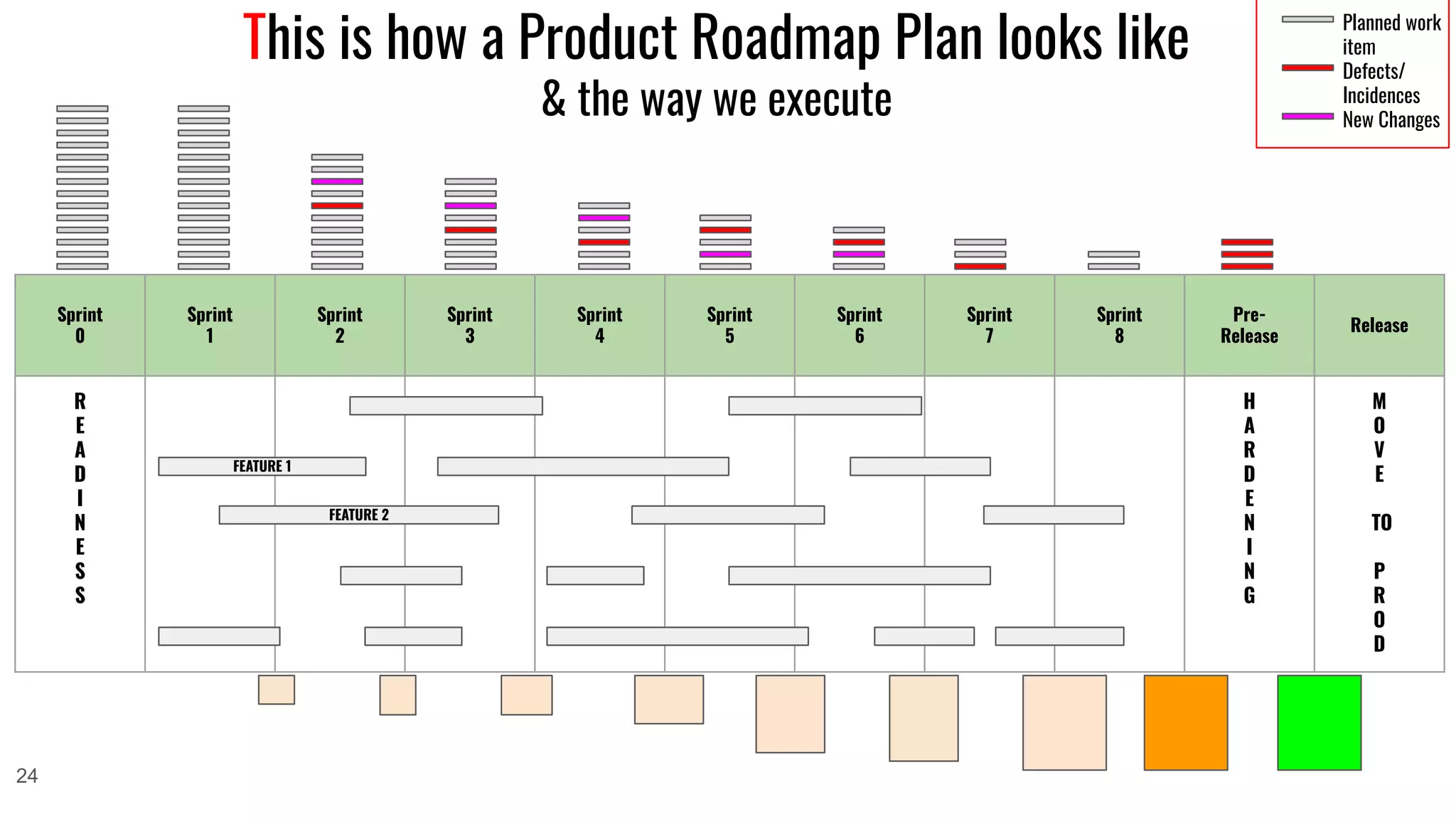
This is how a Product Roadmap Plan looks like
& the way we execute
Sprint
0
Sprint
1
Sprint
2
Sprint
3
Sprint
4
Sprint
5
Sprint
6
Sprint
7
Sprint
8
Pre-
Release
Release
R
E
A
D
I
N
E
S
S
H
A
R
D
E
N
I
N
G
M
O
V
E
TO
P
R
O
D
FEATURE 1
FEATURE 2
Planned work
item
Defects/
Incidences
New Changes
24
25
26
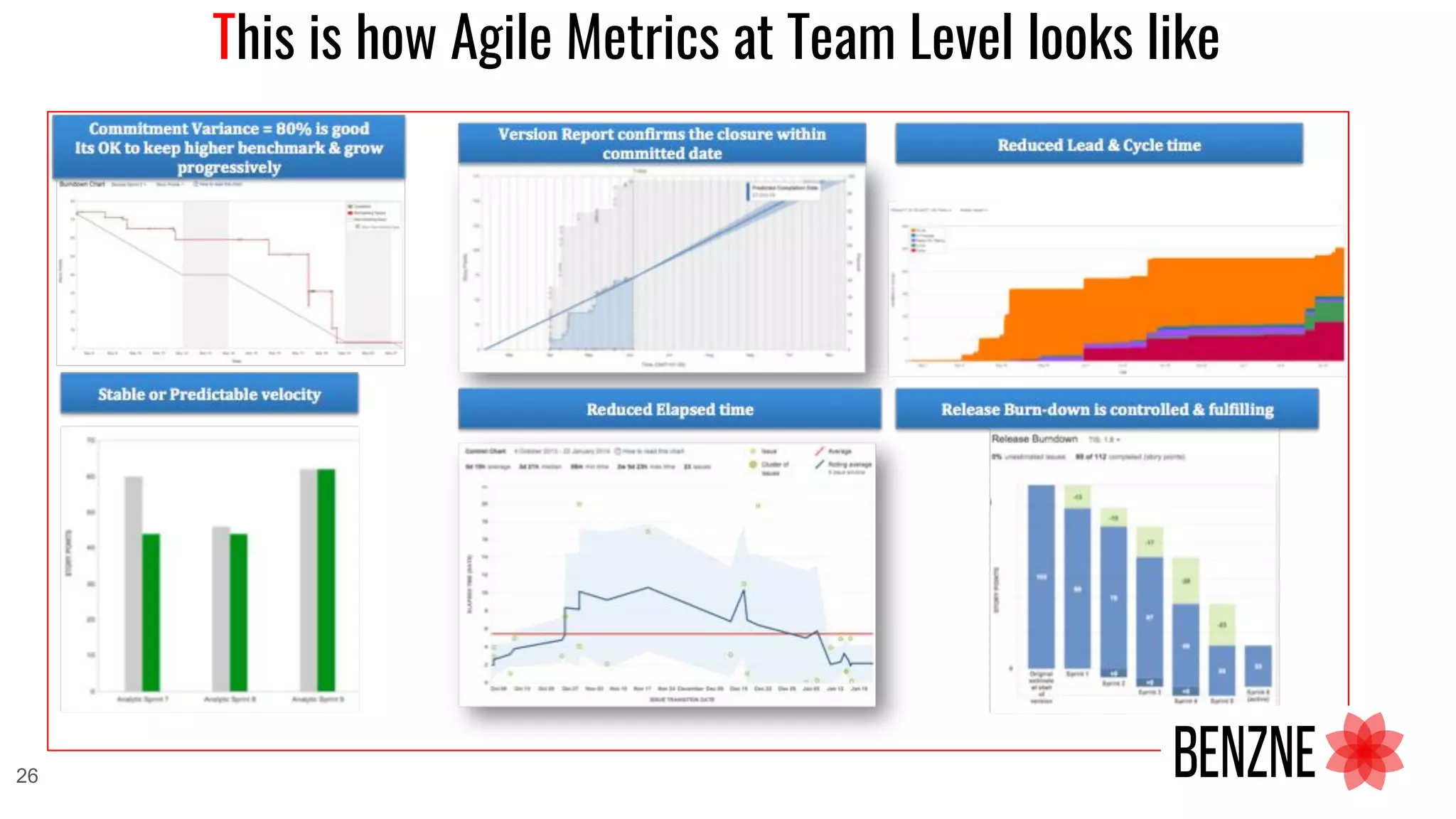
This is how Agile Metrics at Team Level looks like
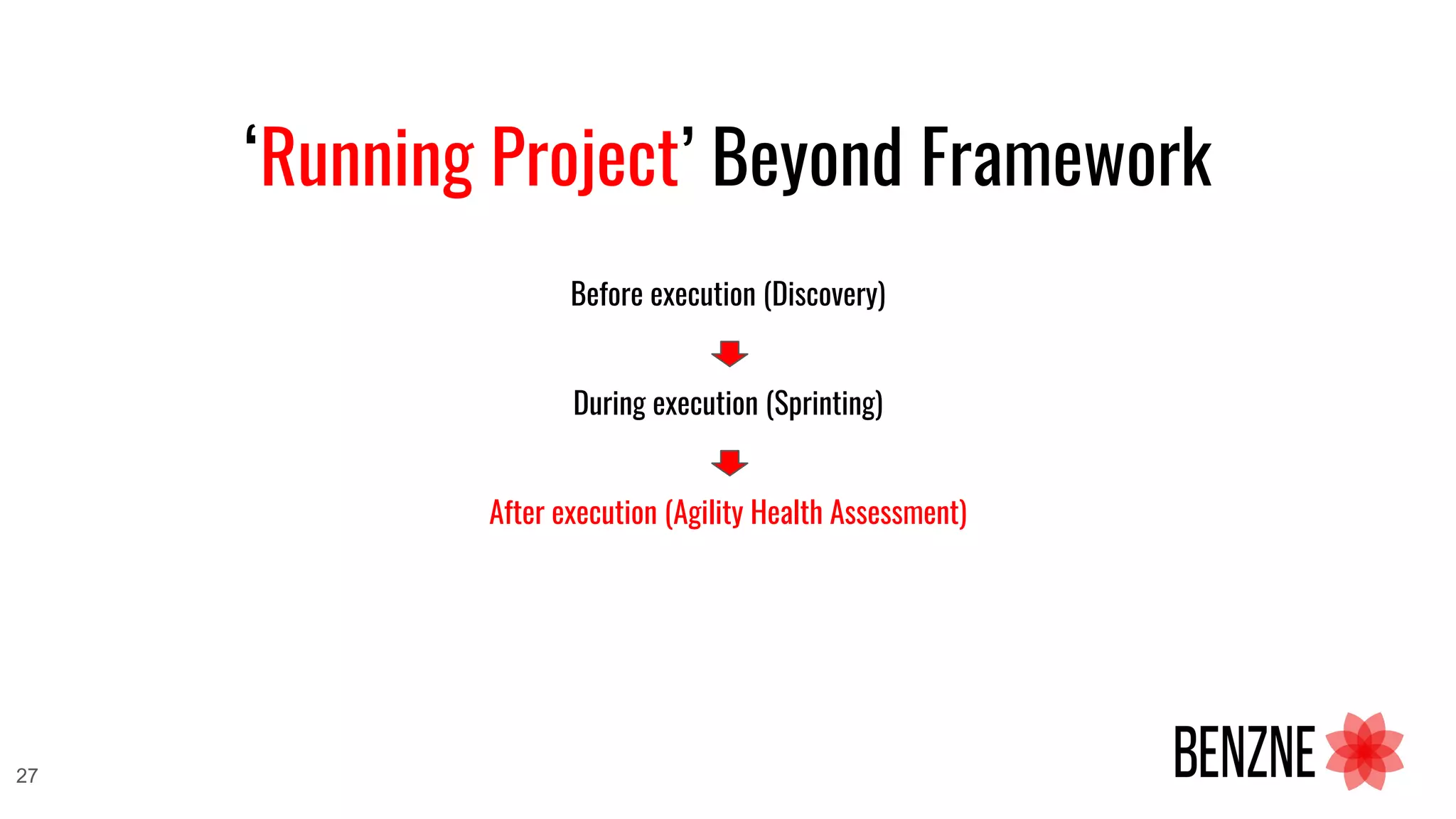
‘Running Project’ Beyond Framework
Before execution (Discovery)
During execution (Sprinting)
After execution (Agility Health Assessment)
27
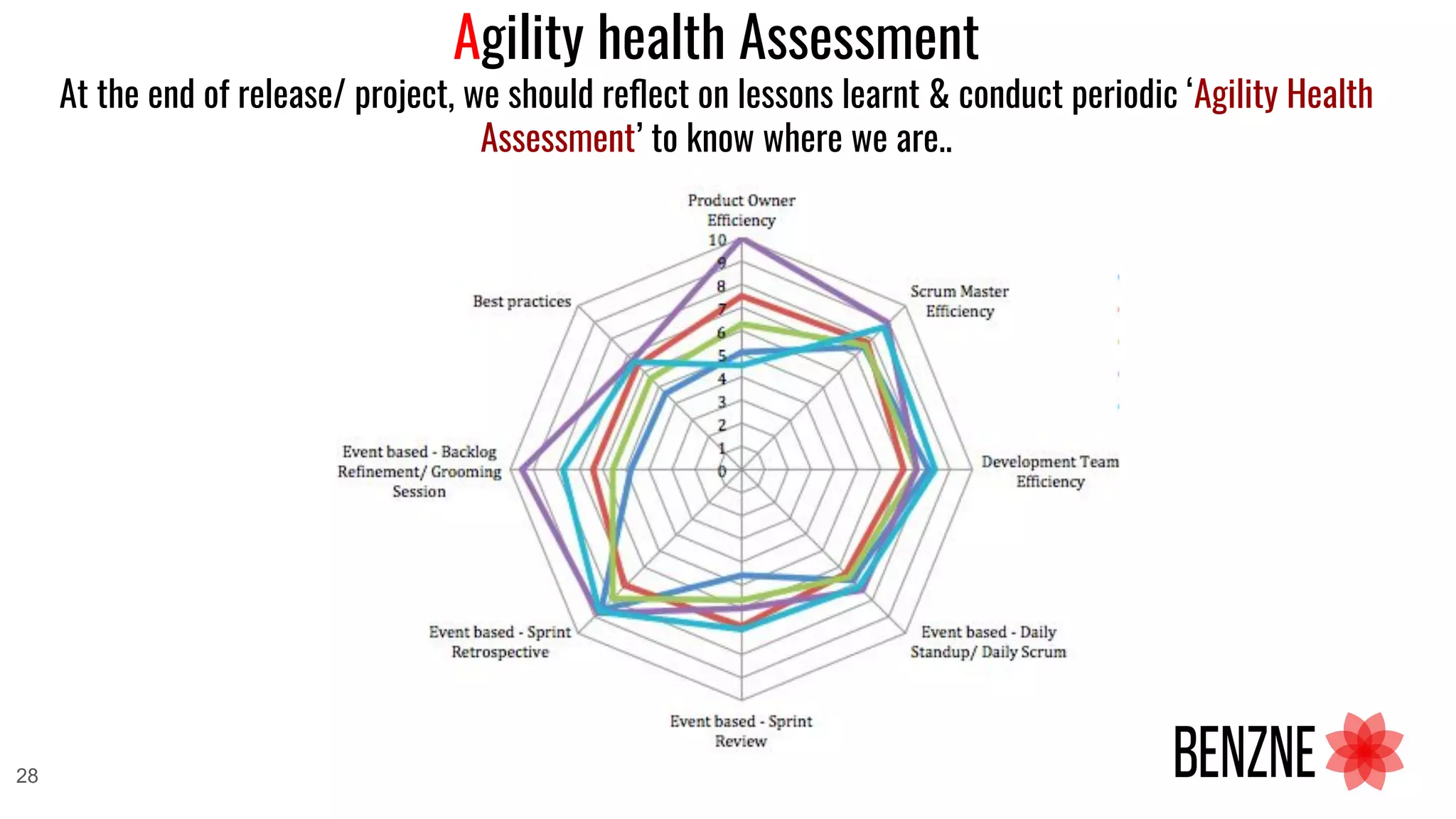
Agility health Assessment
At the end of release/ project, we should reflect on lessons learnt & conduct periodic ‘Agility Health
Assessment’ to know where we are..
28
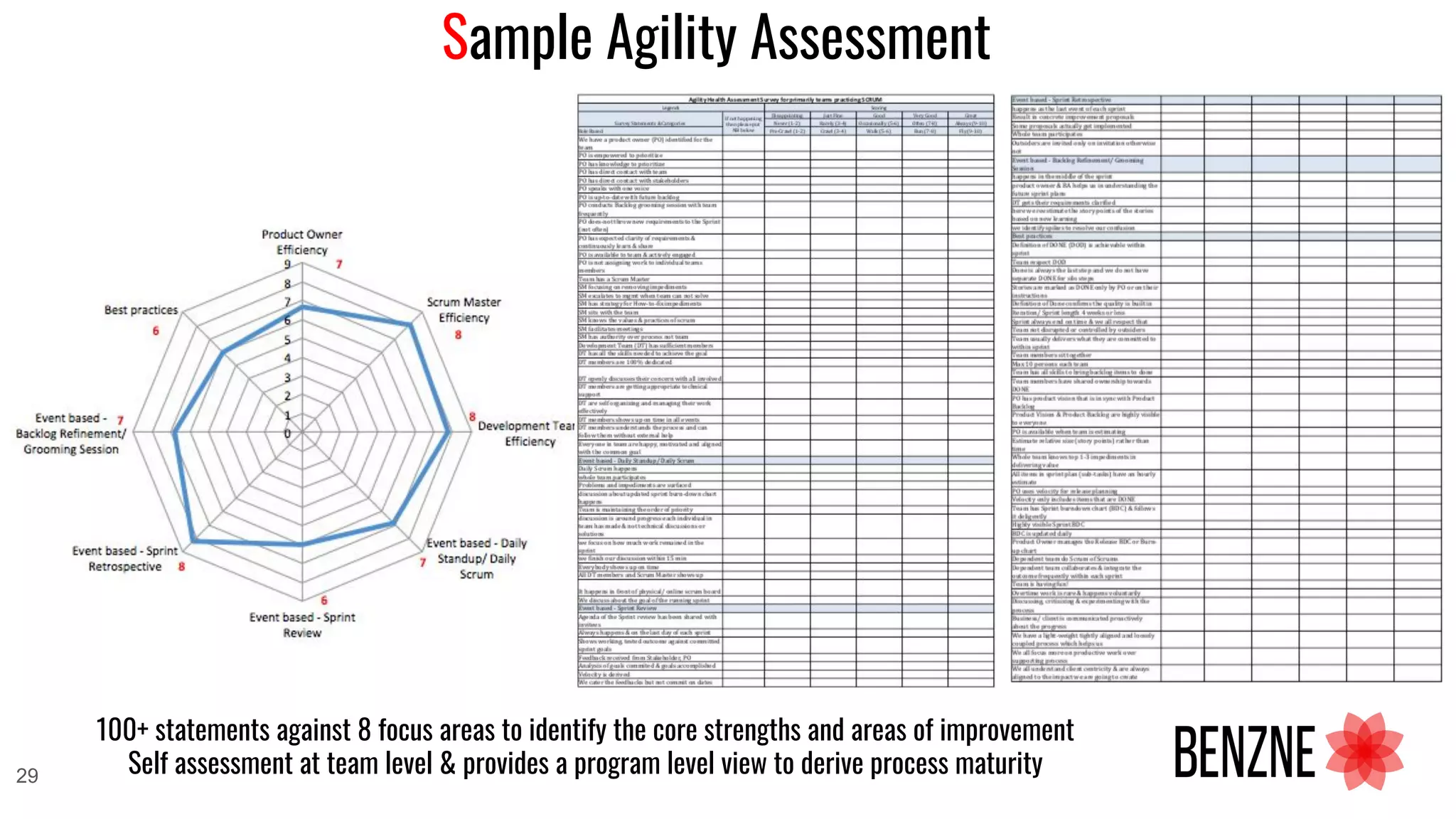
Sample Agility Assessment
29
100+ statements against 8 focus areas to identify the core strengths and areas of improvement
Self assessment at team level & provides a program level view to derive process maturity
‘Questions’
30
Some References
31
Those interested in a more in-depth understanding of Agile fundamentals can join our
upcoming online training workshop on 04-05 July (Sat-Sun), webinar attendees can
claim a flat 20% Discount. Details can be found here -
www.Benzne.com/training-calender/
Find this slide deck and many other learning resources for free at
www.Benzne.com/Learn/
© Benzne. All rights reserved
THANK YOU
www.Benzne.com

Benzne webinar Agility beyond implementing agile framework final

  • 1.
  • 2.
    © Benzne. Allrights reserved 2 AgileIOT AI Design Thinking Culture Lean Kanban Visualization DevOps CI/CD Scrum SAFe XP Cloud Analytics Mindset People Process Technology Data
  • 3.
  • 4.
    ‘Agility’ Beyond Framework TraditionalVs Agile Agile Approaches Just enough mindset Big Picture 4
  • 5.
    © Benzne. Allrights reserved What is Agile & Why are we doing it? 5
  • 6.
    Agile = Scrum? Agileis NOT a standard…. It’s collection of practices which are • Upheld by Values • Guided by Principles • People Centric • Self Organizing • Value Driven • Collaborative • Servant Leadership An approach where typically requirements & solutions evolve through collaboration of cross functional teams. An umbrella term for several iterative and incremental software development methodologies. 6
  • 7.
  • 8.
    © Benzne. Allrights reserved Agile Journey for an organization APPRISE Business Agility Organization Goals & Market demand Here all the functions have to run hand in hand and response continuously to changing business demands and delivering on time so as to sustain and overcome competition ARISE Scaling Agility to Program/ Portfolio/ Product Coaching at Program/ Portfolio level When you want to bring in the agility at a broader layer where the strategies are decided and the success is based on outcomes by multiple teams, technologies and process groups. ASCEND Create High Performing Teams Coaching at Team level When you need to know how to practice, bringing expertise in setting up the agile culture and to harbour the agile mindset in few projects so as to create success stories to cross pollinate. Workshop & Agility Health AssessmentsAWAKE Awareness & Assessment When you know your problem, then we help you by delivering specific workshops to overcome them. When you do not know your problem, then we can help you by assessing your existing process and recommend the growth plan for your agile transformation journey 8
  • 9.
    Less is More| Just-enough Mindset Let’s learn ‘bite of a burger’ concept ☺ What happens when you take the first bite? ‘We need to learn on how to limit our expectation and find out a way to create minimum outcome which can create maximum impact so as to fail faster by shortening the feedback loop…’ 9
  • 10.
    Iterative & IncrementalApproach Here each increment is just-enough high value & meaningful.. AUTHENTICATE FIND & SELECT (MENU CARD) SHOPPING CART PAY TRACK ORDER RETURN OR CANCEL 1st Increment 2nd Increment 3rd Increment USER JOURNEY z z 10
  • 11.
    Many levels ofAgility 11 This is where most of us apply agile.. So let’s learn the agility beyond framework at this level
  • 12.
    Bringing it alltogether Product Level Release Level Sprint Level 12
  • 13.
  • 14.
    ‘Running Project’ BeyondFramework Before execution (Discovery) During execution (Sprinting) After execution (Agility Health Assessment) 14
  • 15.
    © Benzne. Allrights reserved Before execution - Discovery Collect the ideas Goal setting Persona Mapping User journey Story Mapping MVP identification Now - Next - Later Story writing Writing Epics Writing User stories Prioritization Identifying Themes Value & Risk MoSCoW ROI Differentiator, Spoiler, Table Taker, Organizational cost Estimation Scope, Cost & Time Story point estimation Base story definition Dependencies & Risks Timeline View Sprint Zero expectations 15
  • 16.
    Explaining goals byElevator pitch - Vision Statement 16
  • 17.
    Persona Mapping Know yourend user. Give it a name, a face, emotions & make it REAL.. Example ● Car-seeker ○ Student, ○ Professional ○ One-way traveller ○ Driver-in-a-trouble ● Car-provider ○ Intercity ○ Inter-state ○ Premium ○ Affordable 17
  • 18.
    It starts withideas & not stories & Ideas are collected using Story-Mapping We are here right now.. 18
  • 19.
    Time to Convertbi-directional map into a Unidirectional list BACKLOG 19
  • 20.
    Let’s prioritise -Use MoSCoW or 100 point methods 20
  • 21.
    This is howa Product backlog looks like.. Story Writing Prioritization Estimation EPIC Features Story As a I want So that Acceptance Criteria Assumptions MoSCoW Value Point Risk Point Story point E1 A A.1 Must E1 A A.2 Must E1 A A.3 Must E1 A A.4 Should E1 B B.1 Should E1 B B.2 Could E1 B B.3 Could It could be t-shirt sizing or story points or anything to know the size of the backlog 21
  • 22.
  • 23.
    ‘Running Project’ BeyondFramework Before execution (Discovery) During execution (Sprinting) After execution (Agility Health Assessment) 23
  • 24.
    This is howa Product Roadmap Plan looks like & the way we execute Sprint 0 Sprint 1 Sprint 2 Sprint 3 Sprint 4 Sprint 5 Sprint 6 Sprint 7 Sprint 8 Pre- Release Release R E A D I N E S S H A R D E N I N G M O V E TO P R O D FEATURE 1 FEATURE 2 Planned work item Defects/ Incidences New Changes 24
  • 25.
  • 26.
    26 This is howAgile Metrics at Team Level looks like
  • 27.
    ‘Running Project’ BeyondFramework Before execution (Discovery) During execution (Sprinting) After execution (Agility Health Assessment) 27
  • 28.
    Agility health Assessment Atthe end of release/ project, we should reflect on lessons learnt & conduct periodic ‘Agility Health Assessment’ to know where we are.. 28
  • 29.
    Sample Agility Assessment 29 100+statements against 8 focus areas to identify the core strengths and areas of improvement Self assessment at team level & provides a program level view to derive process maturity
  • 30.
  • 31.
    Some References 31 Those interestedin a more in-depth understanding of Agile fundamentals can join our upcoming online training workshop on 04-05 July (Sat-Sun), webinar attendees can claim a flat 20% Discount. Details can be found here - www.Benzne.com/training-calender/ Find this slide deck and many other learning resources for free at www.Benzne.com/Learn/
  • 32.
    © Benzne. Allrights reserved THANK YOU www.Benzne.com