Scrum Session#1
HOSSAM HASSAN
KEEP IT SIMPLE & STRAIGHTFORWARD
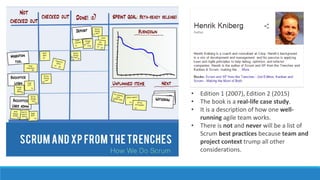
• Edition 1 (2007), Edition 2 (2015)
• The book is a real-life case study.
• It is a description of how one well-
running agile team works.
• There is not and never will be a list of
Scrum best practices because team and
project context trump all other
considerations.
Basic requirements for Agile iterative development:
1. Iterations must have fixed time boxes and be less than 6 weeks long
2. Code at the end of the iteration must be tested by QA and be working properly
Teams need to know Scrum basics.
1. How do you create and estimate a product backlog?
2. How do you turn it into a sprint backlog?
3. How do you manage a burn-down chart and calculate your team velocity?
The Nokia standards for Scrum:
1. A Scrum team must have a product owner and know who that person is.
2. A Scrum team must have a Product Backlog with estimates created by the team.
3. The team must have a Burndown Chart and know their velocity.
4. There must be no one outside a team interfering with the team during a sprint.
Focus on Getting Things Done.
•Scrum and XP teams don’t have time for theories.
•They don’t pursue drawing the perfect UML model in a case tool
•Or writing the perfect requirements document
•Or writing code that will be able to accommodate all imaginable future changes
Content
1. Intro
2. How we do product backlogs
3. How we prepare for sprint planning
4. How we do sprint planning
5. How we communicate sprints
6. How we do sprint backlogs.
7. How we arrange the team room
8. How we do daily scrums
9. How we do sprint demos
10. How we do sprint retrospectives
11. Slack time between sprints
12. How we do release planning and fixed-price contracts
13. How we combine Scrum with XP
14. How we do testing
15. How we handle multiple Scrum teams
16. How we handle geographically distributed teams
17. Scrum-master checklist
PART ONE
INTRO
What is Scrum?
•Scrum is not a methodology, it is a framework.
•What that means is that Scrum is not really going to tell you exactly what to do.
•The strength and pain of Scrum is that you are forced to adapt it to your specific situation.
•Scrum Guide(the official description of Scrum) http://www.scrumguides.org
PART TWO
HOW WE DO PRODUCT BACKLOGS
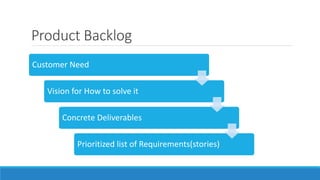
Product Backlog
Customer Need
Vision for How to solve it
Concrete Deliverables
Prioritized list of Requirements(stories)
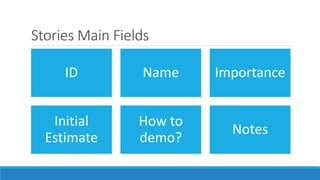
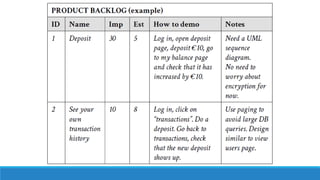
Stories Main Fields
ID Name Importance
Initial
Estimate
How to
demo?
Notes
1. ID
•A unique identification, just an auto-incremented number.
•This is to avoid losing track of stories when we rename them.
2. Name
•A short, descriptive name of the story.
•For example “See your own transaction history.”
•Clear enough so that developers and the product owner understands approximately what we
are talking about, and clear enough to distinguish it from other stories.
•Normally 2-10 words.
3. Importance
•The product owner’s importance rating for this story.
•For example 10. Or 150. High = more important.
•There’s no “importance” column. Instead, I just order the list.
4. Initial Estimate
•The team’s initial assessment of how much work is needed to implement this story compared
to other stories.
•The unit is story points and usually corresponds roughly to “ideal man-days”.
•How many days will you come out with a finished, demonstrable, tested, releasable
implementation? 3 guys * 4 days  12 story points.
•The important thing is to get the relative estimates correct.
•Estimates are in story points or T-shirt sizes (S/M/L), or there are even no estimates at all. But
more on that later.
5. How to Demo?
•A high-level description of how this story will be demonstrated at the sprint demo.
•This is essentially a simple test spec.
•“Do this, then do that, then this should happen.”
6. Notes
•Any other info, clarifications, references to other sources of info, etc.
•Normally very brief.
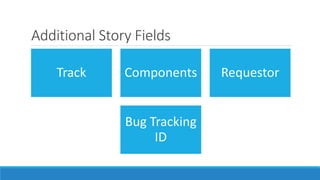
Additional Story Fields
Track Components Requestor
Bug Tracking
ID
Track
•A rough categorization of this story.
•For example “back office” or “optimization”.
•That way the product owner can easily filter out all “optimization” items and set their priority
to low, etc.
Components
•Usually realized as “checkboxes” i.e. “Database, Server, Client”
•The team or product owner can identify which technical components will be involved in
implementing this story.
•This is useful when you have multiple Scrum teams – for example, a back-office team and a
client team, and want to make it easier for each team to decide which stories to take on.
Requestor
•The product owner may want to keep track of which customer or stakeholder originally
requested the item
•In order to give him feedback on the progress
Bug Tracking ID
•If you have a separate bug tracking system, like we do with Jira
•It is useful to keep track of any direct correspondence between a story and one or more
reported bugs.
How we keep the product backlog
at a business level
•If the product owner has a technical background, he might add stories such as “Add indexes to
the Events table”.
•Ask the product owner a series of “but why?” questions until we find the underlying goal
“speed up the search event form in the back office”.
•There’s an old and well-established template for this: “As X, I want Y, so that Z.”
•For example “As buyer, I want to save my shopping cart, so that I can continue shopping
tomorrow.”
Thank You 
Next:
• PART THREE - How we prepare for sprint planning
• PART FOUR - How we do sprint planning

Scrum and-xp-from-the-trenches 01 intro & backlog

  • 1.
    Scrum Session#1 HOSSAM HASSAN KEEPIT SIMPLE & STRAIGHTFORWARD
  • 2.
    • Edition 1(2007), Edition 2 (2015) • The book is a real-life case study. • It is a description of how one well- running agile team works. • There is not and never will be a list of Scrum best practices because team and project context trump all other considerations.
  • 3.
    Basic requirements forAgile iterative development: 1. Iterations must have fixed time boxes and be less than 6 weeks long 2. Code at the end of the iteration must be tested by QA and be working properly
  • 4.
    Teams need toknow Scrum basics. 1. How do you create and estimate a product backlog? 2. How do you turn it into a sprint backlog? 3. How do you manage a burn-down chart and calculate your team velocity?
  • 5.
    The Nokia standardsfor Scrum: 1. A Scrum team must have a product owner and know who that person is. 2. A Scrum team must have a Product Backlog with estimates created by the team. 3. The team must have a Burndown Chart and know their velocity. 4. There must be no one outside a team interfering with the team during a sprint.
  • 6.
    Focus on GettingThings Done. •Scrum and XP teams don’t have time for theories. •They don’t pursue drawing the perfect UML model in a case tool •Or writing the perfect requirements document •Or writing code that will be able to accommodate all imaginable future changes
  • 7.
    Content 1. Intro 2. Howwe do product backlogs 3. How we prepare for sprint planning 4. How we do sprint planning 5. How we communicate sprints 6. How we do sprint backlogs. 7. How we arrange the team room 8. How we do daily scrums 9. How we do sprint demos 10. How we do sprint retrospectives 11. Slack time between sprints 12. How we do release planning and fixed-price contracts 13. How we combine Scrum with XP 14. How we do testing 15. How we handle multiple Scrum teams 16. How we handle geographically distributed teams 17. Scrum-master checklist
  • 8.
  • 9.
    What is Scrum? •Scrumis not a methodology, it is a framework. •What that means is that Scrum is not really going to tell you exactly what to do. •The strength and pain of Scrum is that you are forced to adapt it to your specific situation. •Scrum Guide(the official description of Scrum) http://www.scrumguides.org
  • 10.
    PART TWO HOW WEDO PRODUCT BACKLOGS
  • 11.
    Product Backlog Customer Need Visionfor How to solve it Concrete Deliverables Prioritized list of Requirements(stories)
  • 12.
    Stories Main Fields IDName Importance Initial Estimate How to demo? Notes
  • 13.
    1. ID •A uniqueidentification, just an auto-incremented number. •This is to avoid losing track of stories when we rename them.
  • 14.
    2. Name •A short,descriptive name of the story. •For example “See your own transaction history.” •Clear enough so that developers and the product owner understands approximately what we are talking about, and clear enough to distinguish it from other stories. •Normally 2-10 words.
  • 15.
    3. Importance •The productowner’s importance rating for this story. •For example 10. Or 150. High = more important. •There’s no “importance” column. Instead, I just order the list.
  • 16.
    4. Initial Estimate •Theteam’s initial assessment of how much work is needed to implement this story compared to other stories. •The unit is story points and usually corresponds roughly to “ideal man-days”. •How many days will you come out with a finished, demonstrable, tested, releasable implementation? 3 guys * 4 days  12 story points. •The important thing is to get the relative estimates correct. •Estimates are in story points or T-shirt sizes (S/M/L), or there are even no estimates at all. But more on that later.
  • 17.
    5. How toDemo? •A high-level description of how this story will be demonstrated at the sprint demo. •This is essentially a simple test spec. •“Do this, then do that, then this should happen.”
  • 18.
    6. Notes •Any otherinfo, clarifications, references to other sources of info, etc. •Normally very brief.
  • 20.
    Additional Story Fields TrackComponents Requestor Bug Tracking ID
  • 21.
    Track •A rough categorizationof this story. •For example “back office” or “optimization”. •That way the product owner can easily filter out all “optimization” items and set their priority to low, etc.
  • 22.
    Components •Usually realized as“checkboxes” i.e. “Database, Server, Client” •The team or product owner can identify which technical components will be involved in implementing this story. •This is useful when you have multiple Scrum teams – for example, a back-office team and a client team, and want to make it easier for each team to decide which stories to take on.
  • 23.
    Requestor •The product ownermay want to keep track of which customer or stakeholder originally requested the item •In order to give him feedback on the progress
  • 24.
    Bug Tracking ID •Ifyou have a separate bug tracking system, like we do with Jira •It is useful to keep track of any direct correspondence between a story and one or more reported bugs.
  • 25.
    How we keepthe product backlog at a business level •If the product owner has a technical background, he might add stories such as “Add indexes to the Events table”. •Ask the product owner a series of “but why?” questions until we find the underlying goal “speed up the search event form in the back office”. •There’s an old and well-established template for this: “As X, I want Y, so that Z.” •For example “As buyer, I want to save my shopping cart, so that I can continue shopping tomorrow.”
  • 26.
    Thank You  Next: •PART THREE - How we prepare for sprint planning • PART FOUR - How we do sprint planning