Digital Innovation Group
Arla Foods
Medicine for the pain points of
purchasing agile
Karoliina Luoto
3.9.2013
Karoliina Luoto + Codento

Presently consultant for
 Business and use cases
oriented digital service
concepting
 Agile project management

Before: product owner,
collaboration strategist,
communications specialist
 Consultancy company for
intelligent software
development
This presentation

Pondering agile project management and leadership

Special emphasis on the purchasing techniques and
agreement tools
How many of your
organizations have used
agile development
for web tools?
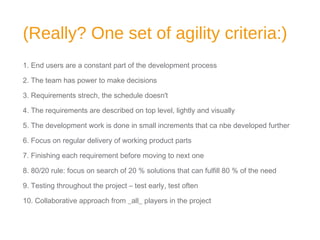
(Really? One set of agility criteria:)
1. End users are a constant part of the development process
2. The team has power to make decisions
3. Requirements strech, the schedule doesn't
4. The requirements are described on top level, lightly and visually
5. The development work is done in small increments that ca nbe developed further
6. Focus on regular delivery of working product parts
7. Finishing each requirement before moving to next one
8. 80/20 rule: focus on search of 20 % solutions that can fulfill 80 % of the need
9. Testing throughout the project – test early, test often
10. Collaborative approach from _all_ players in the project
6
Photo: Boy-piyaphon, Flickr
Beatiful but
potentially
dangerous
The possible dangers of waterfall

Waterfall project models (plan – implement – test –
launch) work fine for clear, well-defined targets

When we step ouside this zone, problems easily arise
 Lack of communication
 Development does not focus on the most value-adding
functionality
 Delays due to cascading problems
 Changing requirements / growing understanding
 Time and money gets spent on arguing
 Client avoiding responsibility
 Who can know and communicate the business needs if not you?
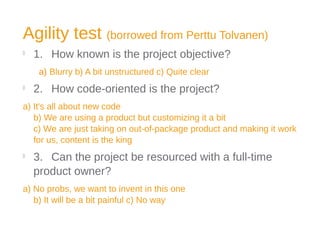
Agility test (borrowed from Perttu Tolvanen)

1. How known is the project objective?
a) Blurry b) A bit unstructured c) Quite clear

2. How code-oriented is the project?
a) It's all about new code
b) We are using a product but customizing it a bit
c) We are just taking on out-of-package product and making it work
for us, content is the king

3. Can the project be resourced with a full-time
product owner?
a) No probs, we want to invent in this one
b) It will be a bit painful c) No way
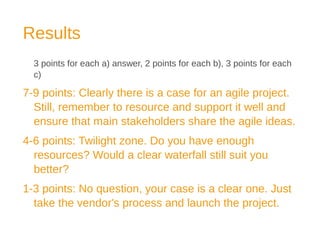
Results
3 points for each a) answer, 2 points for each b), 3 points for each
c)
7-9 points: Clearly there is a case for an agile project.
Still, remember to resource and support it well and
ensure that main stakeholders share the agile ideas.
4-6 points: Twilight zone. Do you have enough
resources? Would a clear waterfall still suit you
better?
1-3 points: No question, your case is a clear one. Just
take the vendor's process and launch the project.
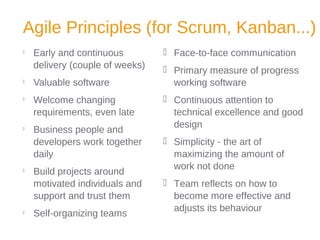
Agile Principles (for Scrum, Kanban...)

Early and continuous
delivery (couple of weeks)

Valuable software

Welcome changing
requirements, even late

Business people and
developers work together
daily

Build projects around
motivated individuals and
support and trust them

Self-organizing teams
 Face-to-face communication
 Primary measure of progress
working software
 Continuous attention to
technical excellence and good
design
 Simplicity - the art of
maximizing the amount of
work not done
 Team reflects on how to
become more effective and
adjusts its behaviour
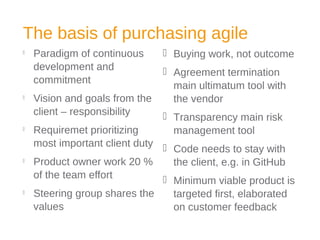
The basis of purchasing agile

Paradigm of continuous
development and
commitment

Vision and goals from the
client – responsibility

Requiremet prioritizing
most important client duty

Product owner work 20 %
of the team effort

Steering group shares the
values
 Buying work, not outcome
 Agreement termination
main ultimatum tool with
the vendor
 Transparency main risk
management tool
 Code needs to stay with
the client, e.g. in GitHub
 Minimum viable product is
targeted first, elaborated
on customer feedback
The key factors in purchasing agile

Buying talent

Buying team work

Keeping the talent

Scalability

Budget control

Quality assurance

Transferrability

Support
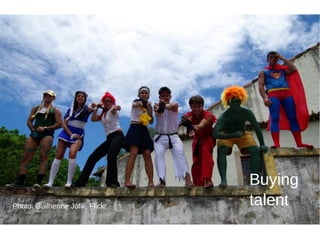
Buying
talentPhoto: Guilherme Jófili, Flickr
Buying talent

Make sure that you get knowhow from specific people,
not from the generic firm

Tools available:
1. In the tendering, ask forrelevant references from the named
team members attending this project
2. Can be verified with interviews
3. ...or with reference requests from former clients
➢
To allure the best talent to participate, make your project
worthwile and advertise it!
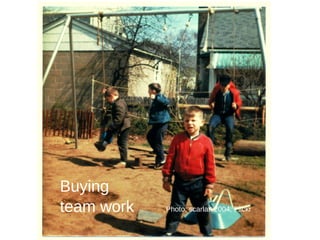
Buying
team work Photo: scarlatti2004, Flickr
Buying team work

The talent does not help much if it doesn't work together

Compare for example:
1. The summed co-work experience days of the team
2. Description of the supplier support and method development
for team work
3. A small test task as part of the tendering process helps
verifying
4. Also psychological tests used in some cases
(would not recommend)
Keeping
the talentPhoto: massdistraction, Flickr
Keeping the talent

Basic problem: in long projects, people in teams tend to
change

Basic solution: make the project worthwhile

Rules for team member changes
1. Right to say no to a specific substitute member
2. The new person must have at least equivalent experience
compared to the original one
3. Verifying know-how with the original process
4. Agreed sanction for team member changes, for example 10
person days of free on-board work
5. In big projects: two suppliers bringing team members
ScalabilityPhoto: Andy Hay, Flickr
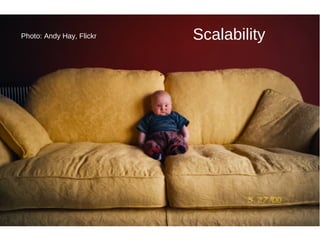
Scalability

In big projects, work can be divided between two or
more teams
 One backlog is then used to serve meaningful goalsets / sprint
backlogs for several teams
 One supplier can be asked for multiple teams, or
 This can build on multi-supplier basis
 Coherent backlog management key success factor
Thoughts on the
talent/people management?
Spotted problems / extra
ideas? Experiences?
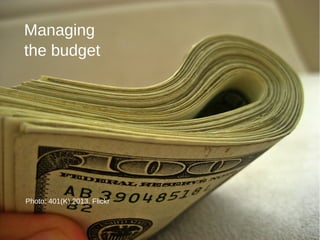
Managing
the budget
Photo: 401(K) 2013, Flickr
Managing the budget

When buying work not outcomes, need for incentives for
maximum effort
1. The product owner can give supplier 5-10 % prize/sanction per
release based on subjective valuation of effort
2. Crucial to aim together at 20 % solutions with 80 % user need
solving
3. 50 % of budget used for the minimum viable product, if not
obtained, missing work with 25 % discount
4. Possibility for the supplier to bring in new talent when
knowledge gaps spotted
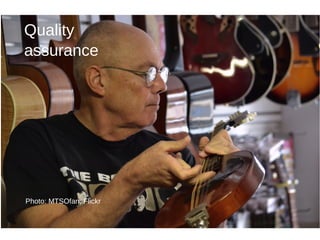
Quality
assurance
Photo: MTSOfan, Flickr
Quality assurance

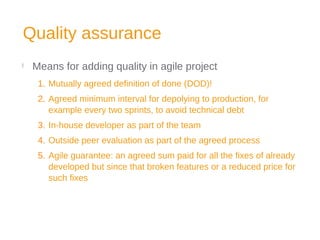
Means for adding quality in agile project
1. Mutually agreed definition of done (DOD)!
2. Agreed minimum interval for depolying to production, for
example every two sprints, to avoid technical debt
3. In-house developer as part of the team
4. Outside peer evaluation as part of the agreed process
5. Agile guarantee: an agreed sum paid for all the fixes of already
developed but since that broken features or a reduced price for
such fixes
Transferrability
Photo: ibm4381, Flickr
Transferrability (in case of supplier
change)

Even best co-work ends sometimes

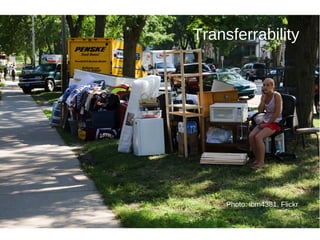
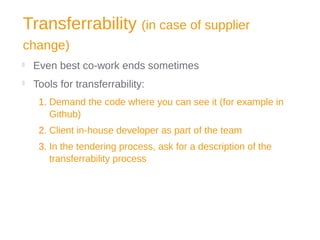
Tools for transferrability:
1. Demand the code where you can see it (for example in
Github)
2. Client in-house developer as part of the team
3. In the tendering process, ask for a description of the
transferrability process
Thoughts on the asset
management? Spotted
problems / extra ideas?
Experiences?
Support
Photo: 4 Cdn Div/4 Div CA – JTFC/FOIC,
Flickr
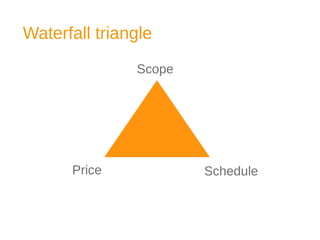
Waterfall triangle
SchedulePrice
Scope
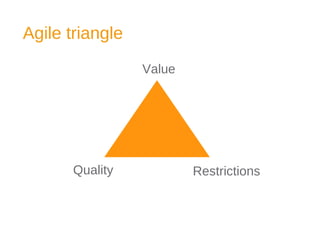
Agile triangle
RestrictionsQuality
Value
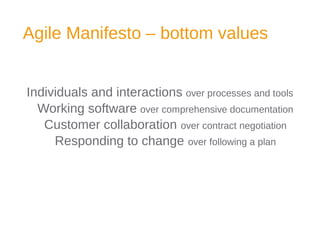
Agile Manifesto – bottom values
Individuals and interactions over processes and tools
Working software over comprehensive documentation
Customer collaboration over contract negotiation
Responding to change over following a plan
Support: ?

Since for a lot of organization this is revolutionary, the
macro key success factor is support from the
organization

Tools
 An oath from the steering group members to be able to steer
the vision and leave the day-to-day decicions for the product
owner
 An oath from the steering group members to be able to
prioritize between product constraints
 Release planning in steering group
 Open reviews the official Scrum answer
 Mutual agile coaching for all key stakeholders and steering
group
What else is there? Must be
something more?
(Worst case scenario: individuals - and
projects - crushed between paradigms)
Thank you!
www.codento.com / @codento
Karoliina Luoto
Karoliina.luoto@codento.com
@totoroki
+358 40 765 8504

Agile purchasing

  • 1.
    Digital Innovation Group ArlaFoods Medicine for the pain points of purchasing agile Karoliina Luoto 3.9.2013
  • 2.
    Karoliina Luoto +Codento  Presently consultant for  Business and use cases oriented digital service concepting  Agile project management  Before: product owner, collaboration strategist, communications specialist  Consultancy company for intelligent software development
  • 3.
    This presentation  Pondering agileproject management and leadership  Special emphasis on the purchasing techniques and agreement tools
  • 4.
    How many ofyour organizations have used agile development for web tools?
  • 5.
    (Really? One setof agility criteria:) 1. End users are a constant part of the development process 2. The team has power to make decisions 3. Requirements strech, the schedule doesn't 4. The requirements are described on top level, lightly and visually 5. The development work is done in small increments that ca nbe developed further 6. Focus on regular delivery of working product parts 7. Finishing each requirement before moving to next one 8. 80/20 rule: focus on search of 20 % solutions that can fulfill 80 % of the need 9. Testing throughout the project – test early, test often 10. Collaborative approach from _all_ players in the project
  • 6.
    6 Photo: Boy-piyaphon, Flickr Beatifulbut potentially dangerous
  • 7.
    The possible dangersof waterfall  Waterfall project models (plan – implement – test – launch) work fine for clear, well-defined targets  When we step ouside this zone, problems easily arise  Lack of communication  Development does not focus on the most value-adding functionality  Delays due to cascading problems  Changing requirements / growing understanding  Time and money gets spent on arguing  Client avoiding responsibility  Who can know and communicate the business needs if not you?
  • 8.
    Agility test (borrowedfrom Perttu Tolvanen)  1. How known is the project objective? a) Blurry b) A bit unstructured c) Quite clear  2. How code-oriented is the project? a) It's all about new code b) We are using a product but customizing it a bit c) We are just taking on out-of-package product and making it work for us, content is the king  3. Can the project be resourced with a full-time product owner? a) No probs, we want to invent in this one b) It will be a bit painful c) No way
  • 9.
    Results 3 points foreach a) answer, 2 points for each b), 3 points for each c) 7-9 points: Clearly there is a case for an agile project. Still, remember to resource and support it well and ensure that main stakeholders share the agile ideas. 4-6 points: Twilight zone. Do you have enough resources? Would a clear waterfall still suit you better? 1-3 points: No question, your case is a clear one. Just take the vendor's process and launch the project.
  • 10.
    Agile Principles (forScrum, Kanban...)  Early and continuous delivery (couple of weeks)  Valuable software  Welcome changing requirements, even late  Business people and developers work together daily  Build projects around motivated individuals and support and trust them  Self-organizing teams  Face-to-face communication  Primary measure of progress working software  Continuous attention to technical excellence and good design  Simplicity - the art of maximizing the amount of work not done  Team reflects on how to become more effective and adjusts its behaviour
  • 11.
    The basis ofpurchasing agile  Paradigm of continuous development and commitment  Vision and goals from the client – responsibility  Requiremet prioritizing most important client duty  Product owner work 20 % of the team effort  Steering group shares the values  Buying work, not outcome  Agreement termination main ultimatum tool with the vendor  Transparency main risk management tool  Code needs to stay with the client, e.g. in GitHub  Minimum viable product is targeted first, elaborated on customer feedback
  • 12.
    The key factorsin purchasing agile  Buying talent  Buying team work  Keeping the talent  Scalability  Budget control  Quality assurance  Transferrability  Support
  • 13.
  • 14.
    Buying talent  Make surethat you get knowhow from specific people, not from the generic firm  Tools available: 1. In the tendering, ask forrelevant references from the named team members attending this project 2. Can be verified with interviews 3. ...or with reference requests from former clients ➢ To allure the best talent to participate, make your project worthwile and advertise it!
  • 15.
    Buying team work Photo:scarlatti2004, Flickr
  • 16.
    Buying team work  Thetalent does not help much if it doesn't work together  Compare for example: 1. The summed co-work experience days of the team 2. Description of the supplier support and method development for team work 3. A small test task as part of the tendering process helps verifying 4. Also psychological tests used in some cases (would not recommend)
  • 17.
  • 18.
    Keeping the talent  Basicproblem: in long projects, people in teams tend to change  Basic solution: make the project worthwhile  Rules for team member changes 1. Right to say no to a specific substitute member 2. The new person must have at least equivalent experience compared to the original one 3. Verifying know-how with the original process 4. Agreed sanction for team member changes, for example 10 person days of free on-board work 5. In big projects: two suppliers bringing team members
  • 19.
  • 20.
    Scalability  In big projects,work can be divided between two or more teams  One backlog is then used to serve meaningful goalsets / sprint backlogs for several teams  One supplier can be asked for multiple teams, or  This can build on multi-supplier basis  Coherent backlog management key success factor
  • 21.
    Thoughts on the talent/peoplemanagement? Spotted problems / extra ideas? Experiences?
  • 22.
  • 23.
    Managing the budget  Whenbuying work not outcomes, need for incentives for maximum effort 1. The product owner can give supplier 5-10 % prize/sanction per release based on subjective valuation of effort 2. Crucial to aim together at 20 % solutions with 80 % user need solving 3. 50 % of budget used for the minimum viable product, if not obtained, missing work with 25 % discount 4. Possibility for the supplier to bring in new talent when knowledge gaps spotted
  • 24.
  • 25.
    Quality assurance  Means foradding quality in agile project 1. Mutually agreed definition of done (DOD)! 2. Agreed minimum interval for depolying to production, for example every two sprints, to avoid technical debt 3. In-house developer as part of the team 4. Outside peer evaluation as part of the agreed process 5. Agile guarantee: an agreed sum paid for all the fixes of already developed but since that broken features or a reduced price for such fixes
  • 26.
  • 27.
    Transferrability (in caseof supplier change)  Even best co-work ends sometimes  Tools for transferrability: 1. Demand the code where you can see it (for example in Github) 2. Client in-house developer as part of the team 3. In the tendering process, ask for a description of the transferrability process
  • 28.
    Thoughts on theasset management? Spotted problems / extra ideas? Experiences?
  • 29.
    Support Photo: 4 CdnDiv/4 Div CA – JTFC/FOIC, Flickr
  • 30.
  • 31.
  • 32.
    Agile Manifesto –bottom values Individuals and interactions over processes and tools Working software over comprehensive documentation Customer collaboration over contract negotiation Responding to change over following a plan
  • 33.
    Support: ?  Since fora lot of organization this is revolutionary, the macro key success factor is support from the organization  Tools  An oath from the steering group members to be able to steer the vision and leave the day-to-day decicions for the product owner  An oath from the steering group members to be able to prioritize between product constraints  Release planning in steering group  Open reviews the official Scrum answer  Mutual agile coaching for all key stakeholders and steering group
  • 34.
    What else isthere? Must be something more? (Worst case scenario: individuals - and projects - crushed between paradigms)
  • 35.
    Thank you! www.codento.com /@codento Karoliina Luoto Karoliina.luoto@codento.com @totoroki +358 40 765 8504