
Apeejay School of Management, Dwarka, New Delhi
Agile Project Management
Workshop
Guest Lecture by Abhishek Prasoon
Chief Scrum Master, Coforge
15th September 2023
1
About Me
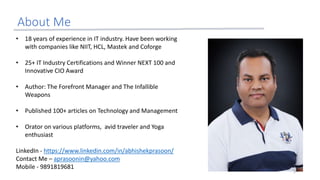
• 18 years of experience in IT industry. Have been working
with companies like NIIT, HCL, Mastek and Coforge
• 25+ IT Industry Certifications and Winner NEXT 100 and
Innovative CIO Award
• Author: The Forefront Manager and The Infallible
Weapons
• Published 100+ articles on Technology and Management
• Orator on various platforms, avid traveler and Yoga
enthusiast
LinkedIn - https://www.linkedin.com/in/abhishekprasoon/
Contact Me – aprasoonin@yahoo.com
Mobile - 9891819681
2
Disclaimer
Any views or opinions represented in the lecture are my own and do not represent those of the
people, institutions, or organizations that I may or may not be associated with in professional or
personal capacity, including past, current, and future employers unless explicitly stated.
Image Credit
Google Image Search Results
3
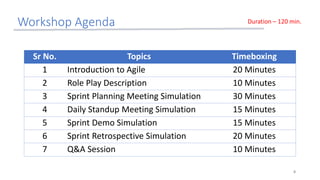
Workshop Agenda
4
Duration – 120 min.
Sr No. Topics Timeboxing
1 Introduction to Agile 20 Minutes
2 Role Play Description 10 Minutes
3 Sprint Planning Meeting Simulation 30 Minutes
4 Daily Standup Meeting Simulation 15 Minutes
5 Sprint Demo Simulation 15 Minutes
6 Sprint Retrospective Simulation 20 Minutes
7 Q&A Session 10 Minutes
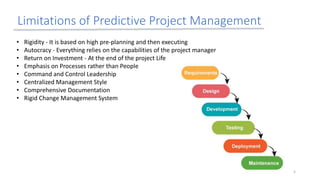
Limitations of Predictive Project Management
• Rigidity - It is based on high pre-planning and then executing
• Autocracy - Everything relies on the capabilities of the project manager
• Return on Investment - At the end of the project Life
• Emphasis on Processes rather than People
• Command and Control Leadership
• Centralized Management Style
• Comprehensive Documentation
• Rigid Change Management System
5
Kent Beck
Mike Beedle
Arie van Bennekum
Alistair Cockburn
Ward Cunningham
Martin Fowler
James Grenning
Jim Highsmith
Andrew Hunt
Ron Jeffries
Jon Kern
Brian Marick
Robert C. Martin
Steve Mellor
Ken Schwaber
Jeff Sutherland
Dave Thomas
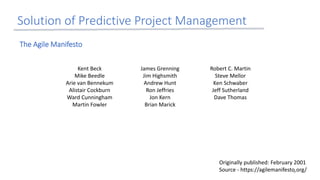
Solution of Predictive Project Management
Originally published: February 2001
Source - https://agilemanifesto.org/
The Agile Manifesto
6
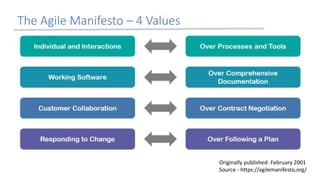
The Agile Manifesto – 4 Values
Originally published: February 2001
Source - https://agilemanifesto.org/
7
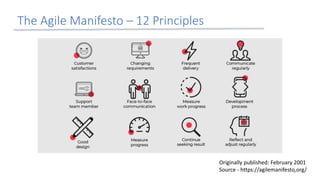
The Agile Manifesto – 12 Principles
Originally published: February 2001
Source - https://agilemanifesto.org/
8
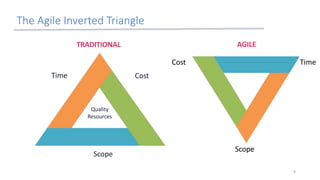
TRADITIONAL
Scope
Time
Cost
Scope
Time Cost
Quality
Resources
The Agile Inverted Triangle
AGILE
9
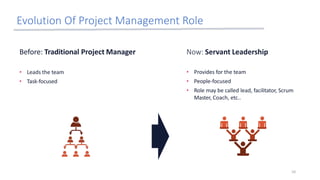
Before: Traditional Project Manager
• Leads the team
• Task-focused
Now: Servant Leadership
• Provides for the team
• People-focused
• Role may be called lead, facilitator, Scrum
Master, Coach, etc..
Evolution Of Project Management Role
10
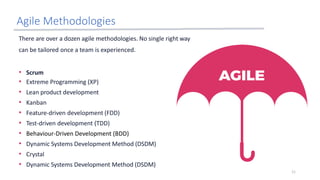
There are over a dozen agile methodologies. No single right way
can be tailored once a team is experienced.
• Scrum
• Extreme Programming (XP)
• Lean product development
• Kanban
• Feature-driven development (FDD)
• Test-driven development (TDD)
• Behaviour-Driven Development (BDD)
• Dynamic Systems Development Method (DSDM)
• Crystal
• Dynamic Systems Development Method (DSDM)
Agile Methodologies
11
12
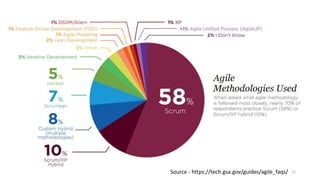
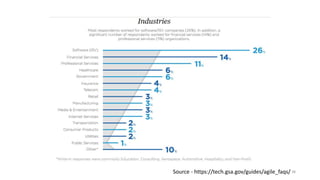
Source - https://tech.gsa.gov/guides/agile_faqs/
13
14
15
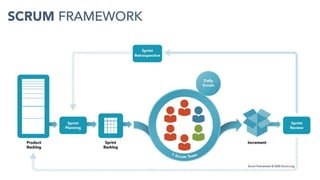
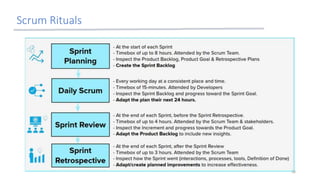
Scrum Rituals
16
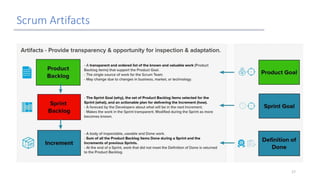
Scrum Artifacts
17
Few more important points…
18
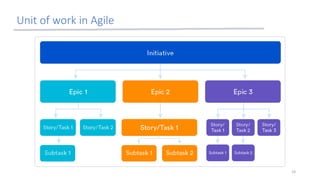
Unit of work in Agile
19
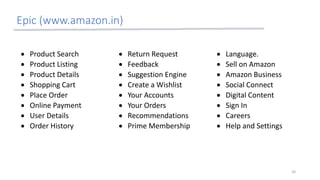
Epic (www.amazon.in)
20
 Product Search
 Product Listing
 Product Details
 Shopping Cart
 Place Order
 Online Payment
 User Details
 Order History
 Return Request
 Feedback
 Suggestion Engine
 Create a Wishlist
 Your Accounts
 Your Orders
 Recommendations
 Prime Membership
 Language.
 Sell on Amazon
 Amazon Business
 Social Connect
 Digital Content
 Sign In
 Careers
 Help and Settings
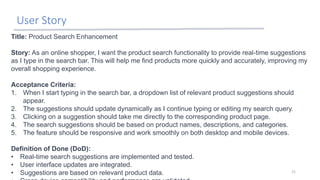
User Story
21
Title: Product Search Enhancement
Story: As an online shopper, I want the product search functionality to provide real-time suggestions
as I type in the search bar. This will help me find products more quickly and accurately, improving my
overall shopping experience.
Acceptance Criteria:
1. When I start typing in the search bar, a dropdown list of relevant product suggestions should
appear.
2. The suggestions should update dynamically as I continue typing or editing my search query.
3. Clicking on a suggestion should take me directly to the corresponding product page.
4. The search suggestions should be based on product names, descriptions, and categories.
5. The feature should be responsive and work smoothly on both desktop and mobile devices.
Definition of Done (DoD):
• Real-time search suggestions are implemented and tested.
• User interface updates are integrated.
• Suggestions are based on relevant product data.
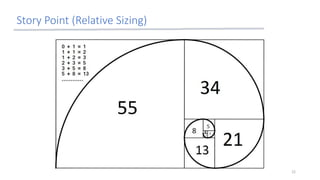
Story Point (Relative Sizing)
22
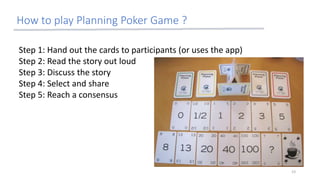
How to play Planning Poker Game ?
23
Step 1: Hand out the cards to participants (or uses the app)
Step 2: Read the story out loud
Step 3: Discuss the story
Step 4: Select and share
Step 5: Reach a consensus
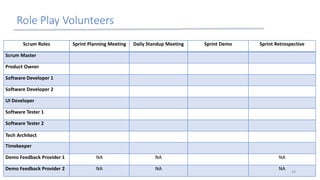
Role Play Volunteers
24
Scrum Roles Sprint Planning Meeting Daily Standup Meeting Sprint Demo Sprint Retrospective
Scrum Master
Product Owner
Software Developer 1
Software Developer 2
UI Developer
Software Tester 1
Software Tester 2
Tech Architect
Timekeeper
Demo Feedback Provider 1 NA NA NA
Demo Feedback Provider 2 NA NA NA
Expectation from your role
25
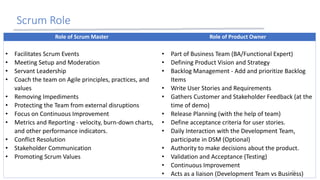
Scrum Role
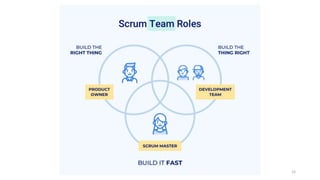
26
Role of Scrum Master Role of Product Owner
• Facilitates Scrum Events
• Meeting Setup and Moderation
• Servant Leadership
• Coach the team on Agile principles, practices, and
values
• Removing Impediments
• Protecting the Team from external disruptions
• Focus on Continuous Improvement
• Metrics and Reporting - velocity, burn-down charts,
and other performance indicators.
• Conflict Resolution
• Stakeholder Communication
• Promoting Scrum Values
• Part of Business Team (BA/Functional Expert)
• Defining Product Vision and Strategy
• Backlog Management - Add and prioritize Backlog
Items
• Write User Stories and Requirements
• Gathers Customer and Stakeholder Feedback (at the
time of demo)
• Release Planning (with the help of team)
• Define acceptance criteria for user stories.
• Daily Interaction with the Development Team,
participate in DSM (Optional)
• Authority to make decisions about the product.
• Validation and Acceptance (Testing)
• Continuous Improvement
• Acts as a liaison (Development Team vs Business)
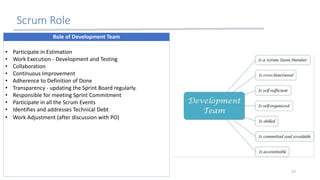
Scrum Role
27
Role of Development Team
• Participate in Estimation
• Work Execution - Development and Testing
• Collaboration
• Continuous Improvement
• Adherence to Definition of Done
• Transparency - updating the Sprint Board regularly.
• Responsible for meeting Sprint Commitment
• Participate in all the Scrum Events
• Identifies and addresses Technical Debt
• Work Adjustment (after discussion with PO)
How to do in these meetings?
28
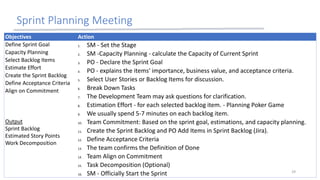
Sprint Planning Meeting
29
Objectives Action
Define Sprint Goal
Capacity Planning
Select Backlog Items
Estimate Effort
Create the Sprint Backlog
Define Acceptance Criteria
Align on Commitment
Output
Sprint Backlog
Estimated Story Points
Work Decomposition
1. SM - Set the Stage
2. SM -Capacity Planning - calculate the Capacity of Current Sprint
3. PO - Declare the Sprint Goal
4. PO - explains the items' importance, business value, and acceptance criteria.
5. Select User Stories or Backlog Items for discussion.
6. Break Down Tasks
7. The Development Team may ask questions for clarification.
8. Estimation Effort - for each selected backlog item. - Planning Poker Game
9. We usually spend 5-7 minutes on each backlog item.
10. Team Commitment: Based on the sprint goal, estimations, and capacity planning.
11. Create the Sprint Backlog and PO Add Items in Sprint Backlog (Jira).
12. Define Acceptance Criteria
13. The team confirms the Definition of Done
14. Team Align on Commitment
15. Task Decomposition (Optional)
16. SM - Officially Start the Sprint
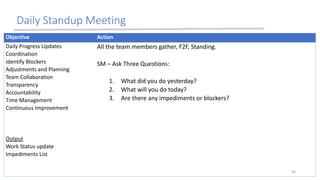
Daily Standup Meeting
30
Objective Action
Daily Progress Updates
Coordination
Identify Blockers
Adjustments and Planning
Team Collaboration
Transparency
Accountability
Time Management
Continuous Improvement
Output
Work Status update
Impediments List
All the team members gather, F2F, Standing.
SM – Ask Three Questions:
1. What did you do yesterday?
2. What will you do today?
3. Are there any impediments or blockers?
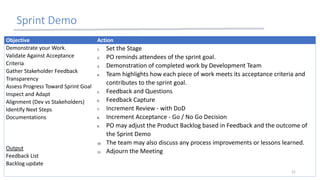
Sprint Demo
31
Objective Action
Demonstrate your Work.
Validate Against Acceptance
Criteria
Gather Stakeholder Feedback
Transparency
Assess Progress Toward Sprint Goal
Inspect and Adapt
Alignment (Dev vs Stakeholders)
Identify Next Steps
Documentations
Output
Feedback List
Backlog update
1. Set the Stage
2. PO reminds attendees of the sprint goal.
3. Demonstration of completed work by Development Team
4. Team highlights how each piece of work meets its acceptance criteria and
contributes to the sprint goal.
5. Feedback and Questions
6. Feedback Capture
7. Increment Review - with DoD
8. Increment Acceptance - Go / No Go Decision
9. PO may adjust the Product Backlog based in Feedback and the outcome of
the Sprint Demo
10. The team may also discuss any process improvements or lessons learned.
11. Adjourn the Meeting
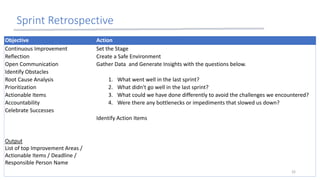
Sprint Retrospective
32
Objective Action
Continuous Improvement
Reflection
Open Communication
Identify Obstacles
Root Cause Analysis
Prioritization
Actionable Items
Accountability
Celebrate Successes
Output
List of top Improvement Areas /
Actionable Items / Deadline /
Responsible Person Name
Set the Stage
Create a Safe Environment
Gather Data and Generate Insights with the questions below.
1. What went well in the last sprint?
2. What didn't go well in the last sprint?
3. What could we have done differently to avoid the challenges we encountered?
4. Were there any bottlenecks or impediments that slowed us down?
Identify Action Items
33
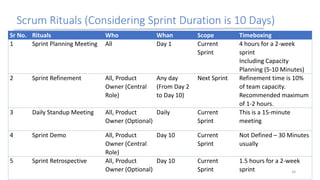
Scrum Rituals (Considering Sprint Duration is 10 Days)
34
Sr No. Rituals Who Whan Scope Timeboxing
1 Sprint Planning Meeting All Day 1 Current
Sprint
4 hours for a 2-week
sprint
Including Capacity
Planning (5-10 Minutes)
2 Sprint Refinement All, Product
Owner (Central
Role)
Any day
(From Day 2
to Day 10)
Next Sprint Refinement time is 10%
of team capacity.
Recommended maximum
of 1-2 hours.
3 Daily Standup Meeting All, Product
Owner (Optional)
Daily Current
Sprint
This is a 15-minute
meeting
4 Sprint Demo All, Product
Owner (Central
Role)
Day 10 Current
Sprint
Not Defined – 30 Minutes
usually
5 Sprint Retrospective All, Product
Owner (Optional)
Day 10 Current
Sprint
1.5 hours for a 2-week
sprint
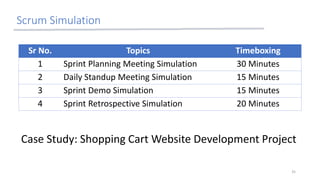
Scrum Simulation
35
Sr No. Topics Timeboxing
1 Sprint Planning Meeting Simulation 30 Minutes
2 Daily Standup Meeting Simulation 15 Minutes
3 Sprint Demo Simulation 15 Minutes
4 Sprint Retrospective Simulation 20 Minutes
Case Study: Shopping Cart Website Development Project
Career Opportunities in
Project Management
36
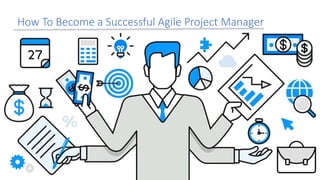
How To Become a Successful Agile Project Manager
37
38
Source - https://tech.gsa.gov/guides/agile_faqs/
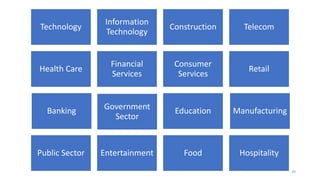
Technology
Information
Technology
Construction Telecom
Health Care
Financial
Services
Consumer
Services
Retail
Banking Government
Sector
Education Manufacturing
Public Sector Entertainment Food Hospitality
39
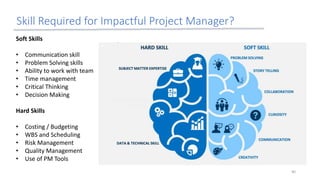
Skill Required for Impactful Project Manager?
40
Soft Skills
• Communication skill
• Problem Solving skills
• Ability to work with team
• Time management
• Critical Thinking
• Decision Making
Hard Skills
• Costing / Budgeting
• WBS and Scheduling
• Risk Management
• Quality Management
• Use of PM Tools
Agile Concepts
41
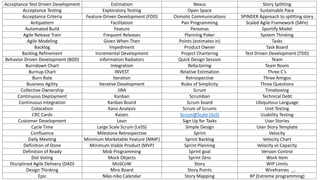
Acceptance Test Driven Development Estimation Nexus Story Splitting
Acceptance Testing Exploratory Testing Open Space Sustainable Pace
Acceptance Criteria Feature-Driven Development (FDD) Osmotic Communications SPINDER Approach to splitting story
Antipattern Facilitation Pair Programming Scaled Agile Framework (SAFe)
Automated Build Feature Personas Sportify Model
Agile Release Train Frequent Releases Planning Poker System Thinking
Agile Modeling Given When Then Points (estimates in) Tasks
Backlog Impediment Product Owner Task Board
Backlog Refinement Incremental Development Project Chartering Test Driven Development (TDD)
Behavior Driven Development (BDD) Information Radiators Quick Design Session Team
Burndown Chart Integration Refactoring Team Room
Burnup Chart INVEST Relative Estimation Three C’s
Burn Rate Iteration Retrospective Three Amigos
Business Agility Iterative Development Rules of Simplicity Three Questions
Collective Ownership JIRA Scrum Timeboxing
Continuous Deployment Kanban Scrumban Technical Debt
Continuous Integration Kanban Board Scrum board Ubiquitous Language
Colocation Kano Analysis Scrum of Scrums Unit Testing
CRC Cards Kaizen Scrum@Scale (SoS) Usability Testing
Customer Development Lean Sign Up for Tasks User Stories
Cycle Time Large Scale Scrum (LeSS) Simple Design User Story Template
Confluence Milestone Retrospective Sprint Velocity
Daily Meeting Minimum Marketable Feature (MMF) Sprint Backlog Velocity Chart
Definition of Done Minimum Viable Product (MVP) Sprint Planning Velocity vs Capacity
Definition of Ready Mob Programming Sprint goal Version Control
Dot Voting Mock Objects Sprint Zero Work Item
Disciplined Agile Delivery (DAD) MoSCoW Story WIP Limits
Design Thinking Miro Board Story Points Wireframes
Epic Niko-niko Calendar Story Mapping XP (Extreme programming)
42
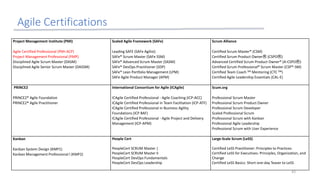
Agile Certifications
43
Project Management Institute (PMI)
Agile Certified Professional (PMI-ACP)
Project Management Professional (PMP)
Disciplined Agile Scrum Master (DASM)
Disciplined Agile Senior Scrum Master (DASSM)
Scaled Agile Framework (SAFe)
Leading SAFE (SAFe Agilist)
SAFe® Scrum Master (SAFe SSM)
SAFe® Advanced Scrum Master (SASM)
SAFe® DevOps Practitioner (SDP)
SAFe® Lean Portfolio Management (LPM)
SAFe Agile Product Manager (APM)
Scrum Alliance
Certified Scrum Master® (CSM)
Certified Scrum Product OwnerⓇ (CSPOⓇ)
Advanced Certified Scrum Product Owner® (A-CSPOⓇ)
Certified Scrum Professional® Scrum Master (CSP®-SM)
Certified Team Coach SM Mentoring (CTC SM)
Certified Agile Leadership Essentials (CAL-E)
PRINCE2
PRINCE2® Agile Foundation
PRINCE2® Agile Practitioner
International Consortium for Agile (ICAgile)
ICAgile Certified Professional - Agile Coaching (ICP-ACC)
ICAgile Certified Professional in Team Facilitation (ICP-ATF)
ICAgile Certified Professional in Business Agility
Foundations (ICP BAF)
ICAgile Certified Professional - Agile Project and Delivery
Management (ICP-APM)
Scum.org
Professional Scrum Master
Professional Scrum Product Owner
Professional Scrum Developer
Scaled Professional Scrum
Professional Scrum with Kanban
Professional Agile Leadership
Professional Scrum with User Experience
Kanban
Kanban System Design (KMP1)
Kanban Management Professional l (KMP2)
People Cert
PeopleCert SCRUM Master |
PeopleCert SCRUM Master II
PeopleCert DevOps Fundamentals
PeopleCert DevOps Leadership
Large-Scale Scrum (LeSS)
Certified LeSS Practitioner: Principles to Practices
Certified LeSS for Executives: Principles, Organization, and
Change
Certified LeSS Basics: Short one-day Teaser to LeSS
44
45
46
Please connect if you need any help in understanding Project Management concepts or
earning the below Project Management Certifications by Project Management Institute.
Agile Certified Professional (PMI-ACP)
Project Management Professional (PMP)
LinkedIn - https://www.linkedin.com/in/abhishekprasoon/
Contact Me – aprasoonin@yahoo.com
9891819681

Agile Project Management Workshop.pptx

  • 1.
    Apeejay School ofManagement, Dwarka, New Delhi Agile Project Management Workshop Guest Lecture by Abhishek Prasoon Chief Scrum Master, Coforge 15th September 2023 1
  • 2.
    About Me • 18years of experience in IT industry. Have been working with companies like NIIT, HCL, Mastek and Coforge • 25+ IT Industry Certifications and Winner NEXT 100 and Innovative CIO Award • Author: The Forefront Manager and The Infallible Weapons • Published 100+ articles on Technology and Management • Orator on various platforms, avid traveler and Yoga enthusiast LinkedIn - https://www.linkedin.com/in/abhishekprasoon/ Contact Me – aprasoonin@yahoo.com Mobile - 9891819681 2
  • 3.
    Disclaimer Any views oropinions represented in the lecture are my own and do not represent those of the people, institutions, or organizations that I may or may not be associated with in professional or personal capacity, including past, current, and future employers unless explicitly stated. Image Credit Google Image Search Results 3
  • 4.
    Workshop Agenda 4 Duration –120 min. Sr No. Topics Timeboxing 1 Introduction to Agile 20 Minutes 2 Role Play Description 10 Minutes 3 Sprint Planning Meeting Simulation 30 Minutes 4 Daily Standup Meeting Simulation 15 Minutes 5 Sprint Demo Simulation 15 Minutes 6 Sprint Retrospective Simulation 20 Minutes 7 Q&A Session 10 Minutes
  • 5.
    Limitations of PredictiveProject Management • Rigidity - It is based on high pre-planning and then executing • Autocracy - Everything relies on the capabilities of the project manager • Return on Investment - At the end of the project Life • Emphasis on Processes rather than People • Command and Control Leadership • Centralized Management Style • Comprehensive Documentation • Rigid Change Management System 5
  • 6.
    Kent Beck Mike Beedle Arievan Bennekum Alistair Cockburn Ward Cunningham Martin Fowler James Grenning Jim Highsmith Andrew Hunt Ron Jeffries Jon Kern Brian Marick Robert C. Martin Steve Mellor Ken Schwaber Jeff Sutherland Dave Thomas Solution of Predictive Project Management Originally published: February 2001 Source - https://agilemanifesto.org/ The Agile Manifesto 6
  • 7.
    The Agile Manifesto– 4 Values Originally published: February 2001 Source - https://agilemanifesto.org/ 7
  • 8.
    The Agile Manifesto– 12 Principles Originally published: February 2001 Source - https://agilemanifesto.org/ 8
  • 9.
  • 10.
    Before: Traditional ProjectManager • Leads the team • Task-focused Now: Servant Leadership • Provides for the team • People-focused • Role may be called lead, facilitator, Scrum Master, Coach, etc.. Evolution Of Project Management Role 10
  • 11.
    There are overa dozen agile methodologies. No single right way can be tailored once a team is experienced. • Scrum • Extreme Programming (XP) • Lean product development • Kanban • Feature-driven development (FDD) • Test-driven development (TDD) • Behaviour-Driven Development (BDD) • Dynamic Systems Development Method (DSDM) • Crystal • Dynamic Systems Development Method (DSDM) Agile Methodologies 11
  • 12.
  • 13.
  • 14.
  • 15.
  • 16.
  • 17.
  • 18.
    Few more importantpoints… 18
  • 19.
    Unit of workin Agile 19
  • 20.
    Epic (www.amazon.in) 20  ProductSearch  Product Listing  Product Details  Shopping Cart  Place Order  Online Payment  User Details  Order History  Return Request  Feedback  Suggestion Engine  Create a Wishlist  Your Accounts  Your Orders  Recommendations  Prime Membership  Language.  Sell on Amazon  Amazon Business  Social Connect  Digital Content  Sign In  Careers  Help and Settings
  • 21.
    User Story 21 Title: ProductSearch Enhancement Story: As an online shopper, I want the product search functionality to provide real-time suggestions as I type in the search bar. This will help me find products more quickly and accurately, improving my overall shopping experience. Acceptance Criteria: 1. When I start typing in the search bar, a dropdown list of relevant product suggestions should appear. 2. The suggestions should update dynamically as I continue typing or editing my search query. 3. Clicking on a suggestion should take me directly to the corresponding product page. 4. The search suggestions should be based on product names, descriptions, and categories. 5. The feature should be responsive and work smoothly on both desktop and mobile devices. Definition of Done (DoD): • Real-time search suggestions are implemented and tested. • User interface updates are integrated. • Suggestions are based on relevant product data.
  • 22.
  • 23.
    How to playPlanning Poker Game ? 23 Step 1: Hand out the cards to participants (or uses the app) Step 2: Read the story out loud Step 3: Discuss the story Step 4: Select and share Step 5: Reach a consensus
  • 24.
    Role Play Volunteers 24 ScrumRoles Sprint Planning Meeting Daily Standup Meeting Sprint Demo Sprint Retrospective Scrum Master Product Owner Software Developer 1 Software Developer 2 UI Developer Software Tester 1 Software Tester 2 Tech Architect Timekeeper Demo Feedback Provider 1 NA NA NA Demo Feedback Provider 2 NA NA NA
  • 25.
  • 26.
    Scrum Role 26 Role ofScrum Master Role of Product Owner • Facilitates Scrum Events • Meeting Setup and Moderation • Servant Leadership • Coach the team on Agile principles, practices, and values • Removing Impediments • Protecting the Team from external disruptions • Focus on Continuous Improvement • Metrics and Reporting - velocity, burn-down charts, and other performance indicators. • Conflict Resolution • Stakeholder Communication • Promoting Scrum Values • Part of Business Team (BA/Functional Expert) • Defining Product Vision and Strategy • Backlog Management - Add and prioritize Backlog Items • Write User Stories and Requirements • Gathers Customer and Stakeholder Feedback (at the time of demo) • Release Planning (with the help of team) • Define acceptance criteria for user stories. • Daily Interaction with the Development Team, participate in DSM (Optional) • Authority to make decisions about the product. • Validation and Acceptance (Testing) • Continuous Improvement • Acts as a liaison (Development Team vs Business)
  • 27.
    Scrum Role 27 Role ofDevelopment Team • Participate in Estimation • Work Execution - Development and Testing • Collaboration • Continuous Improvement • Adherence to Definition of Done • Transparency - updating the Sprint Board regularly. • Responsible for meeting Sprint Commitment • Participate in all the Scrum Events • Identifies and addresses Technical Debt • Work Adjustment (after discussion with PO)
  • 28.
    How to doin these meetings? 28
  • 29.
    Sprint Planning Meeting 29 ObjectivesAction Define Sprint Goal Capacity Planning Select Backlog Items Estimate Effort Create the Sprint Backlog Define Acceptance Criteria Align on Commitment Output Sprint Backlog Estimated Story Points Work Decomposition 1. SM - Set the Stage 2. SM -Capacity Planning - calculate the Capacity of Current Sprint 3. PO - Declare the Sprint Goal 4. PO - explains the items' importance, business value, and acceptance criteria. 5. Select User Stories or Backlog Items for discussion. 6. Break Down Tasks 7. The Development Team may ask questions for clarification. 8. Estimation Effort - for each selected backlog item. - Planning Poker Game 9. We usually spend 5-7 minutes on each backlog item. 10. Team Commitment: Based on the sprint goal, estimations, and capacity planning. 11. Create the Sprint Backlog and PO Add Items in Sprint Backlog (Jira). 12. Define Acceptance Criteria 13. The team confirms the Definition of Done 14. Team Align on Commitment 15. Task Decomposition (Optional) 16. SM - Officially Start the Sprint
  • 30.
    Daily Standup Meeting 30 ObjectiveAction Daily Progress Updates Coordination Identify Blockers Adjustments and Planning Team Collaboration Transparency Accountability Time Management Continuous Improvement Output Work Status update Impediments List All the team members gather, F2F, Standing. SM – Ask Three Questions: 1. What did you do yesterday? 2. What will you do today? 3. Are there any impediments or blockers?
  • 31.
    Sprint Demo 31 Objective Action Demonstrateyour Work. Validate Against Acceptance Criteria Gather Stakeholder Feedback Transparency Assess Progress Toward Sprint Goal Inspect and Adapt Alignment (Dev vs Stakeholders) Identify Next Steps Documentations Output Feedback List Backlog update 1. Set the Stage 2. PO reminds attendees of the sprint goal. 3. Demonstration of completed work by Development Team 4. Team highlights how each piece of work meets its acceptance criteria and contributes to the sprint goal. 5. Feedback and Questions 6. Feedback Capture 7. Increment Review - with DoD 8. Increment Acceptance - Go / No Go Decision 9. PO may adjust the Product Backlog based in Feedback and the outcome of the Sprint Demo 10. The team may also discuss any process improvements or lessons learned. 11. Adjourn the Meeting
  • 32.
    Sprint Retrospective 32 Objective Action ContinuousImprovement Reflection Open Communication Identify Obstacles Root Cause Analysis Prioritization Actionable Items Accountability Celebrate Successes Output List of top Improvement Areas / Actionable Items / Deadline / Responsible Person Name Set the Stage Create a Safe Environment Gather Data and Generate Insights with the questions below. 1. What went well in the last sprint? 2. What didn't go well in the last sprint? 3. What could we have done differently to avoid the challenges we encountered? 4. Were there any bottlenecks or impediments that slowed us down? Identify Action Items
  • 33.
  • 34.
    Scrum Rituals (ConsideringSprint Duration is 10 Days) 34 Sr No. Rituals Who Whan Scope Timeboxing 1 Sprint Planning Meeting All Day 1 Current Sprint 4 hours for a 2-week sprint Including Capacity Planning (5-10 Minutes) 2 Sprint Refinement All, Product Owner (Central Role) Any day (From Day 2 to Day 10) Next Sprint Refinement time is 10% of team capacity. Recommended maximum of 1-2 hours. 3 Daily Standup Meeting All, Product Owner (Optional) Daily Current Sprint This is a 15-minute meeting 4 Sprint Demo All, Product Owner (Central Role) Day 10 Current Sprint Not Defined – 30 Minutes usually 5 Sprint Retrospective All, Product Owner (Optional) Day 10 Current Sprint 1.5 hours for a 2-week sprint
  • 35.
    Scrum Simulation 35 Sr No.Topics Timeboxing 1 Sprint Planning Meeting Simulation 30 Minutes 2 Daily Standup Meeting Simulation 15 Minutes 3 Sprint Demo Simulation 15 Minutes 4 Sprint Retrospective Simulation 20 Minutes Case Study: Shopping Cart Website Development Project
  • 36.
  • 37.
    How To Becomea Successful Agile Project Manager 37
  • 38.
  • 39.
    Technology Information Technology Construction Telecom Health Care Financial Services Consumer Services Retail BankingGovernment Sector Education Manufacturing Public Sector Entertainment Food Hospitality 39
  • 40.
    Skill Required forImpactful Project Manager? 40 Soft Skills • Communication skill • Problem Solving skills • Ability to work with team • Time management • Critical Thinking • Decision Making Hard Skills • Costing / Budgeting • WBS and Scheduling • Risk Management • Quality Management • Use of PM Tools
  • 41.
  • 42.
    Acceptance Test DrivenDevelopment Estimation Nexus Story Splitting Acceptance Testing Exploratory Testing Open Space Sustainable Pace Acceptance Criteria Feature-Driven Development (FDD) Osmotic Communications SPINDER Approach to splitting story Antipattern Facilitation Pair Programming Scaled Agile Framework (SAFe) Automated Build Feature Personas Sportify Model Agile Release Train Frequent Releases Planning Poker System Thinking Agile Modeling Given When Then Points (estimates in) Tasks Backlog Impediment Product Owner Task Board Backlog Refinement Incremental Development Project Chartering Test Driven Development (TDD) Behavior Driven Development (BDD) Information Radiators Quick Design Session Team Burndown Chart Integration Refactoring Team Room Burnup Chart INVEST Relative Estimation Three C’s Burn Rate Iteration Retrospective Three Amigos Business Agility Iterative Development Rules of Simplicity Three Questions Collective Ownership JIRA Scrum Timeboxing Continuous Deployment Kanban Scrumban Technical Debt Continuous Integration Kanban Board Scrum board Ubiquitous Language Colocation Kano Analysis Scrum of Scrums Unit Testing CRC Cards Kaizen Scrum@Scale (SoS) Usability Testing Customer Development Lean Sign Up for Tasks User Stories Cycle Time Large Scale Scrum (LeSS) Simple Design User Story Template Confluence Milestone Retrospective Sprint Velocity Daily Meeting Minimum Marketable Feature (MMF) Sprint Backlog Velocity Chart Definition of Done Minimum Viable Product (MVP) Sprint Planning Velocity vs Capacity Definition of Ready Mob Programming Sprint goal Version Control Dot Voting Mock Objects Sprint Zero Work Item Disciplined Agile Delivery (DAD) MoSCoW Story WIP Limits Design Thinking Miro Board Story Points Wireframes Epic Niko-niko Calendar Story Mapping XP (Extreme programming) 42
  • 43.
    Agile Certifications 43 Project ManagementInstitute (PMI) Agile Certified Professional (PMI-ACP) Project Management Professional (PMP) Disciplined Agile Scrum Master (DASM) Disciplined Agile Senior Scrum Master (DASSM) Scaled Agile Framework (SAFe) Leading SAFE (SAFe Agilist) SAFe® Scrum Master (SAFe SSM) SAFe® Advanced Scrum Master (SASM) SAFe® DevOps Practitioner (SDP) SAFe® Lean Portfolio Management (LPM) SAFe Agile Product Manager (APM) Scrum Alliance Certified Scrum Master® (CSM) Certified Scrum Product OwnerⓇ (CSPOⓇ) Advanced Certified Scrum Product Owner® (A-CSPOⓇ) Certified Scrum Professional® Scrum Master (CSP®-SM) Certified Team Coach SM Mentoring (CTC SM) Certified Agile Leadership Essentials (CAL-E) PRINCE2 PRINCE2® Agile Foundation PRINCE2® Agile Practitioner International Consortium for Agile (ICAgile) ICAgile Certified Professional - Agile Coaching (ICP-ACC) ICAgile Certified Professional in Team Facilitation (ICP-ATF) ICAgile Certified Professional in Business Agility Foundations (ICP BAF) ICAgile Certified Professional - Agile Project and Delivery Management (ICP-APM) Scum.org Professional Scrum Master Professional Scrum Product Owner Professional Scrum Developer Scaled Professional Scrum Professional Scrum with Kanban Professional Agile Leadership Professional Scrum with User Experience Kanban Kanban System Design (KMP1) Kanban Management Professional l (KMP2) People Cert PeopleCert SCRUM Master | PeopleCert SCRUM Master II PeopleCert DevOps Fundamentals PeopleCert DevOps Leadership Large-Scale Scrum (LeSS) Certified LeSS Practitioner: Principles to Practices Certified LeSS for Executives: Principles, Organization, and Change Certified LeSS Basics: Short one-day Teaser to LeSS
  • 44.
  • 45.
  • 46.
    46 Please connect ifyou need any help in understanding Project Management concepts or earning the below Project Management Certifications by Project Management Institute. Agile Certified Professional (PMI-ACP) Project Management Professional (PMP) LinkedIn - https://www.linkedin.com/in/abhishekprasoon/ Contact Me – aprasoonin@yahoo.com 9891819681