P1 FLOW
BLOCKE
D
LEAN WAIT
Making Work Visible
EXPOSING TIME THEFT TO OPTIMIZE WORK &
FLOW
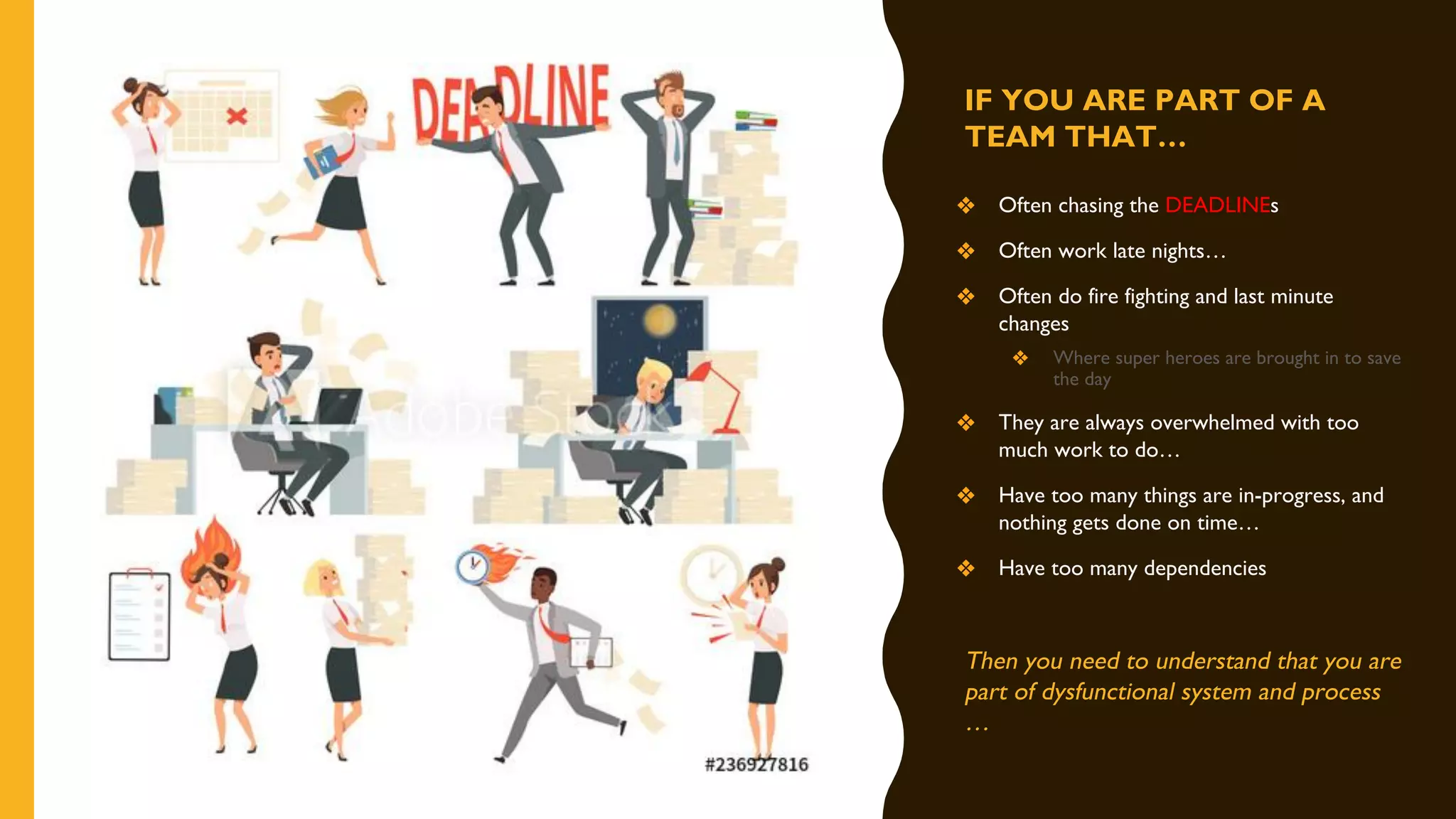
IF YOU ARE PART OF A
TEAM THAT…
❖ Often chasing the DEADLINEs
❖ Often work late nights…
❖ Often do fire fighting and last minute
changes
❖ Where super heroes are brought in to save
the day
❖ They are always overwhelmed with too
much work to do…
❖ Have too many things are in-progress, and
nothing gets done on time…
❖ Have too many dependencies
Then you need to understand that you are
part of dysfunctional system and process
…
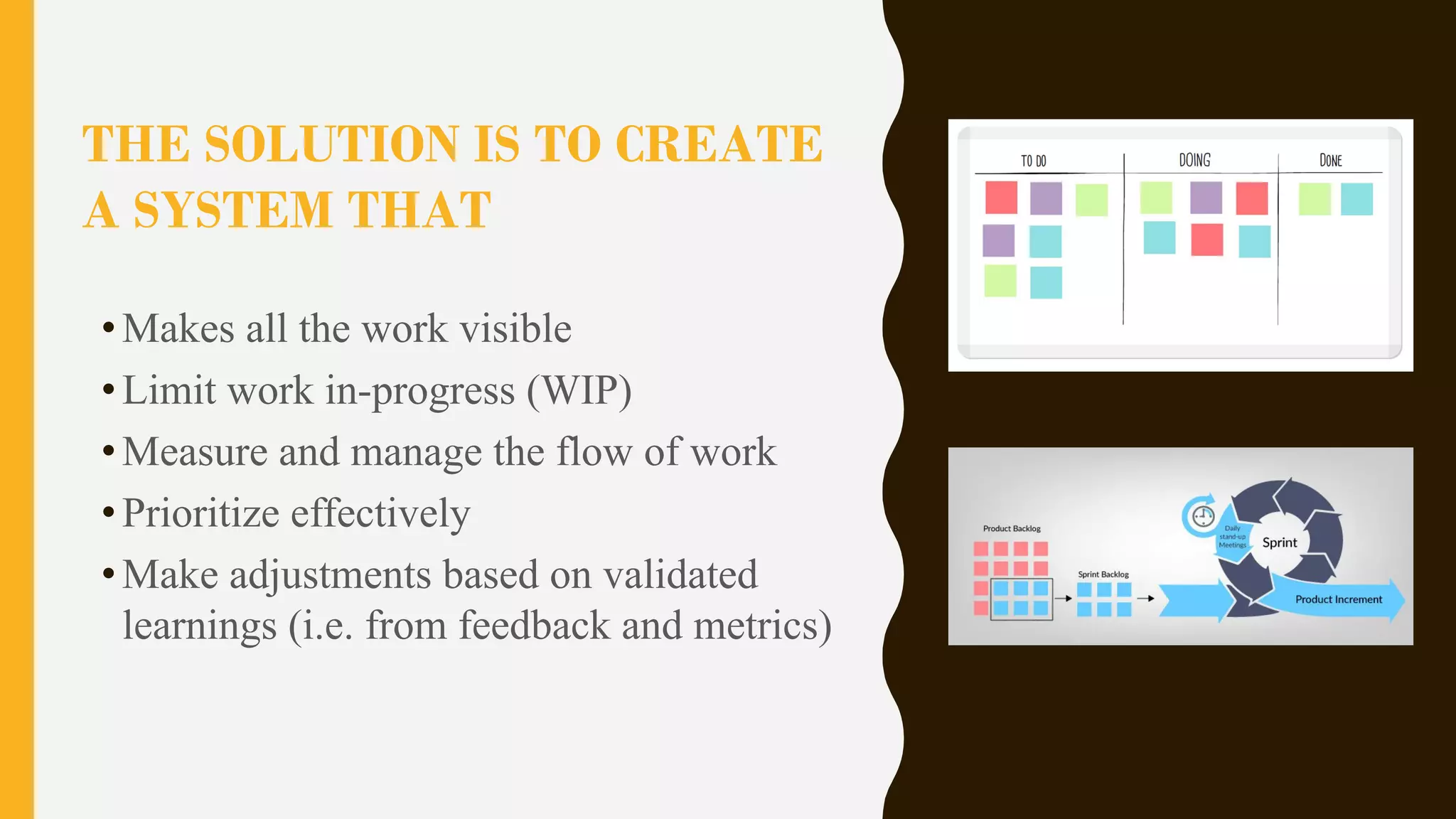
THE SOLUTION IS TO CREATE
A SYSTEM THAT
•Makes all the work visible
•Limit work in-progress (WIP)
•Measure and manage the flow of work
•Prioritize effectively
•Make adjustments based on validated
learnings (i.e. from feedback and metrics)
TODAY, LET’S DISCUSS…
❖ How to spot the 5 thieves that are staling your time…
❖ How to expose them, in order to make our work
visible and optimize the workflow
❖ How to measure the progress by using the right
metrics
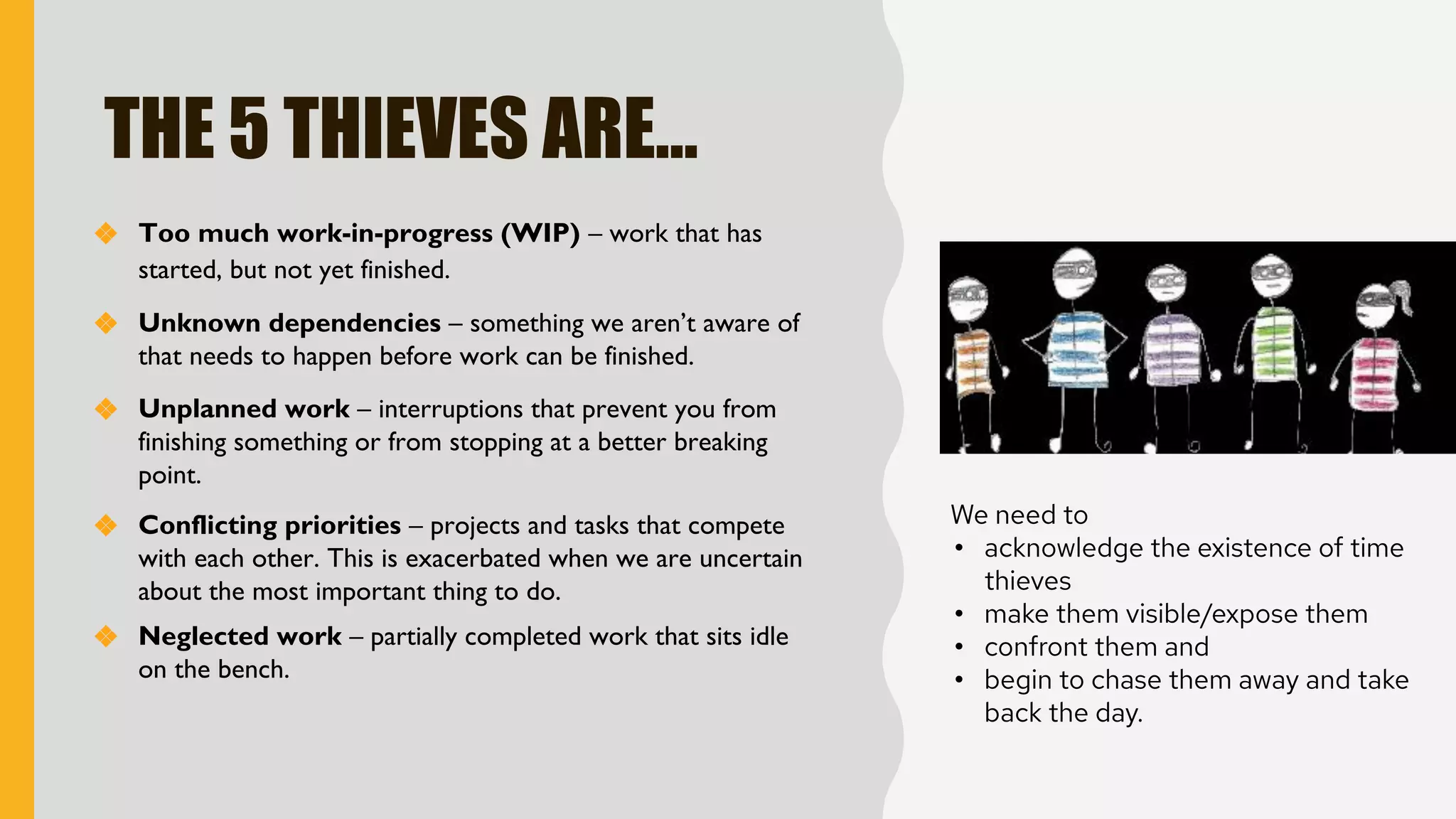
THE 5 THIEVES ARE…
❖ Too much work-in-progress (WIP) – work that has
started, but not yet finished.
We need to
• acknowledge the existence of time
thieves
• make them visible/expose them
• confront them and
• begin to chase them away and take
back the day.
❖ Conflicting priorities – projects and tasks that compete
with each other. This is exacerbated when we are uncertain
about the most important thing to do.
❖ Unknown dependencies – something we aren’t aware of
that needs to happen before work can be finished.
❖ Unplanned work – interruptions that prevent you from
finishing something or from stopping at a better breaking
point.
❖ Neglected work – partially completed work that sits idle
on the bench.
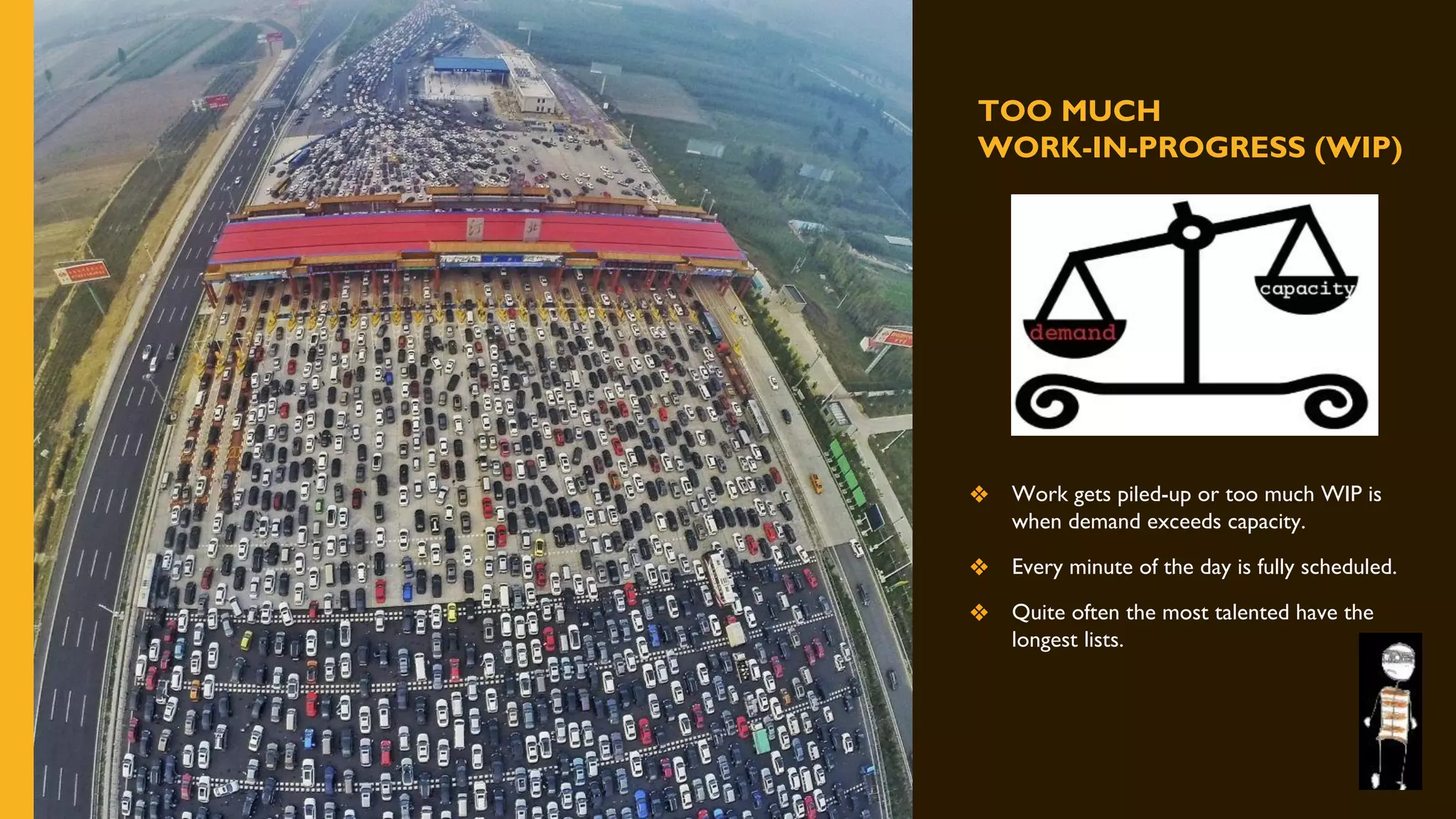
TOO MUCH
WORK-IN-PROGRESS (WIP)
❖ Work gets piled-up or too much WIP is
when demand exceeds capacity.
❖ Every minute of the day is fully scheduled.
❖ Quite often the most talented have the
longest lists.
WE HAVE HARD TIME SAYING NO FOR
VARIETY OF REASONS…
•We like the person who is asking us for a favor
•We are team players, we don’t want to let the team down
•We fear humiliation, I don’t want to criticized or fired
•I like new and Shiny, Its much more fun than doing the grunt work
•We don’t realize how big the request is until we start working on it.
(Planning fallacy)
•We like to please people
•We don’t want people to think poorly of us.
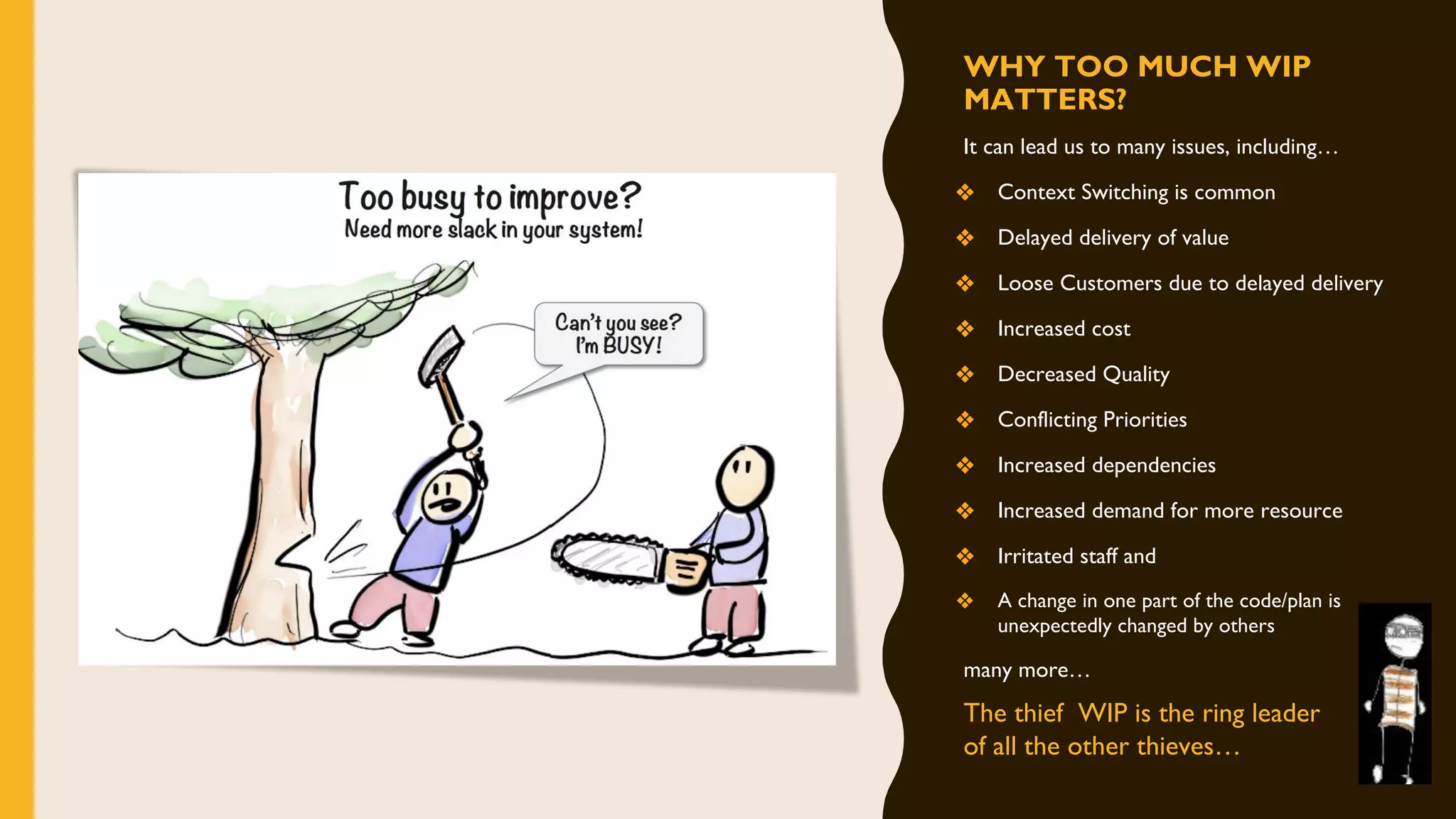
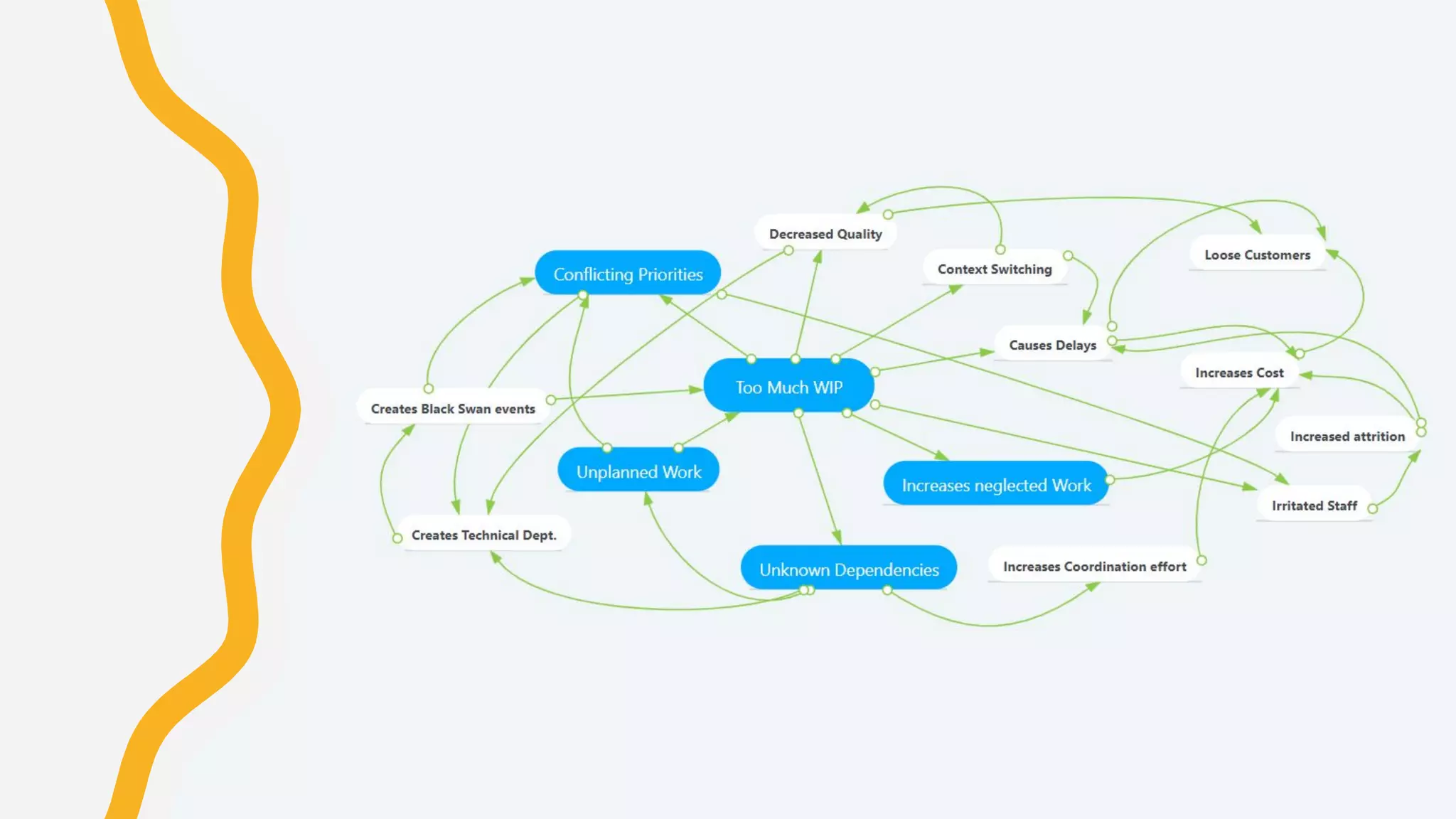
WHY TOO MUCH WIP
MATTERS?
It can lead us to many issues, including…
❖ Context Switching is common
❖ Delayed delivery of value
❖ Loose Customers due to delayed delivery
❖ Increased cost
❖ Decreased Quality
❖ Conflicting Priorities
❖ Increased dependencies
❖ Increased demand for more resource
❖ Irritated staff and
❖ A change in one part of the code/plan is
unexpectedly changed by others
many more…
The thief WIP is the ring leader
of all the other thieves…
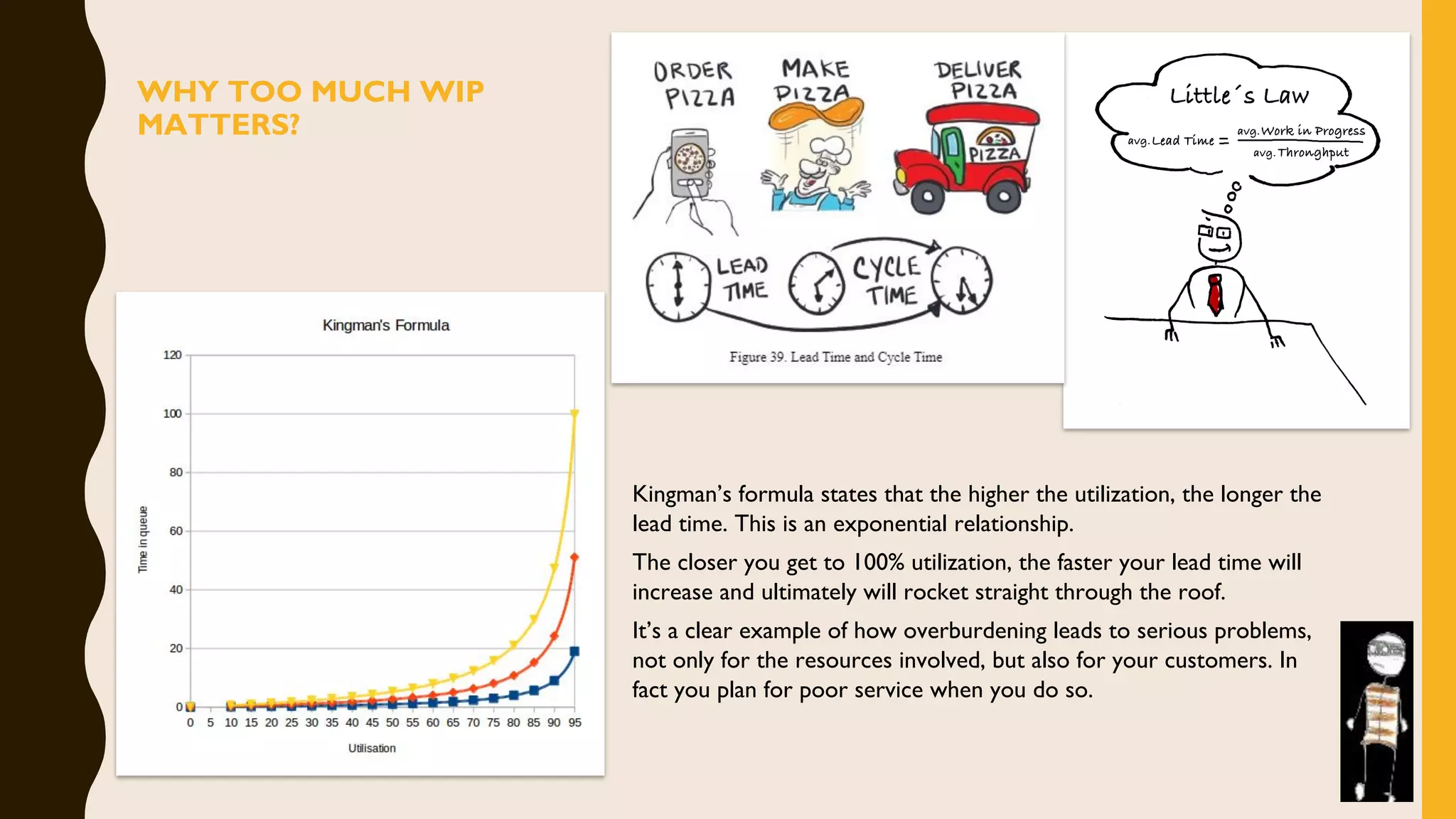
Kingman’s formula states that the higher the utilization, the longer the
lead time. This is an exponential relationship.
The closer you get to 100% utilization, the faster your lead time will
increase and ultimately will rocket straight through the roof.
It’s a clear example of how overburdening leads to serious problems,
not only for the resources involved, but also for your customers. In
fact you plan for poor service when you do so.
WHY TOO MUCH WIP
MATTERS?
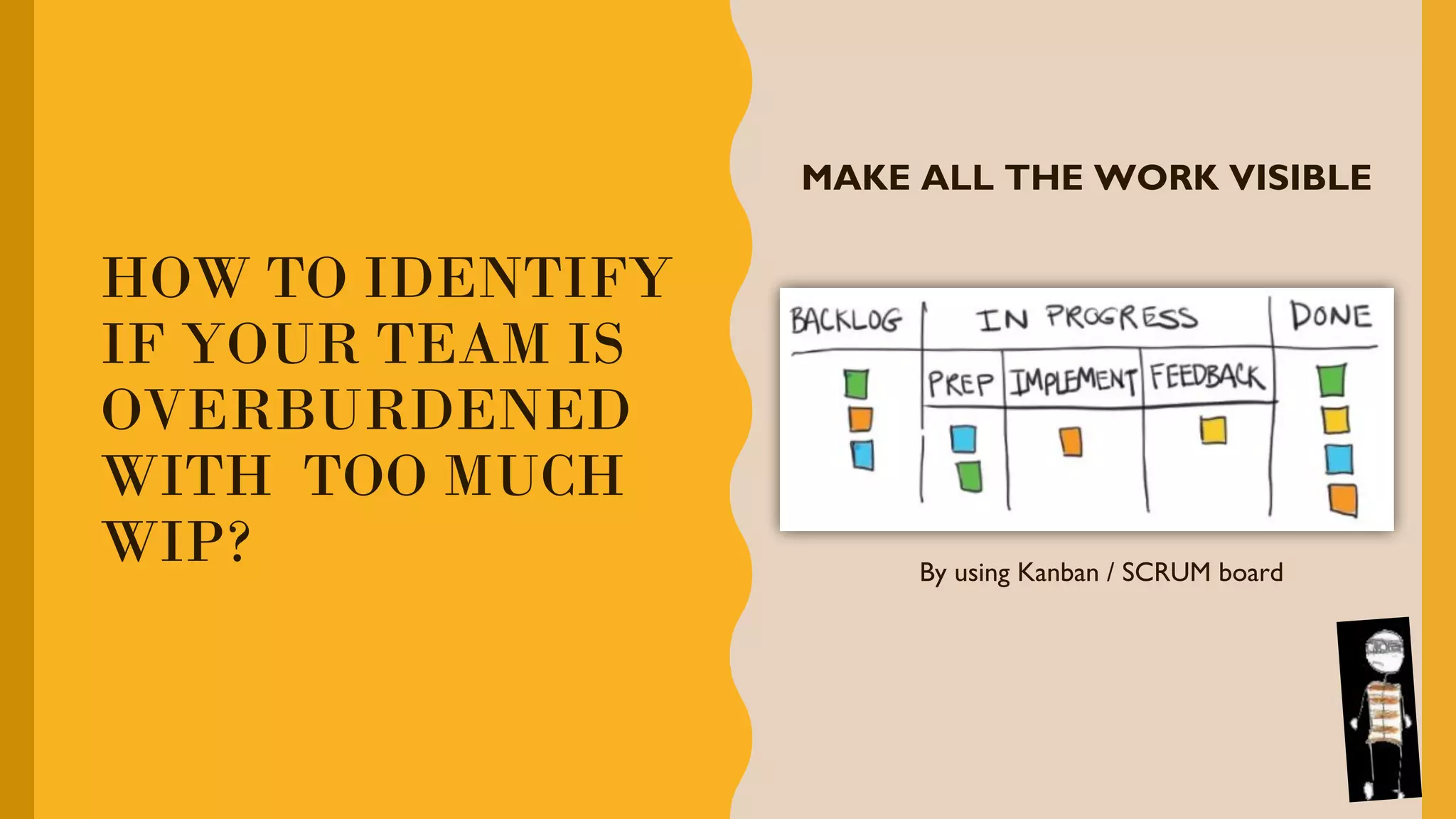
HOW TO IDENTIFY
IF YOUR TEAM IS
OVERBURDENED
WITH TOO MUCH
WIP? By using Kanban / SCRUM board
MAKE ALL THE WORK VISIBLE
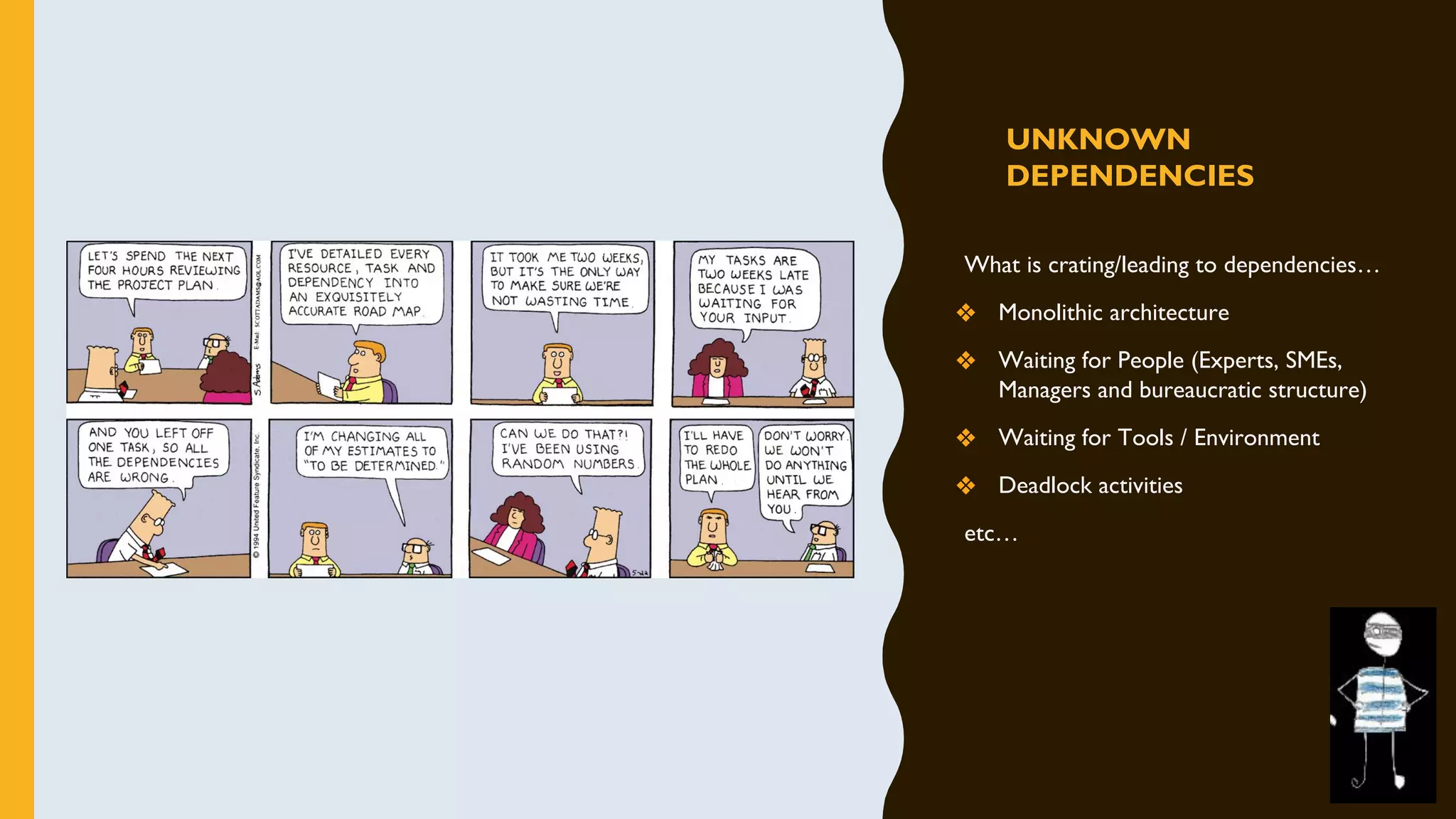
UNKNOWN
DEPENDENCIES
What is crating/leading to dependencies…
❖ Monolithic architecture
❖ Waiting for People (Experts, SMEs,
Managers and bureaucratic structure)
❖ Waiting for Tools / Environment
❖ Deadlock activities
etc…
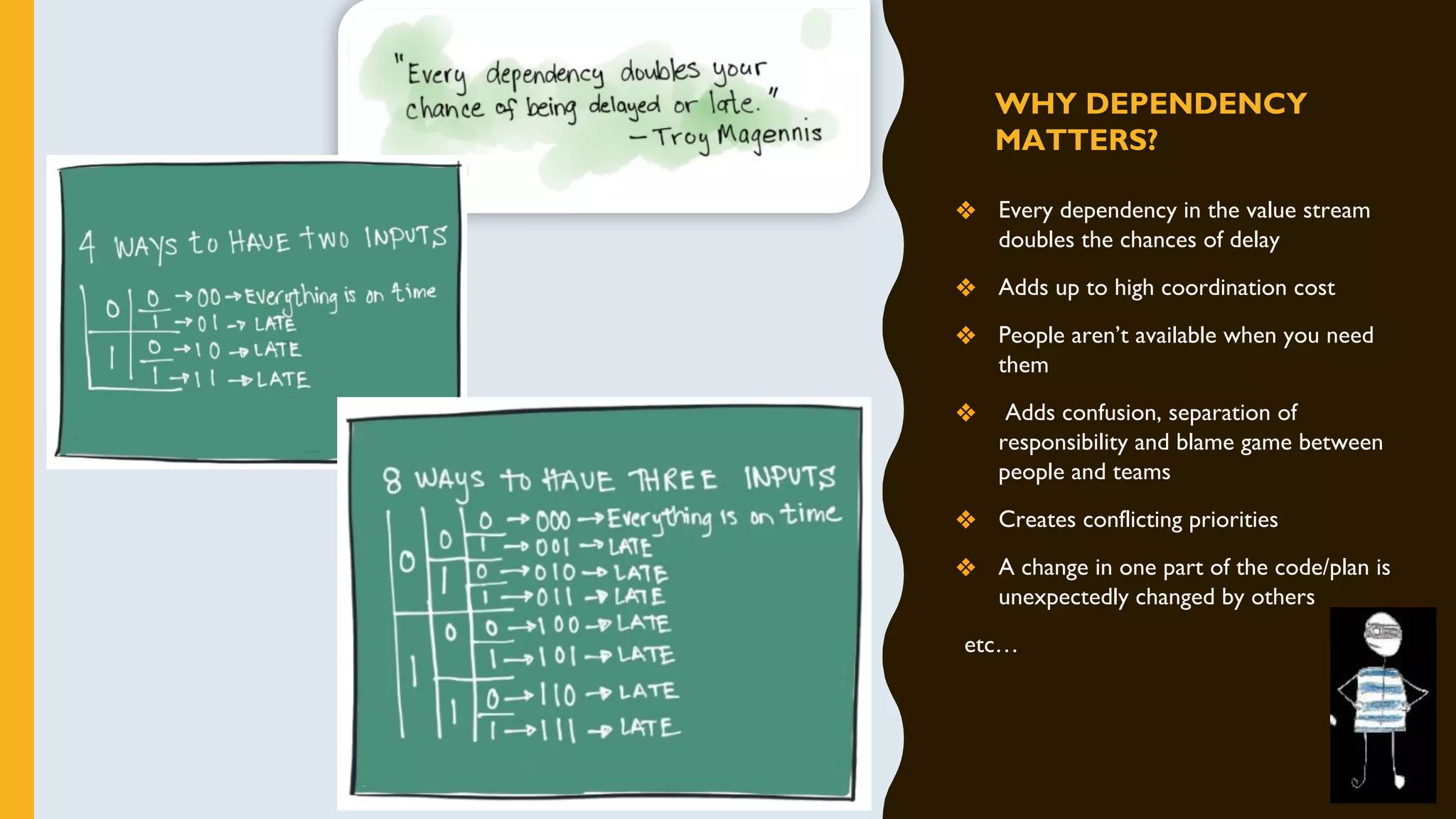
WHY DEPENDENCY
MATTERS?
❖ Every dependency in the value stream
doubles the chances of delay
❖ Adds up to high coordination cost
❖ People aren’t available when you need
them
❖ Adds confusion, separation of
responsibility and blame game between
people and teams
❖ Creates conflicting priorities
❖ A change in one part of the code/plan is
unexpectedly changed by others
etc…
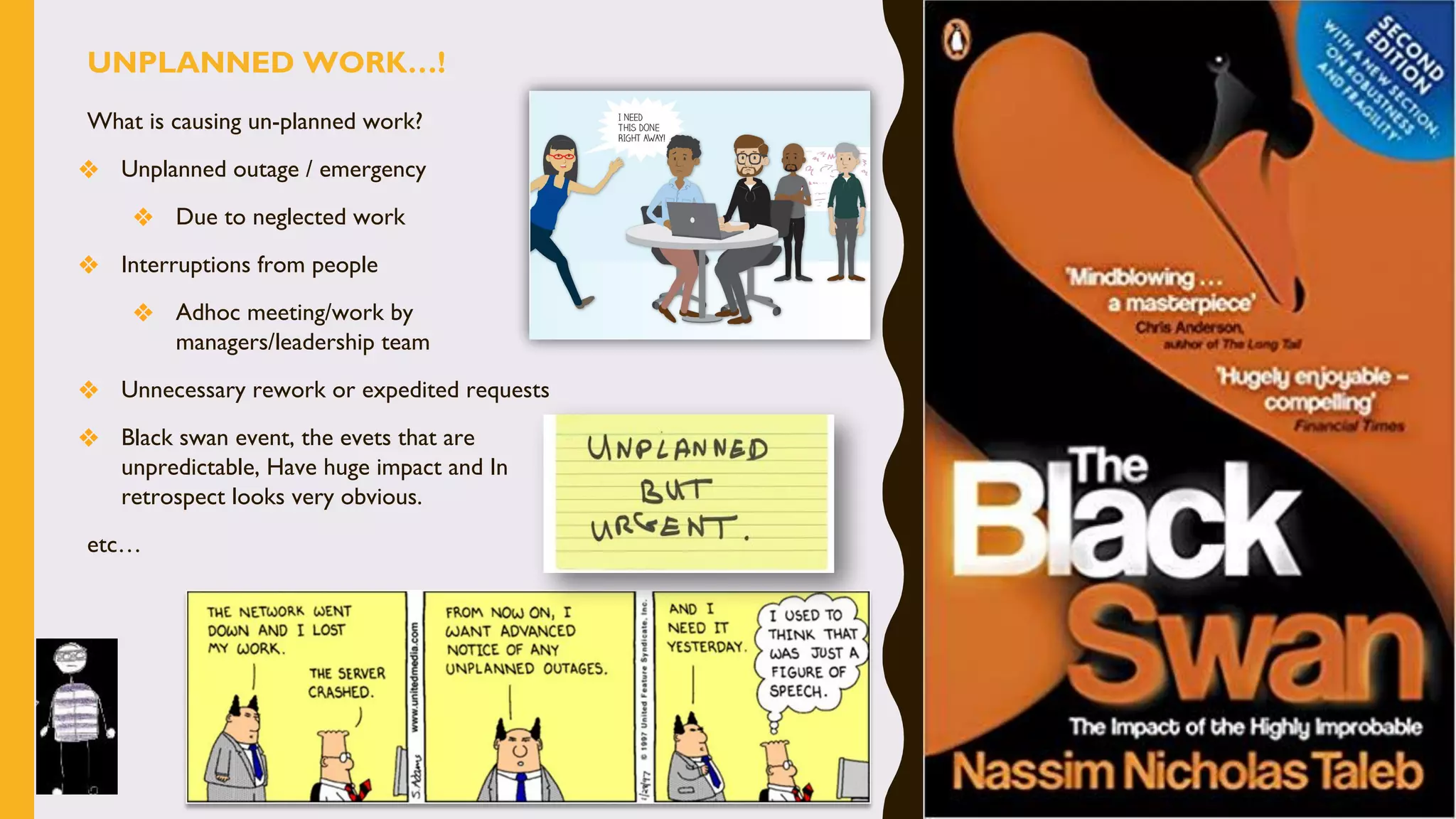
What is causing un-planned work?
❖ Unplanned outage / emergency
❖ Due to neglected work
❖ Interruptions from people
❖ Adhoc meeting/work by
managers/leadership team
❖ Unnecessary rework or expedited requests
❖ Black swan event, the evets that are
unpredictable, Have huge impact and In
retrospect looks very obvious.
etc…
UNPLANNED WORK…!
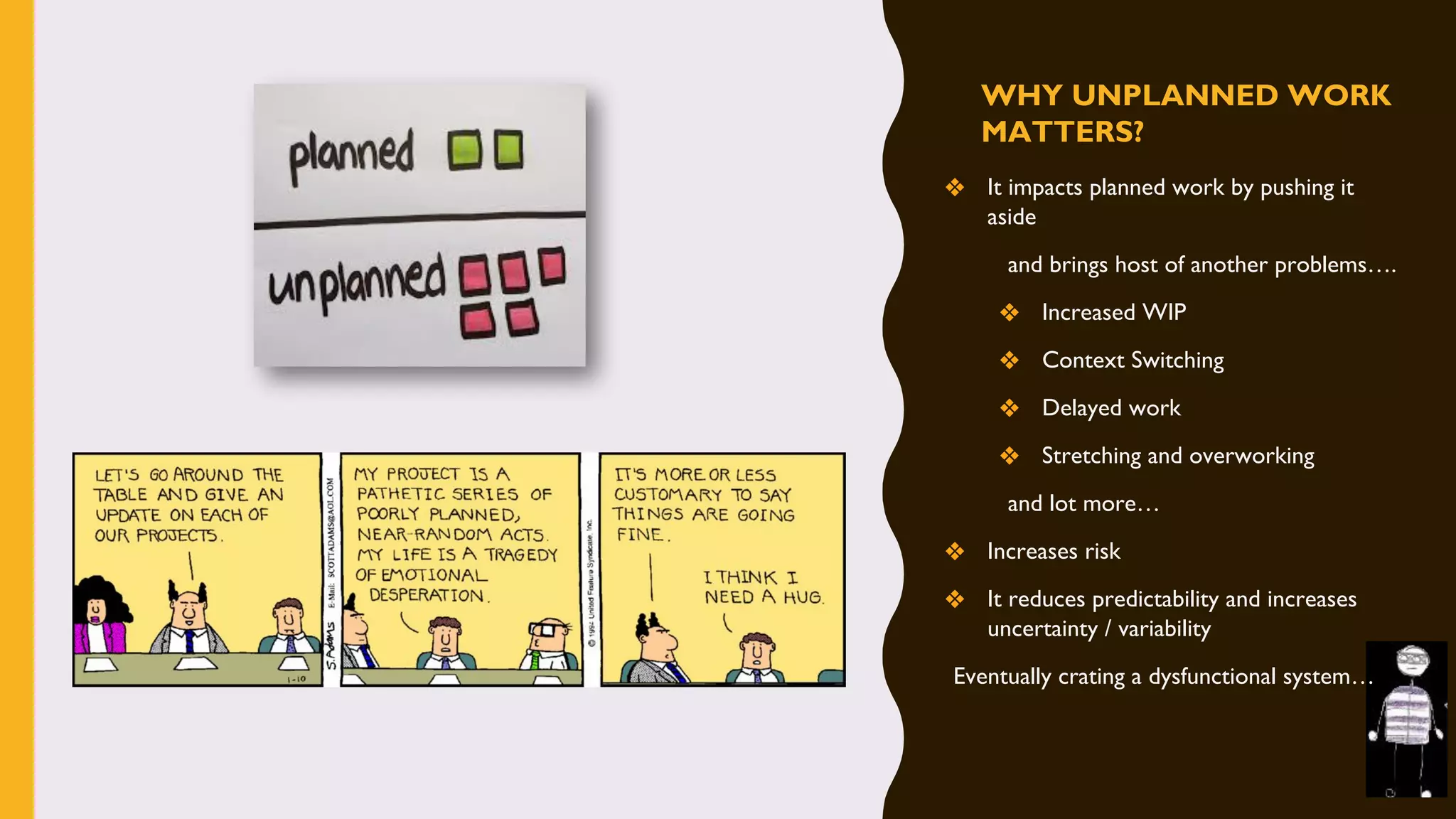
WHY UNPLANNED WORK
MATTERS?
❖ It impacts planned work by pushing it
aside
and brings host of another problems….
❖ Increased WIP
❖ Context Switching
❖ Delayed work
❖ Stretching and overworking
and lot more…
❖ Increases risk
❖ It reduces predictability and increases
uncertainty / variability
Eventually crating a dysfunctional system…
CAN WE COMPLETELY ELIMINATE
THE UNPLANNED WORK?
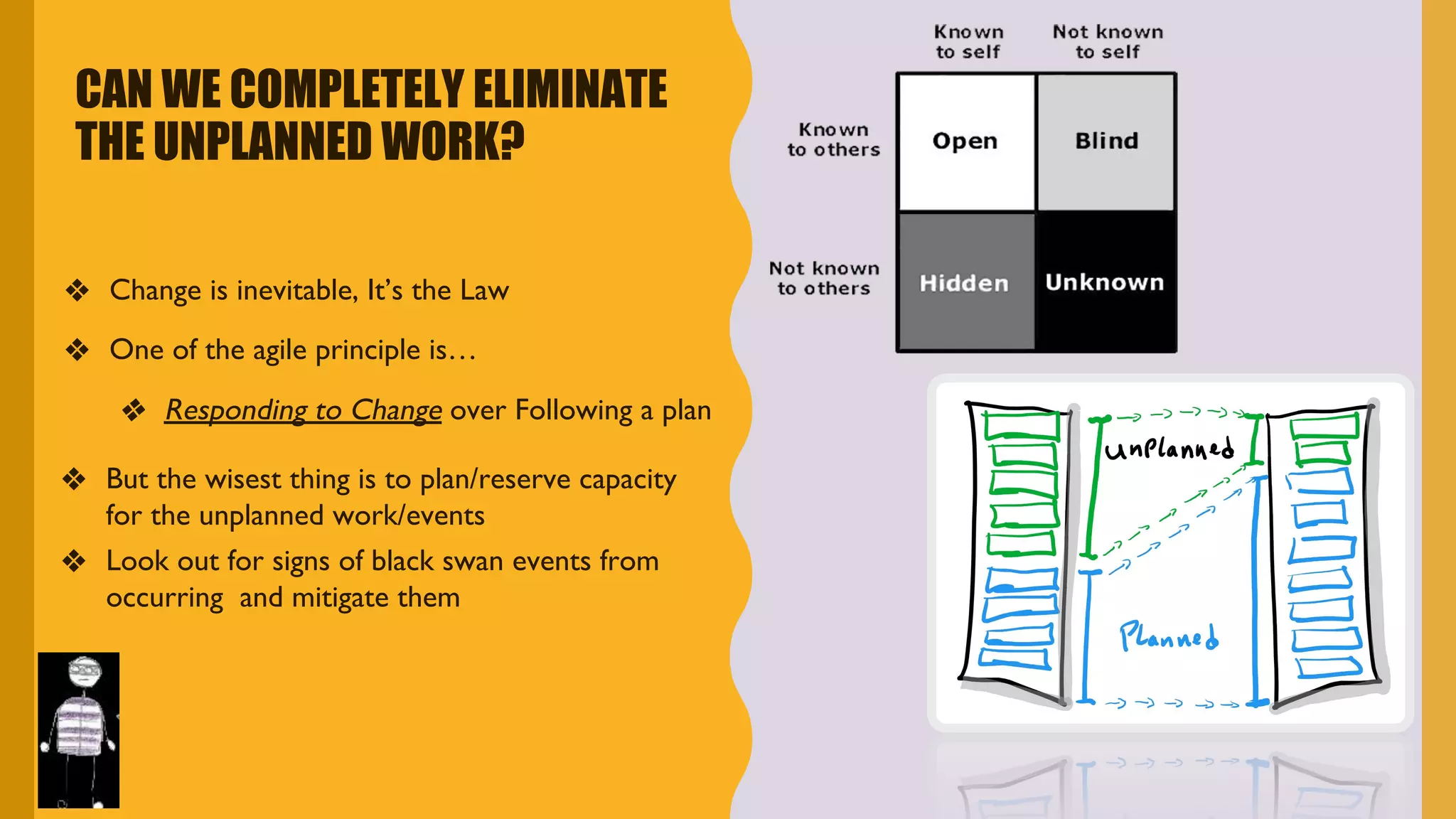
❖ Change is inevitable, It’s the Law
❖ One of the agile principle is…
❖ Responding to Change over Following a plan
❖ But the wisest thing is to plan/reserve capacity
for the unplanned work/events
❖ Look out for signs of black swan events from
occurring and mitigate them
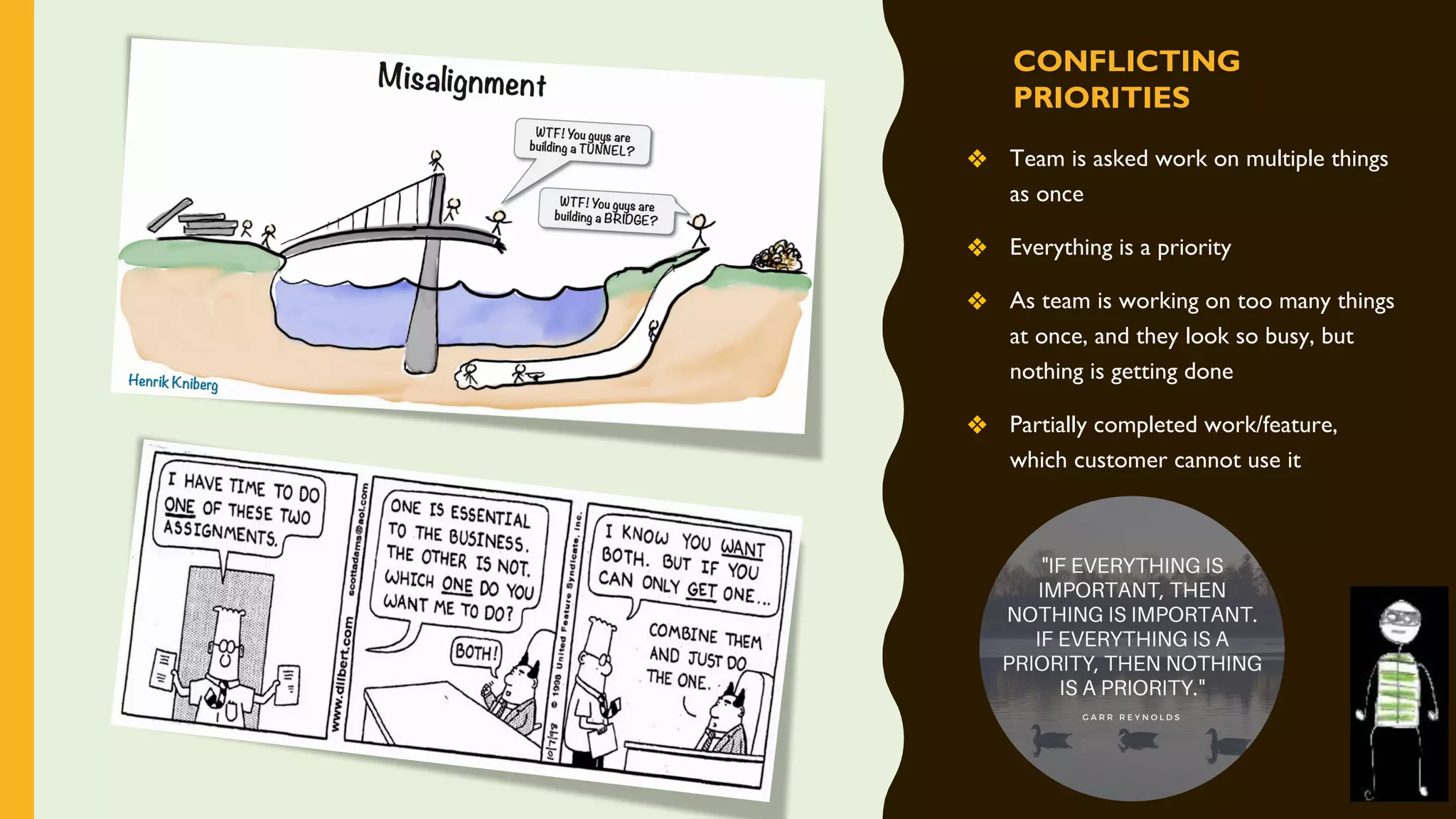
CONFLICTING
PRIORITIES
❖ Team is asked work on multiple things
as once
❖ Everything is a priority
❖ As team is working on too many things
at once, and they look so busy, but
nothing is getting done
❖ Partially completed work/feature,
which customer cannot use it
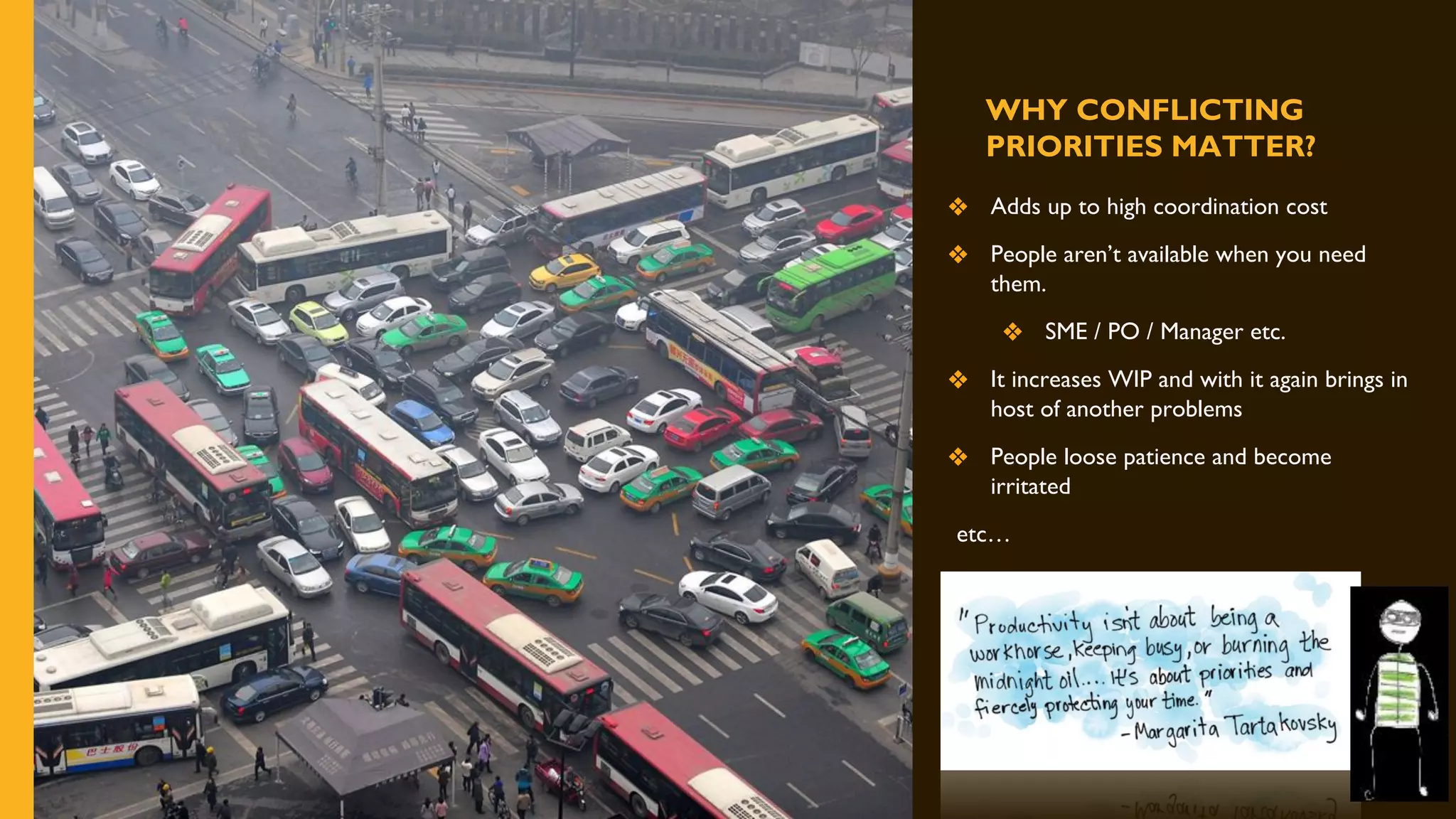
WHY CONFLICTING
PRIORITIES MATTER?
❖ Adds up to high coordination cost
❖ People aren’t available when you need
them.
❖ SME / PO / Manager etc.
❖ It increases WIP and with it again brings in
host of another problems
❖ People loose patience and become
irritated
etc…
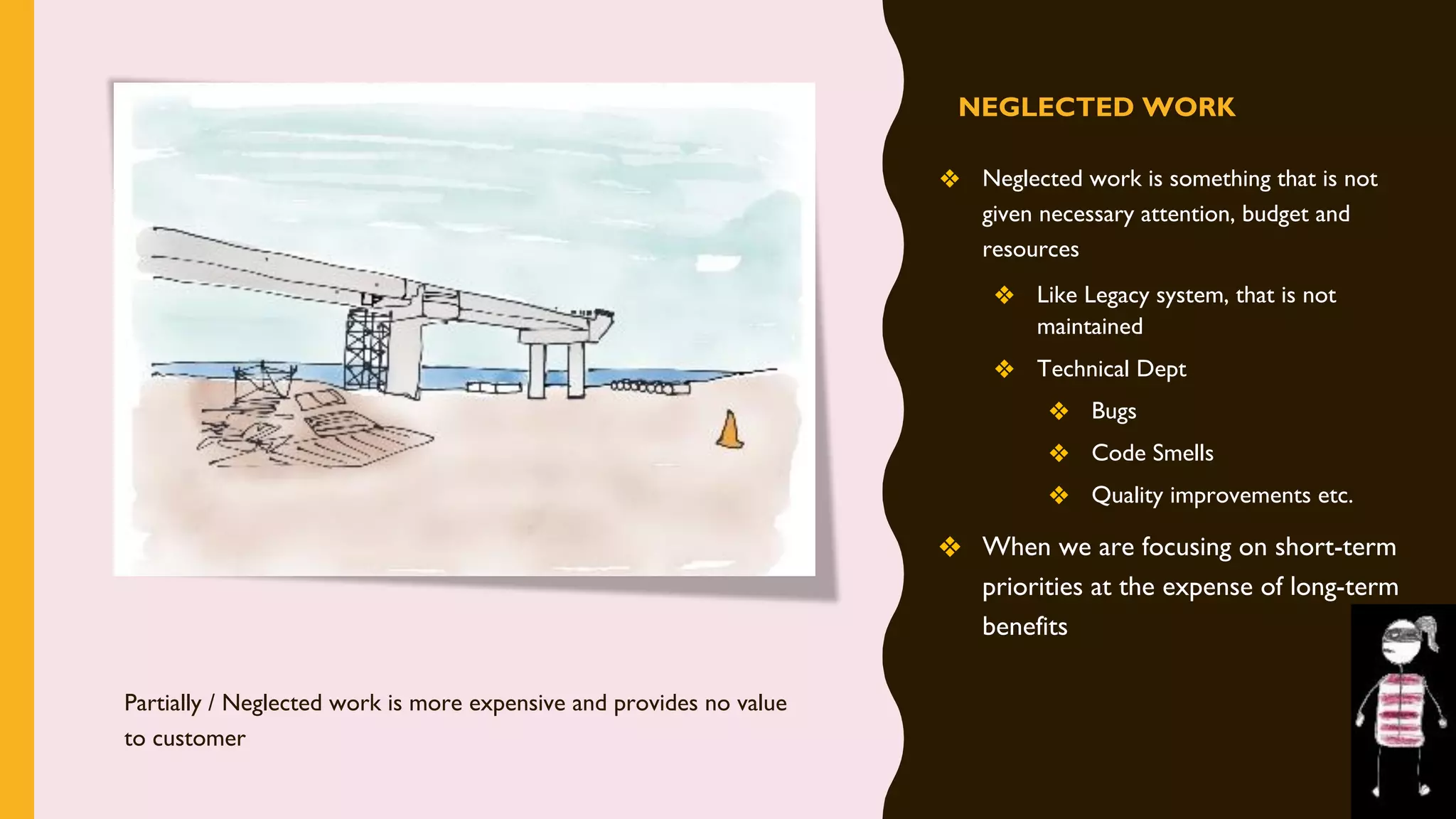
NEGLECTED WORK
❖ Neglected work is something that is not
given necessary attention, budget and
resources
❖ Like Legacy system, that is not
maintained
❖ Technical Dept
❖ Bugs
❖ Code Smells
❖ Quality improvements etc.
❖ When we are focusing on short-term
priorities at the expense of long-term
benefits
Partially / Neglected work is more expensive and provides no value
to customer
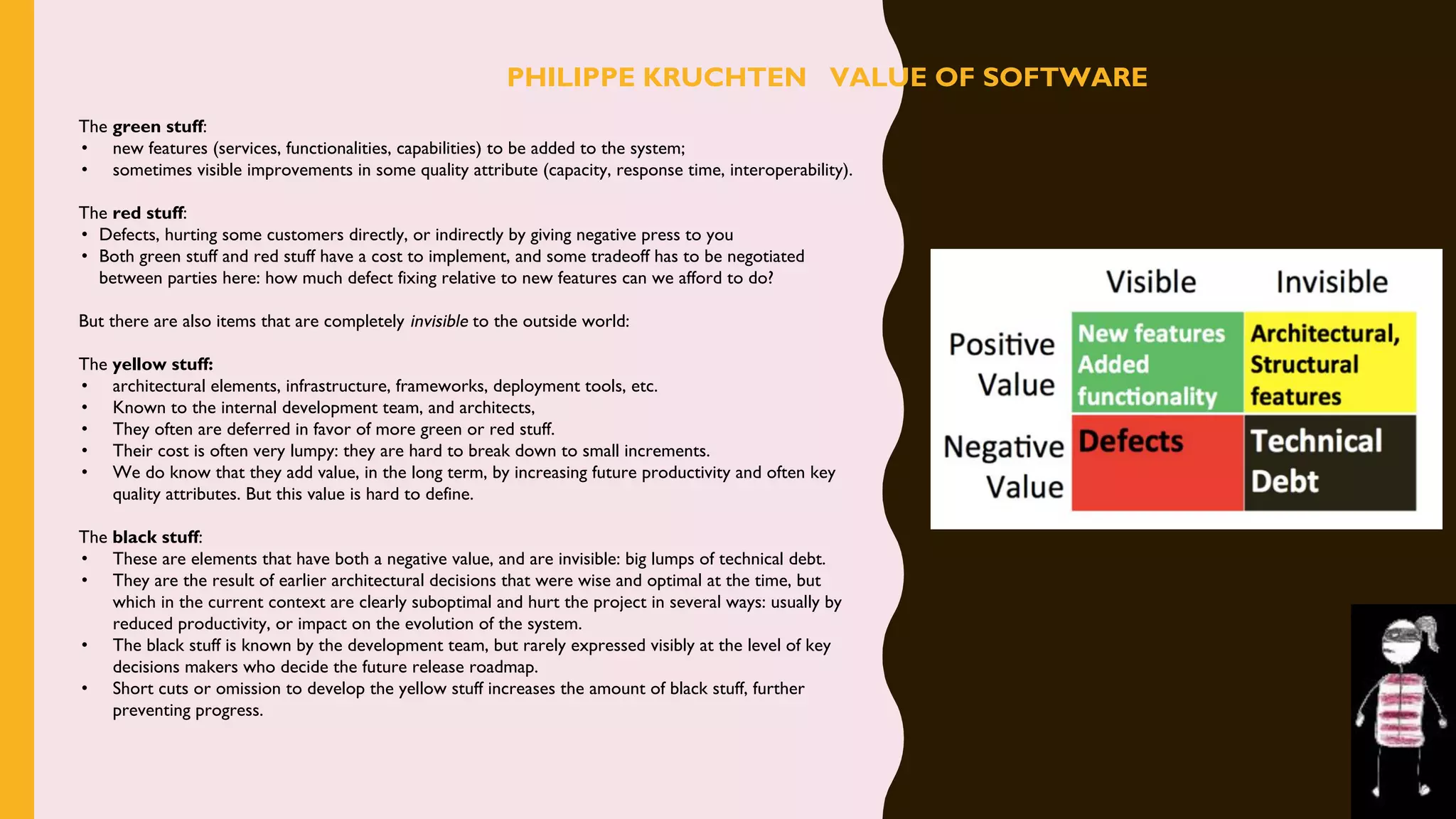
The green stuff:
• new features (services, functionalities, capabilities) to be added to the system;
• sometimes visible improvements in some quality attribute (capacity, response time, interoperability).
The red stuff:
• Defects, hurting some customers directly, or indirectly by giving negative press to you
• Both green stuff and red stuff have a cost to implement, and some tradeoff has to be negotiated
between parties here: how much defect fixing relative to new features can we afford to do?
But there are also items that are completely invisible to the outside world:
The yellow stuff: 
• architectural elements, infrastructure, frameworks, deployment tools, etc.
• Known to the internal development team, and architects,
• They often are deferred in favor of more green or red stuff.
• Their cost is often very lumpy: they are hard to break down to small increments.
• We do know that they add value, in the long term, by increasing future productivity and often key
quality attributes. But this value is hard to define.
The black stuff:
• These are elements that have both a negative value, and are invisible: big lumps of technical debt.
• They are the result of earlier architectural decisions that were wise and optimal at the time, but
which in the current context are clearly suboptimal and hurt the project in several ways: usually by
reduced productivity, or impact on the evolution of the system.
• The black stuff is known by the development team, but rarely expressed visibly at the level of key
decisions makers who decide the future release roadmap.
• Short cuts or omission to develop the yellow stuff increases the amount of black stuff, further
preventing progress.
PHILIPPE KRUCHTEN VALUE OF SOFTWARE
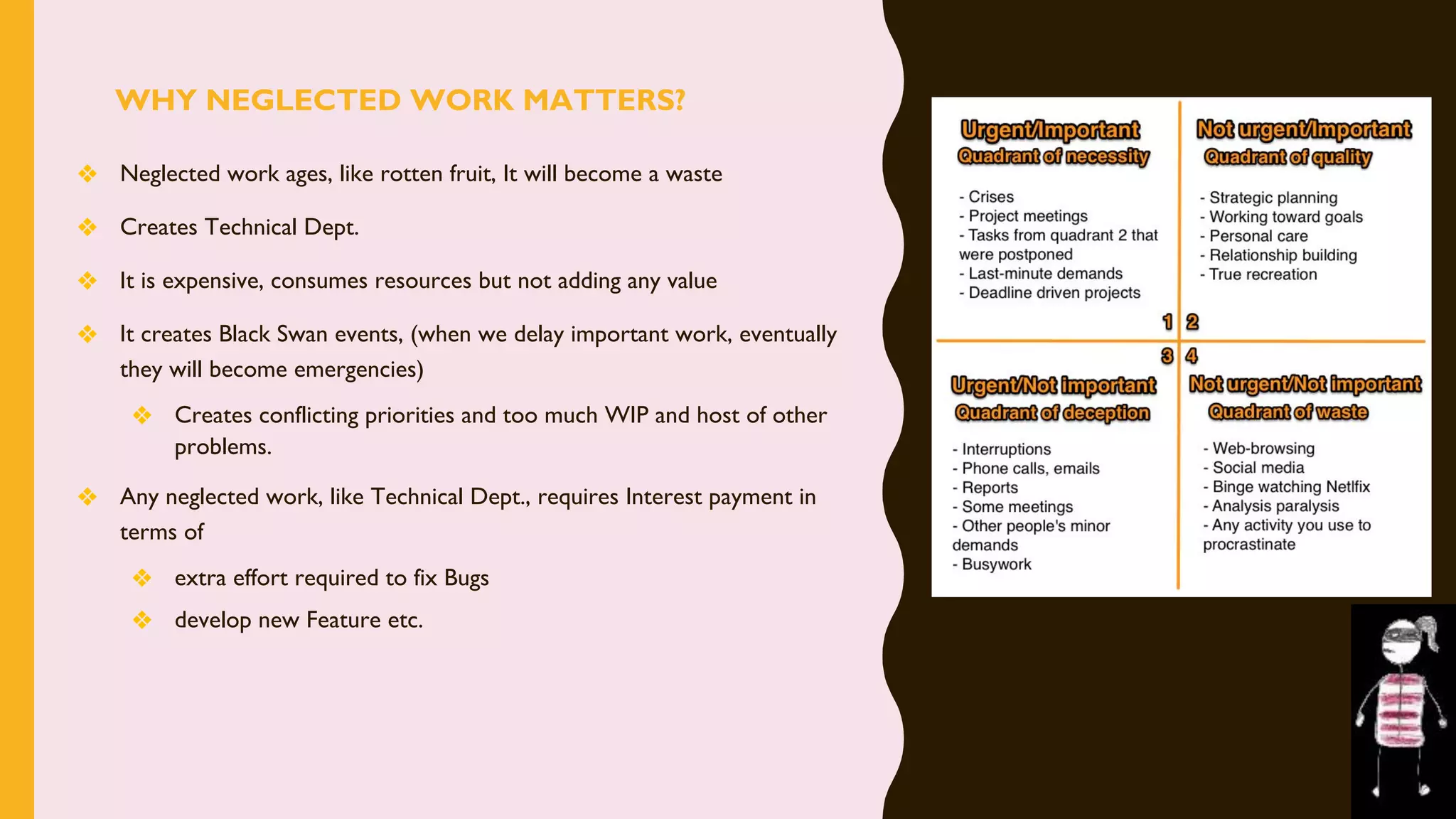
WHY NEGLECTED WORK MATTERS?
❖ Neglected work ages, like rotten fruit, It will become a waste
❖ Creates Technical Dept.
❖ It is expensive, consumes resources but not adding any value
❖ It creates Black Swan events, (when we delay important work, eventually
they will become emergencies)
❖ Creates conflicting priorities and too much WIP and host of other
problems.
❖ Any neglected work, like Technical Dept., requires Interest payment in
terms of
❖ extra effort required to fix Bugs
❖ develop new Feature etc.
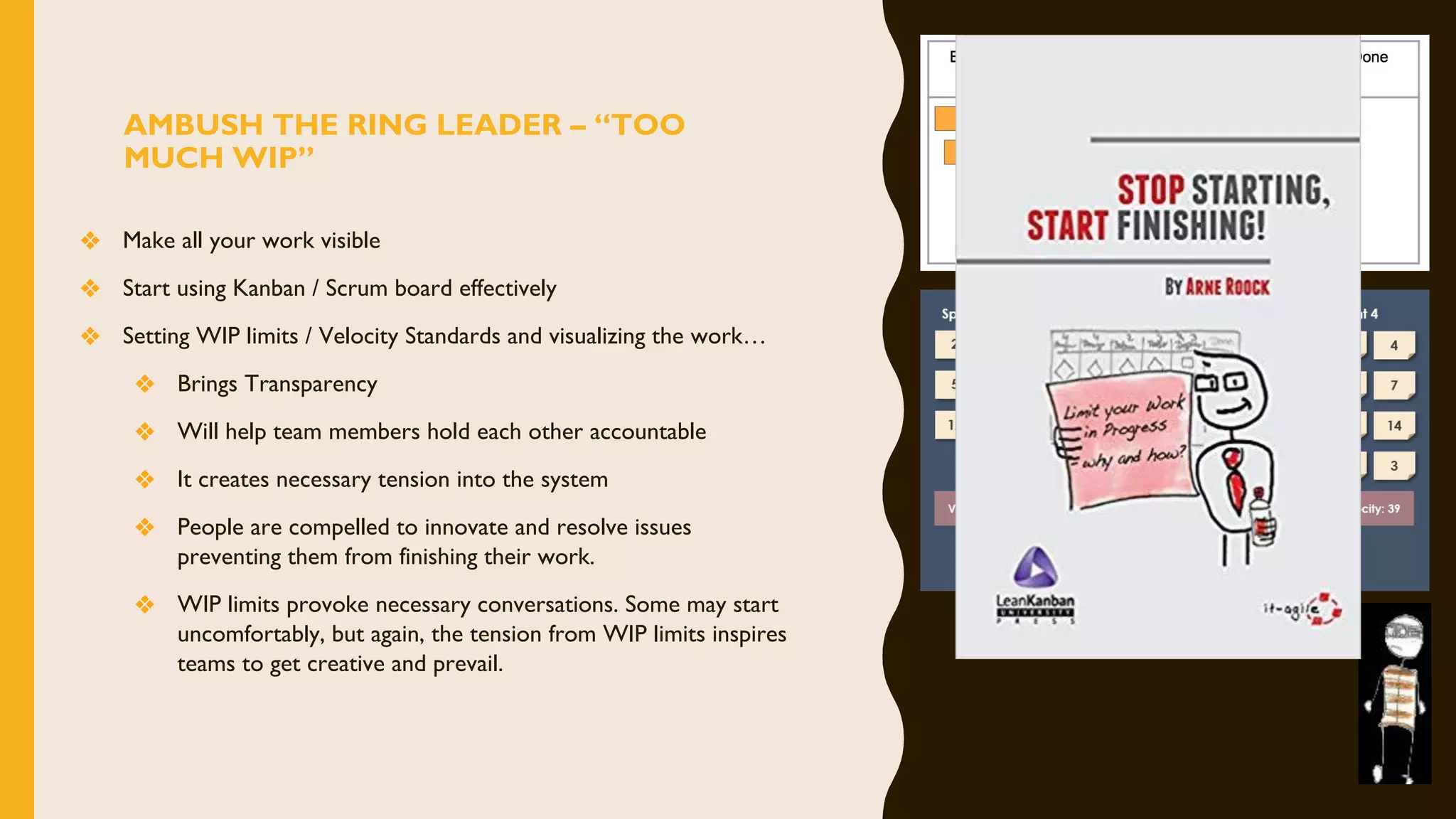
AMBUSH THE RING LEADER – “TOO
MUCH WIP”
❖ Make all your work visible
❖ Start using Kanban / Scrum board effectively
❖ Setting WIP limits / Velocity Standards and visualizing the work…
❖ Brings Transparency
❖ Will help team members hold each other accountable
❖ It creates necessary tension into the system
❖ People are compelled to innovate and resolve issues
preventing them from finishing their work.
❖ WIP limits provoke necessary conversations. Some may start
uncomfortably, but again, the tension from WIP limits inspires
teams to get creative and prevail.
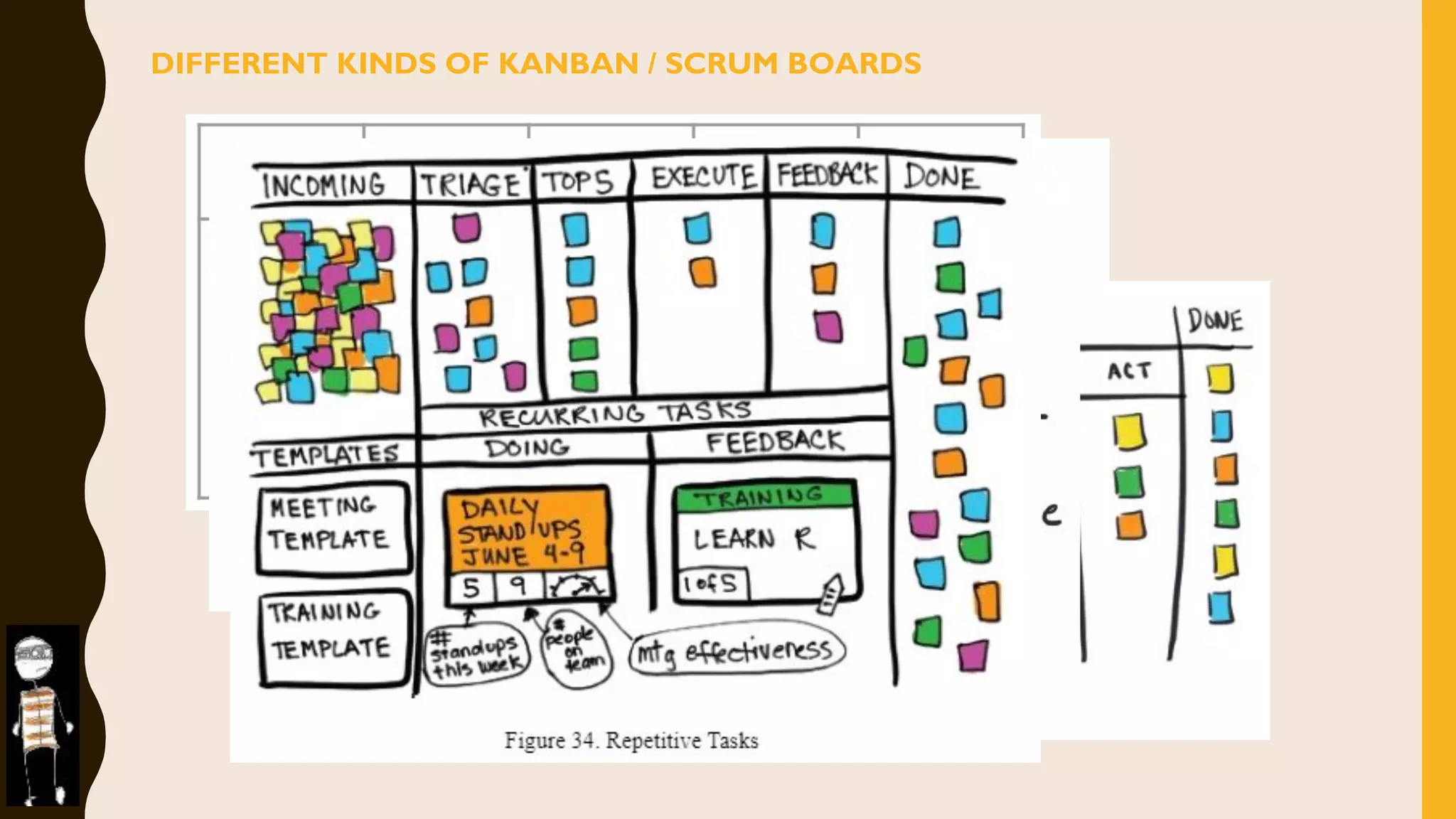
DIFFERENT KINDS OF KANBAN / SCRUM BOARDS
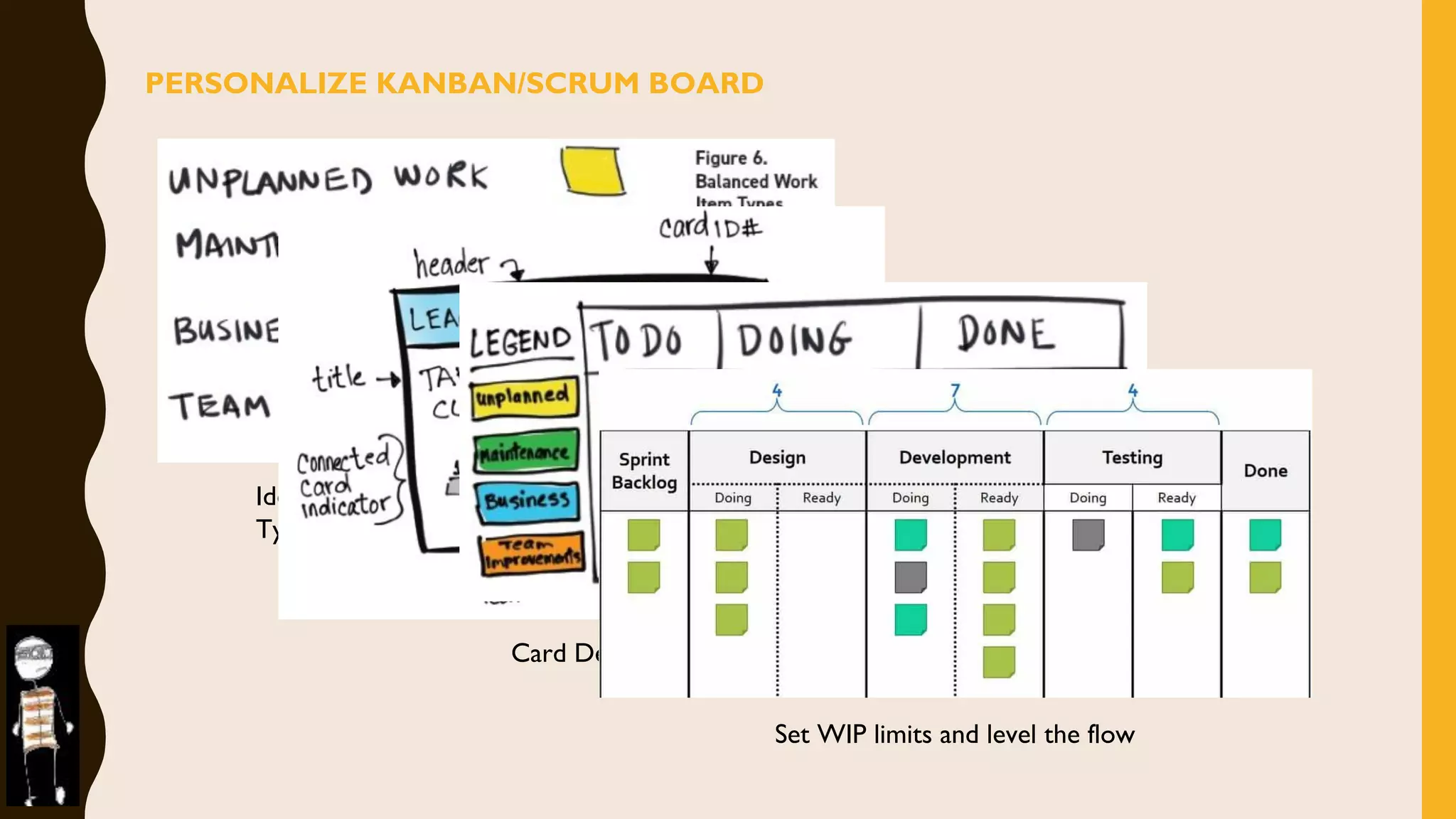
PERSONALIZE KANBAN/SCRUM BOARD
Identify Work Item
Types/Categories
Card Design
Workflow Mapping
Set WIP limits and level the flow
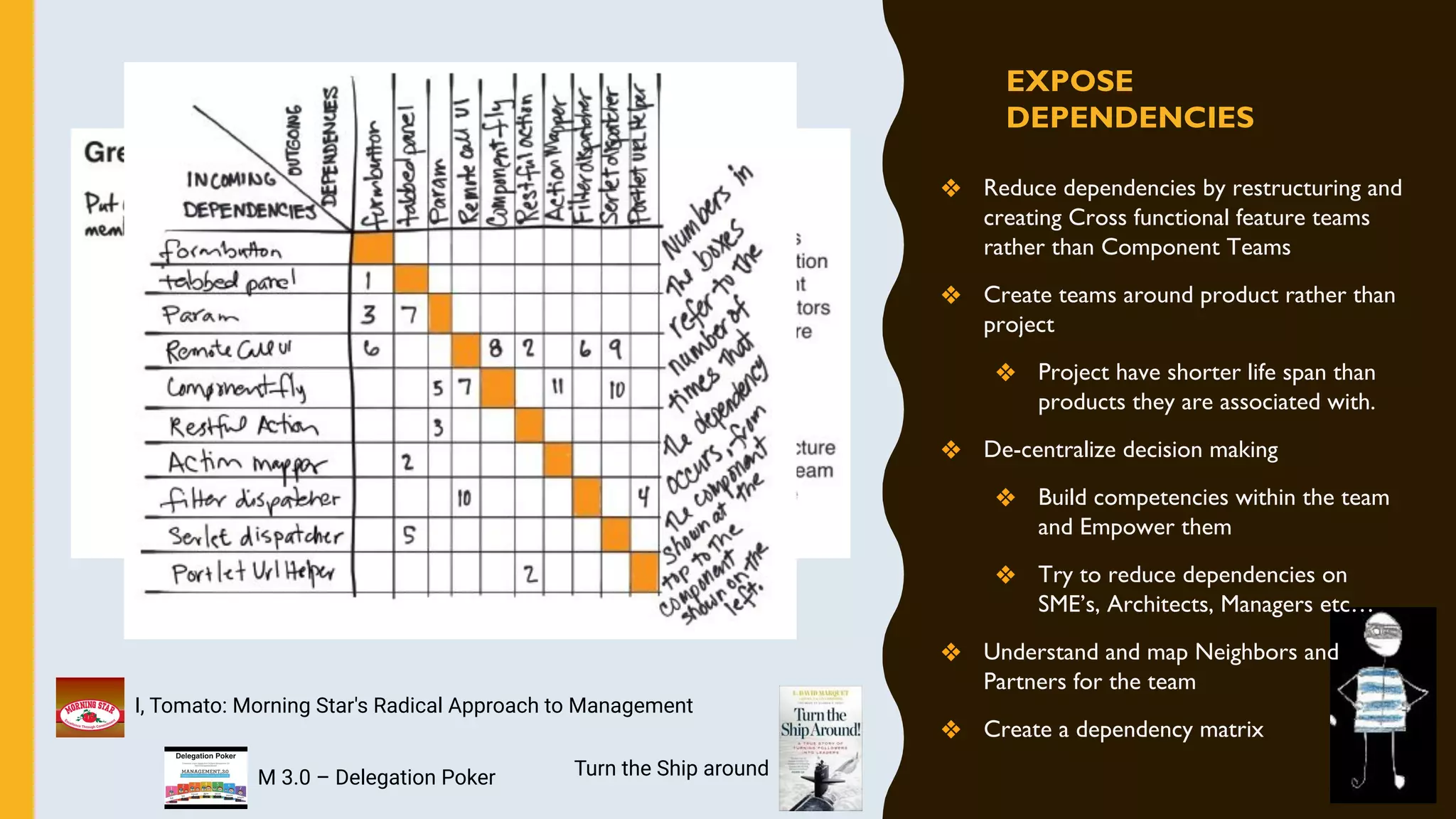
EXPOSE
DEPENDENCIES
❖ Reduce dependencies by restructuring and
creating Cross functional feature teams
rather than Component Teams
❖ Create teams around product rather than
project
❖ Project have shorter life span than
products they are associated with.
❖ De-centralize decision making
❖ Build competencies within the team
and Empower them
❖ Try to reduce dependencies on
SME’s, Architects, Managers etc…
❖ Understand and map Neighbors and
Partners for the team
❖ Create a dependency matrix
I, Tomato: Morning Star's Radical Approach to Management
Turn the Ship aroundM 3.0 – Delegation Poker
EXPOSE
DEPENDENCIES
❖ Expose dependencies at team level
❖ Track dependendencies between teams
using parent-child relationship
❖ During PI/Release planning/ Refinement
sessions identify dependencies
❖ Create dependency tracker and track them
❖ Scrum-of-scrum meeting
❖ multi team Kanban/Scrum board etc.
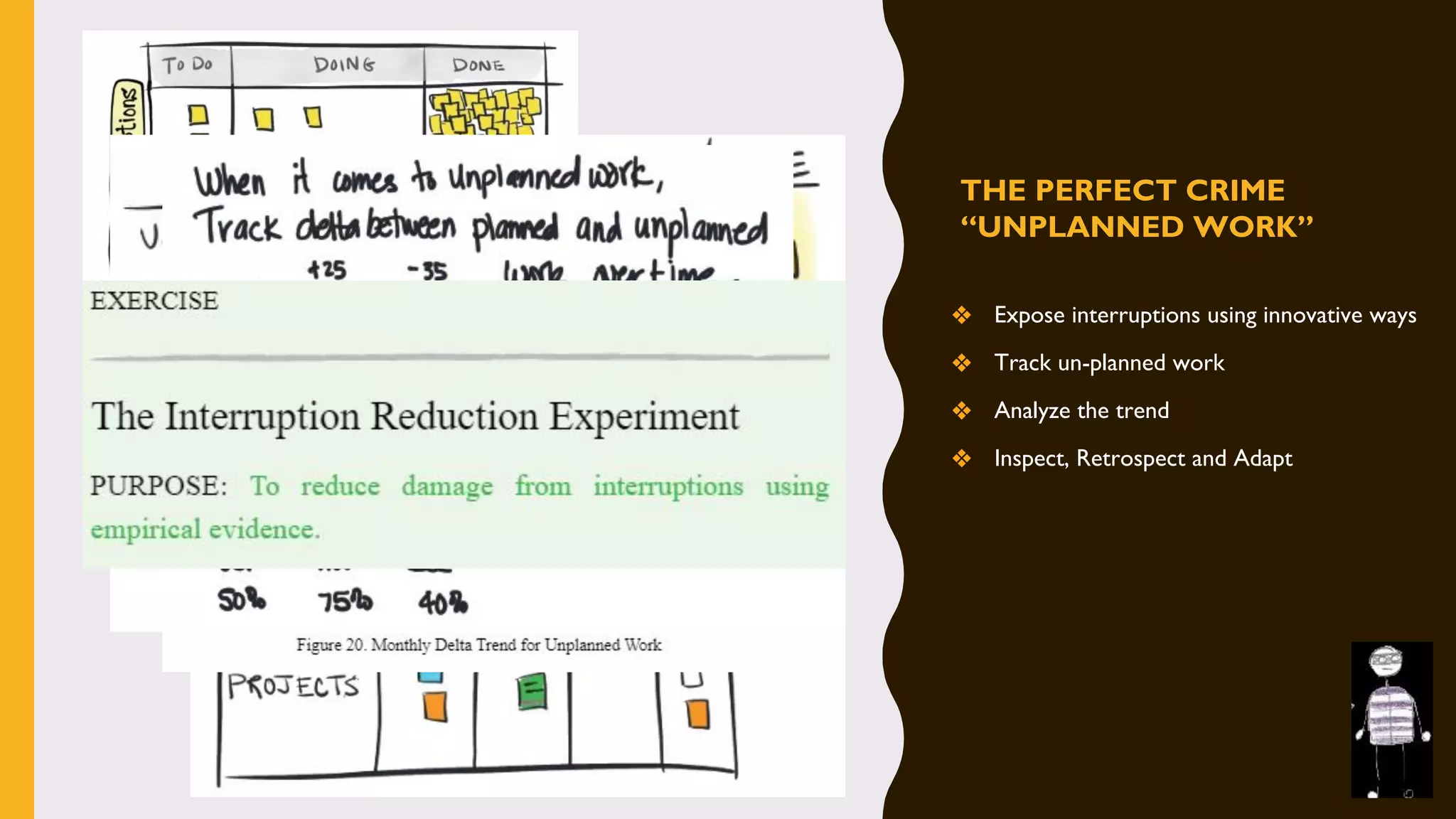
❖ Expose interruptions using innovative ways
❖ Track un-planned work
❖ Analyze the trend
❖ Inspect, Retrospect and Adapt
THE PERFECT CRIME
“UNPLANNED WORK”
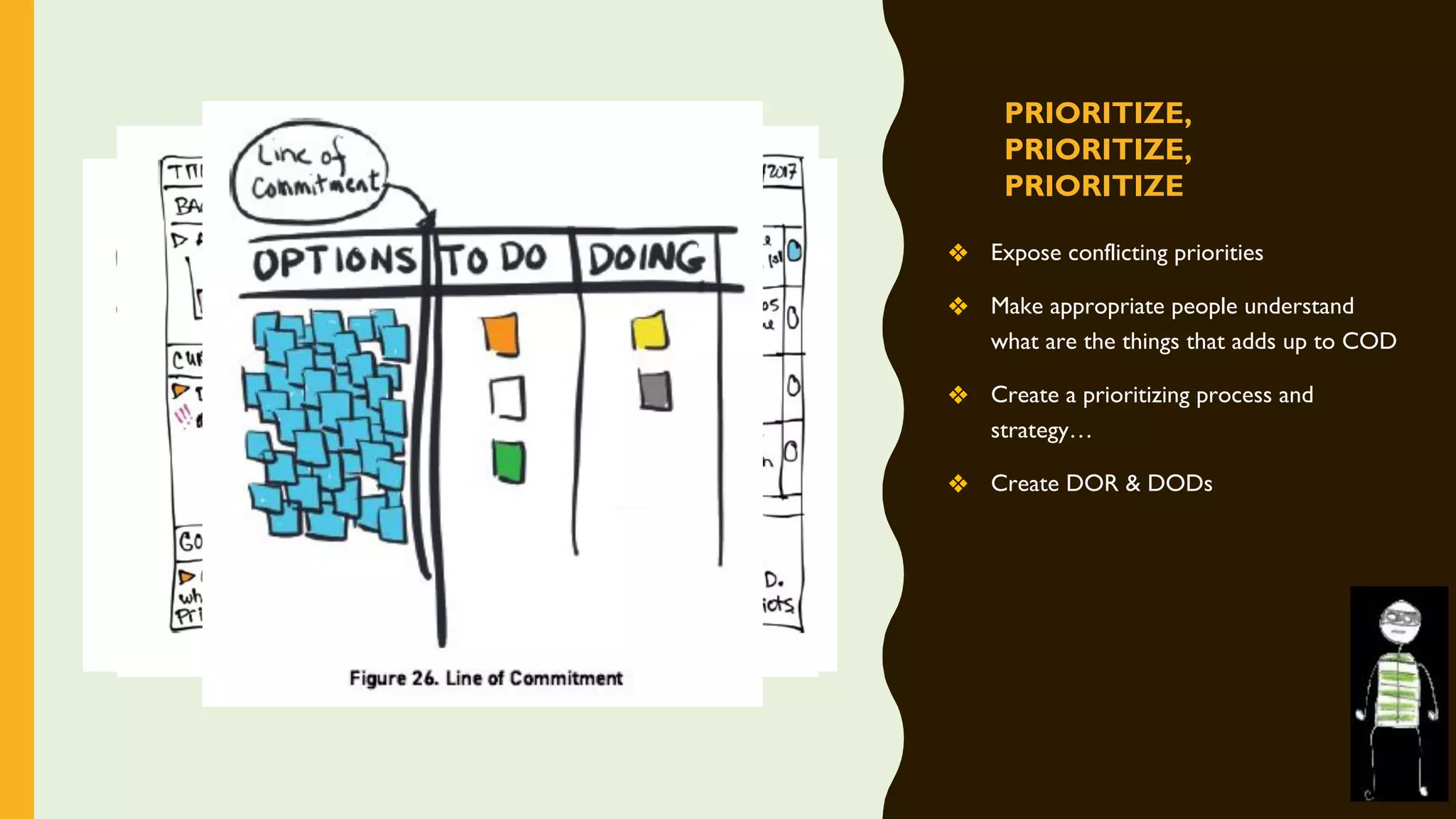
PRIORITIZE,
PRIORITIZE,
PRIORITIZE
❖ Expose conflicting priorities
❖ Make appropriate people understand
what are the things that adds up to COD
❖ Create a prioritizing process and
strategy…
❖ Create DOR & DODs
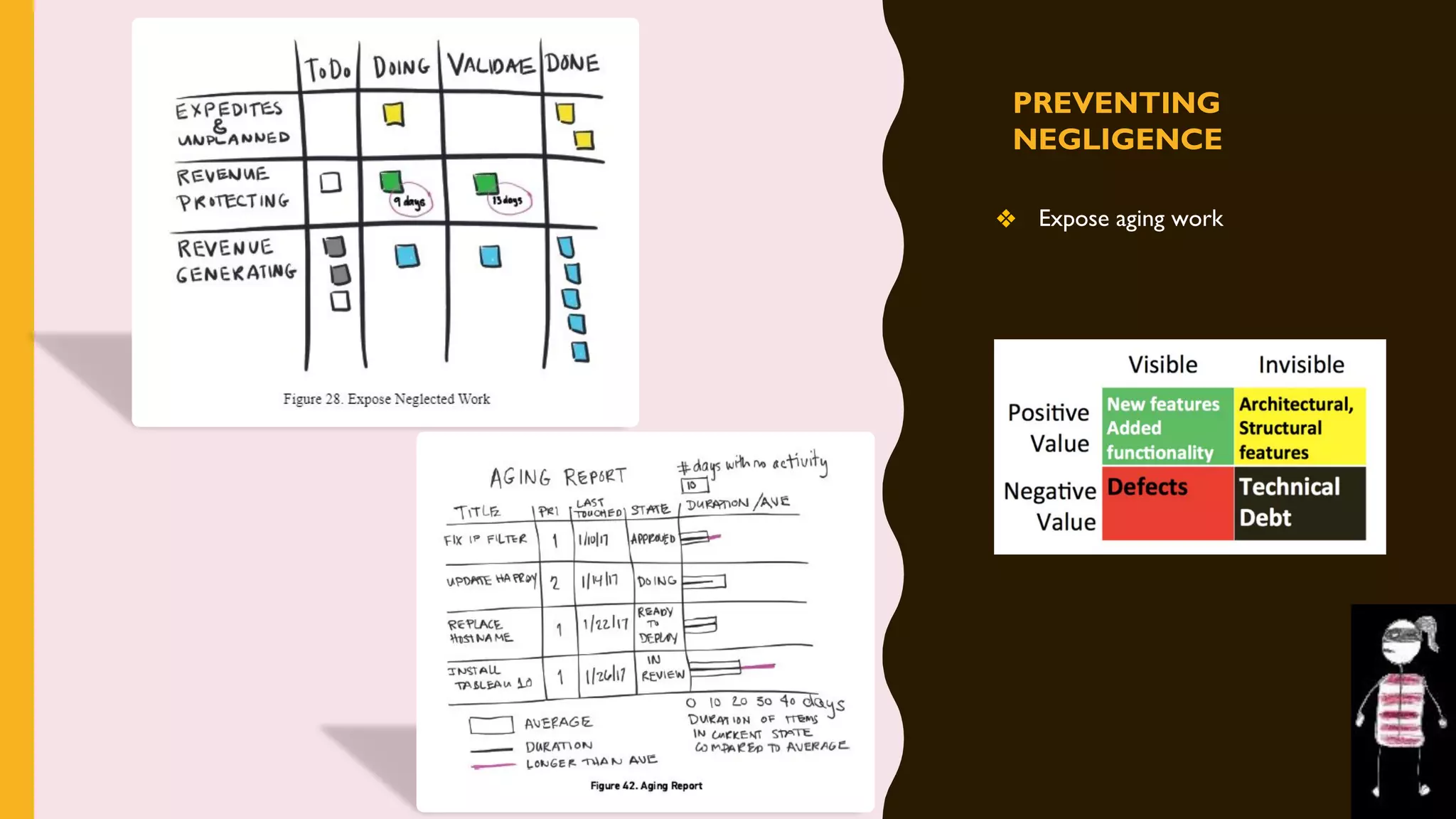
PREVENTING
NEGLIGENCE
❖ Expose aging work
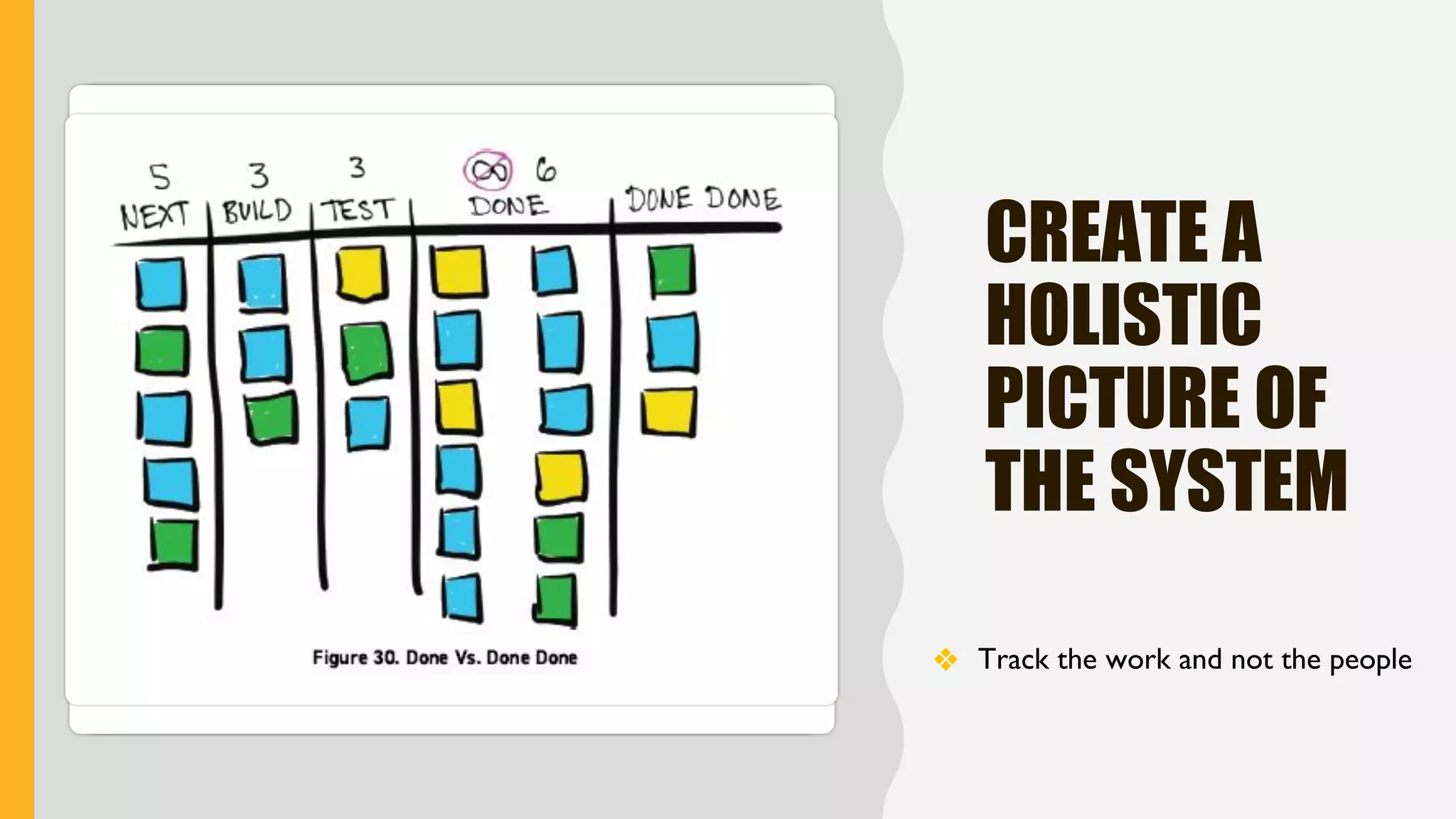
CREATE A
HOLISTIC
PICTURE OF
THE SYSTEM
❖ Track the work and not the people
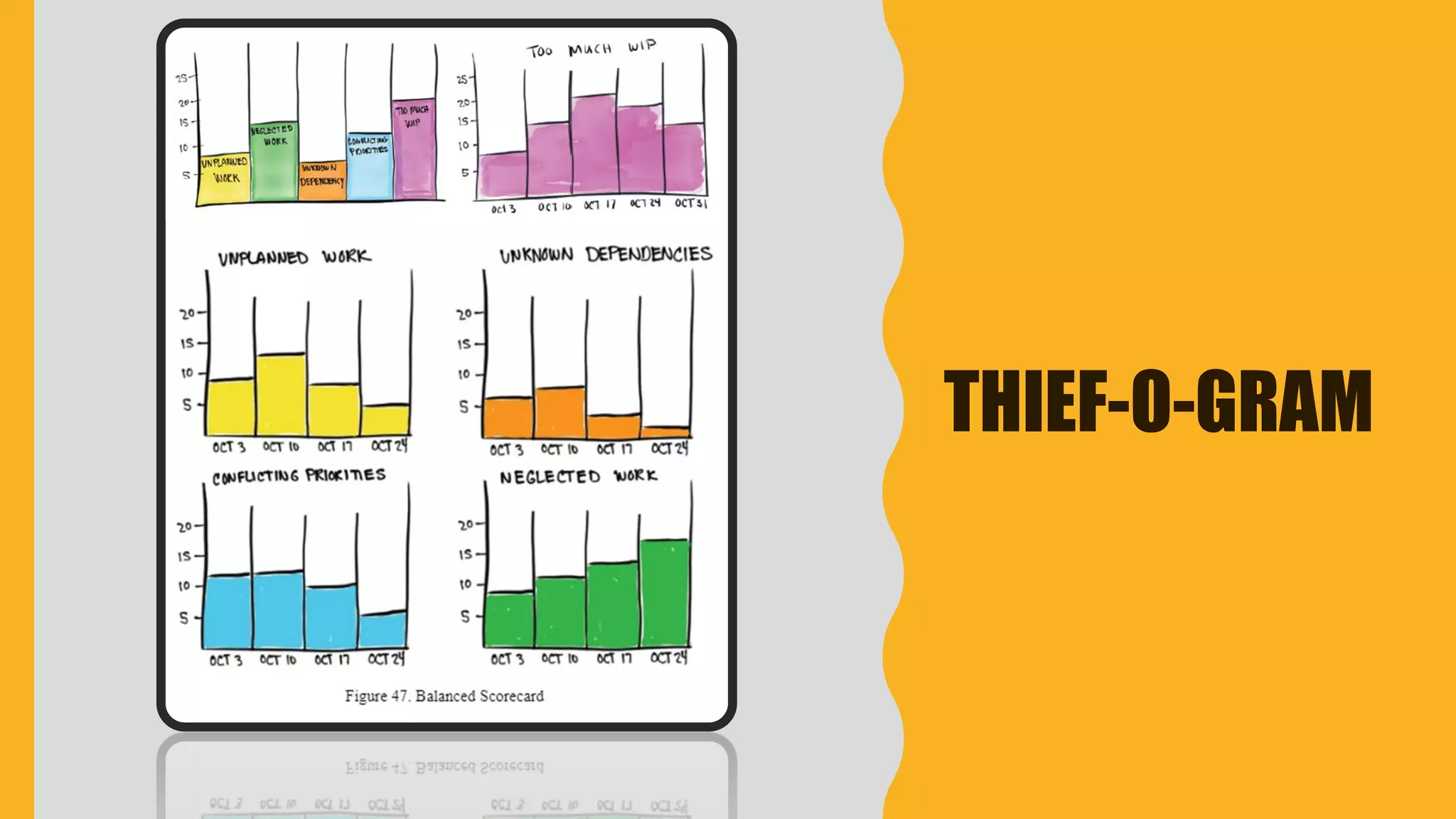
THIEF-O-GRAM
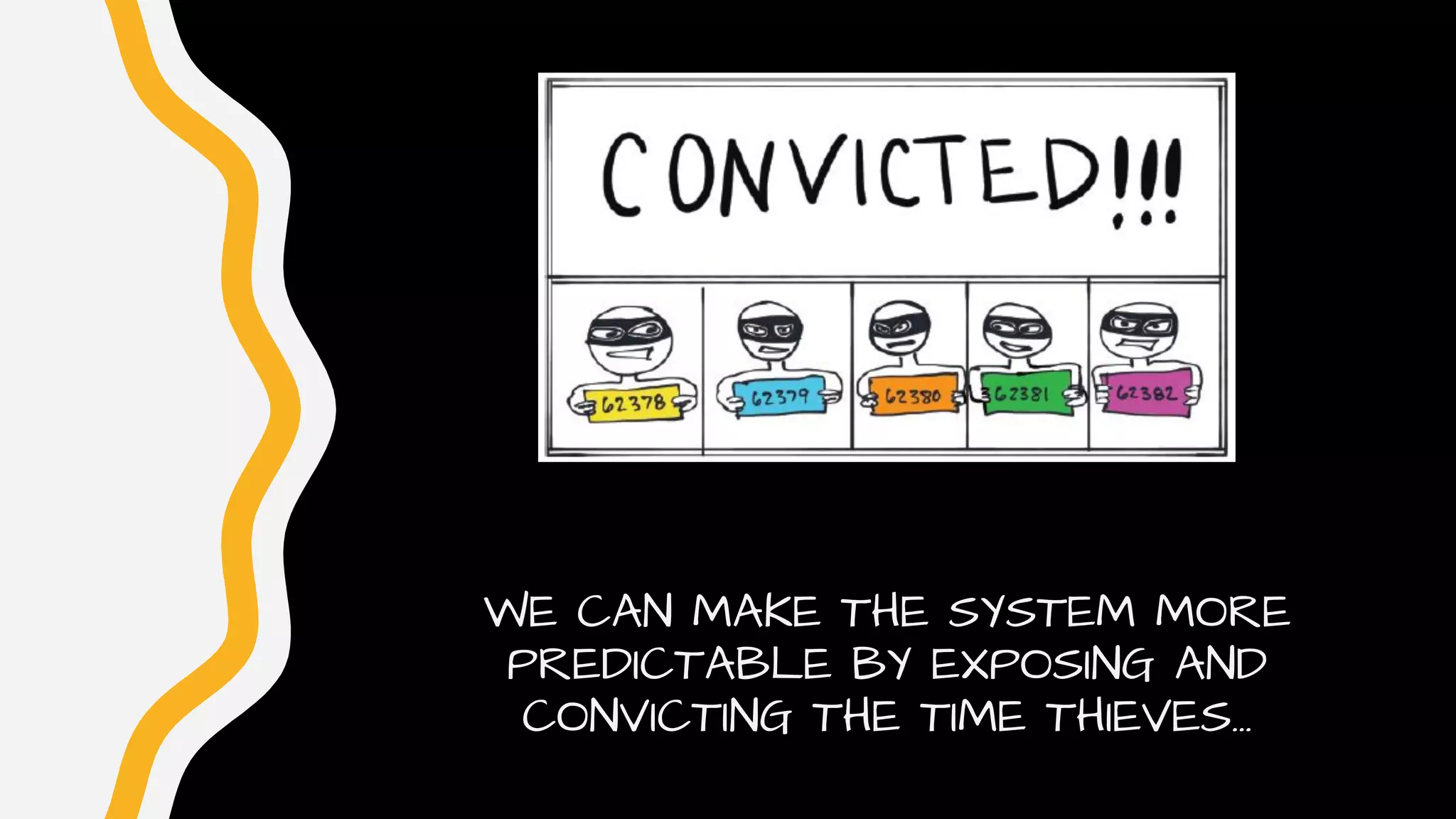
WE CAN MAKE THE SYSTEM MORE
PREDICTABLE BY EXPOSING AND
CONVICTING THE TIME THIEVES...
NOW IT’S YOUR TURN TO
INTERVIEW ME
WHAT QUESTIONS WOULD YOU LIKE TO ASK
ME?
THANK YOU

Agile Network India | "Make Work Visible" - Expose the time thieves to optimize work & flow

  • 1.
    P1 FLOW BLOCKE D LEAN WAIT MakingWork Visible EXPOSING TIME THEFT TO OPTIMIZE WORK & FLOW
  • 4.
    IF YOU AREPART OF A TEAM THAT… ❖ Often chasing the DEADLINEs ❖ Often work late nights… ❖ Often do fire fighting and last minute changes ❖ Where super heroes are brought in to save the day ❖ They are always overwhelmed with too much work to do… ❖ Have too many things are in-progress, and nothing gets done on time… ❖ Have too many dependencies Then you need to understand that you are part of dysfunctional system and process …
  • 6.
    THE SOLUTION ISTO CREATE A SYSTEM THAT •Makes all the work visible •Limit work in-progress (WIP) •Measure and manage the flow of work •Prioritize effectively •Make adjustments based on validated learnings (i.e. from feedback and metrics)
  • 7.
    TODAY, LET’S DISCUSS… ❖How to spot the 5 thieves that are staling your time… ❖ How to expose them, in order to make our work visible and optimize the workflow ❖ How to measure the progress by using the right metrics
  • 8.
    THE 5 THIEVESARE… ❖ Too much work-in-progress (WIP) – work that has started, but not yet finished. We need to • acknowledge the existence of time thieves • make them visible/expose them • confront them and • begin to chase them away and take back the day. ❖ Conflicting priorities – projects and tasks that compete with each other. This is exacerbated when we are uncertain about the most important thing to do. ❖ Unknown dependencies – something we aren’t aware of that needs to happen before work can be finished. ❖ Unplanned work – interruptions that prevent you from finishing something or from stopping at a better breaking point. ❖ Neglected work – partially completed work that sits idle on the bench.
  • 9.
    TOO MUCH WORK-IN-PROGRESS (WIP) ❖Work gets piled-up or too much WIP is when demand exceeds capacity. ❖ Every minute of the day is fully scheduled. ❖ Quite often the most talented have the longest lists.
  • 11.
    WE HAVE HARDTIME SAYING NO FOR VARIETY OF REASONS… •We like the person who is asking us for a favor •We are team players, we don’t want to let the team down •We fear humiliation, I don’t want to criticized or fired •I like new and Shiny, Its much more fun than doing the grunt work •We don’t realize how big the request is until we start working on it. (Planning fallacy) •We like to please people •We don’t want people to think poorly of us.
  • 12.
    WHY TOO MUCHWIP MATTERS? It can lead us to many issues, including… ❖ Context Switching is common ❖ Delayed delivery of value ❖ Loose Customers due to delayed delivery ❖ Increased cost ❖ Decreased Quality ❖ Conflicting Priorities ❖ Increased dependencies ❖ Increased demand for more resource ❖ Irritated staff and ❖ A change in one part of the code/plan is unexpectedly changed by others many more… The thief WIP is the ring leader of all the other thieves…
  • 13.
    Kingman’s formula statesthat the higher the utilization, the longer the lead time. This is an exponential relationship. The closer you get to 100% utilization, the faster your lead time will increase and ultimately will rocket straight through the roof. It’s a clear example of how overburdening leads to serious problems, not only for the resources involved, but also for your customers. In fact you plan for poor service when you do so. WHY TOO MUCH WIP MATTERS?
  • 14.
    HOW TO IDENTIFY IFYOUR TEAM IS OVERBURDENED WITH TOO MUCH WIP? By using Kanban / SCRUM board MAKE ALL THE WORK VISIBLE
  • 15.
    UNKNOWN DEPENDENCIES What is crating/leadingto dependencies… ❖ Monolithic architecture ❖ Waiting for People (Experts, SMEs, Managers and bureaucratic structure) ❖ Waiting for Tools / Environment ❖ Deadlock activities etc…
  • 16.
    WHY DEPENDENCY MATTERS? ❖ Everydependency in the value stream doubles the chances of delay ❖ Adds up to high coordination cost ❖ People aren’t available when you need them ❖ Adds confusion, separation of responsibility and blame game between people and teams ❖ Creates conflicting priorities ❖ A change in one part of the code/plan is unexpectedly changed by others etc…
  • 17.
    What is causingun-planned work? ❖ Unplanned outage / emergency ❖ Due to neglected work ❖ Interruptions from people ❖ Adhoc meeting/work by managers/leadership team ❖ Unnecessary rework or expedited requests ❖ Black swan event, the evets that are unpredictable, Have huge impact and In retrospect looks very obvious. etc… UNPLANNED WORK…!
  • 18.
    WHY UNPLANNED WORK MATTERS? ❖It impacts planned work by pushing it aside and brings host of another problems…. ❖ Increased WIP ❖ Context Switching ❖ Delayed work ❖ Stretching and overworking and lot more… ❖ Increases risk ❖ It reduces predictability and increases uncertainty / variability Eventually crating a dysfunctional system…
  • 19.
    CAN WE COMPLETELYELIMINATE THE UNPLANNED WORK? ❖ Change is inevitable, It’s the Law ❖ One of the agile principle is… ❖ Responding to Change over Following a plan ❖ But the wisest thing is to plan/reserve capacity for the unplanned work/events ❖ Look out for signs of black swan events from occurring and mitigate them
  • 20.
    CONFLICTING PRIORITIES ❖ Team isasked work on multiple things as once ❖ Everything is a priority ❖ As team is working on too many things at once, and they look so busy, but nothing is getting done ❖ Partially completed work/feature, which customer cannot use it
  • 21.
    WHY CONFLICTING PRIORITIES MATTER? ❖Adds up to high coordination cost ❖ People aren’t available when you need them. ❖ SME / PO / Manager etc. ❖ It increases WIP and with it again brings in host of another problems ❖ People loose patience and become irritated etc…
  • 22.
    NEGLECTED WORK ❖ Neglectedwork is something that is not given necessary attention, budget and resources ❖ Like Legacy system, that is not maintained ❖ Technical Dept ❖ Bugs ❖ Code Smells ❖ Quality improvements etc. ❖ When we are focusing on short-term priorities at the expense of long-term benefits Partially / Neglected work is more expensive and provides no value to customer
  • 23.
    The green stuff: • newfeatures (services, functionalities, capabilities) to be added to the system; • sometimes visible improvements in some quality attribute (capacity, response time, interoperability). The red stuff: • Defects, hurting some customers directly, or indirectly by giving negative press to you • Both green stuff and red stuff have a cost to implement, and some tradeoff has to be negotiated between parties here: how much defect fixing relative to new features can we afford to do? But there are also items that are completely invisible to the outside world: The yellow stuff:  • architectural elements, infrastructure, frameworks, deployment tools, etc. • Known to the internal development team, and architects, • They often are deferred in favor of more green or red stuff. • Their cost is often very lumpy: they are hard to break down to small increments. • We do know that they add value, in the long term, by increasing future productivity and often key quality attributes. But this value is hard to define. The black stuff: • These are elements that have both a negative value, and are invisible: big lumps of technical debt. • They are the result of earlier architectural decisions that were wise and optimal at the time, but which in the current context are clearly suboptimal and hurt the project in several ways: usually by reduced productivity, or impact on the evolution of the system. • The black stuff is known by the development team, but rarely expressed visibly at the level of key decisions makers who decide the future release roadmap. • Short cuts or omission to develop the yellow stuff increases the amount of black stuff, further preventing progress. PHILIPPE KRUCHTEN VALUE OF SOFTWARE
  • 24.
    WHY NEGLECTED WORKMATTERS? ❖ Neglected work ages, like rotten fruit, It will become a waste ❖ Creates Technical Dept. ❖ It is expensive, consumes resources but not adding any value ❖ It creates Black Swan events, (when we delay important work, eventually they will become emergencies) ❖ Creates conflicting priorities and too much WIP and host of other problems. ❖ Any neglected work, like Technical Dept., requires Interest payment in terms of ❖ extra effort required to fix Bugs ❖ develop new Feature etc.
  • 26.
    AMBUSH THE RINGLEADER – “TOO MUCH WIP” ❖ Make all your work visible ❖ Start using Kanban / Scrum board effectively ❖ Setting WIP limits / Velocity Standards and visualizing the work… ❖ Brings Transparency ❖ Will help team members hold each other accountable ❖ It creates necessary tension into the system ❖ People are compelled to innovate and resolve issues preventing them from finishing their work. ❖ WIP limits provoke necessary conversations. Some may start uncomfortably, but again, the tension from WIP limits inspires teams to get creative and prevail.
  • 27.
    DIFFERENT KINDS OFKANBAN / SCRUM BOARDS
  • 28.
    PERSONALIZE KANBAN/SCRUM BOARD IdentifyWork Item Types/Categories Card Design Workflow Mapping Set WIP limits and level the flow
  • 29.
    EXPOSE DEPENDENCIES ❖ Reduce dependenciesby restructuring and creating Cross functional feature teams rather than Component Teams ❖ Create teams around product rather than project ❖ Project have shorter life span than products they are associated with. ❖ De-centralize decision making ❖ Build competencies within the team and Empower them ❖ Try to reduce dependencies on SME’s, Architects, Managers etc… ❖ Understand and map Neighbors and Partners for the team ❖ Create a dependency matrix I, Tomato: Morning Star's Radical Approach to Management Turn the Ship aroundM 3.0 – Delegation Poker
  • 30.
    EXPOSE DEPENDENCIES ❖ Expose dependenciesat team level ❖ Track dependendencies between teams using parent-child relationship ❖ During PI/Release planning/ Refinement sessions identify dependencies ❖ Create dependency tracker and track them ❖ Scrum-of-scrum meeting ❖ multi team Kanban/Scrum board etc.
  • 31.
    ❖ Expose interruptionsusing innovative ways ❖ Track un-planned work ❖ Analyze the trend ❖ Inspect, Retrospect and Adapt THE PERFECT CRIME “UNPLANNED WORK”
  • 33.
    PRIORITIZE, PRIORITIZE, PRIORITIZE ❖ Expose conflictingpriorities ❖ Make appropriate people understand what are the things that adds up to COD ❖ Create a prioritizing process and strategy… ❖ Create DOR & DODs
  • 34.
  • 35.
    CREATE A HOLISTIC PICTURE OF THESYSTEM ❖ Track the work and not the people
  • 36.
  • 37.
    WE CAN MAKETHE SYSTEM MORE PREDICTABLE BY EXPOSING AND CONVICTING THE TIME THIEVES...
  • 38.
    NOW IT’S YOURTURN TO INTERVIEW ME WHAT QUESTIONS WOULD YOU LIKE TO ASK ME? THANK YOU