Driving Large Scale Agile
Transformation
Svante Lidman
svante@ivarjacobson.com   I have changed employer since
                          I made this presentation. You
                          can now reach me at
                          svante.lidman@hansoft.se,
                          see: www.hansoft.se for what
                          we do.
This presentation


• Patterns and anti-patterns for transforming an organization with
  huge legacy in product, process, and culture to being lean/agile
• Based on:
    – Experience in the large over the last 18 months
    – Experience in the not quite so large over the
      previous 25 years
    – Hearsay, reading
    – Thinking, trying to generalize, evolve, reformulate
• It is the story as I see it, others may have other
  stories
Outline


•   Introduction
•   What’s the deal with large scale agile?
•   Case study
•   Conclusions and advice
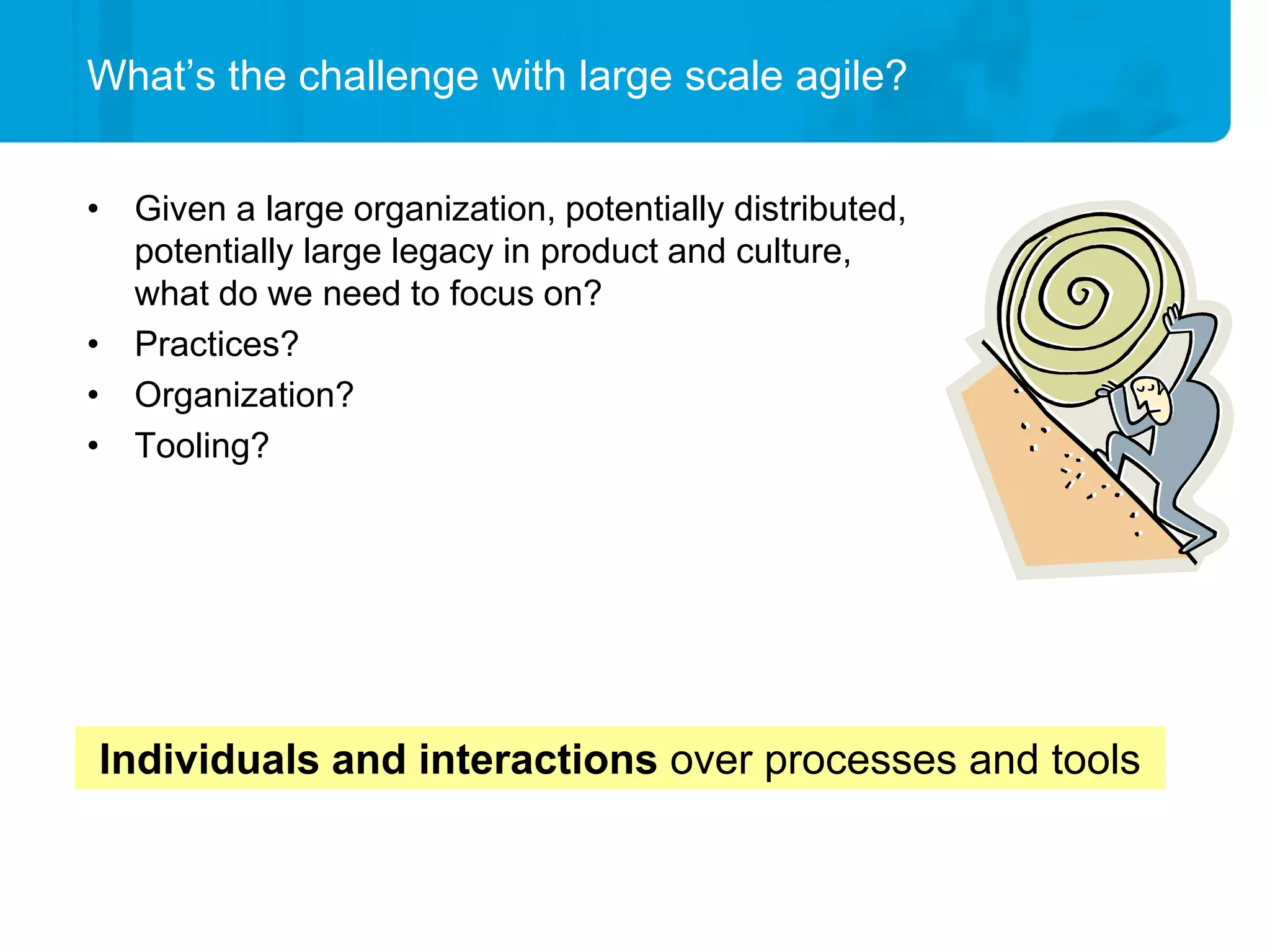
What’s the challenge with large scale agile?


• Given a large organization, potentially distributed,
  potentially large legacy in product and culture,
  what do we need to focus on?
• Practices?
• Organization?
• Tooling?


Individuals and interactions over processes and tools
What’s software development after all?


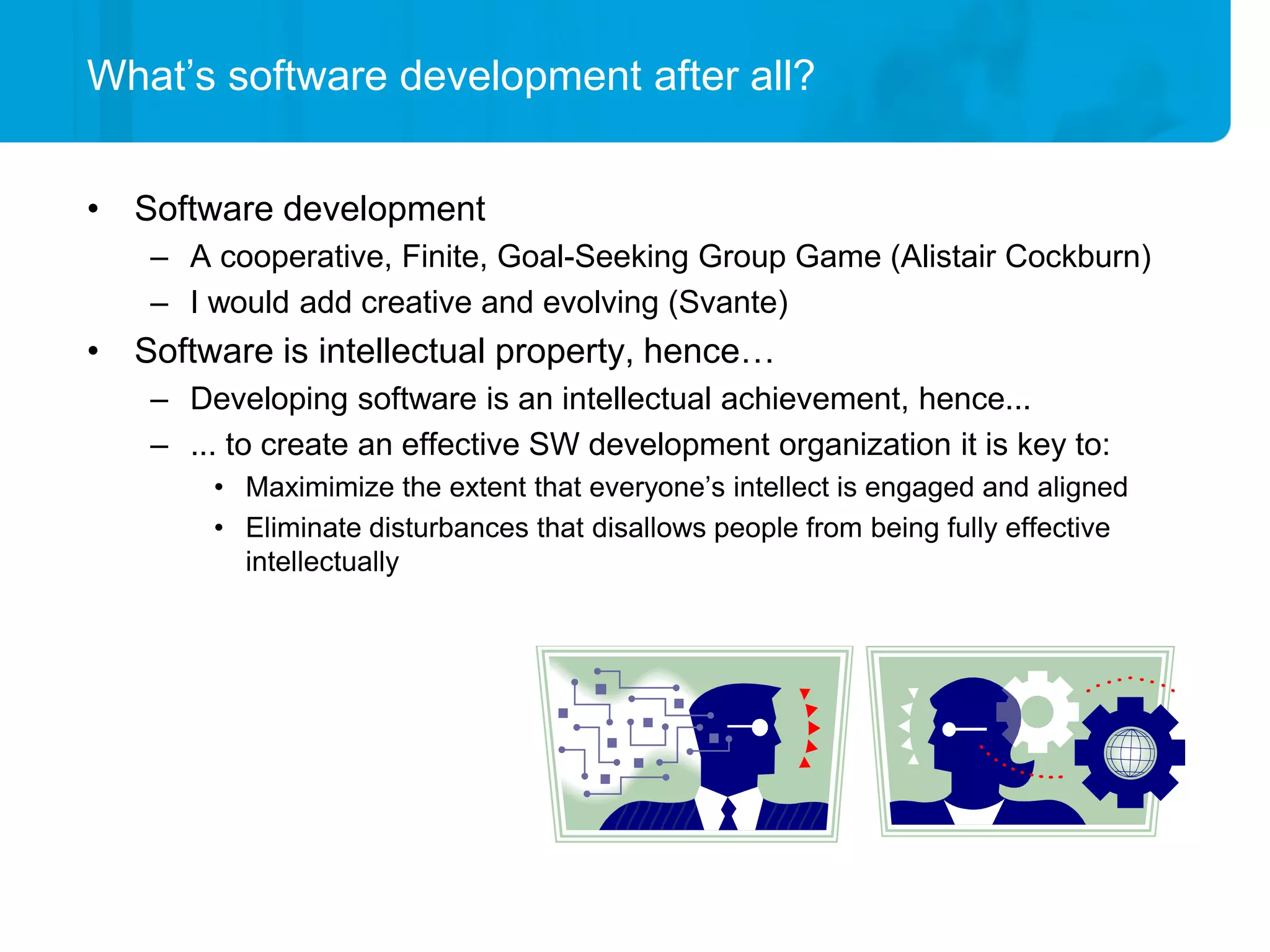
• Software development
   – A cooperative, Finite, Goal-Seeking Group Game (Alistair Cockburn)
   – I would add creative and evolving (Svante)
• Software is intellectual property, hence…
   – Developing software is an intellectual achievement, hence...
   – ... to create an effective SW development organization it is key to:
       • Maximimize the extent that everyone’s intellect is engaged and aligned
       • Eliminate disturbances that disallows people from being fully effective
         intellectually
Outline


•   Introduction
•   What’s the deal with large scale agile?
•   Case study
•   Conclusions and advice
The case in question


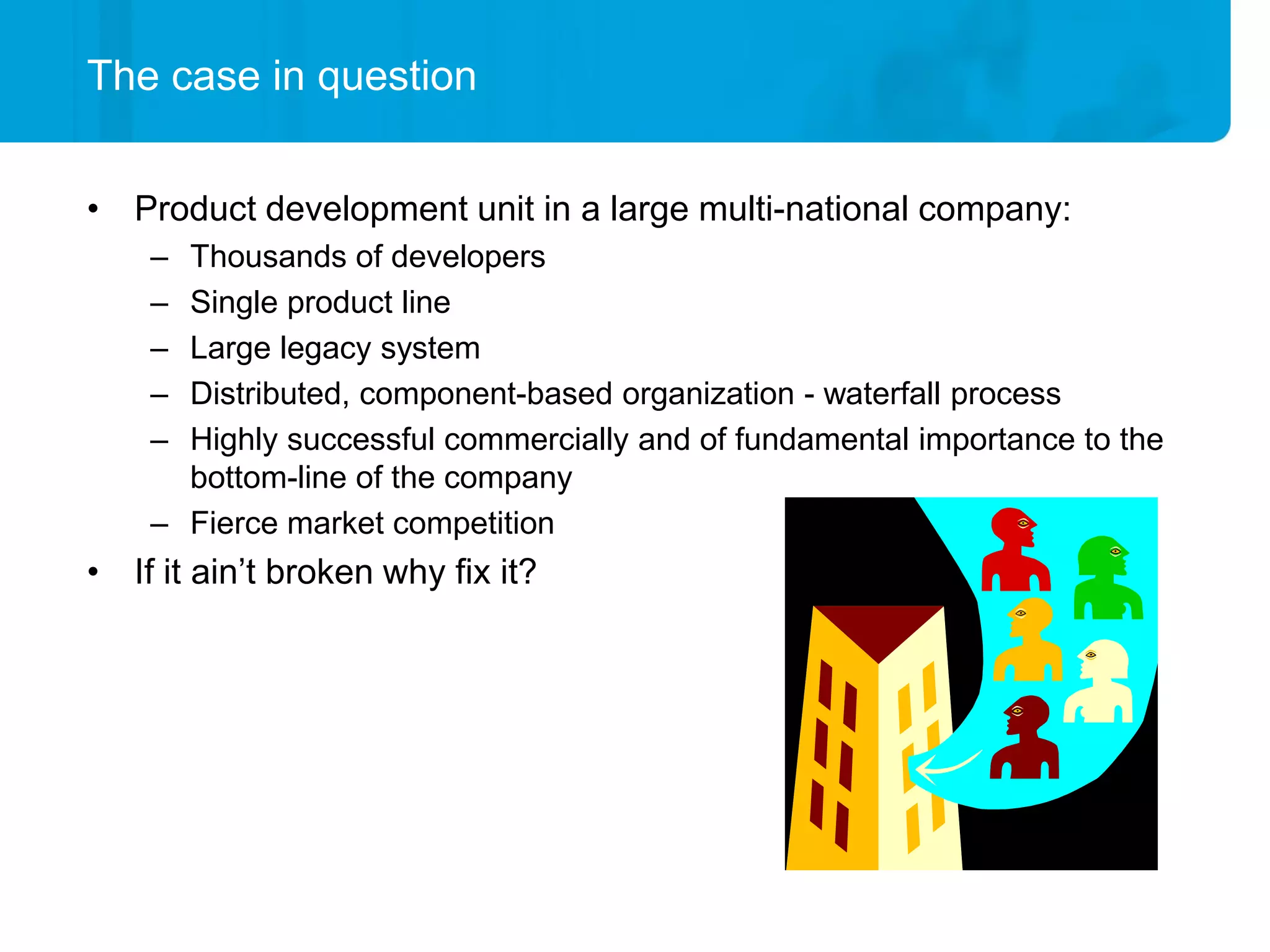
• Product development unit in a large multi-national company:
    – Thousands of developers
    – Single product line
    – Large legacy system
    – Distributed, component-based organization - waterfall process
    – Highly successful commercially and of fundamental importance to the
      bottom-line of the company
    – Fierce market competition
• If it ain’t broken why fix it?
Pain – a prerequisite for change


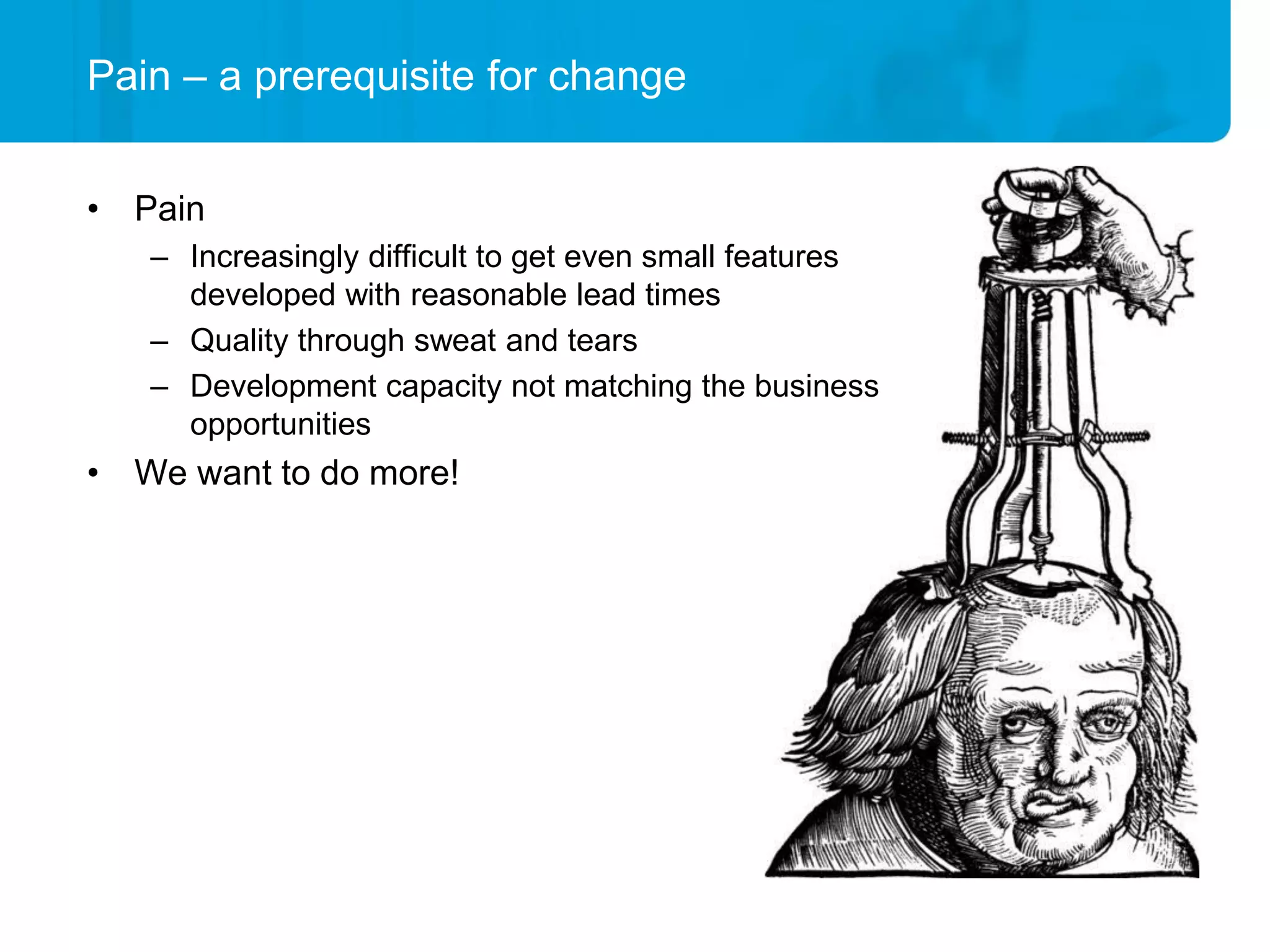
• Pain
   – Increasingly difficult to get even small features
     developed with reasonable lead times
   – Quality through sweat and tears
   – Development capacity not matching the business
     opportunities
• We want to do more!
Cause of pain


• Functional organization
    –   Analysis
    –   Software development
    –   System testing
    –   Waterfall process and an organization that defines
        itself in those terms
• Handovers and functional/component breakdown
    – Few persons understand the whole product
    – Few persons understands the whole process
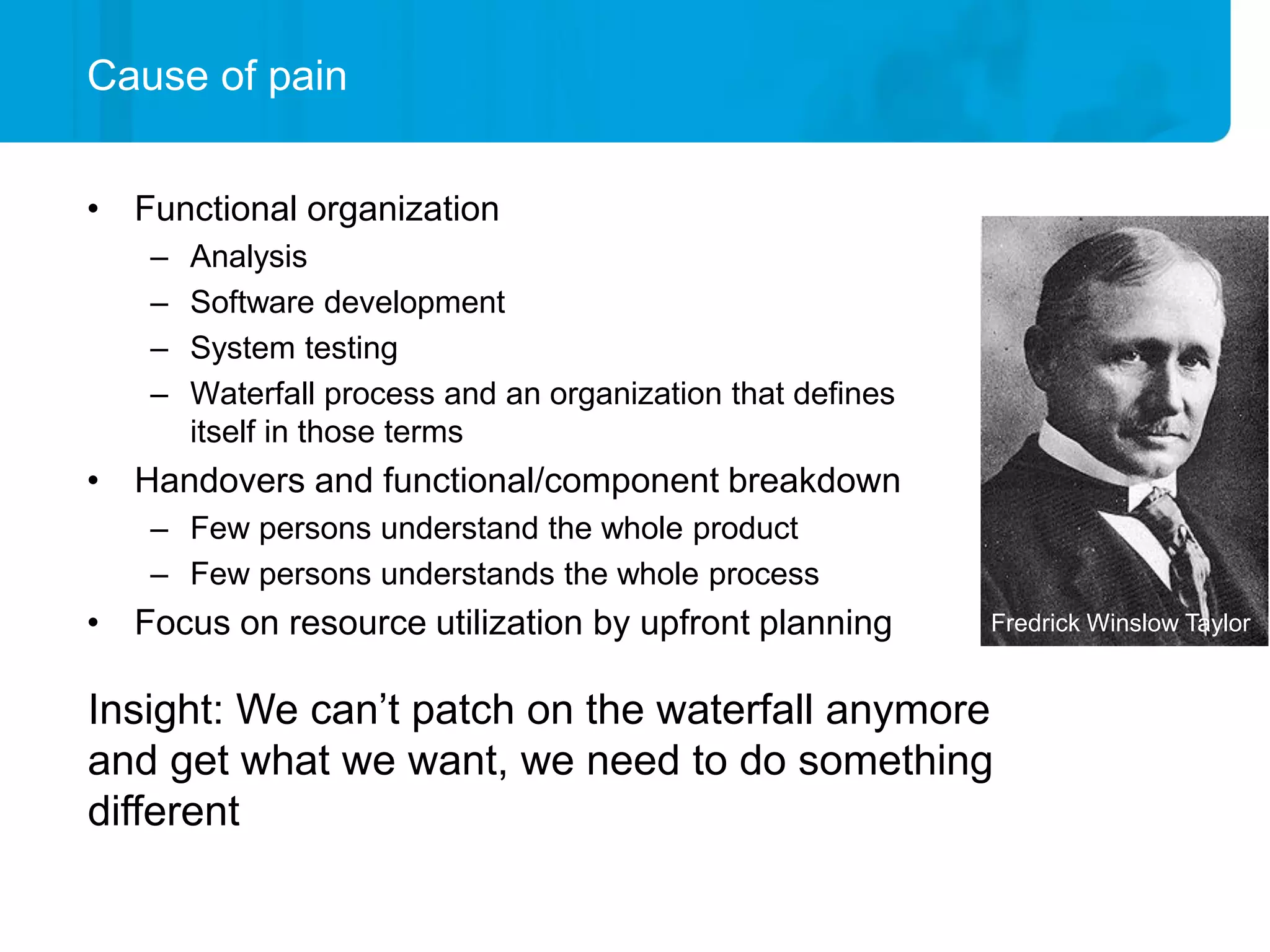
• Focus on resource utilization by upfront planning          Fredrick Winslow Taylor


Insight: We can’t patch on the waterfall anymore
and get what we want, we need to do something
different
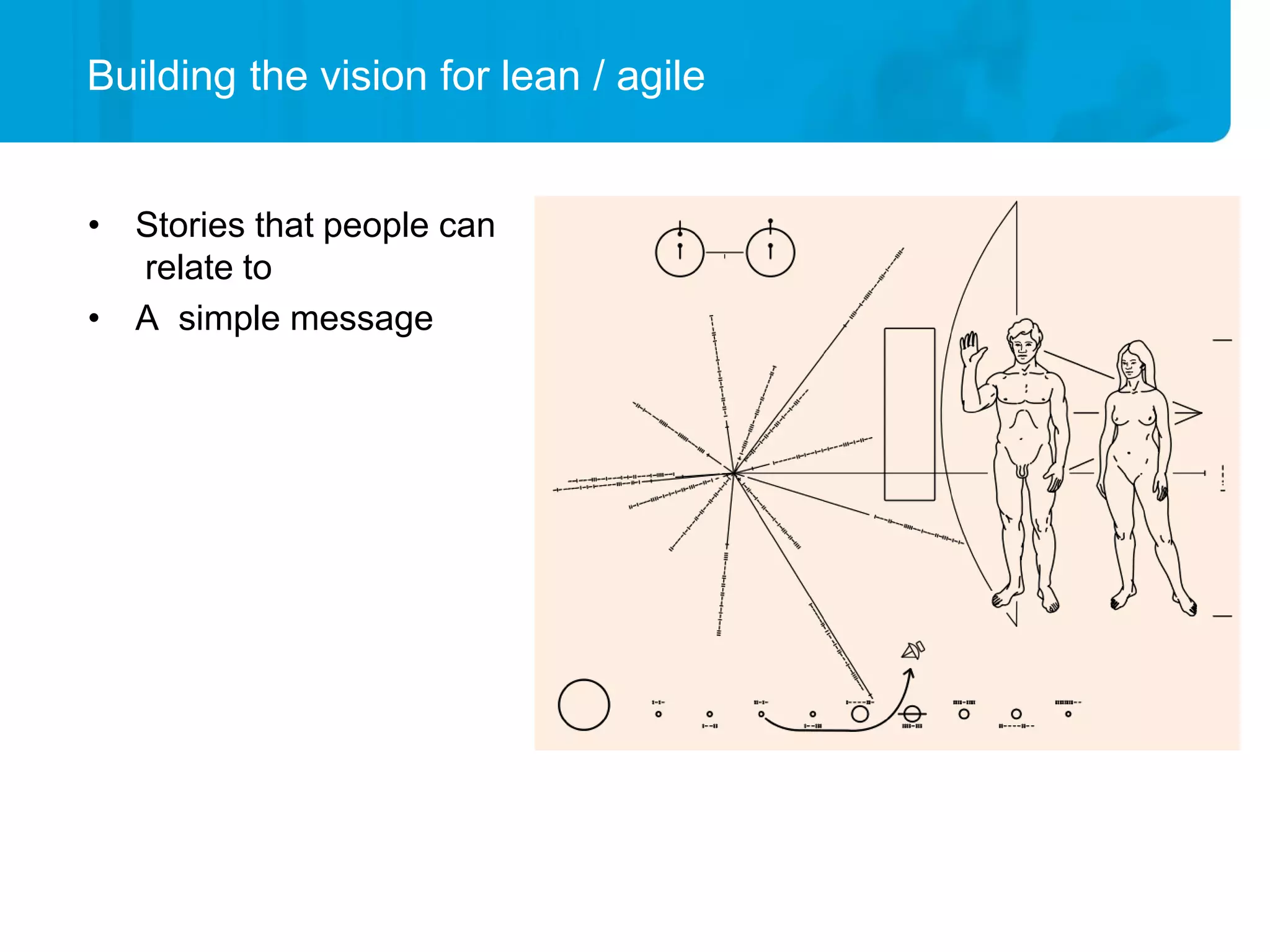
Building the vision for lean / agile


• Stories that people can
  relate to
• A simple message
The Vision Summarized


• Change to a setup where feature development is
  driven in a program decoupled from release projects.
  This is called Streamline Development.
• Implement true cross-functional feature teams with
  responsibility for a feature from analysis through end
  of feature verification
• Enable agility on the team level (Self-organization,
  Stand-ups, Iterations, Retrospectives, TDD,
  Continuous
  Integration and so on)
Key Ideas of the vision

• Focus on flow, customer-to-customer
    – It is more interesting to reduce lead-time with constant productivity
      than to improve productivity with constant lead-time
    – It is more interesting to improve quality with constant productivity than
      to increase productivity with constant quality
• This will expose inefficiencies and force:
    – Reduction of handovers
    – Reduction of delays
    – Reduction of overly detailed studies
      and gold-plated designs
    – Eradication of late and non-repeatable testing
      as a way to get quality

• The focus on lead-time will act as a forcing function
  to address quality and efficiency
Objections to the vision


• We have special needs
   – It is a very large code base, a single designer cannot learn all
   – Some subsystems are complex and requires substantial experience
   – Many different technologies, it is too difficult to learn them all
   – Some features are very large and span the whole system a single
     team cannot handle such a feature
   – Weak code ownership will deteriorate the integrity of the code base
   – It is a complicated domain, experts need to do analysis and design
• That stuff doesn’t work
   – We tried that 7 years ago and it didn’t work
   – Organization X tried that 4 years ago and they dropped it
Pilot – first strike


• We wanted select a pilot with the following characteristics:
    – Right size for a team of 5-7 to complete in 3-4 months
    – Relatively isolated not too much dependencies
    – It should have business value but not be too important
• And we failed before the start line!
Pilot – second strike


• Feature that we already looked at:
    – Too large
    – Too complicated
    – Too important – essential for release
      of new high-end product
    – Work already ongoing
• Waterfall planning now showed that
  this feature would delay the new
  product with 2-3 months
• Hastily we formed a cross functional team that:
    – Sat together (as far as possible)
    – Worked iteratively and light-weight
    – Delivered the feature in a way that did not risk the schedule of the
      new product (took us 7 months)
    – About same cost as projected for traditional way of work
This was the right pilot at the right time

• It had very high business impact and
  high risk -> Attention!
• At sprint reviews/demos we could review:
   – Logic behind our iterative plan
   – Challenges / Issues / Impediments
       • Low quality on the main/trunk forcing us to
         stay on branch using old baselines
       • The difficulty in defining good back log items
       • Problems with IT infrastructure
       • Culture and practices enforcing waterfall behavior
       • Challenges in existing within the big waterfall
       • Shortcomings in tooling / automation
       • Challenges in getting a team assigned, allocated and seated
• Management put a lot of trust in the team!
Advice on pilots


• Don’t run pilots to:
    – Prove that things “work”
    – Benchmark against current ways-of-working
• Do run pilots to:
    – Learn
    – Find problems that you need to fix
• The ideal pilot is:
    – Critical to business
    – Delayed
    – Quite large
• Organizational impediments will surface and become hot issues
  immediately
• Management will care and chances are you will get focus on
  solving some real problems
Find a role model


• Find an organization quite like your own – we got lucky!
    –   Based on the same platform, using same tools
    –   Similarities in culture
    –   Similar order of magnitude of the code base
    –   Very similar starting position in terms of pains,
        processes, organization and culture
• This organization had made a radical change:
    –   Streamline on the high level
    –   Scrum on the team level
    –   Large scale continuous integration
    –   Massive cultural change
It takes an engine to go the distance


• Someone from top management needs to step up
• Ideal characteristics
   –   Highly trusted inside and outside
   –   Eager to learn
   –   Courageous
   –   Inclusive
Outline


•   Introduction
•   What’s the deal with large scale agile?
•   Our journey so far
•   Conclusions and advice
Keep your eye on the ball


• Ideas
   – Continuos improvement
   – Respect for people
• Practices
   –   Cross functional teams sitting together
   –   Working software every 2-4 weeks
   –   Visual management
   –   Go see
Question old truths


• Development should always be done in
  projects
• High resource utilization = effectiveness
• You should write the code ”once”
• Quality comes in a sequence of steps –
  developers develop the product, testers test it
• You get what you predict so we need detailed
  estimates based on detailed specifications
• To be professional you should cleanly separate
  the business side from the IT side
Beware of...


• Analysis-paralysis
• Tool mongers and method
  gnomes
• Leaders getting detached
• Throwing out your gems
• Parrots
• Masquerading
Advice for line managers


•   Educate yourself
•   Manage, lead, or teach?
•   You cannot delegate this agile / lean ”business”
•   What is it that really matters?
     – People
     – Values and principles
     – Practical help to remove impediments / accidental
       complexity
     – Way of working
• Essentially, line management is a support function, it is not part of
  the product development flow
Thank You!
Svante Lidman
svante@ivarjacobson.com   I have changed employer since
                          I made this presentation. You
                          can now reach me at
                          svante.lidman@hansoft.se,
                          see: www.hansoft.se for what
                          we do.

Large scale agile_svante_lidman

  • 1.
    Driving Large ScaleAgile Transformation Svante Lidman svante@ivarjacobson.com I have changed employer since I made this presentation. You can now reach me at svante.lidman@hansoft.se, see: www.hansoft.se for what we do.
  • 2.
    This presentation • Patternsand anti-patterns for transforming an organization with huge legacy in product, process, and culture to being lean/agile • Based on: – Experience in the large over the last 18 months – Experience in the not quite so large over the previous 25 years – Hearsay, reading – Thinking, trying to generalize, evolve, reformulate • It is the story as I see it, others may have other stories
  • 3.
    Outline • Introduction • What’s the deal with large scale agile? • Case study • Conclusions and advice
  • 4.
    What’s the challengewith large scale agile? • Given a large organization, potentially distributed, potentially large legacy in product and culture, what do we need to focus on? • Practices? • Organization? • Tooling? Individuals and interactions over processes and tools
  • 5.
    What’s software developmentafter all? • Software development – A cooperative, Finite, Goal-Seeking Group Game (Alistair Cockburn) – I would add creative and evolving (Svante) • Software is intellectual property, hence… – Developing software is an intellectual achievement, hence... – ... to create an effective SW development organization it is key to: • Maximimize the extent that everyone’s intellect is engaged and aligned • Eliminate disturbances that disallows people from being fully effective intellectually
  • 6.
    Outline • Introduction • What’s the deal with large scale agile? • Case study • Conclusions and advice
  • 7.
    The case inquestion • Product development unit in a large multi-national company: – Thousands of developers – Single product line – Large legacy system – Distributed, component-based organization - waterfall process – Highly successful commercially and of fundamental importance to the bottom-line of the company – Fierce market competition • If it ain’t broken why fix it?
  • 8.
    Pain – aprerequisite for change • Pain – Increasingly difficult to get even small features developed with reasonable lead times – Quality through sweat and tears – Development capacity not matching the business opportunities • We want to do more!
  • 9.
    Cause of pain •Functional organization – Analysis – Software development – System testing – Waterfall process and an organization that defines itself in those terms • Handovers and functional/component breakdown – Few persons understand the whole product – Few persons understands the whole process • Focus on resource utilization by upfront planning Fredrick Winslow Taylor Insight: We can’t patch on the waterfall anymore and get what we want, we need to do something different
  • 10.
    Building the visionfor lean / agile • Stories that people can relate to • A simple message
  • 11.
    The Vision Summarized •Change to a setup where feature development is driven in a program decoupled from release projects. This is called Streamline Development. • Implement true cross-functional feature teams with responsibility for a feature from analysis through end of feature verification • Enable agility on the team level (Self-organization, Stand-ups, Iterations, Retrospectives, TDD, Continuous Integration and so on)
  • 12.
    Key Ideas ofthe vision • Focus on flow, customer-to-customer – It is more interesting to reduce lead-time with constant productivity than to improve productivity with constant lead-time – It is more interesting to improve quality with constant productivity than to increase productivity with constant quality • This will expose inefficiencies and force: – Reduction of handovers – Reduction of delays – Reduction of overly detailed studies and gold-plated designs – Eradication of late and non-repeatable testing as a way to get quality • The focus on lead-time will act as a forcing function to address quality and efficiency
  • 13.
    Objections to thevision • We have special needs – It is a very large code base, a single designer cannot learn all – Some subsystems are complex and requires substantial experience – Many different technologies, it is too difficult to learn them all – Some features are very large and span the whole system a single team cannot handle such a feature – Weak code ownership will deteriorate the integrity of the code base – It is a complicated domain, experts need to do analysis and design • That stuff doesn’t work – We tried that 7 years ago and it didn’t work – Organization X tried that 4 years ago and they dropped it
  • 14.
    Pilot – firststrike • We wanted select a pilot with the following characteristics: – Right size for a team of 5-7 to complete in 3-4 months – Relatively isolated not too much dependencies – It should have business value but not be too important • And we failed before the start line!
  • 15.
    Pilot – secondstrike • Feature that we already looked at: – Too large – Too complicated – Too important – essential for release of new high-end product – Work already ongoing • Waterfall planning now showed that this feature would delay the new product with 2-3 months • Hastily we formed a cross functional team that: – Sat together (as far as possible) – Worked iteratively and light-weight – Delivered the feature in a way that did not risk the schedule of the new product (took us 7 months) – About same cost as projected for traditional way of work
  • 16.
    This was theright pilot at the right time • It had very high business impact and high risk -> Attention! • At sprint reviews/demos we could review: – Logic behind our iterative plan – Challenges / Issues / Impediments • Low quality on the main/trunk forcing us to stay on branch using old baselines • The difficulty in defining good back log items • Problems with IT infrastructure • Culture and practices enforcing waterfall behavior • Challenges in existing within the big waterfall • Shortcomings in tooling / automation • Challenges in getting a team assigned, allocated and seated • Management put a lot of trust in the team!
  • 17.
    Advice on pilots •Don’t run pilots to: – Prove that things “work” – Benchmark against current ways-of-working • Do run pilots to: – Learn – Find problems that you need to fix • The ideal pilot is: – Critical to business – Delayed – Quite large • Organizational impediments will surface and become hot issues immediately • Management will care and chances are you will get focus on solving some real problems
  • 18.
    Find a rolemodel • Find an organization quite like your own – we got lucky! – Based on the same platform, using same tools – Similarities in culture – Similar order of magnitude of the code base – Very similar starting position in terms of pains, processes, organization and culture • This organization had made a radical change: – Streamline on the high level – Scrum on the team level – Large scale continuous integration – Massive cultural change
  • 19.
    It takes anengine to go the distance • Someone from top management needs to step up • Ideal characteristics – Highly trusted inside and outside – Eager to learn – Courageous – Inclusive
  • 20.
    Outline • Introduction • What’s the deal with large scale agile? • Our journey so far • Conclusions and advice
  • 21.
    Keep your eyeon the ball • Ideas – Continuos improvement – Respect for people • Practices – Cross functional teams sitting together – Working software every 2-4 weeks – Visual management – Go see
  • 22.
    Question old truths •Development should always be done in projects • High resource utilization = effectiveness • You should write the code ”once” • Quality comes in a sequence of steps – developers develop the product, testers test it • You get what you predict so we need detailed estimates based on detailed specifications • To be professional you should cleanly separate the business side from the IT side
  • 23.
    Beware of... • Analysis-paralysis •Tool mongers and method gnomes • Leaders getting detached • Throwing out your gems • Parrots • Masquerading
  • 24.
    Advice for linemanagers • Educate yourself • Manage, lead, or teach? • You cannot delegate this agile / lean ”business” • What is it that really matters? – People – Values and principles – Practical help to remove impediments / accidental complexity – Way of working • Essentially, line management is a support function, it is not part of the product development flow
  • 25.
    Thank You! Svante Lidman svante@ivarjacobson.com I have changed employer since I made this presentation. You can now reach me at svante.lidman@hansoft.se, see: www.hansoft.se for what we do.