Agile Estimation and Planning A Quick Guide to Estimating Features and Stories in Agile Development Peter Saddington, CSM CSP Executive Editor AgileScout.com @agilescout
White Barrel LLC. © 2011 Peter Saddington Peter Saddington, CSP CSM Independent Enterprise Agile Coach Rally Software Agile Coach Executive Editor AgileScout.com Author –  Scrum Pocket Guide [email_address] +1.404.669.6662 www.agilescout.com www.scrumpocketguide.com Twitter:  @agilescout
White Barrel LLC. © 2010 Peter Saddington
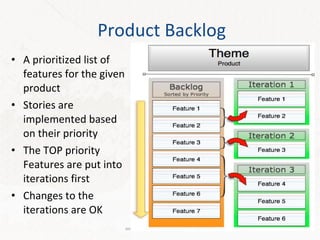
Product Backlog A prioritized list of features for the given product Stories are implemented based on their priority The TOP priority Features are put into iterations first Changes to the iterations are OK White Barrel LLC. © 2010 Peter Saddington
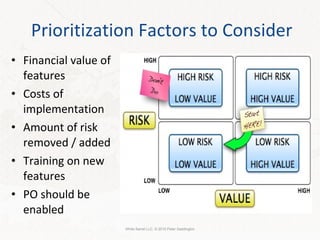
Prioritization Factors to Consider Financial value of features Costs of implementation Amount of risk removed / added Training on new features PO should be enabled  White Barrel LLC. © 2010 Peter Saddington
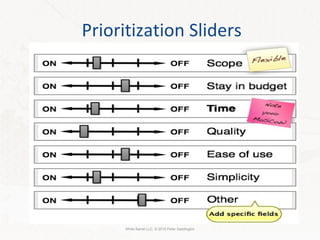
Prioritization Sliders White Barrel LLC. © 2010 Peter Saddington
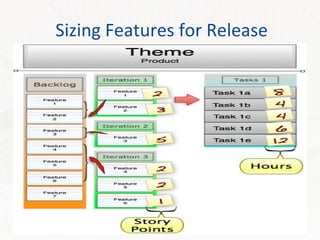
Sizing Features for Release White Barrel LLC. © 2010 Peter Saddington
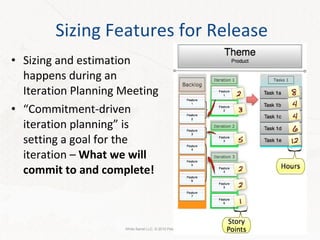
Sizing Features for Release Sizing and estimation happens during an Iteration Planning Meeting “ Commitment-driven iteration planning” is setting a goal for the iteration –  What we will commit to and complete! White Barrel LLC. © 2010 Peter Saddington
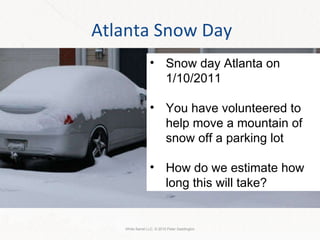
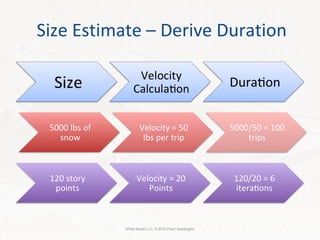
Atlanta Snow Day White Barrel LLC. © 2010 Peter Saddington Snow day Atlanta on 1/10/2011 You have volunteered to help move a mountain of snow off a parking lot How do we estimate how long this will take?
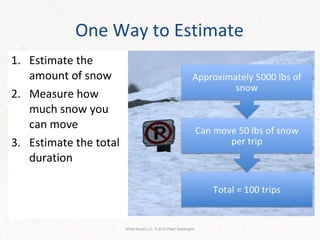
One Way to Estimate  Estimate the amount of snow Measure how much snow you can move Estimate the total duration White Barrel LLC. © 2010 Peter Saddington
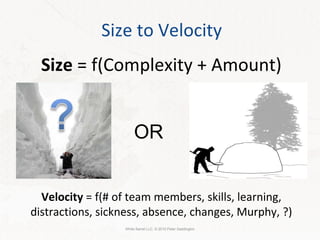
Size to Velocity Size  = f(Complexity + Amount) White Barrel LLC. © 2010 Peter Saddington OR Velocity  = f(# of team members, skills, learning, distractions, sickness, absence, changes, Murphy, ?)
Velocity Is the rate at which a team can produce working software Used for estimation and planning Measured in non-time-referent terms (Story points) Should not be used as a measure of comparison across teams White Barrel LLC. © 2010 Peter Saddington
Size Estimate – Derive Duration White Barrel LLC. © 2010 Peter Saddington
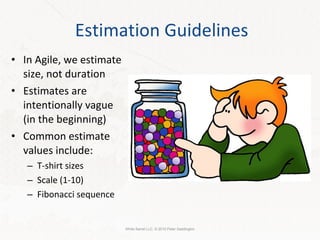
Estimation Guidelines In Agile, we estimate size, not duration Estimates are intentionally vague (in the beginning) Common estimate values include: T-shirt sizes Scale (1-10) Fibonacci sequence White Barrel LLC. © 2010 Peter Saddington
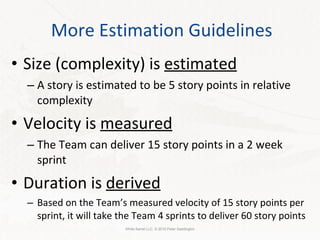
More Estimation Guidelines Size (complexity) is  estimated A story is estimated to be 5 story points in relative complexity Velocity is  measured The Team can deliver 15 story points in a 2 week sprint Duration is  derived Based on the Team’s measured velocity of 15 story points per sprint, it will take the Team 4 sprints to deliver 60 story points White Barrel LLC. © 2010 Peter Saddington
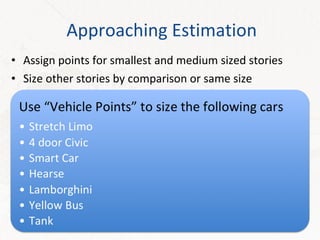
Approaching Estimation Assign points for smallest and medium sized stories Size other stories by comparison or same size White Barrel LLC. © 2010 Peter Saddington
Approaches to Sizing Estimates are made by a GROUP not an INDIVIDUAL Points sizes never decay Sizes don’t change based on estimator Use consistent relative scale Use techniques Analogy Decomposition Planning Poker White Barrel LLC. © 2010 Peter Saddington
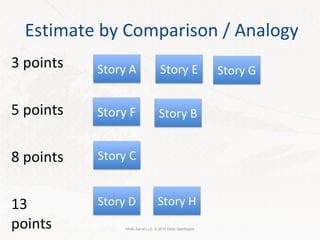
Estimate by Comparison / Analogy 3 points 5 points 8 points 13 points White Barrel LLC. © 2010 Peter Saddington
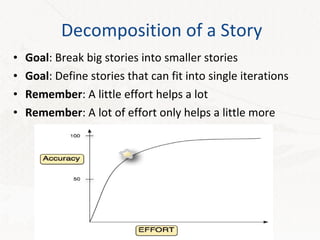
Decomposition of a Story Goal : Break big stories into smaller stories Goal : Define stories that can fit into single iterations Remember : A little effort helps a lot Remember : A lot of effort only helps a little more White Barrel LLC. © 2010 Peter Saddington
Techniques – Planning Poker Each team has a deck of cards – Each card has a point size Product Owner reviews a story (1 minute per story)  PO should have enough knowledge about the story to discuss details Analysis (3 minutes per story) The story is briefly discussed with questions  The discussion should be sufficient enough to determine the complexity and relative size of work Compare story to other previously sized stories Each team member selects a card that is his or her estimate All cards are presented to the group at the same time Differences and outliers are discussed (1 minute) Re-estimate until estimates converge Time-box card considerations if time is needed to discuss Negotiate a happy medium If one individual is in disagreement, ask them if the consensus is agreeable White Barrel LLC. © 2010 Peter Saddington
Breaking Stories into Tasks with Planning Poker Using Mike Cohn’s “Ideal Time vs Elapsed Time”: How long does a football game last? Questions to ask yourself: How long would [task] take:  If it’s all you worked on… You had no interruptions… Had everything you needed to complete it? White Barrel LLC. © 2010 Peter Saddington
Ideal vs Elapsed Time in Planning Poker It’s much easier to estimate in ideal time It’s too hard to estimate in elapsed time Start with ideal time Define what 1 story point equals (1 story point = 1 ideal day) Estimate how many hours each person has available Then gradually move team’s thinknig to unit-less story points (“This story is like that story”). “ Stop talking about how long it will take” – Mike Cohn White Barrel LLC. © 2010 Peter Saddington
Summary Remember the purpose of the iteration planning meeting is to arrive at a commitment to an iteration goal or set of product backlog items. Story point estimation and task estimation takes time! The purpose of the meeting is to come up with a list of tasks and hours. The tasks and estimates are a tool for determining what we can commit to! Inspect and adapt your velocity over time with 90% confidence intervals White Barrel LLC. © 2010 Peter Saddington
Resources Used in Presentation Mike Cohn’s Presentations on “Agile Estimating and Planning” –  http://www.mountaingoatsoftware.com/presentations-estimating Dean Leffingwell’s book – “Scaling Software Agility” Jeff Patton –  http://www.agileproductdesign.com White Barrel LLC © 2010 Peter Saddington
Questions? White Barrel LLC © 2010 Peter Saddington

Agile estimation and planning peter saddington

  • 1.
    Agile Estimation andPlanning A Quick Guide to Estimating Features and Stories in Agile Development Peter Saddington, CSM CSP Executive Editor AgileScout.com @agilescout
  • 2.
    White Barrel LLC.© 2011 Peter Saddington Peter Saddington, CSP CSM Independent Enterprise Agile Coach Rally Software Agile Coach Executive Editor AgileScout.com Author – Scrum Pocket Guide [email_address] +1.404.669.6662 www.agilescout.com www.scrumpocketguide.com Twitter: @agilescout
  • 3.
    White Barrel LLC.© 2010 Peter Saddington
  • 4.
    Product Backlog Aprioritized list of features for the given product Stories are implemented based on their priority The TOP priority Features are put into iterations first Changes to the iterations are OK White Barrel LLC. © 2010 Peter Saddington
  • 5.
    Prioritization Factors toConsider Financial value of features Costs of implementation Amount of risk removed / added Training on new features PO should be enabled White Barrel LLC. © 2010 Peter Saddington
  • 6.
    Prioritization Sliders WhiteBarrel LLC. © 2010 Peter Saddington
  • 7.
    Sizing Features forRelease White Barrel LLC. © 2010 Peter Saddington
  • 8.
    Sizing Features forRelease Sizing and estimation happens during an Iteration Planning Meeting “ Commitment-driven iteration planning” is setting a goal for the iteration – What we will commit to and complete! White Barrel LLC. © 2010 Peter Saddington
  • 9.
    Atlanta Snow DayWhite Barrel LLC. © 2010 Peter Saddington Snow day Atlanta on 1/10/2011 You have volunteered to help move a mountain of snow off a parking lot How do we estimate how long this will take?
  • 10.
    One Way toEstimate Estimate the amount of snow Measure how much snow you can move Estimate the total duration White Barrel LLC. © 2010 Peter Saddington
  • 11.
    Size to VelocitySize = f(Complexity + Amount) White Barrel LLC. © 2010 Peter Saddington OR Velocity = f(# of team members, skills, learning, distractions, sickness, absence, changes, Murphy, ?)
  • 12.
    Velocity Is therate at which a team can produce working software Used for estimation and planning Measured in non-time-referent terms (Story points) Should not be used as a measure of comparison across teams White Barrel LLC. © 2010 Peter Saddington
  • 13.
    Size Estimate –Derive Duration White Barrel LLC. © 2010 Peter Saddington
  • 14.
    Estimation Guidelines InAgile, we estimate size, not duration Estimates are intentionally vague (in the beginning) Common estimate values include: T-shirt sizes Scale (1-10) Fibonacci sequence White Barrel LLC. © 2010 Peter Saddington
  • 15.
    More Estimation GuidelinesSize (complexity) is estimated A story is estimated to be 5 story points in relative complexity Velocity is measured The Team can deliver 15 story points in a 2 week sprint Duration is derived Based on the Team’s measured velocity of 15 story points per sprint, it will take the Team 4 sprints to deliver 60 story points White Barrel LLC. © 2010 Peter Saddington
  • 16.
    Approaching Estimation Assignpoints for smallest and medium sized stories Size other stories by comparison or same size White Barrel LLC. © 2010 Peter Saddington
  • 17.
    Approaches to SizingEstimates are made by a GROUP not an INDIVIDUAL Points sizes never decay Sizes don’t change based on estimator Use consistent relative scale Use techniques Analogy Decomposition Planning Poker White Barrel LLC. © 2010 Peter Saddington
  • 18.
    Estimate by Comparison/ Analogy 3 points 5 points 8 points 13 points White Barrel LLC. © 2010 Peter Saddington
  • 19.
    Decomposition of aStory Goal : Break big stories into smaller stories Goal : Define stories that can fit into single iterations Remember : A little effort helps a lot Remember : A lot of effort only helps a little more White Barrel LLC. © 2010 Peter Saddington
  • 20.
    Techniques – PlanningPoker Each team has a deck of cards – Each card has a point size Product Owner reviews a story (1 minute per story) PO should have enough knowledge about the story to discuss details Analysis (3 minutes per story) The story is briefly discussed with questions The discussion should be sufficient enough to determine the complexity and relative size of work Compare story to other previously sized stories Each team member selects a card that is his or her estimate All cards are presented to the group at the same time Differences and outliers are discussed (1 minute) Re-estimate until estimates converge Time-box card considerations if time is needed to discuss Negotiate a happy medium If one individual is in disagreement, ask them if the consensus is agreeable White Barrel LLC. © 2010 Peter Saddington
  • 21.
    Breaking Stories intoTasks with Planning Poker Using Mike Cohn’s “Ideal Time vs Elapsed Time”: How long does a football game last? Questions to ask yourself: How long would [task] take: If it’s all you worked on… You had no interruptions… Had everything you needed to complete it? White Barrel LLC. © 2010 Peter Saddington
  • 22.
    Ideal vs ElapsedTime in Planning Poker It’s much easier to estimate in ideal time It’s too hard to estimate in elapsed time Start with ideal time Define what 1 story point equals (1 story point = 1 ideal day) Estimate how many hours each person has available Then gradually move team’s thinknig to unit-less story points (“This story is like that story”). “ Stop talking about how long it will take” – Mike Cohn White Barrel LLC. © 2010 Peter Saddington
  • 23.
    Summary Remember thepurpose of the iteration planning meeting is to arrive at a commitment to an iteration goal or set of product backlog items. Story point estimation and task estimation takes time! The purpose of the meeting is to come up with a list of tasks and hours. The tasks and estimates are a tool for determining what we can commit to! Inspect and adapt your velocity over time with 90% confidence intervals White Barrel LLC. © 2010 Peter Saddington
  • 24.
    Resources Used inPresentation Mike Cohn’s Presentations on “Agile Estimating and Planning” – http://www.mountaingoatsoftware.com/presentations-estimating Dean Leffingwell’s book – “Scaling Software Agility” Jeff Patton – http://www.agileproductdesign.com White Barrel LLC © 2010 Peter Saddington
  • 25.
    Questions? White BarrelLLC © 2010 Peter Saddington