Story Points
Agile Estimation
Mirka Weidenbach (Agile Coach)
Comparing Estimates
Experience shows that estimating the time required for a task is often
difficult. The larger and more complex the task becomes, the more difficult
it is to determine an exact number of working hours.
On the contrary it‘s much easier for us to provide a comparing
estimation. It answers how much additional effort a
task involves in relation to another task. Within an agile framework like
Scrum, this estimation can be performed based on Story Points
(anyway Story Points are not mentioned in the official Scrum Guide).
1
Benefits of
Story Points
Relative estimation by story points is easierthan
exact estimation
Deciding on an amount of Story Points means less
discussion time for the team
It‘s independent from the working
speed of every individual team members
Velocityallows the team to get better and better
at estimating how many Story Points they can complete
within a Sprint, using experience from previous Sprints.
2
Understanding Story Points
Story Points are used by a team to estimate the complexity of a User Story. Key rating
factors like the following can help to get clear about the amount of Story Points to be
established:
• Are the steps to finish the Story clear or is there somewhere a lack of clarity?
• How much communication with other people must take place ?
• How many conditions are mentioned in the „Definition of Done“?
• What technical requirements do we need to implement the story and are they
available?
Story Points are often mapped in the form of an adapted Fibonacci sequence:
1, 2, 3, 5, 8, 13, 20, 40, 100…
Higher numbers represent a greater proportion of complexity and therefore greater
uncertainty about the complexity of the story.
3
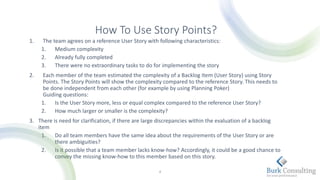
How To Use Story Points?
1. The team agrees on a reference User Story with following characteristics:
1. Medium complexity
2. Already fully completed
3. There were no extraordinary tasks to do for implementing the story
2. Each member of the team estimated the complexity of a Backlog Item (User Story) using Story
Points. The Story Points will show the complexity compared to the reference Story. This needs to
be done independent from each other (for example by using Planning Poker)
Guiding questions:
1. Is the User Story more, less or equal complex compared to the reference User Story?
2. How much larger or smaller is the complexity?
3. There is need for clarification, if there are large discrepancies within the evaluation of a backlog
item
1. Do all team members have the same idea about the requirements of the User Story or are
there ambiguities?
2. Is it possible that a team member lacks know-how? Accordingly, it could be a good chance to
convey the missing know-how to this member based on this story.
4
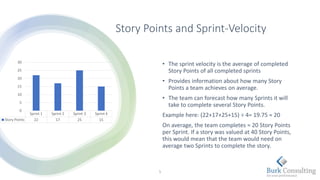
• The sprint velocity is the average of completed
Story Points of all completed sprints
• Provides information about how many Story
Points a team achieves on average.
• The team can forecast how many Sprints it will
take to complete several Story Points.
Example here: (22+17+25+15) ÷ 4= 19.75 ≈ 20
On average, the team completes ≈ 20 Story Points
per Sprint. If a story was valued at 40 Story Points,
this would mean that the team would need on
average two Sprints to complete the story.
Sprint 1 Sprint 2 Sprint 3 Sprint 4
Story Points 22 17 25 15
0
5
10
15
20
25
30
Story Points and Sprint-Velocity
5
Story Points within the
Scrum Events
There is no explicitly mentioned Scrum event for evaluating
Story Points. The complexity estimation can be part of an
optional meeting for the Backlog Refinement.
Regarding the Story Points:
• Usually defined by the developers of the team
• Discussion whether the previous estimates were
correct or whether similar tasks should be evaluated
differently in the future.
6
Source reference
Wolf, Henning / Rook Stefan (2021): Scrum verstehen und erfolgreich einsetzen, 3., überarbeitete
Auflage, dpunkt.verlag, Heidelberg.
Preußig, Jörg (2020): Agiles Projektmanagement. Agilität und Scrum im klassischen Projektumfeld, 2.
Auflage, HAUFE., Freiburg.
https://www.youtube.com/watch?v=EqK3v3fqk08&t=338s (letzter Zugriff 26.10.2021).
7

Story Points

  • 1.
    Story Points Agile Estimation MirkaWeidenbach (Agile Coach)
  • 2.
    Comparing Estimates Experience showsthat estimating the time required for a task is often difficult. The larger and more complex the task becomes, the more difficult it is to determine an exact number of working hours. On the contrary it‘s much easier for us to provide a comparing estimation. It answers how much additional effort a task involves in relation to another task. Within an agile framework like Scrum, this estimation can be performed based on Story Points (anyway Story Points are not mentioned in the official Scrum Guide). 1
  • 3.
    Benefits of Story Points Relativeestimation by story points is easierthan exact estimation Deciding on an amount of Story Points means less discussion time for the team It‘s independent from the working speed of every individual team members Velocityallows the team to get better and better at estimating how many Story Points they can complete within a Sprint, using experience from previous Sprints. 2
  • 4.
    Understanding Story Points StoryPoints are used by a team to estimate the complexity of a User Story. Key rating factors like the following can help to get clear about the amount of Story Points to be established: • Are the steps to finish the Story clear or is there somewhere a lack of clarity? • How much communication with other people must take place ? • How many conditions are mentioned in the „Definition of Done“? • What technical requirements do we need to implement the story and are they available? Story Points are often mapped in the form of an adapted Fibonacci sequence: 1, 2, 3, 5, 8, 13, 20, 40, 100… Higher numbers represent a greater proportion of complexity and therefore greater uncertainty about the complexity of the story. 3
  • 5.
    How To UseStory Points? 1. The team agrees on a reference User Story with following characteristics: 1. Medium complexity 2. Already fully completed 3. There were no extraordinary tasks to do for implementing the story 2. Each member of the team estimated the complexity of a Backlog Item (User Story) using Story Points. The Story Points will show the complexity compared to the reference Story. This needs to be done independent from each other (for example by using Planning Poker) Guiding questions: 1. Is the User Story more, less or equal complex compared to the reference User Story? 2. How much larger or smaller is the complexity? 3. There is need for clarification, if there are large discrepancies within the evaluation of a backlog item 1. Do all team members have the same idea about the requirements of the User Story or are there ambiguities? 2. Is it possible that a team member lacks know-how? Accordingly, it could be a good chance to convey the missing know-how to this member based on this story. 4
  • 6.
    • The sprintvelocity is the average of completed Story Points of all completed sprints • Provides information about how many Story Points a team achieves on average. • The team can forecast how many Sprints it will take to complete several Story Points. Example here: (22+17+25+15) ÷ 4= 19.75 ≈ 20 On average, the team completes ≈ 20 Story Points per Sprint. If a story was valued at 40 Story Points, this would mean that the team would need on average two Sprints to complete the story. Sprint 1 Sprint 2 Sprint 3 Sprint 4 Story Points 22 17 25 15 0 5 10 15 20 25 30 Story Points and Sprint-Velocity 5
  • 7.
    Story Points withinthe Scrum Events There is no explicitly mentioned Scrum event for evaluating Story Points. The complexity estimation can be part of an optional meeting for the Backlog Refinement. Regarding the Story Points: • Usually defined by the developers of the team • Discussion whether the previous estimates were correct or whether similar tasks should be evaluated differently in the future. 6
  • 8.
    Source reference Wolf, Henning/ Rook Stefan (2021): Scrum verstehen und erfolgreich einsetzen, 3., überarbeitete Auflage, dpunkt.verlag, Heidelberg. Preußig, Jörg (2020): Agiles Projektmanagement. Agilität und Scrum im klassischen Projektumfeld, 2. Auflage, HAUFE., Freiburg. https://www.youtube.com/watch?v=EqK3v3fqk08&t=338s (letzter Zugriff 26.10.2021). 7