#onetime@AgileCamp
September 12 2017
#onetime@AgileCamp
#onetime@AgileCamp
The Value of Experimentation
The environment we need to succeed
Generate Ideas
How to Put Into Action
#onetime@AgileCamp
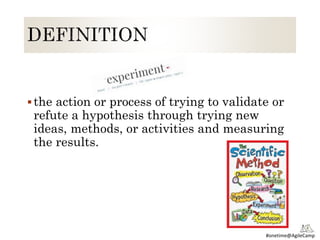
the action or process of trying to validate or
refute a hypothesis through trying new
ideas, methods, or activities and measuring
the results.
#onetime@AgileCamp
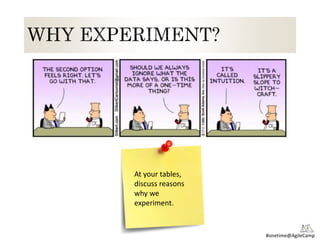
At your tables,
discuss reasons
why we
experiment.
#onetime@AgileCamp
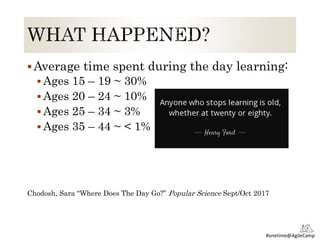
Average time spent during the day learning:
 Ages 15 – 19 ~ 30%
 Ages 20 – 24 ~ 10%
 Ages 25 – 34 ~ 3%
 Ages 35 – 44 ~ < 1%
Chodosh, Sara “Where Does The Day Go?” Popular Science Sept/Oct 2017
#onetime@AgileCamp
#onetime@AgileCamp
#onetime@AgileCamp
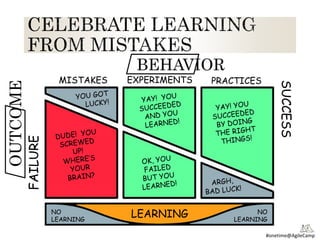
BEHAVIOR
OUTCOME
FAILURE
SUCCESS
LEARNINGNO
LEARNING
NO
LEARNING
MISTAKES EXPERIMENTS PRACTICES
#onetime@AgileCamp
#onetime@AgileCamp
#onetime@AgileCamp
#onetime@AgileCamp
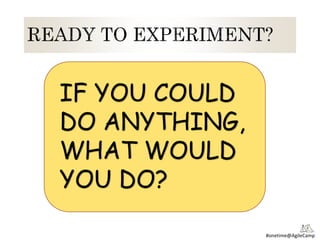
IF YOU COULD
DO ANYTHING,
WHAT WOULD
YOU DO?
#onetime@AgileCamp
#onetime@AgileCamp
#onetime@AgileCamp

Agile camp2017 experimentation

Editor's Notes

  • #3 Who here likes to experiment? Let’s clarify… Golf swing, Gardening, cooking, marketing, etc. – what works and doesn’t work We experiment all the time…
  • #5 Remember science class? Hypothesis, etc. Show scientific method, then simple example (finger in a socket)
  • #6 Ask audience, why do we experiment? Expect answers like: Learning Solve a problem Create something new Make something better We experiment to learn something
  • #7 What happened? We used to learn a lot but it changes as we get older 1% of a day is 14 minutes Explain idea that experiences have changed beliefs and makes us act or behave differently. We stop learning perhaps of how society looks at failure or not following along. Where do we assume where the fences/boundaries are? As far as what we can and can’t do? Are we correct about what we assume is in our Sphere of Influence and what we can control?
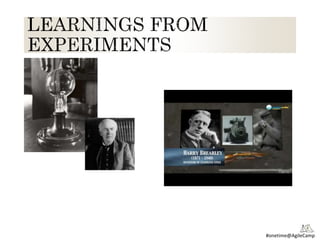
  • #9 Edison – Light Bulb His experiments involved the fabrication and testing of many different metal filaments, including platinum When a reporter asked, "How did it feel to fail 1,000 times?" Edison replied, "I didn’t fail 1,000 times. The light bulb was an invention with 1,000 steps.“ Harry Brearley – Stainless Steel Discovered accidentally Experimented for different types of metals for weapons Metals that didn’t appear to work were thrown in a pile After of a month of these exposed metals, he noticed one wasn’t rusted
  • #10 Explain LEFT and RIGHT columns first Explain MIDDLE column From our previous example Edison and Brearley were both experimenting over and over again. They learned from their successes and failures on every ITERATION of their experiment.
  • #11 Any examples of learning from experiments or mistakes from you? Share your greatest failures and what you learned.
  • #12 So, how can we execute experiments and increase our chances for learning? It is important to be clear with what we are trying to accomplish (hypothesis) We want to be sure that we are changing only a few things so that we know what caused the change. (iterative) How do we know it is successful? What will we learn from it?
  • #13 Like any other User Story we work with, we need a few things to get it into our sprints It needs a clear expected result. What does your experiment create, change or improve Does it decrease risk in a system? Save us tons of time? Create a new opportunity for income? Go to Worksheet What will it take to get it done? How many people? How long will it take? (Story size and ROI)
  • #14 If you try and experiment on ANYTHING here at Nelnet, what would it be? What’s the first step? Individually, take 5 mins to think up an idea Remember the steps to success Each share at your table and sell your idea to each other. Vote on the best idea Share
  • #15 Who has a story that they can put in their backlog?
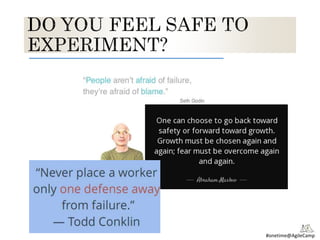
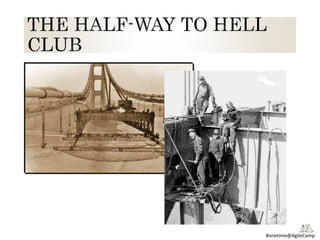
  • #17 Golden Gate Bridge example Common thinking for this type of construction, at the time, was 1 death per million dollars spent. Once the net was installed, productivity skyrocketed.  Workers were able to work with confidence.  In all only 19 people fell into the net. Net cost $130,000 built in 1933 (roughly $2.4M today) Saved 19 Lives Tie to ROI