WeBeAgile.com
2
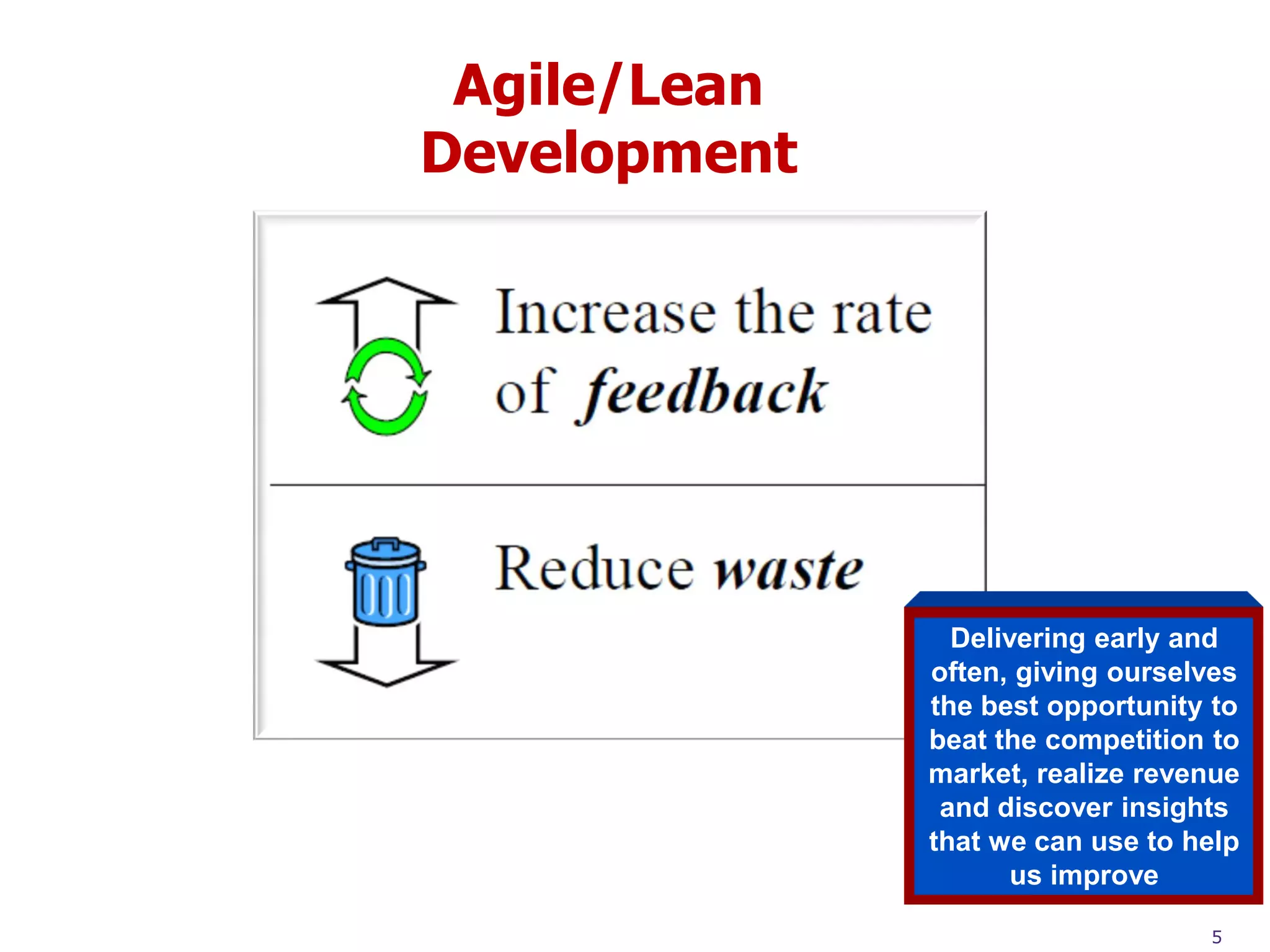
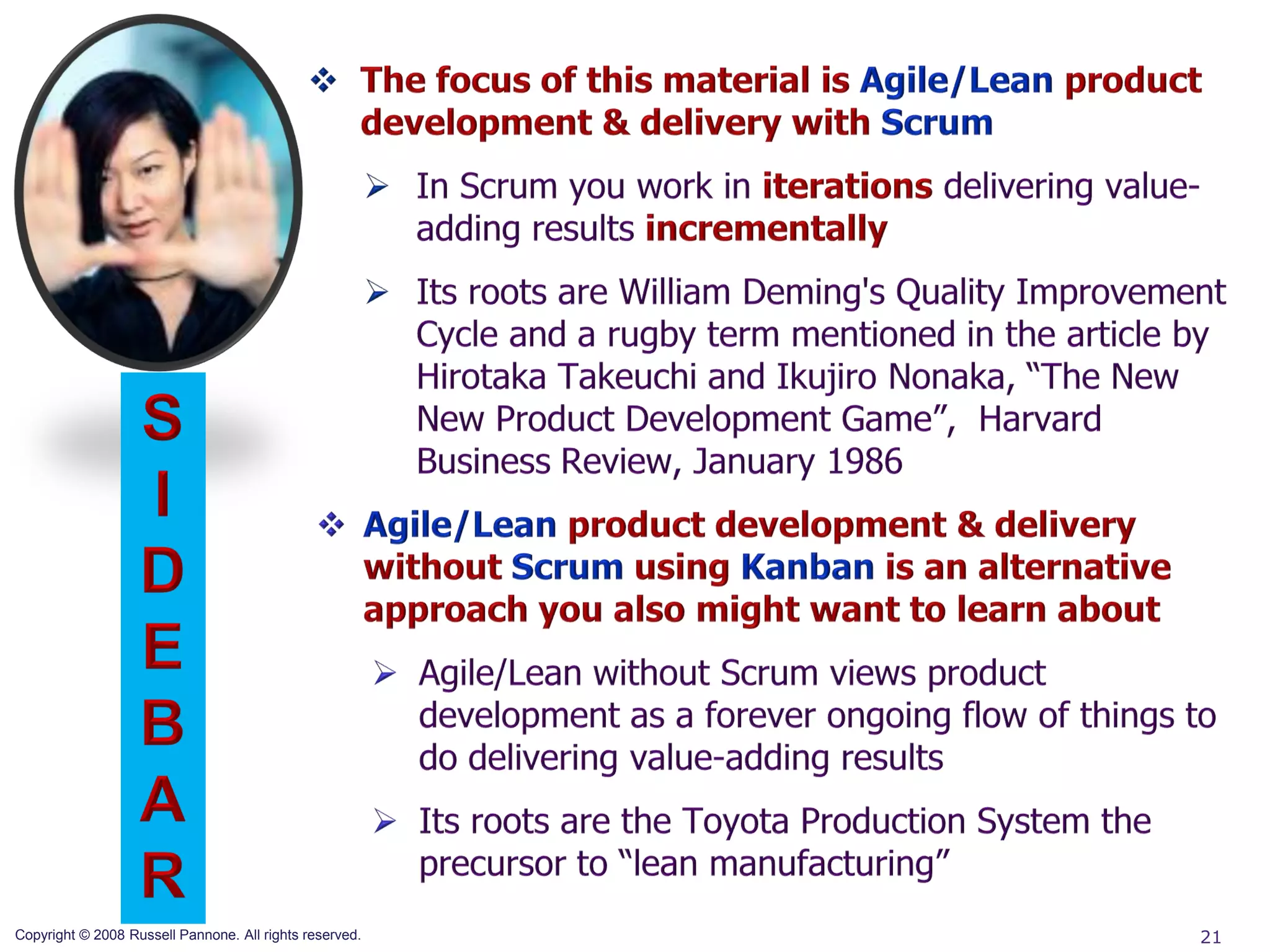
Agile/Lean
Development


                Delivering early and
              often, giving ourselves
              the best opportunity to
              beat the competition to
              market, realize revenue
               and discover insights
              that we can use to help
                     us improve

                                  5
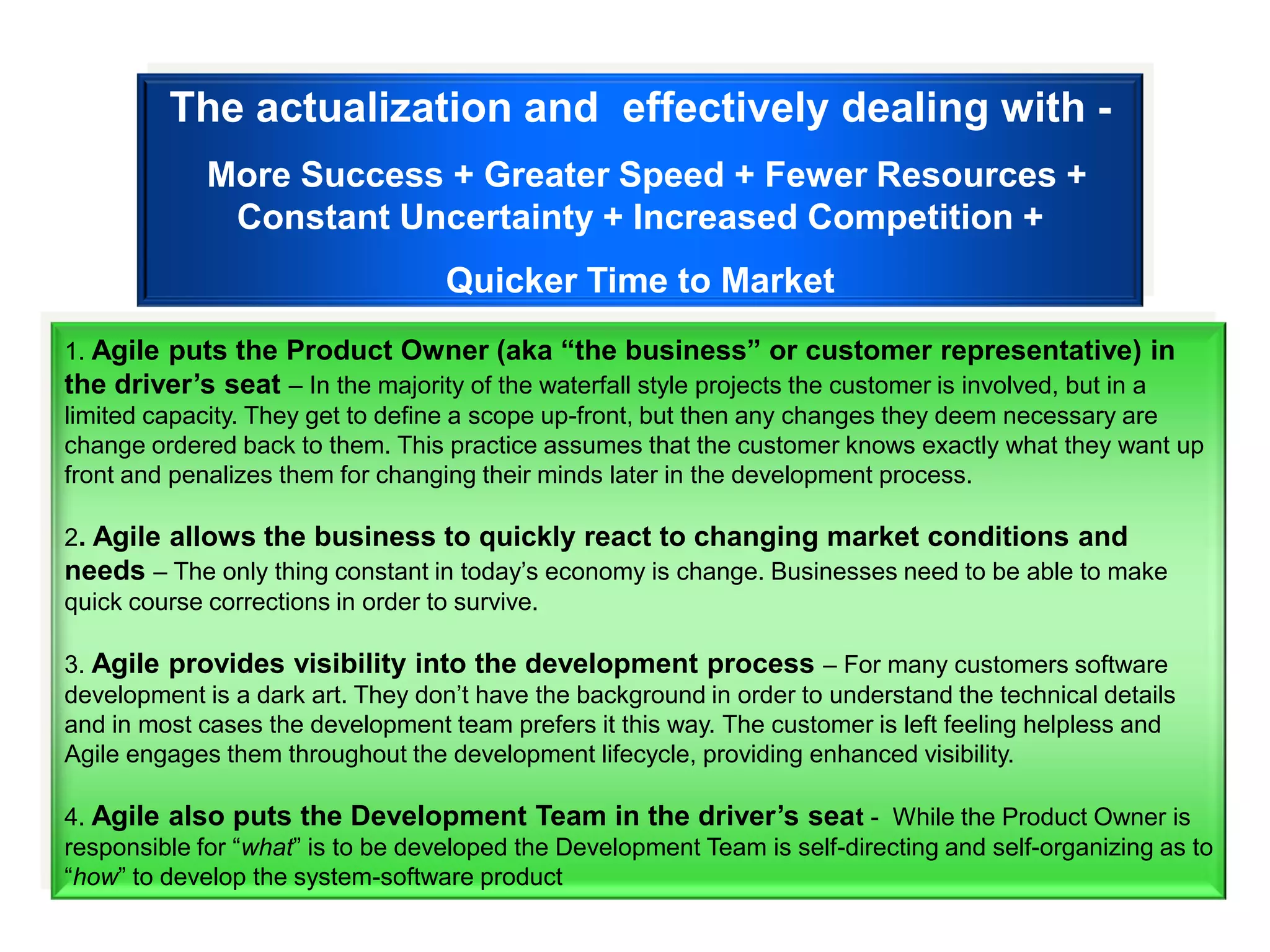
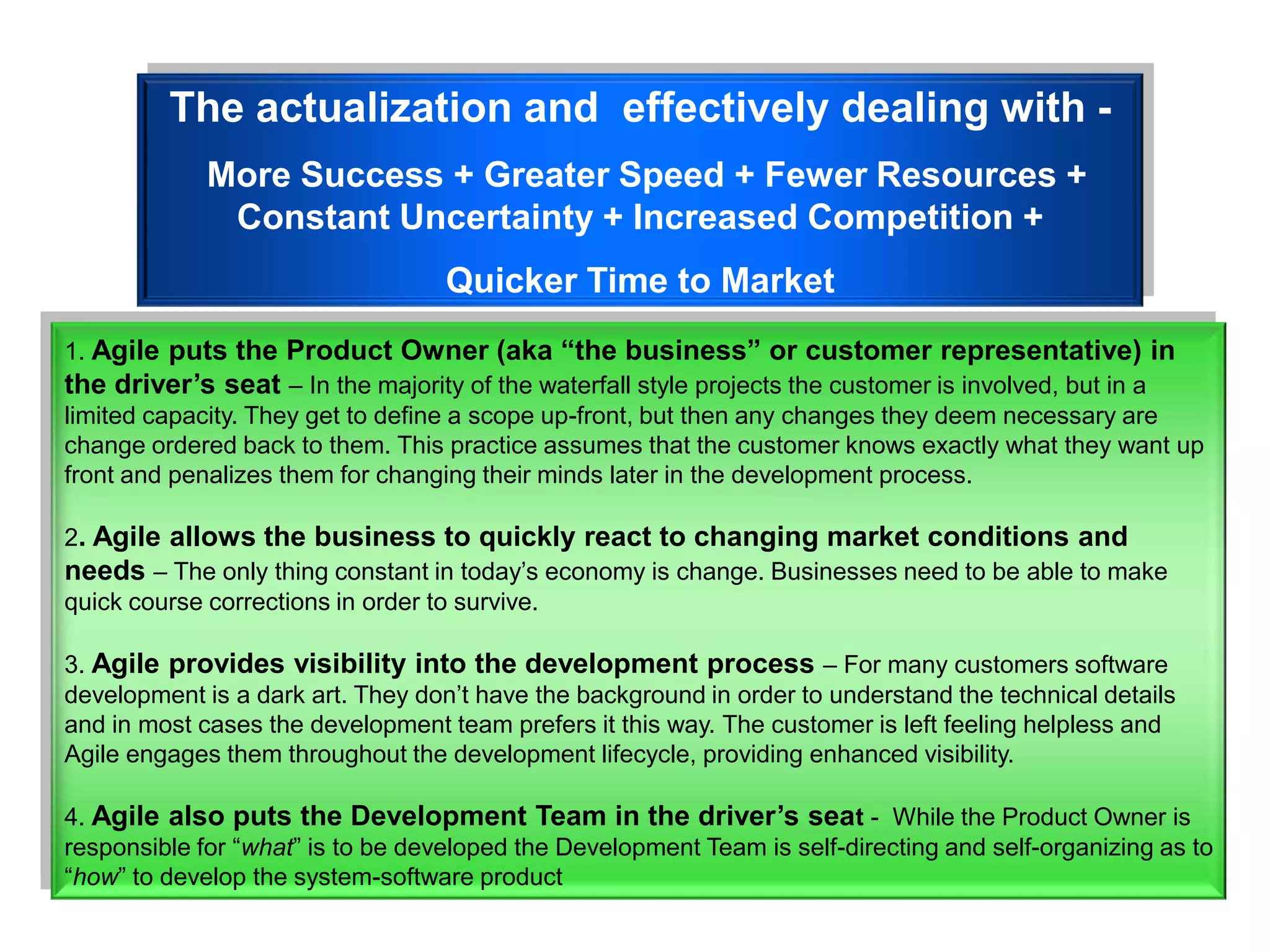
The actualization and effectively dealing with -
             More Success + Greater Speed + Fewer Resources +
              Constant Uncertainty + Increased Competition +
                                   Quicker Time to Market
1. Agile puts the Product Owner (aka “the business” or customer representative) in
the driver’s seat – In the majority of the waterfall style projects the customer is involved, but in a
limited capacity. They get to define a scope up-front, but then any changes they deem necessary are
change ordered back to them. This practice assumes that the customer knows exactly what they want up
front and penalizes them for changing their minds later in the development process.

2. Agile allows the business to quickly react to changing market conditions and
needs – The only thing constant in today‟s economy is change. Businesses need to be able to make
quick course corrections in order to survive.

3. Agile provides visibility into the development process – For many customers software
development is a dark art. They don‟t have the background in order to understand the technical details
and in most cases the development team prefers it this way. The customer is left feeling helpless and
Agile engages them throughout the development lifecycle, providing enhanced visibility.

4. Agile also puts the Development Team in the driver’s seat - While the Product Owner is
responsible for “what” is to be developed the Development Team is self-directing and self-organizing as to
“how” to develop the system-software product
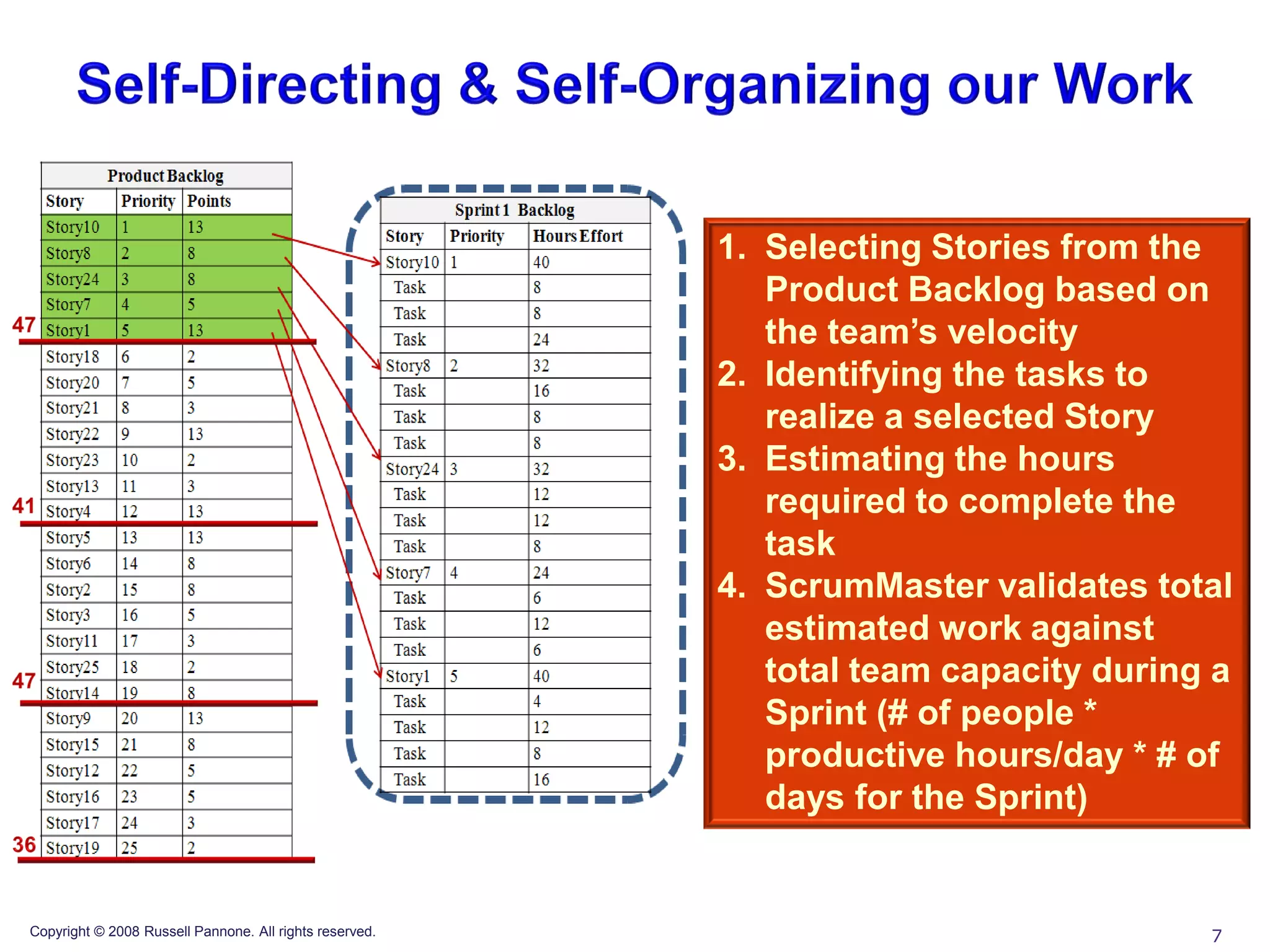
1. Selecting Stories from the
                                                            Product Backlog based on
                                                            the team’s velocity
                                                         2. Identifying the tasks to
                                                            realize a selected Story
                                                         3. Estimating the hours
                                                            required to complete the
                                                            task
                                                         4. ScrumMaster validates total
                                                            estimated work against
                                                            total team capacity during a
                                                            Sprint (# of people *
                                                            productive hours/day * # of
                                                            days for the Sprint)


Copyright © 2008 Russell Pannone. All rights reserved.                                7
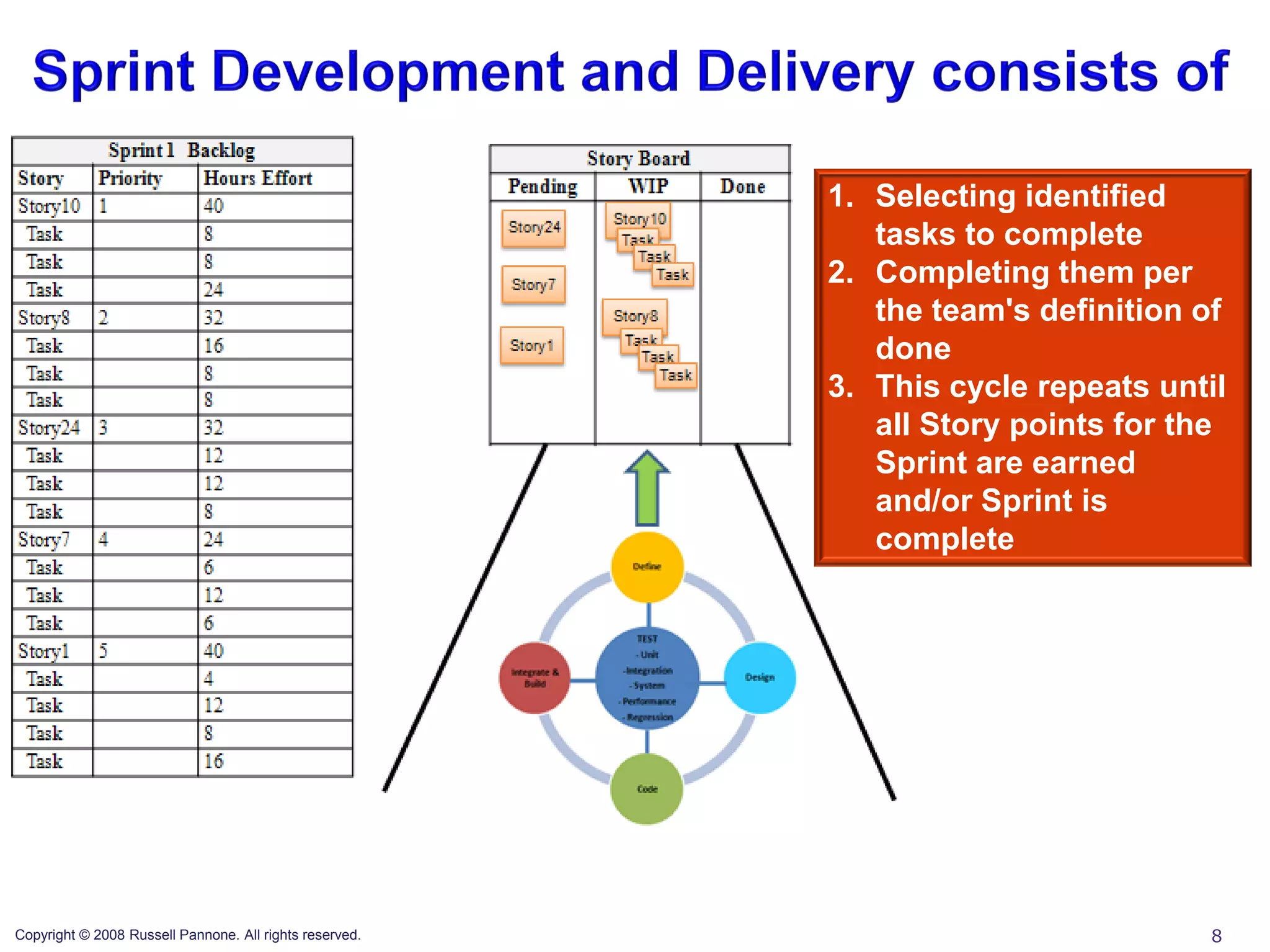
1. Selecting identified
                                                            tasks to complete
                                                         2. Completing them per
                                                            the team's definition of
                                                            done
                                                         3. This cycle repeats until
                                                            all Story points for the
                                                            Sprint are earned
                                                            and/or Sprint is
                                                            complete


Copyright © 2008 Russell Pannone. All rights reserved.                            8
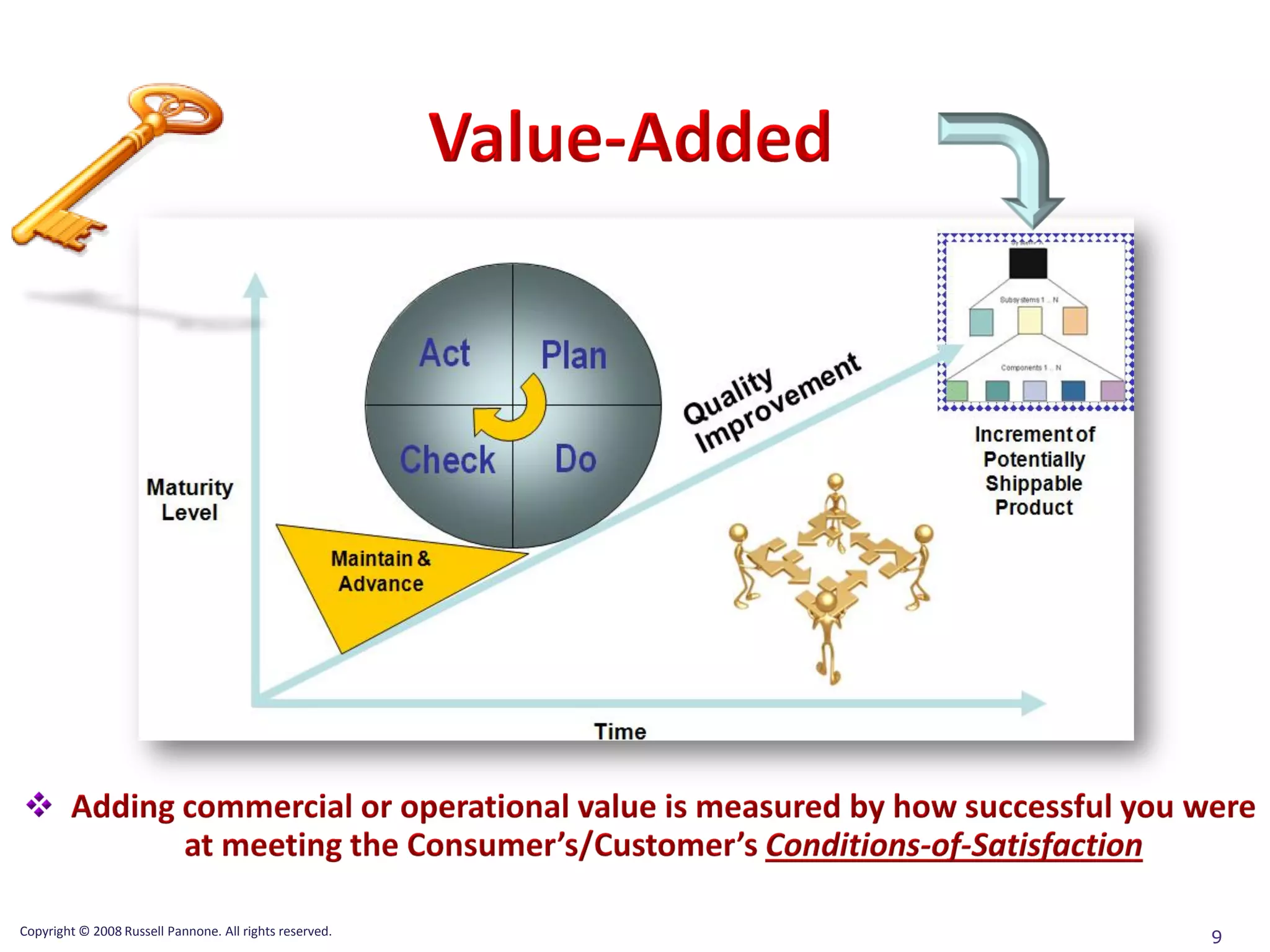
Copyright © 2008 Russell Pannone. All rights reserved.
                                                         9
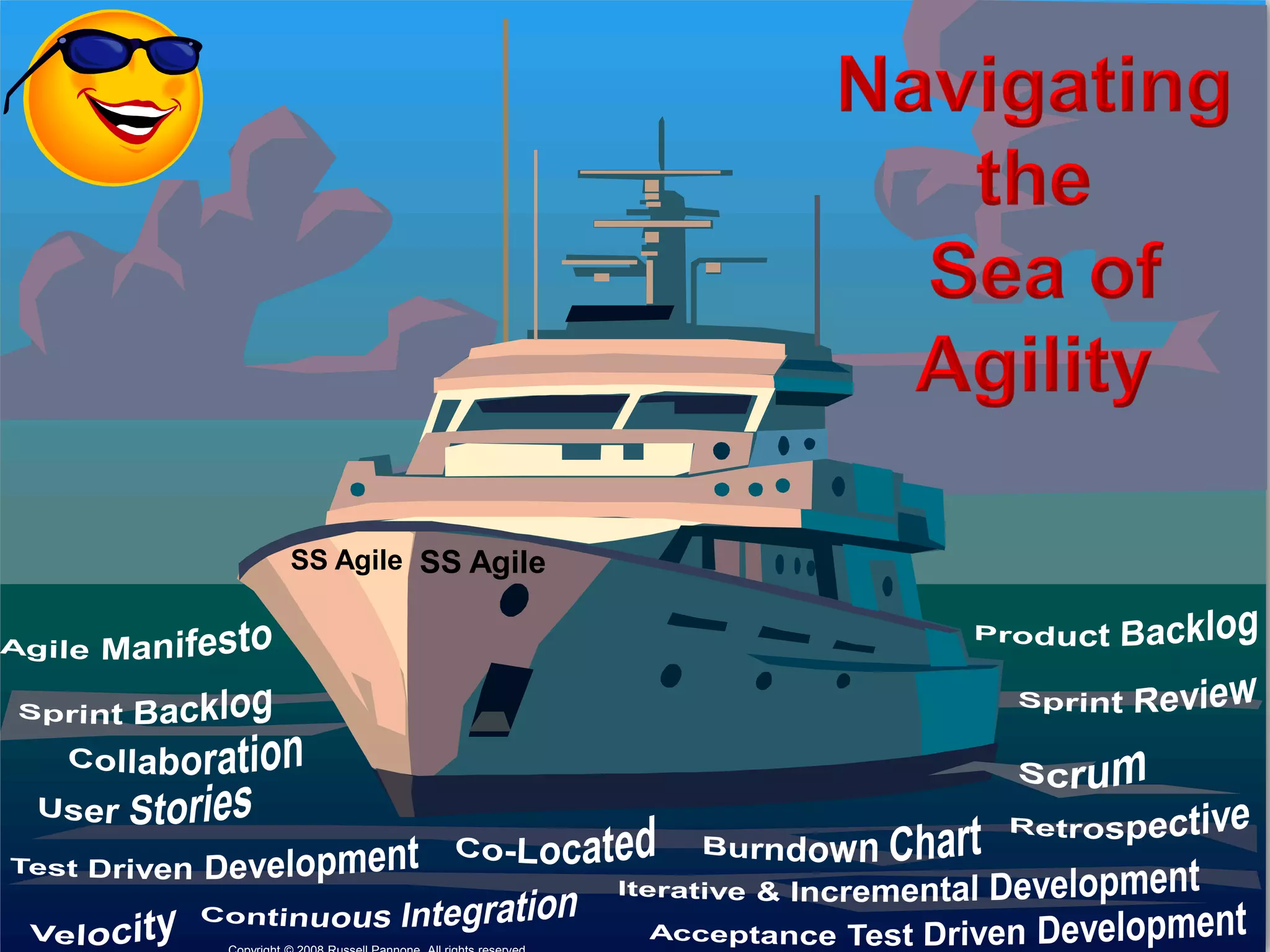
SS Agile SS Agile


                    10
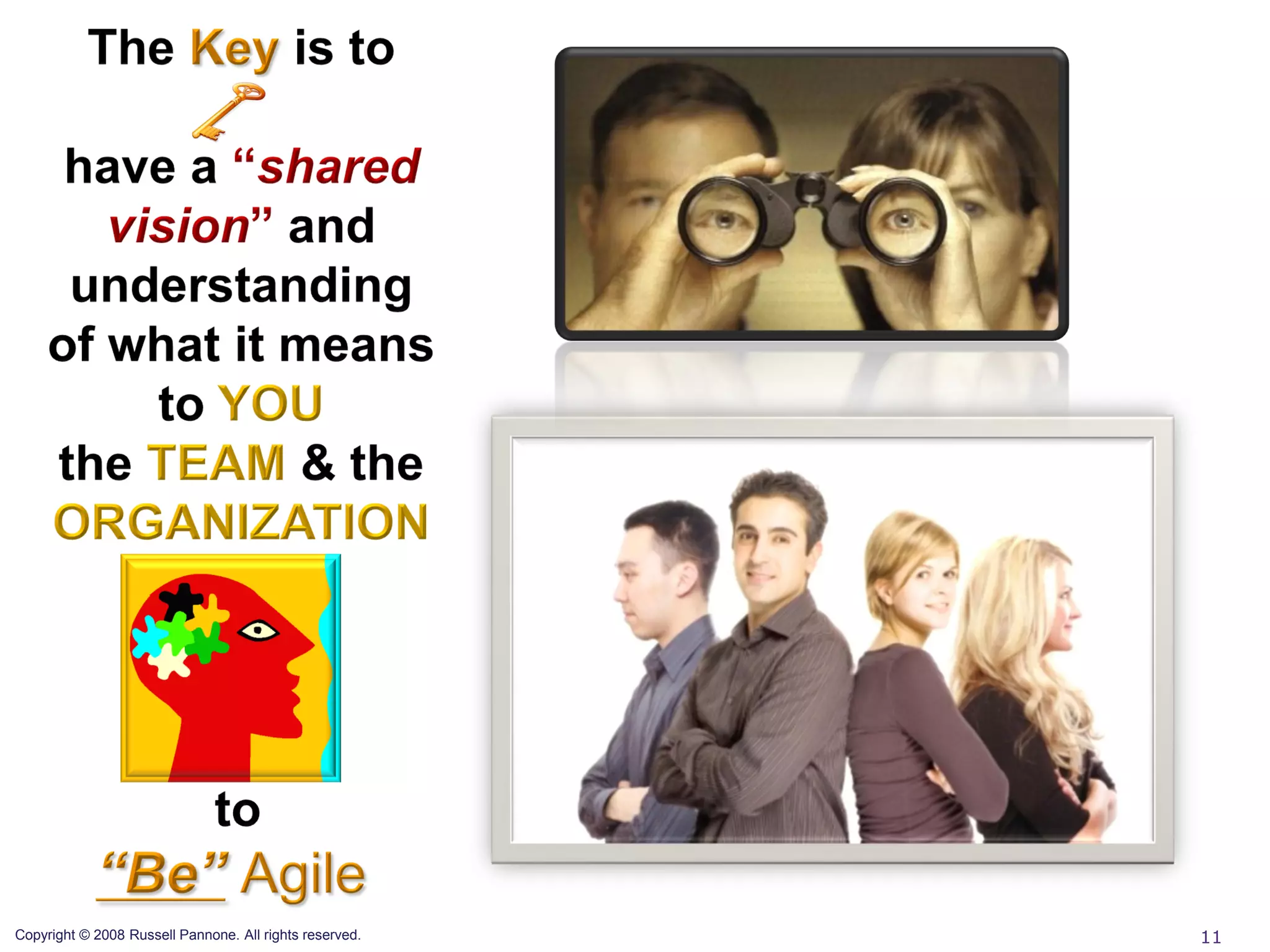
Copyright © 2008 Russell Pannone. All rights reserved.   11
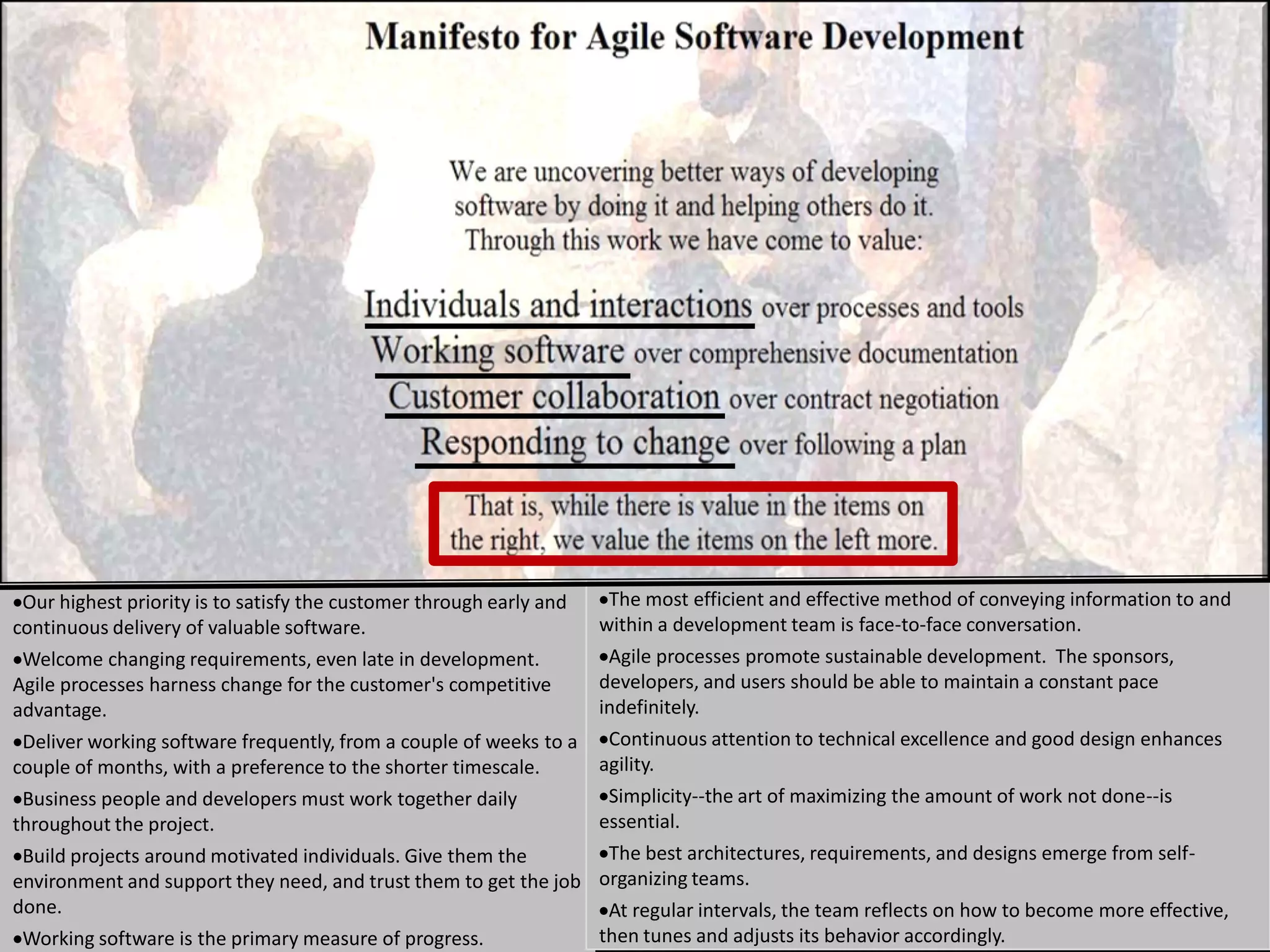
Our highest priority is to satisfy the customer through early and The most efficient and effective method of conveying information to and
continuous delivery of valuable software.                         within a development team is face-to-face conversation.
 Welcome changing requirements, even late in development.          Agile processes promote sustainable development. The sponsors,
Agile processes harness change for the customer's competitive     developers, and users should be able to maintain a constant pace
advantage.                                                        indefinitely.
 Deliver working software frequently, from a couple of weeks to a Continuous attention to technical excellence and good design enhances
couple of months, with a preference to the shorter timescale.     agility.
 Business people and developers must work together daily           Simplicity--the art of maximizing the amount of work not done--is
throughout the project.                                           essential.
 Build projects around motivated individuals. Give them the        The best architectures, requirements, and designs emerge from self-
environment and support they need, and trust them to get the job organizing teams.
done.                                                              At regular intervals, the team reflects on how to become more effective,
 Working software is the primary measure of progress.             then tunes and adjusts its behavior accordingly.                     12
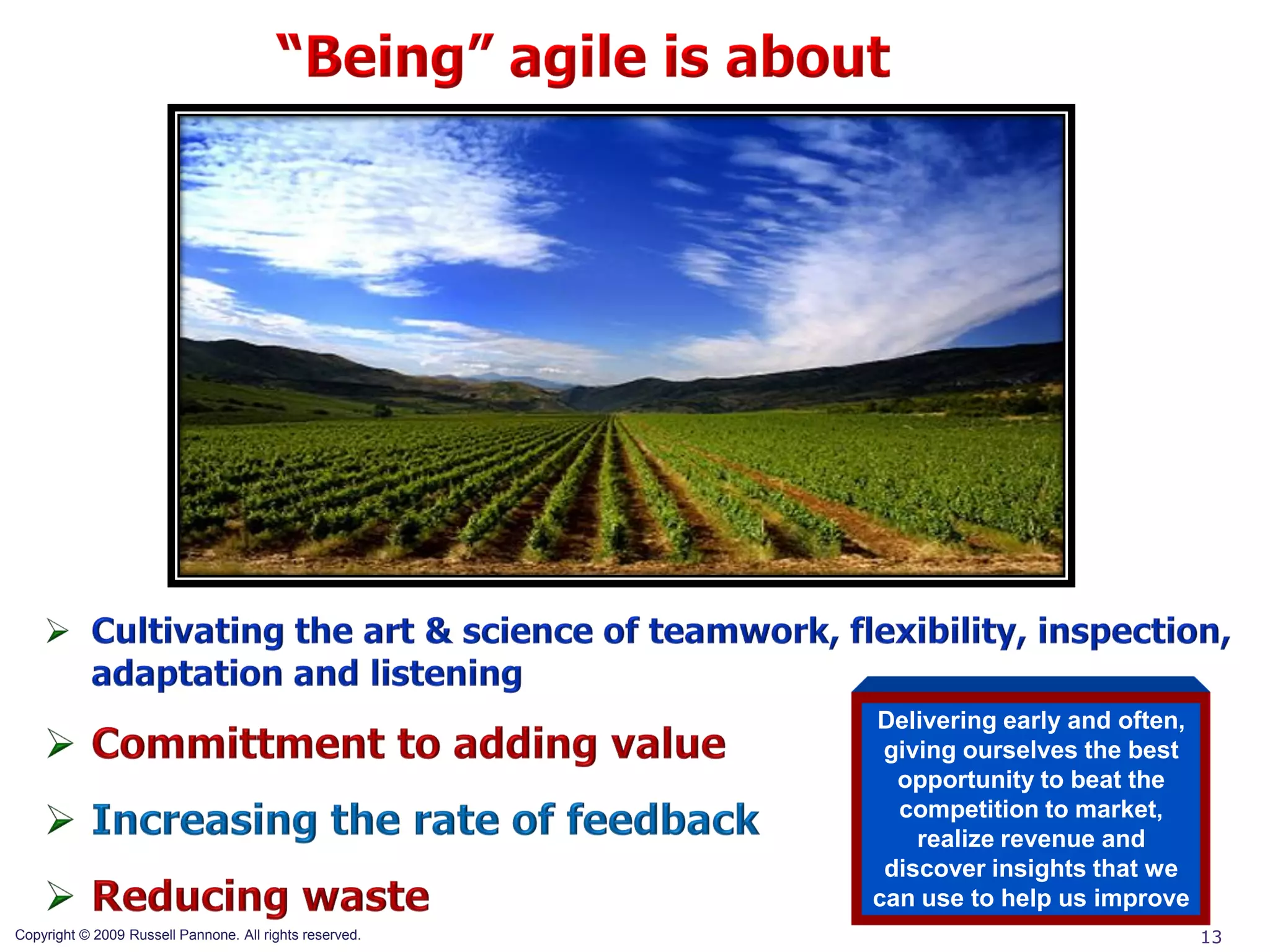
Delivering early and often,
                                                          giving ourselves the best
                                                           opportunity to beat the
                                                           competition to market,
                                                             realize revenue and
                                                          discover insights that we
                                                         can use to help us improve
Copyright © 2009 Russell Pannone. All rights reserved.                                 13
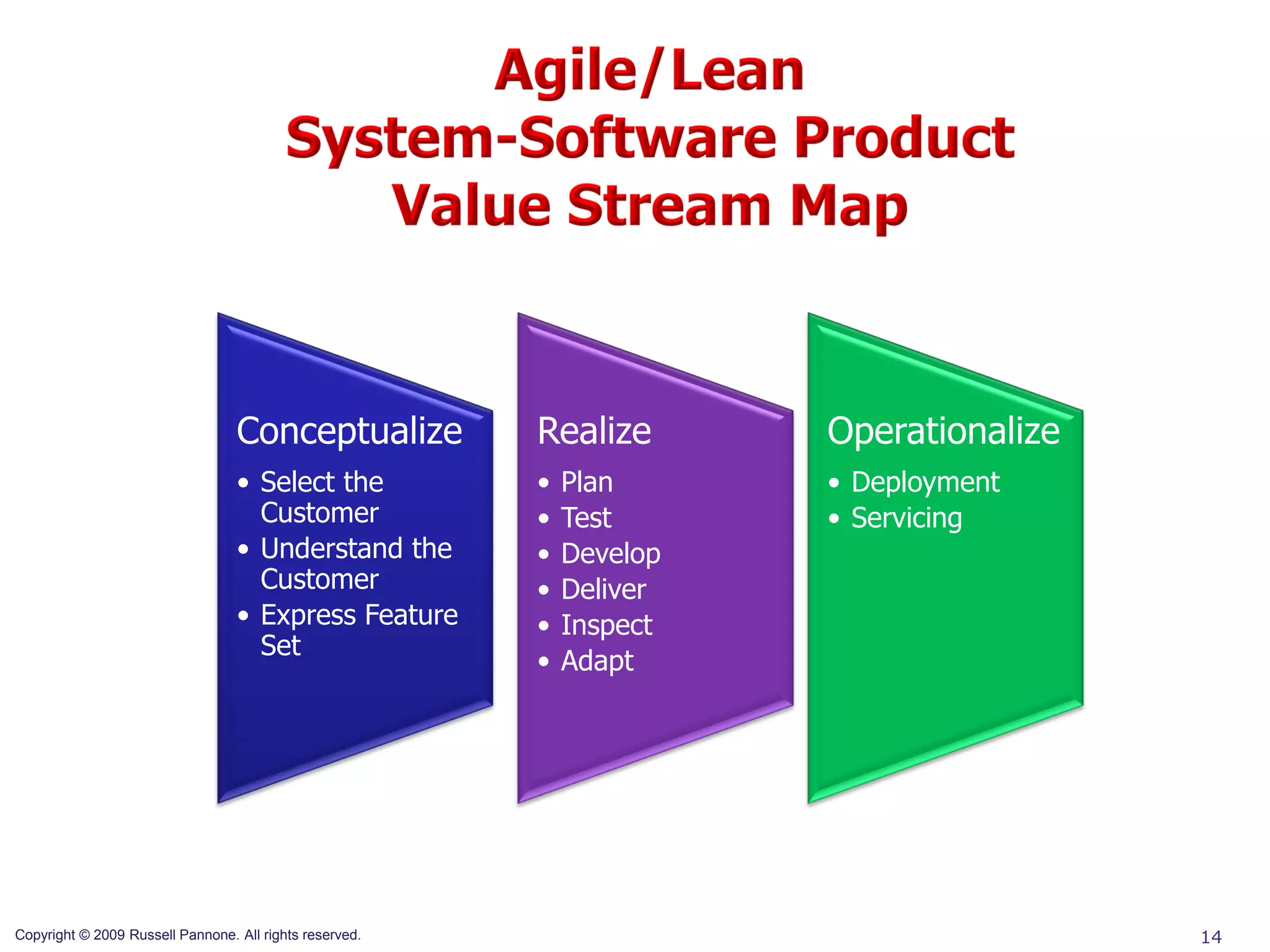
Conceptualize          Realize       Operationalize
                                  • Select the           •   Plan      • Deployment
                                    Customer             •   Test      • Servicing
                                  • Understand the       •   Develop
                                    Customer             •   Deliver
                                  • Express Feature      •   Inspect
                                    Set
                                                         •   Adapt


Copyright © 2009 Russell Pannone. All rights reserved.                                  14
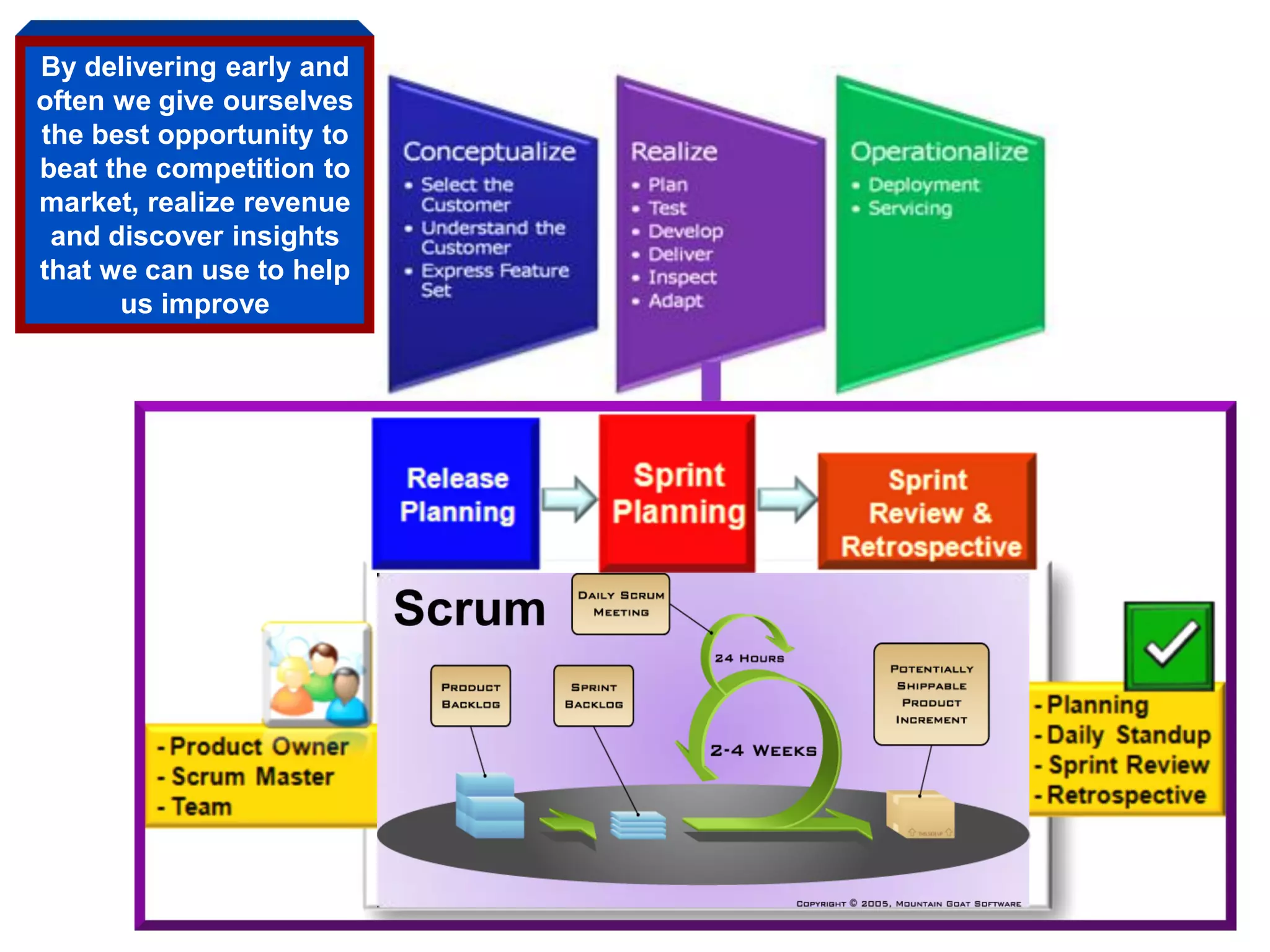
By delivering early and
often we give ourselves
the best opportunity to
beat the competition to
market, realize revenue
 and discover insights
that we can use to help
      us improve
Scrum Explained
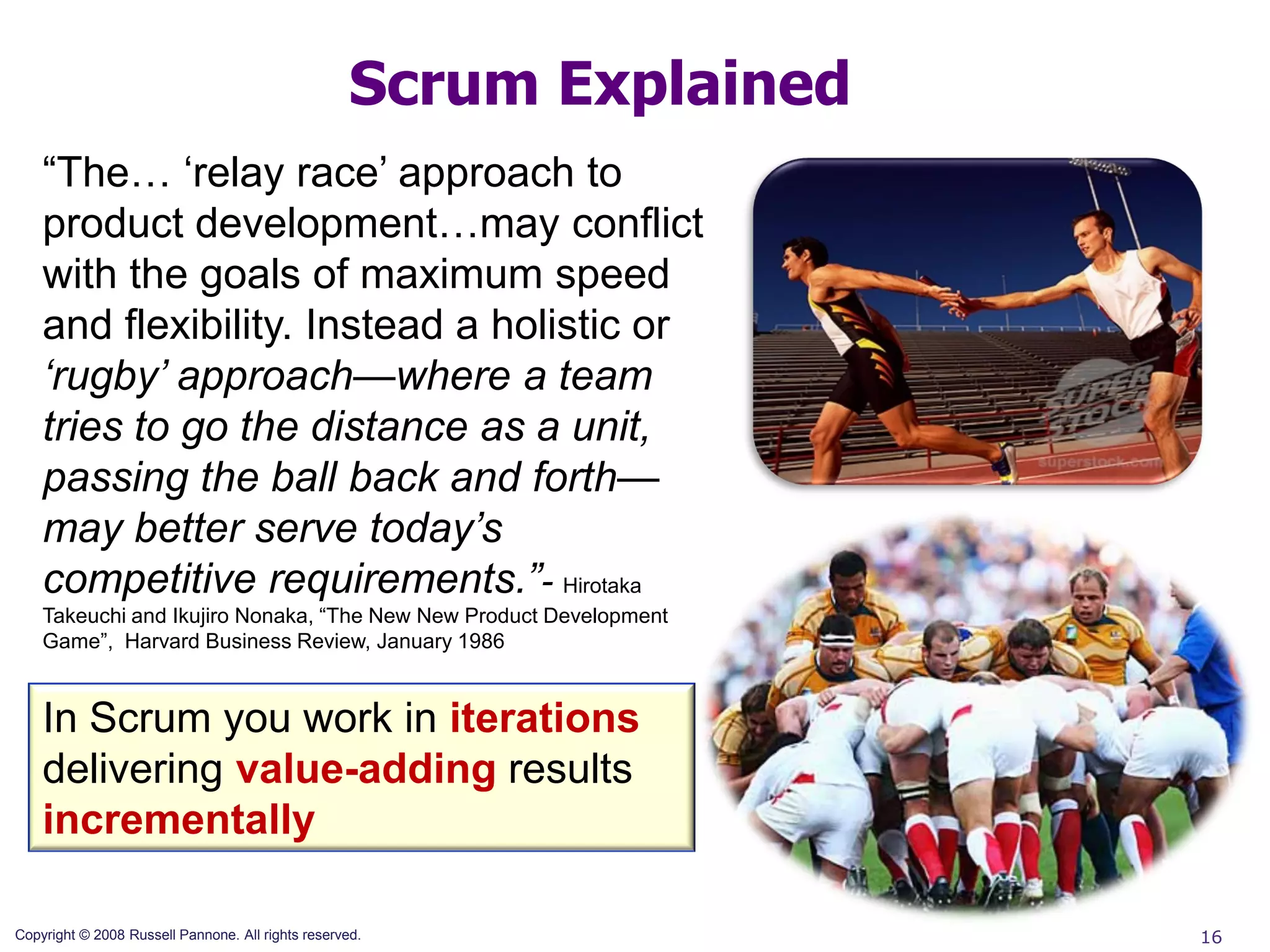
    “The… „relay race‟ approach to
    product development…may conflict
    with the goals of maximum speed
    and flexibility. Instead a holistic or
    ‘rugby’ approach—where a team
    tries to go the distance as a unit,
    passing the ball back and forth—
    may better serve today’s
    competitive requirements.”- Hirotaka
    Takeuchi and Ikujiro Nonaka, “The New New Product Development
    Game”, Harvard Business Review, January 1986


    In Scrum you work in iterations
    delivering value-adding results
    incrementally

Copyright © 2008 Russell Pannone. All rights reserved.                16
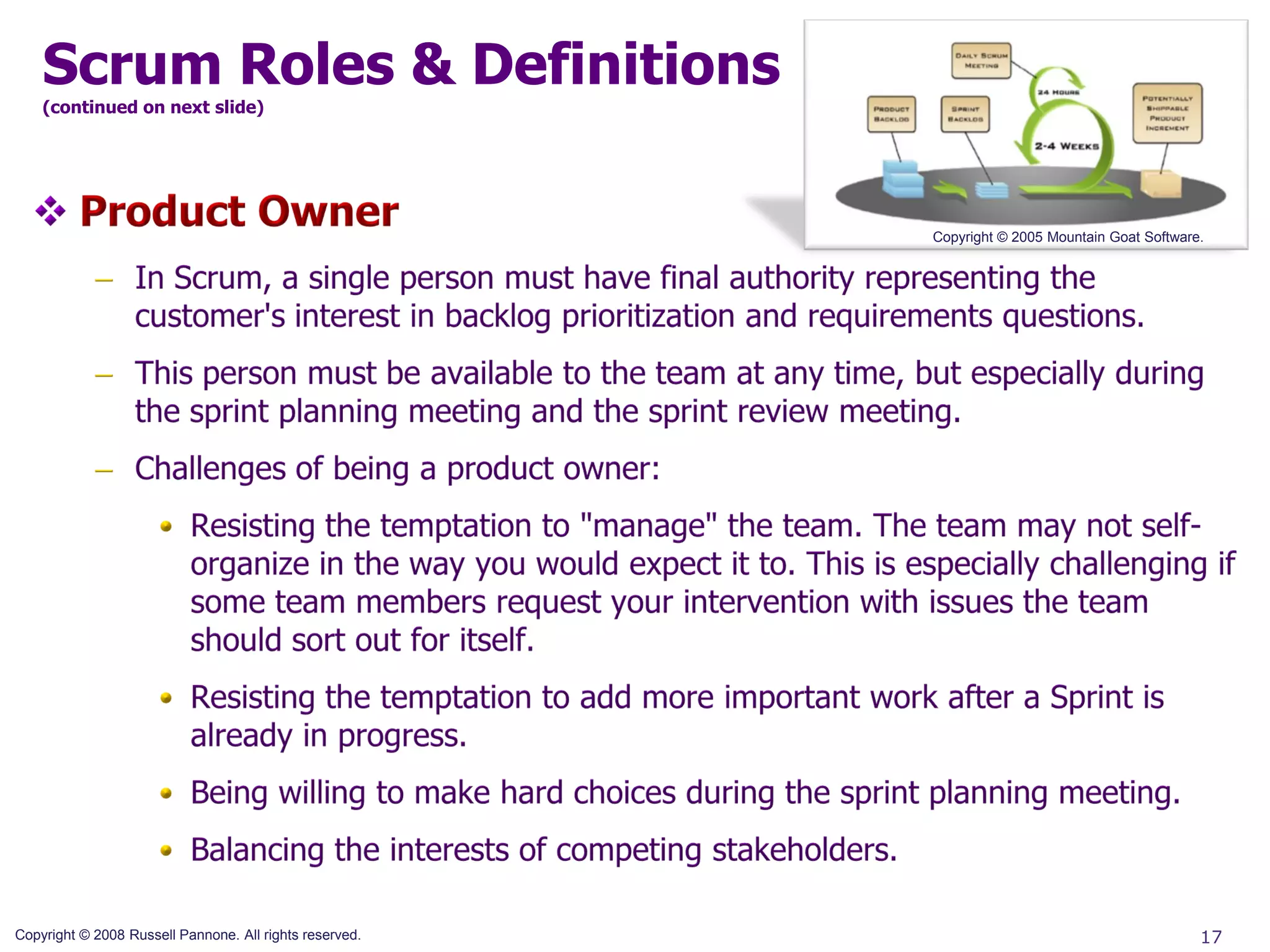
Scrum Roles & Definitions
    (continued on next slide)


                                                         Copyright © 2005 Mountain Goat Software.


Copyright © 2008 Russell Pannone. All rights reserved.                                          17
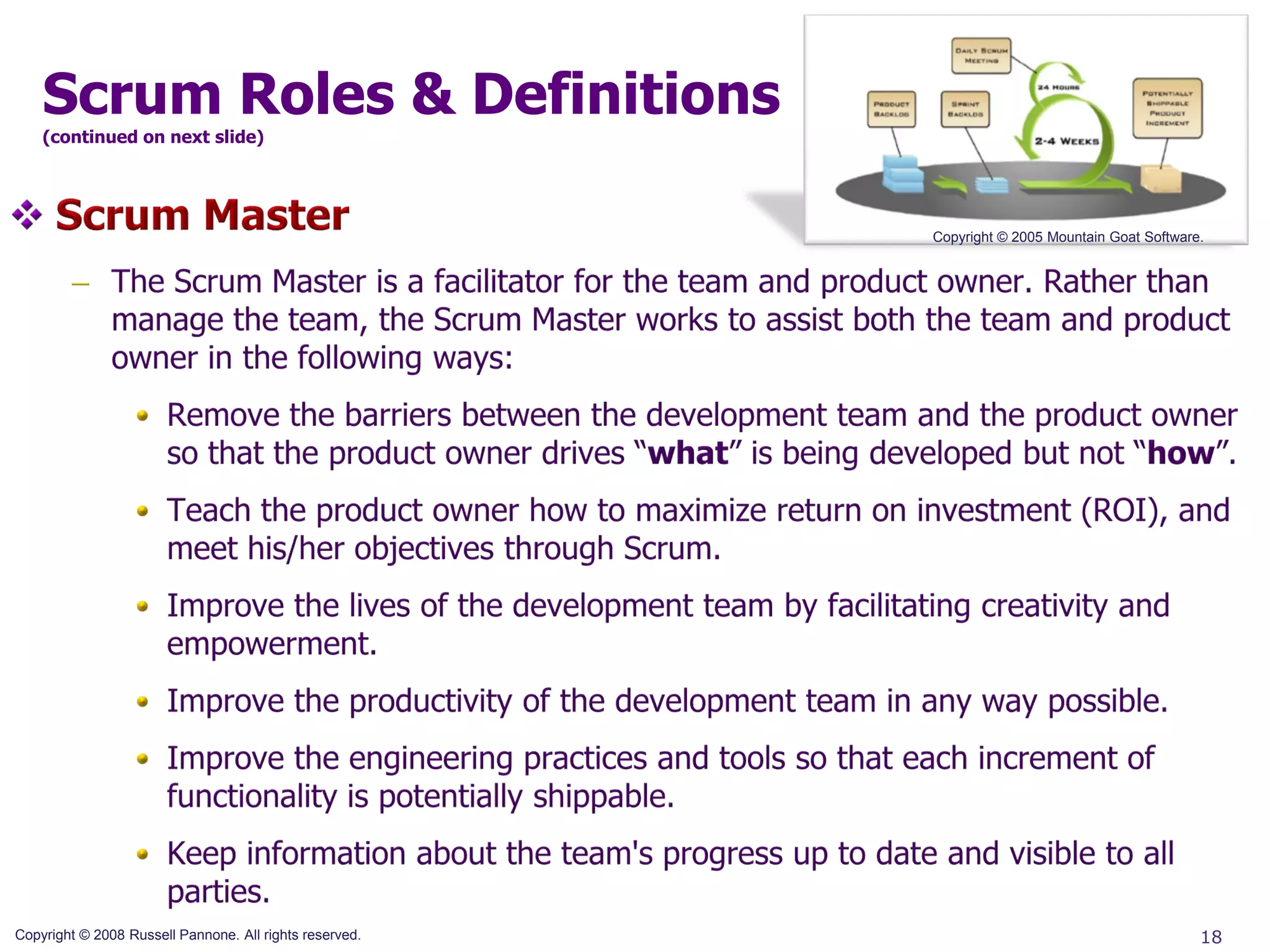
Scrum Roles & Definitions
    (continued on next slide)


                                                         Copyright © 2005 Mountain Goat Software.


Copyright © 2008 Russell Pannone. All rights reserved.                                          18
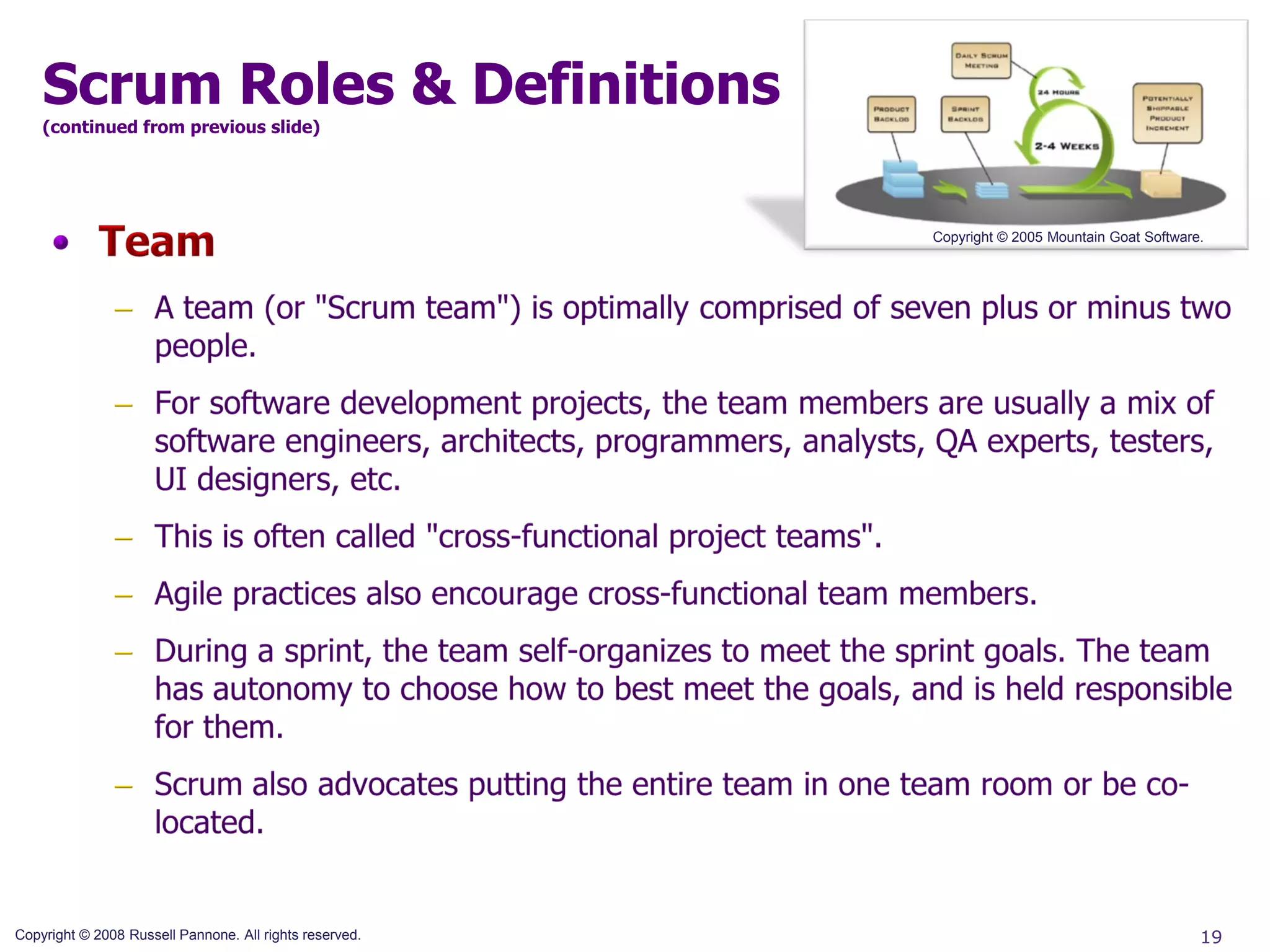
Scrum Roles & Definitions
    (continued from previous slide)


                                                         Copyright © 2005 Mountain Goat Software.


Copyright © 2008 Russell Pannone. All rights reserved.                                          19
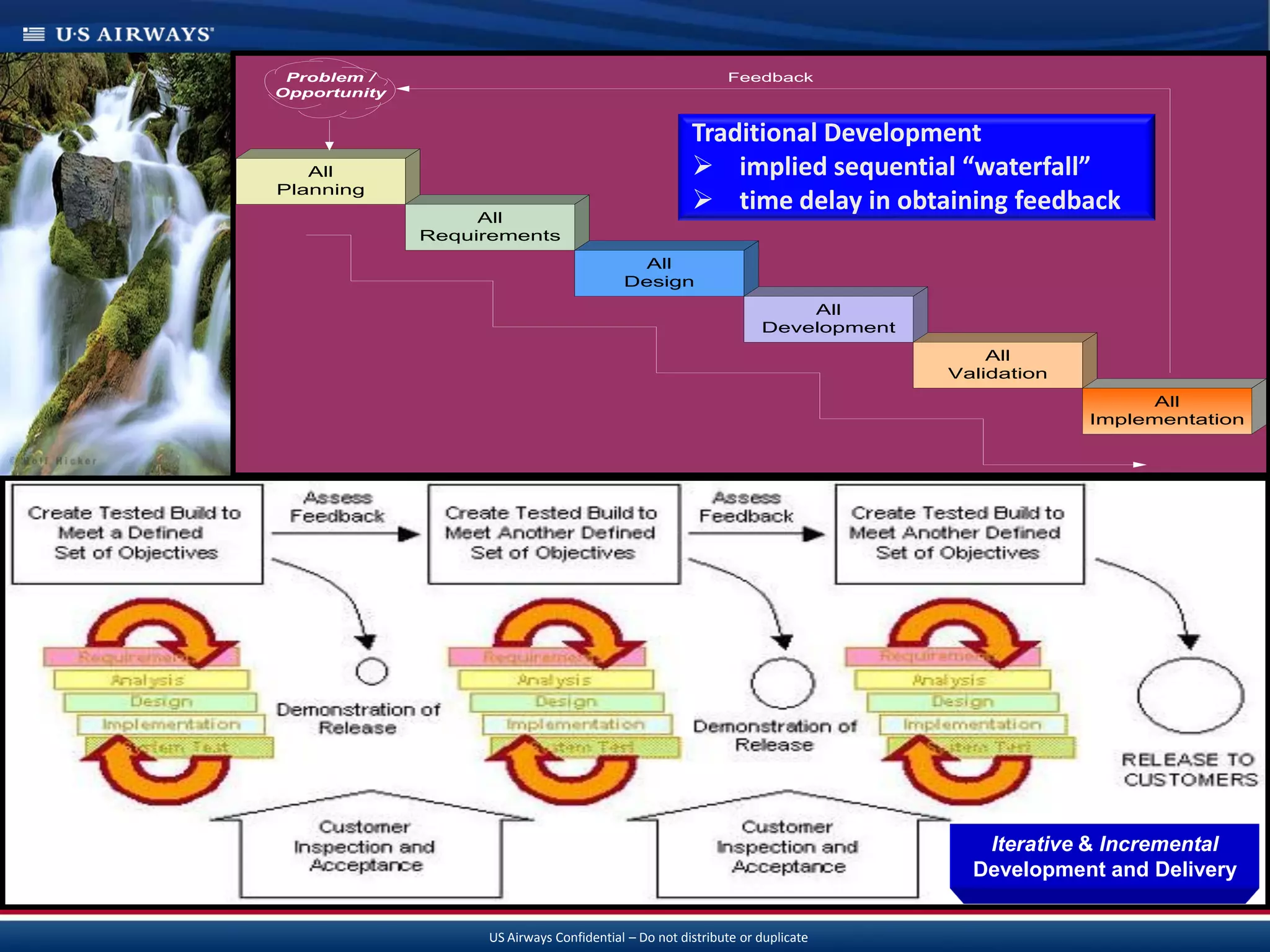
Problem /                                                  Feedback
Opportunity


                                                      Traditional Development
   All                                                 implied sequential “waterfall”
                                                       time delay in obtaining feedback
Planning
                   All
              Requirements
                                           All
                                          Design
                                                                      All
                                                                  Development
                                                                                    All
                                                                                Validation
                                                                                                   All
                                                                                             Implementation


                                                                                   Iterative & Incremental
                                                                                  Development and Delivery


                   US Airways Confidential – Do not distribute or duplicate
Copyright © 2008 Russell Pannone. All rights reserved.   21
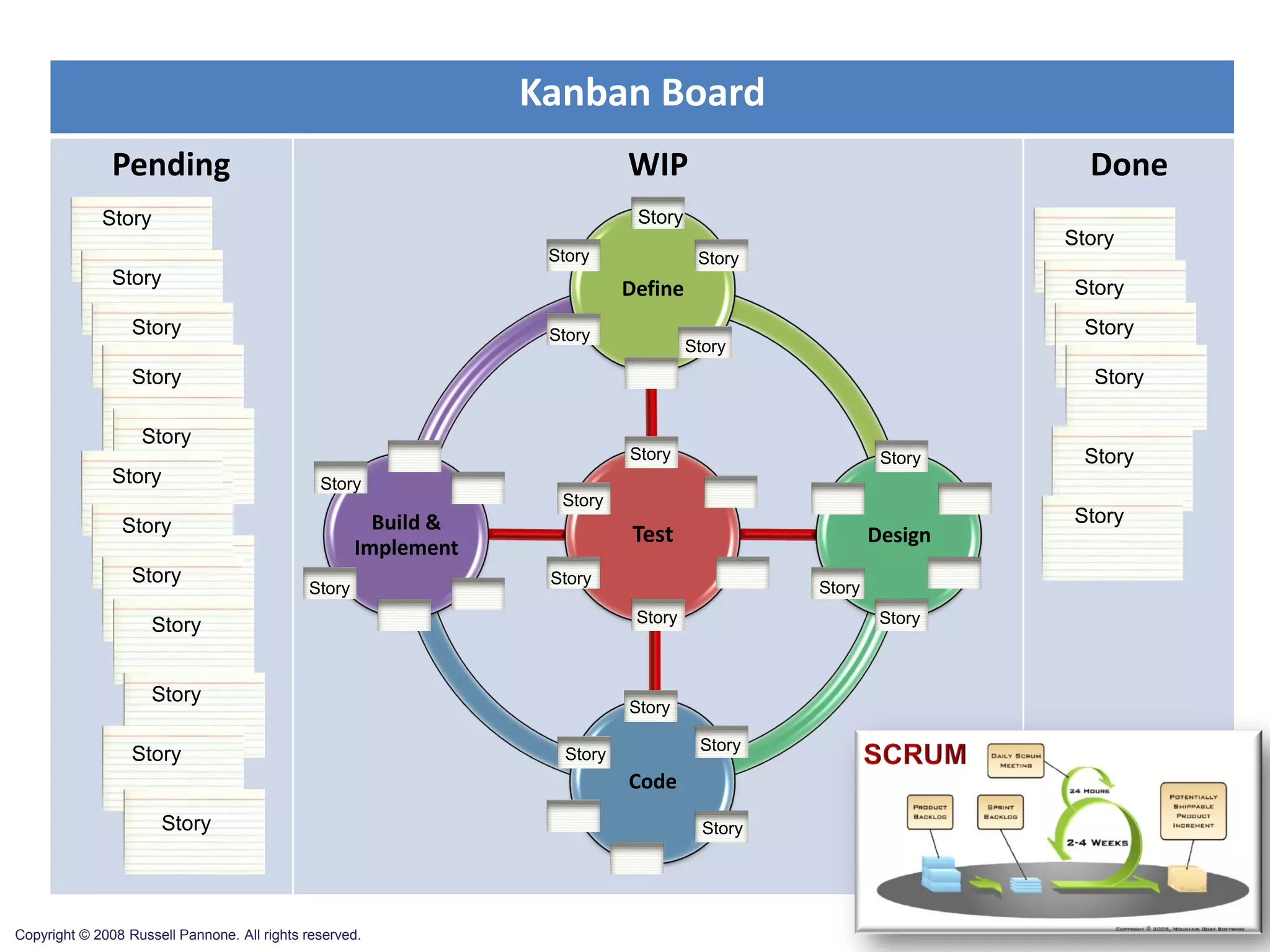
Kanban Board
               Pending                                                      WIP                                   Done
             Story                                                           Story
                                                                                                                Story
                                                                  Story               Story
               Story
                                                                            Define                               Story
                  Story                                           Story                                           Story
                                                                                     Story
                  Story                                                                                            Story

                   Story
                                                                            Story                       Story     Story
               Story                           Story
                                                                   Story
                Story                                  Build &                                                   Story
                                                                             Test                      Design
                                                     Implement
                  Story                                           Story
                                             Story                                             Story

                     Story                                                   Story                      Story


                     Story
                                                                            Story

                                                                                      Story
                  Story                                             Story
                                                                            Code
                       Story                                                           Story


Copyright © 2008 Russell Pannone. All rights reserved.
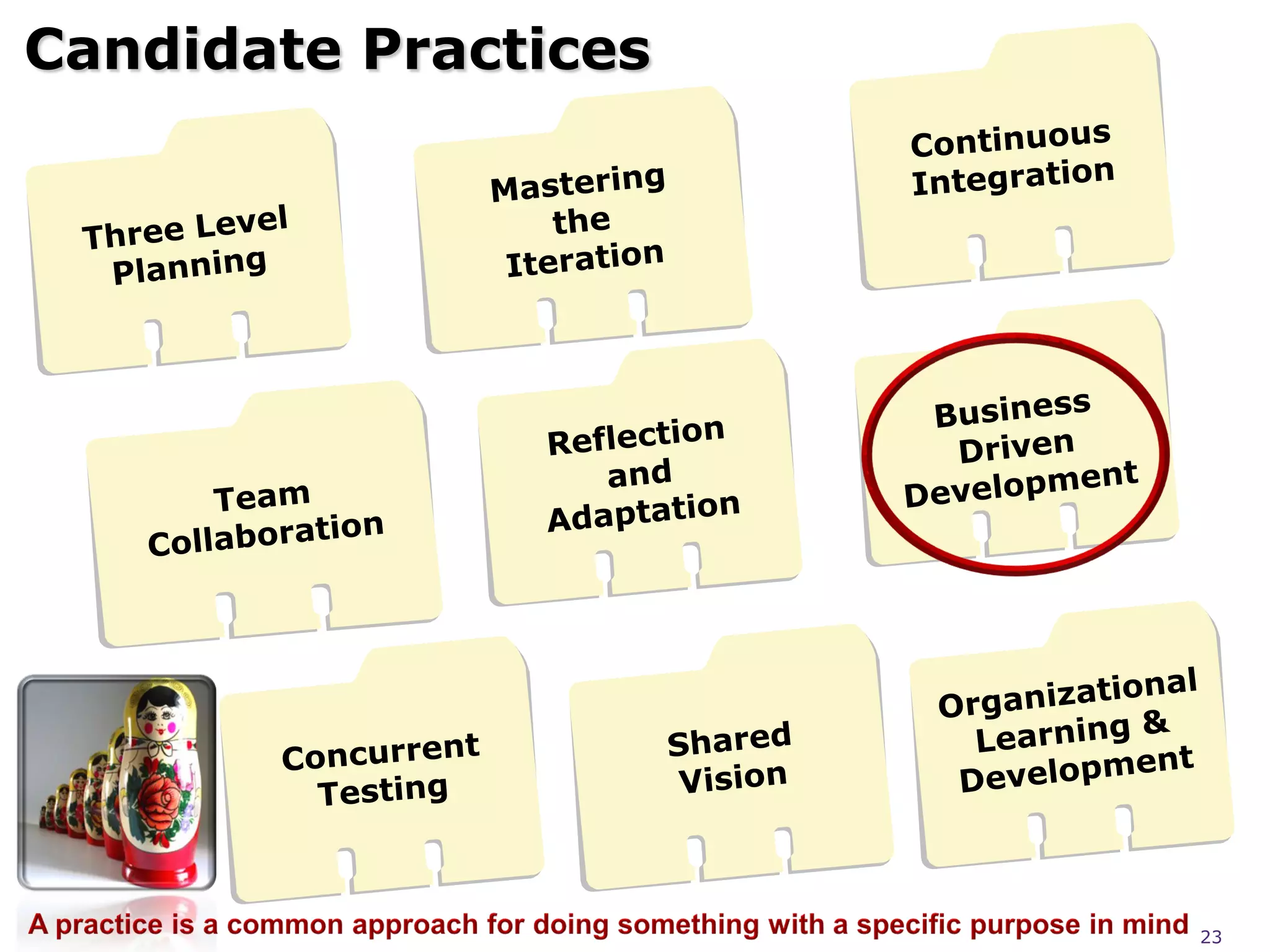
Candidate Practices


                      23
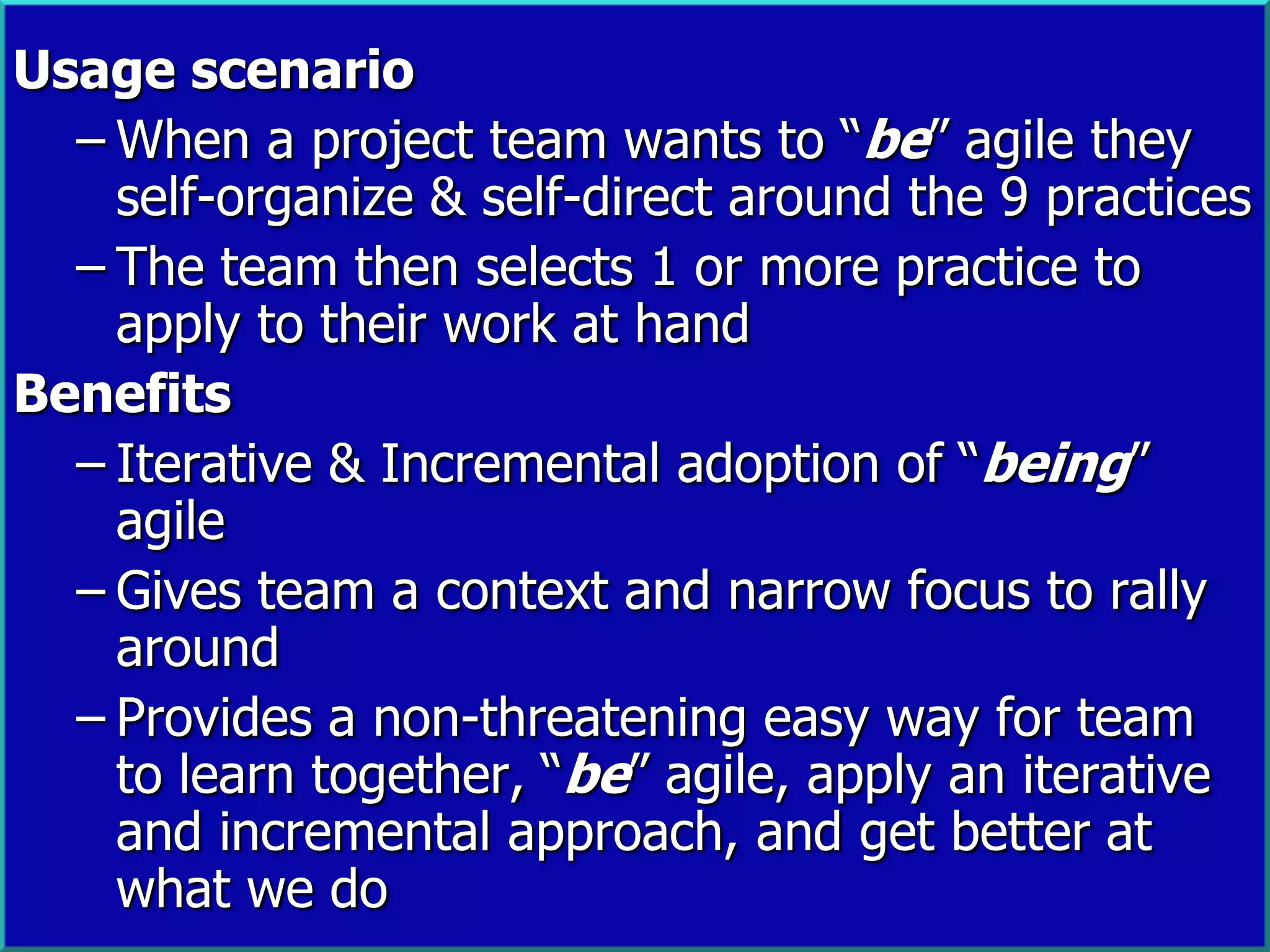
Usage scenario
  – When a project team wants to “be” agile they
    self-organize & self-direct around the 9 practices
  – The team then selects 1 or more practice to
    apply to their work at hand
Benefits
  – Iterative & Incremental adoption of “being”
    agile
  – Gives team a context and narrow focus to rally
    around
  – Provides a non-threatening easy way for team
    to learn together, “be” agile, apply an iterative
    and incremental approach, and get better at
    what we do
                                                   24
The actualization and effectively dealing with -
             More Success + Greater Speed + Fewer Resources +
              Constant Uncertainty + Increased Competition +
                                   Quicker Time to Market
1. Agile puts the Product Owner (aka “the business” or customer representative) in
the driver’s seat – In the majority of the waterfall style projects the customer is involved, but in a
limited capacity. They get to define a scope up-front, but then any changes they deem necessary are
change ordered back to them. This practice assumes that the customer knows exactly what they want up
front and penalizes them for changing their minds later in the development process.

2. Agile allows the business to quickly react to changing market conditions and
needs – The only thing constant in today‟s economy is change. Businesses need to be able to make
quick course corrections in order to survive.

3. Agile provides visibility into the development process – For many customers software
development is a dark art. They don‟t have the background in order to understand the technical details
and in most cases the development team prefers it this way. The customer is left feeling helpless and
Agile engages them throughout the development lifecycle, providing enhanced visibility.

4. Agile also puts the Development Team in the driver’s seat - While the Product Owner is
responsible for “what” is to be developed the Development Team is self-directing and self-organizing as to
“how” to develop the system-software product
Copyright@ 2008 Russell Pannone. All rights reserved.
Copyright © 2008 Russell Pannone. All rights reserved.
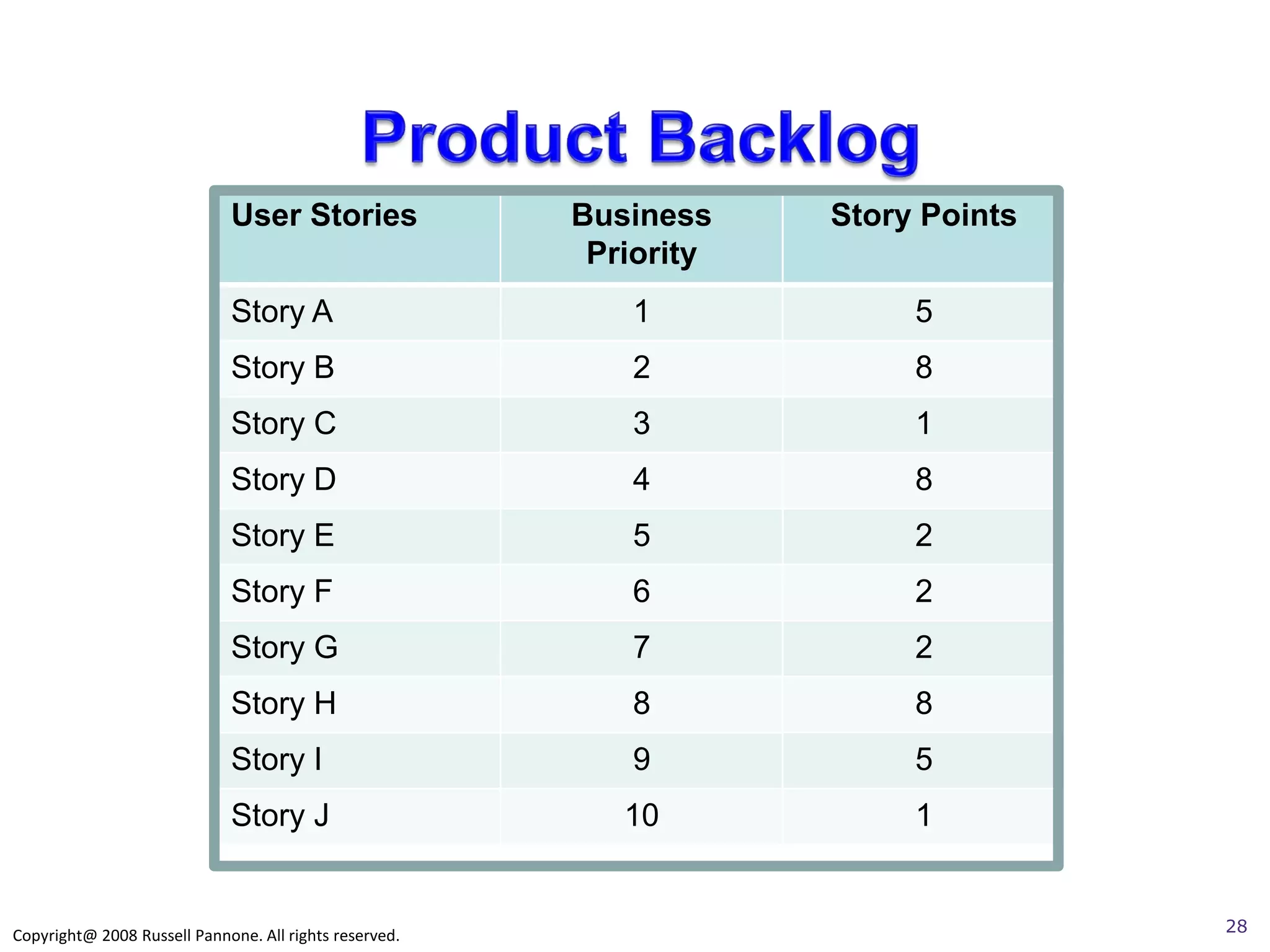
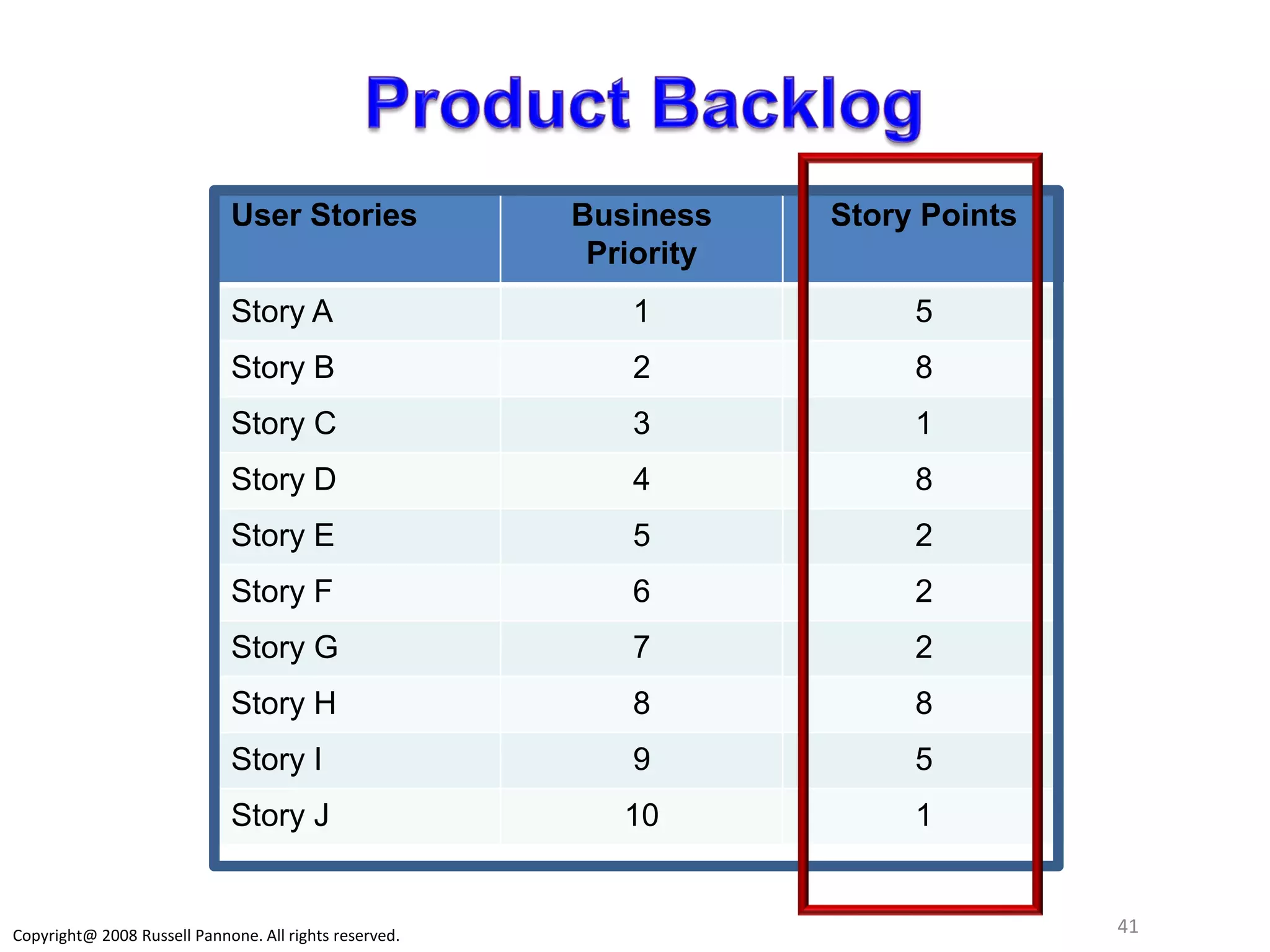
User Stories               Business    Story Points
                                                         Priority
                             Story A                       1             5
                             Story B                       2             8
                             Story C                       3             1
                             Story D                       4             8
                             Story E                       5             2
                             Story F                       6             2
                             Story G                       7             2
                             Story H                       8             8
                             Story I                       9             5
                             Story J                       10            1


Copyright@ 2008 Russell Pannone. All rights reserved.                              28
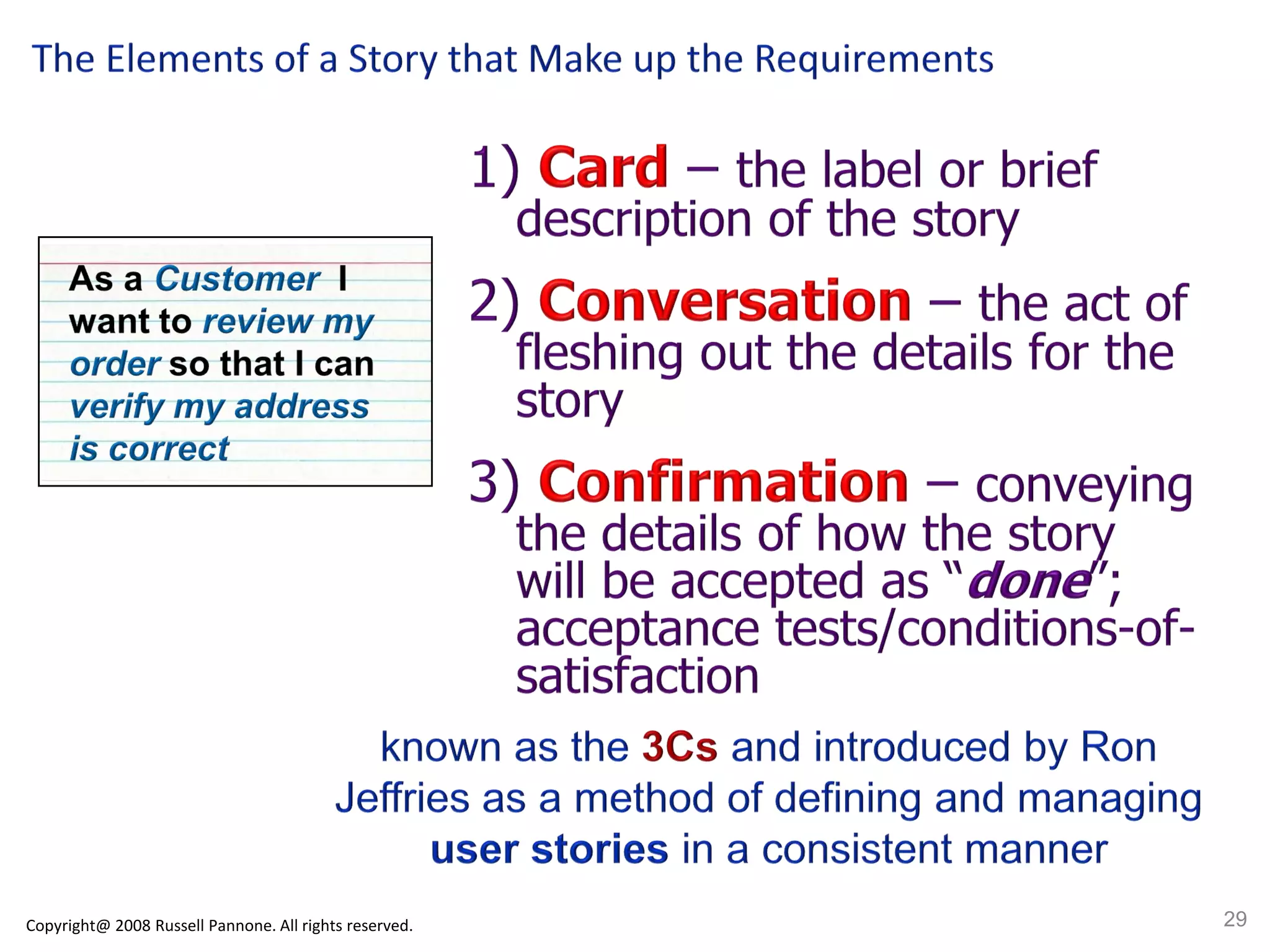
Copyright@ 2008 Russell Pannone. All rights reserved.   29
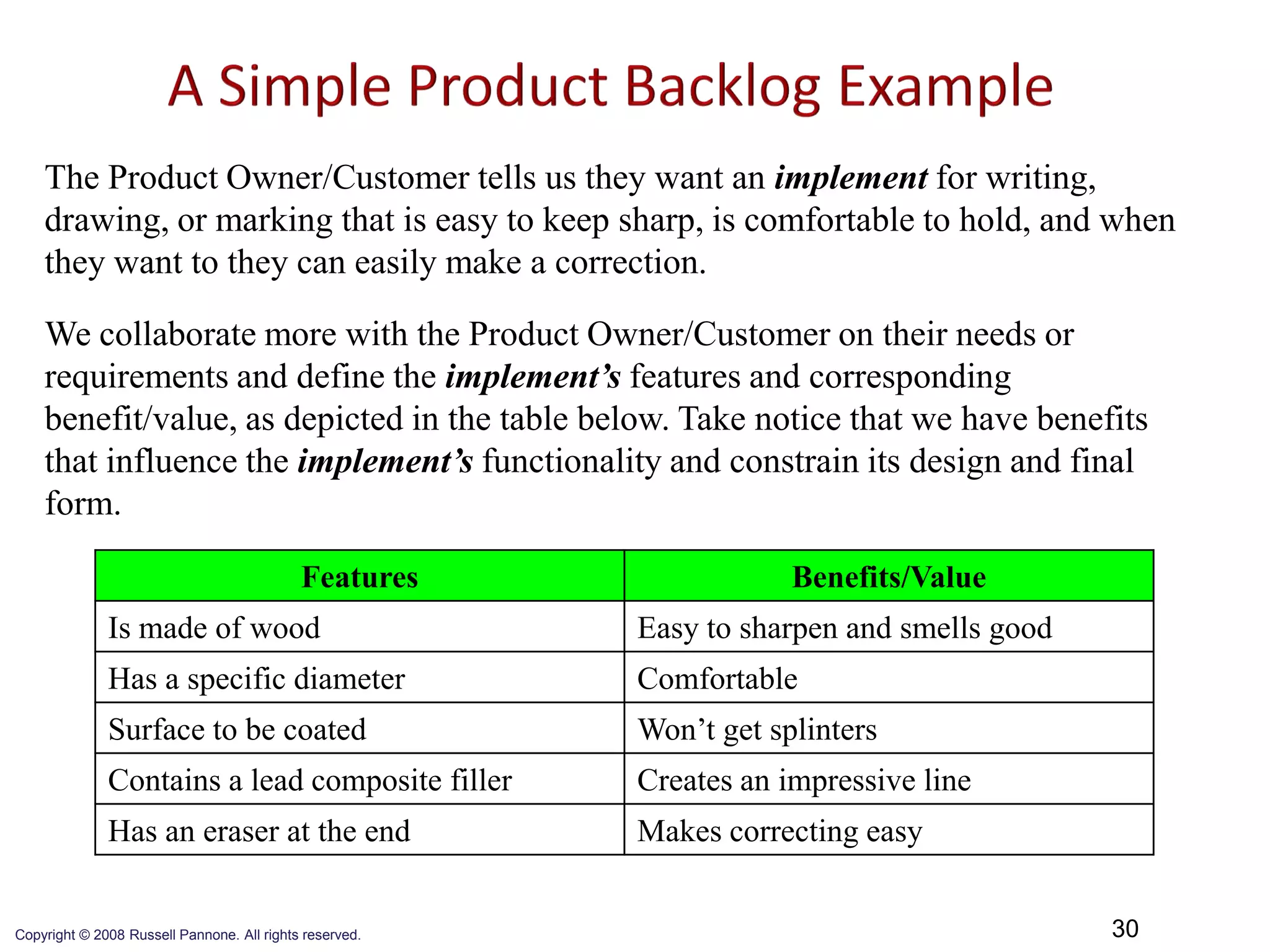
The Product Owner/Customer tells us they want an implement for writing,
    drawing, or marking that is easy to keep sharp, is comfortable to hold, and when
    they want to they can easily make a correction.

    We collaborate more with the Product Owner/Customer on their needs or
    requirements and define the implement’s features and corresponding
    benefit/value, as depicted in the table below. Take notice that we have benefits
    that influence the implement’s functionality and constrain its design and final
    form.

                                            Features                 Benefits/Value
              Is made of wood                            Easy to sharpen and smells good
              Has a specific diameter                    Comfortable
              Surface to be coated                       Won’t get splinters
              Contains a lead composite filler           Creates an impressive line
              Has an eraser at the end                   Makes correcting easy


Copyright © 2008 Russell Pannone. All rights reserved.                                     30
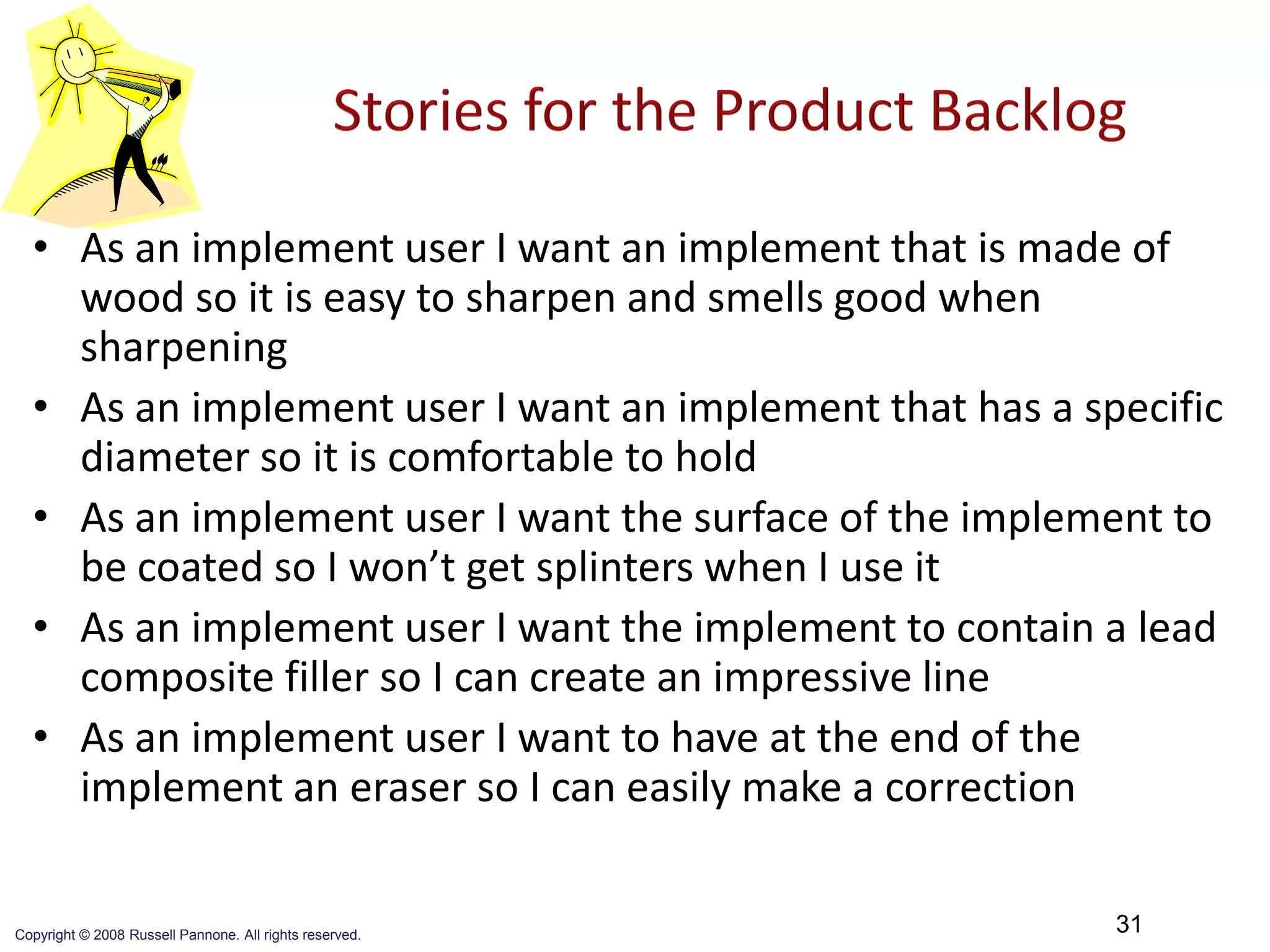
• As an implement user I want an implement that is made of
    wood so it is easy to sharpen and smells good when
    sharpening
  • As an implement user I want an implement that has a specific
    diameter so it is comfortable to hold
  • As an implement user I want the surface of the implement to
    be coated so I won’t get splinters when I use it
  • As an implement user I want the implement to contain a lead
    composite filler so I can create an impressive line
  • As an implement user I want to have at the end of the
    implement an eraser so I can easily make a correction


Copyright © 2008 Russell Pannone. All rights reserved.
                                                          31
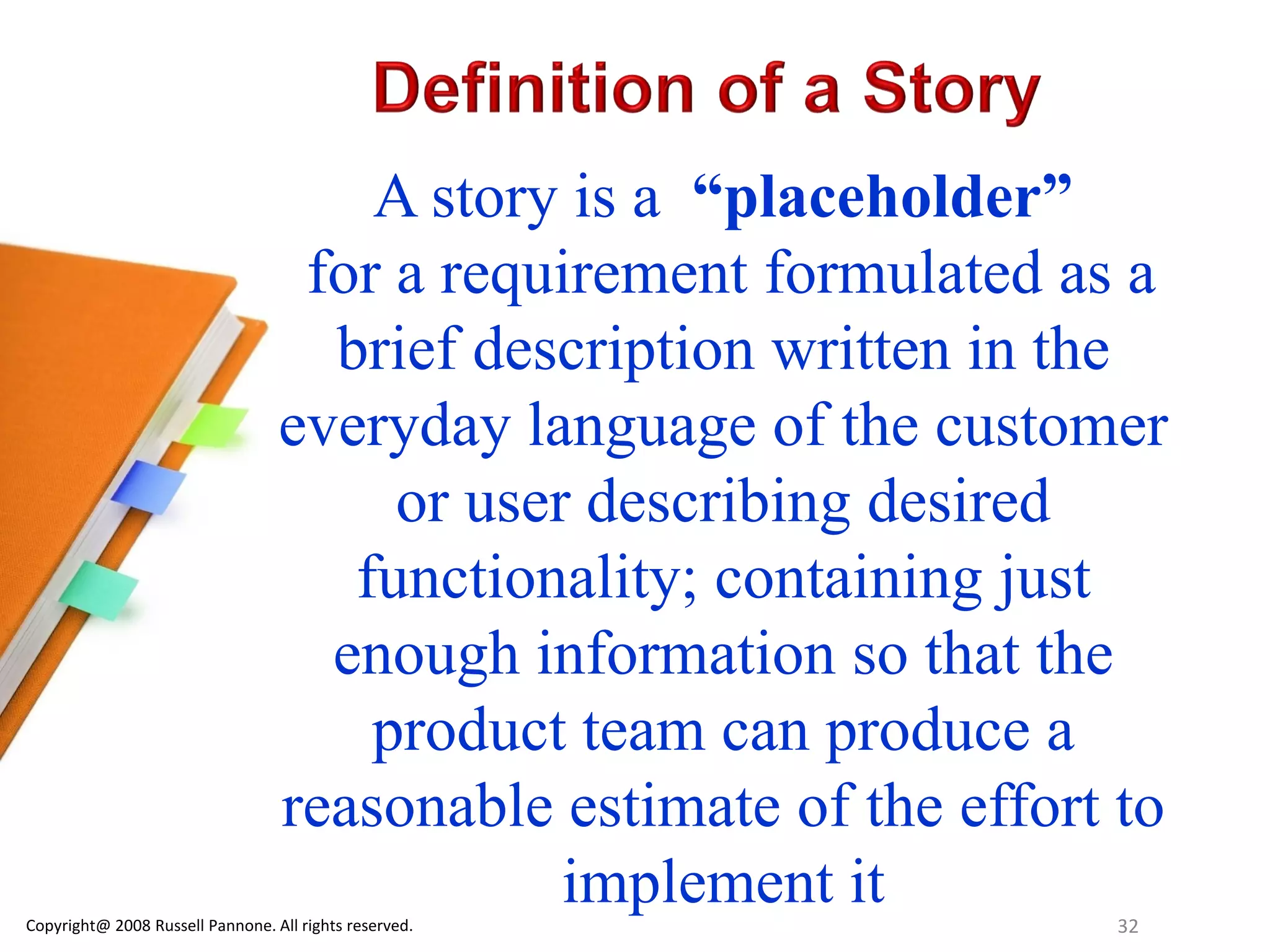
A story is a “placeholder”
                                   for a requirement formulated as a
                                    brief description written in the
                                  everyday language of the customer
                                       or user describing desired
                                     functionality; containing just
                                    enough information so that the
                                      product team can produce a
                                  reasonable estimate of the effort to
                                              implement it
Copyright@ 2008 Russell Pannone. All rights reserved.              32
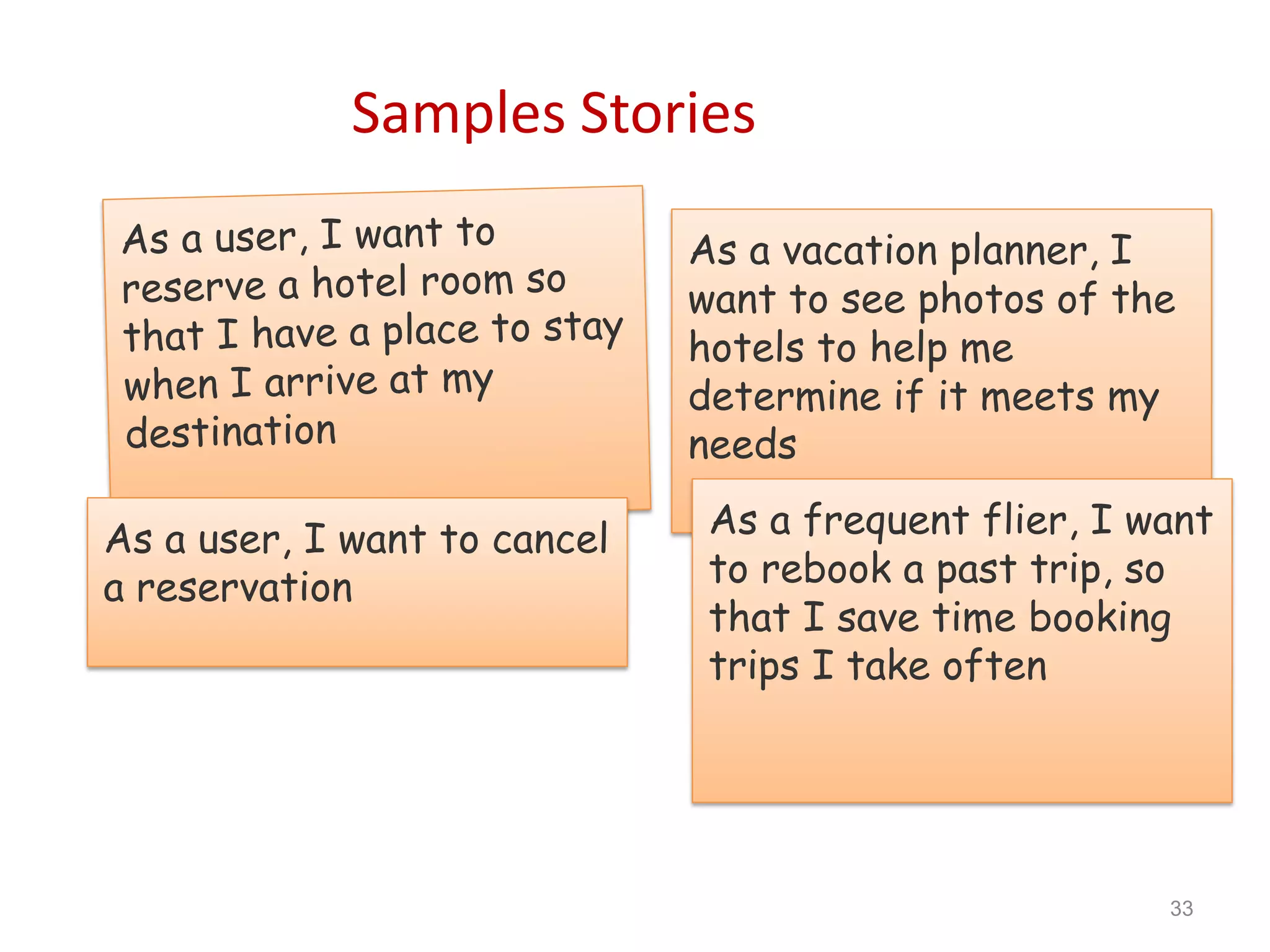
Samples Stories

                              As a vacation planner, I
                              want to see photos of the
                              hotels to help me
                              determine if it meets my
                              needs

As a user, I want to cancel    As a frequent flier, I want
a reservation                  to rebook a past trip, so
                               that I save time booking
                               trips I take often


                                                       33
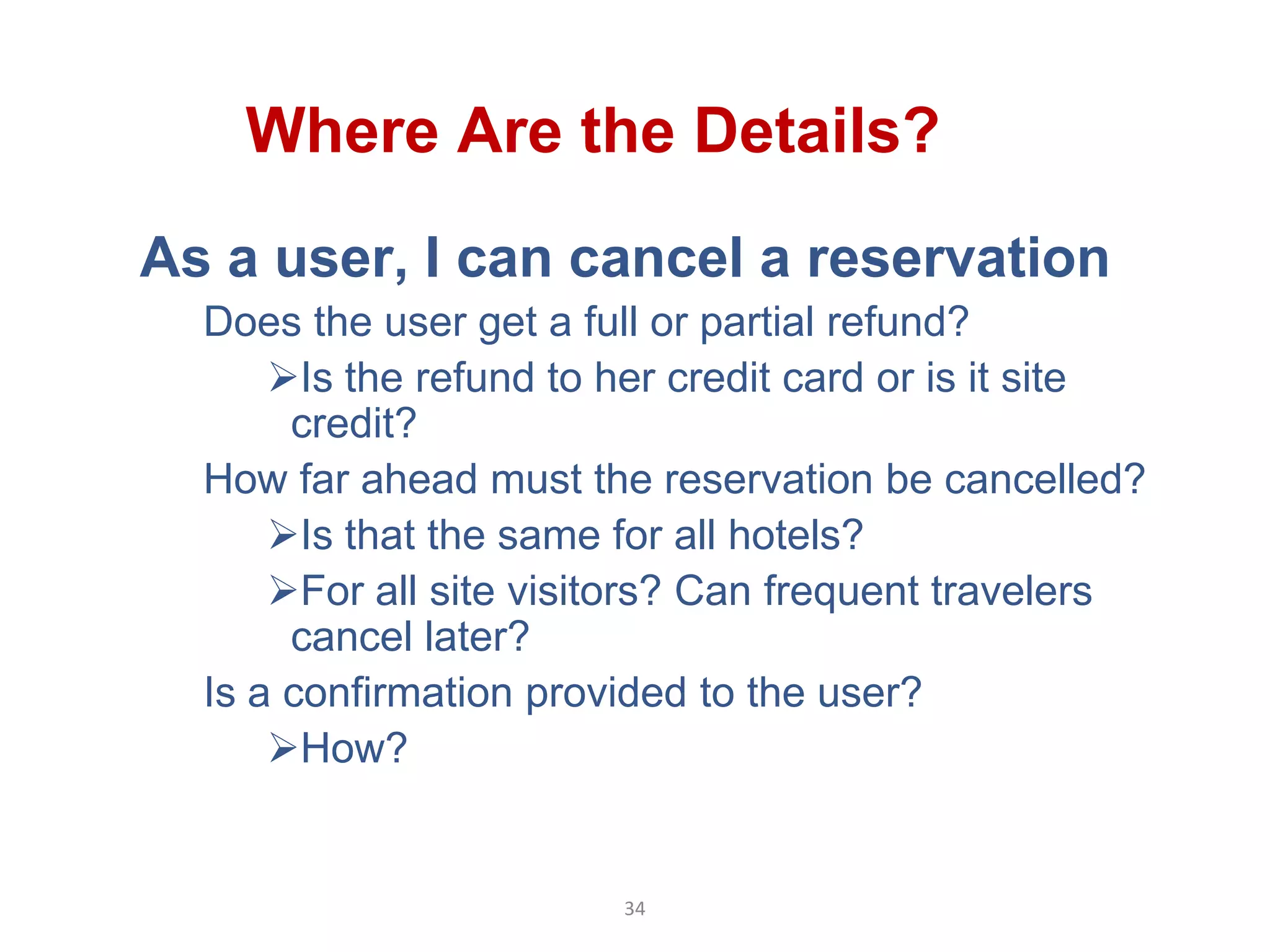
Where Are the Details?
As a user, I can cancel a reservation
  Does the user get a full or partial refund?
      Is the refund to her credit card or is it site
       credit?
  How far ahead must the reservation be cancelled?
      Is that the same for all hotels?
      For all site visitors? Can frequent travelers
       cancel later?
  Is a confirmation provided to the user?
      How?


                        34
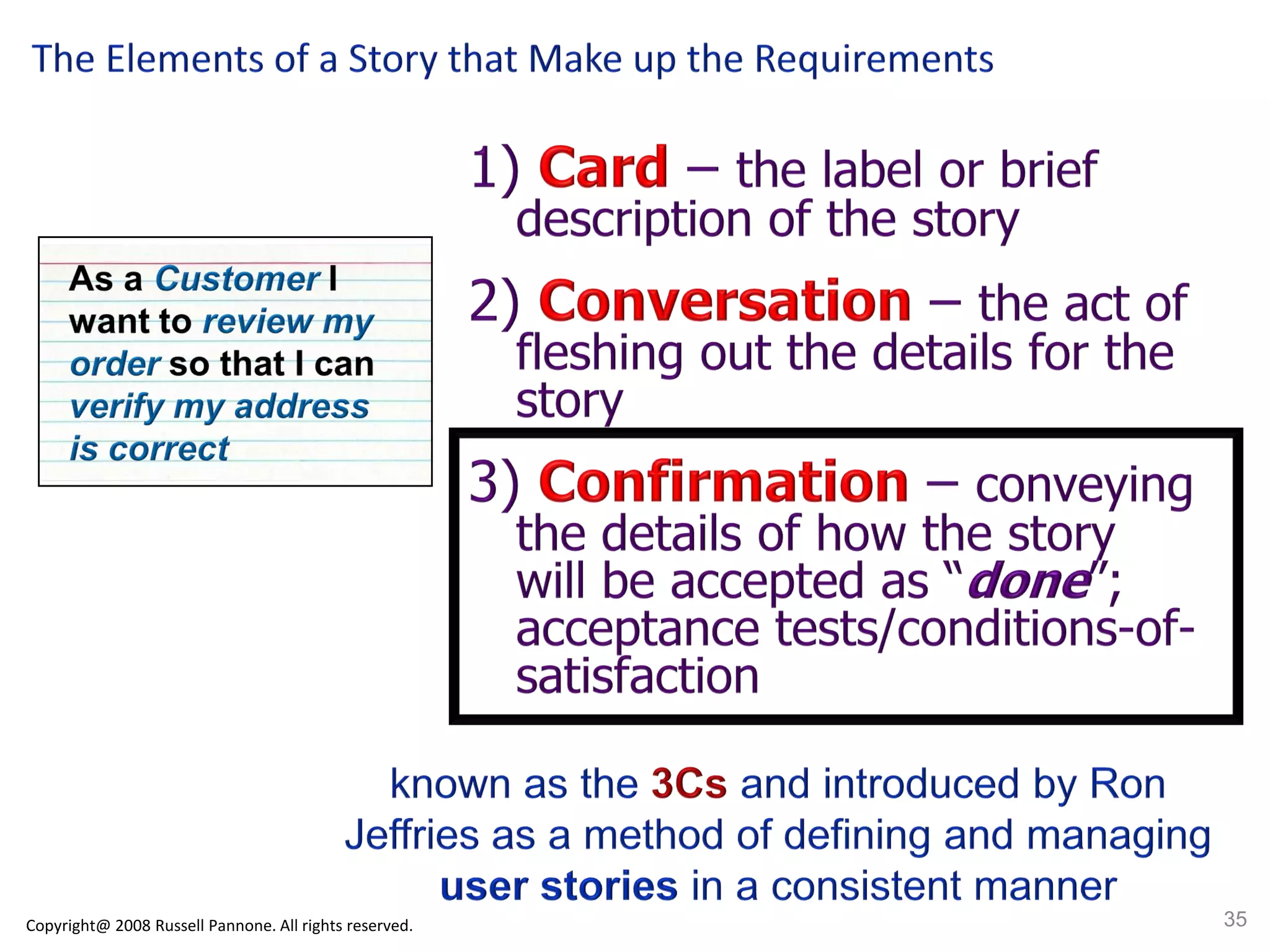
Copyright@ 2008 Russell Pannone. All rights reserved.   35
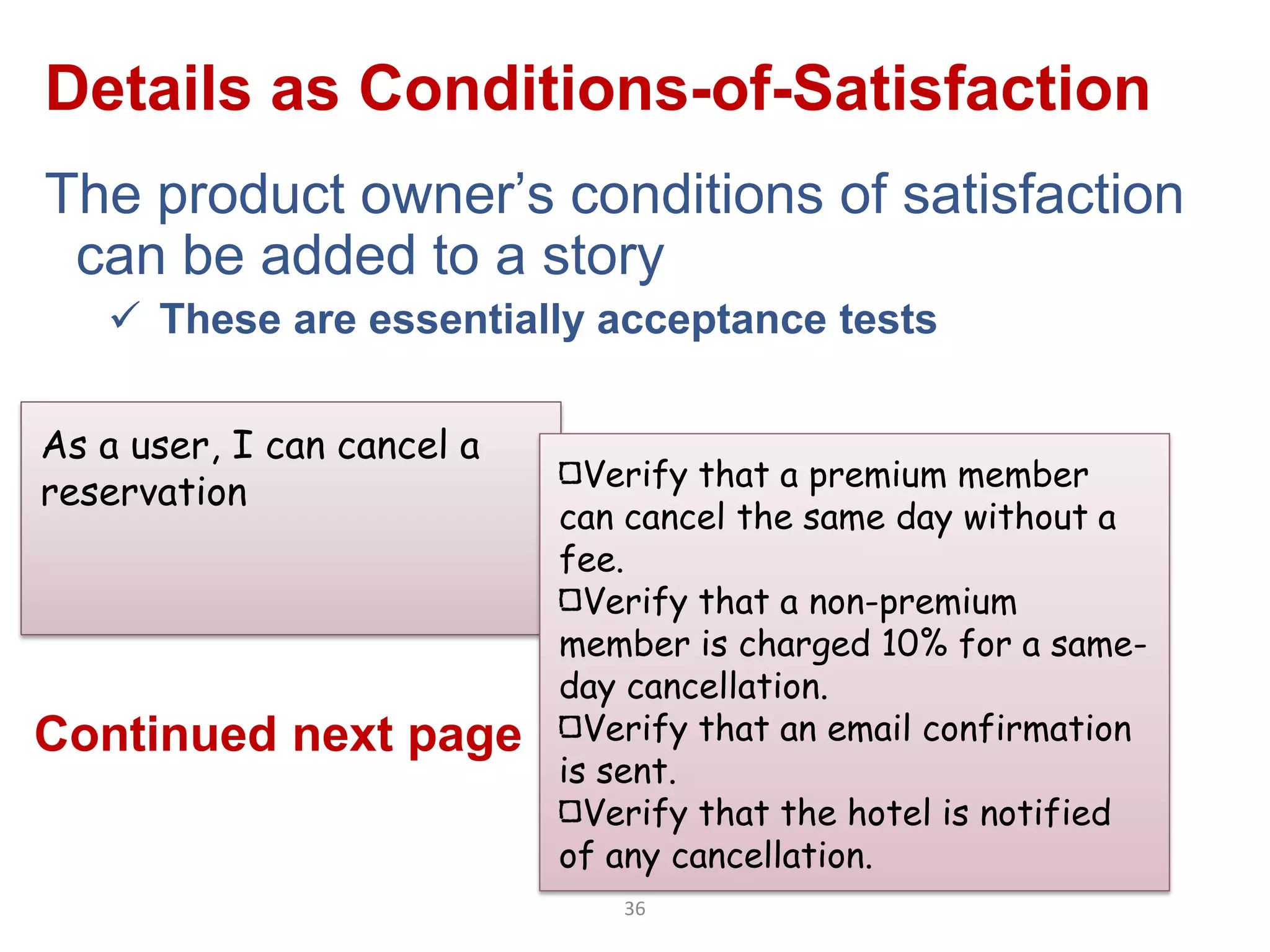
Details as Conditions-of-Satisfaction
The product owner‟s conditions of satisfaction
 can be added to a story
    These are essentially acceptance tests

As a user, I can cancel a
                              Verify that a premium member
reservation
                            can cancel the same day without a
                            fee.
                              Verify that a non-premium
                            member is charged 10% for a same-
                            day cancellation.
Continued next page           Verify that an email confirmation
                            is sent.
                              Verify that the hotel is notified
                            of any cancellation.
                               36
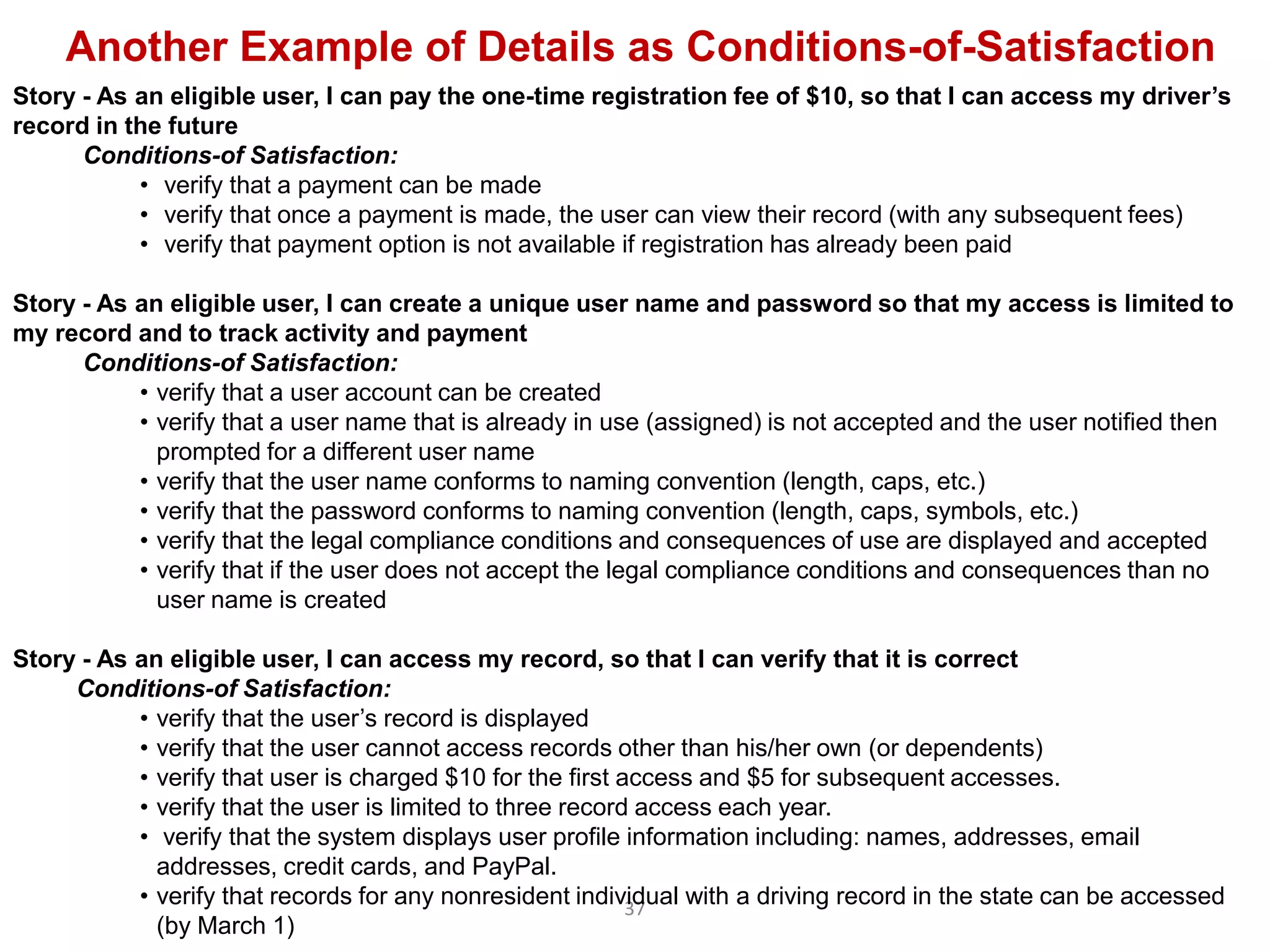
Another Example of Details as Conditions-of-Satisfaction
Story - As an eligible user, I can pay the one-time registration fee of $10, so that I can access my driver’s
record in the future
      Conditions-of Satisfaction:
           • verify that a payment can be made
           • verify that once a payment is made, the user can view their record (with any subsequent fees)
           • verify that payment option is not available if registration has already been paid

Story - As an eligible user, I can create a unique user name and password so that my access is limited to
my record and to track activity and payment
      Conditions-of Satisfaction:
           • verify that a user account can be created
           • verify that a user name that is already in use (assigned) is not accepted and the user notified then
             prompted for a different user name
           • verify that the user name conforms to naming convention (length, caps, etc.)
           • verify that the password conforms to naming convention (length, caps, symbols, etc.)
           • verify that the legal compliance conditions and consequences of use are displayed and accepted
           • verify that if the user does not accept the legal compliance conditions and consequences than no
             user name is created

Story - As an eligible user, I can access my record, so that I can verify that it is correct
     Conditions-of Satisfaction:
           • verify that the user‟s record is displayed
           • verify that the user cannot access records other than his/her own (or dependents)
           • verify that user is charged $10 for the first access and $5 for subsequent accesses.
           • verify that the user is limited to three record access each year.
           • verify that the system displays user profile information including: names, addresses, email
             addresses, credit cards, and PayPal.
           • verify that records for any nonresident individual with a driving record in the state can be accessed
                                                            37
             (by March 1)
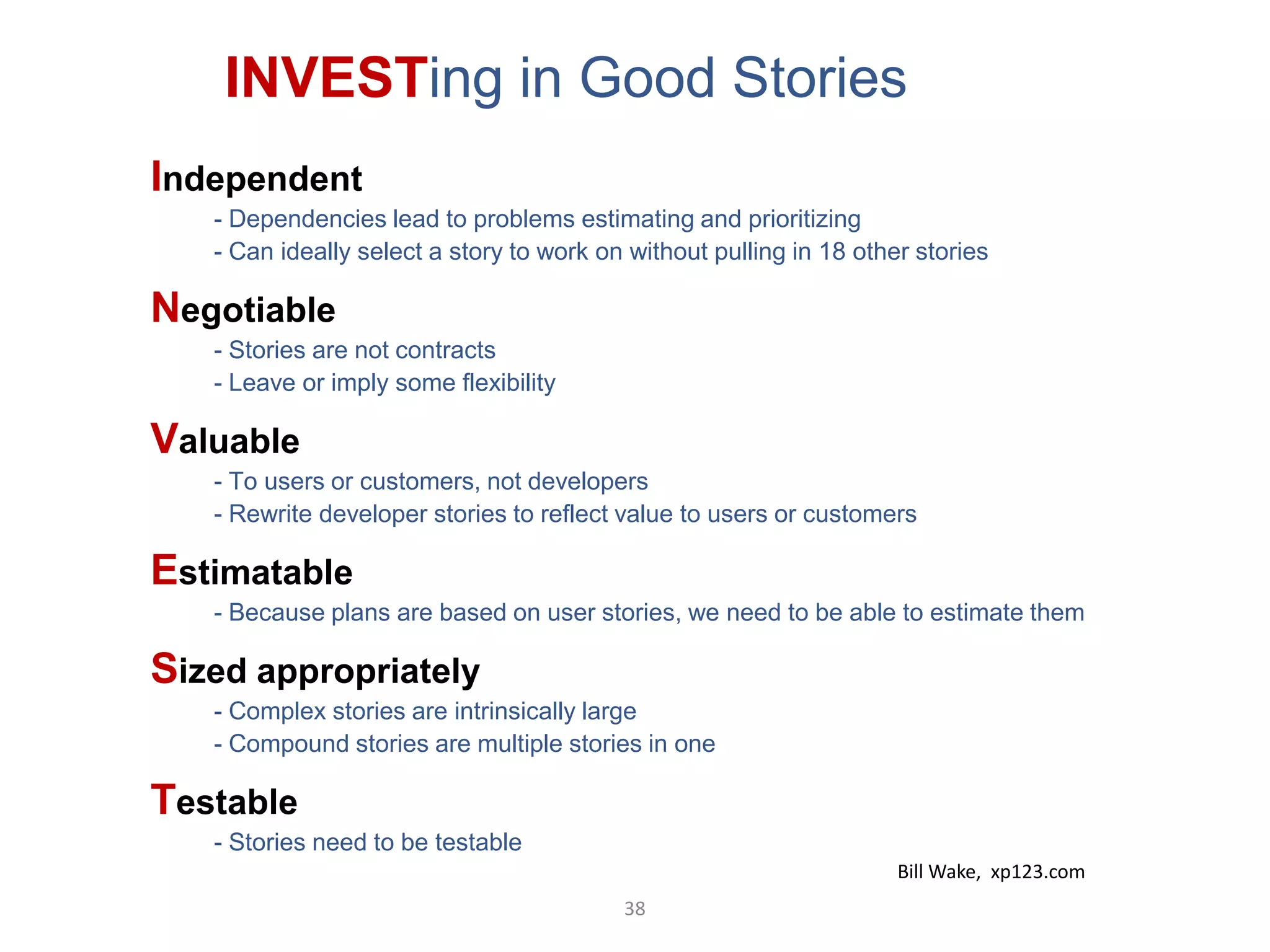
INVESTing in Good Stories
Independent
   - Dependencies lead to problems estimating and prioritizing
   - Can ideally select a story to work on without pulling in 18 other stories

Negotiable
   - Stories are not contracts
   - Leave or imply some flexibility

Valuable
   - To users or customers, not developers
   - Rewrite developer stories to reflect value to users or customers

Estimatable
   - Because plans are based on user stories, we need to be able to estimate them

Sized appropriately
   - Complex stories are intrinsically large
   - Compound stories are multiple stories in one

Testable
   - Stories need to be testable
                                                                     Bill Wake, xp123.com
                                          38
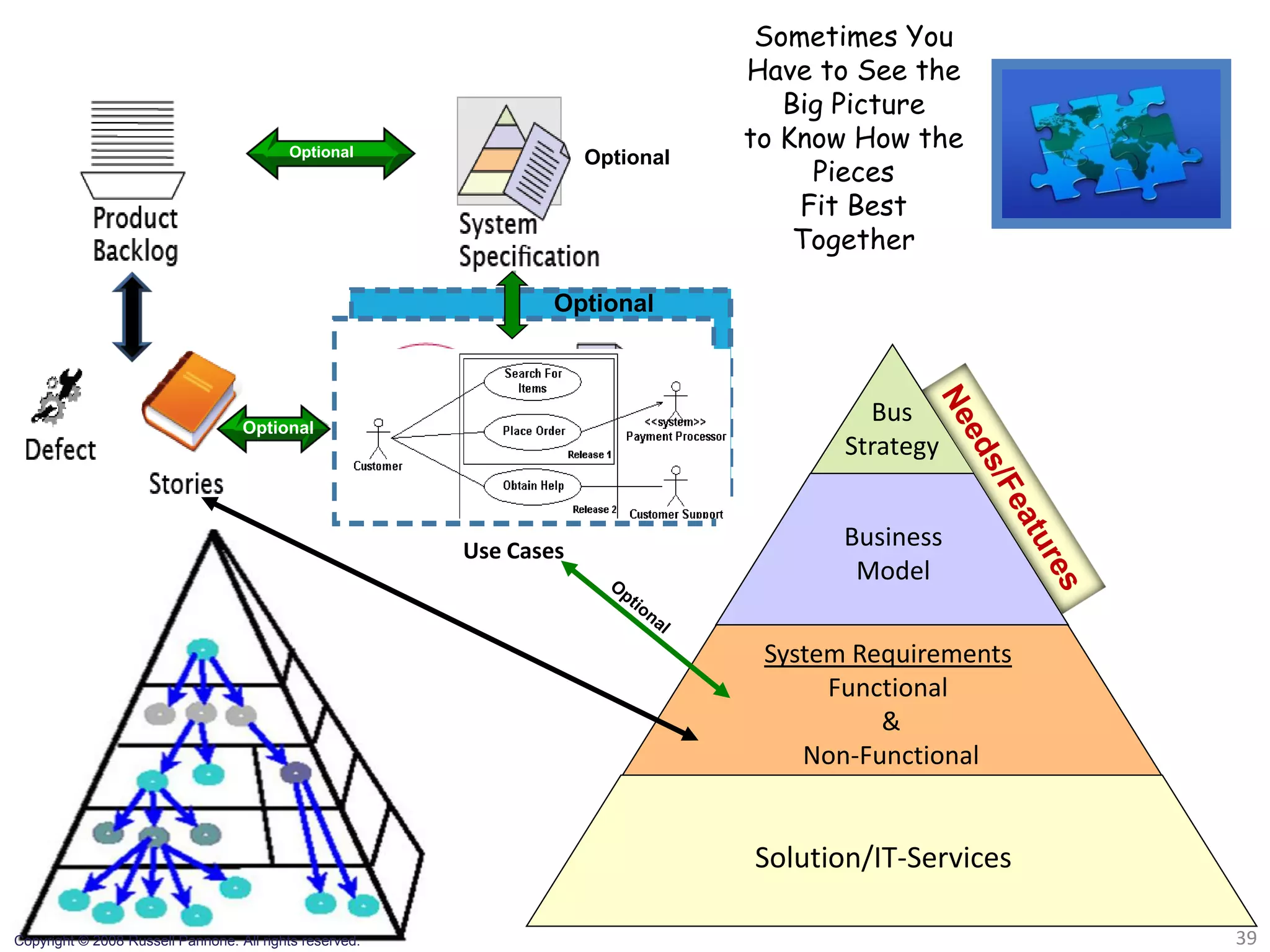
Sometimes You
                                                                                Have to See the
                                                                                   Big Picture
                                          Optional
                                                                                to Know How the
                                                                     Optional
                                                                                     Pieces
                                                                                    Fit Best
                                                                                    Together

                                                                 Optional


                                   Optional
                                                                                         Bus
                                                                                       Strategy


                                                         Use Cases
                                                                                       Business
                                                                                        Model

                                                                                 System Requirements
                                                                                      Functional
                                                                                          &
                                                                                    Non-Functional


                                                                                Solution/IT-Services

Copyright © 2008 Russell Pannone. All rights reserved.                                                 39
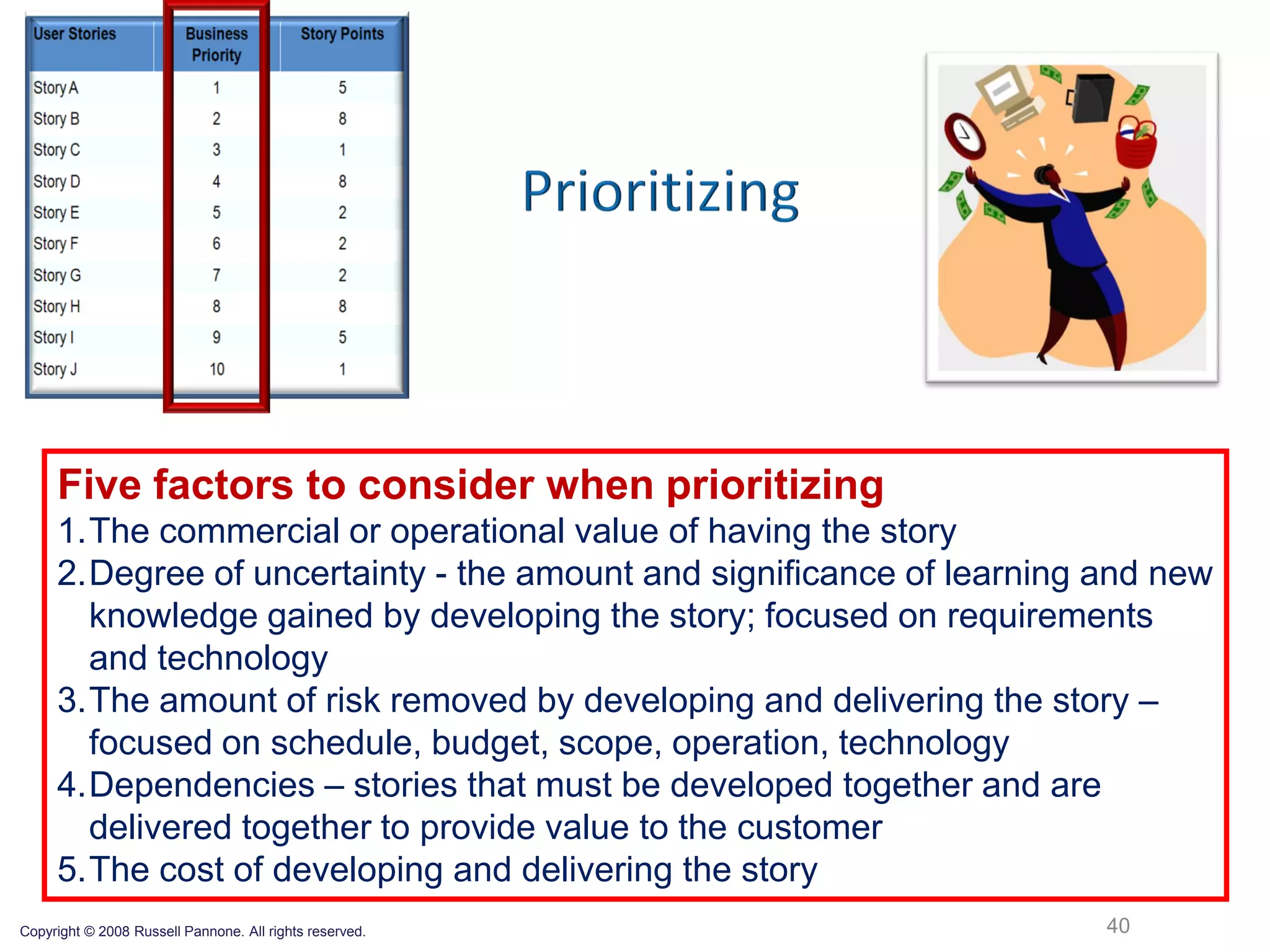
Five factors to consider when prioritizing
     1.The commercial or operational value of having the story
     2.Degree of uncertainty - the amount and significance of learning and new
       knowledge gained by developing the story; focused on requirements
       and technology
     3.The amount of risk removed by developing and delivering the story –
       focused on schedule, budget, scope, operation, technology
     4.Dependencies – stories that must be developed together and are
       delivered together to provide value to the customer
     5.The cost of developing and delivering the story
Copyright © 2008 Russell Pannone. All rights reserved.                 40
User Stories               Business    Story Points
                                                         Priority
                             Story A                       1             5
                             Story B                       2             8
                             Story C                       3             1
                             Story D                       4             8
                             Story E                       5             2
                             Story F                       6             2
                             Story G                       7             2
                             Story H                       8             8
                             Story I                       9             5
                             Story J                       10            1


Copyright@ 2008 Russell Pannone. All rights reserved.                              41
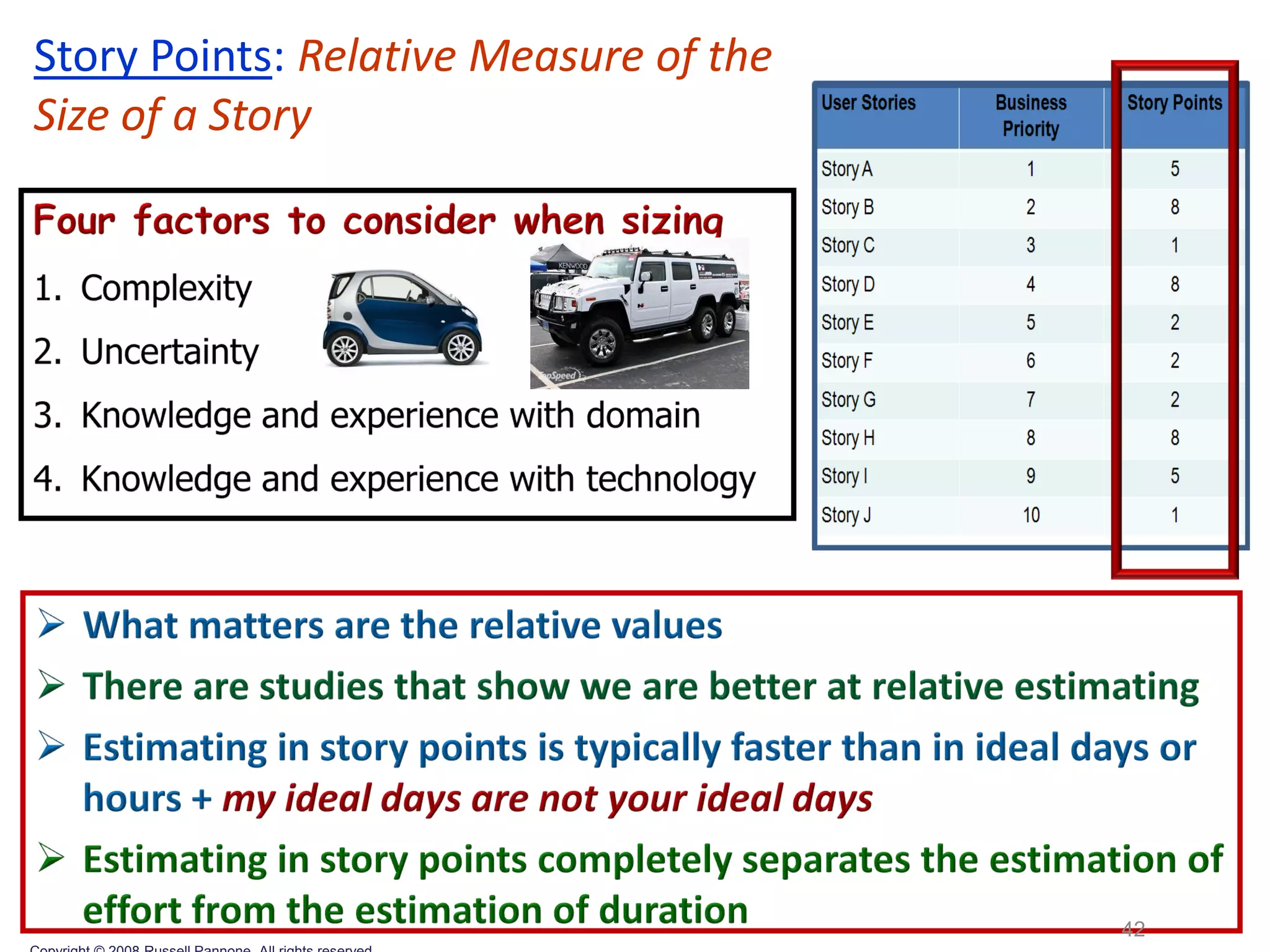
Story Points: Relative Measure of the
Size of a Story


                                        42
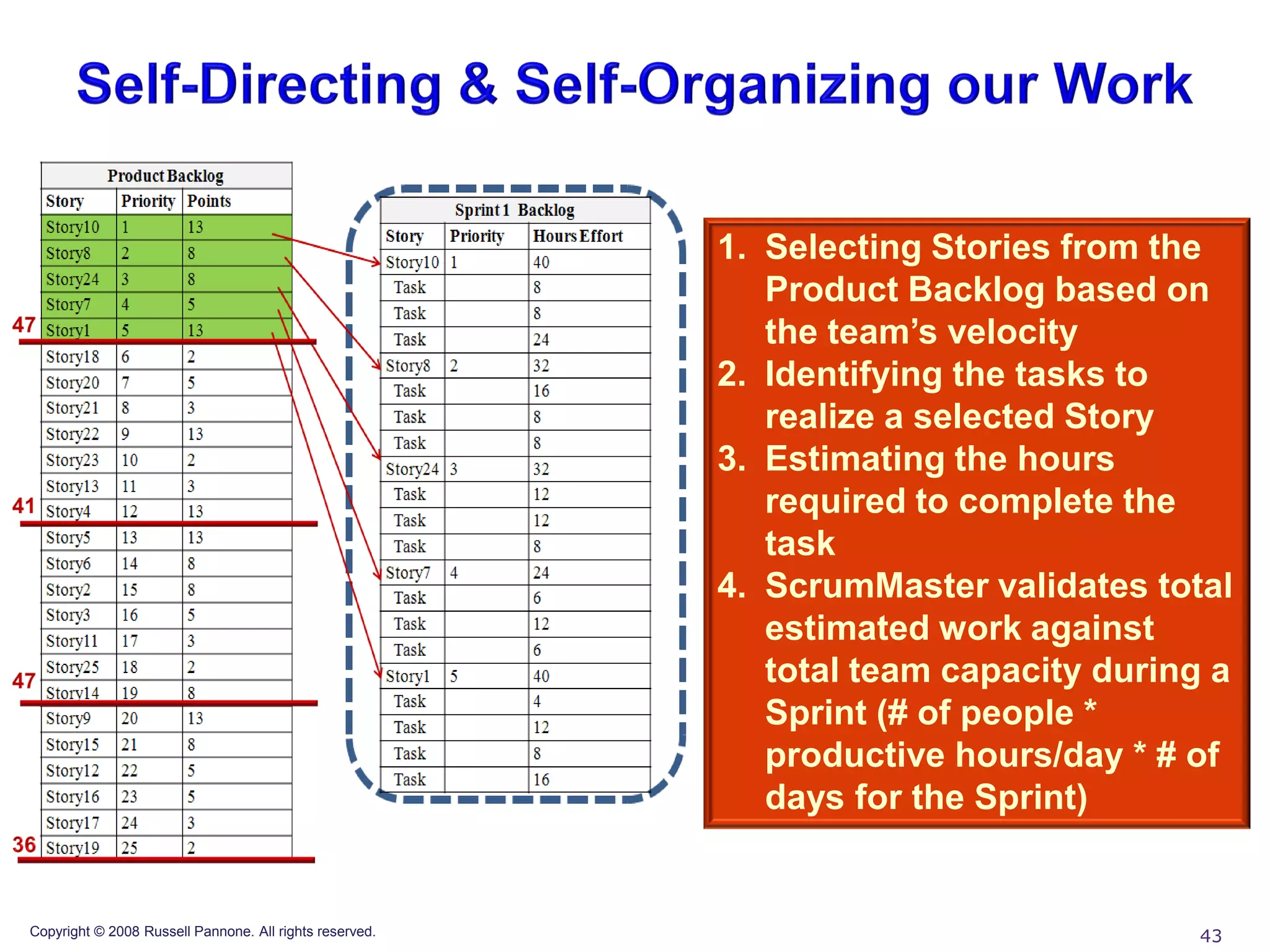
1. Selecting Stories from the
                                                            Product Backlog based on
                                                            the team’s velocity
                                                         2. Identifying the tasks to
                                                            realize a selected Story
                                                         3. Estimating the hours
                                                            required to complete the
                                                            task
                                                         4. ScrumMaster validates total
                                                            estimated work against
                                                            total team capacity during a
                                                            Sprint (# of people *
                                                            productive hours/day * # of
                                                            days for the Sprint)


Copyright © 2008 Russell Pannone. All rights reserved.                                43
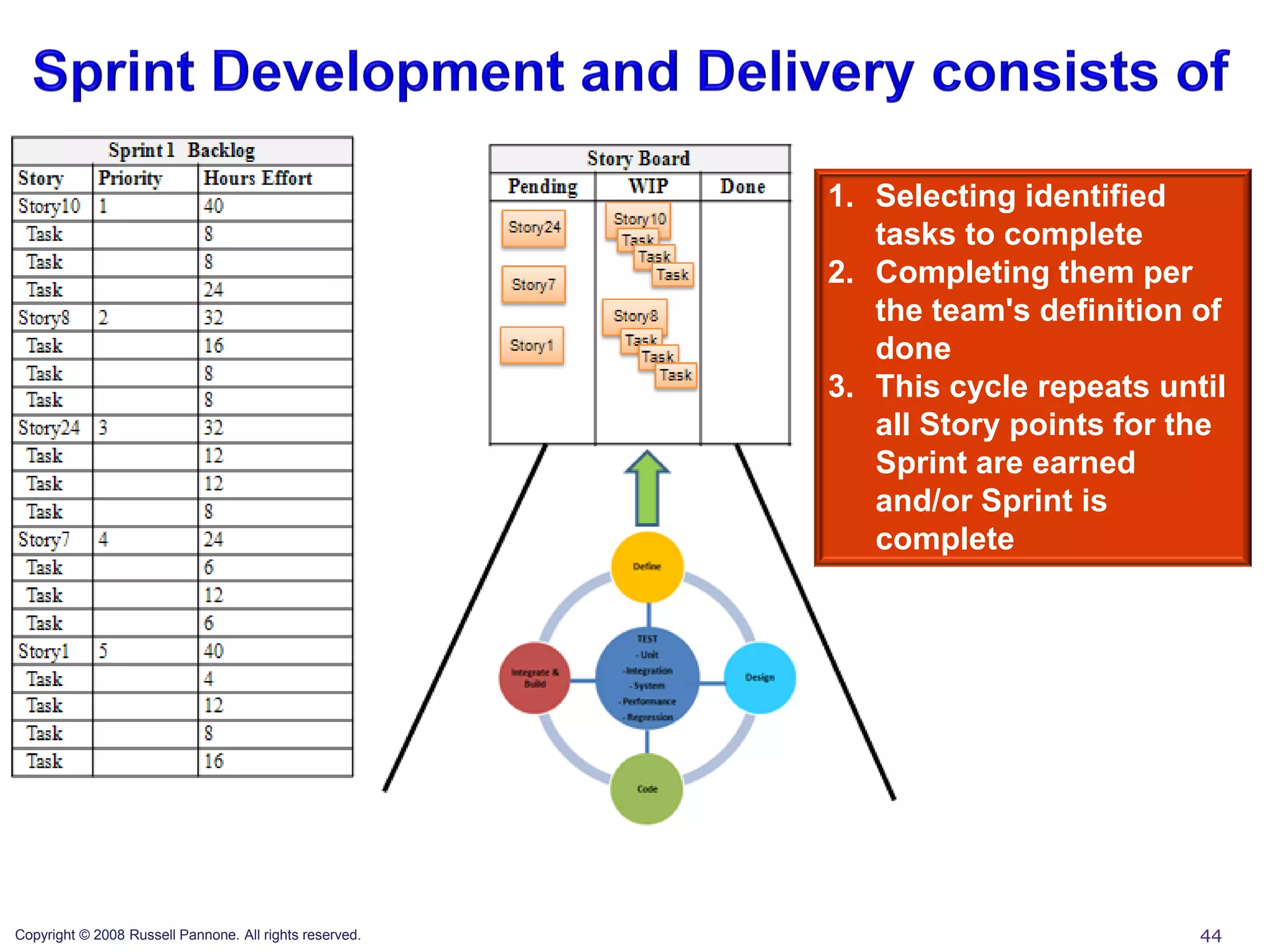
1. Selecting identified
                                                            tasks to complete
                                                         2. Completing them per
                                                            the team's definition of
                                                            done
                                                         3. This cycle repeats until
                                                            all Story points for the
                                                            Sprint are earned
                                                            and/or Sprint is
                                                            complete


Copyright © 2008 Russell Pannone. All rights reserved.                            44
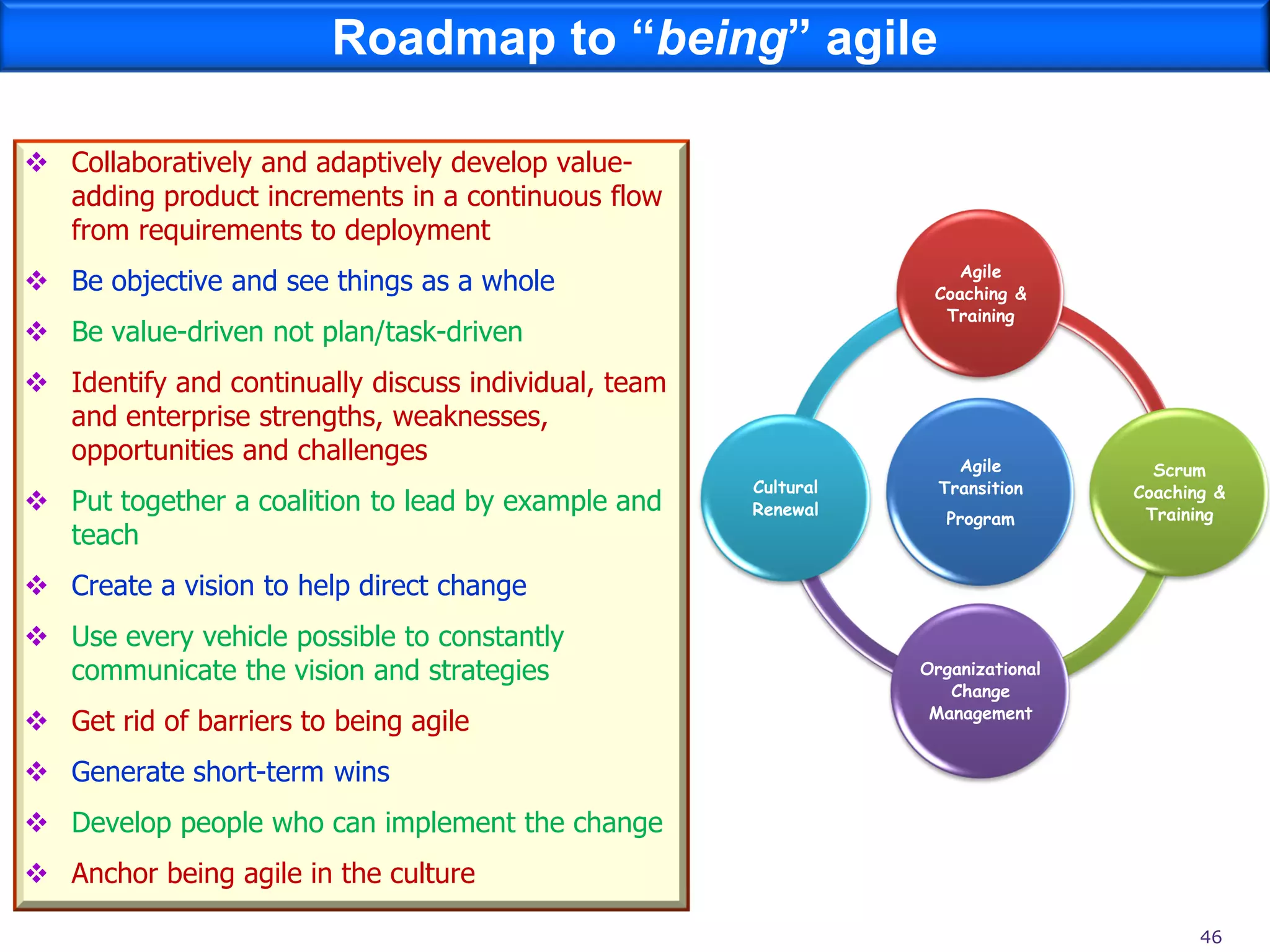
Roadmap to “being” agile

 Collaboratively and adaptively develop value-
  adding product increments in a continuous flow
  from requirements to deployment
                                                                     Agile
 Be objective and see things as a whole                          Coaching &
                                                                   Training
 Be value-driven not plan/task-driven
 Identify and continually discuss individual, team
  and enterprise strengths, weaknesses,
  opportunities and challenges                                       Agile          Scrum
                                                      Cultural     Transition     Coaching &
 Put together a coalition to lead by example and     Renewal                      Training
                                                                    Program
  teach
 Create a vision to help direct change
 Use every vehicle possible to constantly
  communicate the vision and strategies                          Organizational
                                                                    Change
                                                                  Management
 Get rid of barriers to being agile
 Generate short-term wins
 Develop people who can implement the change
 Anchor being agile in the culture

                                                                                         46

Agile Business Driven Development

  • 1.
  • 2.
  • 5.
    Agile/Lean Development Delivering early and often, giving ourselves the best opportunity to beat the competition to market, realize revenue and discover insights that we can use to help us improve 5
  • 6.
    The actualization andeffectively dealing with - More Success + Greater Speed + Fewer Resources + Constant Uncertainty + Increased Competition + Quicker Time to Market 1. Agile puts the Product Owner (aka “the business” or customer representative) in the driver’s seat – In the majority of the waterfall style projects the customer is involved, but in a limited capacity. They get to define a scope up-front, but then any changes they deem necessary are change ordered back to them. This practice assumes that the customer knows exactly what they want up front and penalizes them for changing their minds later in the development process. 2. Agile allows the business to quickly react to changing market conditions and needs – The only thing constant in today‟s economy is change. Businesses need to be able to make quick course corrections in order to survive. 3. Agile provides visibility into the development process – For many customers software development is a dark art. They don‟t have the background in order to understand the technical details and in most cases the development team prefers it this way. The customer is left feeling helpless and Agile engages them throughout the development lifecycle, providing enhanced visibility. 4. Agile also puts the Development Team in the driver’s seat - While the Product Owner is responsible for “what” is to be developed the Development Team is self-directing and self-organizing as to “how” to develop the system-software product
  • 7.
    1. Selecting Storiesfrom the Product Backlog based on the team’s velocity 2. Identifying the tasks to realize a selected Story 3. Estimating the hours required to complete the task 4. ScrumMaster validates total estimated work against total team capacity during a Sprint (# of people * productive hours/day * # of days for the Sprint) Copyright © 2008 Russell Pannone. All rights reserved. 7
  • 8.
    1. Selecting identified tasks to complete 2. Completing them per the team's definition of done 3. This cycle repeats until all Story points for the Sprint are earned and/or Sprint is complete Copyright © 2008 Russell Pannone. All rights reserved. 8
  • 9.
    Copyright © 2008Russell Pannone. All rights reserved. 9
  • 10.
    SS Agile SSAgile 10
  • 11.
    Copyright © 2008Russell Pannone. All rights reserved. 11
  • 12.
    Our highest priorityis to satisfy the customer through early and The most efficient and effective method of conveying information to and continuous delivery of valuable software. within a development team is face-to-face conversation. Welcome changing requirements, even late in development. Agile processes promote sustainable development. The sponsors, Agile processes harness change for the customer's competitive developers, and users should be able to maintain a constant pace advantage. indefinitely. Deliver working software frequently, from a couple of weeks to a Continuous attention to technical excellence and good design enhances couple of months, with a preference to the shorter timescale. agility. Business people and developers must work together daily Simplicity--the art of maximizing the amount of work not done--is throughout the project. essential. Build projects around motivated individuals. Give them the The best architectures, requirements, and designs emerge from self- environment and support they need, and trust them to get the job organizing teams. done. At regular intervals, the team reflects on how to become more effective, Working software is the primary measure of progress. then tunes and adjusts its behavior accordingly. 12
  • 13.
    Delivering early andoften, giving ourselves the best opportunity to beat the competition to market, realize revenue and discover insights that we can use to help us improve Copyright © 2009 Russell Pannone. All rights reserved. 13
  • 14.
    Conceptualize Realize Operationalize • Select the • Plan • Deployment Customer • Test • Servicing • Understand the • Develop Customer • Deliver • Express Feature • Inspect Set • Adapt Copyright © 2009 Russell Pannone. All rights reserved. 14
  • 15.
    By delivering earlyand often we give ourselves the best opportunity to beat the competition to market, realize revenue and discover insights that we can use to help us improve
  • 16.
    Scrum Explained “The… „relay race‟ approach to product development…may conflict with the goals of maximum speed and flexibility. Instead a holistic or ‘rugby’ approach—where a team tries to go the distance as a unit, passing the ball back and forth— may better serve today’s competitive requirements.”- Hirotaka Takeuchi and Ikujiro Nonaka, “The New New Product Development Game”, Harvard Business Review, January 1986 In Scrum you work in iterations delivering value-adding results incrementally Copyright © 2008 Russell Pannone. All rights reserved. 16
  • 17.
    Scrum Roles &Definitions (continued on next slide) Copyright © 2005 Mountain Goat Software. Copyright © 2008 Russell Pannone. All rights reserved. 17
  • 18.
    Scrum Roles &Definitions (continued on next slide) Copyright © 2005 Mountain Goat Software. Copyright © 2008 Russell Pannone. All rights reserved. 18
  • 19.
    Scrum Roles &Definitions (continued from previous slide) Copyright © 2005 Mountain Goat Software. Copyright © 2008 Russell Pannone. All rights reserved. 19
  • 20.
    Problem / Feedback Opportunity Traditional Development All  implied sequential “waterfall”  time delay in obtaining feedback Planning All Requirements All Design All Development All Validation All Implementation Iterative & Incremental Development and Delivery US Airways Confidential – Do not distribute or duplicate
  • 21.
    Copyright © 2008Russell Pannone. All rights reserved. 21
  • 22.
    Kanban Board Pending WIP Done Story Story Story Story Story Story Define Story Story Story Story Story Story Story Story Story Story Story Story Story Story Story Build & Story Test Design Implement Story Story Story Story Story Story Story Story Story Story Story Story Code Story Story Copyright © 2008 Russell Pannone. All rights reserved.
  • 23.
  • 24.
    Usage scenario – When a project team wants to “be” agile they self-organize & self-direct around the 9 practices – The team then selects 1 or more practice to apply to their work at hand Benefits – Iterative & Incremental adoption of “being” agile – Gives team a context and narrow focus to rally around – Provides a non-threatening easy way for team to learn together, “be” agile, apply an iterative and incremental approach, and get better at what we do 24
  • 25.
    The actualization andeffectively dealing with - More Success + Greater Speed + Fewer Resources + Constant Uncertainty + Increased Competition + Quicker Time to Market 1. Agile puts the Product Owner (aka “the business” or customer representative) in the driver’s seat – In the majority of the waterfall style projects the customer is involved, but in a limited capacity. They get to define a scope up-front, but then any changes they deem necessary are change ordered back to them. This practice assumes that the customer knows exactly what they want up front and penalizes them for changing their minds later in the development process. 2. Agile allows the business to quickly react to changing market conditions and needs – The only thing constant in today‟s economy is change. Businesses need to be able to make quick course corrections in order to survive. 3. Agile provides visibility into the development process – For many customers software development is a dark art. They don‟t have the background in order to understand the technical details and in most cases the development team prefers it this way. The customer is left feeling helpless and Agile engages them throughout the development lifecycle, providing enhanced visibility. 4. Agile also puts the Development Team in the driver’s seat - While the Product Owner is responsible for “what” is to be developed the Development Team is self-directing and self-organizing as to “how” to develop the system-software product
  • 26.
    Copyright@ 2008 RussellPannone. All rights reserved.
  • 27.
    Copyright © 2008Russell Pannone. All rights reserved.
  • 28.
    User Stories Business Story Points Priority Story A 1 5 Story B 2 8 Story C 3 1 Story D 4 8 Story E 5 2 Story F 6 2 Story G 7 2 Story H 8 8 Story I 9 5 Story J 10 1 Copyright@ 2008 Russell Pannone. All rights reserved. 28
  • 29.
    Copyright@ 2008 RussellPannone. All rights reserved. 29
  • 30.
    The Product Owner/Customertells us they want an implement for writing, drawing, or marking that is easy to keep sharp, is comfortable to hold, and when they want to they can easily make a correction. We collaborate more with the Product Owner/Customer on their needs or requirements and define the implement’s features and corresponding benefit/value, as depicted in the table below. Take notice that we have benefits that influence the implement’s functionality and constrain its design and final form. Features Benefits/Value Is made of wood Easy to sharpen and smells good Has a specific diameter Comfortable Surface to be coated Won’t get splinters Contains a lead composite filler Creates an impressive line Has an eraser at the end Makes correcting easy Copyright © 2008 Russell Pannone. All rights reserved. 30
  • 31.
    • As animplement user I want an implement that is made of wood so it is easy to sharpen and smells good when sharpening • As an implement user I want an implement that has a specific diameter so it is comfortable to hold • As an implement user I want the surface of the implement to be coated so I won’t get splinters when I use it • As an implement user I want the implement to contain a lead composite filler so I can create an impressive line • As an implement user I want to have at the end of the implement an eraser so I can easily make a correction Copyright © 2008 Russell Pannone. All rights reserved. 31
  • 32.
    A story isa “placeholder” for a requirement formulated as a brief description written in the everyday language of the customer or user describing desired functionality; containing just enough information so that the product team can produce a reasonable estimate of the effort to implement it Copyright@ 2008 Russell Pannone. All rights reserved. 32
  • 33.
    Samples Stories As a vacation planner, I want to see photos of the hotels to help me determine if it meets my needs As a user, I want to cancel As a frequent flier, I want a reservation to rebook a past trip, so that I save time booking trips I take often 33
  • 34.
    Where Are theDetails? As a user, I can cancel a reservation Does the user get a full or partial refund? Is the refund to her credit card or is it site credit? How far ahead must the reservation be cancelled? Is that the same for all hotels? For all site visitors? Can frequent travelers cancel later? Is a confirmation provided to the user? How? 34
  • 35.
    Copyright@ 2008 RussellPannone. All rights reserved. 35
  • 36.
    Details as Conditions-of-Satisfaction Theproduct owner‟s conditions of satisfaction can be added to a story  These are essentially acceptance tests As a user, I can cancel a Verify that a premium member reservation can cancel the same day without a fee. Verify that a non-premium member is charged 10% for a same- day cancellation. Continued next page Verify that an email confirmation is sent. Verify that the hotel is notified of any cancellation. 36
  • 37.
    Another Example ofDetails as Conditions-of-Satisfaction Story - As an eligible user, I can pay the one-time registration fee of $10, so that I can access my driver’s record in the future Conditions-of Satisfaction: • verify that a payment can be made • verify that once a payment is made, the user can view their record (with any subsequent fees) • verify that payment option is not available if registration has already been paid Story - As an eligible user, I can create a unique user name and password so that my access is limited to my record and to track activity and payment Conditions-of Satisfaction: • verify that a user account can be created • verify that a user name that is already in use (assigned) is not accepted and the user notified then prompted for a different user name • verify that the user name conforms to naming convention (length, caps, etc.) • verify that the password conforms to naming convention (length, caps, symbols, etc.) • verify that the legal compliance conditions and consequences of use are displayed and accepted • verify that if the user does not accept the legal compliance conditions and consequences than no user name is created Story - As an eligible user, I can access my record, so that I can verify that it is correct Conditions-of Satisfaction: • verify that the user‟s record is displayed • verify that the user cannot access records other than his/her own (or dependents) • verify that user is charged $10 for the first access and $5 for subsequent accesses. • verify that the user is limited to three record access each year. • verify that the system displays user profile information including: names, addresses, email addresses, credit cards, and PayPal. • verify that records for any nonresident individual with a driving record in the state can be accessed 37 (by March 1)
  • 38.
    INVESTing in GoodStories Independent - Dependencies lead to problems estimating and prioritizing - Can ideally select a story to work on without pulling in 18 other stories Negotiable - Stories are not contracts - Leave or imply some flexibility Valuable - To users or customers, not developers - Rewrite developer stories to reflect value to users or customers Estimatable - Because plans are based on user stories, we need to be able to estimate them Sized appropriately - Complex stories are intrinsically large - Compound stories are multiple stories in one Testable - Stories need to be testable Bill Wake, xp123.com 38
  • 39.
    Sometimes You Have to See the Big Picture Optional to Know How the Optional Pieces Fit Best Together Optional Optional Bus Strategy Use Cases Business Model System Requirements Functional & Non-Functional Solution/IT-Services Copyright © 2008 Russell Pannone. All rights reserved. 39
  • 40.
    Five factors toconsider when prioritizing 1.The commercial or operational value of having the story 2.Degree of uncertainty - the amount and significance of learning and new knowledge gained by developing the story; focused on requirements and technology 3.The amount of risk removed by developing and delivering the story – focused on schedule, budget, scope, operation, technology 4.Dependencies – stories that must be developed together and are delivered together to provide value to the customer 5.The cost of developing and delivering the story Copyright © 2008 Russell Pannone. All rights reserved. 40
  • 41.
    User Stories Business Story Points Priority Story A 1 5 Story B 2 8 Story C 3 1 Story D 4 8 Story E 5 2 Story F 6 2 Story G 7 2 Story H 8 8 Story I 9 5 Story J 10 1 Copyright@ 2008 Russell Pannone. All rights reserved. 41
  • 42.
    Story Points: RelativeMeasure of the Size of a Story 42
  • 43.
    1. Selecting Storiesfrom the Product Backlog based on the team’s velocity 2. Identifying the tasks to realize a selected Story 3. Estimating the hours required to complete the task 4. ScrumMaster validates total estimated work against total team capacity during a Sprint (# of people * productive hours/day * # of days for the Sprint) Copyright © 2008 Russell Pannone. All rights reserved. 43
  • 44.
    1. Selecting identified tasks to complete 2. Completing them per the team's definition of done 3. This cycle repeats until all Story points for the Sprint are earned and/or Sprint is complete Copyright © 2008 Russell Pannone. All rights reserved. 44
  • 46.
    Roadmap to “being”agile  Collaboratively and adaptively develop value- adding product increments in a continuous flow from requirements to deployment Agile  Be objective and see things as a whole Coaching & Training  Be value-driven not plan/task-driven  Identify and continually discuss individual, team and enterprise strengths, weaknesses, opportunities and challenges Agile Scrum Cultural Transition Coaching &  Put together a coalition to lead by example and Renewal Training Program teach  Create a vision to help direct change  Use every vehicle possible to constantly communicate the vision and strategies Organizational Change Management  Get rid of barriers to being agile  Generate short-term wins  Develop people who can implement the change  Anchor being agile in the culture 46