Success Factors
Jean-Michel Franco
Innovation & Solutions Director
jean-michel.franco@businessdecision.com
Telephone, : +33 6 67 70 01 32
Twitter : @jmichel_franco
Agile Business Intelligence
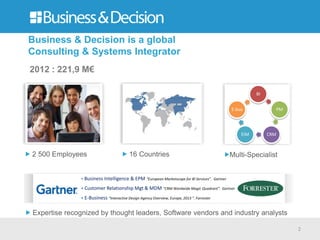
Business & Decision is a global
Consulting & Systems Integrator
2012 : 221,9 M€
2
2 500 Employees 16 Countries Multi-Specialist
BI
PM
CRMEIM
E-bus
Expertise recognized by thought leaders, Software vendors and industry analysts
• Business Intelligence & EPM “European Marketscope for BI Services”. Gartner
• Customer Relationship Mgt & MDM “CRM Wordwide Magic Quadrant”. Gartner
• E-Business “Interactive Design Agency Overview, Europe, 2013 ”. Forrester
3
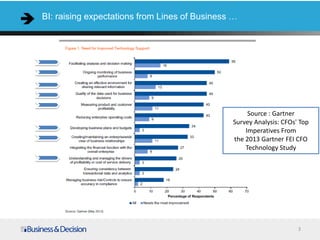
BI: raising expectations from Lines of Business …
Source : Gartner
Survey Analysis: CFOs' Top
Imperatives From
the 2013 Gartner FEI CFO
Technology Study
4
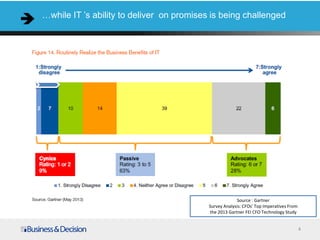
…while IT ’s ability to deliver on promises is being challenged
Source : Gartner
Survey Analysis: CFOs' Top Imperatives From
the 2013 Gartner FEI CFO Technology Study
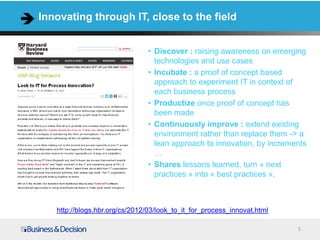
Innovating through IT, close to the field
• Discover : raising awareness on emerging
technologies and use cases
• Incubate : a proof of concept based
approach to experiment IT in context of
each business process
• Productize once proof of concept has
been made
• Continuously improve : extend existing
environment rather than replace them -> a
lean approach to innovation, by increments
…
• Shares lessons learned, turn « next
practices » into « best practices ».
•
5
http://blogs.hbr.org/cs/2012/03/look_to_it_for_process_innovat.html
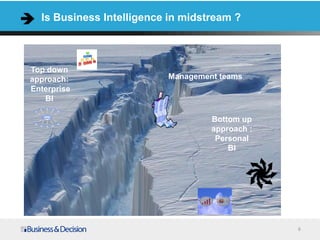
6
Top down
approach:
Enterprise
BI
Bottom up
approach :
Personal
BI
Management teams
Is Business Intelligence in midstream ?
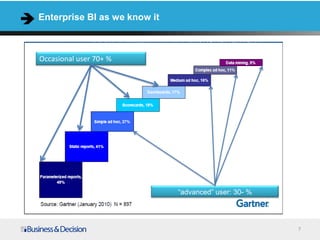
Enterprise BI as we know it
Occasional user 70+ %
“advanced” user: 30- %
7
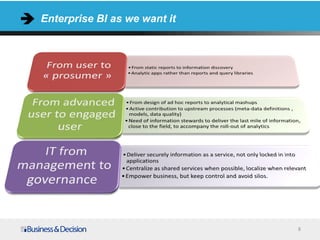
Enterprise BI as we want it
8
9
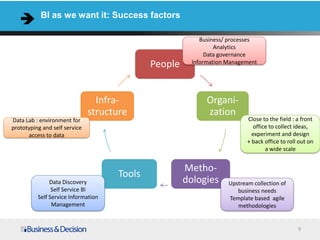
BI as we want it: Success factors
People
Organi-
zation
Metho-
dologies
Tools
Infra-
structure
Business/ processes
Analytics
Data governance
Information Management
Data Discovery
Self Service BI
Self Service Information
Management
Data Lab : environment for
prototyping and self service
access to data
Close to the field : a front
office to collect ideas,
experiment and design
+ back office to roll out on
a wide scale
Upstream collection of
business needs
Template based agile
methodologies
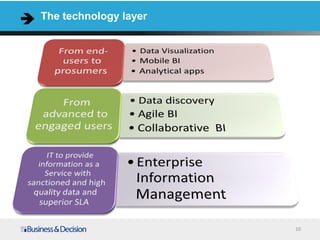
The technology layer
10
11
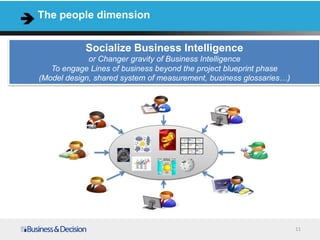
The people dimension
Socialize Business Intelligence
or Changer gravity of Business Intelligence
To engage Lines of business beyond the project blueprint phase
(Model design, shared system of measurement, business glossaries…)
12
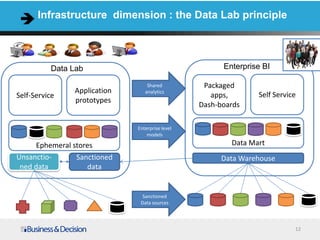
Infrastructure dimension : the Data Lab principle
Enterprise BI
Data Warehouse
Data Mart
Packaged
apps,
Dash-boards
Self Service
Data Lab
Ephemeral stores
Application
prototypes
Self-Service
Sanctioned
data
Shared
analytics
Enterprise level
models
Sanctioned
Data sources
Unsanctio-
ned data
13
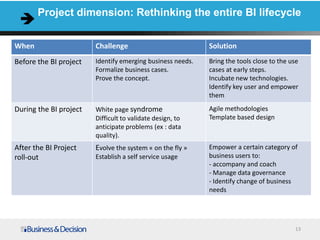
Project dimension: Rethinking the entire BI lifecycle
When Challenge Solution
Before the BI project Identify emerging business needs.
Formalize business cases.
Prove the concept.
Bring the tools close to the use
cases at early steps.
Incubate new technologies.
Identify key user and empower
them
During the BI project White page syndrome
Difficult to validate design, to
anticipate problems (ex : data
quality).
Agile methodologies
Template based design
After the BI Project
roll-out
Evolve the system « on the fly »
Establish a self service usage
Empower a certain category of
business users to:
- accompany and coach
- Manage data governance
- Identify change of business
needs
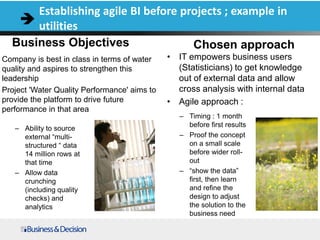
Business Objectives
Company is best in class in terms of water
quality and aspires to strengthen this
leadership
Project 'Water Quality Performance' aims to
provide the platform to drive future
performance in that area
Chosen approach
• IT empowers business users
(Statisticians) to get knowledge
out of external data and allow
cross analysis with internal data
• Agile approach :
Establishing agile BI before projects ; example in
utilities
– Ability to source
external “multi-
structured “ data
14 million rows at
that time
– Allow data
crunching
(including quality
checks) and
analytics
– Timing : 1 month
before first results
– Proof the concept
on a small scale
before wider roll-
out
– “show the data”
first, then learn
and refine the
design to adjust
the solution to the
business need
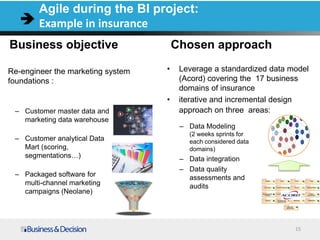
Business objective
Re-engineer the marketing system
foundations :
Chosen approach
• Leverage a standardized data model
(Acord) covering the 17 business
domains of insurance
• iterative and incremental design
approach on three areas:
Agile during the BI project:
Example in insurance
– Customer master data and
marketing data warehouse
– Customer analytical Data
Mart (scoring,
segmentations…)
– Packaged software for
multi-channel marketing
campaigns (Neolane)
– Data Modeling
(2 weeks sprints for
each considered data
domains)
– Data integration
– Data quality
assessments and
audits
15
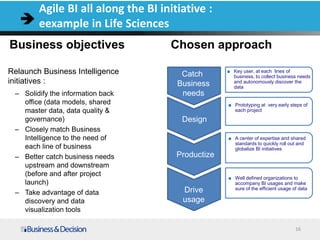
Agile BI all along the BI initiative :
eexample in Life Sciences
Business objectives
Relaunch Business Intelligence
initiatives :
Chosen approach
– Solidify the information back
office (data models, shared
master data, data quality &
governance)
– Closely match Business
Intelligence to the need of
each line of business
– Better catch business needs
upstream and downstream
(before and after project
launch)
– Take advantage of data
discovery and data
visualization tools
Catch
Business
needs
Design
Productize
Key user, at each lines of
business, to collect business needs
and autonomously discover the
data
Prototyping at very early steps of
each project
A center of expertise and shared
standards to quickly roll out and
globalize BI initiatives
Drive
usage
Well defined organizations to
accompany BI usages and make
sure of the efficient usage of data
16
Success Factors
Jean-Michel Franco
Innovation & Solutions Director
jean-michel.franco@businessdecision.com
Telephone, : +33 6 67 70 01 32
Twitter : @jmichel_franco
Agile Business Intelligence

Agile BI success factors

  • 1.
    Success Factors Jean-Michel Franco Innovation& Solutions Director jean-michel.franco@businessdecision.com Telephone, : +33 6 67 70 01 32 Twitter : @jmichel_franco Agile Business Intelligence
  • 2.
    Business & Decisionis a global Consulting & Systems Integrator 2012 : 221,9 M€ 2 2 500 Employees 16 Countries Multi-Specialist BI PM CRMEIM E-bus Expertise recognized by thought leaders, Software vendors and industry analysts • Business Intelligence & EPM “European Marketscope for BI Services”. Gartner • Customer Relationship Mgt & MDM “CRM Wordwide Magic Quadrant”. Gartner • E-Business “Interactive Design Agency Overview, Europe, 2013 ”. Forrester
  • 3.
    3 BI: raising expectationsfrom Lines of Business … Source : Gartner Survey Analysis: CFOs' Top Imperatives From the 2013 Gartner FEI CFO Technology Study
  • 4.
    4 …while IT ’sability to deliver on promises is being challenged Source : Gartner Survey Analysis: CFOs' Top Imperatives From the 2013 Gartner FEI CFO Technology Study
  • 5.
    Innovating through IT,close to the field • Discover : raising awareness on emerging technologies and use cases • Incubate : a proof of concept based approach to experiment IT in context of each business process • Productize once proof of concept has been made • Continuously improve : extend existing environment rather than replace them -> a lean approach to innovation, by increments … • Shares lessons learned, turn « next practices » into « best practices ». • 5 http://blogs.hbr.org/cs/2012/03/look_to_it_for_process_innovat.html
  • 6.
    6 Top down approach: Enterprise BI Bottom up approach: Personal BI Management teams Is Business Intelligence in midstream ?
  • 7.
    Enterprise BI aswe know it Occasional user 70+ % “advanced” user: 30- % 7
  • 8.
    Enterprise BI aswe want it 8
  • 9.
    9 BI as wewant it: Success factors People Organi- zation Metho- dologies Tools Infra- structure Business/ processes Analytics Data governance Information Management Data Discovery Self Service BI Self Service Information Management Data Lab : environment for prototyping and self service access to data Close to the field : a front office to collect ideas, experiment and design + back office to roll out on a wide scale Upstream collection of business needs Template based agile methodologies
  • 10.
  • 11.
    11 The people dimension SocializeBusiness Intelligence or Changer gravity of Business Intelligence To engage Lines of business beyond the project blueprint phase (Model design, shared system of measurement, business glossaries…)
  • 12.
    12 Infrastructure dimension :the Data Lab principle Enterprise BI Data Warehouse Data Mart Packaged apps, Dash-boards Self Service Data Lab Ephemeral stores Application prototypes Self-Service Sanctioned data Shared analytics Enterprise level models Sanctioned Data sources Unsanctio- ned data
  • 13.
    13 Project dimension: Rethinkingthe entire BI lifecycle When Challenge Solution Before the BI project Identify emerging business needs. Formalize business cases. Prove the concept. Bring the tools close to the use cases at early steps. Incubate new technologies. Identify key user and empower them During the BI project White page syndrome Difficult to validate design, to anticipate problems (ex : data quality). Agile methodologies Template based design After the BI Project roll-out Evolve the system « on the fly » Establish a self service usage Empower a certain category of business users to: - accompany and coach - Manage data governance - Identify change of business needs
  • 14.
    Business Objectives Company isbest in class in terms of water quality and aspires to strengthen this leadership Project 'Water Quality Performance' aims to provide the platform to drive future performance in that area Chosen approach • IT empowers business users (Statisticians) to get knowledge out of external data and allow cross analysis with internal data • Agile approach : Establishing agile BI before projects ; example in utilities – Ability to source external “multi- structured “ data 14 million rows at that time – Allow data crunching (including quality checks) and analytics – Timing : 1 month before first results – Proof the concept on a small scale before wider roll- out – “show the data” first, then learn and refine the design to adjust the solution to the business need
  • 15.
    Business objective Re-engineer themarketing system foundations : Chosen approach • Leverage a standardized data model (Acord) covering the 17 business domains of insurance • iterative and incremental design approach on three areas: Agile during the BI project: Example in insurance – Customer master data and marketing data warehouse – Customer analytical Data Mart (scoring, segmentations…) – Packaged software for multi-channel marketing campaigns (Neolane) – Data Modeling (2 weeks sprints for each considered data domains) – Data integration – Data quality assessments and audits 15
  • 16.
    Agile BI allalong the BI initiative : eexample in Life Sciences Business objectives Relaunch Business Intelligence initiatives : Chosen approach – Solidify the information back office (data models, shared master data, data quality & governance) – Closely match Business Intelligence to the need of each line of business – Better catch business needs upstream and downstream (before and after project launch) – Take advantage of data discovery and data visualization tools Catch Business needs Design Productize Key user, at each lines of business, to collect business needs and autonomously discover the data Prototyping at very early steps of each project A center of expertise and shared standards to quickly roll out and globalize BI initiatives Drive usage Well defined organizations to accompany BI usages and make sure of the efficient usage of data 16
  • 17.
    Success Factors Jean-Michel Franco Innovation& Solutions Director jean-michel.franco@businessdecision.com Telephone, : +33 6 67 70 01 32 Twitter : @jmichel_franco Agile Business Intelligence