…“An approach that combines processes, methodologies,
organizational structure, tools, and technologies that enable strategic,
tactical, and operational decision-makers to be more flexible and more
responsive to the fast pace of changes to business and regulatory
requirements”. Forrester on Business Intelligence, 2011
• More than 49% of surveyed companies have concrete plans to expand
their BI solutions by 2014
• Enterprise BI maturity levels are still below average (2.75 on a scale
of 5, a modest 6% increase over 2009)

• Lack of agility and flexibility leads to unsuccessful BI initiatives
• Implementing BI requires using best practices and building upon
lessons learned
• BI technologies and processes have not kept pace with business
realities
• Centralization has not led to agile, streamlined BI implementations
• Agility is the key to efficient business intelligence processes

• Untamed business processes create challenges for standard BI
approaches:
    • Untamed processes are often invisible
    • Traditional SDLC doesn’t work well for automating untamed
    processes
    • Untamed processes often require new approaches and
    technologies
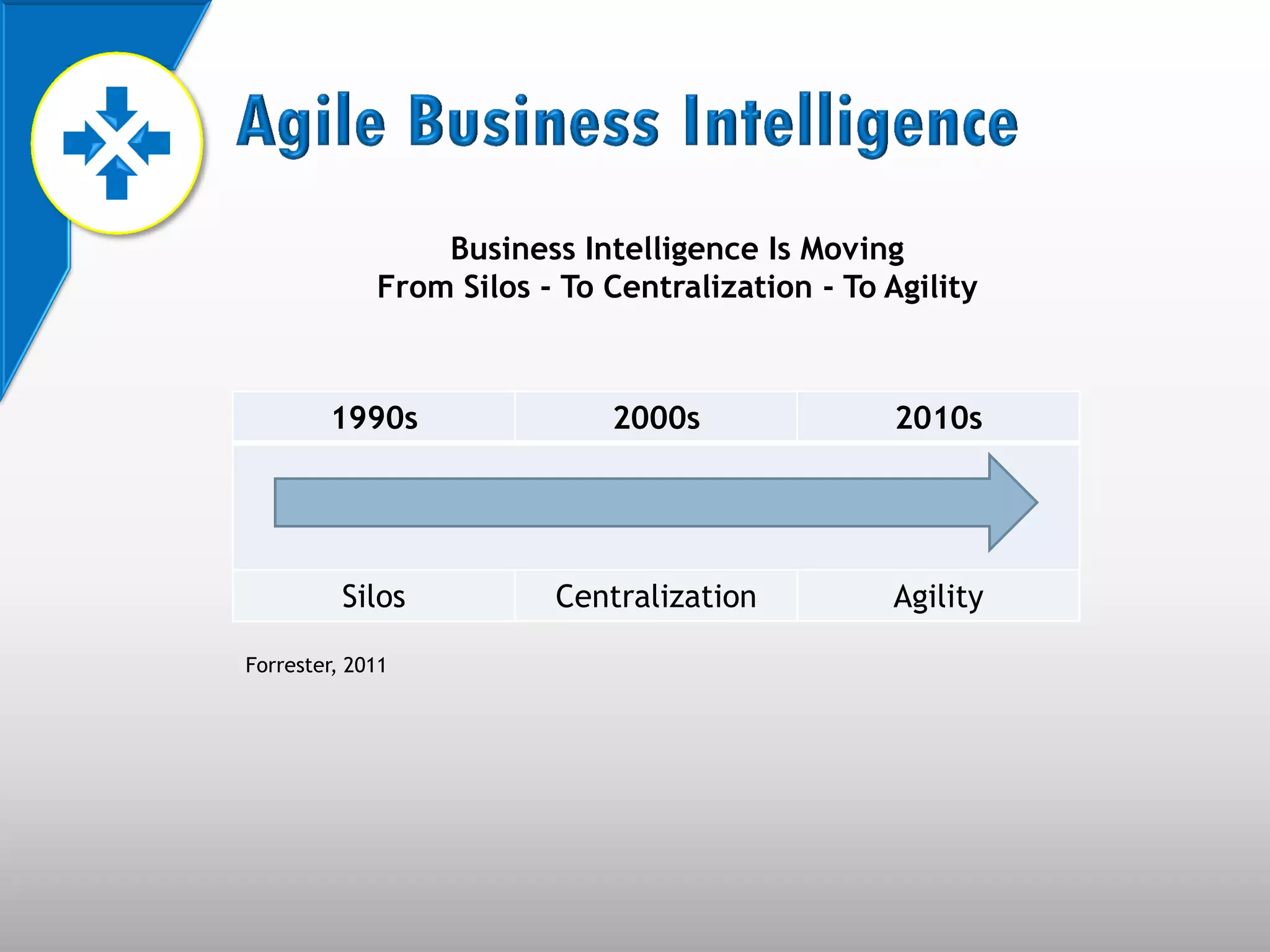
Business Intelligence Is Moving
             From Silos - To Centralization - To Agility


        1990s                2000s                2010s


          Silos          Centralization          Agility

Forrester, 2011
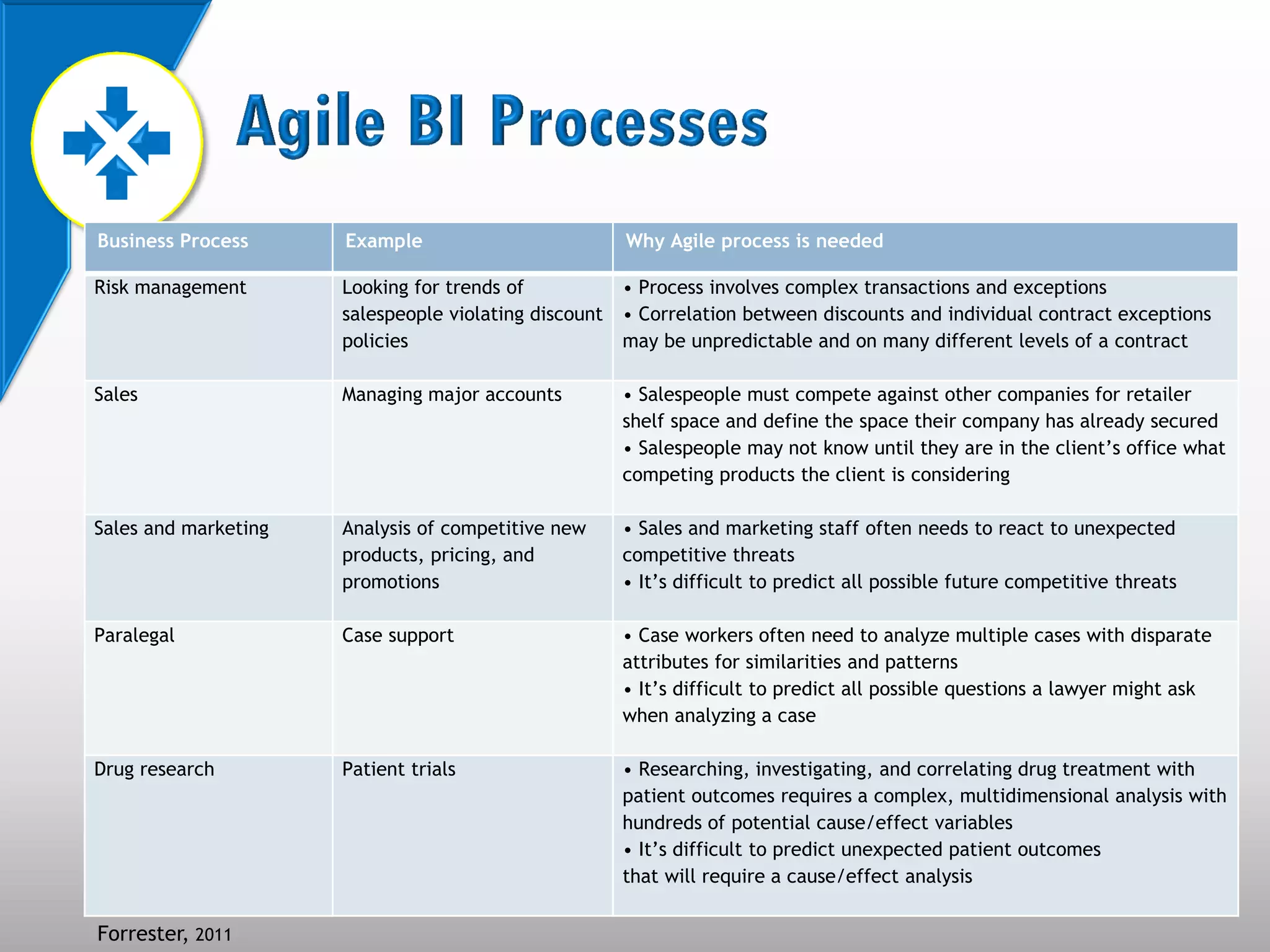
Business Process      Example                          Why Agile process is needed

Risk management       Looking for trends of            • Process involves complex transactions and exceptions
                      salespeople violating discount   • Correlation between discounts and individual contract exceptions
                      policies                         may be unpredictable and on many different levels of a contract

Sales                 Managing major accounts          • Salespeople must compete against other companies for retailer
                                                       shelf space and define the space their company has already secured
                                                       • Salespeople may not know until they are in the client’s office what
                                                       competing products the client is considering

Sales and marketing   Analysis of competitive new      • Sales and marketing staff often needs to react to unexpected
                      products, pricing, and           competitive threats
                      promotions                       • It’s difficult to predict all possible future competitive threats

Paralegal             Case support                     • Case workers often need to analyze multiple cases with disparate
                                                       attributes for similarities and patterns
                                                       • It’s difficult to predict all possible questions a lawyer might ask
                                                       when analyzing a case

Drug research         Patient trials                   • Researching, investigating, and correlating drug treatment with
                                                       patient outcomes requires a complex, multidimensional analysis with
                                                       hundreds of potential cause/effect variables
                                                       • It’s difficult to predict unexpected patient outcomes
                                                       that will require a cause/effect analysis

Forrester, 2011
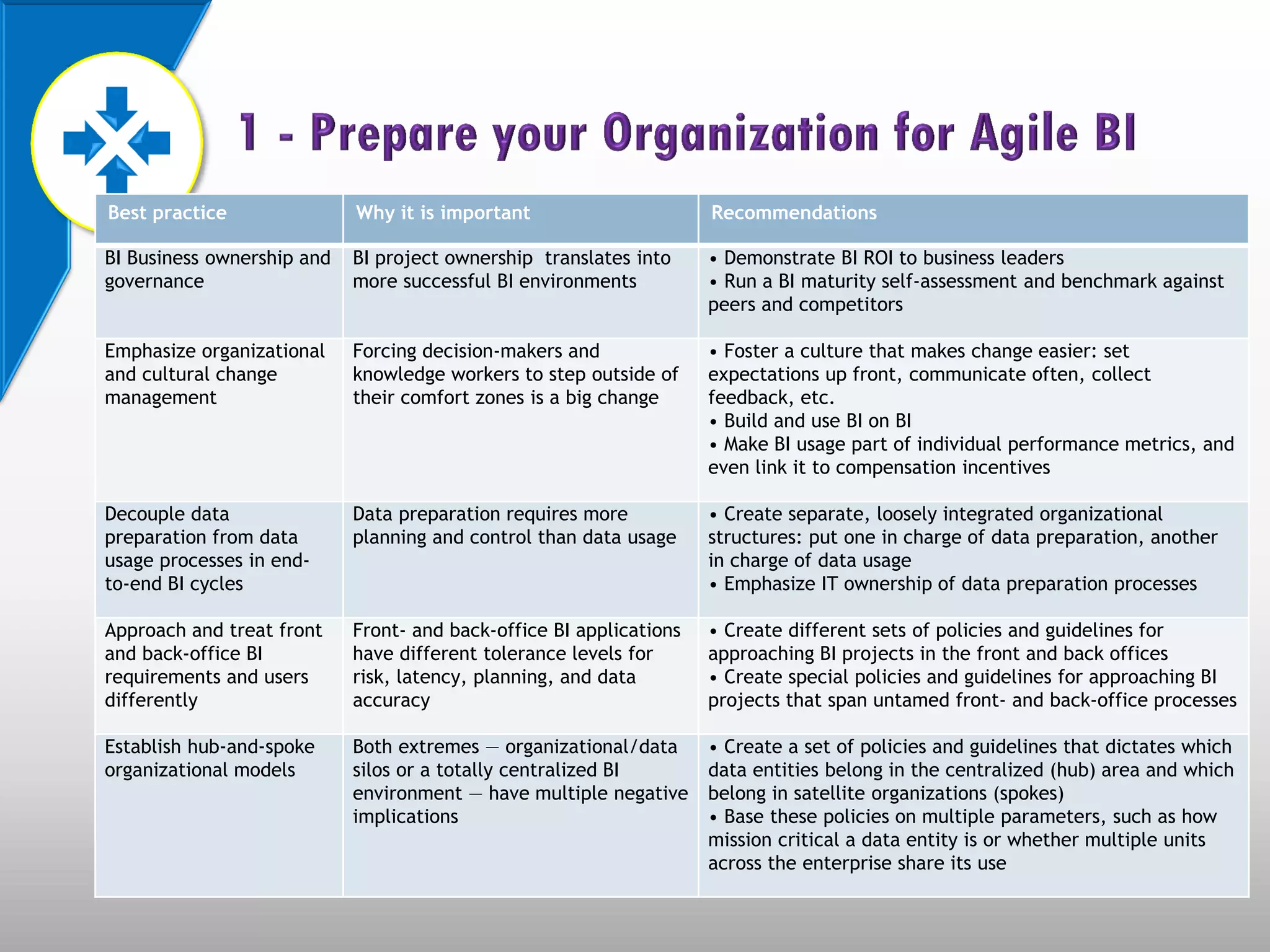
Best practice               Why it is important                      Recommendations
                Requirements for Some Business Processes Can Change Daily
BI Business ownership and   BI project ownership translates into     • Demonstrate BI ROI to business leaders
governance                  more successful BI environments          • Run a BI maturity self-assessment and benchmark against
                                                                     peers and competitors

Emphasize organizational    Forcing decision-makers and              • Foster a culture that makes change easier: set
and cultural change         knowledge workers to step outside of     expectations up front, communicate often, collect
management                  their comfort zones is a big change      feedback, etc.
                                                                     • Build and use BI on BI
                                                                     • Make BI usage part of individual performance metrics, and
                                                                     even link it to compensation incentives

Decouple data               Data preparation requires more           • Create separate, loosely integrated organizational
preparation from data       planning and control than data usage     structures: put one in charge of data preparation, another
usage processes in end-                                              in charge of data usage
to-end BI cycles                                                     • Emphasize IT ownership of data preparation processes

Approach and treat front    Front- and back-office BI applications   • Create different sets of policies and guidelines for
and back-office BI          have different tolerance levels for      approaching BI projects in the front and back offices
                Forrester, 2011
requirements and users      risk, latency, planning, and data        • Create special policies and guidelines for approaching BI
differently                 accuracy                                 projects that span untamed front- and back-office processes

Establish hub-and-spoke     Both extremes — organizational/data      • Create a set of policies and guidelines that dictates which
organizational models       silos or a totally centralized BI        data entities belong in the centralized (hub) area and which
                            environment — have multiple negative     belong in satellite organizations (spokes)
                            implications                             • Base these policies on multiple parameters, such as how
                                                                     mission critical a data entity is or whether multiple units
                                                                     across the enterprise share its use
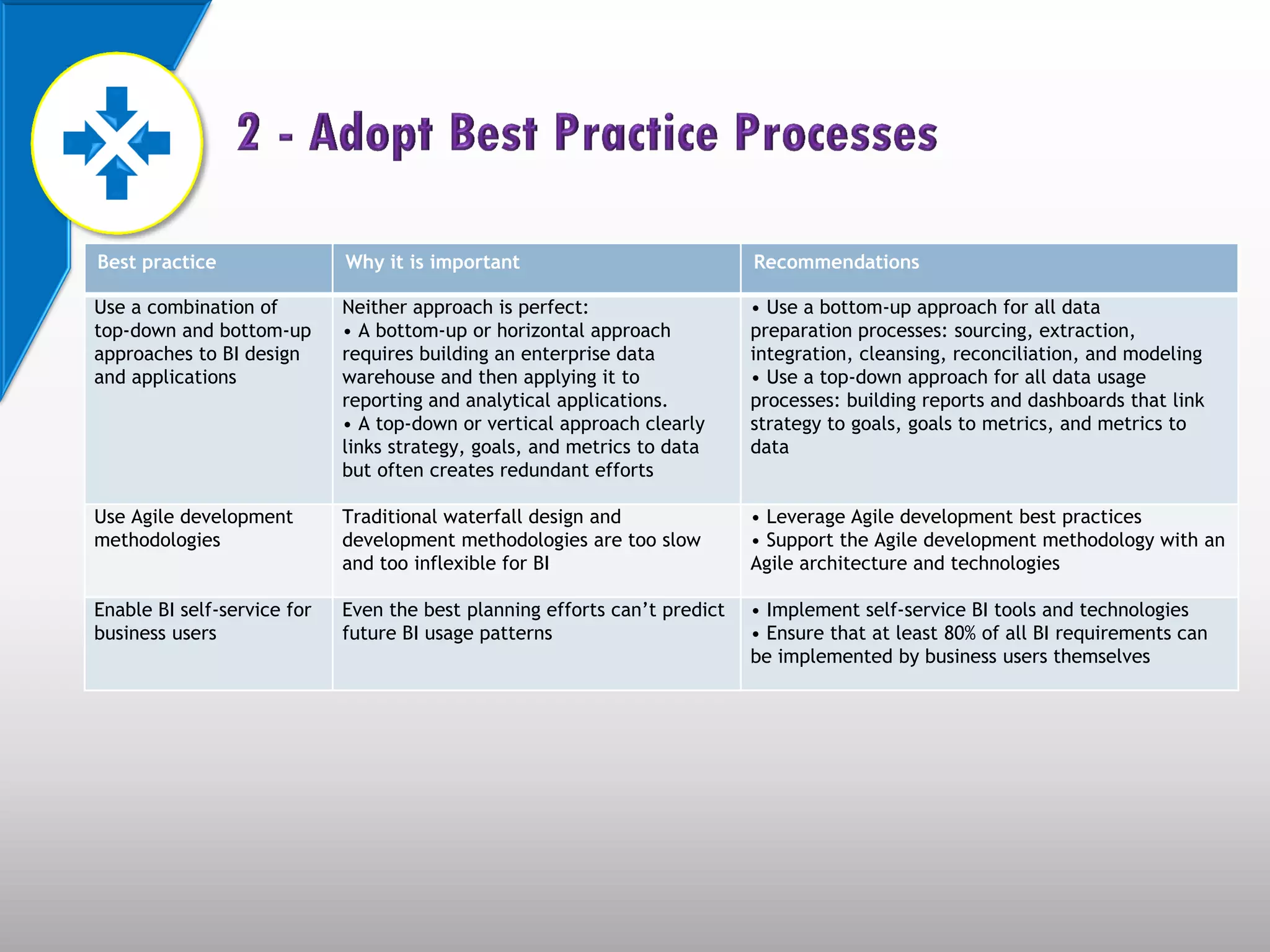
Best practice                Why it is important                            Recommendations

Use a combination of         Neither approach is perfect:                   • Use a bottom-up approach for all data
top-down and bottom-up       • A bottom-up or horizontal approach           preparation processes: sourcing, extraction,
approaches to BI design      requires building an enterprise data           integration, cleansing, reconciliation, and modeling
and applications             warehouse and then applying it to              • Use a top-down approach for all data usage
                             reporting and analytical applications.         processes: building reports and dashboards that link
                             • A top-down or vertical approach clearly      strategy to goals, goals to metrics, and metrics to
                             links strategy, goals, and metrics to data     data
                             but often creates redundant efforts

Use Agile development        Traditional waterfall design and               • Leverage Agile development best practices
methodologies                development methodologies are too slow         • Support the Agile development methodology with an
                             and too inflexible for BI                      Agile architecture and technologies

Enable BI self-service for   Even the best planning efforts can’t predict   • Implement self-service BI tools and technologies
business users               future BI usage patterns                       • Ensure that at least 80% of all BI requirements can
                  Forrester, 2011                                           be implemented by business users themselves
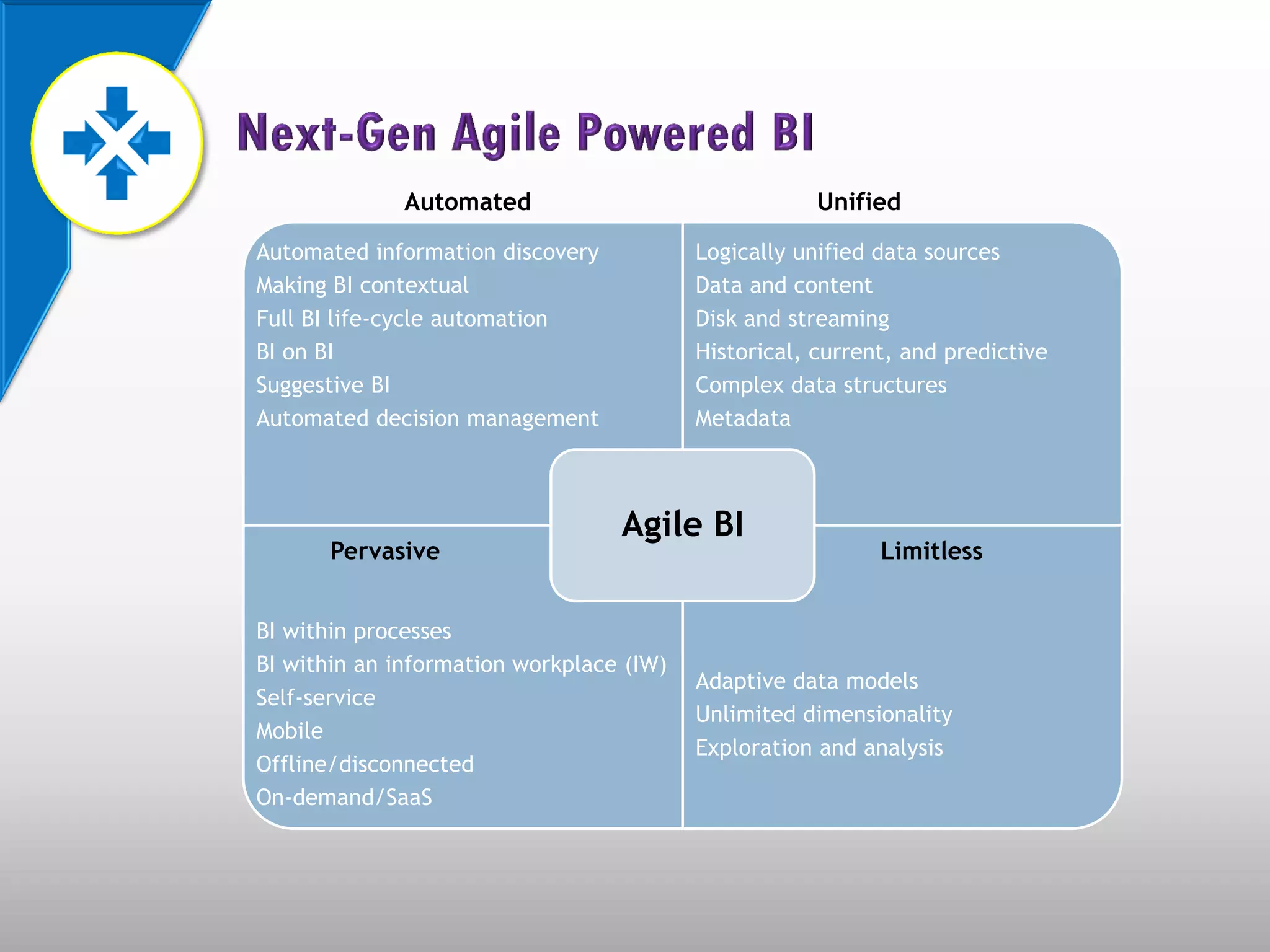
Automated                               Unified
Automated information discovery           Logically unified data sources
Making BI contextual                      Data and content
Full BI life-cycle automation             Disk and streaming
BI on BI                                  Historical, current, and predictive
Suggestive BI                             Complex data structures
Automated decision management             Metadata


                                  Agile BI
       Pervasive                                            Limitless


BI within processes
BI within an information workplace (IW)
                                          Adaptive data models
Self-service
                                          Unlimited dimensionality
Mobile
                                          Exploration and analysis
Offline/disconnected
On-demand/SaaS
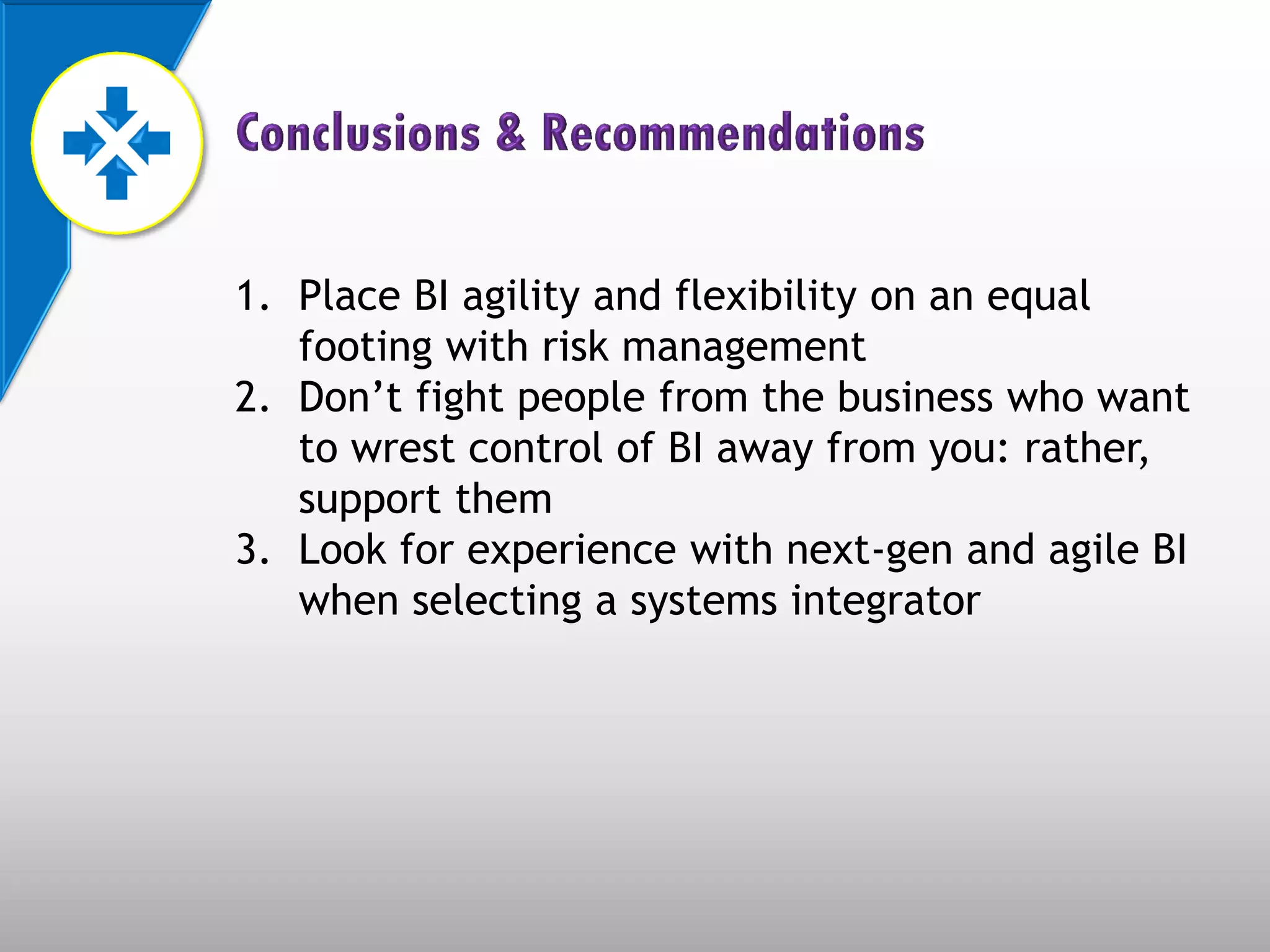
1. Place BI agility and flexibility on an equal
   footing with risk management
2. Don’t fight people from the business who want
   to wrest control of BI away from you: rather,
   support them
3. Look for experience with next-gen and agile BI
   when selecting a systems integrator

Agile Business Intelligence

  • 2.
    …“An approach thatcombines processes, methodologies, organizational structure, tools, and technologies that enable strategic, tactical, and operational decision-makers to be more flexible and more responsive to the fast pace of changes to business and regulatory requirements”. Forrester on Business Intelligence, 2011
  • 3.
    • More than49% of surveyed companies have concrete plans to expand their BI solutions by 2014 • Enterprise BI maturity levels are still below average (2.75 on a scale of 5, a modest 6% increase over 2009) • Lack of agility and flexibility leads to unsuccessful BI initiatives • Implementing BI requires using best practices and building upon lessons learned • BI technologies and processes have not kept pace with business realities • Centralization has not led to agile, streamlined BI implementations
  • 4.
    • Agility isthe key to efficient business intelligence processes • Untamed business processes create challenges for standard BI approaches: • Untamed processes are often invisible • Traditional SDLC doesn’t work well for automating untamed processes • Untamed processes often require new approaches and technologies
  • 5.
    Business Intelligence IsMoving From Silos - To Centralization - To Agility 1990s 2000s 2010s Silos Centralization Agility Forrester, 2011
  • 6.
    Business Process Example Why Agile process is needed Risk management Looking for trends of • Process involves complex transactions and exceptions salespeople violating discount • Correlation between discounts and individual contract exceptions policies may be unpredictable and on many different levels of a contract Sales Managing major accounts • Salespeople must compete against other companies for retailer shelf space and define the space their company has already secured • Salespeople may not know until they are in the client’s office what competing products the client is considering Sales and marketing Analysis of competitive new • Sales and marketing staff often needs to react to unexpected products, pricing, and competitive threats promotions • It’s difficult to predict all possible future competitive threats Paralegal Case support • Case workers often need to analyze multiple cases with disparate attributes for similarities and patterns • It’s difficult to predict all possible questions a lawyer might ask when analyzing a case Drug research Patient trials • Researching, investigating, and correlating drug treatment with patient outcomes requires a complex, multidimensional analysis with hundreds of potential cause/effect variables • It’s difficult to predict unexpected patient outcomes that will require a cause/effect analysis Forrester, 2011
  • 7.
    Best practice Why it is important Recommendations Requirements for Some Business Processes Can Change Daily BI Business ownership and BI project ownership translates into • Demonstrate BI ROI to business leaders governance more successful BI environments • Run a BI maturity self-assessment and benchmark against peers and competitors Emphasize organizational Forcing decision-makers and • Foster a culture that makes change easier: set and cultural change knowledge workers to step outside of expectations up front, communicate often, collect management their comfort zones is a big change feedback, etc. • Build and use BI on BI • Make BI usage part of individual performance metrics, and even link it to compensation incentives Decouple data Data preparation requires more • Create separate, loosely integrated organizational preparation from data planning and control than data usage structures: put one in charge of data preparation, another usage processes in end- in charge of data usage to-end BI cycles • Emphasize IT ownership of data preparation processes Approach and treat front Front- and back-office BI applications • Create different sets of policies and guidelines for and back-office BI have different tolerance levels for approaching BI projects in the front and back offices Forrester, 2011 requirements and users risk, latency, planning, and data • Create special policies and guidelines for approaching BI differently accuracy projects that span untamed front- and back-office processes Establish hub-and-spoke Both extremes — organizational/data • Create a set of policies and guidelines that dictates which organizational models silos or a totally centralized BI data entities belong in the centralized (hub) area and which environment — have multiple negative belong in satellite organizations (spokes) implications • Base these policies on multiple parameters, such as how mission critical a data entity is or whether multiple units across the enterprise share its use
  • 8.
    Best practice Why it is important Recommendations Use a combination of Neither approach is perfect: • Use a bottom-up approach for all data top-down and bottom-up • A bottom-up or horizontal approach preparation processes: sourcing, extraction, approaches to BI design requires building an enterprise data integration, cleansing, reconciliation, and modeling and applications warehouse and then applying it to • Use a top-down approach for all data usage reporting and analytical applications. processes: building reports and dashboards that link • A top-down or vertical approach clearly strategy to goals, goals to metrics, and metrics to links strategy, goals, and metrics to data data but often creates redundant efforts Use Agile development Traditional waterfall design and • Leverage Agile development best practices methodologies development methodologies are too slow • Support the Agile development methodology with an and too inflexible for BI Agile architecture and technologies Enable BI self-service for Even the best planning efforts can’t predict • Implement self-service BI tools and technologies business users future BI usage patterns • Ensure that at least 80% of all BI requirements can Forrester, 2011 be implemented by business users themselves
  • 9.
    Automated Unified Automated information discovery Logically unified data sources Making BI contextual Data and content Full BI life-cycle automation Disk and streaming BI on BI Historical, current, and predictive Suggestive BI Complex data structures Automated decision management Metadata Agile BI Pervasive Limitless BI within processes BI within an information workplace (IW) Adaptive data models Self-service Unlimited dimensionality Mobile Exploration and analysis Offline/disconnected On-demand/SaaS
  • 10.
    1. Place BIagility and flexibility on an equal footing with risk management 2. Don’t fight people from the business who want to wrest control of BI away from you: rather, support them 3. Look for experience with next-gen and agile BI when selecting a systems integrator