Collaborative
Lean
Evolving
Adaptable
Reportable
Organically Scaled Agile: Creating a
CLEAR Project Portfolio
Robert Woods –
Agile Coach & Delivery Manager
MATRIX Resources
@mindoverprocess
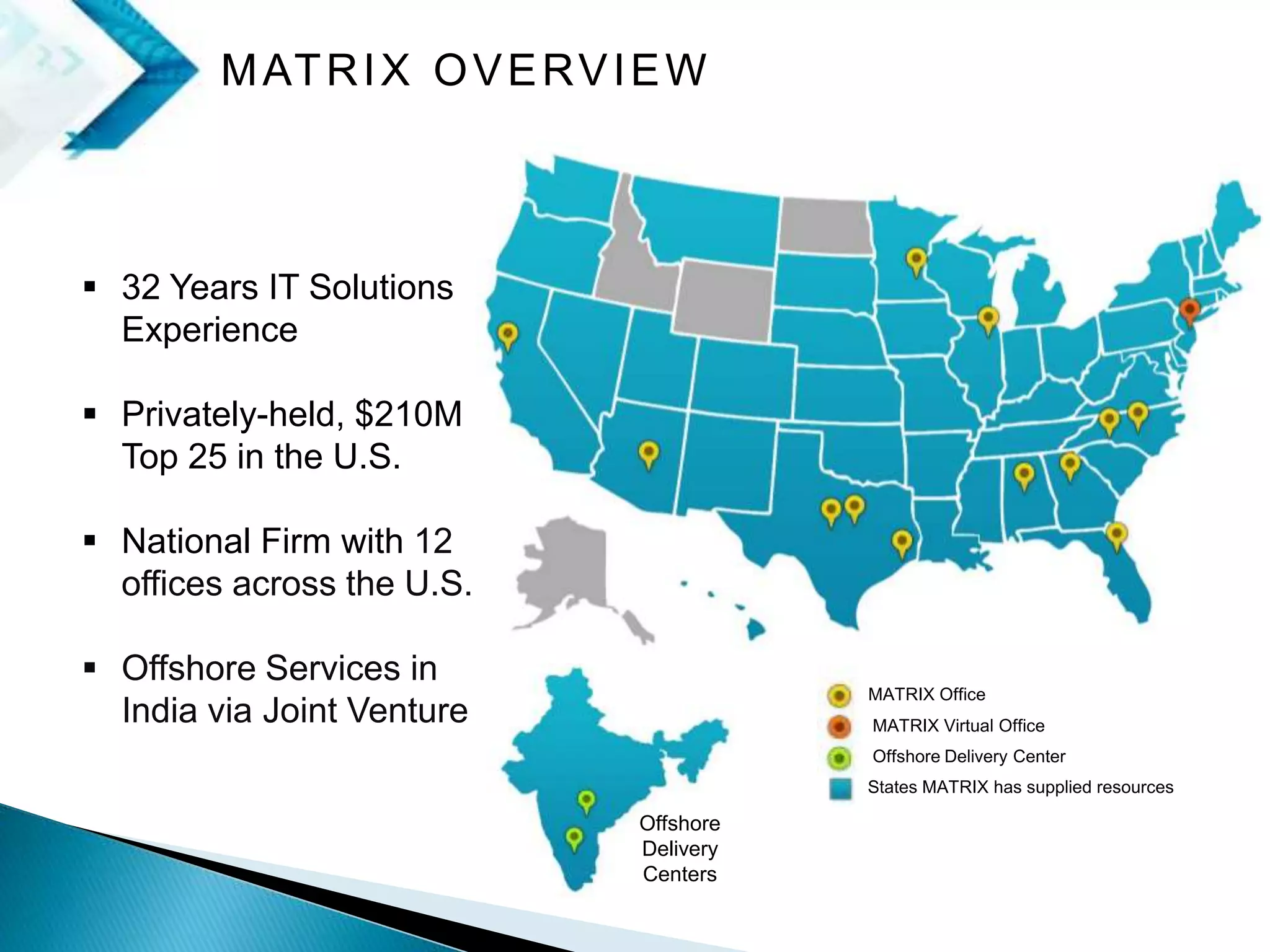
MATRIX OVERVIEW
 32 Years IT Solutions
Experience
 Privately-held, $210M
Top 25 in the U.S.
 National Firm with 12
offices across the U.S.
 Offshore Services in
India via Joint Venture
Offshore
Delivery
Centers
MATRIX Office
MATRIX Virtual Office
Offshore Delivery Center
States MATRIX has supplied resources
Agile portfolio management is not about taking a bunch of
‘agile-like’ projects and throwing them into a portfolio; it’s about
creating agility at the actual portfolio & decision-making level.
gen-education.com
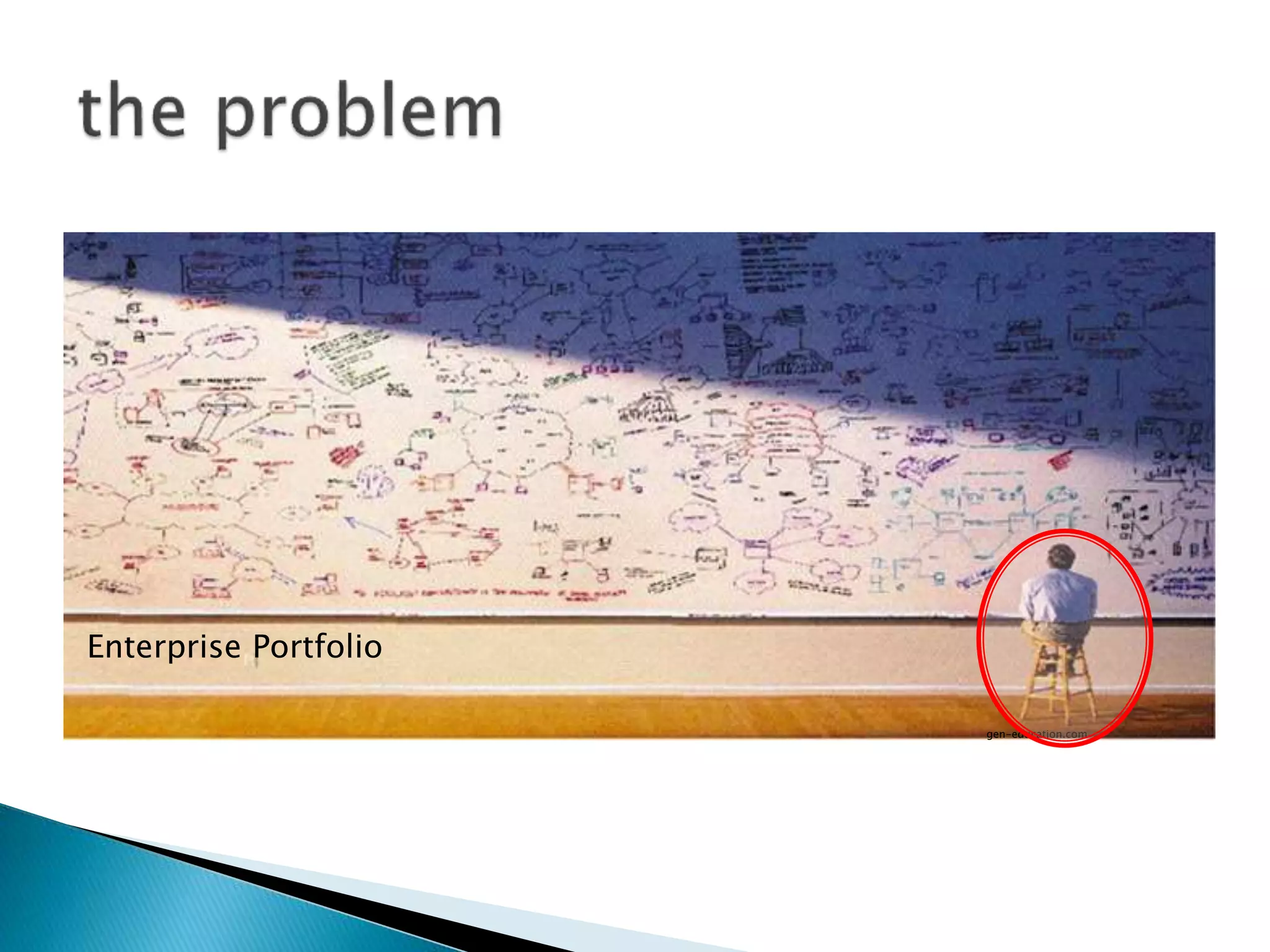
Enterprise Portfolio
AGILE!!
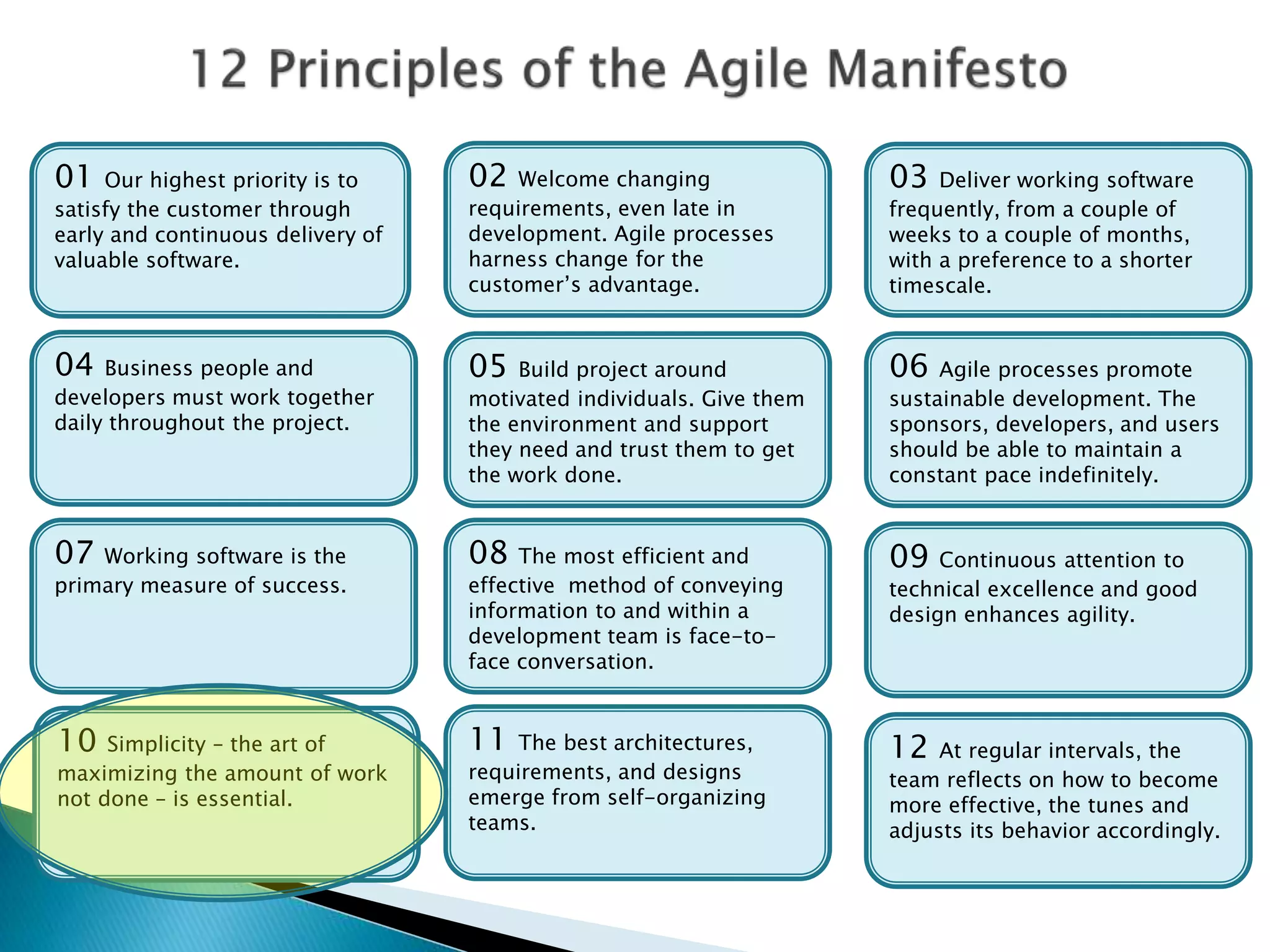
09 Continuous attention to
technical excellence and good
design enhances agility.
07 Working software is the
primary measure of success.
08 The most efficient and
effective method of conveying
information to and within a
development team is face-to-
face conversation.
06 Agile processes promote
sustainable development. The
sponsors, developers, and users
should be able to maintain a
constant pace indefinitely.
05 Build project around
motivated individuals. Give them
the environment and support
they need and trust them to get
the work done.
04 Business people and
developers must work together
daily throughout the project.
01 Our highest priority is to
satisfy the customer through
early and continuous delivery of
valuable software.
02 Welcome changing
requirements, even late in
development. Agile processes
harness change for the
customer’s advantage.
03 Deliver working software
frequently, from a couple of
weeks to a couple of months,
with a preference to a shorter
timescale.
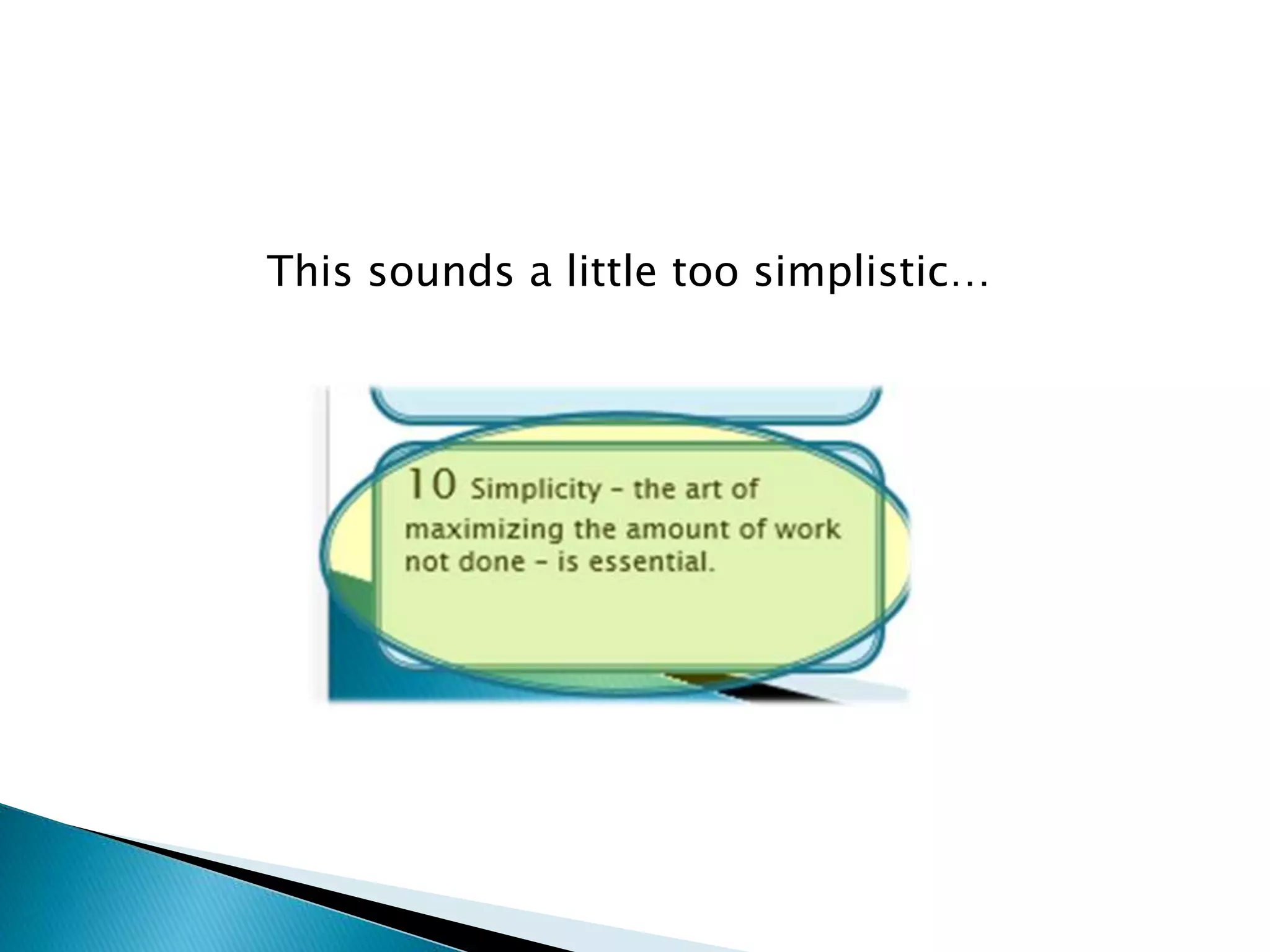
10 Simplicity – the art of
maximizing the amount of work
not done – is essential.
11 The best architectures,
requirements, and designs
emerge from self-organizing
teams.
12 At regular intervals, the
team reflects on how to become
more effective, the tunes and
adjusts its behavior accordingly.
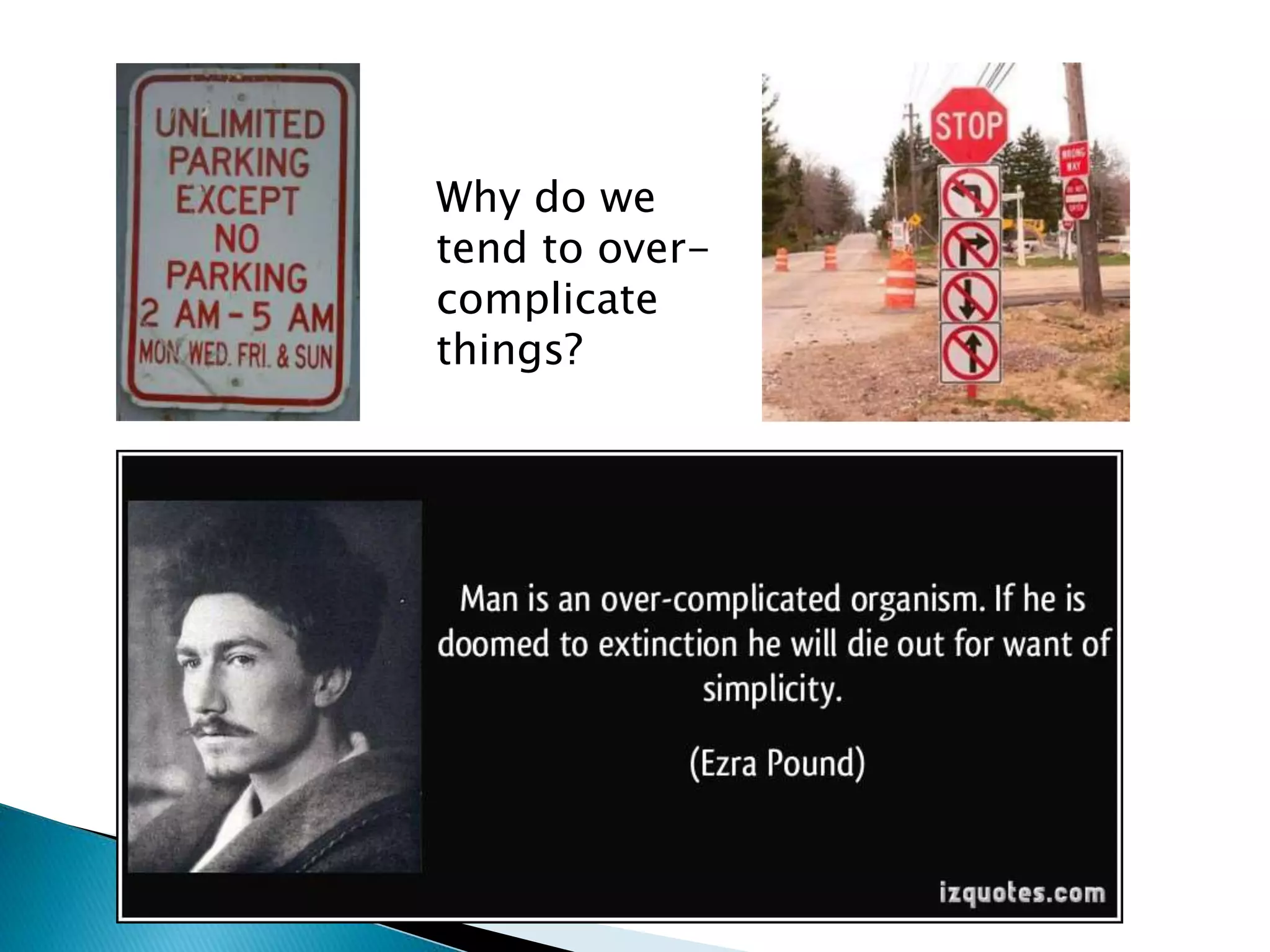
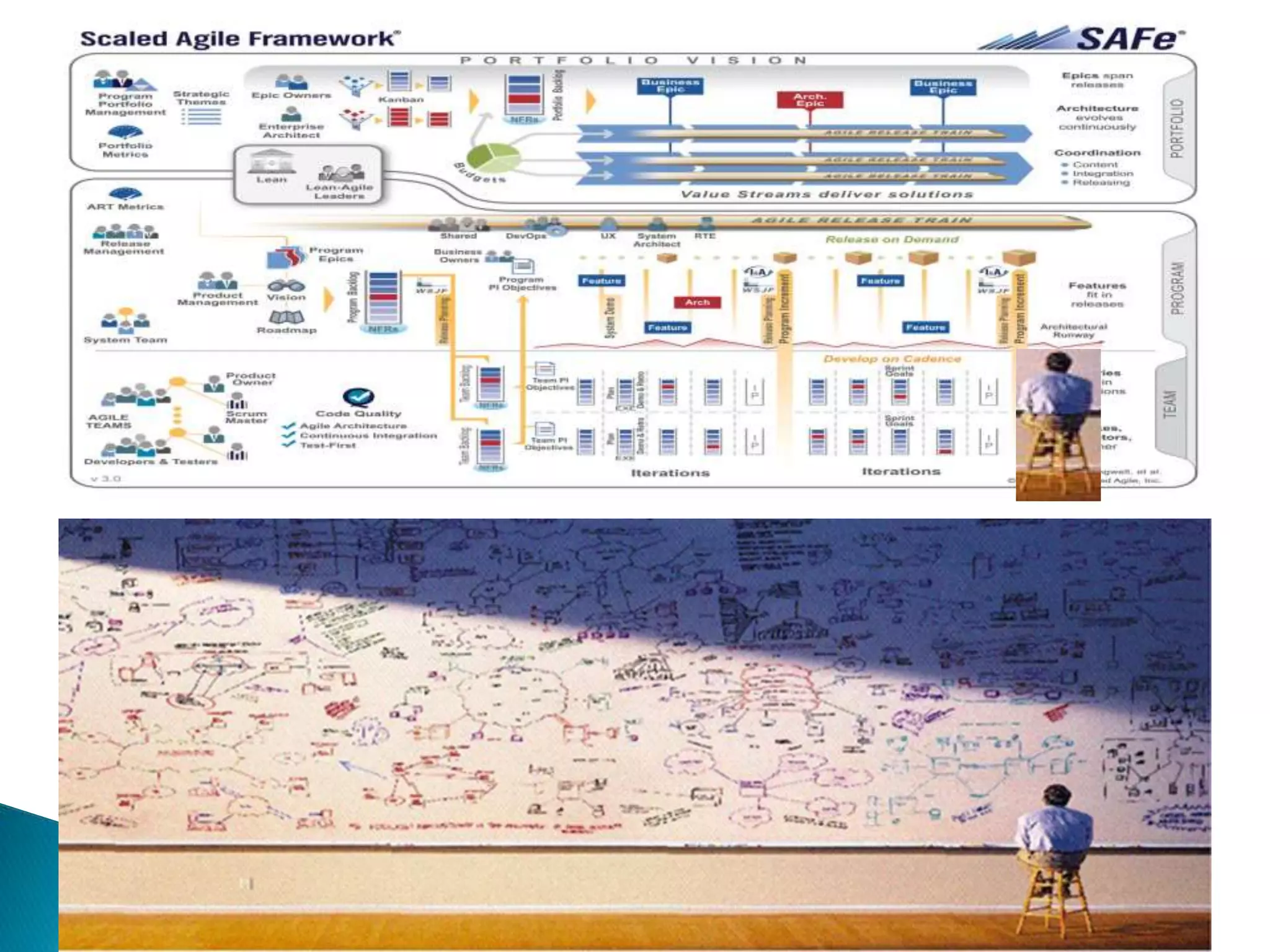
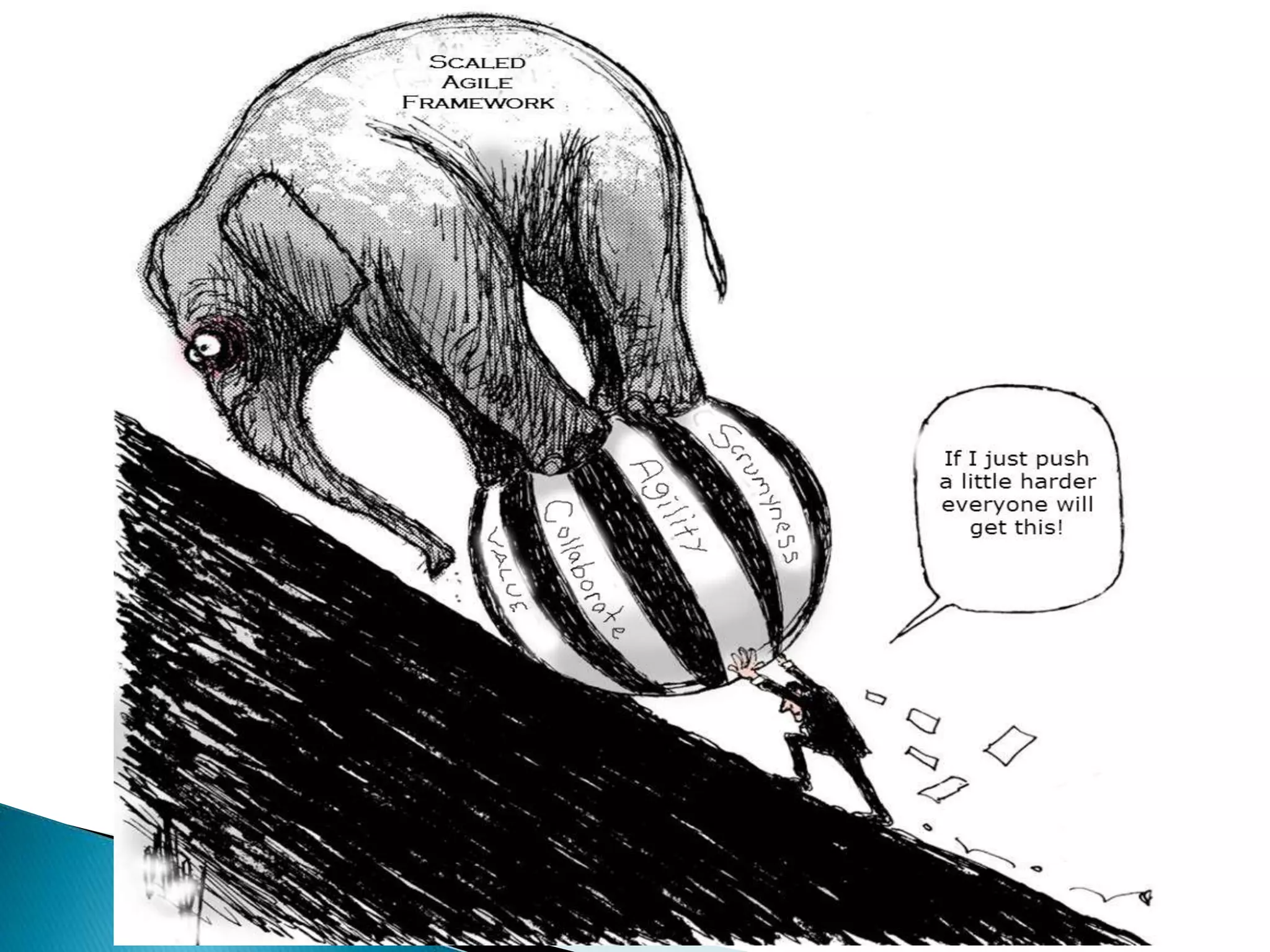
Why do we
tend to over-
complicate
things?
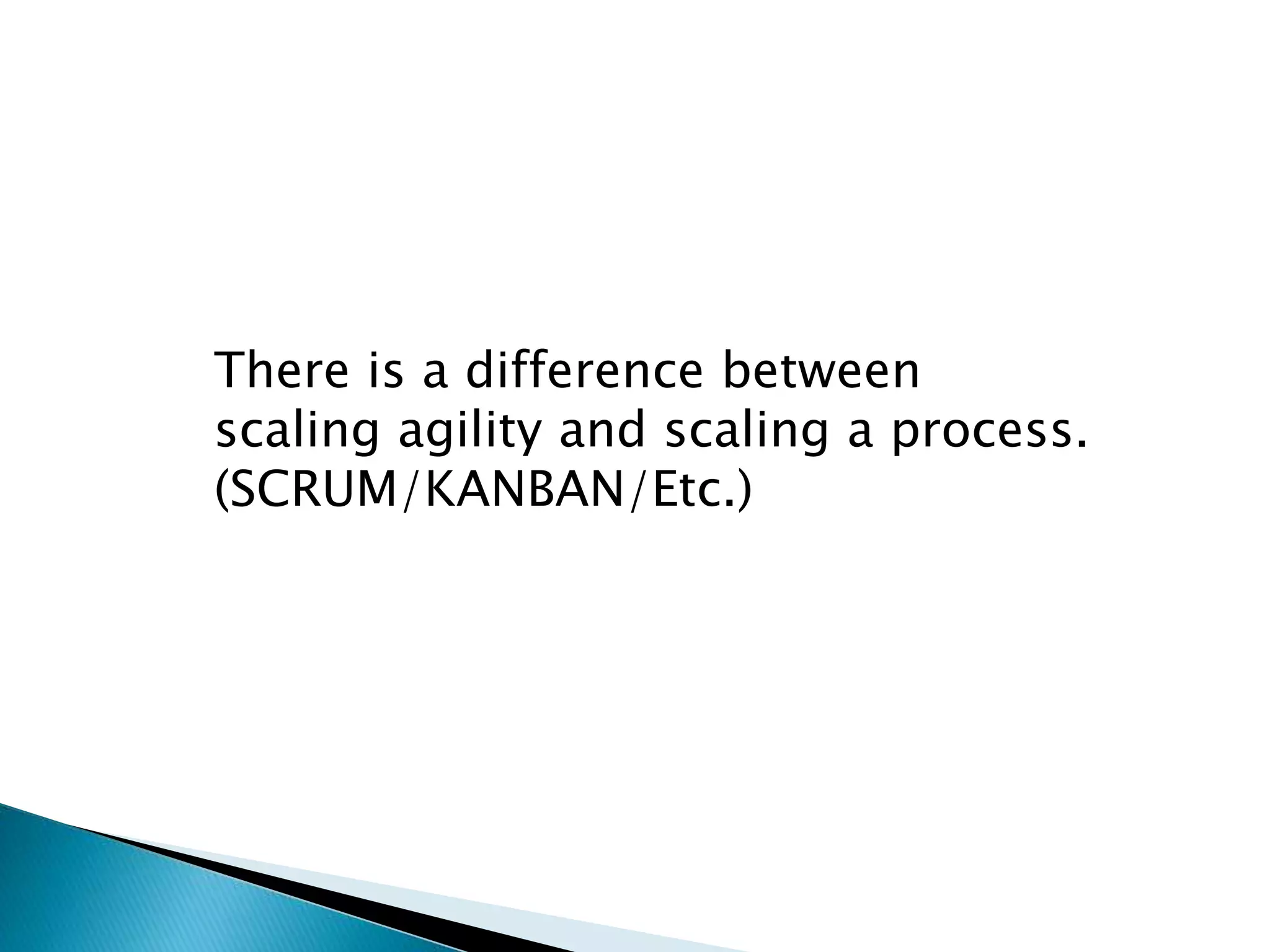
There is a difference between
scaling agility and scaling a process.
(SCRUM/KANBAN/Etc.)
 Based on common failures (and successes) in
scaling agility into a portfolio process
 Focuses on some of the most core aspects of
Agile principles that often get lost in scaling
 Can be applied at every level of an enterprise
portfolio
 Is process agnostic and organically creates
agility as opposed to forcing a framework-fit
scenario.
15
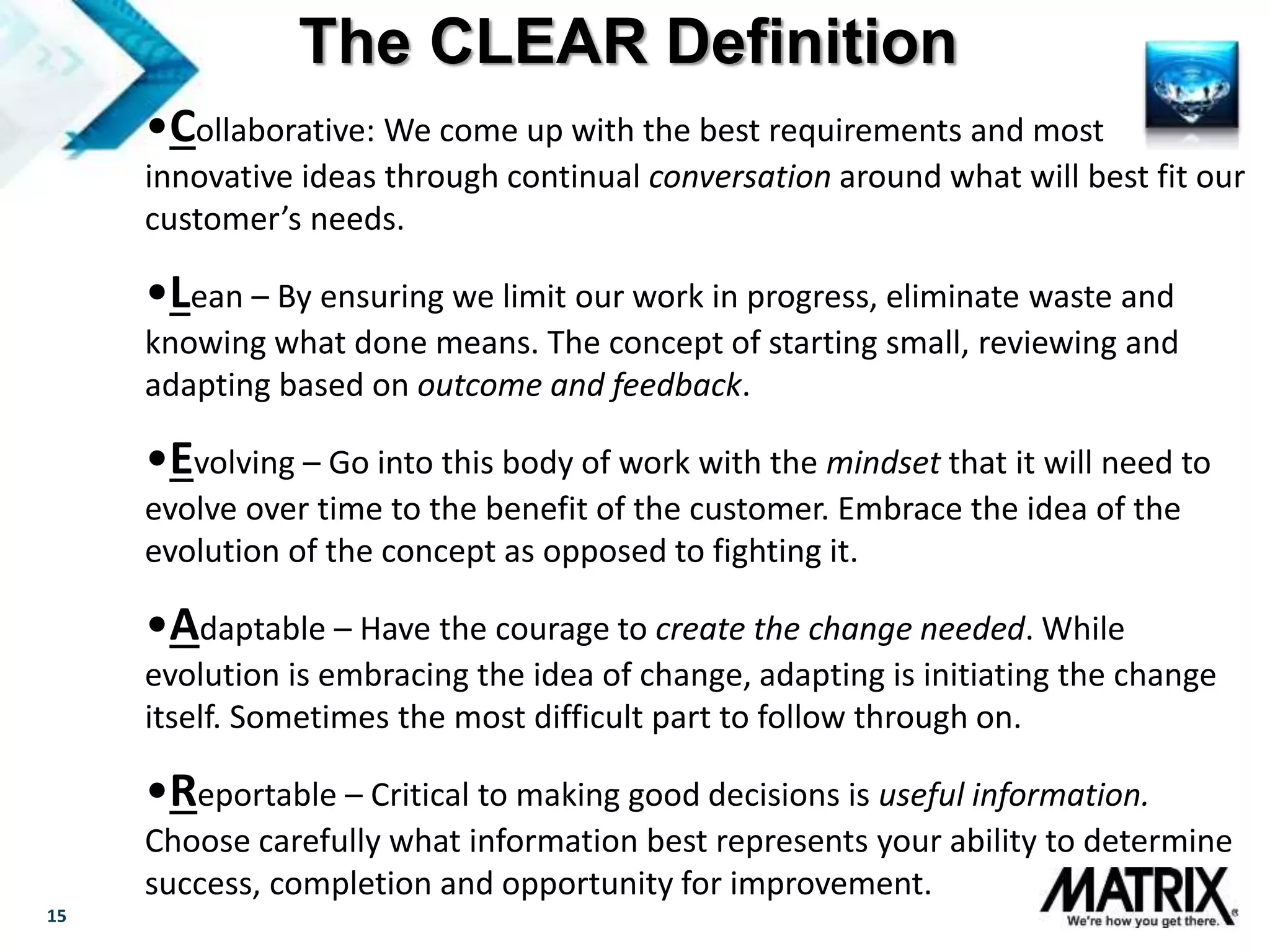
•Collaborative: We come up with the best requirements and most
innovative ideas through continual conversation around what will best fit our
customer’s needs.
•Lean – By ensuring we limit our work in progress, eliminate waste and
knowing what done means. The concept of starting small, reviewing and
adapting based on outcome and feedback.
•Evolving – Go into this body of work with the mindset that it will need to
evolve over time to the benefit of the customer. Embrace the idea of the
evolution of the concept as opposed to fighting it.
•Adaptable – Have the courage to create the change needed. While
evolution is embracing the idea of change, adapting is initiating the change
itself. Sometimes the most difficult part to follow through on.
•Reportable – Critical to making good decisions is useful information.
Choose carefully what information best represents your ability to determine
success, completion and opportunity for improvement.
The CLEAR Definition
This sounds a little too simplistic…
1. What is the reasoning behind taking a user story and pruning it
down to a small consumable level?
(Quick feedback, adaptability, response to change, fail quickly)
2. What is the value behind identifying a minimum viable product?
(Good enough not perfect, quick to market, feedback, value)
3. Why is it important for a team to understand backlog priority?
(Working right items, highest business value)
4. Top attributes of a truly Agile project/team?
(Adaptability, collaborative, predictable, transparent)
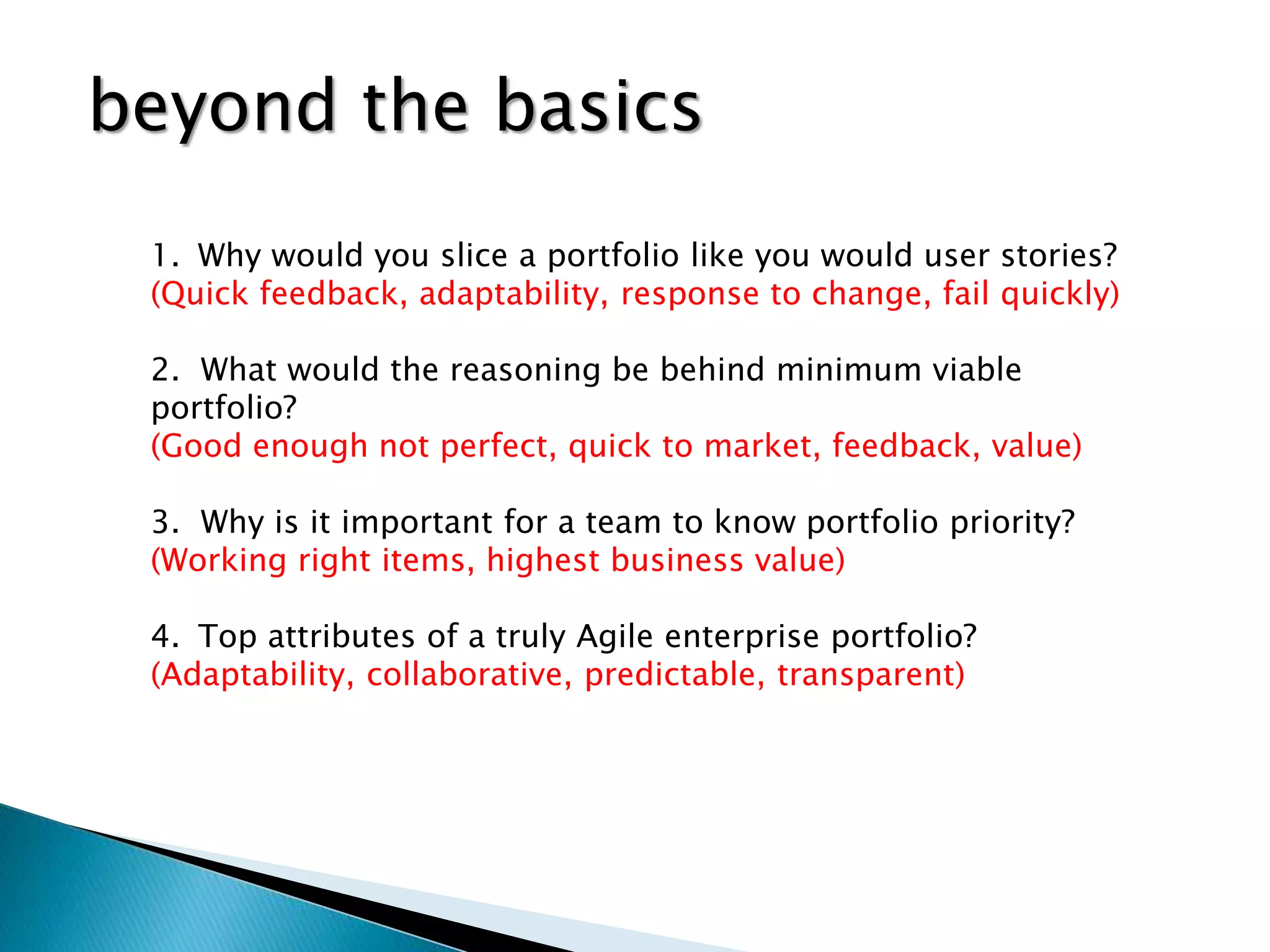
1. Why would you slice a portfolio like you would user stories?
(Quick feedback, adaptability, response to change, fail quickly)
2. What would the reasoning be behind minimum viable
portfolio?
(Good enough not perfect, quick to market, feedback, value)
3. Why is it important for a team to know portfolio priority?
(Working right items, highest business value)
4. Top attributes of a truly Agile enterprise portfolio?
(Adaptability, collaborative, predictable, transparent)
beyond the basics
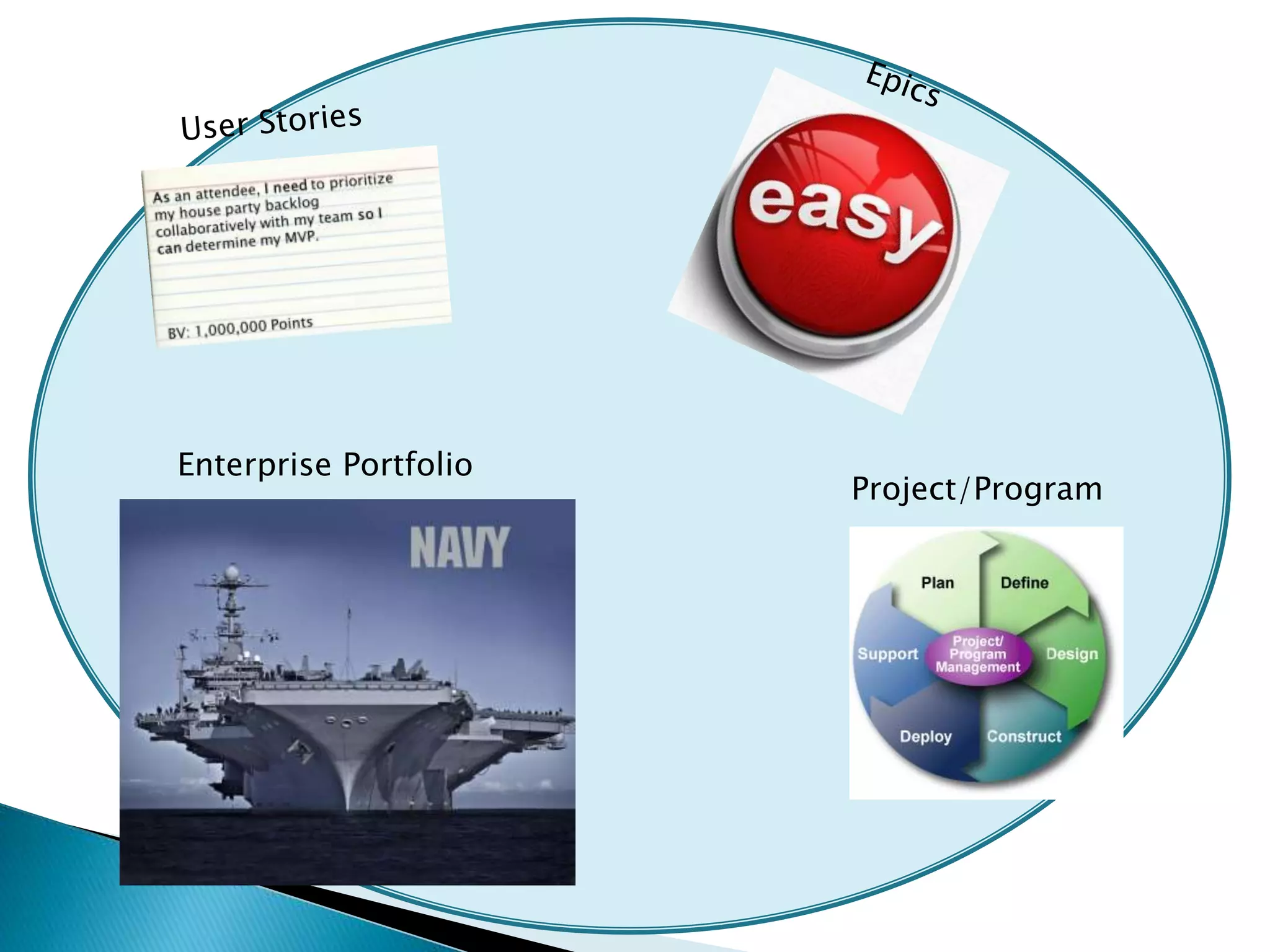
Project/Program
Enterprise Portfolio
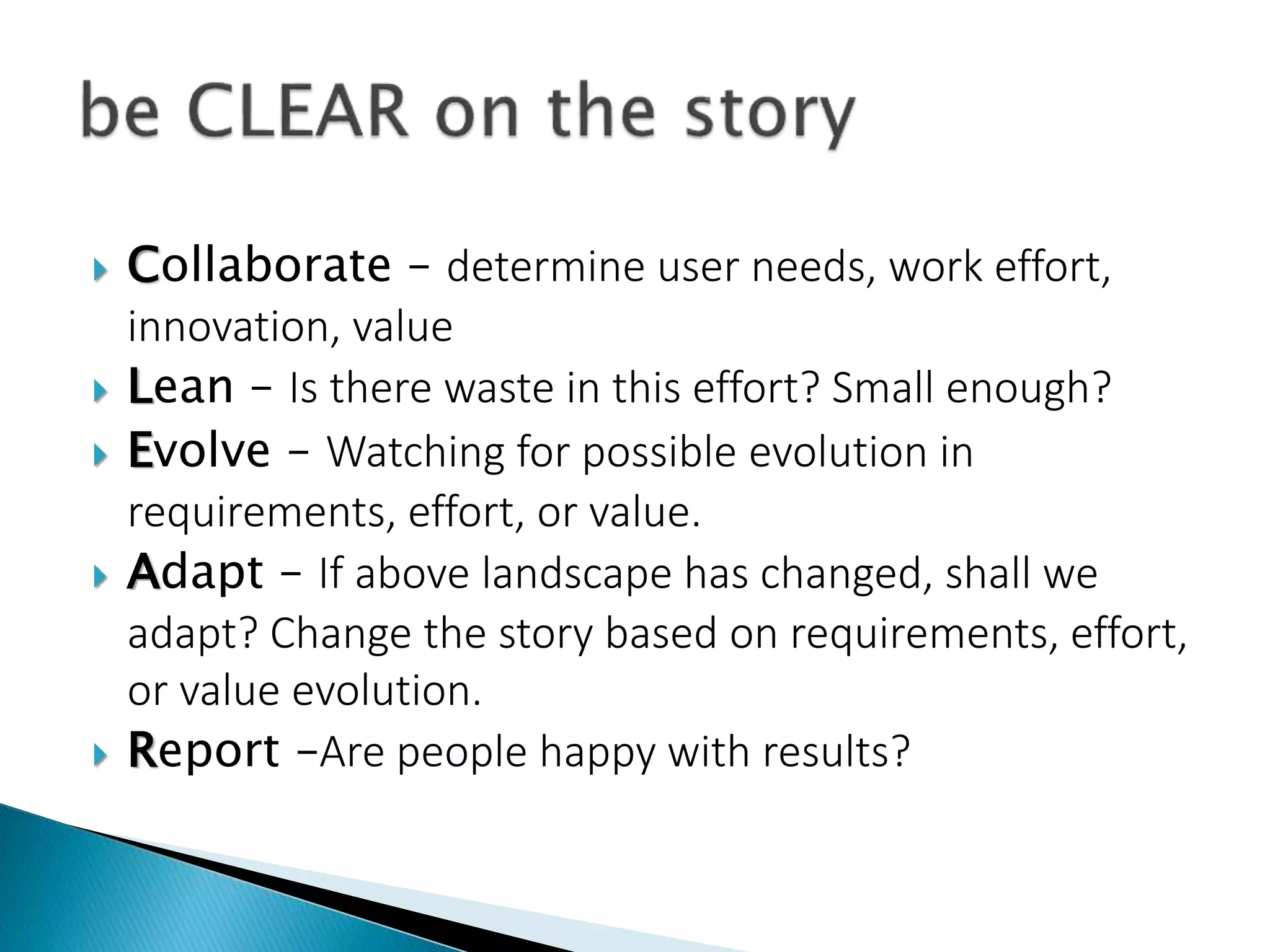
 Collaborate – determine user needs, work effort,
innovation, value
 Lean – Is there waste in this effort? Small enough?
 Evolve – Watching for possible evolution in
requirements, effort, or value.
 Adapt – If above landscape has changed, shall we
adapt? Change the story based on requirements, effort,
or value evolution.
 Report –Are people happy with results?
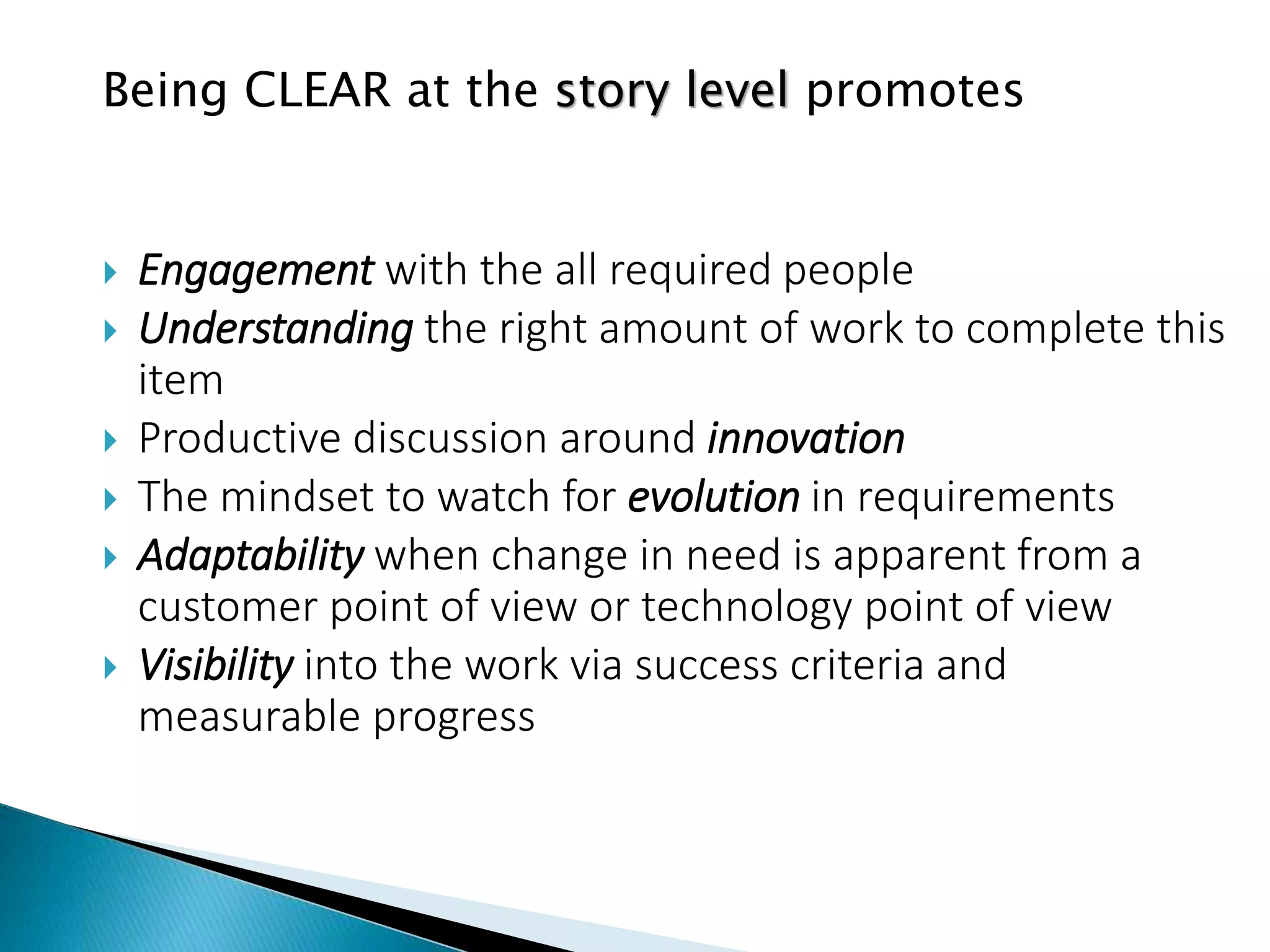
Being CLEAR at the story level promotes
 Engagement with the all required people
 Understanding the right amount of work to complete this
item
 Productive discussion around innovation
 The mindset to watch for evolution in requirements
 Adaptability when change in need is apparent from a
customer point of view or technology point of view
 Visibility into the work via success criteria and
measurable progress
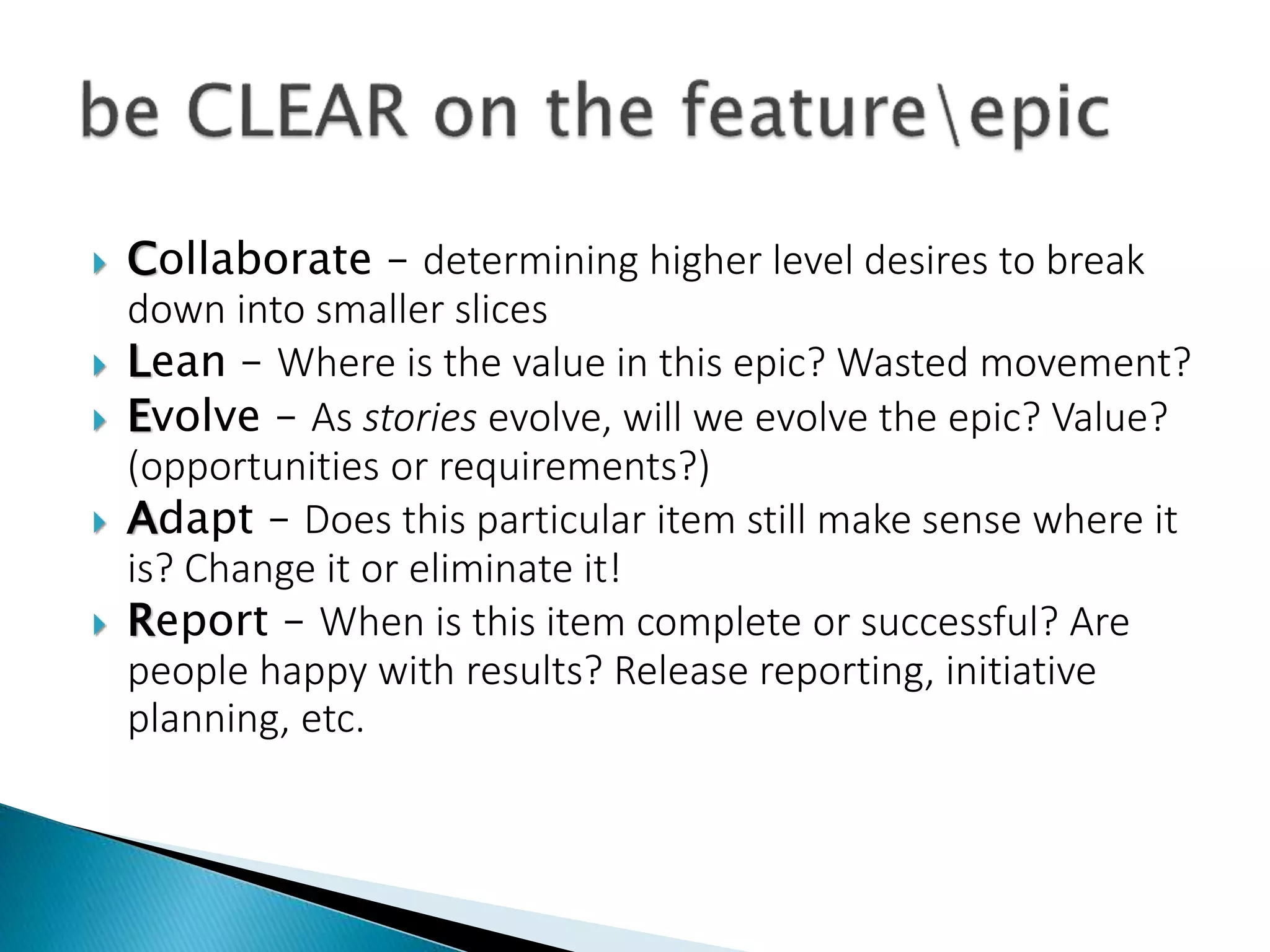
 Collaborate – determining higher level desires to break
down into smaller slices
 Lean – Where is the value in this epic? Wasted movement?
 Evolve – As stories evolve, will we evolve the epic? Value?
(opportunities or requirements?)
 Adapt – Does this particular item still make sense where it
is? Change it or eliminate it!
 Report – When is this item complete or successful? Are
people happy with results? Release reporting, initiative
planning, etc.
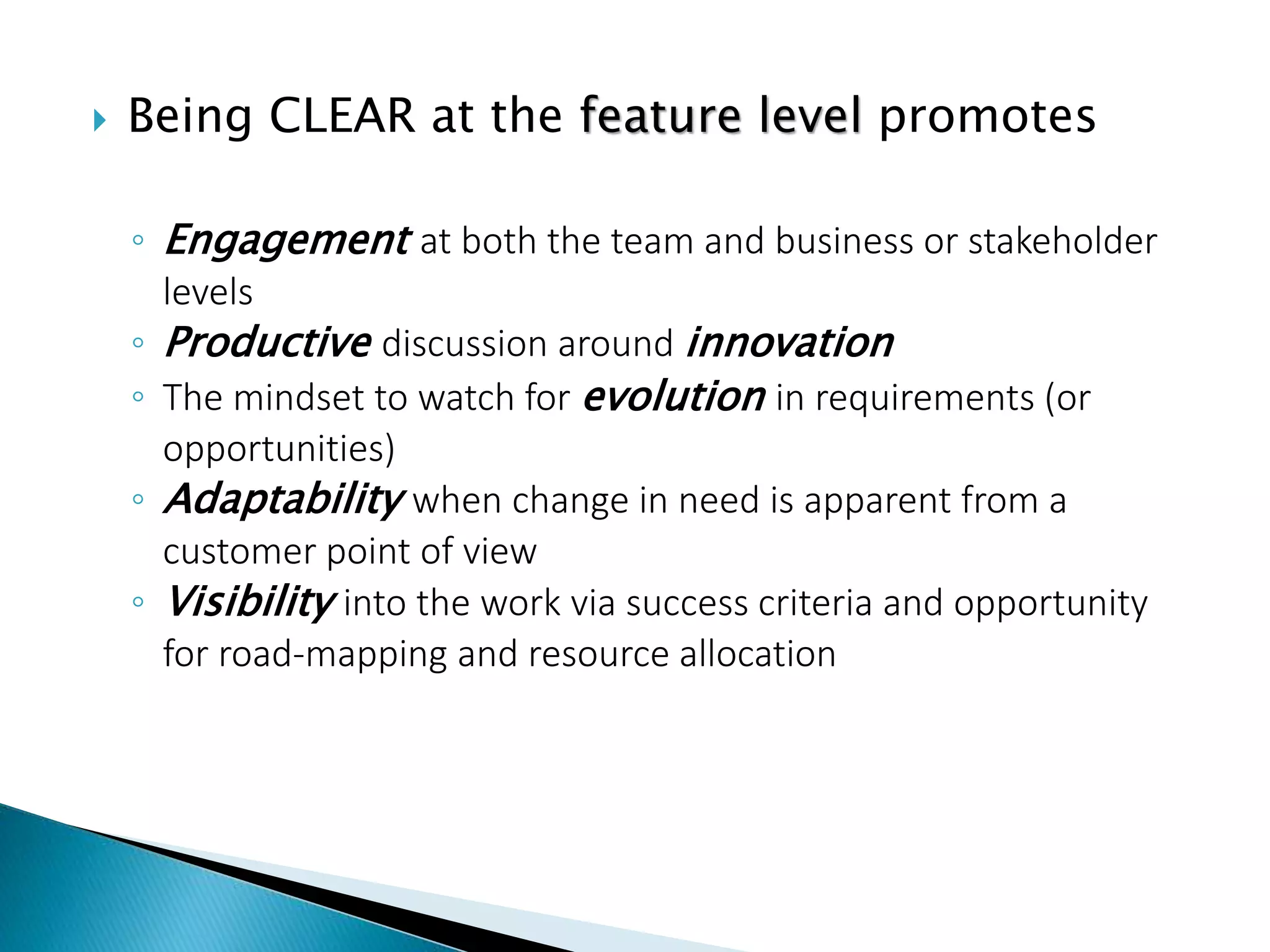
 Being CLEAR at the feature level promotes
◦ Engagement at both the team and business or stakeholder
levels
◦ Productive discussion around innovation
◦ The mindset to watch for evolution in requirements (or
opportunities)
◦ Adaptability when change in need is apparent from a
customer point of view
◦ Visibility into the work via success criteria and opportunity
for road-mapping and resource allocation
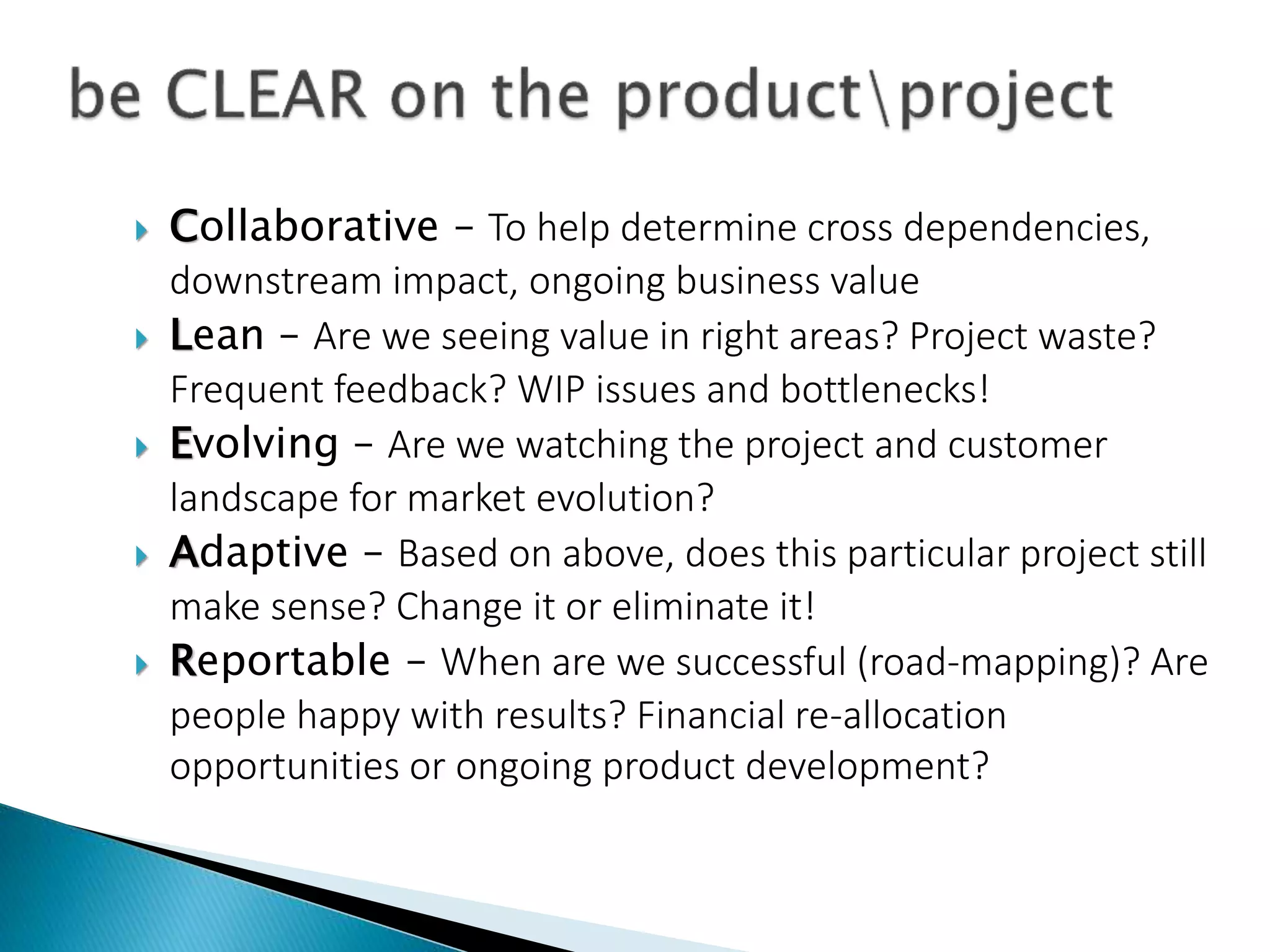
 Collaborative – To help determine cross dependencies,
downstream impact, ongoing business value
 Lean – Are we seeing value in right areas? Project waste?
Frequent feedback? WIP issues and bottlenecks!
 Evolving – Are we watching the project and customer
landscape for market evolution?
 Adaptive – Based on above, does this particular project still
make sense? Change it or eliminate it!
 Reportable – When are we successful (road-mapping)? Are
people happy with results? Financial re-allocation
opportunities or ongoing product development?
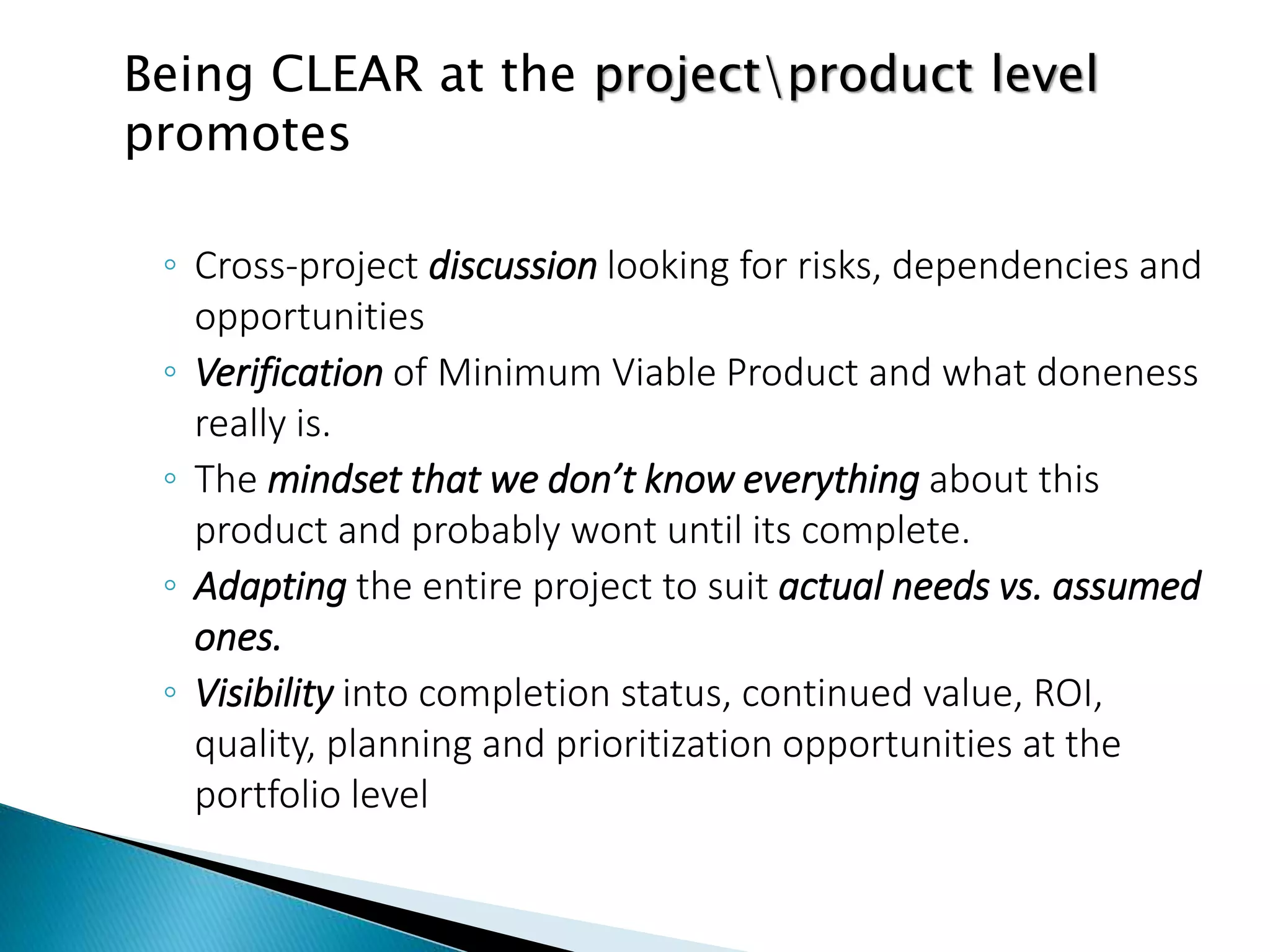
Being CLEAR at the projectproduct level
promotes
◦ Cross-project discussion looking for risks, dependencies and
opportunities
◦ Verification of Minimum Viable Product and what doneness
really is.
◦ The mindset that we don’t know everything about this
product and probably wont until its complete.
◦ Adapting the entire project to suit actual needs vs. assumed
ones.
◦ Visibility into completion status, continued value, ROI,
quality, planning and prioritization opportunities at the
portfolio level
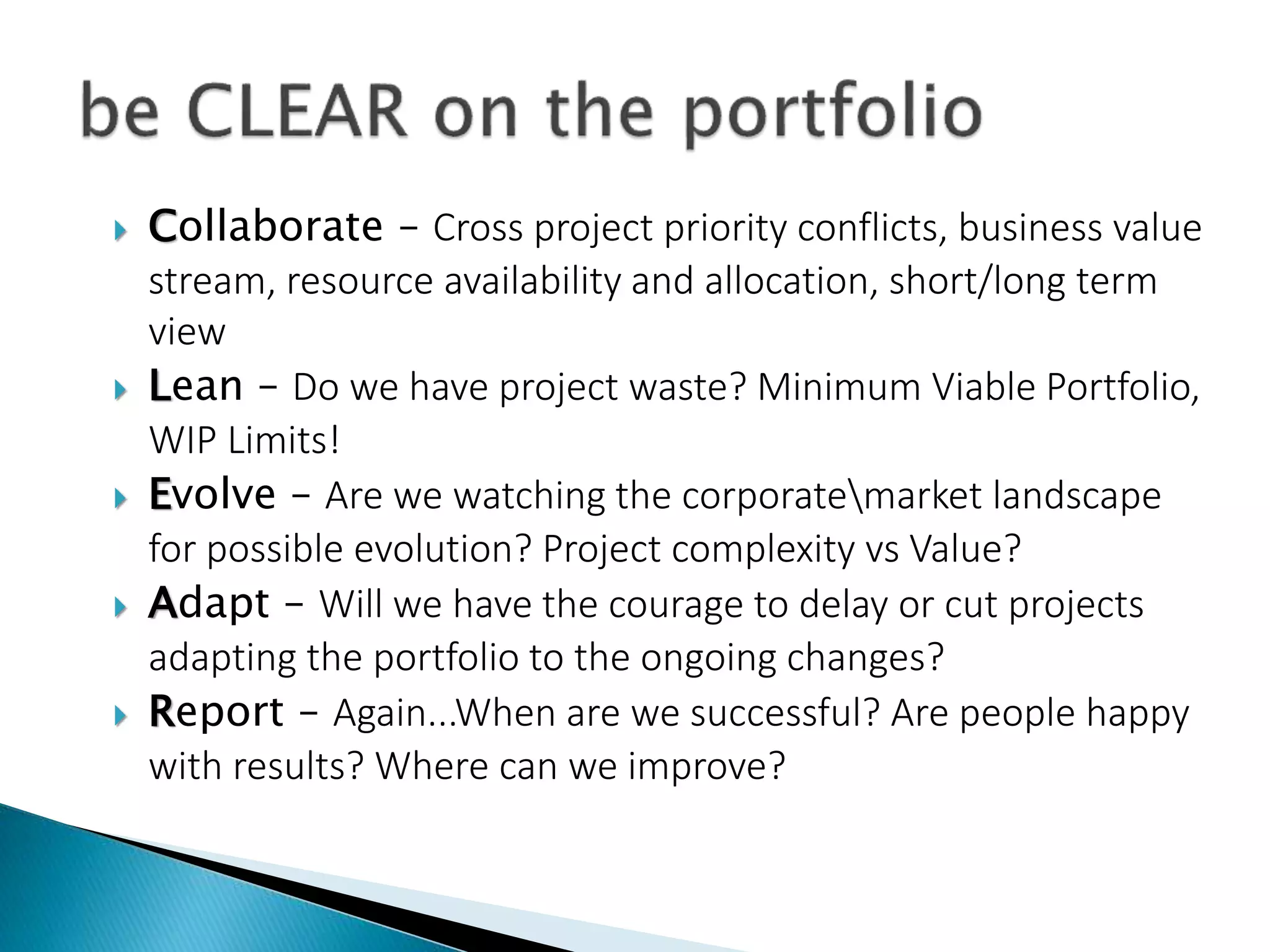
 Collaborate – Cross project priority conflicts, business value
stream, resource availability and allocation, short/long term
view
 Lean – Do we have project waste? Minimum Viable Portfolio,
WIP Limits!
 Evolve – Are we watching the corporatemarket landscape
for possible evolution? Project complexity vs Value?
 Adapt – Will we have the courage to delay or cut projects
adapting the portfolio to the ongoing changes?
 Report – Again...When are we successful? Are people happy
with results? Where can we improve?
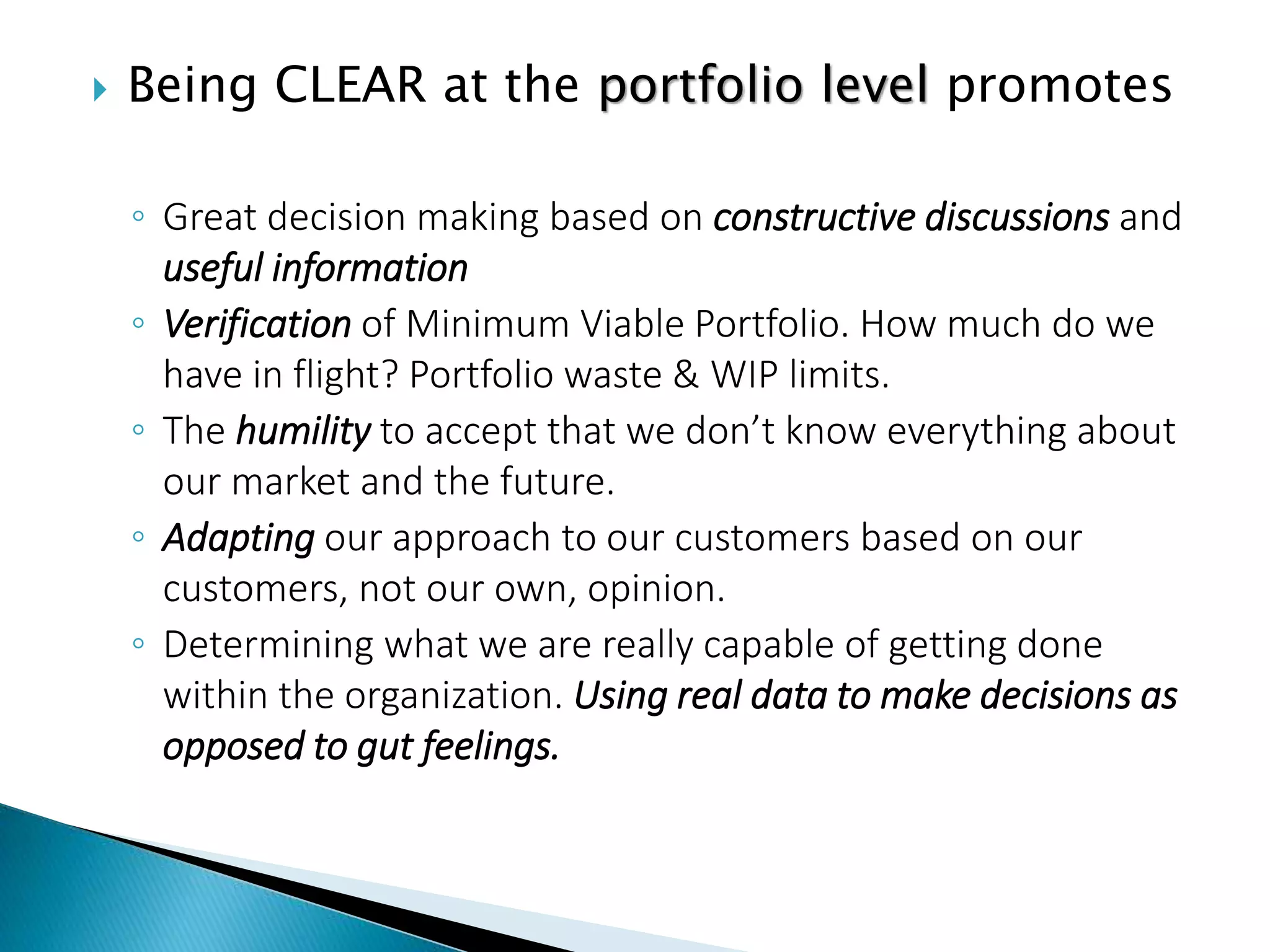
 Being CLEAR at the portfolio level promotes
◦ Great decision making based on constructive discussions and
useful information
◦ Verification of Minimum Viable Portfolio. How much do we
have in flight? Portfolio waste & WIP limits.
◦ The humility to accept that we don’t know everything about
our market and the future.
◦ Adapting our approach to our customers based on our
customers, not our own, opinion.
◦ Determining what we are really capable of getting done
within the organization. Using real data to make decisions as
opposed to gut feelings.
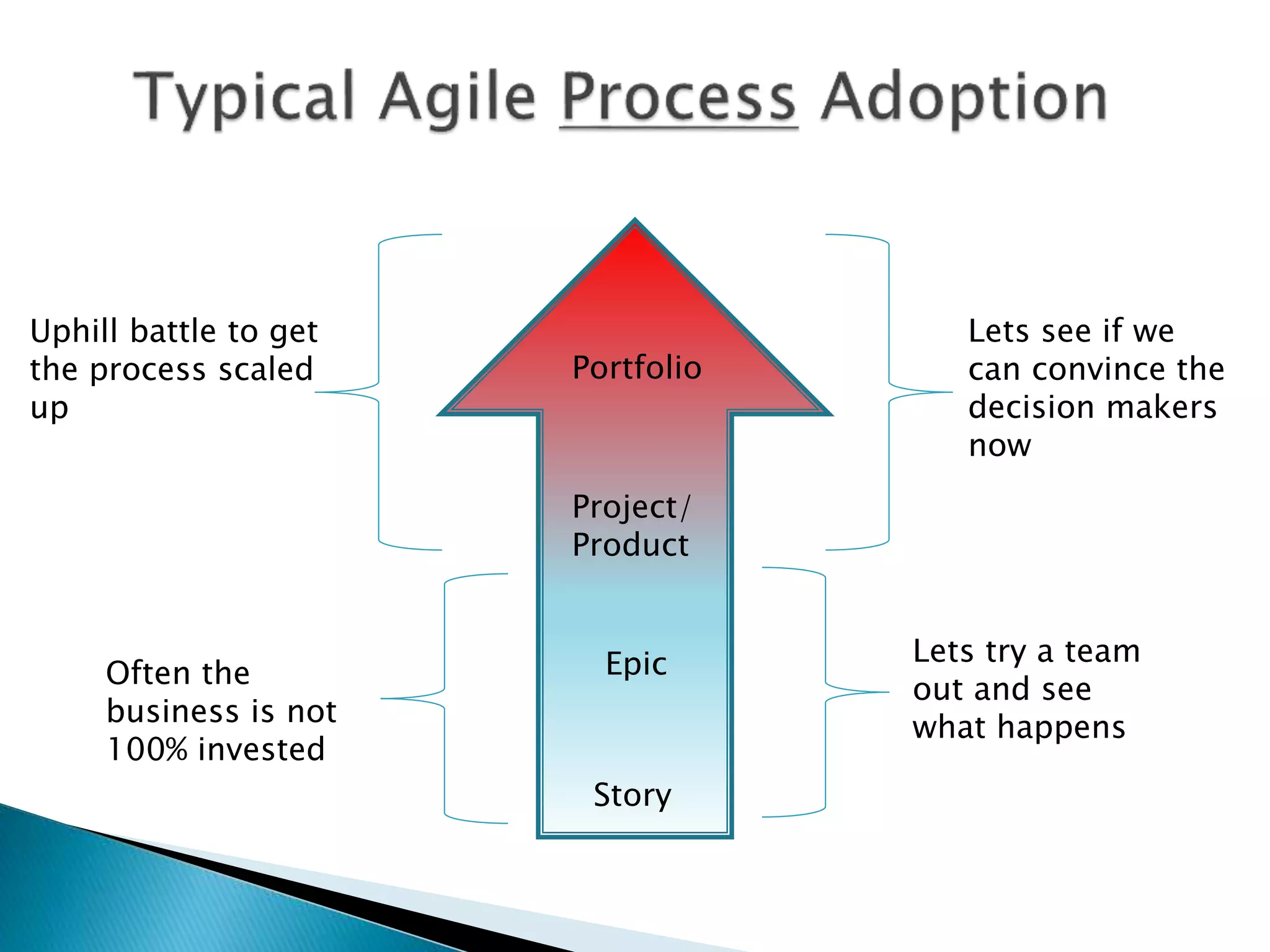
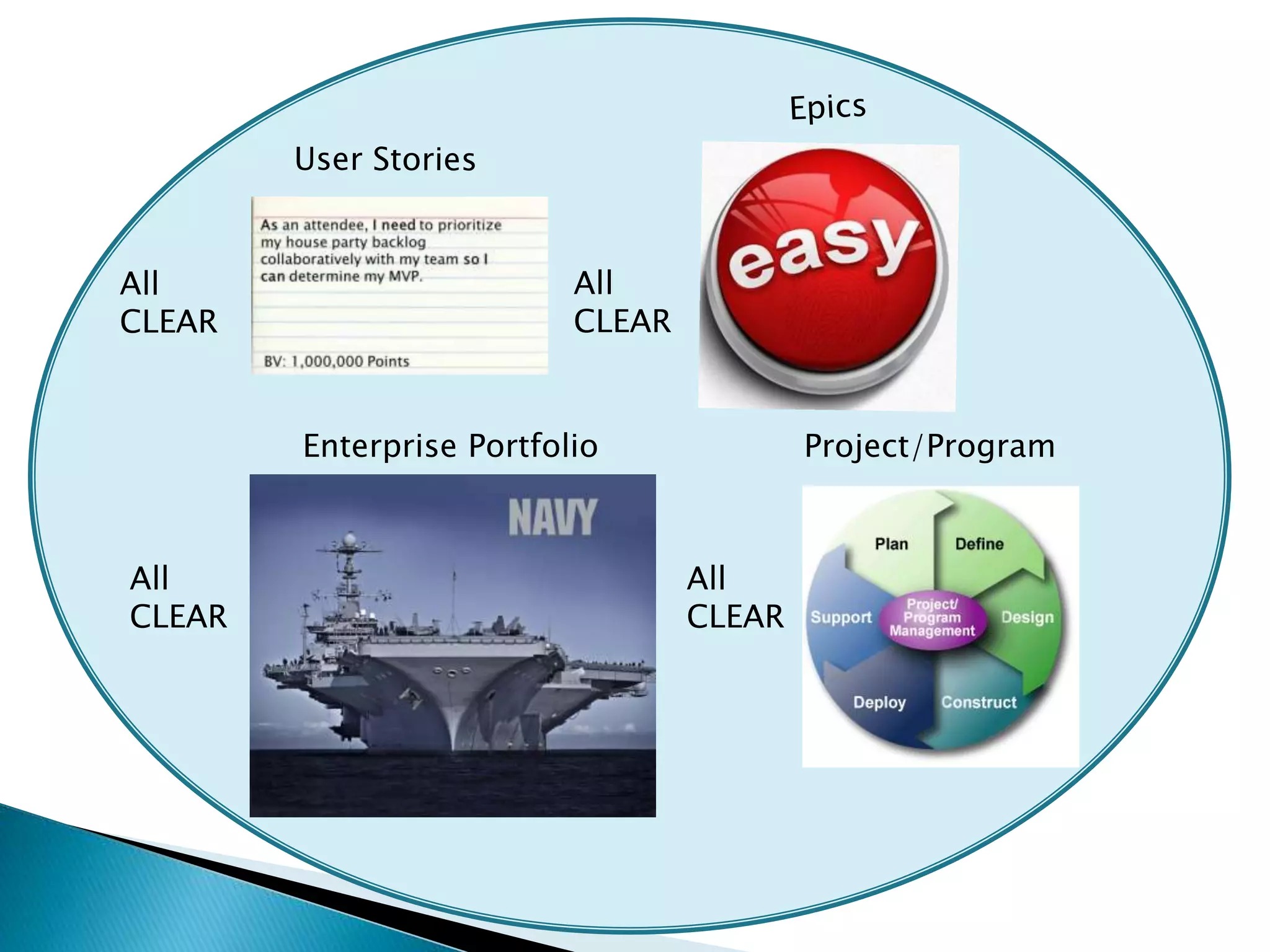
Portfolio
Project/
Product
Epic
Story
Lets try a team
out and see
what happens
Lets see if we
can convince the
decision makers
now
Often the
business is not
100% invested
Uphill battle to get
the process scaled
up
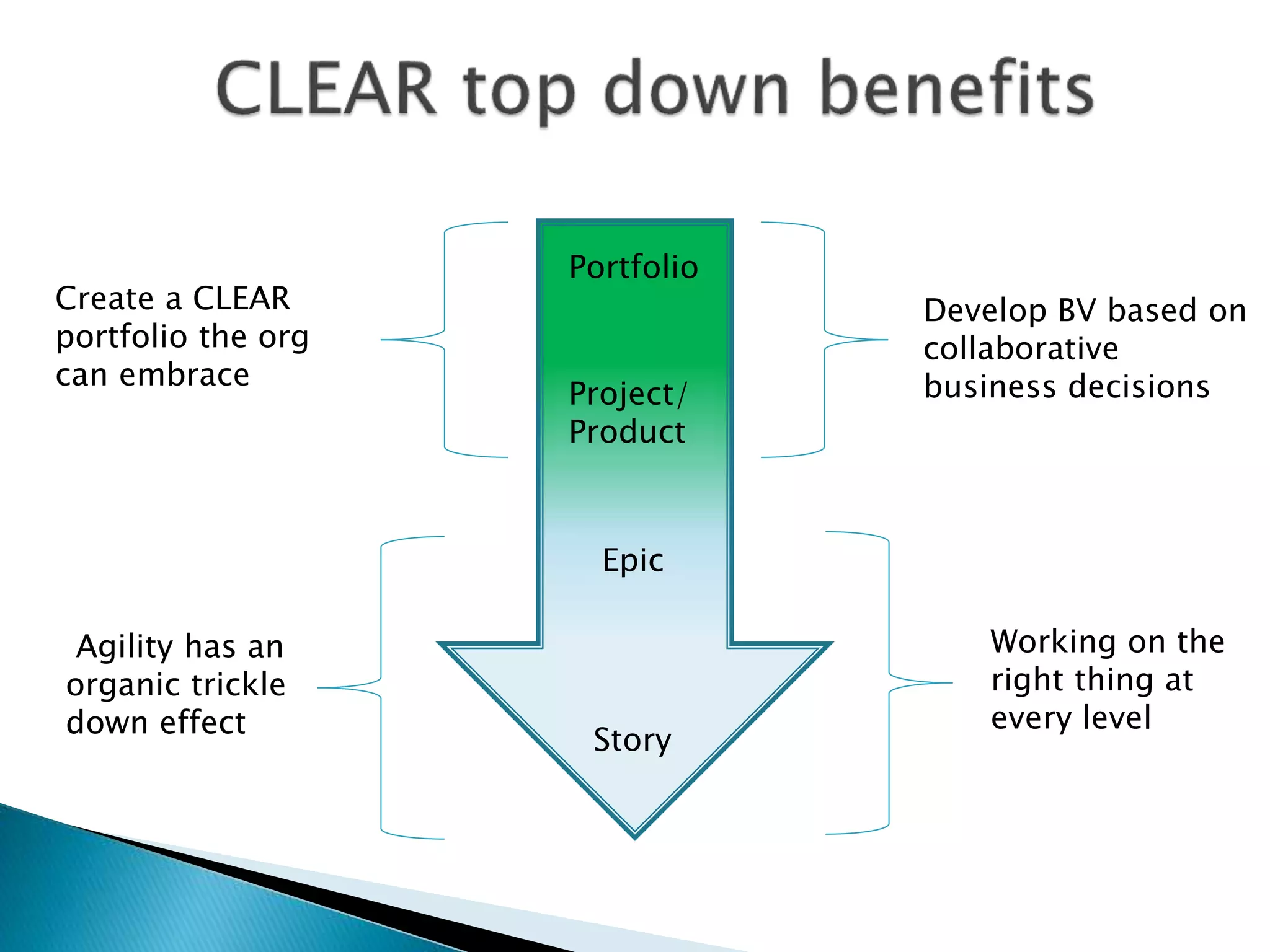
Portfolio
Project/
Product
Epic
Story
Develop BV based on
collaborative
business decisions
Agility has an
organic trickle
down effect
Create a CLEAR
portfolio the org
can embrace
Working on the
right thing at
every level
Project/ProgramEnterprise Portfolio
All
CLEAR
All
CLEAR
All
CLEAR
All
CLEAR
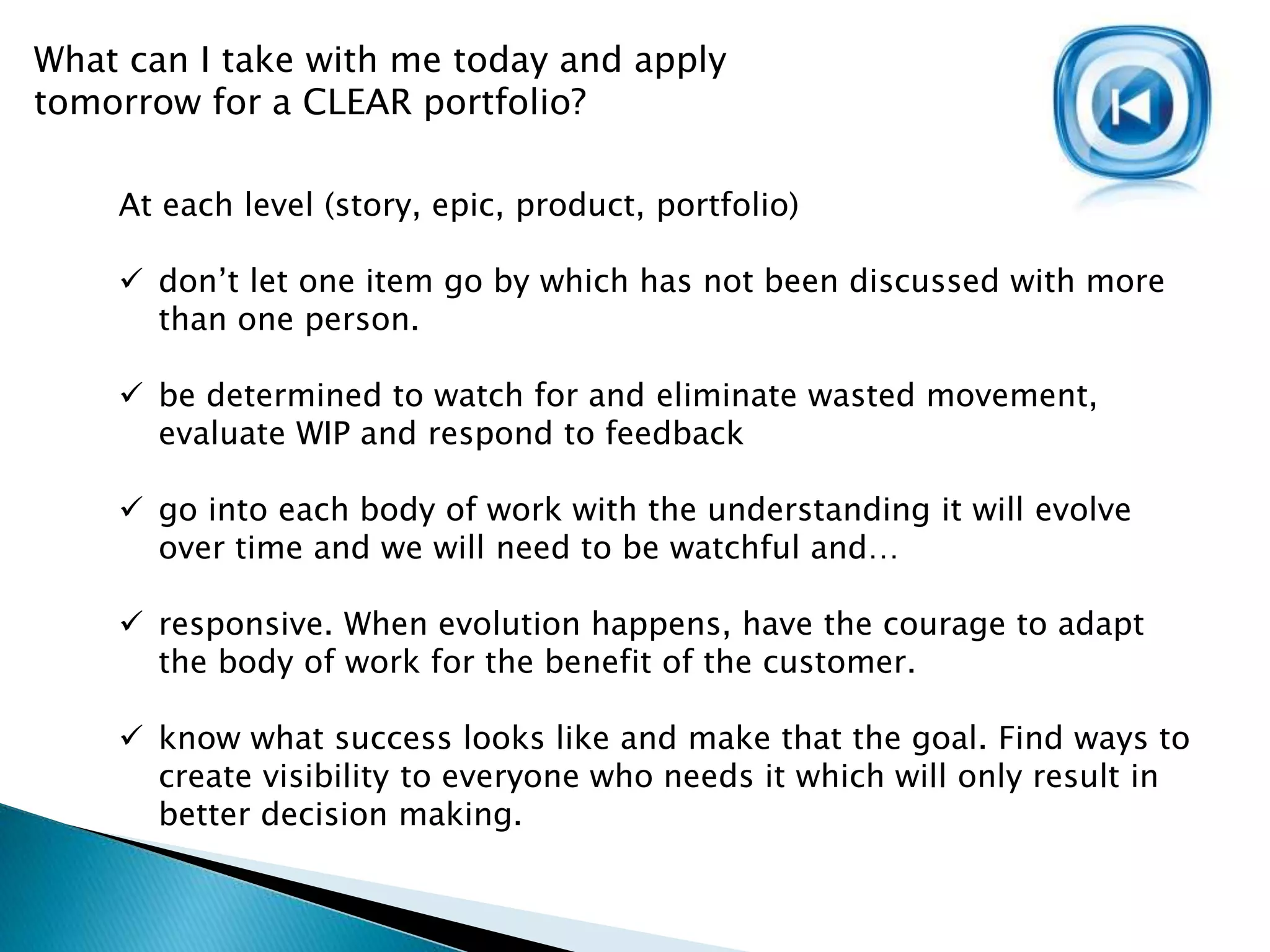
What can I take with me today and apply
tomorrow for a CLEAR portfolio?
At each level (story, epic, product, portfolio)
 don’t let one item go by which has not been discussed with more
than one person.
 be determined to watch for and eliminate wasted movement,
evaluate WIP and respond to feedback
 go into each body of work with the understanding it will evolve
over time and we will need to be watchful and…
 responsive. When evolution happens, have the courage to adapt
the body of work for the benefit of the customer.
 know what success looks like and make that the goal. Find ways to
create visibility to everyone who needs it which will only result in
better decision making.
STOP Doing Agile
START Being Agile
Are We All CLEAR?
Thank you for attending today!
Questions?
 Collaborative
 Lean
 Evolving
 Adaptable
 Reportable
Robert Woods –
Agile Coach & Delivery Manager
MATRIX Resources
@mindoverprocess

Agile & Beyond - Organically Scaled Agile: Creating a CLEAR Enterprise Portfolio

  • 1.
    Collaborative Lean Evolving Adaptable Reportable Organically Scaled Agile:Creating a CLEAR Project Portfolio Robert Woods – Agile Coach & Delivery Manager MATRIX Resources @mindoverprocess
  • 2.
    MATRIX OVERVIEW  32Years IT Solutions Experience  Privately-held, $210M Top 25 in the U.S.  National Firm with 12 offices across the U.S.  Offshore Services in India via Joint Venture Offshore Delivery Centers MATRIX Office MATRIX Virtual Office Offshore Delivery Center States MATRIX has supplied resources
  • 3.
    Agile portfolio managementis not about taking a bunch of ‘agile-like’ projects and throwing them into a portfolio; it’s about creating agility at the actual portfolio & decision-making level.
  • 4.
  • 5.
  • 6.
    09 Continuous attentionto technical excellence and good design enhances agility. 07 Working software is the primary measure of success. 08 The most efficient and effective method of conveying information to and within a development team is face-to- face conversation. 06 Agile processes promote sustainable development. The sponsors, developers, and users should be able to maintain a constant pace indefinitely. 05 Build project around motivated individuals. Give them the environment and support they need and trust them to get the work done. 04 Business people and developers must work together daily throughout the project. 01 Our highest priority is to satisfy the customer through early and continuous delivery of valuable software. 02 Welcome changing requirements, even late in development. Agile processes harness change for the customer’s advantage. 03 Deliver working software frequently, from a couple of weeks to a couple of months, with a preference to a shorter timescale. 10 Simplicity – the art of maximizing the amount of work not done – is essential. 11 The best architectures, requirements, and designs emerge from self-organizing teams. 12 At regular intervals, the team reflects on how to become more effective, the tunes and adjusts its behavior accordingly.
  • 7.
    Why do we tendto over- complicate things?
  • 13.
    There is adifference between scaling agility and scaling a process. (SCRUM/KANBAN/Etc.)
  • 14.
     Based oncommon failures (and successes) in scaling agility into a portfolio process  Focuses on some of the most core aspects of Agile principles that often get lost in scaling  Can be applied at every level of an enterprise portfolio  Is process agnostic and organically creates agility as opposed to forcing a framework-fit scenario.
  • 15.
    15 •Collaborative: We comeup with the best requirements and most innovative ideas through continual conversation around what will best fit our customer’s needs. •Lean – By ensuring we limit our work in progress, eliminate waste and knowing what done means. The concept of starting small, reviewing and adapting based on outcome and feedback. •Evolving – Go into this body of work with the mindset that it will need to evolve over time to the benefit of the customer. Embrace the idea of the evolution of the concept as opposed to fighting it. •Adaptable – Have the courage to create the change needed. While evolution is embracing the idea of change, adapting is initiating the change itself. Sometimes the most difficult part to follow through on. •Reportable – Critical to making good decisions is useful information. Choose carefully what information best represents your ability to determine success, completion and opportunity for improvement. The CLEAR Definition
  • 16.
    This sounds alittle too simplistic…
  • 18.
    1. What isthe reasoning behind taking a user story and pruning it down to a small consumable level? (Quick feedback, adaptability, response to change, fail quickly) 2. What is the value behind identifying a minimum viable product? (Good enough not perfect, quick to market, feedback, value) 3. Why is it important for a team to understand backlog priority? (Working right items, highest business value) 4. Top attributes of a truly Agile project/team? (Adaptability, collaborative, predictable, transparent)
  • 19.
    1. Why wouldyou slice a portfolio like you would user stories? (Quick feedback, adaptability, response to change, fail quickly) 2. What would the reasoning be behind minimum viable portfolio? (Good enough not perfect, quick to market, feedback, value) 3. Why is it important for a team to know portfolio priority? (Working right items, highest business value) 4. Top attributes of a truly Agile enterprise portfolio? (Adaptability, collaborative, predictable, transparent) beyond the basics
  • 20.
  • 21.
     Collaborate –determine user needs, work effort, innovation, value  Lean – Is there waste in this effort? Small enough?  Evolve – Watching for possible evolution in requirements, effort, or value.  Adapt – If above landscape has changed, shall we adapt? Change the story based on requirements, effort, or value evolution.  Report –Are people happy with results?
  • 22.
    Being CLEAR atthe story level promotes  Engagement with the all required people  Understanding the right amount of work to complete this item  Productive discussion around innovation  The mindset to watch for evolution in requirements  Adaptability when change in need is apparent from a customer point of view or technology point of view  Visibility into the work via success criteria and measurable progress
  • 23.
     Collaborate –determining higher level desires to break down into smaller slices  Lean – Where is the value in this epic? Wasted movement?  Evolve – As stories evolve, will we evolve the epic? Value? (opportunities or requirements?)  Adapt – Does this particular item still make sense where it is? Change it or eliminate it!  Report – When is this item complete or successful? Are people happy with results? Release reporting, initiative planning, etc.
  • 24.
     Being CLEARat the feature level promotes ◦ Engagement at both the team and business or stakeholder levels ◦ Productive discussion around innovation ◦ The mindset to watch for evolution in requirements (or opportunities) ◦ Adaptability when change in need is apparent from a customer point of view ◦ Visibility into the work via success criteria and opportunity for road-mapping and resource allocation
  • 25.
     Collaborative –To help determine cross dependencies, downstream impact, ongoing business value  Lean – Are we seeing value in right areas? Project waste? Frequent feedback? WIP issues and bottlenecks!  Evolving – Are we watching the project and customer landscape for market evolution?  Adaptive – Based on above, does this particular project still make sense? Change it or eliminate it!  Reportable – When are we successful (road-mapping)? Are people happy with results? Financial re-allocation opportunities or ongoing product development?
  • 26.
    Being CLEAR atthe projectproduct level promotes ◦ Cross-project discussion looking for risks, dependencies and opportunities ◦ Verification of Minimum Viable Product and what doneness really is. ◦ The mindset that we don’t know everything about this product and probably wont until its complete. ◦ Adapting the entire project to suit actual needs vs. assumed ones. ◦ Visibility into completion status, continued value, ROI, quality, planning and prioritization opportunities at the portfolio level
  • 27.
     Collaborate –Cross project priority conflicts, business value stream, resource availability and allocation, short/long term view  Lean – Do we have project waste? Minimum Viable Portfolio, WIP Limits!  Evolve – Are we watching the corporatemarket landscape for possible evolution? Project complexity vs Value?  Adapt – Will we have the courage to delay or cut projects adapting the portfolio to the ongoing changes?  Report – Again...When are we successful? Are people happy with results? Where can we improve?
  • 28.
     Being CLEARat the portfolio level promotes ◦ Great decision making based on constructive discussions and useful information ◦ Verification of Minimum Viable Portfolio. How much do we have in flight? Portfolio waste & WIP limits. ◦ The humility to accept that we don’t know everything about our market and the future. ◦ Adapting our approach to our customers based on our customers, not our own, opinion. ◦ Determining what we are really capable of getting done within the organization. Using real data to make decisions as opposed to gut feelings.
  • 29.
    Portfolio Project/ Product Epic Story Lets try ateam out and see what happens Lets see if we can convince the decision makers now Often the business is not 100% invested Uphill battle to get the process scaled up
  • 30.
    Portfolio Project/ Product Epic Story Develop BV basedon collaborative business decisions Agility has an organic trickle down effect Create a CLEAR portfolio the org can embrace Working on the right thing at every level
  • 31.
  • 32.
    What can Itake with me today and apply tomorrow for a CLEAR portfolio? At each level (story, epic, product, portfolio)  don’t let one item go by which has not been discussed with more than one person.  be determined to watch for and eliminate wasted movement, evaluate WIP and respond to feedback  go into each body of work with the understanding it will evolve over time and we will need to be watchful and…  responsive. When evolution happens, have the courage to adapt the body of work for the benefit of the customer.  know what success looks like and make that the goal. Find ways to create visibility to everyone who needs it which will only result in better decision making.
  • 33.
    STOP Doing Agile STARTBeing Agile Are We All CLEAR?
  • 34.
    Thank you forattending today! Questions?  Collaborative  Lean  Evolving  Adaptable  Reportable Robert Woods – Agile Coach & Delivery Manager MATRIX Resources @mindoverprocess