
How to Successfully Scale 
Agile in your Enterprise 
October 23, 2014
Tim Wise 
Enterprise Agile Coach 
tim@leadingagile.com 
linkedin.com/in/timwise 
twitter.com/timswise 
www.leadingagile.com 
facebook.com/leadingagile
Agenda 
• Agile Basics 
• Agile at Scale 
• Mapping out the Journey 
• Agile Pilot – Incremental Iterations for Fast 
ROI…
Agenda 
• Agile Basics 
• Agile at Scale 
• Mapping out the Journey 
• Agile Pilot – Incremental Iterations for Fast ROI
Agenda 
• Agile Basics 
• Agile at Scale 
• Mapping out the Journey 
• Agile Pilot – Incremental Iterations for Fast ROI
Agenda 
• Agile Basics 
• Agile at Scale 
• Mapping out the Journey 
• Agile Pilot – Incremental Iterations for Fast ROI
Agenda 
• Agile Basics 
• Agile at Scale 
• Mapping out the Journey 
• Agile Pilot – 
Incremental Iterations for Fast ROI
Agile Basics
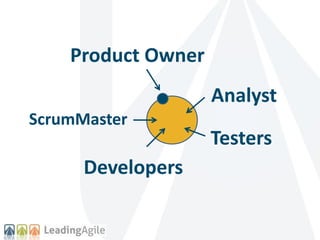
Product Owner 
Analyst 
Testers 
ScrumMaster 
Developers
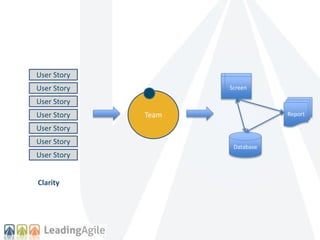
How Agile Teams Work
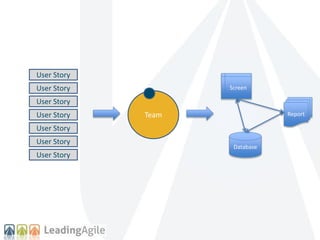
Team 
Database 
Report 
Screen 
User Story 
User Story 
User Story 
User Story 
User Story 
User Story 
User Story
Team 
Database 
Report 
Screen 
User Story 
User Story 
User Story 
User Story 
User Story 
User Story 
User Story 
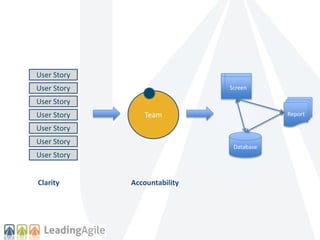
Clarity
Team 
Database 
Report 
Screen 
User Story 
User Story 
User Story 
User Story 
User Story 
User Story 
User Story 
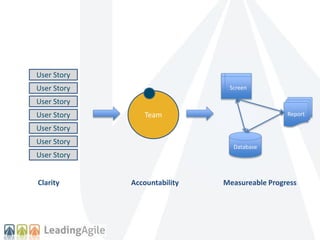
Clarity Accountability
Team 
Database 
Report 
Screen 
User Story 
User Story 
User Story 
User Story 
User Story 
User Story 
User Story 
Clarity Accountability Measureable Progress
Managing Scope
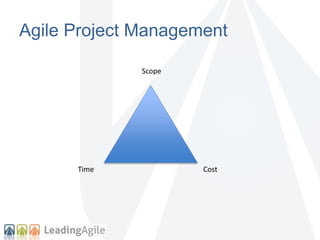
Agile Project Management 
Scope 
Time Cost
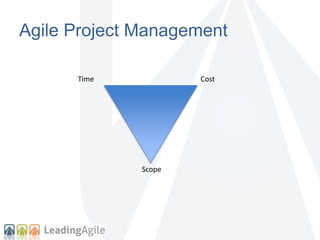
Agile Project Management 
Time Cost 
Scope
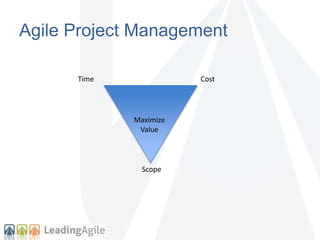
Agile Project Management 
Time Cost 
Maximize 
Value 
Scope
Agile at Scale
Different Teams for 
Different Jobs
Team 
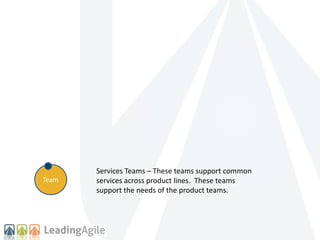
Services Teams – These teams support common 
services across product lines. These teams 
support the needs of the product teams.
Team 
Team 
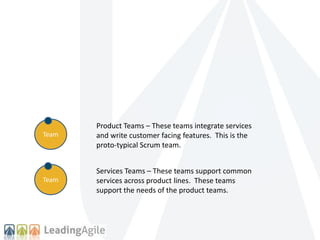
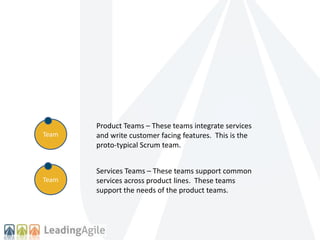
Product Teams – These teams integrate services 
and write customer facing features. This is the 
proto-typical Scrum team. 
Services Teams – These teams support common 
services across product lines. These teams 
support the needs of the product teams.
Team 
Team Team Team 
Team Team Team 
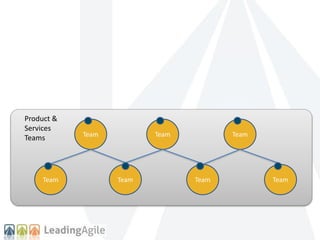
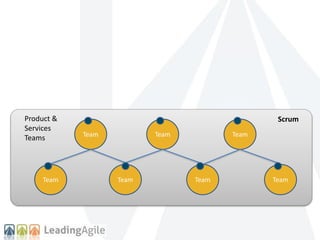
Product & 
Services 
Teams
Team 
Team Team Team 
Team Team Team 
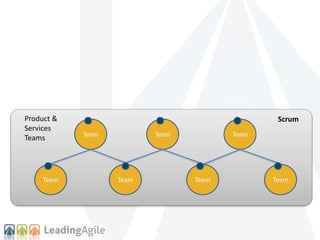
Product & 
Services 
Teams 
Scrum
Team 
Team 
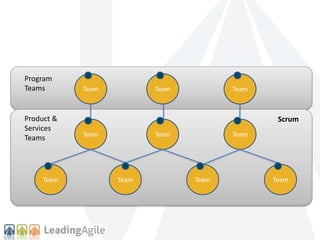
Product Teams – These teams integrate services 
and write customer facing features. This is the 
proto-typical Scrum team. 
Services Teams – These teams support common 
services across product lines. These teams 
support the needs of the product teams.
Team 
Team 
Team 
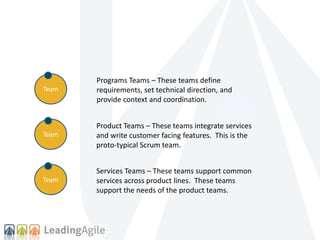
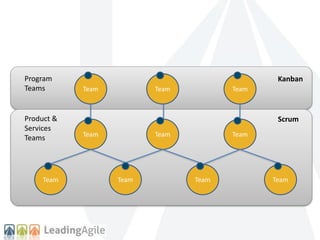
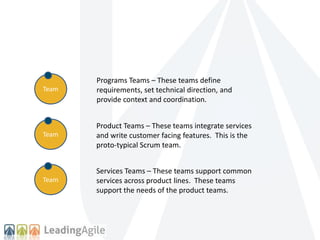
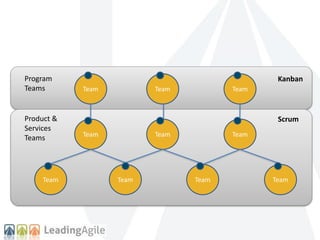
Programs Teams – These teams define 
requirements, set technical direction, and 
provide context and coordination. 
Product Teams – These teams integrate services 
and write customer facing features. This is the 
proto-typical Scrum team. 
Services Teams – These teams support common 
services across product lines. These teams 
support the needs of the product teams.
Team 
Team Team Team 
Team Team Team 
Product & 
Services 
Teams 
Scrum
Program 
Teams 
Team 
Team Team 
Team 
Team Team 
Team 
Team Team Team 
Product & 
Services 
Teams 
Scrum
Program 
Teams 
Team 
Team Team 
Team 
Team Team 
Team 
Kanban 
Team Team Team 
Product & 
Services 
Teams 
Scrum
Team 
Team 
Team 
Programs Teams – These teams define 
requirements, set technical direction, and 
provide context and coordination. 
Product Teams – These teams integrate services 
and write customer facing features. This is the 
proto-typical Scrum team. 
Services Teams – These teams support common 
services across product lines. These teams 
support the needs of the product teams.
Team 
Team 
Team 
Team 
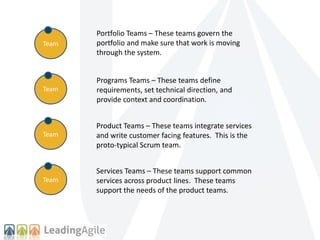
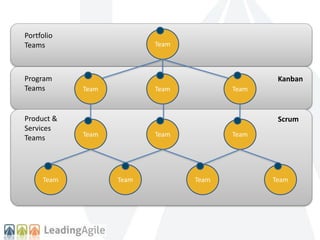
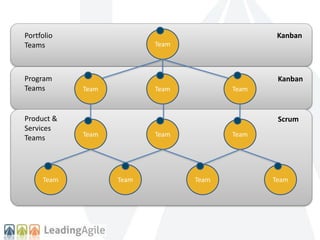
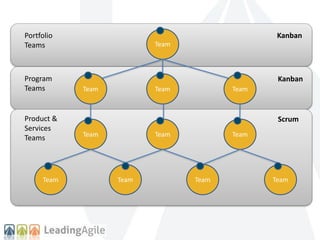
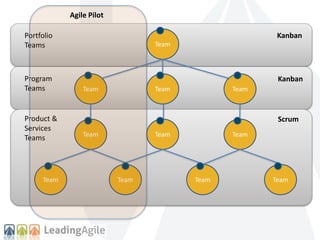
Portfolio Teams – These teams govern the 
portfolio and make sure that work is moving 
through the system. 
Programs Teams – These teams define 
requirements, set technical direction, and 
provide context and coordination. 
Product Teams – These teams integrate services 
and write customer facing features. This is the 
proto-typical Scrum team. 
Services Teams – These teams support common 
services across product lines. These teams 
support the needs of the product teams.
Program 
Teams 
Team 
Team Team 
Team 
Team Team 
Team 
Kanban 
Team Team Team 
Product & 
Services 
Teams 
Scrum
Portfolio 
Teams 
Program 
Teams 
Team 
Team 
Team 
Team 
Team 
Team Team 
Team 
Kanban 
Team Team Team 
Product & 
Services 
Teams 
Scrum
Portfolio 
Teams 
Program 
Teams 
Team 
Team 
Team 
Team 
Team 
Team Team 
Team 
Kanban 
Kanban 
Team Team Team 
Product & 
Services 
Teams 
Scrum
Agile Delivery Structure 
& Conway’s Law
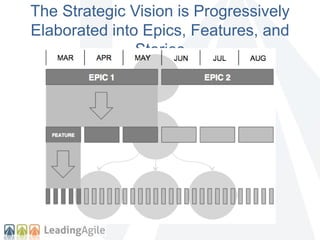
The Strategic Vision is Progressively 
Elaborated into Epics, Features, and 
Stories
Agile Governance
Done 
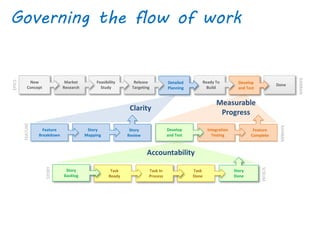
Governing the flow of work 
Develop 
and Test 
Ready To 
Build 
Detailed 
Planning 
Release 
Targeting 
Feasibility 
Study 
Market 
Research 
New 
Concept 
Feature 
Complete 
Integration 
Testing 
Develop 
and Test 
Story 
Review 
Story 
Mapping 
Feature 
Breakdown 
Story 
Done 
Task 
Done 
Task In 
Process 
Task 
Ready 
Story 
Backlog 
KANBAN 
FEATURE 
STORY 
EPICS 
KANBAN 
SCRUM 
Clarity 
Accountability 
Measurable 
Progress
How do you begin to get 
There?
Break Down the Agile 
Misconception 
What we say: “We want to do agile” 
What do they really hear?
Breaking Down the Agile Misconception 
A wise, retired CIO once told me. “Don’t sell me your 
solution, solve my problem.”
Beginning a Discussion of an Agile 
Transformation 
Our Problem: We are selling the solution not fixing the 
problem. 
Solution: Listen to customer needs 
Outcome: Shared Understanding of the real problem 
and a place to begin collaborating on a solution.
Their Problems 
• Predictability 
• Time to ROI 
• Quality 
• Economics 
• Adaptability 
• Risk Reduction
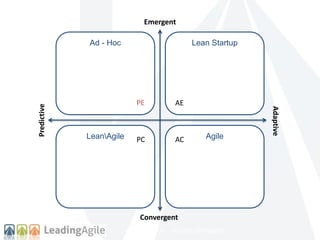
Finding where to start
Lean Startup 
PE 
AE 
PC AC 
–CONFIDENTIAL – DO NOT DISTRIBUTE - 
Ad - Hoc 
LeanAgile Agile 
Adaptive 
Predictive 
Emergent 
Convergent
Lean Startup 
AE 
–CONFIDENTIAL – DO NOT DISTRIBUTE - 
Ad - Hoc 
Lean/Agile Agile 
Adaptive 
Predictive 
Emergent 
Convergent 
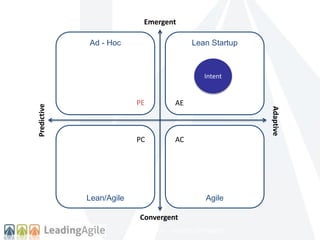
Intent 
PE 
PC AC
Lean Startup 
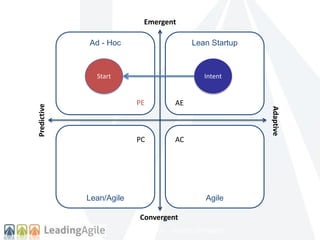
Start Intent 
PE 
AE 
PC AC 
–CONFIDENTIAL – DO NOT DISTRIBUTE - 
Ad - Hoc 
Lean/Agile Agile 
Adaptive 
Predictive 
Emergent 
Convergent
Lean Startup 
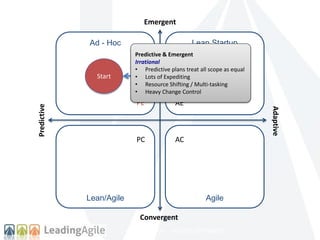
Predictive & Emergent 
Irrational 
• Predictive plans treat all scope as equal 
• Lots of Expediting 
• Resource Shifting / Multi-tasking 
• Heavy Change Control 
Start Intent 
PE 
AE 
PC AC 
–CONFIDENTIAL – DO NOT DISTRIBUTE - 
Ad - Hoc 
Lean/Agile Agile 
Adaptive 
Predictive 
Emergent 
Convergent
Lean Startup 
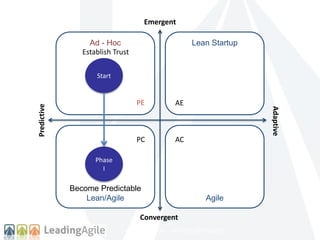
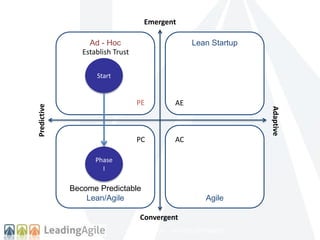
Establish Trust 
AE 
–CONFIDENTIAL – DO NOT DISTRIBUTE - 
Ad - Hoc 
Become Predictable 
Lean/Agile Agile 
Adaptive 
Predictive 
Emergent 
Convergent 
Start 
Phase 
I 
PE 
PC AC
Lean Startup 
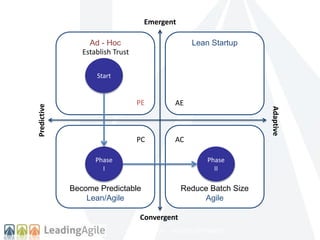
Establish Trust 
AE 
–CONFIDENTIAL – DO NOT DISTRIBUTE - 
Ad - Hoc 
Become Predictable 
Lean/Agile 
Reduce Batch Size 
Agile 
Adaptive 
Predictive 
Emergent 
Convergent 
Start 
Phase 
I 
Phase 
II 
PE 
PC AC
Lean Startup 
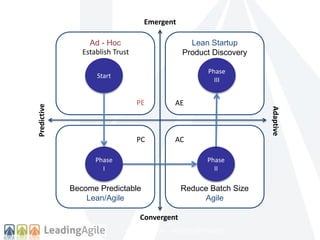
Product Discovery 
Establish Trust 
Phase 
III 
AE 
–CONFIDENTIAL – DO NOT DISTRIBUTE - 
Ad - Hoc 
Become Predictable 
Lean/Agile 
Reduce Batch Size 
Agile 
Adaptive 
Predictive 
Emergent 
Convergent 
Start 
Phase 
I 
Phase 
II 
PE 
PC AC
Up Next… 
- Mapping out the Journey
Mapping out the Journey
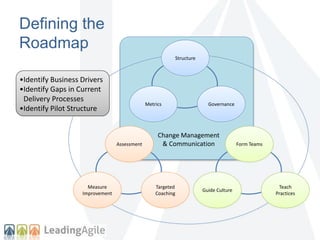
Defining the 
Roadmap 
Structure 
Metrics Governance 
Change Management 
& Communication 
Assessment 
Targeted 
Coaching 
Measure 
Improvement 
Form Teams 
Teach 
Practices 
Guide Culture 
•Identify Business Drivers 
•Identify Gaps in Current 
Delivery Processes 
•Identify Pilot Structure
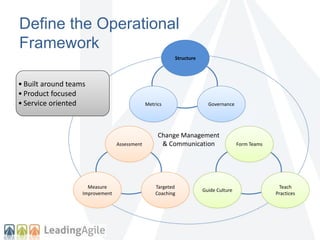
Define the Operational 
Framework 
Structure 
Metrics Governance 
Assessment 
Targeted 
Coaching 
Measure 
Improvement 
Form Teams 
Teach 
Practices 
Guide Culture 
• Built around teams 
• Product focused 
• Service oriented 
Change Management 
& Communication
Define the Operational 
Framework 
Structure 
Metrics Governance 
Change Management 
& Communication 
Assessment 
Targeted 
Coaching 
Measure 
Improvement 
Form Teams 
Teach 
Practices 
Guide Culture 
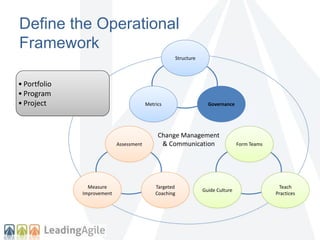
• Portfolio 
• Program 
• Project
Define the Operational 
Framework 
Structure 
Metrics Governance 
Change Management 
& Communication 
Assessment 
Targeted 
Coaching 
Measure 
Improvement 
Form Teams 
Teach 
Practices 
Guide Culture 
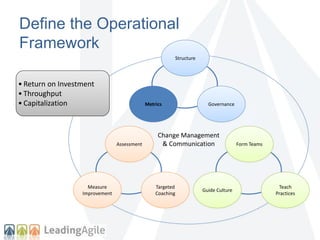
• Return on Investment 
• Throughput 
• Capitalization
Transforming through the 
Phases
Lean Startup 
Establish Trust 
AE 
–CONFIDENTIAL – DO NOT DISTRIBUTE - 
Ad - Hoc 
Become Predictable 
Lean/Agile Agile 
Adaptive 
Predictive 
Emergent 
Convergent 
Start 
Phase 
I 
PE 
PC AC
Agile Pilot – Incremental 
Iterations for Fast ROI
Portfolio 
Teams 
Program 
Teams 
Team 
Team 
Team 
Team 
Team 
Team Team 
Team 
Kanban 
Kanban 
Team Team Team 
Product & 
Services 
Teams 
Scrum
Portfolio 
Teams 
Program 
Teams 
Team 
Team 
Team 
Team 
Team 
Team Team 
Team 
Kanban 
Kanban 
Team Team Team 
Product & 
Services 
Teams 
Scrum 
Agile Pilot
Introduce Change 
Incrementally 
Structure 
Metrics Governance 
Change Management 
& Communication 
Assessment 
Targeted 
Coaching 
Measure 
Improvement 
Form Teams 
Teach 
Practices 
Guide Culture 
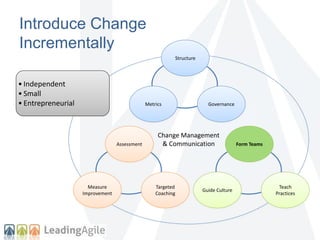
• Independent 
• Small 
• Entrepreneurial
Introduce Change 
Incrementally 
Structure 
Metrics Governance 
Change Management 
& Communication 
Assessment 
Targeted 
Coaching 
Measure 
Improvement 
Form Teams 
Teach 
Practices 
Guide Culture 
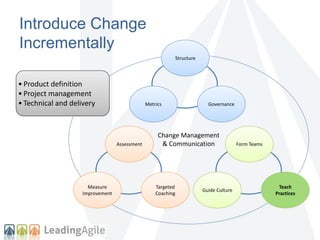
• Product definition 
• Project management 
• Technical and delivery
Introduce Change 
Incrementally 
Structure 
Metrics Governance 
Change Management 
& Communication 
Assessment 
Targeted 
Coaching 
Measure 
Improvement 
Form Teams 
Teach 
Practices 
Guide Culture 
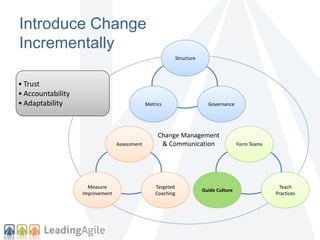
• Trust 
• Accountability 
• Adaptability
Measure 
Improvement 
Structure 
Metrics Governance 
Change Management 
& Communication 
Assessment 
Targeted 
Coaching 
Measure 
Improvement 
Form Teams 
Teach 
Practices 
Guide Culture 
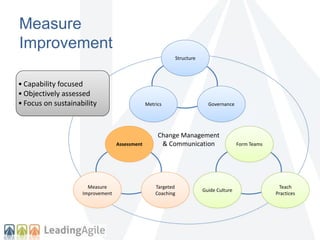
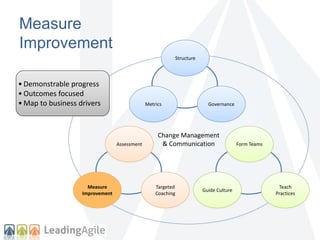
• Capability focused 
• Objectively assessed 
• Focus on sustainability
Measure 
Improvement 
Structure 
Metrics Governance 
Change Management 
& Communication 
Assessment 
Targeted 
Coaching 
Measure 
Improvement 
Form Teams 
Teach 
Practices 
Guide Culture 
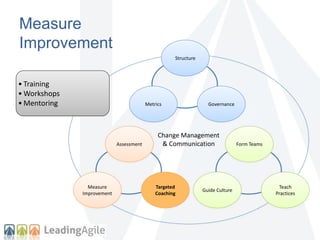
• Training 
•Workshops 
• Mentoring
Measure 
Improvement 
Structure 
Metrics Governance 
Change Management 
& Communication 
Assessment 
Targeted 
Coaching 
Measure 
Improvement 
Form Teams 
Teach 
Practices 
Guide Culture 
• Demonstrable progress 
• Outcomes focused 
• Map to business drivers
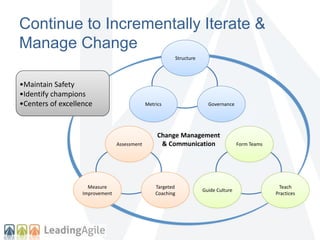
Continue to Incrementally Iterate & 
Manage Change 
Structure 
Metrics Governance 
Change Management 
& Communication 
Assessment 
Targeted 
Coaching 
Measure 
Improvement 
Form Teams 
Teach 
Practices 
Guide Culture 
•Maintain Safety 
•Identify champions 
•Centers of excellence
Tim Wise 
Enterprise Agile Coach 
tim@leadingagile.com 
twitter.com/timswise 
linkedin.com/in/timwise 
www.leadingagile.com 
facebook.com/leadingagile

How to scale agility in your enterprise

  • 1.
    How to SuccessfullyScale Agile in your Enterprise October 23, 2014
  • 2.
    Tim Wise EnterpriseAgile Coach tim@leadingagile.com linkedin.com/in/timwise twitter.com/timswise www.leadingagile.com facebook.com/leadingagile
  • 3.
    Agenda • AgileBasics • Agile at Scale • Mapping out the Journey • Agile Pilot – Incremental Iterations for Fast ROI…
  • 4.
    Agenda • AgileBasics • Agile at Scale • Mapping out the Journey • Agile Pilot – Incremental Iterations for Fast ROI
  • 5.
    Agenda • AgileBasics • Agile at Scale • Mapping out the Journey • Agile Pilot – Incremental Iterations for Fast ROI
  • 6.
    Agenda • AgileBasics • Agile at Scale • Mapping out the Journey • Agile Pilot – Incremental Iterations for Fast ROI
  • 7.
    Agenda • AgileBasics • Agile at Scale • Mapping out the Journey • Agile Pilot – Incremental Iterations for Fast ROI
  • 8.
  • 9.
    Product Owner Analyst Testers ScrumMaster Developers
  • 10.
  • 11.
    Team Database Report Screen User Story User Story User Story User Story User Story User Story User Story
  • 12.
    Team Database Report Screen User Story User Story User Story User Story User Story User Story User Story Clarity
  • 13.
    Team Database Report Screen User Story User Story User Story User Story User Story User Story User Story Clarity Accountability
  • 14.
    Team Database Report Screen User Story User Story User Story User Story User Story User Story User Story Clarity Accountability Measureable Progress
  • 15.
  • 16.
    Agile Project Management Scope Time Cost
  • 17.
    Agile Project Management Time Cost Scope
  • 18.
    Agile Project Management Time Cost Maximize Value Scope
  • 19.
  • 20.
    Different Teams for Different Jobs
  • 21.
    Team Services Teams– These teams support common services across product lines. These teams support the needs of the product teams.
  • 22.
    Team Team ProductTeams – These teams integrate services and write customer facing features. This is the proto-typical Scrum team. Services Teams – These teams support common services across product lines. These teams support the needs of the product teams.
  • 23.
    Team Team TeamTeam Team Team Team Product & Services Teams
  • 24.
    Team Team TeamTeam Team Team Team Product & Services Teams Scrum
  • 25.
    Team Team ProductTeams – These teams integrate services and write customer facing features. This is the proto-typical Scrum team. Services Teams – These teams support common services across product lines. These teams support the needs of the product teams.
  • 26.
    Team Team Team Programs Teams – These teams define requirements, set technical direction, and provide context and coordination. Product Teams – These teams integrate services and write customer facing features. This is the proto-typical Scrum team. Services Teams – These teams support common services across product lines. These teams support the needs of the product teams.
  • 27.
    Team Team TeamTeam Team Team Team Product & Services Teams Scrum
  • 28.
    Program Teams Team Team Team Team Team Team Team Team Team Team Product & Services Teams Scrum
  • 29.
    Program Teams Team Team Team Team Team Team Team Kanban Team Team Team Product & Services Teams Scrum
  • 30.
    Team Team Team Programs Teams – These teams define requirements, set technical direction, and provide context and coordination. Product Teams – These teams integrate services and write customer facing features. This is the proto-typical Scrum team. Services Teams – These teams support common services across product lines. These teams support the needs of the product teams.
  • 31.
    Team Team Team Team Portfolio Teams – These teams govern the portfolio and make sure that work is moving through the system. Programs Teams – These teams define requirements, set technical direction, and provide context and coordination. Product Teams – These teams integrate services and write customer facing features. This is the proto-typical Scrum team. Services Teams – These teams support common services across product lines. These teams support the needs of the product teams.
  • 32.
    Program Teams Team Team Team Team Team Team Team Kanban Team Team Team Product & Services Teams Scrum
  • 33.
    Portfolio Teams Program Teams Team Team Team Team Team Team Team Team Kanban Team Team Team Product & Services Teams Scrum
  • 34.
    Portfolio Teams Program Teams Team Team Team Team Team Team Team Team Kanban Kanban Team Team Team Product & Services Teams Scrum
  • 35.
    Agile Delivery Structure & Conway’s Law
  • 36.
    The Strategic Visionis Progressively Elaborated into Epics, Features, and Stories
  • 37.
  • 38.
    Done Governing theflow of work Develop and Test Ready To Build Detailed Planning Release Targeting Feasibility Study Market Research New Concept Feature Complete Integration Testing Develop and Test Story Review Story Mapping Feature Breakdown Story Done Task Done Task In Process Task Ready Story Backlog KANBAN FEATURE STORY EPICS KANBAN SCRUM Clarity Accountability Measurable Progress
  • 39.
    How do youbegin to get There?
  • 40.
    Break Down theAgile Misconception What we say: “We want to do agile” What do they really hear?
  • 41.
    Breaking Down theAgile Misconception A wise, retired CIO once told me. “Don’t sell me your solution, solve my problem.”
  • 42.
    Beginning a Discussionof an Agile Transformation Our Problem: We are selling the solution not fixing the problem. Solution: Listen to customer needs Outcome: Shared Understanding of the real problem and a place to begin collaborating on a solution.
  • 43.
    Their Problems •Predictability • Time to ROI • Quality • Economics • Adaptability • Risk Reduction
  • 44.
  • 45.
    Lean Startup PE AE PC AC –CONFIDENTIAL – DO NOT DISTRIBUTE - Ad - Hoc LeanAgile Agile Adaptive Predictive Emergent Convergent
  • 46.
    Lean Startup AE –CONFIDENTIAL – DO NOT DISTRIBUTE - Ad - Hoc Lean/Agile Agile Adaptive Predictive Emergent Convergent Intent PE PC AC
  • 47.
    Lean Startup StartIntent PE AE PC AC –CONFIDENTIAL – DO NOT DISTRIBUTE - Ad - Hoc Lean/Agile Agile Adaptive Predictive Emergent Convergent
  • 48.
    Lean Startup Predictive& Emergent Irrational • Predictive plans treat all scope as equal • Lots of Expediting • Resource Shifting / Multi-tasking • Heavy Change Control Start Intent PE AE PC AC –CONFIDENTIAL – DO NOT DISTRIBUTE - Ad - Hoc Lean/Agile Agile Adaptive Predictive Emergent Convergent
  • 49.
    Lean Startup EstablishTrust AE –CONFIDENTIAL – DO NOT DISTRIBUTE - Ad - Hoc Become Predictable Lean/Agile Agile Adaptive Predictive Emergent Convergent Start Phase I PE PC AC
  • 50.
    Lean Startup EstablishTrust AE –CONFIDENTIAL – DO NOT DISTRIBUTE - Ad - Hoc Become Predictable Lean/Agile Reduce Batch Size Agile Adaptive Predictive Emergent Convergent Start Phase I Phase II PE PC AC
  • 51.
    Lean Startup ProductDiscovery Establish Trust Phase III AE –CONFIDENTIAL – DO NOT DISTRIBUTE - Ad - Hoc Become Predictable Lean/Agile Reduce Batch Size Agile Adaptive Predictive Emergent Convergent Start Phase I Phase II PE PC AC
  • 52.
    Up Next… -Mapping out the Journey
  • 53.
  • 54.
    Defining the Roadmap Structure Metrics Governance Change Management & Communication Assessment Targeted Coaching Measure Improvement Form Teams Teach Practices Guide Culture •Identify Business Drivers •Identify Gaps in Current Delivery Processes •Identify Pilot Structure
  • 55.
    Define the Operational Framework Structure Metrics Governance Assessment Targeted Coaching Measure Improvement Form Teams Teach Practices Guide Culture • Built around teams • Product focused • Service oriented Change Management & Communication
  • 56.
    Define the Operational Framework Structure Metrics Governance Change Management & Communication Assessment Targeted Coaching Measure Improvement Form Teams Teach Practices Guide Culture • Portfolio • Program • Project
  • 57.
    Define the Operational Framework Structure Metrics Governance Change Management & Communication Assessment Targeted Coaching Measure Improvement Form Teams Teach Practices Guide Culture • Return on Investment • Throughput • Capitalization
  • 58.
  • 59.
    Lean Startup EstablishTrust AE –CONFIDENTIAL – DO NOT DISTRIBUTE - Ad - Hoc Become Predictable Lean/Agile Agile Adaptive Predictive Emergent Convergent Start Phase I PE PC AC
  • 60.
    Agile Pilot –Incremental Iterations for Fast ROI
  • 61.
    Portfolio Teams Program Teams Team Team Team Team Team Team Team Team Kanban Kanban Team Team Team Product & Services Teams Scrum
  • 62.
    Portfolio Teams Program Teams Team Team Team Team Team Team Team Team Kanban Kanban Team Team Team Product & Services Teams Scrum Agile Pilot
  • 63.
    Introduce Change Incrementally Structure Metrics Governance Change Management & Communication Assessment Targeted Coaching Measure Improvement Form Teams Teach Practices Guide Culture • Independent • Small • Entrepreneurial
  • 64.
    Introduce Change Incrementally Structure Metrics Governance Change Management & Communication Assessment Targeted Coaching Measure Improvement Form Teams Teach Practices Guide Culture • Product definition • Project management • Technical and delivery
  • 65.
    Introduce Change Incrementally Structure Metrics Governance Change Management & Communication Assessment Targeted Coaching Measure Improvement Form Teams Teach Practices Guide Culture • Trust • Accountability • Adaptability
  • 66.
    Measure Improvement Structure Metrics Governance Change Management & Communication Assessment Targeted Coaching Measure Improvement Form Teams Teach Practices Guide Culture • Capability focused • Objectively assessed • Focus on sustainability
  • 67.
    Measure Improvement Structure Metrics Governance Change Management & Communication Assessment Targeted Coaching Measure Improvement Form Teams Teach Practices Guide Culture • Training •Workshops • Mentoring
  • 68.
    Measure Improvement Structure Metrics Governance Change Management & Communication Assessment Targeted Coaching Measure Improvement Form Teams Teach Practices Guide Culture • Demonstrable progress • Outcomes focused • Map to business drivers
  • 69.
    Continue to IncrementallyIterate & Manage Change Structure Metrics Governance Change Management & Communication Assessment Targeted Coaching Measure Improvement Form Teams Teach Practices Guide Culture •Maintain Safety •Identify champions •Centers of excellence
  • 71.
    Tim Wise EnterpriseAgile Coach tim@leadingagile.com twitter.com/timswise linkedin.com/in/timwise www.leadingagile.com facebook.com/leadingagile

Editor's Notes

  • #19 End of scrum – Next is agile at scale
  • #35 Clear accountability and alignment of the system will foster responsibility and loose coupling products that you produce. Talk about Kanban here and why we use it.
  • #36 Design of the communication influences the architecture of the products produced Over time, this leads to decoupling. Think about cross functional
  • #37 Elaborate on conways law
  • #39 It’s all about getting a ready backlog to the teams
  • #41 Agile and scrum in particular, has a bad rap. It has failed for many. Maybe a fairer statement would be that many have failed it. However, that is not the issue… Intent – point out that agile doesn’t mean… scrum or TDD Agile – “We want to do our own thing” or “We want to do something that has made you look bad before” or “We don’t want to use hours for estimation, we are a bunch of hippies and we estimate in rainbows.”
  • #42 We have been selling a solution, but we haven’t listened to the problem.
  • #43  Intent – point out that agile doesn’t mean… scrum or TDD
  • #44 Predictability Time to ROI Quality – How satisfied are their customers and how much are they paying on the backend of delivering solutions Economics – Market pressures are calling for them to do more with less Adaptability –The need to adapt and run experiments with the market quickly Risk Reduction – Early and Often