Preeti Kana Sikder
Lecturer
Department of Law & Justice
Jahangirnagar University
Principles of Trust
Relevant portions of The
Trusts Act, 1882 for this
course
1. Creation of Trusts
2. Classification of Trusts
3. Rights of Beneficiaries and
Trustees
4. Duties of Trustees and
Beneficiaries
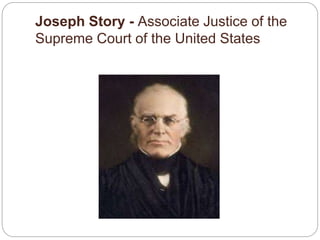
Joseph Story - Associate Justice of the
Supreme Court of the United States
Classification of Equitable
Rights
 Equities to protect confidences, i.e.
Trust
 Equities to prevent oppression, i.e.
issues relating to mortgage and liens,
protection of infants, lunatics.
 Equities to promote fair dealings, i.e.
protection from fraud and undue
influence, Accident, Set off.
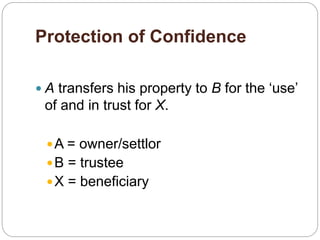
Protection of Confidence
 A transfers his property to B for the ‘use’
of and in trust for X.
A = owner/settlor
B = trustee
X = beneficiary
Why would anyone want to set up
trusts in modern era?
 To provide for loved ones in a way one cannot
do, or it would be unwise to do, simply by
transferring legal title.
 A minor can not become a legal owner,
therefore if someone wants the minor to have
any land, it must be held on trust by someone
else.
 One may be worried that his son is a
spendthrift, and so give money for his
expenses to a trustee to dispense.
Classification of Trust
Page 225 of BM Gandhi
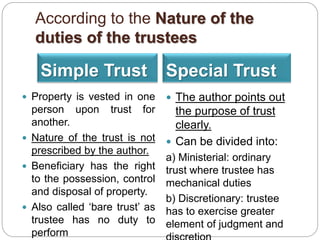
According to the Nature of the
duties of the trustees
Simple Trust Special Trust
 Property is vested in one
person upon trust for
another.
 Nature of the trust is not
prescribed by the author.
 Beneficiary has the right
to the possession, control
and disposal of property.
 Also called ‘bare trust’ as
trustee has no duty to
perform
 The author points out
the purpose of trust
clearly.
 Can be divided into:
a) Ministerial: ordinary
trust where trustee has
mechanical duties
b) Discretionary: trustee
has to exercise greater
element of judgment and
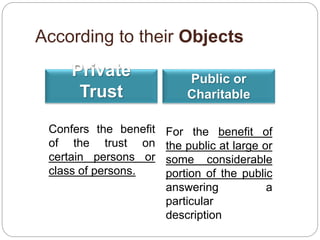
According to their Objects
Private
Trust
Public or
Charitable
Confers the benefit
of the trust on
certain persons or
class of persons.
For the benefit of
the public at large or
some considerable
portion of the public
answering a
particular
description
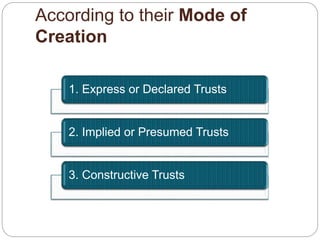
According to their Mode of
Creation
1. Express or Declared Trusts
2. Implied or Presumed Trusts
3. Constructive Trusts
According to their Mode of
Creation
4. Resulting Trusts
5. Precatory Trusts
6. Secret Trusts
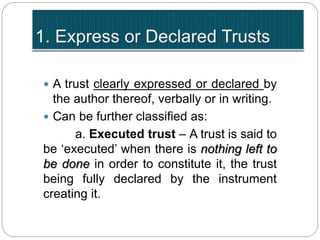
 A trust clearly expressed or declared by
the author thereof, verbally or in writing.
 Can be further classified as:
a. Executed trust – A trust is said to
be ‘executed’ when there is nothing left to
be done in order to constitute it, the trust
being fully declared by the instrument
creating it.
b. Executory trust – A trust is
executory when something remains to
be done in order to complete it.
If the service has been imperfectly
created at the outset, and the creator
of the trust has merely devoted his
ultimate object imposing on the
trustee or on the court the duty of
effectuating it in the most convenient
 A trust which is not so clearly expressed
but is indirectly gathered from the
settlor’s “presumable intention”.
 It arises where property is not held by a
person subject to any declared trust but
vested in him under such circumstances
that the court is held to presume that the
property so vested is intended to be
held in trust for his own benefit or for
benefit of another.
3. Constructive Trust
 A trust not created by words or
circumstances importing an intention to
create a trust, but is imposed by Courts
of Equity in order to prevent the
inequitable acquisition of another’s
property.
 It arises in case of an unconscionable
advantage gained by a fiduciary or by
any other person.
Resulting Trust
 The beneficial interest in the property
‘results’ or comes back to the person
who transferred the property to the
trustee, or provided the means for
obtaining it.
 A trust arising or resulting, in favour of
either of the person who creates it, or
his representatives.
 A species of implied trust.
Resulting Trust
 This trust arises in the following
three ways–
a) Where a purchase is made in
another’s name or a transfer is
made without consideration.
b) Where the beneficial interest has
been disposed of either wholly or
partially
c) Where the trusts declared are
illegal.
Precatory Trust
 A trust declared and created not by
express words, but by precatory words.
 No technical words are required to
constitute such trust.
 Where a trust appears to be intended,
but words of recommendation or
entreaty are used, it’s called precatory
trust.
Secret Trust
 This trust arises only in cases of transfer
by will, when at the time of writing the
will, the testator does not declare his
intention to create trust, but he discloses
his intention after writing the will.
 A trust not disclosed on the face of the
will.
Secret Trust
 A secret trust is created when property
is given to a person either absolutely or
upon an indefinite trust, but there has
been an understanding given by him or
an understanding between him and the
donor, that it shall be applied for the
benefit of some other person or object.
Section 3: Trusts Act,
1882
A trust is an obligation annexed to
the ownership of property, and
arising out of a confidence reposed
in and accepted by the owner, or
declared and accepted by him, for
the benefit of another, or of another
and the owner
Legal Definition of Trust
 This definition covers only a specific field in the
concept of trusts, which is private express
trusts..
 Firstly, it emphasises upon obligation, laying
down that a trust is an obligation annexed to the
ownership of property for the benefit of another.
There is no trust where such obligation is
absent.
 Secondly, the beneficiary has no interest in the
trust property but has only a right against the
trustee who is the owner of the property
 Lastly, the settlor himself can be a trustee.
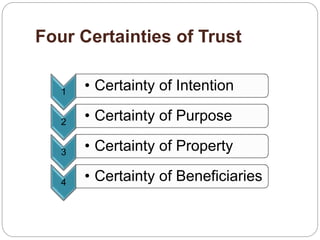
Four Certainties of Trust
1 • Certainty of Intention
2 • Certainty of Purpose
3 • Certainty of Property
4 • Certainty of Beneficiaries
Creation of Trusts
Parties to a Trust (Section 3)
 the person who reposes or declares
the confidence is called the author of
the trust:
 the person who accepts the
confidence is called the trustee:
 the person for whose benefit the
confidence is accepted is called the
beneficiary:
Creation of Trusts
Who may create Trust (Section 7)
 A trust may be created-
(a) by every person competent to
contract, and,
(b) with the permission of a principal Civil
Court of original jurisdiction, by or on
behalf of a minor
Creation of Trusts
Who may be beneficiary (Section
9)
 Every person capable of holding
property may be a beneficiary.
Creation of Trusts
Who may be Trustee (Section 10 )
 Every person capable of holding
property may be a trustee; but,
where the trust involves the
exercise of discretion, he cannot
execute it unless he is competent to
contract.
Creation of Trusts
Right to proper trustees (Section 60)
 The beneficiary has a right (subject to the provisions
of the instrument of trust) that the trust property shall
be properly protected and held and administered by
proper persons and by a proper number of such
persons.
Explanation I - The following are not proper persons
within the meaning of this section:-
 A person domiciled abroad:
 an alien enemy:
 a person having an interest inconsistent with that of the
beneficiary:
 a person in insolvent circumstances; and,
 unless the personal law of the beneficiary allows
otherwise, a married woman and a minor.
Creation of Trusts
When is a Trust Created (Section 6)
 Subject to the provisions of section 5, a trust is
created when the author of the trust indicates with
reasonable certainty by any words or acts
(a) an intention on his part to create thereby a trust,
(b) the purpose of the trust,
(c) the beneficiary, and
(d) the trust-property, and
(e) (unless the trust is declared by will or the author
of the trust is himself to be the trustee) transfers
the trust property to the trustee.
Who are competent to contract?
Section 11 of Contract Act, 1872
 Every person is competent to contract who is of
the age of majority according to the law to which
he is subject, and who is of sound mind, and is
not disqualified from contracting by any law to
which he is subject.
Sui Juris
Section 11 of Contract Act, 1872
 Every person is competent to contract who is of
the age of majority according to the law to which
he is subject, and who is of sound mind, and is
not disqualified from contracting by any law to
which he is subject.
Majority Act, 1985
 Every other person domiciled in
Bangladesh shall be deemed to have
attained his majority when he shall have
completed his age of eighteen years and
not before
Important to remember
Beneficiary has no estate or interest
in the subject matter of the trust. He
has only right to proceed against the
trustee

Principles of Trust: Classification and Creation

  • 1.
    Preeti Kana Sikder Lecturer Departmentof Law & Justice Jahangirnagar University Principles of Trust
  • 2.
    Relevant portions ofThe Trusts Act, 1882 for this course 1. Creation of Trusts 2. Classification of Trusts 3. Rights of Beneficiaries and Trustees 4. Duties of Trustees and Beneficiaries
  • 3.
    Joseph Story -Associate Justice of the Supreme Court of the United States
  • 4.
    Classification of Equitable Rights Equities to protect confidences, i.e. Trust  Equities to prevent oppression, i.e. issues relating to mortgage and liens, protection of infants, lunatics.  Equities to promote fair dealings, i.e. protection from fraud and undue influence, Accident, Set off.
  • 5.
    Protection of Confidence A transfers his property to B for the ‘use’ of and in trust for X. A = owner/settlor B = trustee X = beneficiary
  • 6.
    Why would anyonewant to set up trusts in modern era?  To provide for loved ones in a way one cannot do, or it would be unwise to do, simply by transferring legal title.  A minor can not become a legal owner, therefore if someone wants the minor to have any land, it must be held on trust by someone else.  One may be worried that his son is a spendthrift, and so give money for his expenses to a trustee to dispense.
  • 7.
  • 8.
    According to theNature of the duties of the trustees Simple Trust Special Trust  Property is vested in one person upon trust for another.  Nature of the trust is not prescribed by the author.  Beneficiary has the right to the possession, control and disposal of property.  Also called ‘bare trust’ as trustee has no duty to perform  The author points out the purpose of trust clearly.  Can be divided into: a) Ministerial: ordinary trust where trustee has mechanical duties b) Discretionary: trustee has to exercise greater element of judgment and
  • 9.
    According to theirObjects Private Trust Public or Charitable Confers the benefit of the trust on certain persons or class of persons. For the benefit of the public at large or some considerable portion of the public answering a particular description
  • 10.
    According to theirMode of Creation 1. Express or Declared Trusts 2. Implied or Presumed Trusts 3. Constructive Trusts
  • 11.
    According to theirMode of Creation 4. Resulting Trusts 5. Precatory Trusts 6. Secret Trusts
  • 12.
     A trustclearly expressed or declared by the author thereof, verbally or in writing.  Can be further classified as: a. Executed trust – A trust is said to be ‘executed’ when there is nothing left to be done in order to constitute it, the trust being fully declared by the instrument creating it.
  • 13.
    b. Executory trust– A trust is executory when something remains to be done in order to complete it. If the service has been imperfectly created at the outset, and the creator of the trust has merely devoted his ultimate object imposing on the trustee or on the court the duty of effectuating it in the most convenient
  • 14.
     A trustwhich is not so clearly expressed but is indirectly gathered from the settlor’s “presumable intention”.  It arises where property is not held by a person subject to any declared trust but vested in him under such circumstances that the court is held to presume that the property so vested is intended to be held in trust for his own benefit or for benefit of another.
  • 15.
    3. Constructive Trust A trust not created by words or circumstances importing an intention to create a trust, but is imposed by Courts of Equity in order to prevent the inequitable acquisition of another’s property.  It arises in case of an unconscionable advantage gained by a fiduciary or by any other person.
  • 16.
    Resulting Trust  Thebeneficial interest in the property ‘results’ or comes back to the person who transferred the property to the trustee, or provided the means for obtaining it.  A trust arising or resulting, in favour of either of the person who creates it, or his representatives.  A species of implied trust.
  • 17.
    Resulting Trust  Thistrust arises in the following three ways– a) Where a purchase is made in another’s name or a transfer is made without consideration. b) Where the beneficial interest has been disposed of either wholly or partially c) Where the trusts declared are illegal.
  • 18.
    Precatory Trust  Atrust declared and created not by express words, but by precatory words.  No technical words are required to constitute such trust.  Where a trust appears to be intended, but words of recommendation or entreaty are used, it’s called precatory trust.
  • 19.
    Secret Trust  Thistrust arises only in cases of transfer by will, when at the time of writing the will, the testator does not declare his intention to create trust, but he discloses his intention after writing the will.  A trust not disclosed on the face of the will.
  • 20.
    Secret Trust  Asecret trust is created when property is given to a person either absolutely or upon an indefinite trust, but there has been an understanding given by him or an understanding between him and the donor, that it shall be applied for the benefit of some other person or object.
  • 21.
    Section 3: TrustsAct, 1882 A trust is an obligation annexed to the ownership of property, and arising out of a confidence reposed in and accepted by the owner, or declared and accepted by him, for the benefit of another, or of another and the owner
  • 22.
    Legal Definition ofTrust  This definition covers only a specific field in the concept of trusts, which is private express trusts..  Firstly, it emphasises upon obligation, laying down that a trust is an obligation annexed to the ownership of property for the benefit of another. There is no trust where such obligation is absent.  Secondly, the beneficiary has no interest in the trust property but has only a right against the trustee who is the owner of the property  Lastly, the settlor himself can be a trustee.
  • 23.
    Four Certainties ofTrust 1 • Certainty of Intention 2 • Certainty of Purpose 3 • Certainty of Property 4 • Certainty of Beneficiaries
  • 24.
    Creation of Trusts Partiesto a Trust (Section 3)  the person who reposes or declares the confidence is called the author of the trust:  the person who accepts the confidence is called the trustee:  the person for whose benefit the confidence is accepted is called the beneficiary:
  • 25.
    Creation of Trusts Whomay create Trust (Section 7)  A trust may be created- (a) by every person competent to contract, and, (b) with the permission of a principal Civil Court of original jurisdiction, by or on behalf of a minor
  • 26.
    Creation of Trusts Whomay be beneficiary (Section 9)  Every person capable of holding property may be a beneficiary.
  • 27.
    Creation of Trusts Whomay be Trustee (Section 10 )  Every person capable of holding property may be a trustee; but, where the trust involves the exercise of discretion, he cannot execute it unless he is competent to contract.
  • 28.
    Creation of Trusts Rightto proper trustees (Section 60)  The beneficiary has a right (subject to the provisions of the instrument of trust) that the trust property shall be properly protected and held and administered by proper persons and by a proper number of such persons. Explanation I - The following are not proper persons within the meaning of this section:-  A person domiciled abroad:  an alien enemy:  a person having an interest inconsistent with that of the beneficiary:  a person in insolvent circumstances; and,  unless the personal law of the beneficiary allows otherwise, a married woman and a minor.
  • 29.
    Creation of Trusts Whenis a Trust Created (Section 6)  Subject to the provisions of section 5, a trust is created when the author of the trust indicates with reasonable certainty by any words or acts (a) an intention on his part to create thereby a trust, (b) the purpose of the trust, (c) the beneficiary, and (d) the trust-property, and (e) (unless the trust is declared by will or the author of the trust is himself to be the trustee) transfers the trust property to the trustee.
  • 30.
    Who are competentto contract? Section 11 of Contract Act, 1872  Every person is competent to contract who is of the age of majority according to the law to which he is subject, and who is of sound mind, and is not disqualified from contracting by any law to which he is subject.
  • 31.
    Sui Juris Section 11of Contract Act, 1872  Every person is competent to contract who is of the age of majority according to the law to which he is subject, and who is of sound mind, and is not disqualified from contracting by any law to which he is subject.
  • 32.
    Majority Act, 1985 Every other person domiciled in Bangladesh shall be deemed to have attained his majority when he shall have completed his age of eighteen years and not before
  • 33.
    Important to remember Beneficiaryhas no estate or interest in the subject matter of the trust. He has only right to proceed against the trustee