Mortgage section 58
Mortgage is the transfer of an interest in specific
immovable property for the purpose of securing the
payment of money advance or to be advance by
the way of loan, an existing or future debt or the
performance of an engagement which may give
rise to a pecuniary liability.
Section 58(a) define mortgage
Case:
Mortgage
Anomalous
mortgage
Section 58(g)
Simple mortgage
Section 58(b)
English mortgage
Section 58(e)
Usufructuary
mortgage
Section 58(d)
Mortgage by
conditional sale
Section 58(c)
Mortgage by
deposit of title
deeds
Section 58(f)
Essentials of mortgage
 Transfer of an interest
 Transferred must be of some specific
immovable property.
 Consideration of mortgage:
consideration my be in any form
i. Money advance or to be advance
ii. An existing or future debt
iii. The performance of any
engagement giving rise to a
pecuniary liability
Simple mortgage
When the mortgager promises to pay the mortgage
money without delivering the possession of the
mortgage property and agree that in case of default
of payment, mortgagee can sale the property.
 Registration is mandatory
According to section 59 registration is mandatory
even if the sum of money is less then 100 rupees.
characteristics:
1. The mortgager takes a personal undertaking to
pay the loan
2. The possession of the mortgage property is not
given to mortgage
3. After default of payment mortgagee can sell the
property
Mortgage by conditional sale
In this type of mortgage, mortgagee will sale to the
mortgager after the expiration of time.
Case: Tulsi Vs Chandrika Prasad AIR 2006 SC
3359
In this case Hon’ble Supreme Court Held that this
transaction is a mortgage by conditional sale, it was
not a sale.
NirBhay Jha
LL.B 3rd Year
Topic: -Section 58 of Transfer of property act, 1882
Essentials
•Its is an ostensible sale of an immovable property
•Condition for sale:
1. Non payment of mortgage money, sale will be
absolute
2. After the payment of mortgage money, sale
shall be void or mortgagee must have to send
the property to the mortgager.
Case: Rajamma(smt) Vs B. Renuka Murthy
AIR 2017NOC 614 Kar.
Held: Karnataka High Court held that the condition
was imposed on this sale.
i.e only for five(5 ) Years, so it was conditional
sale.
Usufructuary mortgage
•In this types of mortgage property must be transfer
to the mortgage.
• mortgagee can use all types of benefit
Essentials
Delivery of possession of the mortgage property
Enjoyment of the property by the mortgagee until
payment are due
No personal liability of mortgagor
Mortgagee cannot sale the property
case: Butto Kristo vs Govindram AIR1939pat,540
Held that where the mortgage property is a
tenanted house the only way in which possession
can be given to mortgagee is to give him the right
to collect the rents and appropriate them towards
the debt.
English mortgage
Under this types of mortgage, all types of rights
shall be transfer to the mortgagee with the
condition that after the payment property will
retransfer to the mortgager.
Case Ramkinkar Vs Satyacharan AIR 1939 PC14
Privy Council observed that the this section deals
with form not substance. The substantial rights are
dealt with in this section and section 60.nothing
more than an interest is transferred and that
interest is subject to the right of redemption.
Essentials
 Mortgagor himself will pay the mortgage
money on the certain date
 Interest must be transfer absolutely
Mortgage by deposit of title
 Under this types there must be deposit
the mortgage deed as well as title of
property to the mortgagee.
 Under the English law it is called as
equitable mortgage. Equity ensure the
return of money.
Essentials
 Existence of debt
 Deposit of title deed
 Intention to create security
 Territorial restriction
Case: Mukesh Kothari vs SBI, AIR2017
BOM131
Held that the property must be wasted within
the territorial limit.
Anomalous Mortgage
 It is another types of mortgage, it will apply
when the mortgage does not fall any describes
types of mortgage.
Three types:
 Simple mortgage usufructuary
 Case: Munni Lal Vs Phuddi Singh AIR
1987All155
Held that it was simple mortgage usufructuary
which is an anomalous mortgage under section
58(g)
 Mortgage usufructuary by conditional sale
 Customary forms of anomalous mortgage
Simple mortgage usufructuary: It is
combination of simple and
usufructuary
Mortgage usufructuary by conditional
sale: in this type mortgagee will
entitled to take possession and
enjoyment of property then also
imposed condition that after the
default of payment he may sale the
property after the expiration of the
specific time.
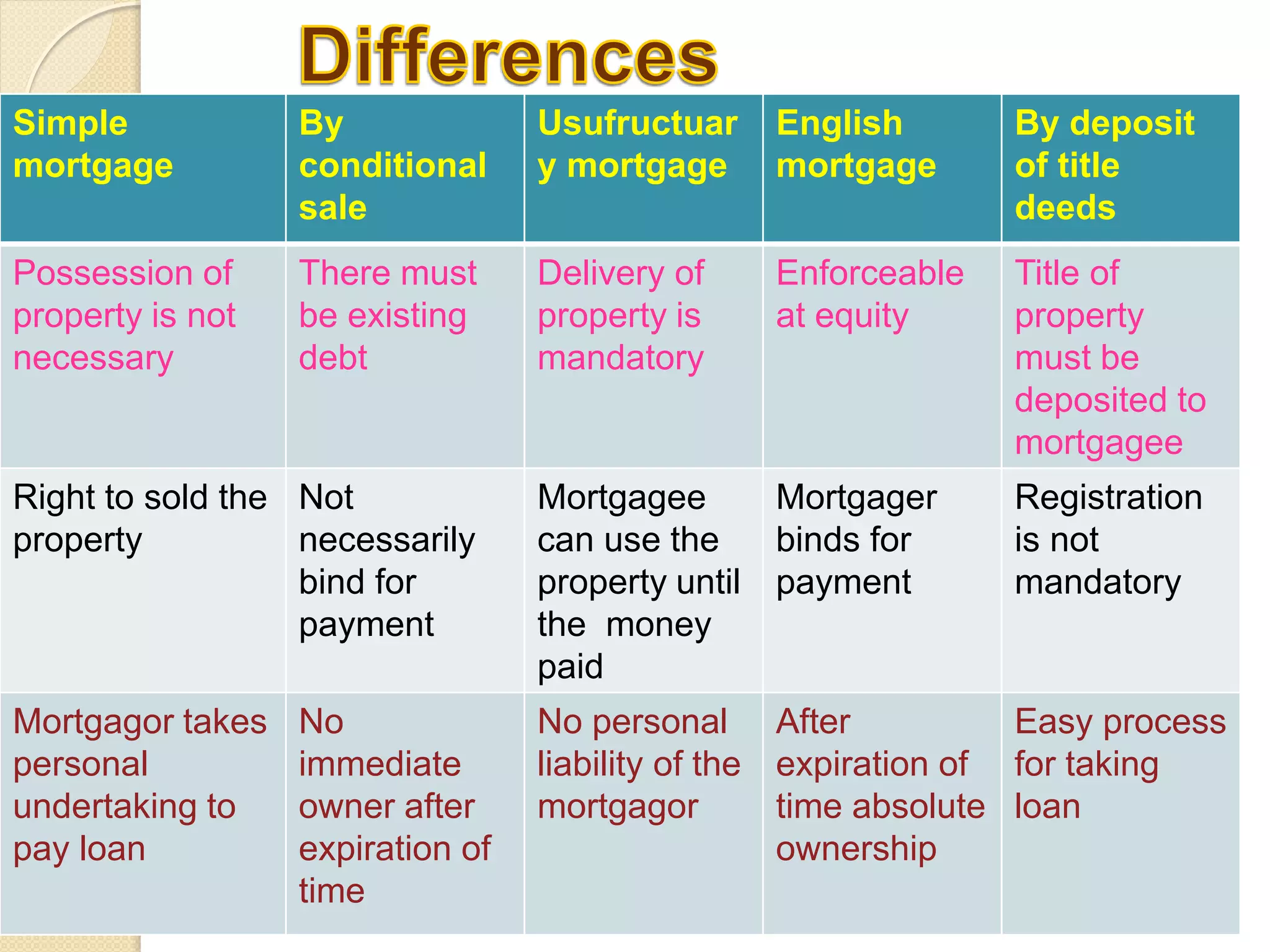
Simple
mortgage
By
conditional
sale
Usufructuar
y mortgage
English
mortgage
By deposit
of title
deeds
Possession of
property is not
necessary
There must
be existing
debt
Delivery of
property is
mandatory
Enforceable
at equity
Title of
property
must be
deposited to
mortgagee
Right to sold the
property
Not
necessarily
bind for
payment
Mortgagee
can use the
property until
the money
paid
Mortgager
binds for
payment
Registration
is not
mandatory
Mortgagor takes
personal
undertaking to
pay loan
No
immediate
owner after
expiration of
time
No personal
liability of the
mortgagor
After
expiration of
time absolute
ownership
Easy process
for taking
loan
TPA presentation

TPA presentation

  • 1.
    Mortgage section 58 Mortgageis the transfer of an interest in specific immovable property for the purpose of securing the payment of money advance or to be advance by the way of loan, an existing or future debt or the performance of an engagement which may give rise to a pecuniary liability. Section 58(a) define mortgage Case:
  • 2.
    Mortgage Anomalous mortgage Section 58(g) Simple mortgage Section58(b) English mortgage Section 58(e) Usufructuary mortgage Section 58(d) Mortgage by conditional sale Section 58(c) Mortgage by deposit of title deeds Section 58(f)
  • 3.
    Essentials of mortgage Transfer of an interest  Transferred must be of some specific immovable property.  Consideration of mortgage: consideration my be in any form i. Money advance or to be advance ii. An existing or future debt iii. The performance of any engagement giving rise to a pecuniary liability
  • 4.
    Simple mortgage When themortgager promises to pay the mortgage money without delivering the possession of the mortgage property and agree that in case of default of payment, mortgagee can sale the property.  Registration is mandatory According to section 59 registration is mandatory even if the sum of money is less then 100 rupees.
  • 5.
    characteristics: 1. The mortgagertakes a personal undertaking to pay the loan 2. The possession of the mortgage property is not given to mortgage 3. After default of payment mortgagee can sell the property
  • 6.
    Mortgage by conditionalsale In this type of mortgage, mortgagee will sale to the mortgager after the expiration of time. Case: Tulsi Vs Chandrika Prasad AIR 2006 SC 3359 In this case Hon’ble Supreme Court Held that this transaction is a mortgage by conditional sale, it was not a sale.
  • 7.
    NirBhay Jha LL.B 3rdYear Topic: -Section 58 of Transfer of property act, 1882
  • 8.
    Essentials •Its is anostensible sale of an immovable property •Condition for sale: 1. Non payment of mortgage money, sale will be absolute 2. After the payment of mortgage money, sale shall be void or mortgagee must have to send the property to the mortgager.
  • 9.
    Case: Rajamma(smt) VsB. Renuka Murthy AIR 2017NOC 614 Kar. Held: Karnataka High Court held that the condition was imposed on this sale. i.e only for five(5 ) Years, so it was conditional sale.
  • 10.
    Usufructuary mortgage •In thistypes of mortgage property must be transfer to the mortgage. • mortgagee can use all types of benefit
  • 11.
    Essentials Delivery of possessionof the mortgage property Enjoyment of the property by the mortgagee until payment are due No personal liability of mortgagor Mortgagee cannot sale the property case: Butto Kristo vs Govindram AIR1939pat,540 Held that where the mortgage property is a tenanted house the only way in which possession can be given to mortgagee is to give him the right to collect the rents and appropriate them towards the debt.
  • 12.
    English mortgage Under thistypes of mortgage, all types of rights shall be transfer to the mortgagee with the condition that after the payment property will retransfer to the mortgager. Case Ramkinkar Vs Satyacharan AIR 1939 PC14 Privy Council observed that the this section deals with form not substance. The substantial rights are dealt with in this section and section 60.nothing more than an interest is transferred and that interest is subject to the right of redemption.
  • 13.
    Essentials  Mortgagor himselfwill pay the mortgage money on the certain date  Interest must be transfer absolutely
  • 14.
    Mortgage by depositof title  Under this types there must be deposit the mortgage deed as well as title of property to the mortgagee.  Under the English law it is called as equitable mortgage. Equity ensure the return of money.
  • 15.
    Essentials  Existence ofdebt  Deposit of title deed  Intention to create security  Territorial restriction Case: Mukesh Kothari vs SBI, AIR2017 BOM131 Held that the property must be wasted within the territorial limit.
  • 16.
    Anomalous Mortgage  Itis another types of mortgage, it will apply when the mortgage does not fall any describes types of mortgage. Three types:  Simple mortgage usufructuary  Case: Munni Lal Vs Phuddi Singh AIR 1987All155 Held that it was simple mortgage usufructuary which is an anomalous mortgage under section 58(g)  Mortgage usufructuary by conditional sale  Customary forms of anomalous mortgage
  • 17.
    Simple mortgage usufructuary:It is combination of simple and usufructuary Mortgage usufructuary by conditional sale: in this type mortgagee will entitled to take possession and enjoyment of property then also imposed condition that after the default of payment he may sale the property after the expiration of the specific time.
  • 18.
    Simple mortgage By conditional sale Usufructuar y mortgage English mortgage By deposit oftitle deeds Possession of property is not necessary There must be existing debt Delivery of property is mandatory Enforceable at equity Title of property must be deposited to mortgagee Right to sold the property Not necessarily bind for payment Mortgagee can use the property until the money paid Mortgager binds for payment Registration is not mandatory Mortgagor takes personal undertaking to pay loan No immediate owner after expiration of time No personal liability of the mortgagor After expiration of time absolute ownership Easy process for taking loan