JUDGEMENT AND DEGREE
• The term Judgement is defined in Section 2(9) of the Code of Civil Procedure,
1908.
• A judgement contains facts of the case, the issues involved, the evidence
brought by the parties, finding on issues based on evidence and arguments.
• Every judgement shall include:
 a summary of the pleadings,
 issues, finding on each issue, and
 the relief granted by the court.
• The judgement pronounced, always states the reasons for such a decision.
• On a daily basis, numerous judgements are pronounced and various cases are
disposed of Judgements play a very important role in the working of our judicial
system because they act as examples for cases to come in the near future.
Judgement
CS Bhuwan Taragi - The Law Talks
Pronouncement of a judgement means that after the hearing is completed, the
judgement shall be announced by the Judges in an open Court, either at once or at
some future day, after providing due notice to the parties or their learned counsels.
If a judgement is not pronounced immediately then it must be pronounced within
30 days from the date of the conclusion of hearing.
However, sometimes it so happens that due to exceptional and some extraordinary
reasons, it may be delivered within 60 days from the conclusion of the hearing.
It is not mandatory for a judge to read out the whole judgement and it would be enough
if only the final order is pronounced.
The judge shall put the date on which the judgement was pronounced along with his
signature.
Rule 2 Order XX of CPC, 1908 provides a judge with the right to pronounce the
judgement which is already written but is not pronounced by his predecessor.
Pronouncement of a judgement
The Law Talks
Once the judgement is pronounced:
The copies of that particular judgement should be
immediately made available to the parties on payment of
costs as specified,
by the party applying for such copy, of such charges as may
be specified in the rules and orders made by the High Court
(H.C.) Such a rule is specified in Order XX Rule 6-B of the
Code of Civil Procedure, 1908.
Copy of the judgement
CS Bhuwan Taragi - The Law Talks
• Once a judgement is dated and signed by the judge it can only be
altered or amended if:
 There are arithmetical or clerical errors. (clerical errors refer to
the errors made by clerks and arithmetical errors refer to errors
made in numbers such as addition, subtraction, multiplication and
division).
 There are errors due to accidental slips or omissions (these errors
take place when some essential element is left unnoticed) on
review (Section 114).
Alteration of a judgement/ decree/ order (Section 152)
The Law Talks
• The term decree is defined in Section 2(2) of CPC, 1908.
• The decree is a formal expression of adjudication by which the court
determines the rights of parties regarding the matter in dispute.
• A decree always follows judgement and is based upon a judgement.
Decree
Essential elements of Decree:
• There must be a formal declaration or adjudication.
• The adjudication should be done in a suit.
• Determines the rights of the parties with regard to the issues in dispute in
the suit.
• Right should be of conclusive nature.
• Formal expression
CS Bhuwan Taragi -The Law Talks
Decree
Preliminary
Decree
Final Decree
Partly
preliminary and
partly final
Decree
The Law Talks
• In general sense, the word preliminary means preparation for the main matter, initial,
introductory, foundation.
• In a legal sense, a preliminary decree is a decree where further proceedings have
to take place before the suit can be completely disposed of.
• It decides the rights of the parties in respect to all or any of the matters of discussion but
it does not completely dispose of the suit.
• In such a decree the rights and liabilities of the parties to be worked out in future
proceedings.
• A preliminary decree is passed in those cases where the proceedings are to be carried
out in two different stages.
• The first stage is when the rights of the parties are adjudicated and the second stage
is when those rights are implemented or executed.
Preliminary Decree
• In general sense, the word ‘final’ means last, ultimate,
conclusive or decisive.
• In legal sense, a final decree is a decree which completely
disposes of the suit and settles all the questions in discussion
between the parties and nothing is left further for deciding
thereafter.
• It is only said to be final when such adjudication completely
disposes of the suit.
Final Decree
CS Bhuwan Taragi - The Law Talks
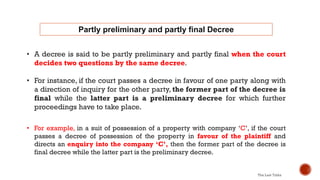
• A decree is said to be partly preliminary and partly final when the court
decides two questions by the same decree.
• For instance, if the court passes a decree in favour of one party along with
a direction of inquiry for the other party, the former part of the decree is
final while the latter part is a preliminary decree for which further
proceedings have to take place.
• For example, in a suit of possession of a property with company ‘C’, if the court
passes a decree of possession of the property in favour of the plaintiff and
directs an enquiry into the company ‘C’, then the former part of the decree is
final decree while the latter part is the preliminary decree.
Partly preliminary and partly final Decree
The Law Talks
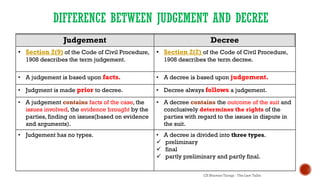
DIFFERENCE BETWEEN JUDGEMENT AND DECREE
Judgement Decree
• Section 2(9) of the Code of Civil Procedure,
1908 describes the term judgement.
• Section 2(2) of the Code of Civil Procedure,
1908 describes the term decree.
• A judgement is based upon facts. • A decree is based upon judgement.
• Judgment is made prior to decree. • Decree always follows a judgement.
• A judgement contains facts of the case, the
issues involved, the evidence brought by the
parties, finding on issues(based on evidence
and arguments).
• A decree contains the outcome of the suit and
conclusively determines the rights of the
parties with regard to the issues in dispute in
the suit.
• Judgement has no types. • A decree is divided into three types.
 preliminary
 final
 partly preliminary and partly final.
CS Bhuwan Taragi - The Law Talks
Telegram: https://t.me/TheLawTalks
Facebook Page: The Law Talks
LinkedIn: https://www.linkedin.com/in/csBhuwanTaragi
Instagram: @the_law_talks and @bhuwantaragi
Podcast: https://thelawtalks
Twitter: @csbhuwantaragi
Do write for any Queries/suggestions and to get a free PDF copy of this PPT on Slideshare

Judgment and decree

  • 1.
  • 2.
    • The termJudgement is defined in Section 2(9) of the Code of Civil Procedure, 1908. • A judgement contains facts of the case, the issues involved, the evidence brought by the parties, finding on issues based on evidence and arguments. • Every judgement shall include:  a summary of the pleadings,  issues, finding on each issue, and  the relief granted by the court. • The judgement pronounced, always states the reasons for such a decision. • On a daily basis, numerous judgements are pronounced and various cases are disposed of Judgements play a very important role in the working of our judicial system because they act as examples for cases to come in the near future. Judgement CS Bhuwan Taragi - The Law Talks
  • 3.
    Pronouncement of ajudgement means that after the hearing is completed, the judgement shall be announced by the Judges in an open Court, either at once or at some future day, after providing due notice to the parties or their learned counsels. If a judgement is not pronounced immediately then it must be pronounced within 30 days from the date of the conclusion of hearing. However, sometimes it so happens that due to exceptional and some extraordinary reasons, it may be delivered within 60 days from the conclusion of the hearing. It is not mandatory for a judge to read out the whole judgement and it would be enough if only the final order is pronounced. The judge shall put the date on which the judgement was pronounced along with his signature. Rule 2 Order XX of CPC, 1908 provides a judge with the right to pronounce the judgement which is already written but is not pronounced by his predecessor. Pronouncement of a judgement The Law Talks
  • 4.
    Once the judgementis pronounced: The copies of that particular judgement should be immediately made available to the parties on payment of costs as specified, by the party applying for such copy, of such charges as may be specified in the rules and orders made by the High Court (H.C.) Such a rule is specified in Order XX Rule 6-B of the Code of Civil Procedure, 1908. Copy of the judgement CS Bhuwan Taragi - The Law Talks
  • 5.
    • Once ajudgement is dated and signed by the judge it can only be altered or amended if:  There are arithmetical or clerical errors. (clerical errors refer to the errors made by clerks and arithmetical errors refer to errors made in numbers such as addition, subtraction, multiplication and division).  There are errors due to accidental slips or omissions (these errors take place when some essential element is left unnoticed) on review (Section 114). Alteration of a judgement/ decree/ order (Section 152) The Law Talks
  • 6.
    • The termdecree is defined in Section 2(2) of CPC, 1908. • The decree is a formal expression of adjudication by which the court determines the rights of parties regarding the matter in dispute. • A decree always follows judgement and is based upon a judgement. Decree Essential elements of Decree: • There must be a formal declaration or adjudication. • The adjudication should be done in a suit. • Determines the rights of the parties with regard to the issues in dispute in the suit. • Right should be of conclusive nature. • Formal expression CS Bhuwan Taragi -The Law Talks
  • 7.
  • 8.
    • In generalsense, the word preliminary means preparation for the main matter, initial, introductory, foundation. • In a legal sense, a preliminary decree is a decree where further proceedings have to take place before the suit can be completely disposed of. • It decides the rights of the parties in respect to all or any of the matters of discussion but it does not completely dispose of the suit. • In such a decree the rights and liabilities of the parties to be worked out in future proceedings. • A preliminary decree is passed in those cases where the proceedings are to be carried out in two different stages. • The first stage is when the rights of the parties are adjudicated and the second stage is when those rights are implemented or executed. Preliminary Decree
  • 9.
    • In generalsense, the word ‘final’ means last, ultimate, conclusive or decisive. • In legal sense, a final decree is a decree which completely disposes of the suit and settles all the questions in discussion between the parties and nothing is left further for deciding thereafter. • It is only said to be final when such adjudication completely disposes of the suit. Final Decree CS Bhuwan Taragi - The Law Talks
  • 10.
    • A decreeis said to be partly preliminary and partly final when the court decides two questions by the same decree. • For instance, if the court passes a decree in favour of one party along with a direction of inquiry for the other party, the former part of the decree is final while the latter part is a preliminary decree for which further proceedings have to take place. • For example, in a suit of possession of a property with company ‘C’, if the court passes a decree of possession of the property in favour of the plaintiff and directs an enquiry into the company ‘C’, then the former part of the decree is final decree while the latter part is the preliminary decree. Partly preliminary and partly final Decree The Law Talks
  • 11.
    DIFFERENCE BETWEEN JUDGEMENTAND DECREE Judgement Decree • Section 2(9) of the Code of Civil Procedure, 1908 describes the term judgement. • Section 2(2) of the Code of Civil Procedure, 1908 describes the term decree. • A judgement is based upon facts. • A decree is based upon judgement. • Judgment is made prior to decree. • Decree always follows a judgement. • A judgement contains facts of the case, the issues involved, the evidence brought by the parties, finding on issues(based on evidence and arguments). • A decree contains the outcome of the suit and conclusively determines the rights of the parties with regard to the issues in dispute in the suit. • Judgement has no types. • A decree is divided into three types.  preliminary  final  partly preliminary and partly final. CS Bhuwan Taragi - The Law Talks
  • 12.
    Telegram: https://t.me/TheLawTalks Facebook Page:The Law Talks LinkedIn: https://www.linkedin.com/in/csBhuwanTaragi Instagram: @the_law_talks and @bhuwantaragi Podcast: https://thelawtalks Twitter: @csbhuwantaragi Do write for any Queries/suggestions and to get a free PDF copy of this PPT on Slideshare