OVERVIEW 
African Farmer 
A FARMINGSIMULATIONGAME 
www.africanfarmergame.org
Flowchart 
Contents 
UNCERTAINTY 
African Farmer Game puts players in ‘realistic’ scenarios that require decision- making with limited resources, imperfect knowledge and chance events 
• 
The weather is not known until all the farming decisions for a season have been made 
• 
Crop hazardsare an ever-present possibility 
• 
Chance events (good and bad) may disrupt plans 
• 
Market prices may vary, depending on community harvest yields and other factors 
• 
The possibility of illness and deathincreases for individuals on poor diets
Flowchart 
Contents 
GAME OVERVIEW 
• 
Players are given responsibility for a farming household comprised of a number of adult, child and infant characters 
• 
They must feed their household, educate their children and manage a small farm, buying crops and inputs at market and trading goods and labour with other households 
• 
They must respond to crop hazards and other chance events and provide their households with a balanced diet from food they have grown or purchased at the market
Flowchart 
Contents 
ANTECEDENTS 
African Farmer develops ideas from the educational board simulation games. 
• 
Green Revolution Game, developed in the 1970s by Graham Chapman and Liz Dowlersimulated the experience of rice growers in Bihar 
• 
Exaction, which extended the Green RevolutionGame to include international trade, was developed in the 1980s by Graham Chapman and Isabelle Tsakok 
• 
Africulture, which explored the dynamics of gender in agricultural communities, was developed in the 1990sby Graham Chapman, Janice Jiggins andHenk de Zeeuw
Flowchart 
Contents 
PLAYERS’ GOALS 
Players must decide how to prioritise various goals: 
• 
Agricultural -successfully manage and develop their farm. 
• 
Educational -provide children with a good education. 
• 
Social –foster co-operation, strengthen relationships and increase social standing by helping neighbours. 
• 
Financial–increase the net worth of the household by farming or trading. 
A balance must be struck which enables players to achieve their chosen goals without taking undue risks or jeopardising relationships with the community.
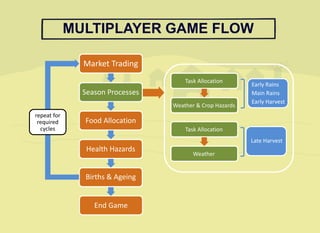
Task Allocation 
Weather & Crop Hazards 
Task Allocation 
Weather 
Early Rains 
Main Rains 
Early Harvest 
Late Harvest 
Market Trading 
Season Processes 
End Game 
Health Hazards 
Food Allocation 
Births & Ageing 
repeat for required cycles 
MULTIPLAYER GAME FLOW
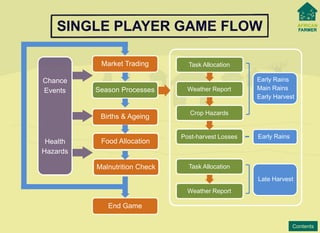
Task Allocation 
Weather Report 
Task Allocation 
Weather Report 
Early Rains 
Main Rains 
Early Harvest 
Late Harvest 
Market Trading 
Season Processes 
End Game 
Malnutrition Check 
Food Allocation 
Births & Ageing 
Crop Hazards 
Post-harvest Losses 
Early Rains 
SINGLE PLAYER GAME FLOW 
Chance 
Events 
Health 
Hazards 
Contents
Flowchart 
Contents 
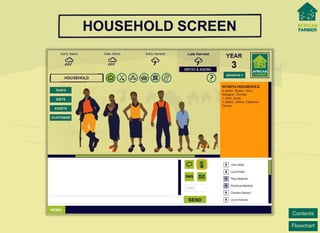
HOUSEHOLDSCREEN
Flowchart 
Contents 
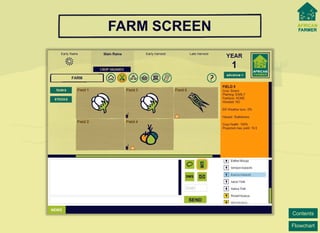
FARMSCREEN
Flowchart 
Contents 
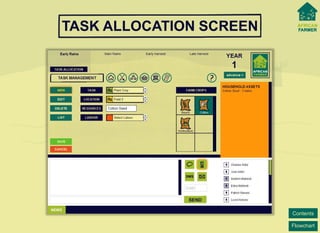
TASK ALLOCATION SCREEN
Flowchart 
Contents 
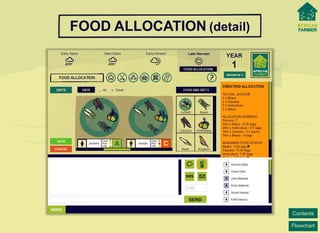
FOOD ALLOCATION(detail)
Flowchart 
Contents 
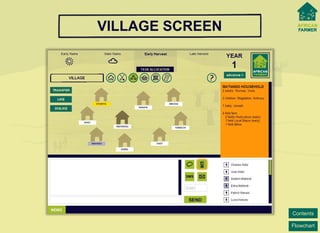
VILLAGESCREEN
Flowchart 
Contents 
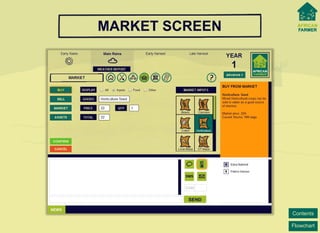
MARKETSCREEN
Flowchart 
Contents 
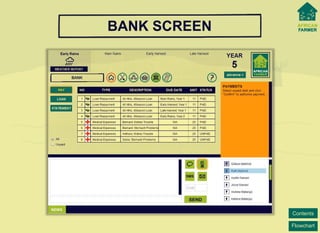
BANKSCREEN
Flowchart 
Contents 
PROJECT INFORMATION 
African Farmer Game was developed by: 
• 
John Thompson –Project Coordinator –j.thompson@ids.ac.uk 
• 
Judith Good –Technical Advisor –j.good@sussex.ac.uk 
• 
Jim Jackson –Single Player Game Development – j.a.jackson@sussex.ac.uk 
• 
Ellie Martin–Multiplayer Game Development – e.martin@sussex.ac.uk 
• 
Nathan Oxley –Communications and Networking – n.oxley@ids.ac.uk 
Supported by: 
• 
UK Department for International Development through a grant to the Future Agricultures Consortium 
• 
UK Economic and Social Research Council (ESRC) through a grant to the STEPS Centre
African Farmer: Play the Game 
www.africanfarmergame.org 
THANK YOU
Flowchart 
Contents 
LINKS 
•African Farmer Game 
Collaborators 
•Future Agricultures Consortium 
•Institute of DevelopmentStudies 
•Informatics Department, University of Sussex 
•STEPS Centre 
Sponsoring Partners 
•UK Department for International Development 
•UK Economic and Social Research Council

African Farmer Game

  • 1.
    OVERVIEW African Farmer A FARMINGSIMULATIONGAME www.africanfarmergame.org
  • 2.
    Flowchart Contents UNCERTAINTY African Farmer Game puts players in ‘realistic’ scenarios that require decision- making with limited resources, imperfect knowledge and chance events • The weather is not known until all the farming decisions for a season have been made • Crop hazardsare an ever-present possibility • Chance events (good and bad) may disrupt plans • Market prices may vary, depending on community harvest yields and other factors • The possibility of illness and deathincreases for individuals on poor diets
  • 3.
    Flowchart Contents GAMEOVERVIEW • Players are given responsibility for a farming household comprised of a number of adult, child and infant characters • They must feed their household, educate their children and manage a small farm, buying crops and inputs at market and trading goods and labour with other households • They must respond to crop hazards and other chance events and provide their households with a balanced diet from food they have grown or purchased at the market
  • 4.
    Flowchart Contents ANTECEDENTS African Farmer develops ideas from the educational board simulation games. • Green Revolution Game, developed in the 1970s by Graham Chapman and Liz Dowlersimulated the experience of rice growers in Bihar • Exaction, which extended the Green RevolutionGame to include international trade, was developed in the 1980s by Graham Chapman and Isabelle Tsakok • Africulture, which explored the dynamics of gender in agricultural communities, was developed in the 1990sby Graham Chapman, Janice Jiggins andHenk de Zeeuw
  • 5.
    Flowchart Contents PLAYERS’GOALS Players must decide how to prioritise various goals: • Agricultural -successfully manage and develop their farm. • Educational -provide children with a good education. • Social –foster co-operation, strengthen relationships and increase social standing by helping neighbours. • Financial–increase the net worth of the household by farming or trading. A balance must be struck which enables players to achieve their chosen goals without taking undue risks or jeopardising relationships with the community.
  • 6.
    Task Allocation Weather& Crop Hazards Task Allocation Weather Early Rains Main Rains Early Harvest Late Harvest Market Trading Season Processes End Game Health Hazards Food Allocation Births & Ageing repeat for required cycles MULTIPLAYER GAME FLOW
  • 7.
    Task Allocation WeatherReport Task Allocation Weather Report Early Rains Main Rains Early Harvest Late Harvest Market Trading Season Processes End Game Malnutrition Check Food Allocation Births & Ageing Crop Hazards Post-harvest Losses Early Rains SINGLE PLAYER GAME FLOW Chance Events Health Hazards Contents
  • 8.
  • 9.
  • 10.
    Flowchart Contents TASKALLOCATION SCREEN
  • 11.
    Flowchart Contents FOODALLOCATION(detail)
  • 12.
  • 13.
  • 14.
  • 15.
    Flowchart Contents PROJECTINFORMATION African Farmer Game was developed by: • John Thompson –Project Coordinator –j.thompson@ids.ac.uk • Judith Good –Technical Advisor –j.good@sussex.ac.uk • Jim Jackson –Single Player Game Development – j.a.jackson@sussex.ac.uk • Ellie Martin–Multiplayer Game Development – e.martin@sussex.ac.uk • Nathan Oxley –Communications and Networking – n.oxley@ids.ac.uk Supported by: • UK Department for International Development through a grant to the Future Agricultures Consortium • UK Economic and Social Research Council (ESRC) through a grant to the STEPS Centre
  • 16.
    African Farmer: Playthe Game www.africanfarmergame.org THANK YOU
  • 17.
    Flowchart Contents LINKS •African Farmer Game Collaborators •Future Agricultures Consortium •Institute of DevelopmentStudies •Informatics Department, University of Sussex •STEPS Centre Sponsoring Partners •UK Department for International Development •UK Economic and Social Research Council