buildingSMART International


Exploiting BIM – how standards allow
you to take the advantage
Nick Nisbet
Technical Coordinator
buildingSMART UK & Ireland
buildingSMART International

About buildingSMART International
 • Founded in 1995
 • 13 Chapters
 • 24 Countries
 • Not-for-profit Standards Organization
Vision
Sustainability by building SMARTER


Mission
Contribute to a sustainable built environment through
SMARTER information sharing and communication using
open international standards in the building and construction
sector, private and public.

Organization
Not-for-profit
Internationally co-ordinated development of standards
Activities mainly in local chapters
Why data not documents ?

 Sharing …
   Strategy: Inter-operability
   » One input, many paths

 Structured …
   Management: Check-ability
   » One input, many checks

 Information.
    Productivity: Re-usability
   » One input, many outputs
Sharing

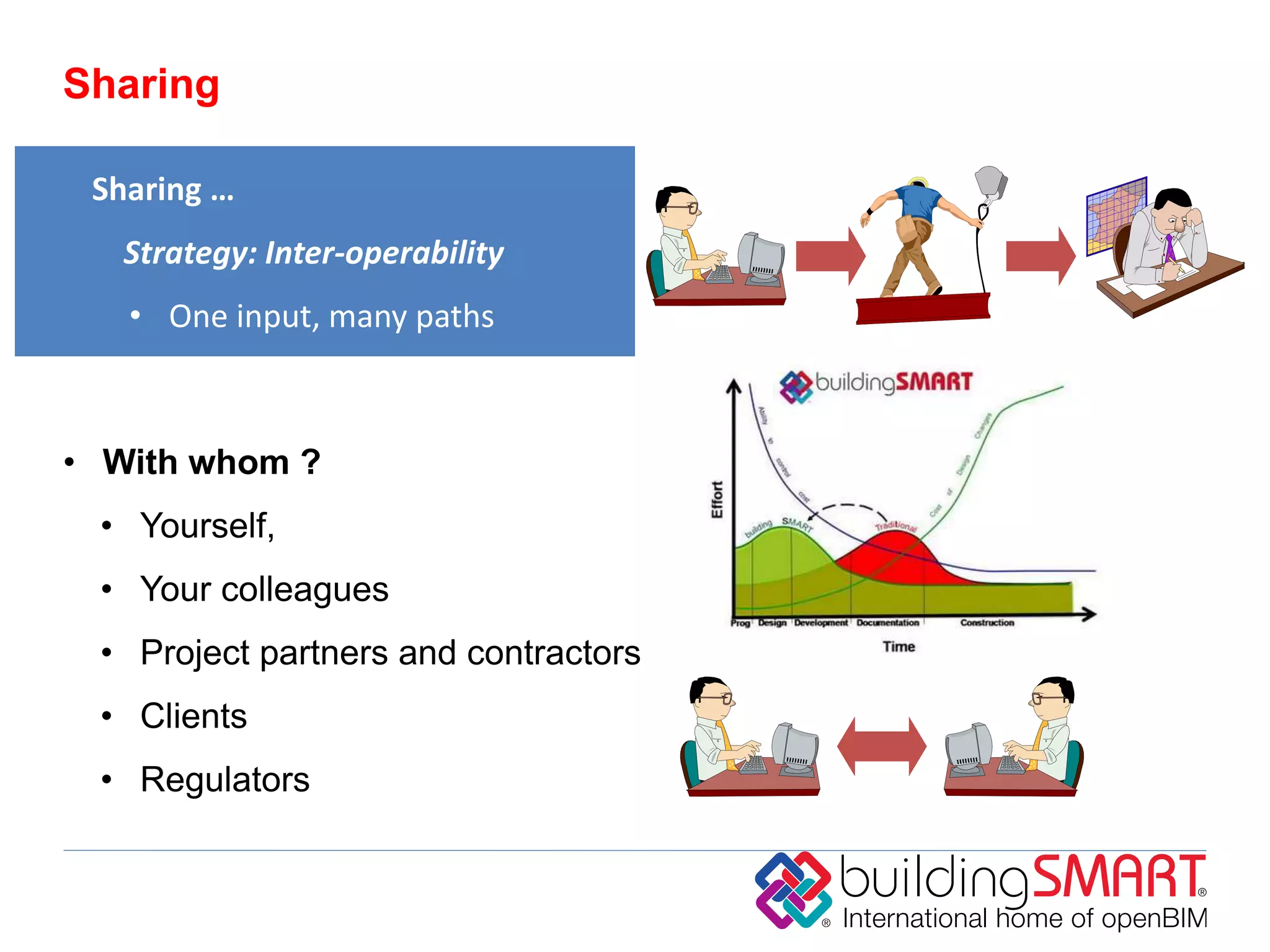
 Sharing …
   Strategy: Inter-operability
   • One input, many paths


• With whom ?
 • Yourself,
 • Your colleagues
 • Project partners and contractors
 • Clients
 • Regulators
Structured …

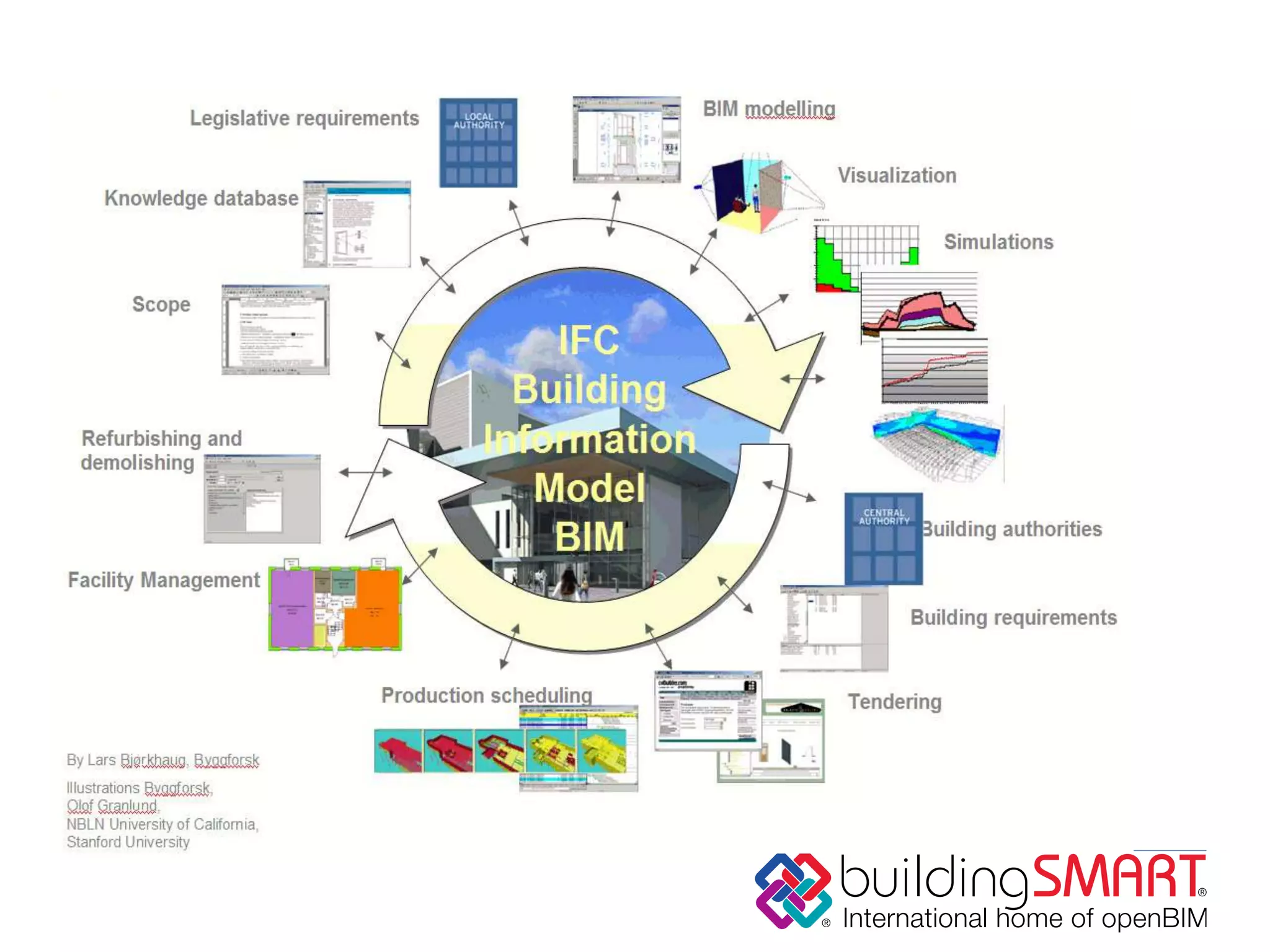
                                    BIM       IFC
                                B         S
                                I         U         D
                                M         B         A
                                S         M         T
                                O         I         A
                                F         S         B
  Structured …                  T
                                W
                                          S         A
    Management: Check-ability   A         I         S
                                R         O         E
    • One input, many checks    E         N

                                                    RULE CHECK


                                      VIEW/BROWSE
Information


  Information
    Productivity: Re-usability
    • One input, many outputs
                                 •   (courtesy HLN and Bryden Wood)


18 May 2012
buildingSMART International is:
• A neutral, international and unique
  organisation supporting open BIM through
  the life cycle.
• We have regional chapters in Europe, North
  America, Australia, Asia and Middle East.
What we do:
• buildingSMART Processes
• buildingSMART Data dictionary
• buildingSMART Data model


• Through activity in our local chapters we
  provide activities to support implementation
  of openBIM
• You can find more information about us in
  our Strategic plan.
Standards

  Sharing …              Processes     IDM
    • Repeatability
    • Process improvement


  Structured …            Product      IFC
    • Facilities and capacity
    • Information


  Information …           Terms        IFD
    • Objects
    • Properties and classifications


18 May 2012
Three Key Standards
     BIM is about sharing           structured data.

     •   IFC – “Information for Construction”             ISO/PAS 16739-2005
          – What information can be re-used.
          – Includes designs, processes, resources, participants.
          – IFC STEP files and IFC XML files define portable file structures.


     •   IDM – “Information Delivery Manuals” ISO/FDIS 29491-1:2009
          – How specific required information exchanges can be documented.
          – How to capture your requirements for application developers to meet.
          – Integrates with workflow management


     •   IFD – “International Framework Dictionary” ISO 12006-3:2007
          – Catalogues terms and concepts.
          – Includes multiple languages
          – Includes proprietary dialects such as “Revit-speak”, “Bentley-speak”
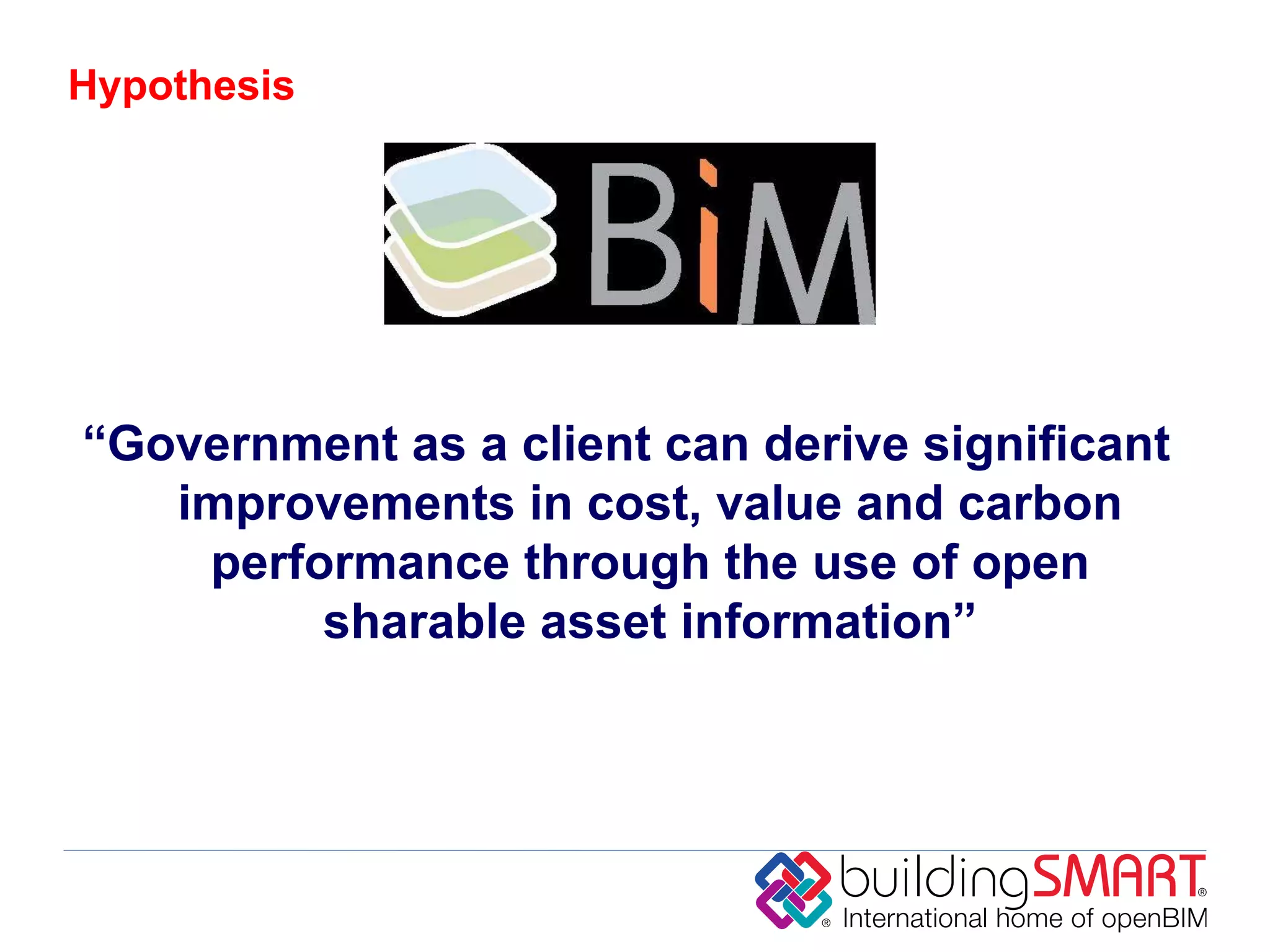
Hypothesis


“Government as a client can derive significant
   improvements in cost, value and carbon
    performance through the use of open
         sharable asset information”
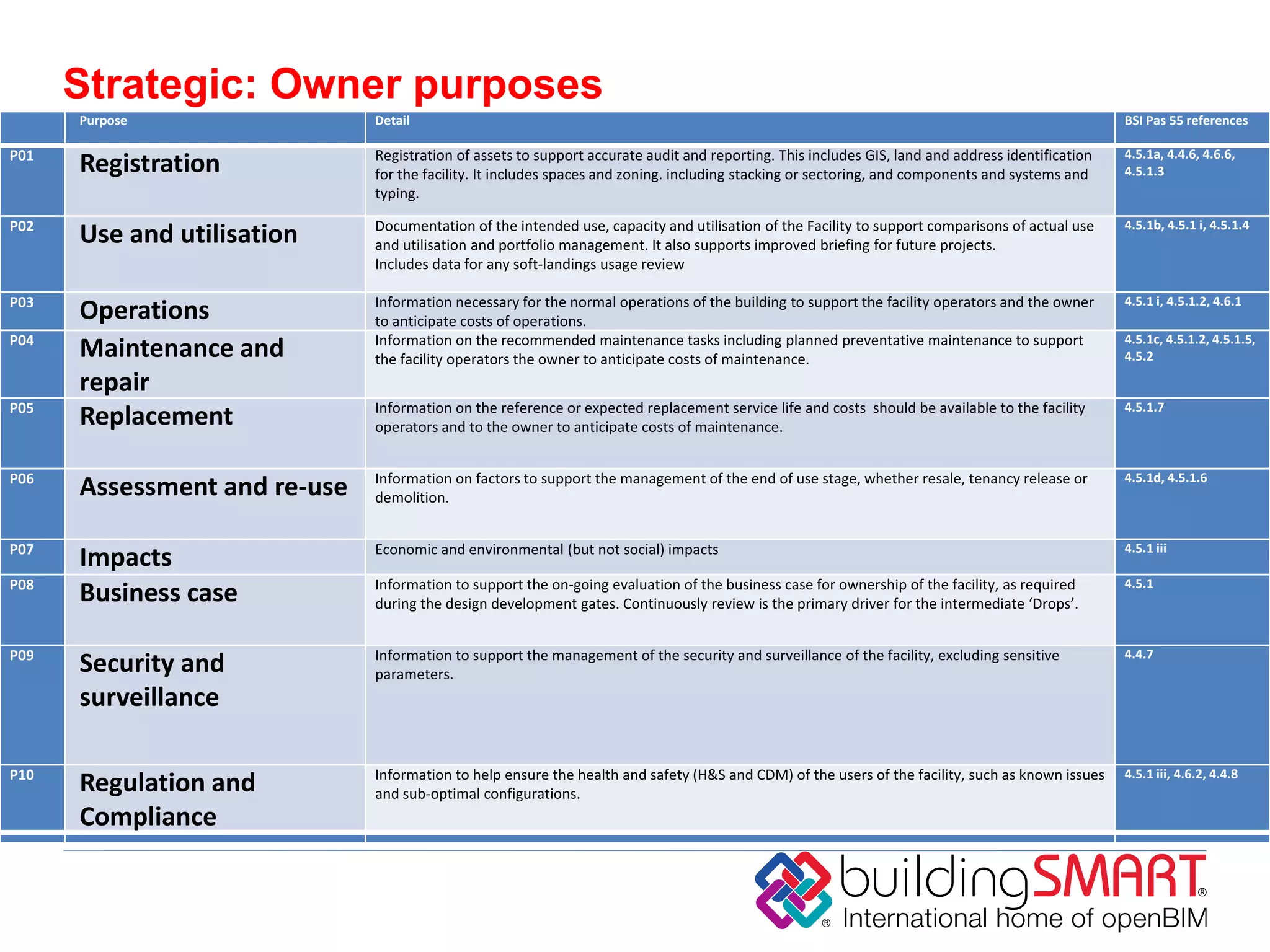
Strategic: Owner purposes
      Purpose                 Detail                                                                                                               BSI Pas 55 references

P01                           Registration of assets to support accurate audit and reporting. This includes GIS, land and address identification   4.5.1a, 4.4.6, 4.6.6,
      Registration            for the facility. It includes spaces and zoning. including stacking or sectoring, and components and systems and     4.5.1.3
                              typing.

P02                           Documentation of the intended use, capacity and utilisation of the Facility to support comparisons of actual use     4.5.1b, 4.5.1 i, 4.5.1.4
      Use and utilisation     and utilisation and portfolio management. It also supports improved briefing for future projects.
                              Includes data for any soft-landings usage review

P03                           Information necessary for the normal operations of the building to support the facility operators and the owner      4.5.1 i, 4.5.1.2, 4.6.1
      Operations              to anticipate costs of operations.
P04                           Information on the recommended maintenance tasks including planned preventative maintenance to support               4.5.1c, 4.5.1.2, 4.5.1.5,
      Maintenance and         the facility operators the owner to anticipate costs of maintenance.                                                 4.5.2

      repair
P05                           Information on the reference or expected replacement service life and costs should be available to the facility      4.5.1.7
      Replacement             operators and to the owner to anticipate costs of maintenance.


P06                           Information on factors to support the management of the end of use stage, whether resale, tenancy release or         4.5.1d, 4.5.1.6
      Assessment and re-use   demolition.


P07                           Economic and environmental (but not social) impacts                                                                  4.5.1 iii
      Impacts
P08                           Information to support the on-going evaluation of the business case for ownership of the facility, as required       4.5.1
      Business case           during the design development gates. Continuously review is the primary driver for the intermediate ‘Drops’.


P09                           Information to support the management of the security and surveillance of the facility, excluding sensitive          4.4.7
      Security and            parameters.
      surveillance

P10                           Information to help ensure the health and safety (H&S and CDM) of the users of the facility, such as known issues    4.5.1 iii, 4.6.2, 4.4.8
      Regulation and          and sub-optimal configurations.
      Compliance
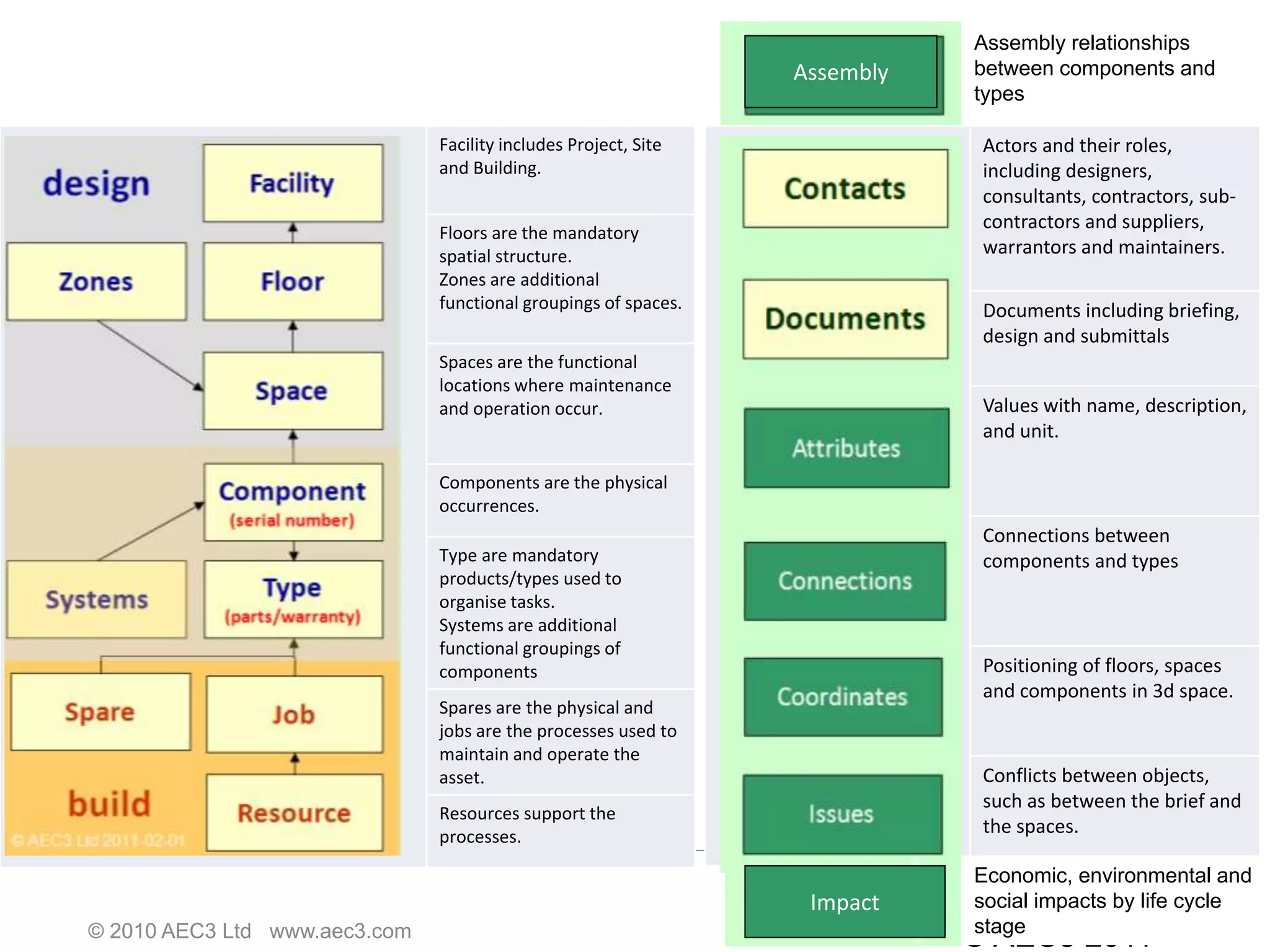
Assembly relationships
COBie                                                             Assembly   between components and
                                                                             types

                                Facility includes Project, Site               Actors and their roles,
                                and Building.                                 including designers,
                                                                              consultants, contractors, sub-
                                                                              contractors and suppliers,
                                Floors are the mandatory
                                spatial structure.                            warrantors and maintainers.
                                Zones are additional
                                functional groupings of spaces.               Documents including briefing,
                                                                              design and submittals
                                Spaces are the functional
                                locations where maintenance
                                and operation occur.                          Values with name, description,
                                                                              and unit.

                                Components are the physical
                                occurrences.
                                                                              Connections between
                                Type are mandatory                            components and types
                                products/types used to
                                organise tasks.
                                Systems are additional
                                functional groupings of
                                components                                    Positioning of floors, spaces
                                                                              and components in 3d space.
                                Spares are the physical and
                                jobs are the processes used to
                                maintain and operate the
                                asset.                                        Conflicts between objects,
                                                                              such as between the brief and
                                Resources support the
                                processes.
                                                                              the spaces.

                                                                             Economic, environmental and
                                                                   Impact    social impacts by life cycle
 © 2010 AEC3 Ltd www.aec3.com                                                stage
                                                                             © AEC3 2011
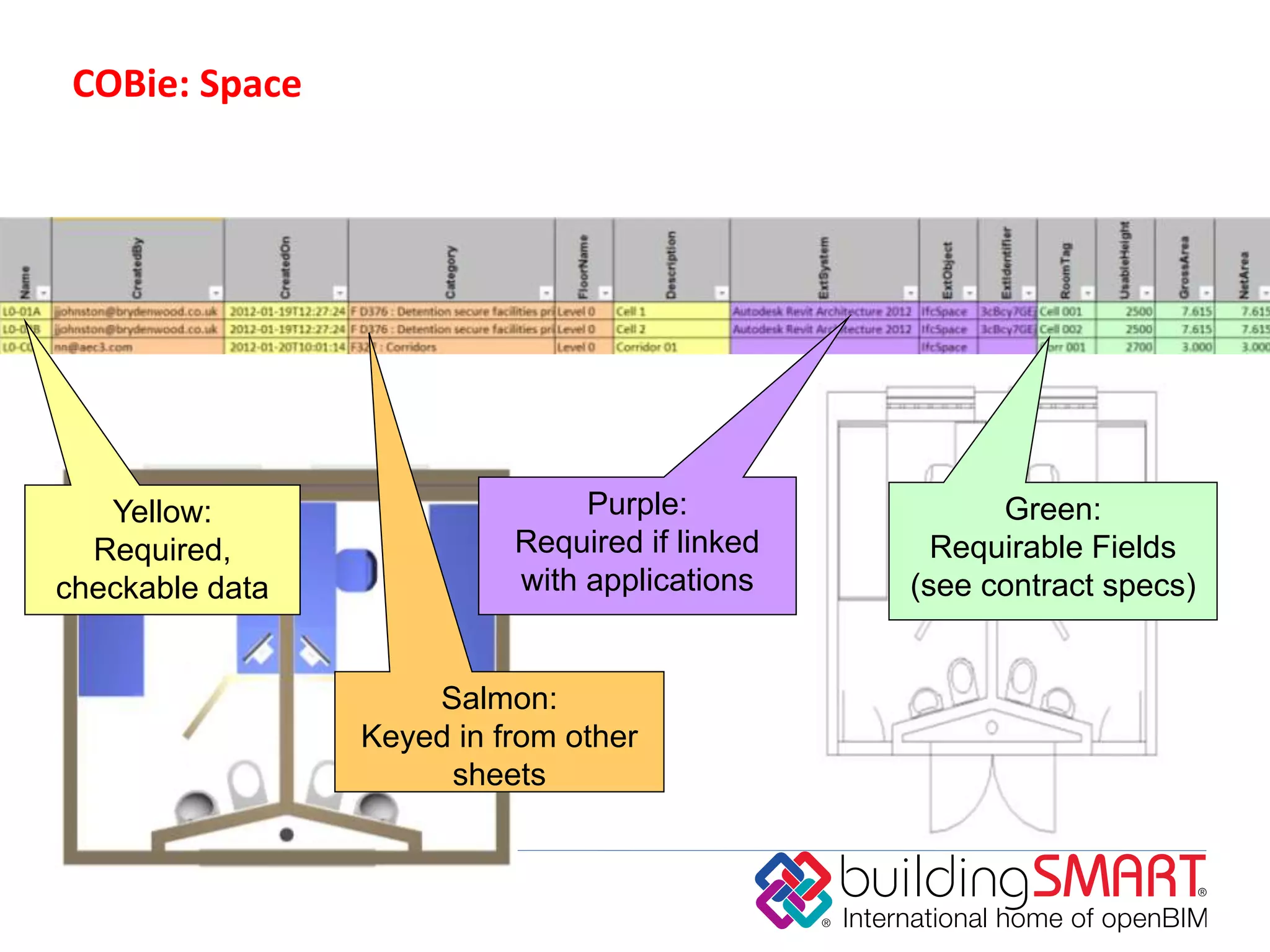
COBie: Space


   Yellow:                      Purple:               Green:
  Required,                Required if linked     Requirable Fields
checkable data             with applications    (see contract specs)


                     Salmon:
                 Keyed in from other
                      sheets
buildingSMART
       International
       UKI


Any Questions ?

Building Smart - Nick Nisbet

  • 1.
    buildingSMART International Exploiting BIM– how standards allow you to take the advantage Nick Nisbet Technical Coordinator buildingSMART UK & Ireland
  • 2.
    buildingSMART International About buildingSMARTInternational • Founded in 1995 • 13 Chapters • 24 Countries • Not-for-profit Standards Organization
  • 3.
    Vision Sustainability by buildingSMARTER Mission Contribute to a sustainable built environment through SMARTER information sharing and communication using open international standards in the building and construction sector, private and public. Organization Not-for-profit Internationally co-ordinated development of standards Activities mainly in local chapters
  • 6.
    Why data notdocuments ? Sharing … Strategy: Inter-operability » One input, many paths Structured … Management: Check-ability » One input, many checks Information. Productivity: Re-usability » One input, many outputs
  • 8.
    Sharing Sharing … Strategy: Inter-operability • One input, many paths • With whom ? • Yourself, • Your colleagues • Project partners and contractors • Clients • Regulators
  • 9.
    Structured … BIM IFC B S I U D M B A S M T O I A F S B Structured … T W S A Management: Check-ability A I S R O E • One input, many checks E N RULE CHECK VIEW/BROWSE
  • 10.
    Information Information Productivity: Re-usability • One input, many outputs • (courtesy HLN and Bryden Wood) 18 May 2012
  • 11.
    buildingSMART International is: •A neutral, international and unique organisation supporting open BIM through the life cycle. • We have regional chapters in Europe, North America, Australia, Asia and Middle East.
  • 12.
    What we do: •buildingSMART Processes • buildingSMART Data dictionary • buildingSMART Data model • Through activity in our local chapters we provide activities to support implementation of openBIM • You can find more information about us in our Strategic plan.
  • 13.
    Standards Sharing… Processes IDM • Repeatability • Process improvement Structured … Product IFC • Facilities and capacity • Information Information … Terms IFD • Objects • Properties and classifications 18 May 2012
  • 14.
    Three Key Standards BIM is about sharing structured data. • IFC – “Information for Construction” ISO/PAS 16739-2005 – What information can be re-used. – Includes designs, processes, resources, participants. – IFC STEP files and IFC XML files define portable file structures. • IDM – “Information Delivery Manuals” ISO/FDIS 29491-1:2009 – How specific required information exchanges can be documented. – How to capture your requirements for application developers to meet. – Integrates with workflow management • IFD – “International Framework Dictionary” ISO 12006-3:2007 – Catalogues terms and concepts. – Includes multiple languages – Includes proprietary dialects such as “Revit-speak”, “Bentley-speak”
  • 16.
    Hypothesis “Government as aclient can derive significant improvements in cost, value and carbon performance through the use of open sharable asset information”
  • 17.
    Strategic: Owner purposes Purpose Detail BSI Pas 55 references P01 Registration of assets to support accurate audit and reporting. This includes GIS, land and address identification 4.5.1a, 4.4.6, 4.6.6, Registration for the facility. It includes spaces and zoning. including stacking or sectoring, and components and systems and 4.5.1.3 typing. P02 Documentation of the intended use, capacity and utilisation of the Facility to support comparisons of actual use 4.5.1b, 4.5.1 i, 4.5.1.4 Use and utilisation and utilisation and portfolio management. It also supports improved briefing for future projects. Includes data for any soft-landings usage review P03 Information necessary for the normal operations of the building to support the facility operators and the owner 4.5.1 i, 4.5.1.2, 4.6.1 Operations to anticipate costs of operations. P04 Information on the recommended maintenance tasks including planned preventative maintenance to support 4.5.1c, 4.5.1.2, 4.5.1.5, Maintenance and the facility operators the owner to anticipate costs of maintenance. 4.5.2 repair P05 Information on the reference or expected replacement service life and costs should be available to the facility 4.5.1.7 Replacement operators and to the owner to anticipate costs of maintenance. P06 Information on factors to support the management of the end of use stage, whether resale, tenancy release or 4.5.1d, 4.5.1.6 Assessment and re-use demolition. P07 Economic and environmental (but not social) impacts 4.5.1 iii Impacts P08 Information to support the on-going evaluation of the business case for ownership of the facility, as required 4.5.1 Business case during the design development gates. Continuously review is the primary driver for the intermediate ‘Drops’. P09 Information to support the management of the security and surveillance of the facility, excluding sensitive 4.4.7 Security and parameters. surveillance P10 Information to help ensure the health and safety (H&S and CDM) of the users of the facility, such as known issues 4.5.1 iii, 4.6.2, 4.4.8 Regulation and and sub-optimal configurations. Compliance
  • 18.
    Assembly relationships COBie Assembly between components and types Facility includes Project, Site Actors and their roles, and Building. including designers, consultants, contractors, sub- contractors and suppliers, Floors are the mandatory spatial structure. warrantors and maintainers. Zones are additional functional groupings of spaces. Documents including briefing, design and submittals Spaces are the functional locations where maintenance and operation occur. Values with name, description, and unit. Components are the physical occurrences. Connections between Type are mandatory components and types products/types used to organise tasks. Systems are additional functional groupings of components Positioning of floors, spaces and components in 3d space. Spares are the physical and jobs are the processes used to maintain and operate the asset. Conflicts between objects, such as between the brief and Resources support the processes. the spaces. Economic, environmental and Impact social impacts by life cycle © 2010 AEC3 Ltd www.aec3.com stage © AEC3 2011
  • 19.
    COBie: Space Yellow: Purple: Green: Required, Required if linked Requirable Fields checkable data with applications (see contract specs) Salmon: Keyed in from other sheets
  • 20.
    buildingSMART International UKI Any Questions ?