HOW TO BENEFIT MORE FROM YOUR OFFICE SPACE
Boris Zupančič
Philips Lighting
February, 2015
1. Development from history to present time and to current trends (from closed offices across
open to new approaches, interest for talents a pleasant environment, offices for people,
trends, trends, clean desk policy, home office)
„The Roman architect Vitruvius described good design as a combination of ‘firmness, commodity
and delight’ and it remains a definition that has never been bettered. The words of Vitruvius may
belong to the ancient past but they have special resonance today in the context of workplace
design, which we believe provides rather too much ‘firmness’ and ‘commodity’ and not nearly
enough ‘delight’“ (Life of Work by Jeremy Myerson).
This is one of the best thoughts which I came across up to now and it demonstrates how far the
level of thinking an understanding of the antique human society was, on certain topics,
The evolution of the workspace concept and environment was connected with the evolution of
the human society and economy models through the history.
Today our society is based on knowledge and the workspace concept needs to evolve accordingly.
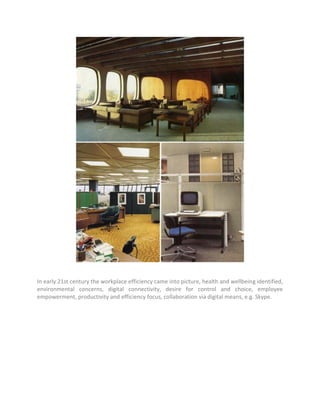
In early 20th century the office had fixed desks, task orientation, strict hierarchies, no worker
empowerment and micro-management.
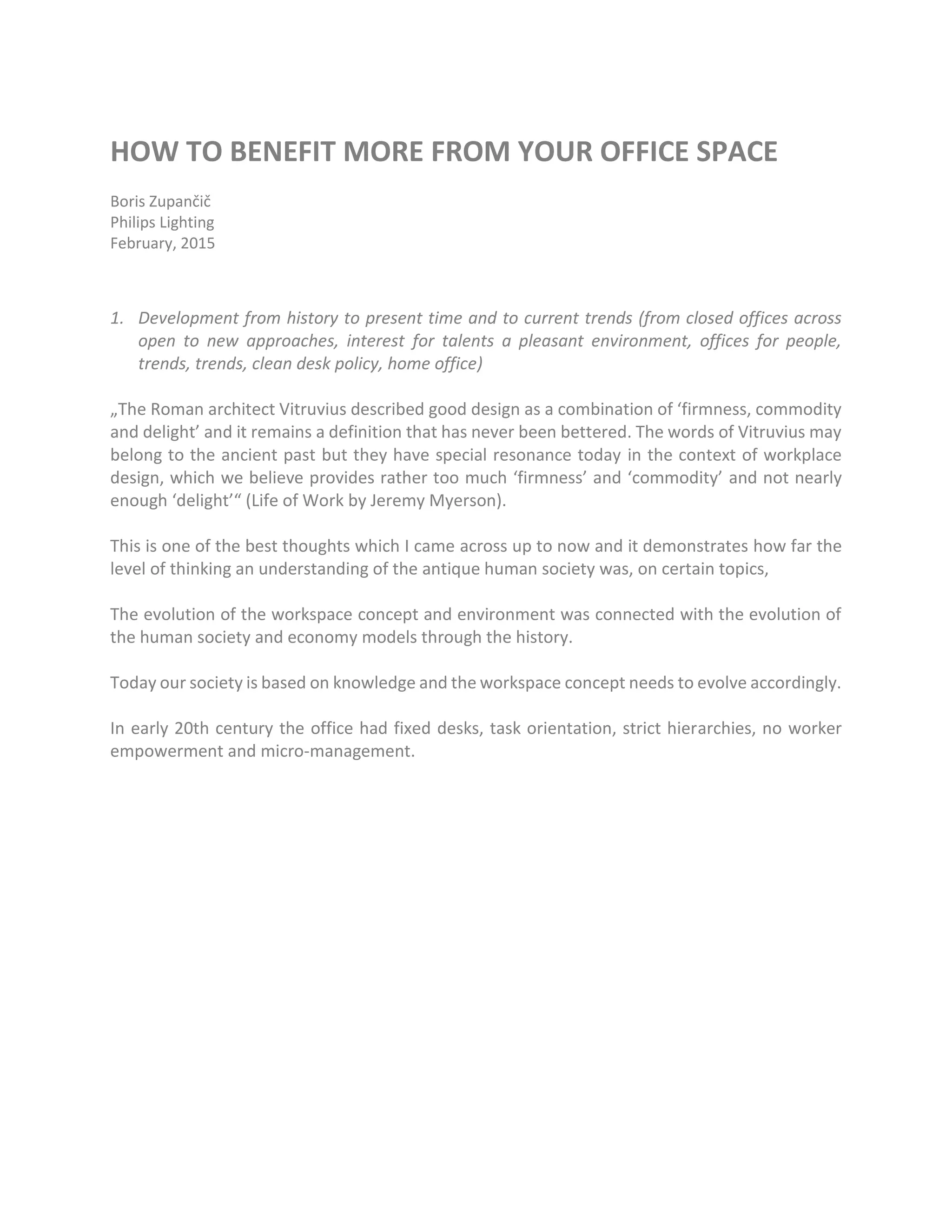
In mid-20th century the offices were open plan offices, there was increase in communications,
beginnings of electronics, more efficient working methods and still task oriented autonomous
working.
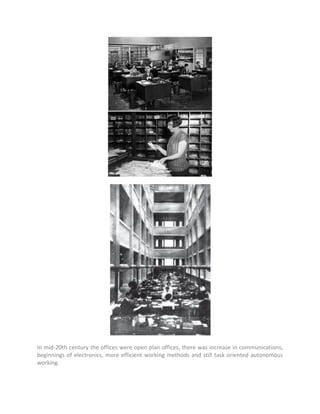
In late 20th Century computer technology was introduced, democratization of workplace
emerged, collaborative working, portable communications, flextime, hot desking.
In early 21st century the workplace efficiency came into picture, health and wellbeing identified,
environmental concerns, digital connectivity, desire for control and choice, employee
empowerment, productivity and efficiency focus, collaboration via digital means, e.g. Skype.
In the knowledge companies the Workplace and Workspace Concept has direct impact on the
culture of the company, business performance of the company, attraction and retention of
talents. The definition of Work/Life balance is transferring to Work in Life/Life in Work balance as
due to modern technologies we are in fact „Always On“. This goes hand in hand with the principal
to combine Office + Home Office principal applied with common sense approach.
Together with evolution of workspace concept and technology possibilities also the change
management process needs to be done with management and employees of the companies.
The management style is in this case transforming together with workspace concept from Control
& Micromanagement to Trust & Empower Employees or in other words from „I see employee
behind desk all day thus she/he is working“ to „Defining Task/Assignment-Follow the
development-Measure performance/result“. At the same time also employees need to evolve
and demonstrate responsible, engaging, take initiative and collaboration type of behavior.
The biggest asset of the knowledge companies are people and all the companies would like attract
and retain best talents. Through that element the Workspace Concept/Company Culture is
playing a very important role in the HR policy and goals of the management of the company.
When you have an interview with talent candidate and he comes to your office for an discussion
the first thing which he will do is to look around and observe. For talents and especially younger
generation the salary is not the only important factor but also in which environment she/he would
work, management style, how to combine work and private life. Imagine the talent coming to the
office, observing, discussing and saying „I would like to work here“.
Philips CZ decided 2,5 years ago to redefine the Workspace Concept and redefine the company
culture. In our old premises we had long dark corridors and small offices on left and right. In the
new premises, where we moved 1,5 years ago, we implemented Activity Based Workspace
concept.
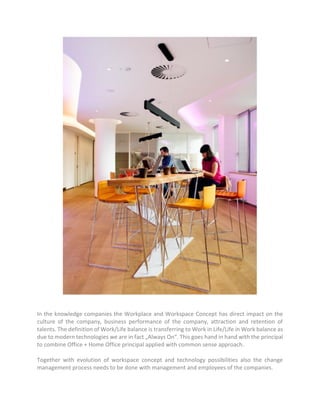
The Workspace Concept should provide the different types of the working space according to the
tasks which employees need to do during the day. Normally this is combination of concentration
and collaboration area. Certain functions like HR, IT, Legal have a fix desk policy while the other
functions like sales and marketing have desk sharing policy. The daily work process is not uniform
and you are doing different type of tasks per day. You are preparing offer for client-you need
concentration and quite place, you have a Skype call with colleague somewhere in the world and
you need focus room also not to disturb other with noise, you have a team meeting in meeting
room, you need to share some information with colleague so you make coffee and use the bench,
you have client meeting and you need meeting room or bench again. Each task has its own specific
and workspace should provide the environment in the form to support efficiency and quality
execution.
The Activity Workspace Concept also demands professional behavior and respect of and between
employees. The employees using shared desks should find the desk clean when arriving and
should leave the desk clean when leaving. When sitting in concentration area and receiving phone
call you should go to focus room not to disturb others. When having meeting you start on time
and you finish on time.
One of the elements which needs to be taking care of is also acoustic comfort. One element is the
space organization and equipment installed to reduce the noise level while the other is the
prudent and respectful behavior of employees.
The Activity Based Workspace implemented in our new premises substantially improved the
collaboration and communication between employees and teams which resulted in faster speed
of decision making process through all the levels. New space is also not allowing us to be sloppy
but it is simply forcing us to be responsible and respectful to each other. Completely different
experience is also when clients are visiting us and especially when we have discussions with
talents.
We are encouraging the other companies and managers to understand and embrace the
relocation or reconstruction of existing offices as an opportunity and not as threat through
sharing our experience. The well done evolution of the workspace concept can substantial help
to evolve the company to better cope and manage the challenges in the future and outperform
the competitors.
2. Differences in current offices - open versus closed (teamwork versus individual, communication
versus privacy, generosity versus the size of the investment, efficiency, productivity, introvert X
extrovert, how to get to the offices the image, branding etc.)
Urbanism, Traffic management, Architecture, Workspace Concept are influencing what we do in
which way, what is easy to do and what harder. All this has unconscious and conscious element
of perception and influence on behavior of human being.
If you work in office with long corridors and small office left and right where doors are closed you
can hardly expect high collaboration and communication level.
The Workspace Concept has to provide areas which are suitable for concentration type of work
and areas for collaboration/communication type of work or “quieter” and “noisier” areas. In this
case you create environment where all psychological profiles of employees can find suitable place
of work according to the task they need to perform and regardless if they are introverts or
extroverts.
In principle every company should scan the workflow process of all the functions in the company,
should define what the new workspace concept should provide/deliver/change before starting
the creation process itself. I strongly suggest to spend adequate time for thinking, discussion,
getting inspiration because whatever “mistake” will be implemented, and there is always
something which could be done better, you will be stuck with this “mistake in workspace” most
probably for very long time, till next renovation?, and will have to cope with that every day after.
The Workspace should also clearly communicate to employees and all visitors’ identity of the
company which includes Brand Image and what/who the company does/is.
All this does not mean that the creation of new Work Space Concept needs to be expensive –
well, for sure it also cannot be free of charge. It is mainly about ideas, inspiration and creativity
to find a balance between investment and goals.
3. Acoustics, HVAC (Heating-Ventilation-Air Conditioning), lighting (how to solve the noise, drafts,
temperature setting, sufficient light)
One of the important elements in Workspace Concept is to provide to employees the Functional
Comfort (visual comfort, thermal comfort, indoor air quality, acoustic comfort).
A lot of that is influenced strongly by the architecture of the building, quality of the envelope of
the building and technologies installed in the building. The modern building are today very
advanced in that aspect and are providing good balance of all this elements.
Lighting Solution: the solution is a combination of natural and artificial light. The amount of
natural light depends on size and numbers of windows, the orientation of the building and the
potential shading of the neighboring buildings/structures/trees. With installation and adequate
location of sensors, light level and presence, taking into consideration all before mentioned
influences you can deliver very high level of comfort and quality to employees while reducing the
energy consumption for several 10th percent. The light level will always be the on the comfortable
and healthy level because the system will measure daylight level and add or deduct the artificial
light level automatically. The presence sensor will detect when you come and increase the light
level if needed and will also switch of the lighting if there is nobody in this area. For strong sunny
days the shading system should be installed (inside or outside) which will provide protection from
too much light and form overheating of interior.
HVAC: it is normally incorporated into the building structure. The system should provide adequate
airflow of fresh air and the temperature comfort. There are control units in every area through
which you can adjust parameters. in modern office buildings the default value of temperature is
defined centrally and employees can adjust it for +/- 2°C. Even more important that temperature
in the adequate circulation of fresh air. In modern office buildings the windows can be opened to
secure short term fresh air circulation. If the system is designed professionally there should not
be the issue with potential draft in the workplace.
Acoustics: this element is often forgotten and you cannot manage it only by technology but also
trough behavior of the employees. According to the type of the area the anti-acoustic elements
can be used and installed through the area like thick carpet, textile chairs, anti-acoustic wall
elements which are at the same time decoration, anti-acoustic ceiling or even Luminous Anti-
Acoustic Ceiling, textile work desk separators, floor standing or pendant anti-acoustic panels.
The important element is also behavior of employees and respect between them. If you are in
quite area you should not speak loud, you should take phone calls somewhere else and similar.
4. Stimulation: paints, level of comfort, coziness (how to properly design a meeting room and office
space in order to encourage creativity, productivity, speed, etc.)
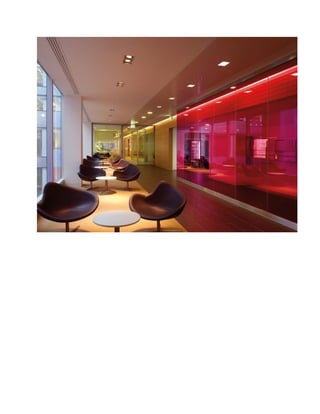
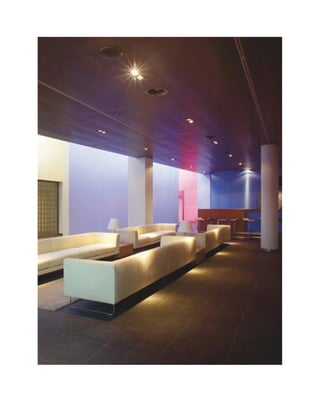
Materials and their color but also the color of light are important element in the workspace
concept and are having strong impact on work efficiency, work quality, mood and atmosphere of
the space.
The psychological influence of the colors is commonly known like Red is Love but can be also
Anger, White is Purity/Sincerity, Black is Expensive but also Grief and similar. It is advised to be
cautious which color to choose where with which intensity and in which area. The colors should
correspond with purpose of the area. In “quiet/concentration” areas we will probably use “softer”
colors while in “collaboration/communication” areas more lively one.
Hand in hand with that the suitable light color should be used. In the “quite/concentration” areas
the colder white type of light called Daylight should be used. This color of light has direct influence
through our eye to the certain centers in our brain and through that to our concentration level
on the work efficiency and quality. In the “collaboration/communication” the color of light should
be Warm White. This color is closer to our home environment which has impact on a mood and
ambient of a space and is supporting more open and relaxed atmosphere with higher engagement
and collaboration of people.
We have in our workspace a meeting room of “classical” type and a meeting room of
“collaboration” type. The first one is rectangular shape with rectangular table and with
conservative color code and Daylight, colder white, color of light. The second has half curved
shape, round table which communicates “we are all on the same level”, wood on the floor, warm
color code and Warm White color of light.
I observed a substantial difference in behavior of employees when they were on the meeting in
first or second meeting room. In the “collaborative” meeting room the engagement of the people
was on much higher level and the atmosphere was much more relaxed while still very productive.
I use this meeting room when I am looking for brainstorming, ideas, creativity, engagement, team
work of my team including me and for the meeting with clients of certain type and level of
relationship. The “classical” is used for more formal type of communication to/with employees
and meetings with clients.
I believe that combining all elements together with common sense approach and with “measure
twice-cut once” will deliver to employees and company the Workspace Environment which will
help them to better cope with todays and future challenges.

Workspace concept evolution

  • 1.
    HOW TO BENEFITMORE FROM YOUR OFFICE SPACE Boris Zupančič Philips Lighting February, 2015 1. Development from history to present time and to current trends (from closed offices across open to new approaches, interest for talents a pleasant environment, offices for people, trends, trends, clean desk policy, home office) „The Roman architect Vitruvius described good design as a combination of ‘firmness, commodity and delight’ and it remains a definition that has never been bettered. The words of Vitruvius may belong to the ancient past but they have special resonance today in the context of workplace design, which we believe provides rather too much ‘firmness’ and ‘commodity’ and not nearly enough ‘delight’“ (Life of Work by Jeremy Myerson). This is one of the best thoughts which I came across up to now and it demonstrates how far the level of thinking an understanding of the antique human society was, on certain topics, The evolution of the workspace concept and environment was connected with the evolution of the human society and economy models through the history. Today our society is based on knowledge and the workspace concept needs to evolve accordingly. In early 20th century the office had fixed desks, task orientation, strict hierarchies, no worker empowerment and micro-management.
  • 2.
    In mid-20th centurythe offices were open plan offices, there was increase in communications, beginnings of electronics, more efficient working methods and still task oriented autonomous working.
  • 3.
    In late 20thCentury computer technology was introduced, democratization of workplace emerged, collaborative working, portable communications, flextime, hot desking.
  • 4.
    In early 21stcentury the workplace efficiency came into picture, health and wellbeing identified, environmental concerns, digital connectivity, desire for control and choice, employee empowerment, productivity and efficiency focus, collaboration via digital means, e.g. Skype.
  • 7.
    In the knowledgecompanies the Workplace and Workspace Concept has direct impact on the culture of the company, business performance of the company, attraction and retention of talents. The definition of Work/Life balance is transferring to Work in Life/Life in Work balance as due to modern technologies we are in fact „Always On“. This goes hand in hand with the principal to combine Office + Home Office principal applied with common sense approach. Together with evolution of workspace concept and technology possibilities also the change management process needs to be done with management and employees of the companies.
  • 8.
    The management styleis in this case transforming together with workspace concept from Control & Micromanagement to Trust & Empower Employees or in other words from „I see employee behind desk all day thus she/he is working“ to „Defining Task/Assignment-Follow the development-Measure performance/result“. At the same time also employees need to evolve and demonstrate responsible, engaging, take initiative and collaboration type of behavior. The biggest asset of the knowledge companies are people and all the companies would like attract and retain best talents. Through that element the Workspace Concept/Company Culture is playing a very important role in the HR policy and goals of the management of the company. When you have an interview with talent candidate and he comes to your office for an discussion the first thing which he will do is to look around and observe. For talents and especially younger generation the salary is not the only important factor but also in which environment she/he would work, management style, how to combine work and private life. Imagine the talent coming to the office, observing, discussing and saying „I would like to work here“. Philips CZ decided 2,5 years ago to redefine the Workspace Concept and redefine the company culture. In our old premises we had long dark corridors and small offices on left and right. In the new premises, where we moved 1,5 years ago, we implemented Activity Based Workspace concept. The Workspace Concept should provide the different types of the working space according to the tasks which employees need to do during the day. Normally this is combination of concentration and collaboration area. Certain functions like HR, IT, Legal have a fix desk policy while the other functions like sales and marketing have desk sharing policy. The daily work process is not uniform and you are doing different type of tasks per day. You are preparing offer for client-you need concentration and quite place, you have a Skype call with colleague somewhere in the world and you need focus room also not to disturb other with noise, you have a team meeting in meeting room, you need to share some information with colleague so you make coffee and use the bench, you have client meeting and you need meeting room or bench again. Each task has its own specific and workspace should provide the environment in the form to support efficiency and quality execution. The Activity Workspace Concept also demands professional behavior and respect of and between employees. The employees using shared desks should find the desk clean when arriving and should leave the desk clean when leaving. When sitting in concentration area and receiving phone call you should go to focus room not to disturb others. When having meeting you start on time and you finish on time. One of the elements which needs to be taking care of is also acoustic comfort. One element is the space organization and equipment installed to reduce the noise level while the other is the prudent and respectful behavior of employees.
  • 9.
    The Activity BasedWorkspace implemented in our new premises substantially improved the collaboration and communication between employees and teams which resulted in faster speed of decision making process through all the levels. New space is also not allowing us to be sloppy but it is simply forcing us to be responsible and respectful to each other. Completely different experience is also when clients are visiting us and especially when we have discussions with talents. We are encouraging the other companies and managers to understand and embrace the relocation or reconstruction of existing offices as an opportunity and not as threat through sharing our experience. The well done evolution of the workspace concept can substantial help to evolve the company to better cope and manage the challenges in the future and outperform the competitors. 2. Differences in current offices - open versus closed (teamwork versus individual, communication versus privacy, generosity versus the size of the investment, efficiency, productivity, introvert X extrovert, how to get to the offices the image, branding etc.) Urbanism, Traffic management, Architecture, Workspace Concept are influencing what we do in which way, what is easy to do and what harder. All this has unconscious and conscious element of perception and influence on behavior of human being. If you work in office with long corridors and small office left and right where doors are closed you can hardly expect high collaboration and communication level. The Workspace Concept has to provide areas which are suitable for concentration type of work and areas for collaboration/communication type of work or “quieter” and “noisier” areas. In this case you create environment where all psychological profiles of employees can find suitable place of work according to the task they need to perform and regardless if they are introverts or extroverts. In principle every company should scan the workflow process of all the functions in the company, should define what the new workspace concept should provide/deliver/change before starting the creation process itself. I strongly suggest to spend adequate time for thinking, discussion, getting inspiration because whatever “mistake” will be implemented, and there is always something which could be done better, you will be stuck with this “mistake in workspace” most probably for very long time, till next renovation?, and will have to cope with that every day after. The Workspace should also clearly communicate to employees and all visitors’ identity of the company which includes Brand Image and what/who the company does/is. All this does not mean that the creation of new Work Space Concept needs to be expensive – well, for sure it also cannot be free of charge. It is mainly about ideas, inspiration and creativity to find a balance between investment and goals.
  • 10.
    3. Acoustics, HVAC(Heating-Ventilation-Air Conditioning), lighting (how to solve the noise, drafts, temperature setting, sufficient light) One of the important elements in Workspace Concept is to provide to employees the Functional Comfort (visual comfort, thermal comfort, indoor air quality, acoustic comfort). A lot of that is influenced strongly by the architecture of the building, quality of the envelope of the building and technologies installed in the building. The modern building are today very advanced in that aspect and are providing good balance of all this elements. Lighting Solution: the solution is a combination of natural and artificial light. The amount of natural light depends on size and numbers of windows, the orientation of the building and the potential shading of the neighboring buildings/structures/trees. With installation and adequate location of sensors, light level and presence, taking into consideration all before mentioned influences you can deliver very high level of comfort and quality to employees while reducing the energy consumption for several 10th percent. The light level will always be the on the comfortable and healthy level because the system will measure daylight level and add or deduct the artificial light level automatically. The presence sensor will detect when you come and increase the light level if needed and will also switch of the lighting if there is nobody in this area. For strong sunny days the shading system should be installed (inside or outside) which will provide protection from too much light and form overheating of interior. HVAC: it is normally incorporated into the building structure. The system should provide adequate airflow of fresh air and the temperature comfort. There are control units in every area through which you can adjust parameters. in modern office buildings the default value of temperature is defined centrally and employees can adjust it for +/- 2°C. Even more important that temperature in the adequate circulation of fresh air. In modern office buildings the windows can be opened to secure short term fresh air circulation. If the system is designed professionally there should not be the issue with potential draft in the workplace. Acoustics: this element is often forgotten and you cannot manage it only by technology but also trough behavior of the employees. According to the type of the area the anti-acoustic elements can be used and installed through the area like thick carpet, textile chairs, anti-acoustic wall elements which are at the same time decoration, anti-acoustic ceiling or even Luminous Anti- Acoustic Ceiling, textile work desk separators, floor standing or pendant anti-acoustic panels. The important element is also behavior of employees and respect between them. If you are in quite area you should not speak loud, you should take phone calls somewhere else and similar.
  • 11.
    4. Stimulation: paints,level of comfort, coziness (how to properly design a meeting room and office space in order to encourage creativity, productivity, speed, etc.) Materials and their color but also the color of light are important element in the workspace concept and are having strong impact on work efficiency, work quality, mood and atmosphere of the space. The psychological influence of the colors is commonly known like Red is Love but can be also Anger, White is Purity/Sincerity, Black is Expensive but also Grief and similar. It is advised to be cautious which color to choose where with which intensity and in which area. The colors should correspond with purpose of the area. In “quiet/concentration” areas we will probably use “softer” colors while in “collaboration/communication” areas more lively one. Hand in hand with that the suitable light color should be used. In the “quite/concentration” areas the colder white type of light called Daylight should be used. This color of light has direct influence through our eye to the certain centers in our brain and through that to our concentration level on the work efficiency and quality. In the “collaboration/communication” the color of light should be Warm White. This color is closer to our home environment which has impact on a mood and ambient of a space and is supporting more open and relaxed atmosphere with higher engagement and collaboration of people. We have in our workspace a meeting room of “classical” type and a meeting room of “collaboration” type. The first one is rectangular shape with rectangular table and with conservative color code and Daylight, colder white, color of light. The second has half curved shape, round table which communicates “we are all on the same level”, wood on the floor, warm color code and Warm White color of light. I observed a substantial difference in behavior of employees when they were on the meeting in first or second meeting room. In the “collaborative” meeting room the engagement of the people was on much higher level and the atmosphere was much more relaxed while still very productive. I use this meeting room when I am looking for brainstorming, ideas, creativity, engagement, team work of my team including me and for the meeting with clients of certain type and level of relationship. The “classical” is used for more formal type of communication to/with employees and meetings with clients. I believe that combining all elements together with common sense approach and with “measure twice-cut once” will deliver to employees and company the Workspace Environment which will help them to better cope with todays and future challenges.