From Conventional
to Collaborative
Space plan shows how to
support collaborative work
styles with no increase in
real estate costs.
Technology has freed knowledge workers to work just about anywhere,
causing organizations to reevalute the role of their physical workplace.
This much is becoming clear: The need for dedicated offices and
walled conference rooms is on the wane, replaced by a desire for
informal collaboration space.
“Time and again, clients tell us their workplace isn’t doing enough
to help their people work together,” says Dr. Tracy Brower, director
of Herman Miller Performance Environments. “The nature of work is
changing, but many workplaces haven’t kept pace.”
The evidence isn’t just anecdotal. Data collected across various
industries by Herman Miller shows some startling trends:
•	 Private offices are unoccupied more than 75 percent of the time.
•	 Workstations are unoccupied 60 percent of the time.
•	Conference rooms are rarely used to capacity—in larger ones, four
out of five seats typically sit empty.
Those quantitative findings are from Space Utilization Service studies.
Part of Herman Miller Performance Environments—a suite of
workplace-improvement services—the Space Utilization Service
collects occupancy data via wireless sensors attached to the
underside of chairs. The data show precisely when every chair is
used—whether in private offices, workstations, meeting rooms, or
common areas.
“Herman Miller analyzes the data to recommend space-allocation
strategies that better support how an organization actually works,”
says Paula Edwards, senior manager of Performance Environments.
“Invariably, we find that companies would be better served with a
floor plan that includes a variety of spaces for informal interaction—
often, the kind that occurs spontaneously.”
Collaboration Scenario / 2012
TRACKING THE TREND
Research reveals a continuing shift toward collaboration in the
workplace. Back in 1985, just 30 percent of an individual’s output
depended on working within a group; by 2010, that figure was up
to 80 percent.1
What’s behind this transition toward greater reliance on
collaboration—and a workplace that supports it?
•	 Complexity. Today’s knowledge workers tend to be more specialized
than previous generations. It’s rare for any one person to have all
the expertise needed to solve complex tasks.
•	 Speed. Technology has raised expectations. When every deadline
seems to be ASAP, knowledge workers have no choice but to
prove the axiom: “Two working together can accomplish more
than twice as much as one working alone.”
•	 Insight. Research suggests there’s wisdom in numbers. The
sharing of information and opinions improves decision making.
In one study, researchers found that subjects’ collective decisions
outperformed those of each person working alone.2
•	 Mobility. Thanks to technology, much of what knowledge workers
do can be done pretty much anywhere—at home, on the road, in a
coffee shop. So why do they still come to the office? Buildings are
no longer the containers for work; they now function as places for
people to gather and collaborate. These connections are quickly
becoming the main justification for the physical workplace.
Though the nature of collaborative space varies according to culture,
the one constant is the need for a greater variety of informal areas
that give workers a choice about where and how they interact. That
choice can come in many forms—lounge seating, focus rooms,
stools and tall tables, perhaps even file islands that invite colleagues
to gather and compare notes when they bump into each other on
the go.
“Formal conference rooms are great for presentations, but informal
spaces encourage a different kind of interaction—more unstructured,
more creative, and more conducive to a collaborative culture,” Dr.
Brower says.
Such unstructured collaboration is crucial to keeping up with the
pace of change characteristic of the modern workday. If a cell phone
conversation takes a confidential turn, the person can move to a
private “quiet” room. If a team needs to meet in order to discuss
a pressing project, the members can find a casual sitting area. If a
sales rep drops in for an update between appointments, she can
head to the coffee bar.
Creating effective group spaces starts with understanding the types
of interaction performed there and the number of people to be
supported. Based on that understanding, a space can be designed
to have the right tools and appropriate degree of enclosure to
support the activity.
Collaboration Scenario / 2
THE RESERVATION FALLACY
The traditional alternative—an enclosed conference room with
a large table—simply isn’t being used much anymore, certainly not
to capacity. That may seem counterintuitive; after all, facility managers
frequently complain about lack of meeting space—“Our conference
rooms are always booked.” But booked isn’t the same as occupied.
As part of the Space Utilization Service, Herman Miller compares the
online reservation system of client companies with actual occupancy
data. They find that conference rooms are often reserved but not
used—and vice versa even more frequently. Why?
“Work moves so fast nowadays that plans made Tuesday can be moot
by Thursday,” Dr. Brower says. “People are meeting on the fly and
forgetting to cancel their reservation or ducking into a room on the
spur of the moment without bothering to make one. Clearly, what’s
needed is more informal collaboration areas for unplanned encounters.”
Informal implies smaller. Data collected by the Space Utilization
Service indicate that rooms with eight or fewer people are used
more than half the time.
Technology helps, too. Space Utilization findings across various
industries reveal that meeting rooms equipped with technology—
speakerphones, monitors, screens—are used five times as much as
those without.
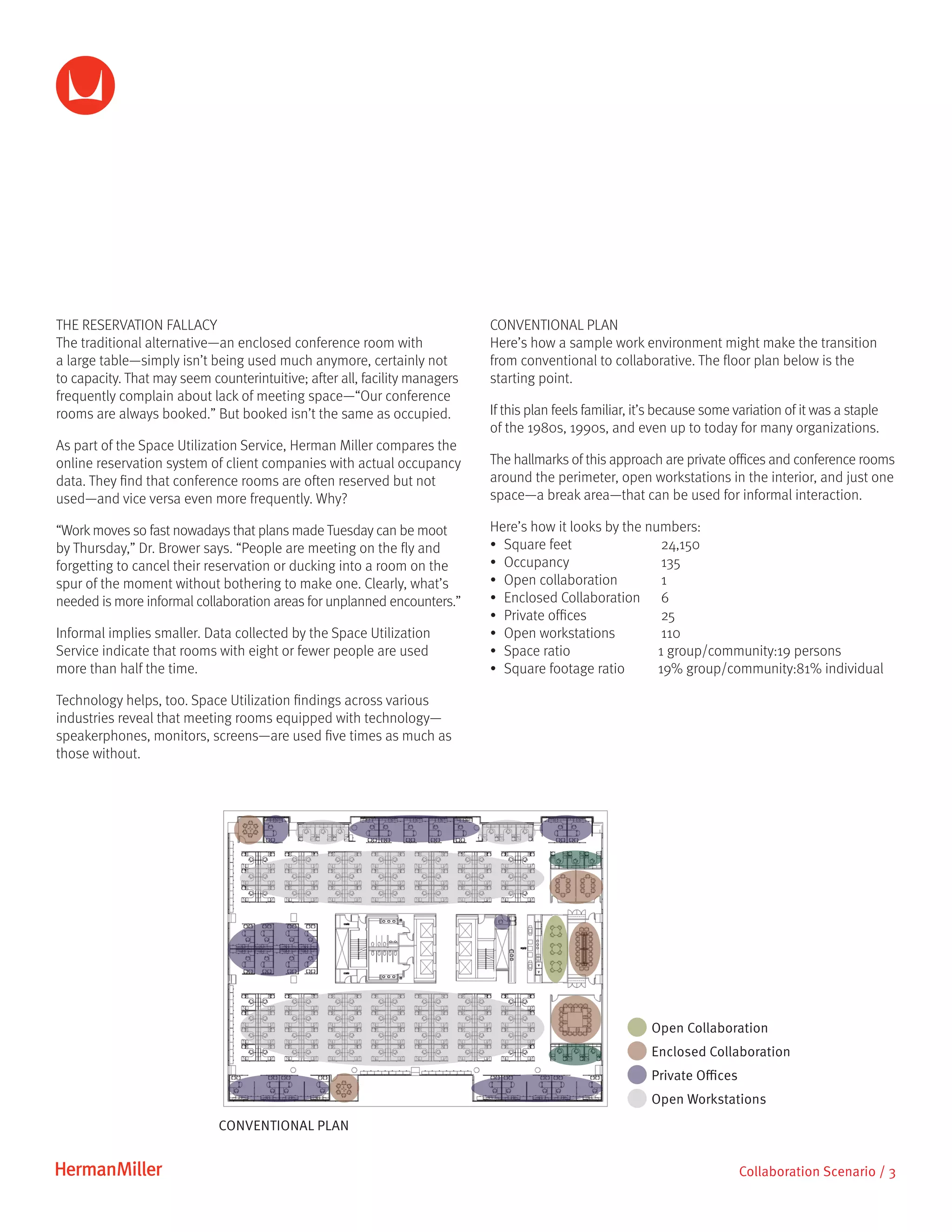
CONVENTIONAL PLAN
Here’s how a sample work environment might make the transition
from conventional to collaborative. The floor plan below is the
starting point.
If this plan feels familiar, it’s because some variation of it was a staple
of the 1980s, 1990s, and even up to today for many organizations.
The hallmarks of this approach are private offices and conference rooms
around the perimeter, open workstations in the interior, and just one
space—a break area—that can be used for informal interaction.
Here’s how it looks by the numbers:
•	 Square feet 	 24,150
•	 Occupancy 	 135
•	 Open collaboration	 1
•	 Enclosed Collaboration	 6
•	 Private offices	 25
•	 Open workstations	 110
•	 Space ratio 	 1 group/community:19 persons	
•	 Square footage ratio 	 19% group/community:81% individual
Collaboration Scenario / 3
CONVENTIONAL PLAN
Open Workstations
Private Offices
Open Collaboration
Enclosed Collaboration
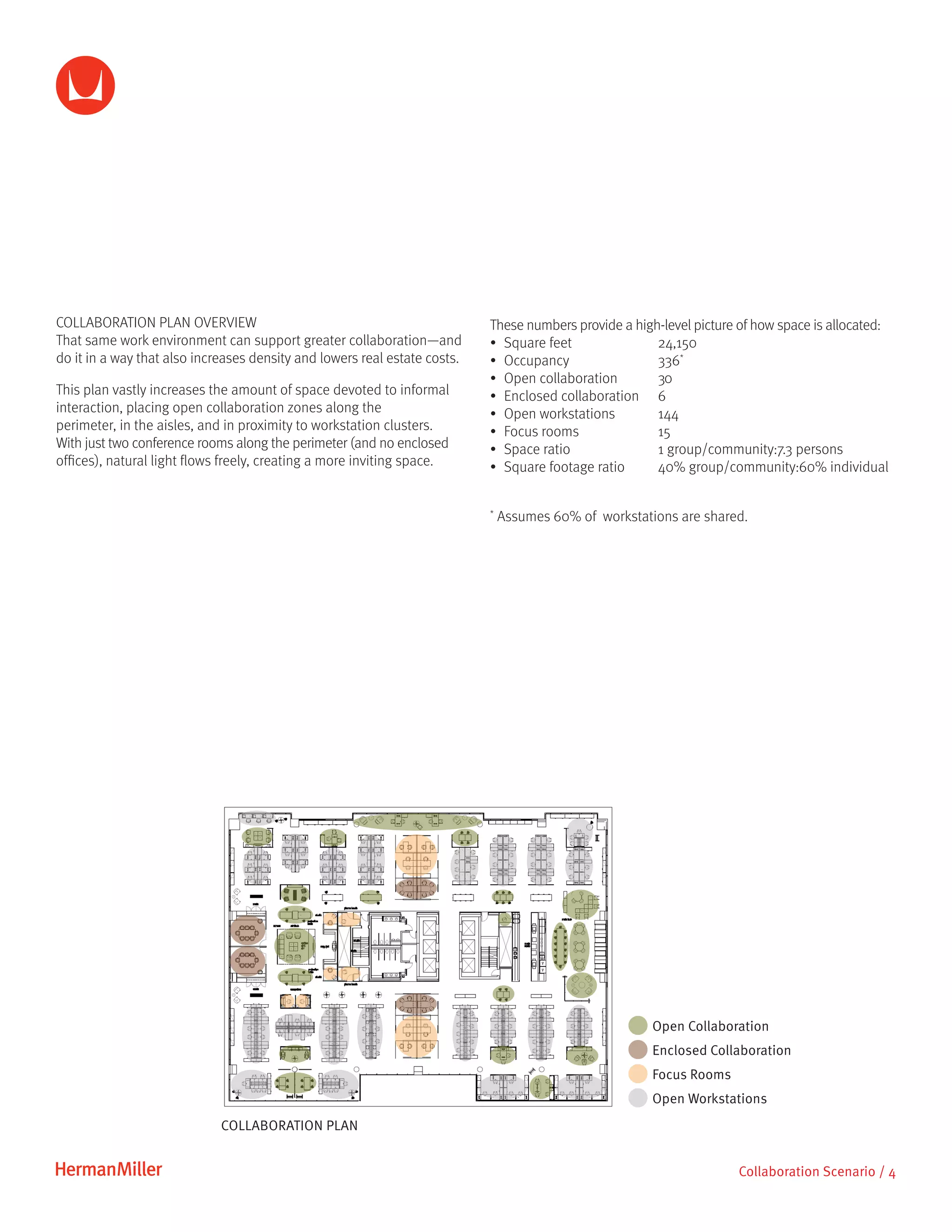
COLLABORATION PLAN OVERVIEW
That same work environment can support greater collaboration—and
do it in a way that also increases density and lowers real estate costs.
This plan vastly increases the amount of space devoted to informal
interaction, placing open collaboration zones along the
perimeter, in the aisles, and in proximity to workstation clusters.
With just two conference rooms along the perimeter (and no enclosed
offices), natural light flows freely, creating a more inviting space.
Collaboration Scenario / 4
These numbers provide a high-level picture of how space is allocated:
•	 Square feet	 24,150
•	 Occupancy	336*
•	 Open collaboration	 30
•	 Enclosed collaboration	 6
•	 Open workstations 	 144
•	 Focus rooms	 15
•	 Space ratio 	 1 group/community:7.3 persons	
•	 Square footage ratio 	 40% group/community:60% individual
*
Assumes 60% of workstations are shared.
COLLABORATION PLAN
Open Workstations
Focus Rooms
Open Collaboration
Enclosed Collaboration
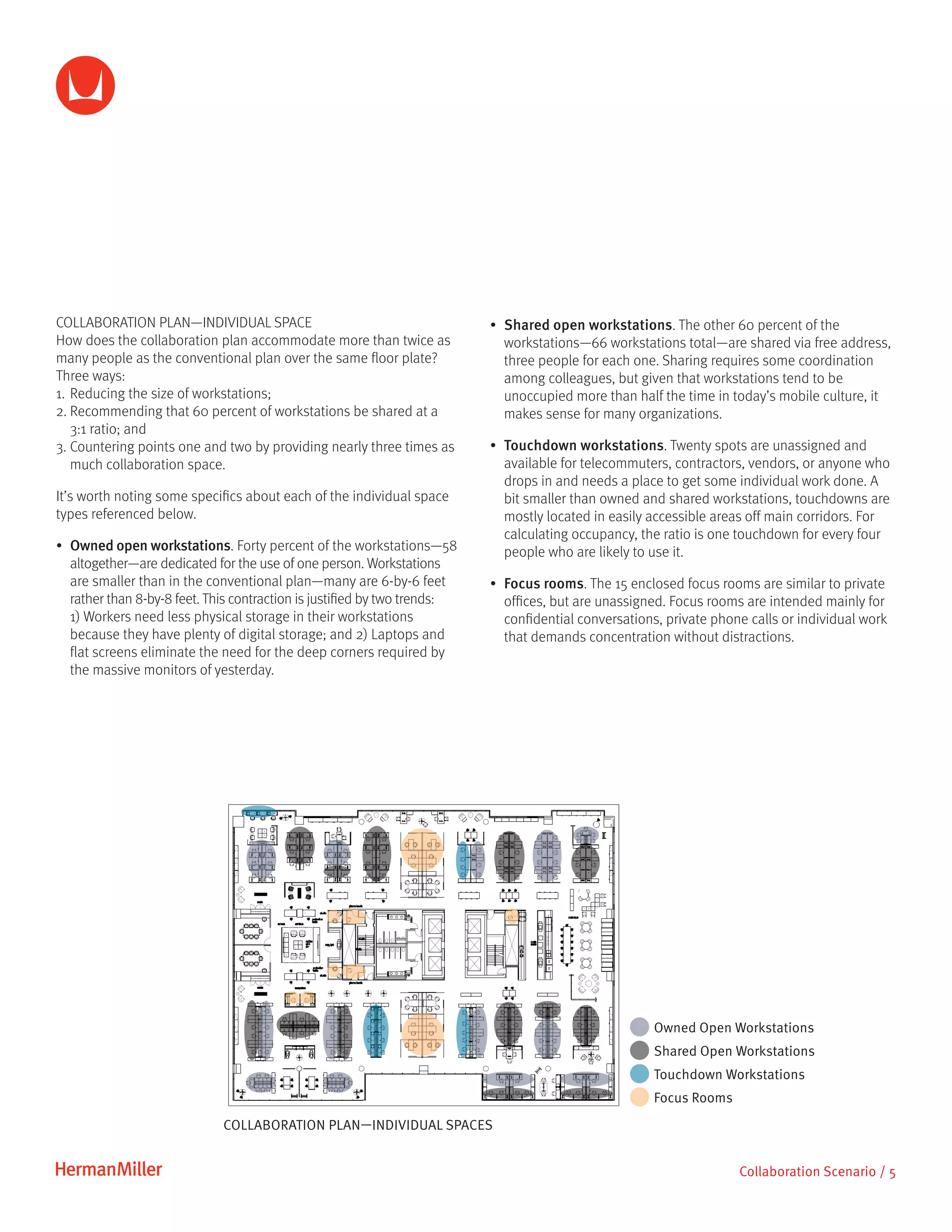
COLLABORATION PLAN—INDIVIDUAL SPACE
How does the collaboration plan accommodate more than twice as
many people as the conventional plan over the same floor plate?
Three ways:
1.	Reducing the size of workstations;
2.	Recommending that 60 percent of workstations be shared at a
3:1 ratio; and
3.	Countering points one and two by providing nearly three times as
much collaboration space.
It’s worth noting some specifics about each of the individual space
types referenced below.
•	Owned open workstations. Forty percent of the workstations—58
altogether—are dedicated for the use of one person. Workstations
are smaller than in the conventional plan—many are 6-by-6 feet
rather than 8-by-8 feet. This contraction is justified by two trends:
1) Workers need less physical storage in their workstations
because they have plenty of digital storage; and 2) Laptops and
flat screens eliminate the need for the deep corners required by
the massive monitors of yesterday.
Collaboration Scenario / 5
•	Shared open workstations. The other 60 percent of the
workstations—66 workstations total—are shared via free address,
three people for each one. Sharing requires some coordination
among colleagues, but given that workstations tend to be
unoccupied more than half the time in today’s mobile culture, it
makes sense for many organizations.
•	Touchdown workstations. Twenty spots are unassigned and
available for telecommuters, contractors, vendors, or anyone who
drops in and needs a place to get some individual work done. A
bit smaller than owned and shared workstations, touchdowns are
mostly located in easily accessible areas off main corridors. For
calculating occupancy, the ratio is one touchdown for every four
people who are likely to use it.
•	Focus rooms. The 15 enclosed focus rooms are similar to private
offices, but are unassigned. Focus rooms are intended mainly for
confidential conversations, private phone calls or individual work
that demands concentration without distractions.
COLLABORATION PLAN—INDIVIDUAL SPACES
Owned Open Workstations
Focus Rooms
Shared Open Workstations
Touchdown Workstations
COLLABORATION PLAN—GROUP SPACE
The group space in the collaboration plan—40% of the total square
footage—is divided between community space and group space.
Community collaboration areas are available to all and located in the
interior along major corridors, making planned interaction convenient
and chance encounters likely. Group collaboration areas, meanwhile,
are “owned” by specific work groups and located around the perimeter,
near the teams they serve.
Each type of collabortion space in this sample plan has
specific characteristics:
Community Collaboration
•	The large block on the right of the plan is community space. Tables
and booths characteristic of a café or coffee bar are flanked by
casual lounge areas, providing impromptu meeting space near a
natural gathering spot.
•	The circulation space along both central corridors is punctuated by
file islands and tall tables with stools, supporting quick information
exchange as people encounter each other while on the move. The
file islands do double duty, both as group storage and as a place
where colleagues can gather and compare notes.
Collaboration Scenario / 6
•	Four enclosed meeting rooms are in the center of the space. All
are small (just four seats) and equipped with technology, the right
tools, boundaries, and postural support—all attributes proven to
encourage usage.
•	On the far left are two enclosed conference rooms for formal
meetings. Across the hall is a lounge area for quick interaction
before or after meetings. The lounge is also adjacent to a printer
area—again, supporting casual collaboration near a place where
people are likely to bump into one another.
Group Collaboration
•	Much of the perimeter serves as both circulation space and
open collaboration zones for nearby work teams. Windows aren’t
blocked, allowing daylight to penetrate and contributing to a
bright, energetic environment.
•	The two rectangular areas in the lower left provide project space,
offering both tables for teamwork and a benching setup for
individual work. Occupants can shift between collaboration and
focused work without leaving the space.
•	Collaboration zones are adjacent to workstation clusters. Proximity
encourages spontaneous interaction.
COLLABORATION PLAN–COMMUNITY AND GROUP SPACES
Group (team-owned)
Community (shared)
•	Midway across the top, the floor plan suggests benching applications
for mobile workers who need to be available to nearby work
teams. Soft seating in architectural nichés offers another option
for casual interaction.
Though the collaboration plan can accommodate more than 300
people, the assumption is that no more than 200 will be on hand at any
given time since many workstations are shared. Not coincidentally, the
spaces designed for interaction offer an additional 160 seats—nearly
one for each person.
“That’s the ideal,” says Edwards of Herman Miller Performance
Environments. “To support a collaborative culture, we generally
recommend one interaction space for every five to ten people—or
about one seat per person. In effect, everyone gets multiple places
to work.”
Adds Dr. Brower: “The collaboration plan represents a cultural shift
from space that is ‘mine’ to space that is ‘ours.’ It encourages
people to start thinking of the entire floor as their office, not just
their individual workstation.”
Collaboration Scenario / 7
FINANCIAL CONSIDERATIONS
The collaboration plan doesn’t just offer a better place to work—it
can save money. The combination of shared workstations and multiple
collaboration zones permits increased density while offering a
broader range of workplace choice.
Since the alternative plan accommodates more than twice as many
people as the conventional approach, it could eliminate the need
for an entire floor affording significant lease savings. In making the
transition from the conventional to the collaboration plan in this
paper, the projected annual savings are over $560,000, or nearly
$4 million over a seven-year lease.
“That could be more than enough to furnish the new space, right
down to the printers and coffee makers,” Dr. Brower says. “In effect,
the switch from a conventional to a collaborative plan allows the client
to harvest from the existing real estate and reinvest in a space that
aligns with how work is getting done. It pays for itself—and then some.”
NOTES
1	
D. Morello and B. Burton, “Future Worker 2015: Extreme Individualism,”
Gartner, 2006.
2	
“Optimally Interacting Minds,” Bahador Bahrami, Karsten Olsen, Peter E.
Latham, Andreas Roepstorff, Geraint Rees, and Chris D. Frith.

Collaboration scenario

  • 1.
    From Conventional to Collaborative Spaceplan shows how to support collaborative work styles with no increase in real estate costs. Technology has freed knowledge workers to work just about anywhere, causing organizations to reevalute the role of their physical workplace. This much is becoming clear: The need for dedicated offices and walled conference rooms is on the wane, replaced by a desire for informal collaboration space. “Time and again, clients tell us their workplace isn’t doing enough to help their people work together,” says Dr. Tracy Brower, director of Herman Miller Performance Environments. “The nature of work is changing, but many workplaces haven’t kept pace.” The evidence isn’t just anecdotal. Data collected across various industries by Herman Miller shows some startling trends: • Private offices are unoccupied more than 75 percent of the time. • Workstations are unoccupied 60 percent of the time. • Conference rooms are rarely used to capacity—in larger ones, four out of five seats typically sit empty. Those quantitative findings are from Space Utilization Service studies. Part of Herman Miller Performance Environments—a suite of workplace-improvement services—the Space Utilization Service collects occupancy data via wireless sensors attached to the underside of chairs. The data show precisely when every chair is used—whether in private offices, workstations, meeting rooms, or common areas. “Herman Miller analyzes the data to recommend space-allocation strategies that better support how an organization actually works,” says Paula Edwards, senior manager of Performance Environments. “Invariably, we find that companies would be better served with a floor plan that includes a variety of spaces for informal interaction— often, the kind that occurs spontaneously.” Collaboration Scenario / 2012
  • 2.
    TRACKING THE TREND Researchreveals a continuing shift toward collaboration in the workplace. Back in 1985, just 30 percent of an individual’s output depended on working within a group; by 2010, that figure was up to 80 percent.1 What’s behind this transition toward greater reliance on collaboration—and a workplace that supports it? • Complexity. Today’s knowledge workers tend to be more specialized than previous generations. It’s rare for any one person to have all the expertise needed to solve complex tasks. • Speed. Technology has raised expectations. When every deadline seems to be ASAP, knowledge workers have no choice but to prove the axiom: “Two working together can accomplish more than twice as much as one working alone.” • Insight. Research suggests there’s wisdom in numbers. The sharing of information and opinions improves decision making. In one study, researchers found that subjects’ collective decisions outperformed those of each person working alone.2 • Mobility. Thanks to technology, much of what knowledge workers do can be done pretty much anywhere—at home, on the road, in a coffee shop. So why do they still come to the office? Buildings are no longer the containers for work; they now function as places for people to gather and collaborate. These connections are quickly becoming the main justification for the physical workplace. Though the nature of collaborative space varies according to culture, the one constant is the need for a greater variety of informal areas that give workers a choice about where and how they interact. That choice can come in many forms—lounge seating, focus rooms, stools and tall tables, perhaps even file islands that invite colleagues to gather and compare notes when they bump into each other on the go. “Formal conference rooms are great for presentations, but informal spaces encourage a different kind of interaction—more unstructured, more creative, and more conducive to a collaborative culture,” Dr. Brower says. Such unstructured collaboration is crucial to keeping up with the pace of change characteristic of the modern workday. If a cell phone conversation takes a confidential turn, the person can move to a private “quiet” room. If a team needs to meet in order to discuss a pressing project, the members can find a casual sitting area. If a sales rep drops in for an update between appointments, she can head to the coffee bar. Creating effective group spaces starts with understanding the types of interaction performed there and the number of people to be supported. Based on that understanding, a space can be designed to have the right tools and appropriate degree of enclosure to support the activity. Collaboration Scenario / 2
  • 3.
    THE RESERVATION FALLACY Thetraditional alternative—an enclosed conference room with a large table—simply isn’t being used much anymore, certainly not to capacity. That may seem counterintuitive; after all, facility managers frequently complain about lack of meeting space—“Our conference rooms are always booked.” But booked isn’t the same as occupied. As part of the Space Utilization Service, Herman Miller compares the online reservation system of client companies with actual occupancy data. They find that conference rooms are often reserved but not used—and vice versa even more frequently. Why? “Work moves so fast nowadays that plans made Tuesday can be moot by Thursday,” Dr. Brower says. “People are meeting on the fly and forgetting to cancel their reservation or ducking into a room on the spur of the moment without bothering to make one. Clearly, what’s needed is more informal collaboration areas for unplanned encounters.” Informal implies smaller. Data collected by the Space Utilization Service indicate that rooms with eight or fewer people are used more than half the time. Technology helps, too. Space Utilization findings across various industries reveal that meeting rooms equipped with technology— speakerphones, monitors, screens—are used five times as much as those without. CONVENTIONAL PLAN Here’s how a sample work environment might make the transition from conventional to collaborative. The floor plan below is the starting point. If this plan feels familiar, it’s because some variation of it was a staple of the 1980s, 1990s, and even up to today for many organizations. The hallmarks of this approach are private offices and conference rooms around the perimeter, open workstations in the interior, and just one space—a break area—that can be used for informal interaction. Here’s how it looks by the numbers: • Square feet 24,150 • Occupancy 135 • Open collaboration 1 • Enclosed Collaboration 6 • Private offices 25 • Open workstations 110 • Space ratio 1 group/community:19 persons • Square footage ratio 19% group/community:81% individual Collaboration Scenario / 3 CONVENTIONAL PLAN Open Workstations Private Offices Open Collaboration Enclosed Collaboration
  • 4.
    COLLABORATION PLAN OVERVIEW Thatsame work environment can support greater collaboration—and do it in a way that also increases density and lowers real estate costs. This plan vastly increases the amount of space devoted to informal interaction, placing open collaboration zones along the perimeter, in the aisles, and in proximity to workstation clusters. With just two conference rooms along the perimeter (and no enclosed offices), natural light flows freely, creating a more inviting space. Collaboration Scenario / 4 These numbers provide a high-level picture of how space is allocated: • Square feet 24,150 • Occupancy 336* • Open collaboration 30 • Enclosed collaboration 6 • Open workstations 144 • Focus rooms 15 • Space ratio 1 group/community:7.3 persons • Square footage ratio 40% group/community:60% individual * Assumes 60% of workstations are shared. COLLABORATION PLAN Open Workstations Focus Rooms Open Collaboration Enclosed Collaboration
  • 5.
    COLLABORATION PLAN—INDIVIDUAL SPACE Howdoes the collaboration plan accommodate more than twice as many people as the conventional plan over the same floor plate? Three ways: 1. Reducing the size of workstations; 2. Recommending that 60 percent of workstations be shared at a 3:1 ratio; and 3. Countering points one and two by providing nearly three times as much collaboration space. It’s worth noting some specifics about each of the individual space types referenced below. • Owned open workstations. Forty percent of the workstations—58 altogether—are dedicated for the use of one person. Workstations are smaller than in the conventional plan—many are 6-by-6 feet rather than 8-by-8 feet. This contraction is justified by two trends: 1) Workers need less physical storage in their workstations because they have plenty of digital storage; and 2) Laptops and flat screens eliminate the need for the deep corners required by the massive monitors of yesterday. Collaboration Scenario / 5 • Shared open workstations. The other 60 percent of the workstations—66 workstations total—are shared via free address, three people for each one. Sharing requires some coordination among colleagues, but given that workstations tend to be unoccupied more than half the time in today’s mobile culture, it makes sense for many organizations. • Touchdown workstations. Twenty spots are unassigned and available for telecommuters, contractors, vendors, or anyone who drops in and needs a place to get some individual work done. A bit smaller than owned and shared workstations, touchdowns are mostly located in easily accessible areas off main corridors. For calculating occupancy, the ratio is one touchdown for every four people who are likely to use it. • Focus rooms. The 15 enclosed focus rooms are similar to private offices, but are unassigned. Focus rooms are intended mainly for confidential conversations, private phone calls or individual work that demands concentration without distractions. COLLABORATION PLAN—INDIVIDUAL SPACES Owned Open Workstations Focus Rooms Shared Open Workstations Touchdown Workstations
  • 6.
    COLLABORATION PLAN—GROUP SPACE Thegroup space in the collaboration plan—40% of the total square footage—is divided between community space and group space. Community collaboration areas are available to all and located in the interior along major corridors, making planned interaction convenient and chance encounters likely. Group collaboration areas, meanwhile, are “owned” by specific work groups and located around the perimeter, near the teams they serve. Each type of collabortion space in this sample plan has specific characteristics: Community Collaboration • The large block on the right of the plan is community space. Tables and booths characteristic of a café or coffee bar are flanked by casual lounge areas, providing impromptu meeting space near a natural gathering spot. • The circulation space along both central corridors is punctuated by file islands and tall tables with stools, supporting quick information exchange as people encounter each other while on the move. The file islands do double duty, both as group storage and as a place where colleagues can gather and compare notes. Collaboration Scenario / 6 • Four enclosed meeting rooms are in the center of the space. All are small (just four seats) and equipped with technology, the right tools, boundaries, and postural support—all attributes proven to encourage usage. • On the far left are two enclosed conference rooms for formal meetings. Across the hall is a lounge area for quick interaction before or after meetings. The lounge is also adjacent to a printer area—again, supporting casual collaboration near a place where people are likely to bump into one another. Group Collaboration • Much of the perimeter serves as both circulation space and open collaboration zones for nearby work teams. Windows aren’t blocked, allowing daylight to penetrate and contributing to a bright, energetic environment. • The two rectangular areas in the lower left provide project space, offering both tables for teamwork and a benching setup for individual work. Occupants can shift between collaboration and focused work without leaving the space. • Collaboration zones are adjacent to workstation clusters. Proximity encourages spontaneous interaction. COLLABORATION PLAN–COMMUNITY AND GROUP SPACES Group (team-owned) Community (shared)
  • 7.
    • Midway across thetop, the floor plan suggests benching applications for mobile workers who need to be available to nearby work teams. Soft seating in architectural nichés offers another option for casual interaction. Though the collaboration plan can accommodate more than 300 people, the assumption is that no more than 200 will be on hand at any given time since many workstations are shared. Not coincidentally, the spaces designed for interaction offer an additional 160 seats—nearly one for each person. “That’s the ideal,” says Edwards of Herman Miller Performance Environments. “To support a collaborative culture, we generally recommend one interaction space for every five to ten people—or about one seat per person. In effect, everyone gets multiple places to work.” Adds Dr. Brower: “The collaboration plan represents a cultural shift from space that is ‘mine’ to space that is ‘ours.’ It encourages people to start thinking of the entire floor as their office, not just their individual workstation.” Collaboration Scenario / 7 FINANCIAL CONSIDERATIONS The collaboration plan doesn’t just offer a better place to work—it can save money. The combination of shared workstations and multiple collaboration zones permits increased density while offering a broader range of workplace choice. Since the alternative plan accommodates more than twice as many people as the conventional approach, it could eliminate the need for an entire floor affording significant lease savings. In making the transition from the conventional to the collaboration plan in this paper, the projected annual savings are over $560,000, or nearly $4 million over a seven-year lease. “That could be more than enough to furnish the new space, right down to the printers and coffee makers,” Dr. Brower says. “In effect, the switch from a conventional to a collaborative plan allows the client to harvest from the existing real estate and reinvest in a space that aligns with how work is getting done. It pays for itself—and then some.” NOTES 1 D. Morello and B. Burton, “Future Worker 2015: Extreme Individualism,” Gartner, 2006. 2 “Optimally Interacting Minds,” Bahador Bahrami, Karsten Olsen, Peter E. Latham, Andreas Roepstorff, Geraint Rees, and Chris D. Frith.