School of Mechanical Engineering


                          Tuesday, November 10, 2009


  Aeroacoustic simulation of bluff
body noise using a hybrid statistical
              method
                    Con Doolan
          School of Mechanical Engineering
          University of Adelaide, SA, 5005


                       ACOUSTICS 2009

                                    Life Impact The University of Adelaide
Summary
•   Bluff Body Noise - What is it?
•   Why is it important?
•   Physics controlling flow and noise
•   Simulation methods - limitations for
    engineers
•   Statistical Correction
•   Results


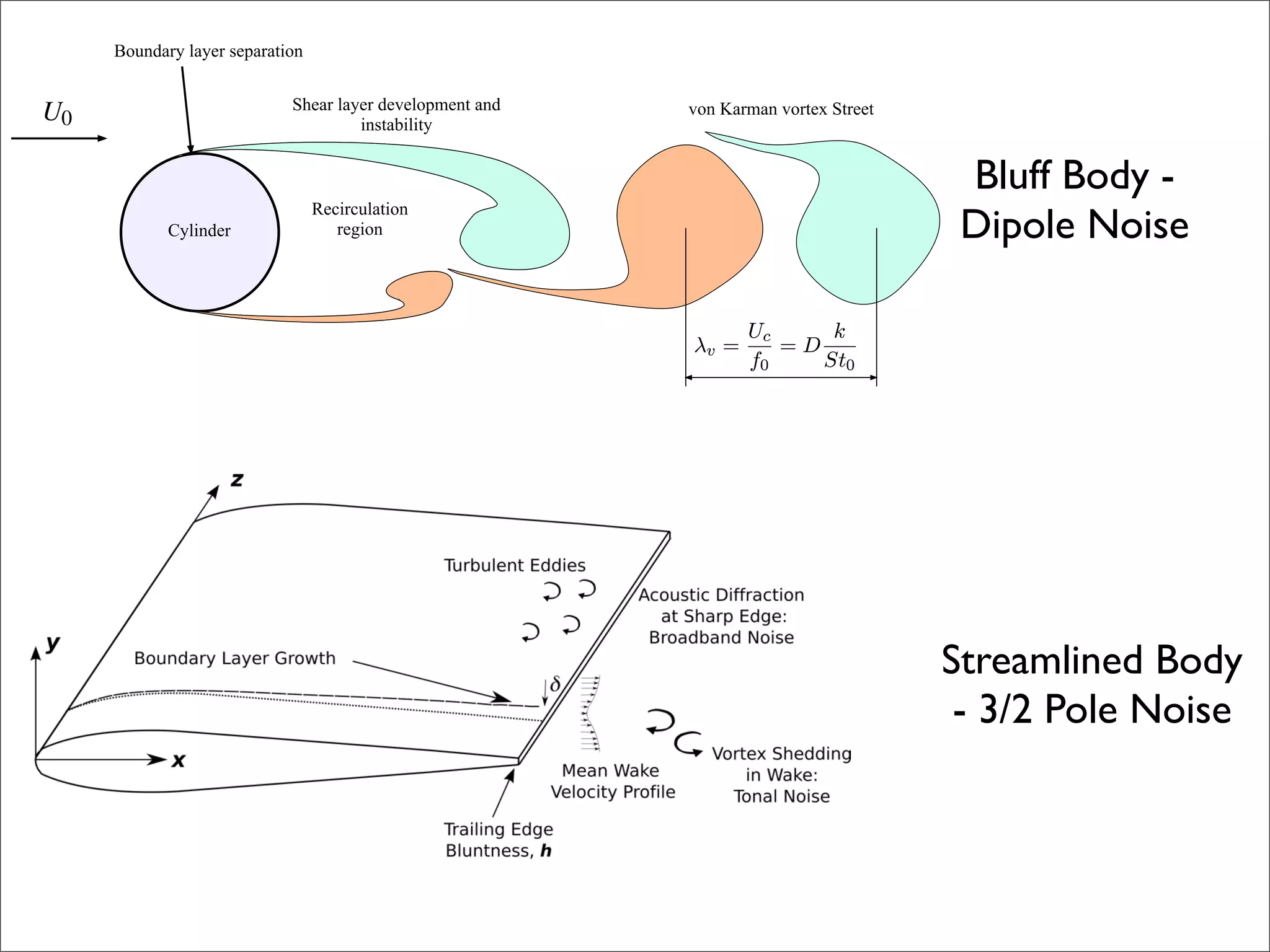
                               
U0                                   


                                                                                       Bluff Body -
                                 
                                                                         Dipole Noise

                                                                  Uc     k
                                                           λv =      =D
                                                                  f0    St0


                                                                                      Streamlined Body
                                                                                       - 3/2 Pole Noise
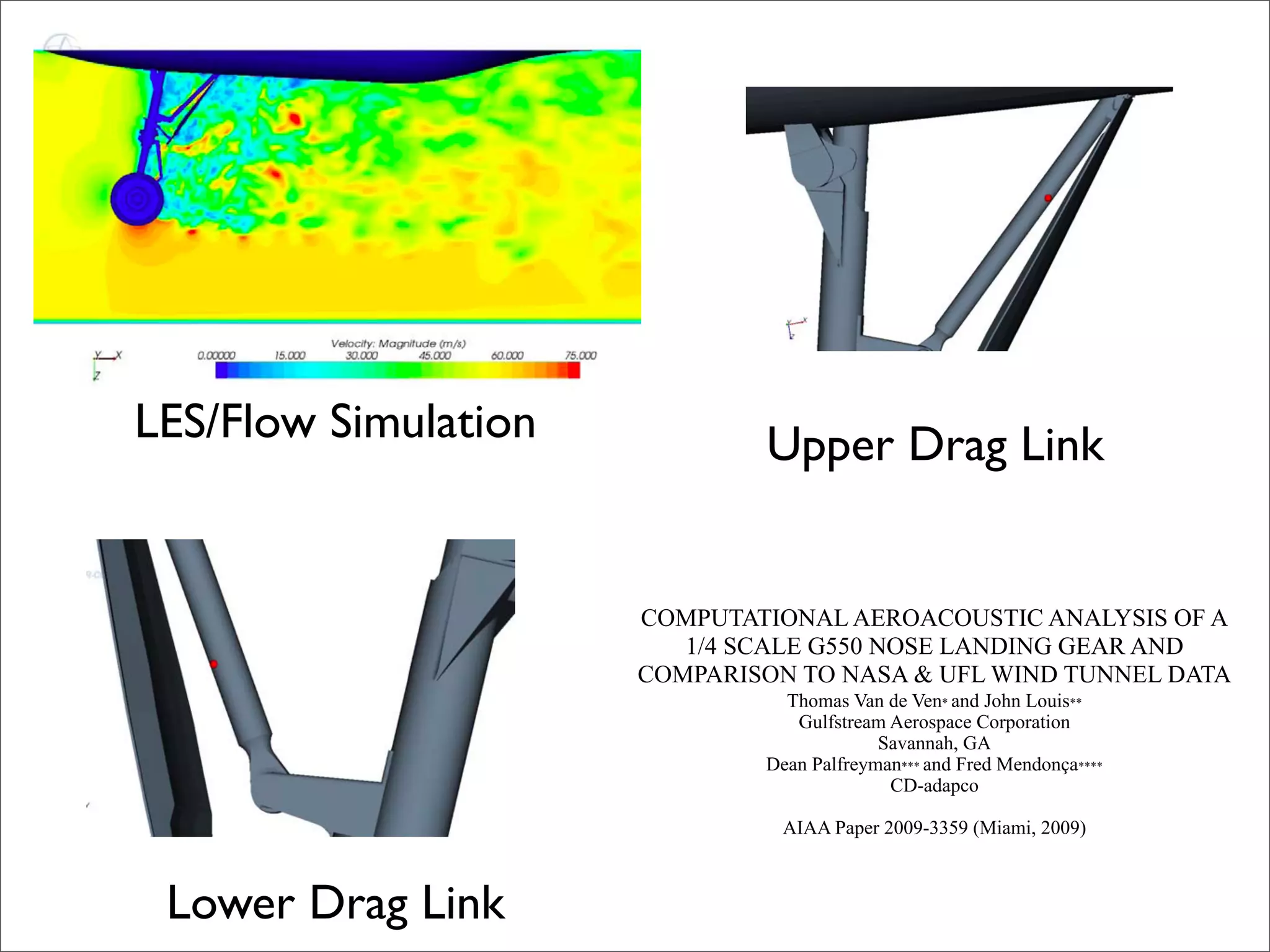
LES/Flow Simulation           Upper Drag Link


                      COMPUTATIONAL AEROACOUSTIC ANALYSIS OF A
                         1/4 SCALE G550 NOSE LANDING GEAR AND
                      COMPARISON TO NASA & UFL WIND TUNNEL DATA
                                Thomas Van de Ven* and John Louis**
                                 Gulfstream Aerospace Corporation
                                           Savannah, GA
                              Dean Palfreyman*** and Fred Mendonça****
                                            CD-adapco

                                AIAA Paper 2009-3359 (Miami, 2009)


 Lower Drag Link
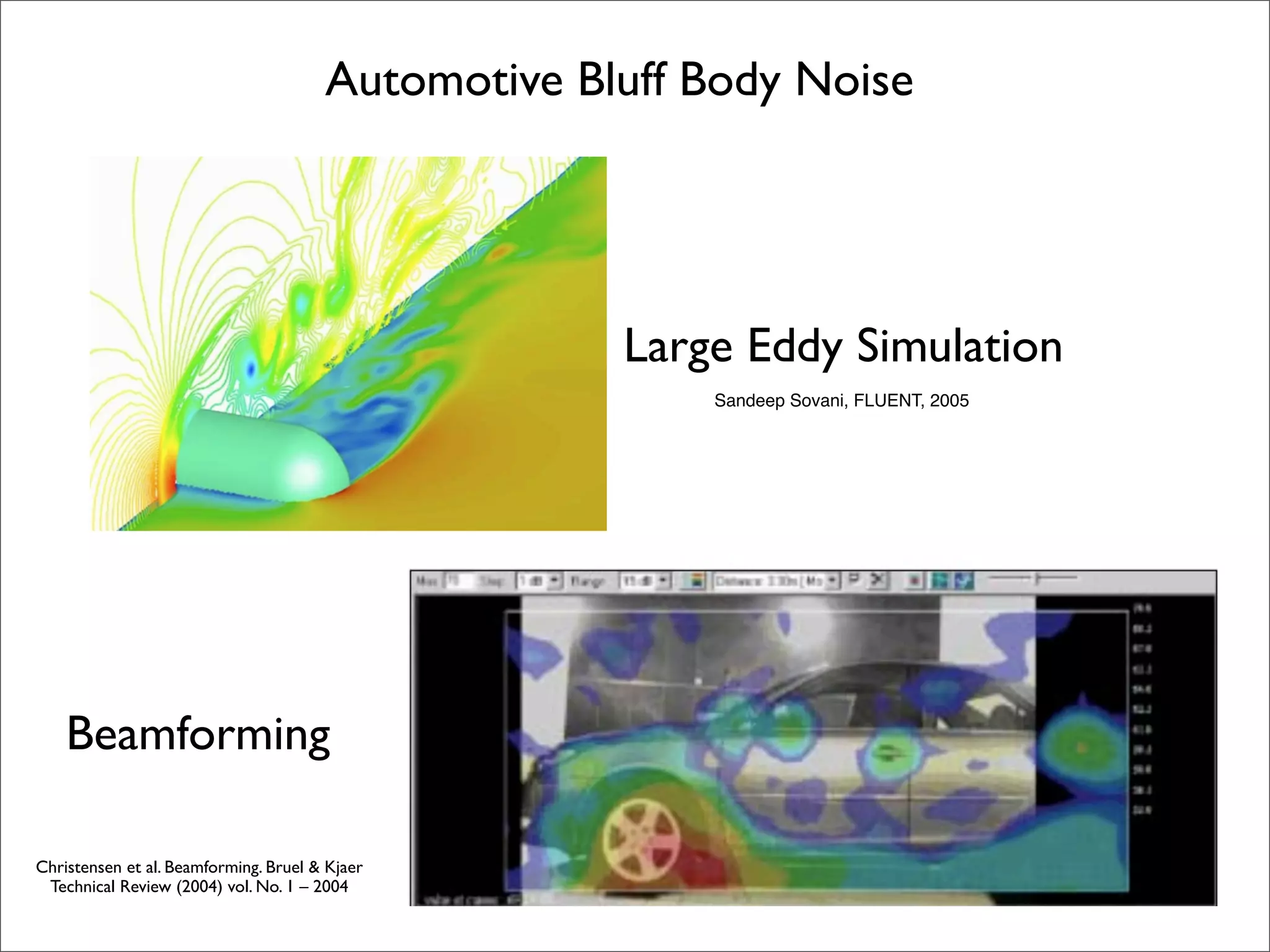
Automotive Bluff Body Noise


                                                    Large Eddy Simulation
                                                        Sandeep Sovani, FLUENT, 2005


    Beamforming

Christensen et al. Beamforming. Bruel & Kjaer
 Technical Review (2004) vol. No. 1 – 2004
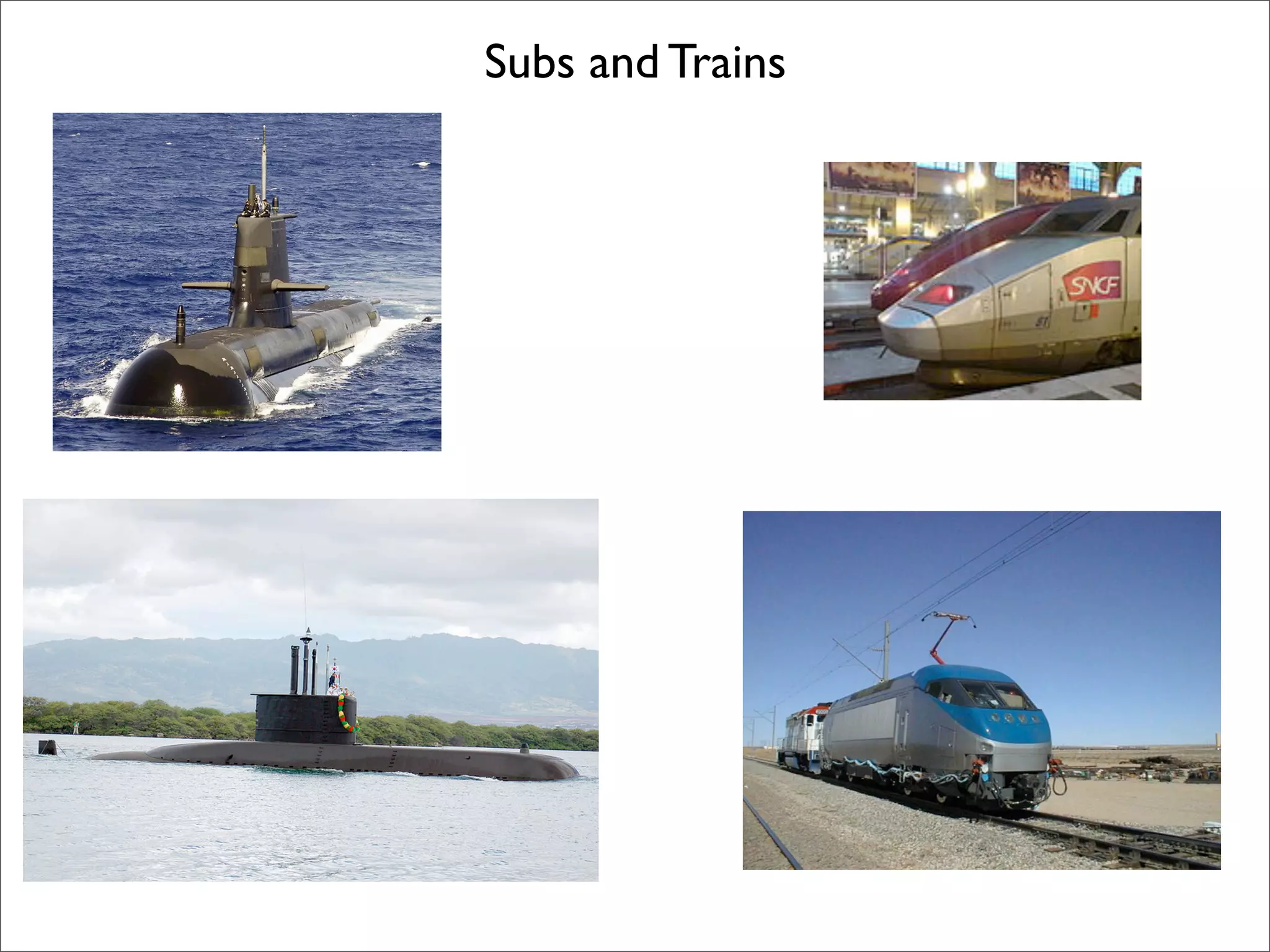
Subs and Trains
an be simplified to predict the acoustic far field (represented
   Theory
s a density fluctuation ρ  ) generated at an observation point by 2 
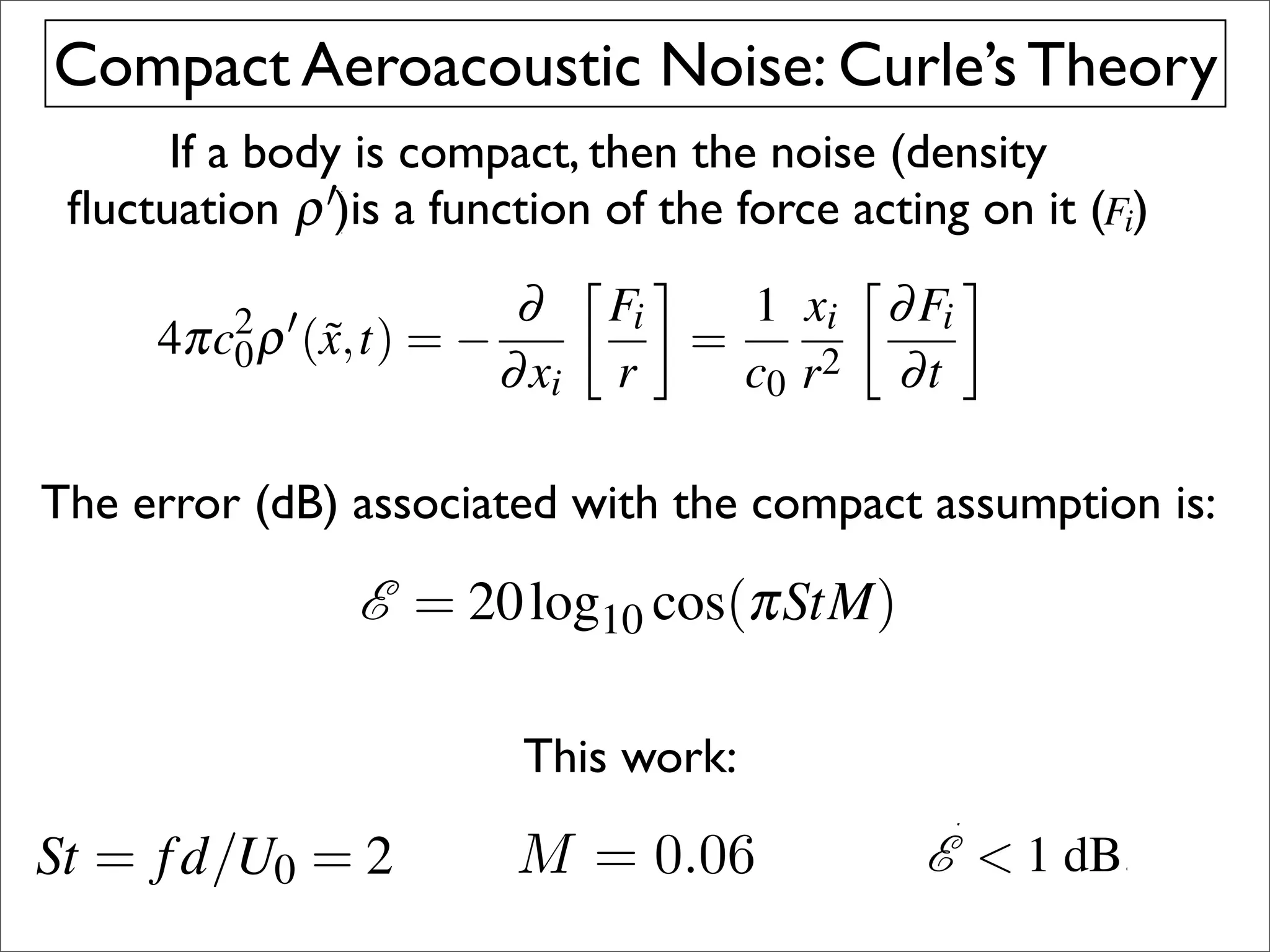
      Compact Aeroacoustic equation (Curle 1955) 4πc
                        form of Curle’s Noise: Curle’s Theory
ustically compact force F applied on a compressible fluid that 0 ρ
  fluctuating point             ˜
                   predict the23–25 November 2009, Adelaide, Austral
 implifiedIfto body is compact, then the noise (density
   initially atarest             acoustic far field (represented
       fluctuation ρ )is function of the force acting on it 2009, t
 sity23–25 Novembera2009, Adelaide, Australia point by (Fi)are theA
                        ) generated at an observation November
                                                    23–25     where
en the propagation time between points onfluidapplied on is zer
                        ˜ applied on compressible the surface the flu
  ting point force F     Brief Article
                                   ∂ 0.
                                        a                 that
  in the above points the propagation time ∂ an estimate of th
 ly at rest4πc2 ρ equation d →surface 1 xi between points on th
                        then on the Fi Therefore, Fi (air) at rest. The
  time between (x,t) = −
                  0    ˜                    = is zero,                (4)
                                                    2 be∂t 0. to the compact b
ror due→ 0. Therefore,∂an estimate0of the made by dividin
              to a compactthe above equation d → The distance bet
                        or in assumption c r
  tion d Region about cylinder      xi r         can           Therefore, an
          (b)
q. 2 by itself but error be =0. a compact assumption can (takin
                         with due to Author 
                               The Inby dividing
                               d made dB,this expression is by the
 act assumption can aerodynamic1simulation                    described be m
      Thecomponent) ∂ F with the (taking
          2 error (dB) associated
     4πc0 0. In
 ith d                    this r       =
                                               i ∂ the
e real=arex,t)dB,Eq. 2 expression xis compact assumption is:
  omputational the threefor by iitself but with Fi = resulting forceexpre
  here Fiρ  ( ˜ grid= − vector components ofd 0. Intaken at the retard
                     used                                      dB, this
                                                                (4)
                         andreal component) ∂t
                           ∂ i                2 sound of the medium
pplied on the fluid the xc0 is the speed of 2009
                           November 010,  c r
                          E = 434,783 10 cos(πStM) with URANS simula
  h times. This corresponds to  20 log time steps and
                                              ˜               A
                                                                  respect (3
air) at rest. The observation point is x measured (F (t), used to ca
                                                E = 20of the cos(πStM)
                                                       log10 cylinder).
                                                                i
o0are the three vector(in this case, thethe resulting force acoustic
    the compact body with 439 non-dimensional
     vortex shedding cycles components of centre
   =shedding 10 cos(πStM) the maximum frequency is limite
       20 log period.                                 (3) compact
per thecase considered here, of soundobservation point is is we
 onthe fluid and c0For the speedconsideredof the medium
  r
 he distance between the case and the here, the maximum freq
                          is the body                         However, it
  a Strouhal number,pointThis number, Stwith respect number o
                                  The x work:brackets f Mach 2 simulati
 escribed by the distance r.= is d/U0 is limitedad/U a value a M
                              St frequency = 2 and denote = of and
                                      f square
 ed here, observation Strouhal˜ measured =
  est.SIMULATION to a
        The the maximum                                       types
TIC                      METHOD                                0
06. Thisf results thisand aMtE centre an error E  1 the vortex s
                        0.06. Θ the r/cin
ompactthed/U(in intimeThisMach number of
                                                              mate the assum
 r, St at body 0 = 2an error −  1 .dB. the cylinder). poor noise
  ken
         = retarded case,=results 0 of Therefore in Theref
                                        = 0.06                ing dB.
on of compactness isof compactness is the presentis the pre
  Acoustic Assumption appropriate for
                                                    appropriate work. No
 an error E  1 dB. Therefore the assump- point for results fr
  ance between the body and the observation
                        tion                                  ciencies
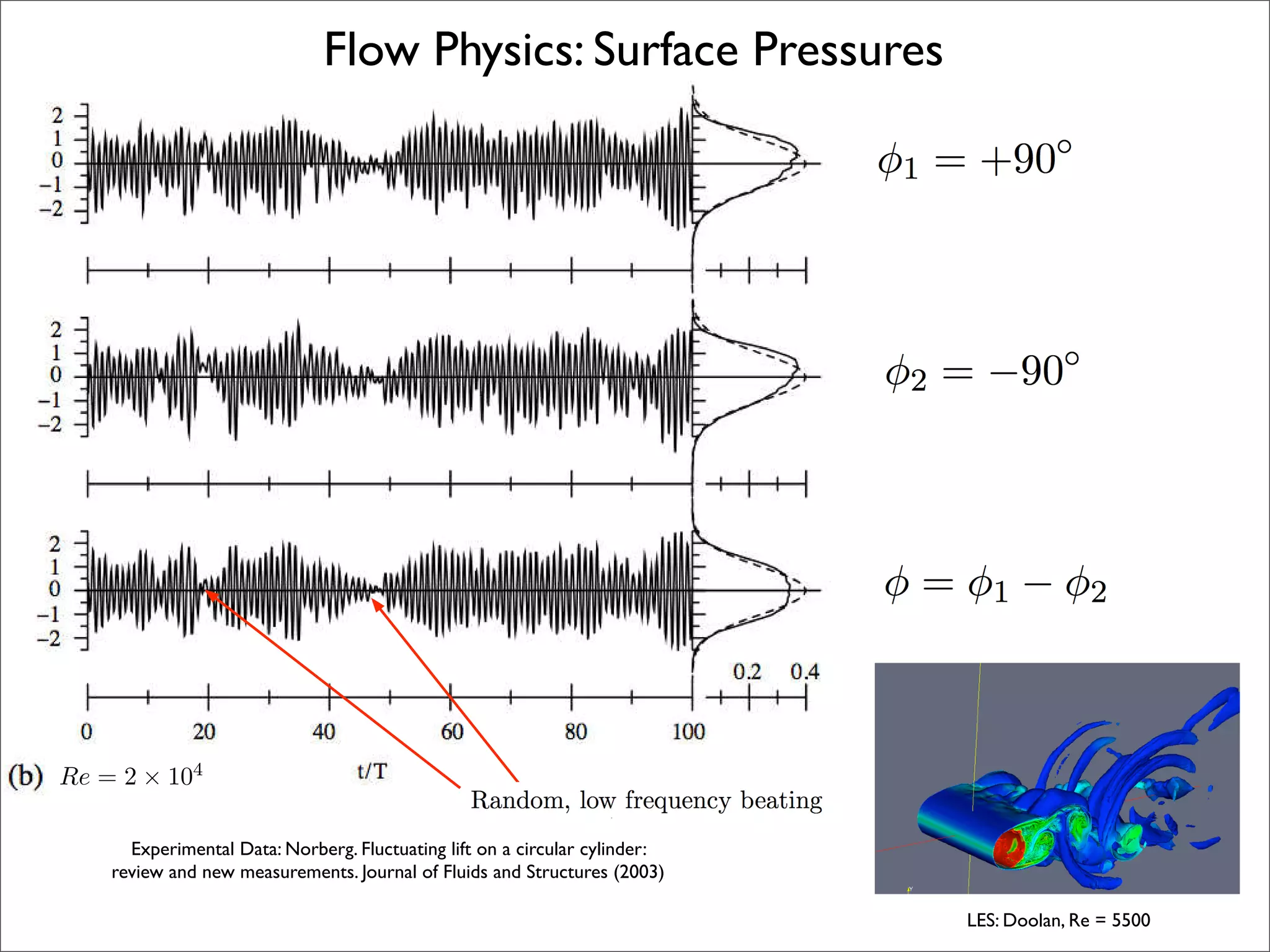
Flow Physics: Surface Pressures

                                                                                 φ1 = +90◦


                                                                                 φ2 = −90◦


                                                                                 φ = φ1 − φ2


Re = 2 × 10⁴
                                                 Random, low frequency beating
                                                                     4
      Experimental Data: Norberg. Fluctuating lift on a circular cylinder:
    review and new measurements. Journal of Fluids and Structures (2003)

                                                                                     LES: Doolan, Re = 5500
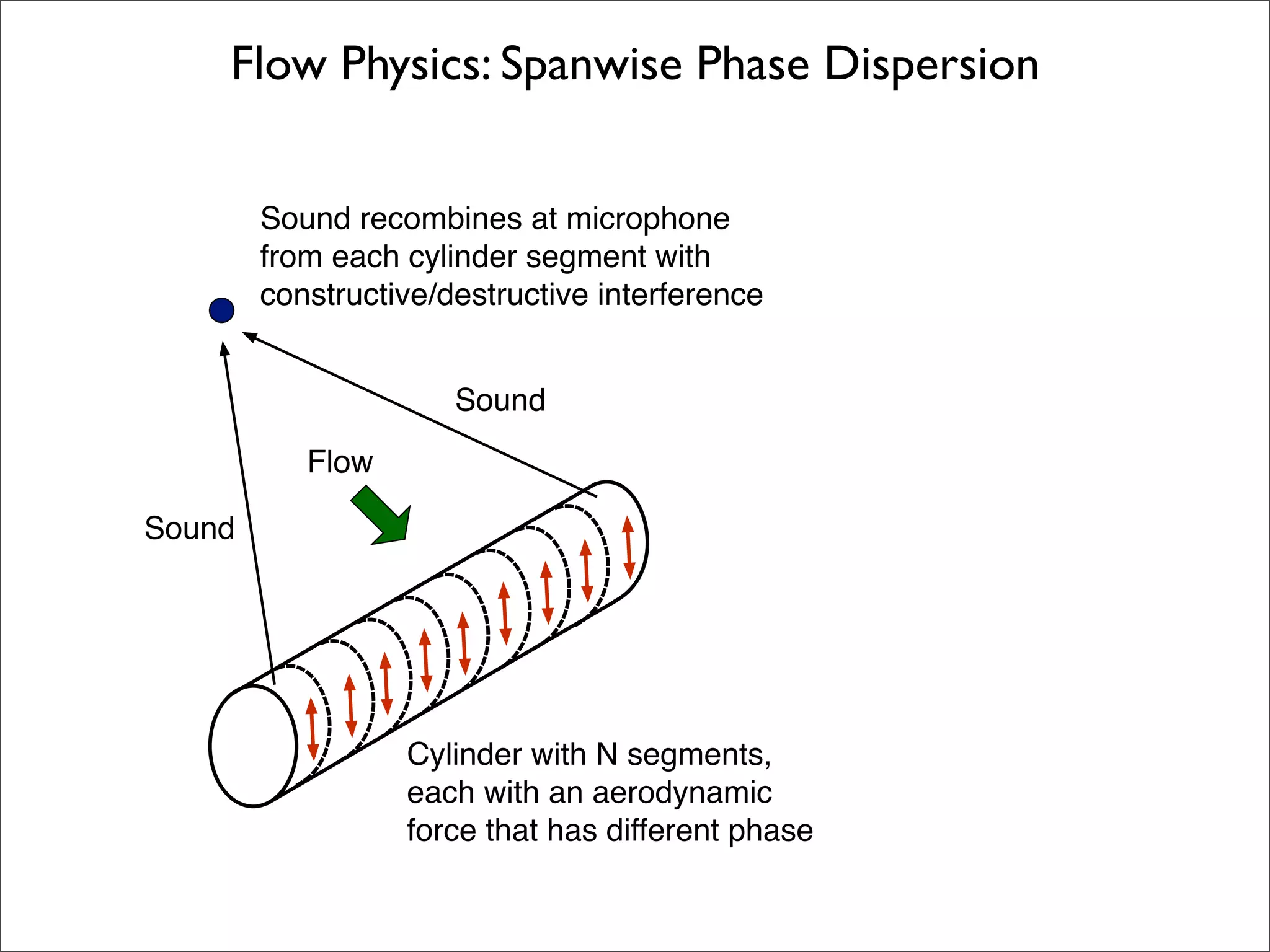
Flow Physics: Spanwise Phase Dispersion


        
        
        


                      
           




                  
                  
                  
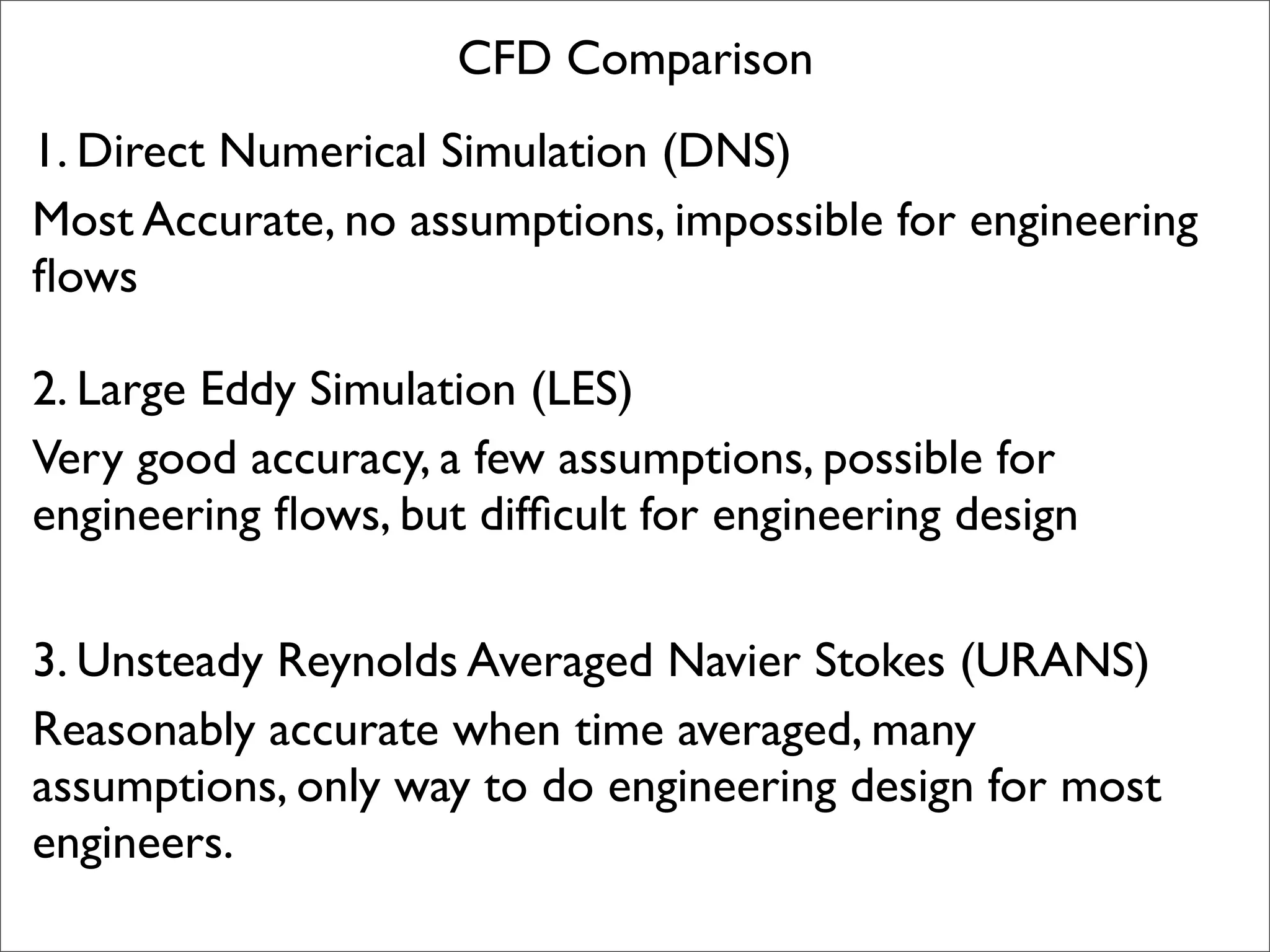
CFD Comparison
1. Direct Numerical Simulation (DNS)
Most Accurate, no assumptions, impossible for engineering
flows

2. Large Eddy Simulation (LES)
Very good accuracy, a few assumptions, possible for
engineering flows, but difficult for engineering design

3. Unsteady Reynolds Averaged Navier Stokes (URANS)
Reasonably accurate when time averaged, many
assumptions, only way to do engineering design for most
engineers.
New Methodology:

                   Use a statistical model to correct URANS flow
                simulations in order to correctly model far-field noise

                  URANS                                                                       “TRUE”
                                                ADD STATISTICS
                 SIGNALS                                                                     SIGNALS

          1.2                                                                   80
                                   Cd
           1                                                                    70                    With Spanwise Effects
          0.8                                                                   60                    Pure Tone
                                        Cl
          0.6
                                                                                50


                                                                 PSD [dB/Hz]
          0.4
Cl, Cd


                                                                                40
          0.2
                                                                                30
           0
                                                                                20
         −0.2
                                                                                10
         −0.4
         −0.6                                                                    0

                                                                               −10
           220     240   260             280   300     320                       0.1   0.2    0.4           0.8 1      1.4    2
                               tU0 /d                                                            St
- is (t) = summarised below.
 rue
     a normalised time scale associated with the
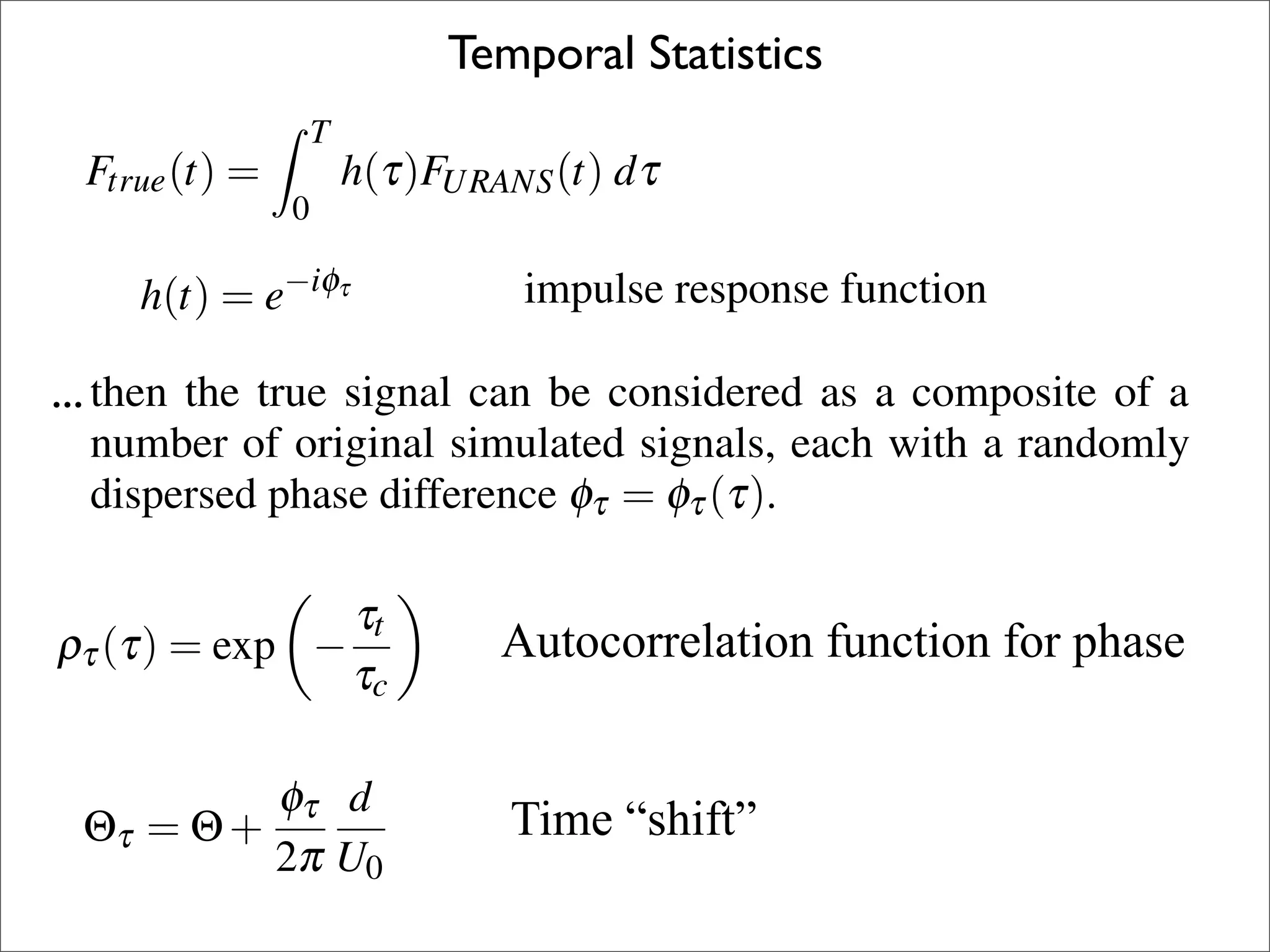
 ) using an impulseURANS (t) dτ
                    h(τ)F response function h(t) (5)            This procedure is
 e time signal. Australia
 009, Adelaide, Note, Gaussian statistics could
               0                   Temporal Statistics          of coherency alon
d.              Temporal Model
                        T                                      way of introducing
  nal can be considereddescribed as
sponse function canh(τ)F    be   as a composite of a
nal simulated a linear distribution a randomly
                It                URANS                    (5) flowfield to a noise
         Ftrue (t)is signals, each withtrue force F (t) is convoluted over a
                    =assumed that the(t) dτ
odel calls for           0                 of variancetrue      simulation.
difference signalφof time length T to the URANS simulated force signal
                φτ = τ (τ).
         23–25 URANS (t) 2009, be described as(6)
  ulse response function can an impulse response
             h(t) = e−iφτ using Adelaide, Australia function h(t)
                FNovember
                                                                To estimate the s
nner as the spatial case (Casalino and Jacob
                                                                Using the spanwi
                                                                relations (Norberg
ection), (τ is = w
      ...wτ it t )the true signalthe autocorrelation as a composite measurem
         then assumed τt      that can be considered
                        τ,max                T    (8)          phase (φof a
                                                                imental η ) is crea
an be number of according τto Laplacian statis-each(6) a randomly
          distributed original simulated signals, 3
                       h(t) = e−iφ (t) =                    with
                                  Ftrue          h(τ)FURANS (t) dτ
                                                                instead.       (5)
  /τc . This variance distribution isφτ = φτ (τ).
         dispersed phase difference used to gen-
                                              0                 The phase distrib
                of phase (φτ ) response τt ≤ 1 that
 ispersion If the impulse over 0 ≤ function can be described as time
                                                                Frequency Com
         In the same manner as the spatial case (Casalino and Jacob
                                                           3
                             τt
 arded time of the URANS signal used to cal-
          (τ)                         Autocorrelation function for phase
       ρτ2003, see next section), it is assumed that the autocorrelation
q. 4 using = exp − τc                               (7)         The experimental
         coefficient (ρτ ) can be distributed according to Laplacian statis- oc
                                                                the main tone
                                                     −iφτ
 ,       tics                               h(t) = e            URANS simulatio(6)
 is the time delayφnormalised by the time base
                          τ d                                   frequency scaling
   is a normalised 2π U0
                                       Time “shift” 
         Θτ = Θ + time scale associated with (9) the           The frequency and
                                                                This procedure is
  e time signal. Note, Gaussian statistics could     τt                          3
                                   ρτ (τ) = exp −                          (7)
                                                                of coherency alo
                                                     τ



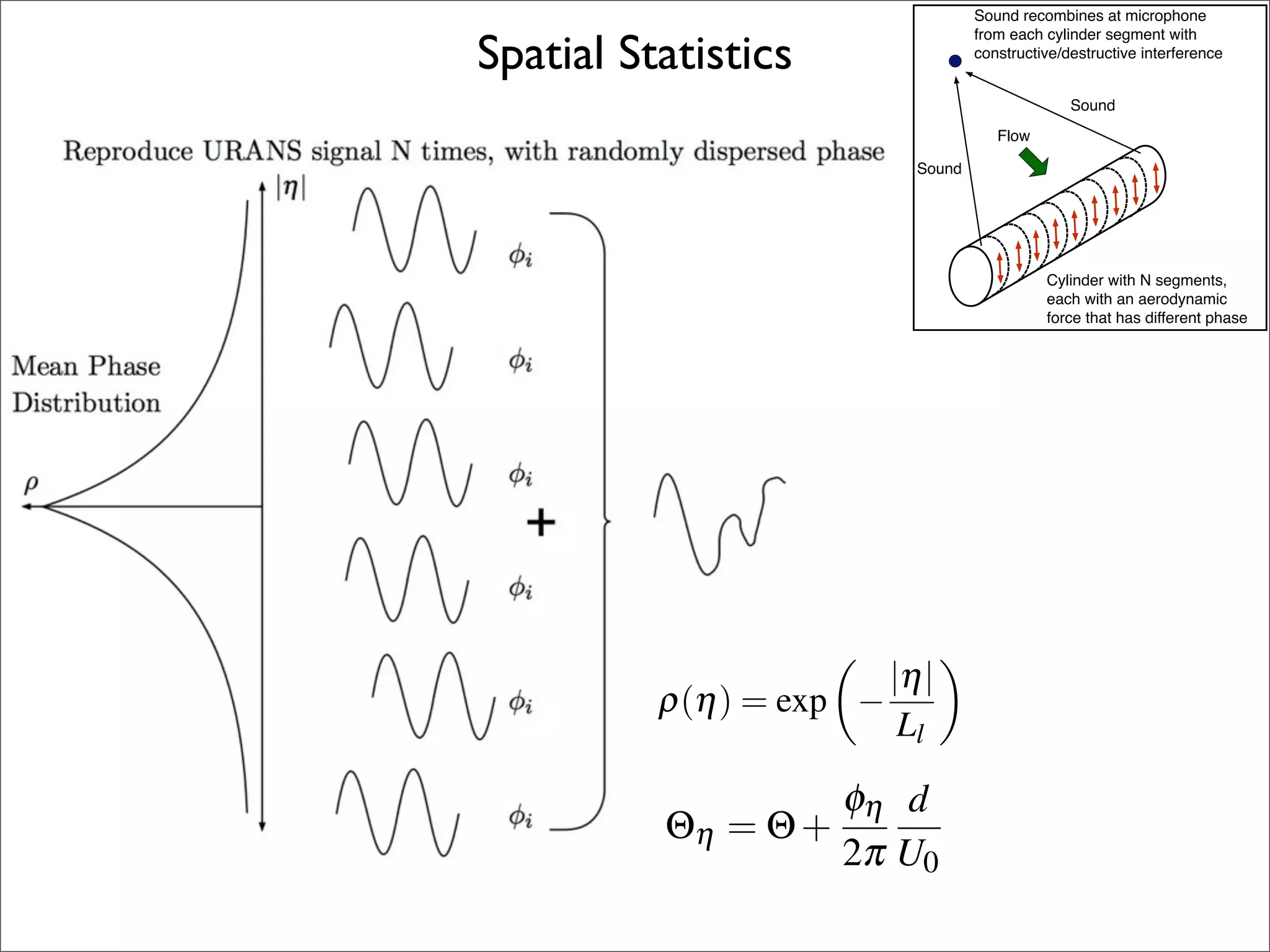
                               Spatial Statistics
                                                                     
                                                                     


                                                                                   
                                                                        

                                                             


                                                     Proceedings of ACOUSTICS 200
                                                                               

 osite of a                                               
                                                                               
                                                                               

 randomly                                              |η|
                                          ρ(η) = exp −                                                       (12
                                                        Ll

 and Jacob
                     Using the spanwise statistical model, a random dispersion i
correlation
                     phase (φη ) is created along the span of the cylinder.
 cian statis-                                         Proceedings of ACOUSTICS 2009

 composite of a      The phase distribution is then used to 
                                                           modulate the retarde
with a randomly      time                 ρ(η) = exp −
                                                        |η|
                                                                           (12)
                                                            Ll
         (7)
alino and Jacob                                         φ   d
                        Using the spanwise statistical + η a random dispersion in
                                              Θη = Θ model,                    (13
 autocorrelation                                           2π U the
                        phase (φη ) is created along the span of 0 cylinder.
 Laplacian statis-
 time base
                        The phase distribution is then used to modulate the retarded
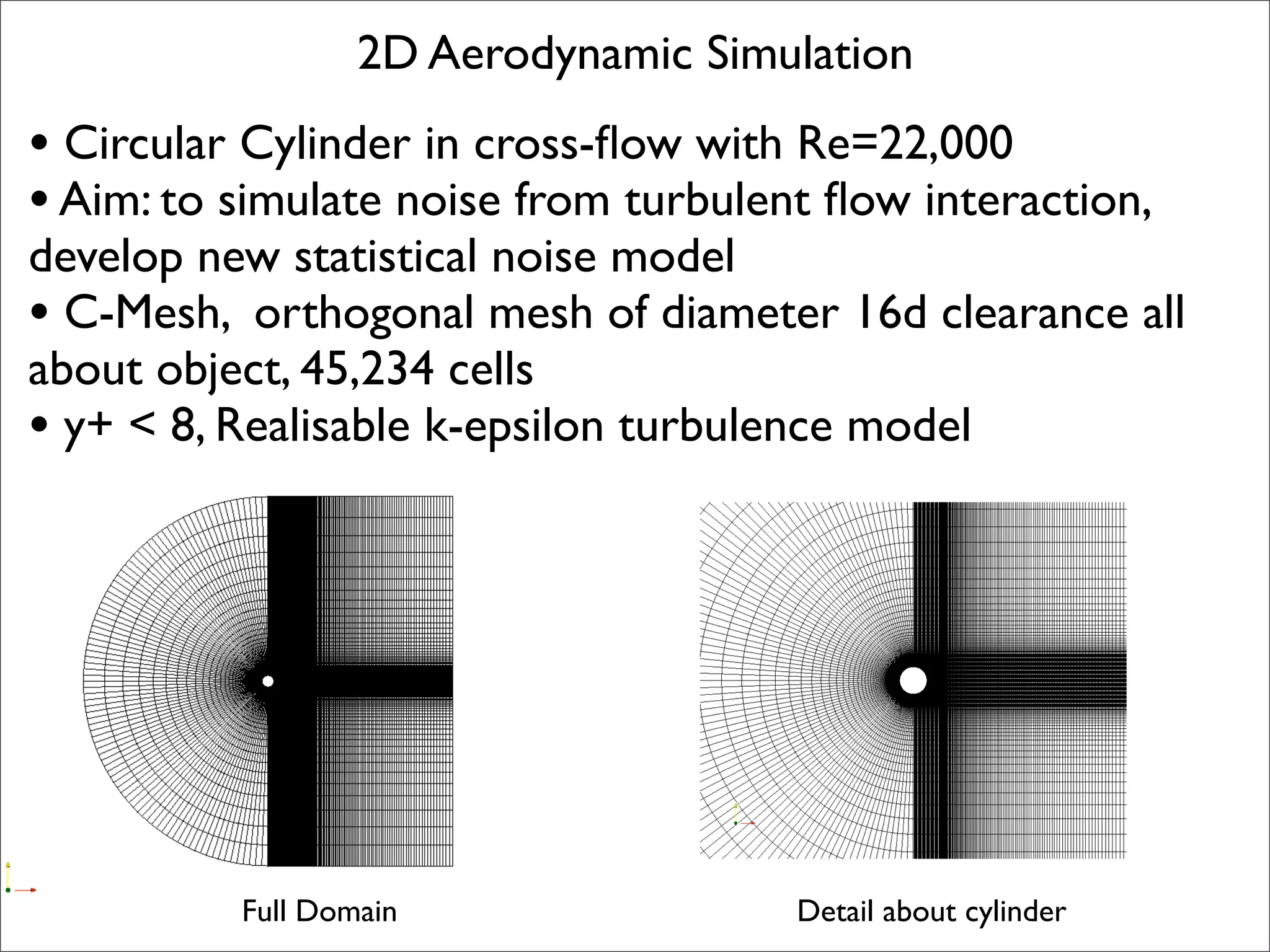
2D Aerodynamic Simulation
• Circular Cylinder in cross-flow with Re=22,000
• Aim: to simulate noise from turbulent flow interaction,
develop new statistical noise model
• C-Mesh, orthogonal mesh of diameter 16d clearance all
about object, 45,234 cells
• y+  8, Realisable k-epsilon turbulence model


          Full Domain                 Detail about cylinder
1
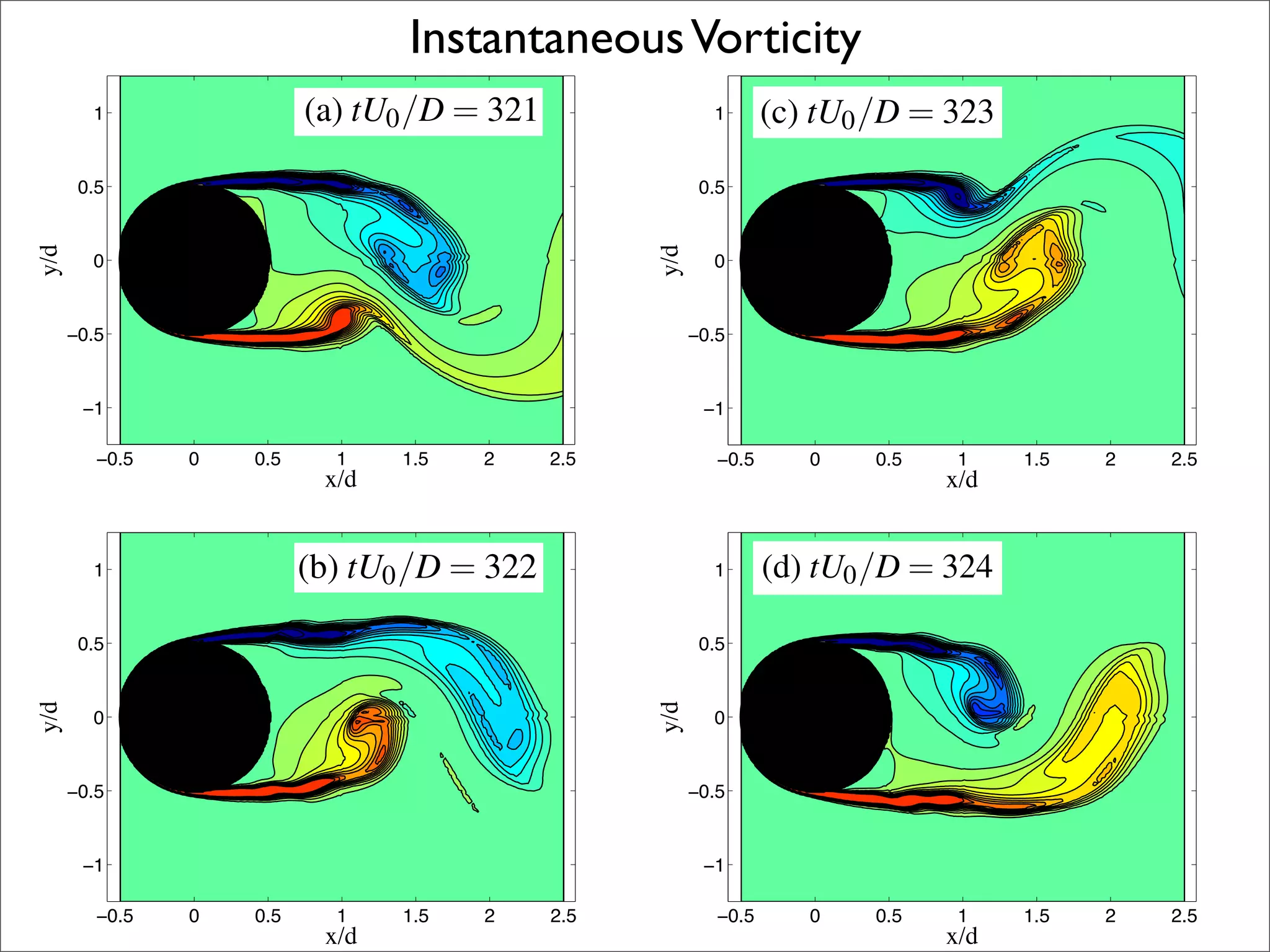
                                          Instantaneous Vorticityx/d
                                                      0 −0.5
                                                           0.5    1                                1.5       2      2.5

       0.5
               1                 (a) tU0 /D = 321
                                               0.5                          1       (c) tU0 /D = 323
y/d


              0.5                                                          0.5
         0


                                                y/d
                                                        0
       y/d


                                                                    y/d
               0                                                            0

      −0.5                                            −0.5
             −0.5                                                         −0.5

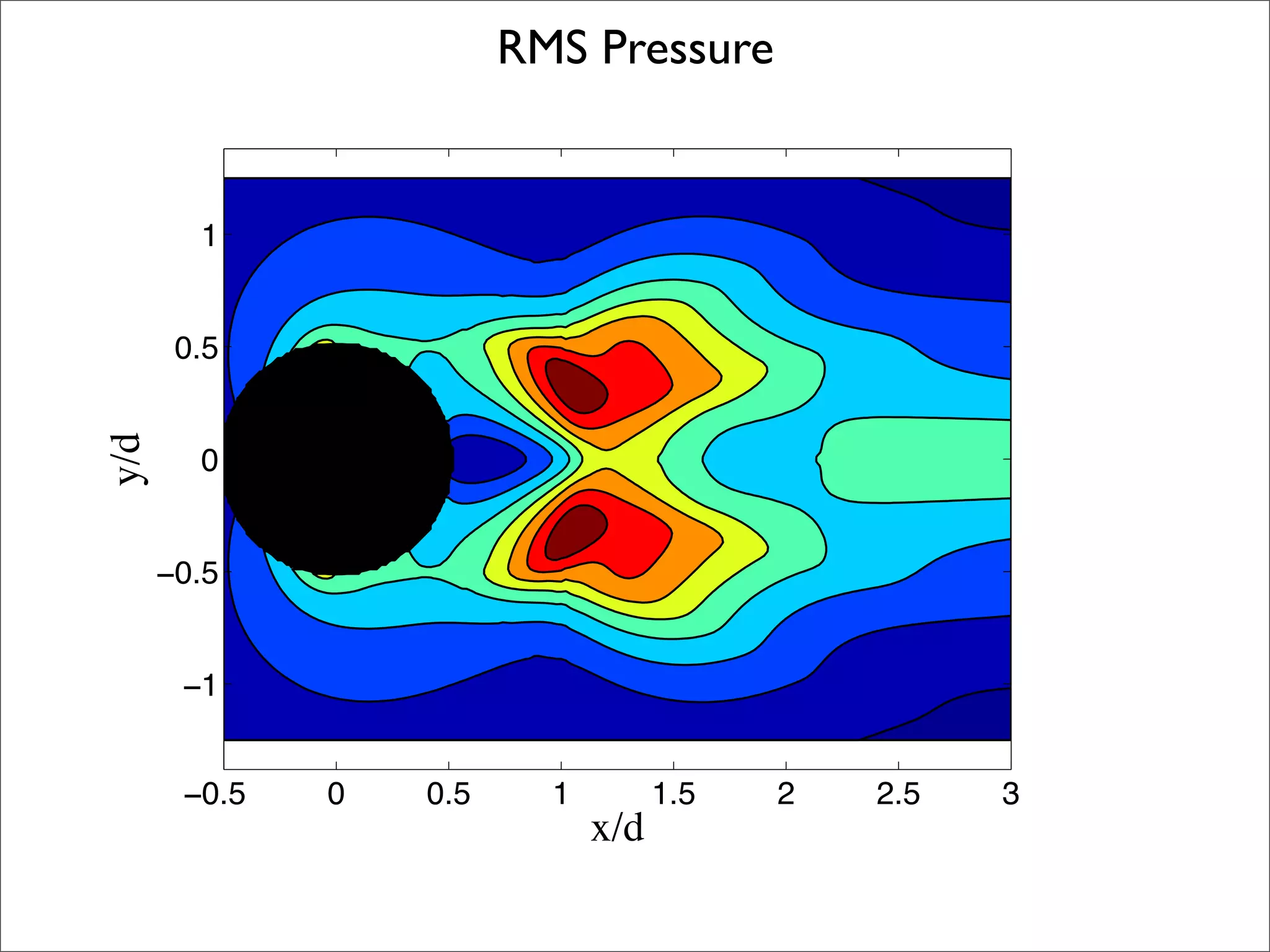
                                                                                                       Figure 4: RMS pres
       −1 −1                                           −1
                                                                           −1
                                                                                                       der in turbulent flow
                −0.5   0   0.5       1
                                    x/d
                                          1.5     2          2.5             −0.5      0   0.5    1
                                                                                                 x/d
                                                                                                       intervals2 ∆prms /(ρ0
                                                                                                          1.5        2.5
             −0.5      0         0.5       1           1.5
                                                         −0.5      2 0       2.50.5        1      1.5        2     2.5
                                        x/d                                     x/d
               1                 (b) tU0 /D = 322                   1    (d) tU0 /D = 324
                                                                                          Figure 4: RMS pres
                                                                                          source associated w
                                              Figure 3: Instantaneous spanwise vorticity in turbulent flow
                                                                                          der contours over on
              0.5                                                 0.5                     therefore very ineffic
                                                                                         ωz d
                                              vortex shedding cycle. Levels: −15 ≤ U∞ ≤ 15 with intervaU
                                                                                          intervals ∆prms /(ρ0
                                                                                          the surface of the cy
                                              |∆ω|d
       y/d


                                                                    y/d
               0
                                               U∞   =5              0

                                                                                          For this case, the uns
             −0.5                (b) tU0 /D = 322                −0.5    (d) tU0 /D = 324to noise is that on th
                                              Australian Acoustical Society               source associated w
                                                                                          largest unsteady pre
                                             Figure 3: Instantaneous spanwise vorticity contours over o
              −1                                                  −1                      therefore very ineffic
                                             vortex shedding cycle. Levels: −15 ≤ ωz∞ ≤ 15 withof the c
                                                                                            d
                                                                                          tom surfaces interva
                                                                                          the surface of the cy
                                                                                       1 U 1.5
                                                                                      x/d largest source of noi
                −0.5   0   0.5      1    1.5     2     2.5          −0.5     0    0.5              2    2.5
                                   x/d       |∆ω|d
RMS Pressure


        1


       0.5
y/d


        0


      −0.5


       −1


       −0.5   0   0.5     1         1.5   2   2.5   3
                              x/d
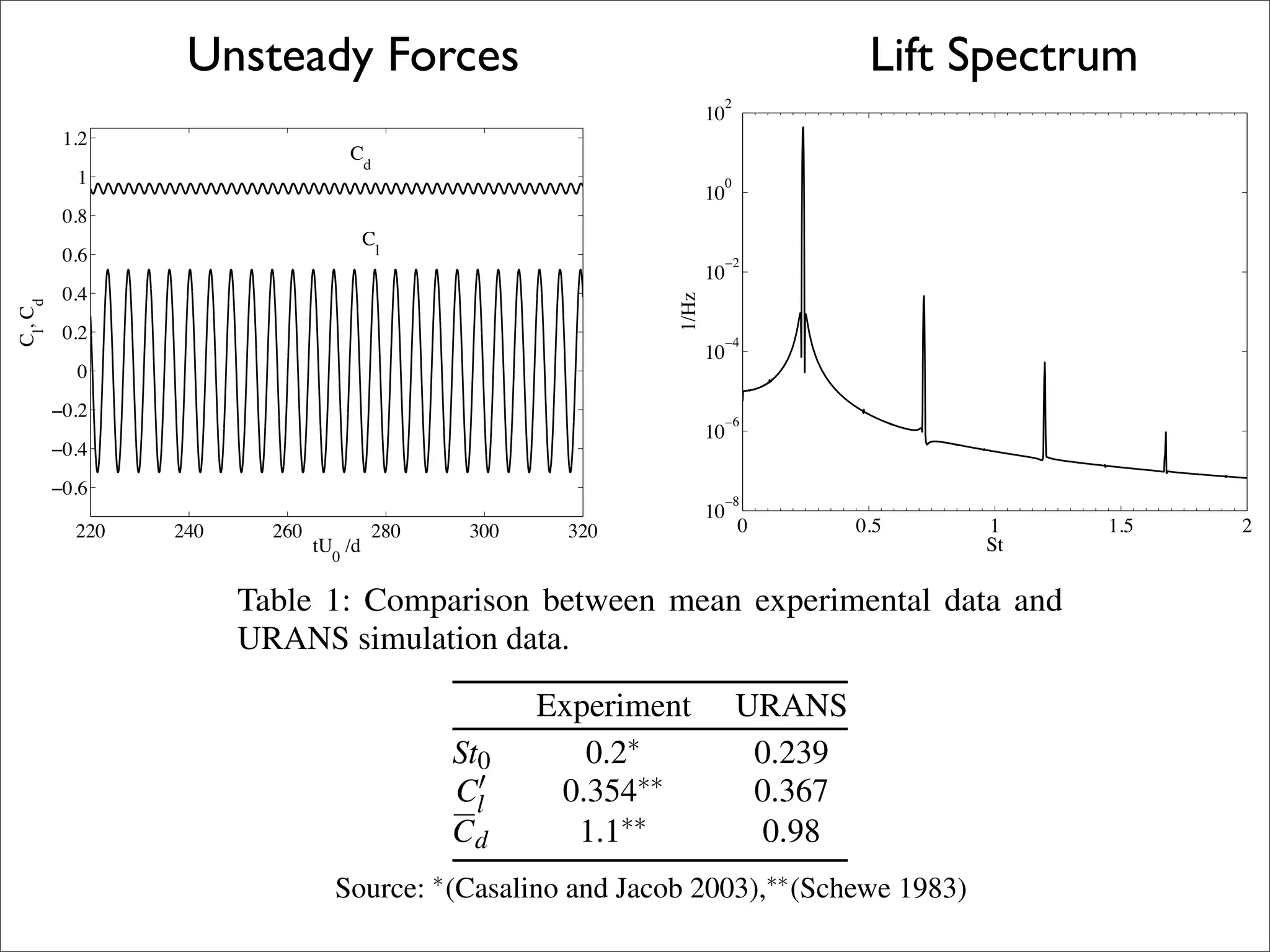
Unsteady Forces                                                      Lift Spectrum
                                                                         2
                                                                       10
          1.2
                                   Cd
           1                                                             0
                                                                       10
          0.8
                                        Cl
          0.6                                                            −2
                                                                       10
          0.4


                                                                1/Hz
Cl, Cd


          0.2                                                            −4
                                                                       10
           0
         −0.2                                                            −6
                                                                       10
         −0.4
         −0.6
                                                                         −8
                                                                       10
           220   240     260             280    300    320                   0        0.5   1     1.5   2
                               tU0 /d                 23–25 November 2009, Adelaide, Australia
                                                                                       St

                       Table 1: Comparison between mean experimental data and
                       URANS simulation data.

                                                      Experiment             URANS
                                               St0       0.2∗                 0.239
                                               Cl     0.354∗∗                0.367
                                               Cd       1.1∗∗                  0.98
                                 Source: ∗ (Casalino and Jacob 2003),∗∗ (Schewe 1983)
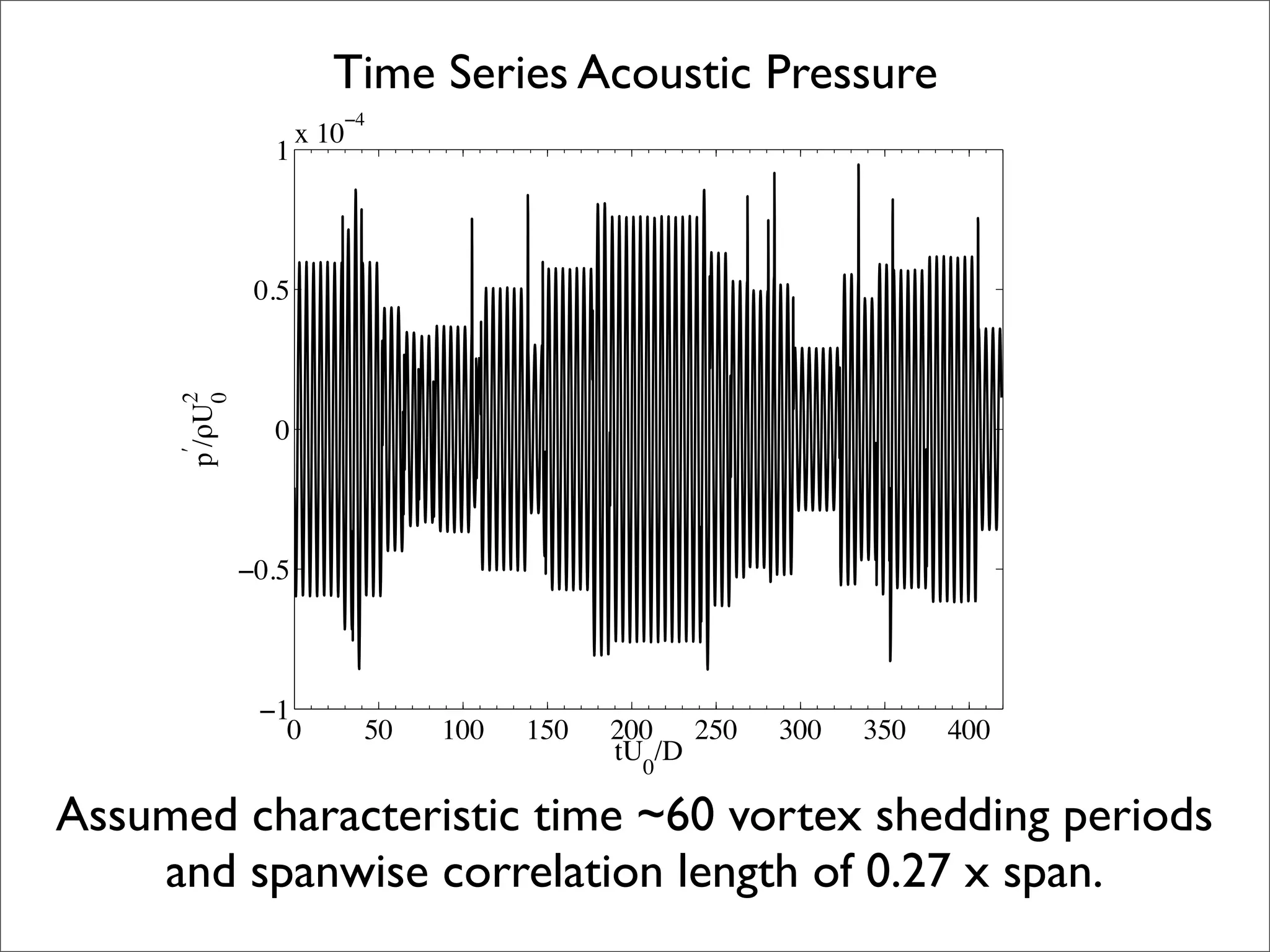
Time Series Acoustic Pressure
                         −4
                      x 10
                 1


                0.5
     2
      p /ρU0


                 0
     ʹ′


               −0.5


                −1
                  0          50   100   150   200 250   300   350   400
                                              tU /D
                                               0

Assumed characteristic time ~60 vortex shedding periods
    and spanwise correlation length of 0.27 x span.
Acoustic PSD at 86.25D above centre of cylinder
                 80
                                      URANS + Statistics
                 70
                                      URANS
                 60                   Experiment

                 50
   PSD [dB/Hz]


                 40

                 30

                 20

                 10

                  0
                  0.1   0.2   0.4          0.8 1     1.4   2
                                 St
100 statistical acoustic signal PSD’s were averaged.
Application to the NASA Tandem Cylinder Case
                                                          120
                                                                                        URANS + Statistics
                                                          110
                                                                                        2D URANS
                                                          100                           Experiment (NASA QFF)

                                                          90


                                            PSD [dB/Hz]
                                                          80

                                                          70

                                                          60

                                                          50

                                                          40
                                                           0.1       0.2        0.4            0.8 1        1.4   2
                                                                                   St


              Grid                                                             Acoustics
       1.5                                                                                             15


        1
                             Flow: vorticity                                                           10


       0.5                                                                                             5
y/d


        0                                                                                              0


      −0.5                                                                                             −5


       −1                                                                                              −10


      −1.5                                                                                             −15
         −1    0     1   2              3                        4         5               6
                                  x/d
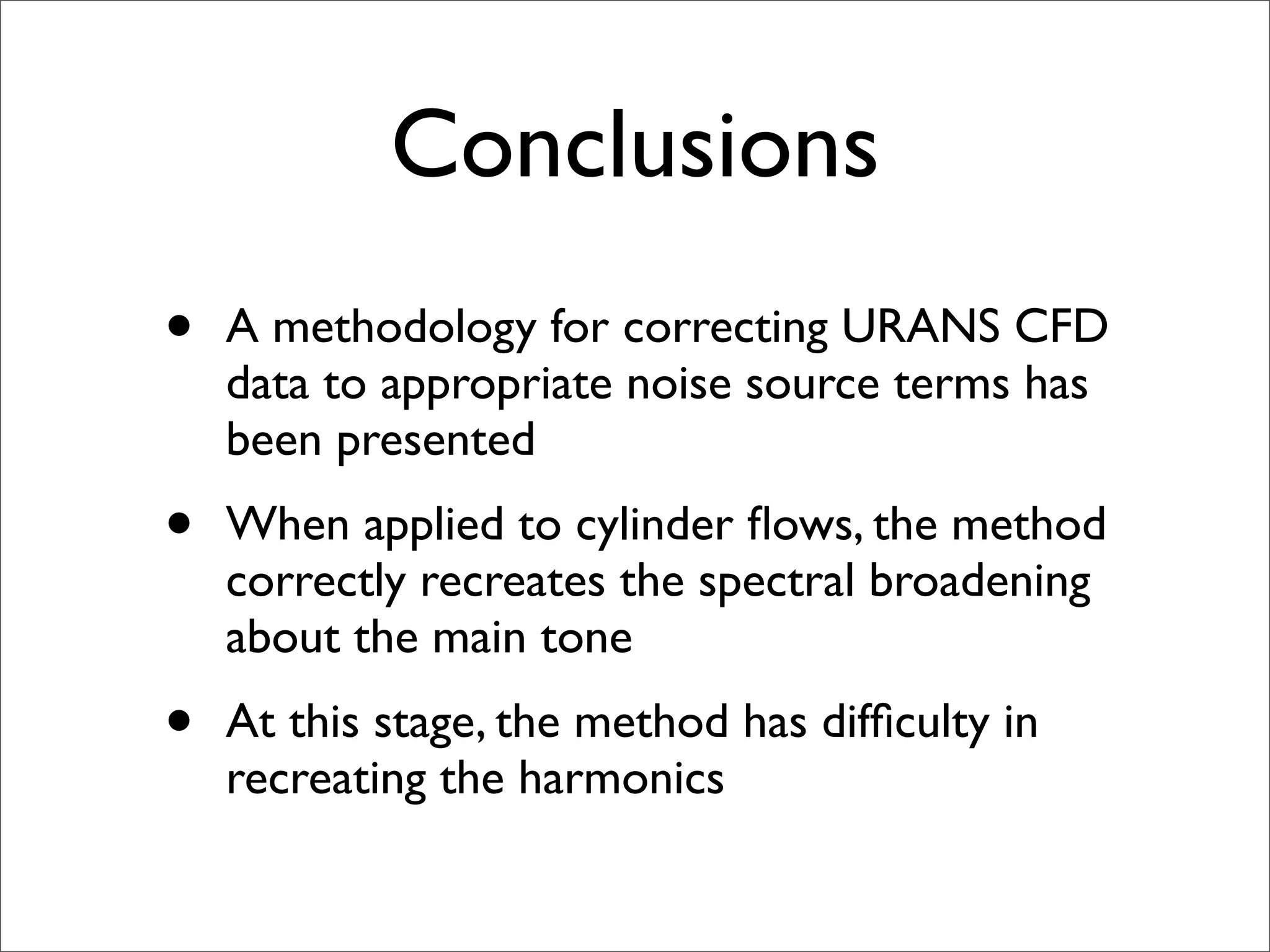
Conclusions
•   A methodology for correcting URANS CFD
    data to appropriate noise source terms has
    been presented
•   When applied to cylinder flows, the method
    correctly recreates the spectral broadening
    about the main tone
•   At this stage, the method has difficulty in
    recreating the harmonics

Aeroacoustic simulation of bluff body noise using a hybrid statistical method

  • 1.
    School of MechanicalEngineering Tuesday, November 10, 2009 Aeroacoustic simulation of bluff body noise using a hybrid statistical method Con Doolan School of Mechanical Engineering University of Adelaide, SA, 5005 ACOUSTICS 2009 Life Impact The University of Adelaide
  • 2.
    Summary • Bluff Body Noise - What is it? • Why is it important? • Physics controlling flow and noise • Simulation methods - limitations for engineers • Statistical Correction • Results
  • 3.
       U0  Bluff Body -    Dipole Noise Uc k λv = =D f0 St0 Streamlined Body - 3/2 Pole Noise
  • 5.
    LES/Flow Simulation Upper Drag Link COMPUTATIONAL AEROACOUSTIC ANALYSIS OF A 1/4 SCALE G550 NOSE LANDING GEAR AND COMPARISON TO NASA & UFL WIND TUNNEL DATA Thomas Van de Ven* and John Louis** Gulfstream Aerospace Corporation Savannah, GA Dean Palfreyman*** and Fred Mendonça**** CD-adapco AIAA Paper 2009-3359 (Miami, 2009) Lower Drag Link
  • 6.
    Automotive Bluff BodyNoise Large Eddy Simulation Sandeep Sovani, FLUENT, 2005 Beamforming Christensen et al. Beamforming. Bruel & Kjaer Technical Review (2004) vol. No. 1 – 2004
  • 7.
  • 8.
    an be simplifiedto predict the acoustic far field (represented Theory s a density fluctuation ρ ) generated at an observation point by 2 Compact Aeroacoustic equation (Curle 1955) 4πc form of Curle’s Noise: Curle’s Theory ustically compact force F applied on a compressible fluid that 0 ρ fluctuating point ˜ predict the23–25 November 2009, Adelaide, Austral implifiedIfto body is compact, then the noise (density initially atarest acoustic far field (represented fluctuation ρ )is function of the force acting on it 2009, t sity23–25 Novembera2009, Adelaide, Australia point by (Fi)are theA ) generated at an observation November 23–25 where en the propagation time between points onfluidapplied on is zer ˜ applied on compressible the surface the flu ting point force F Brief Article ∂ 0. a that in the above points the propagation time ∂ an estimate of th ly at rest4πc2 ρ equation d →surface 1 xi between points on th then on the Fi Therefore, Fi (air) at rest. The time between (x,t) = − 0 ˜ = is zero, (4) 2 be∂t 0. to the compact b ror due→ 0. Therefore,∂an estimate0of the made by dividin to a compactthe above equation d → The distance bet or in assumption c r tion d Region about cylinder xi r can Therefore, an (b) q. 2 by itself but error be =0. a compact assumption can (takin with due to Author The Inby dividing d made dB,this expression is by the act assumption can aerodynamic1simulation described be m Thecomponent) ∂ F with the (taking 2 error (dB) associated 4πc0 0. In ith d this r = i ∂ the e real=arex,t)dB,Eq. 2 expression xis compact assumption is: omputational the threefor by iitself but with Fi = resulting forceexpre here Fiρ ( ˜ grid= − vector components ofd 0. Intaken at the retard used dB, this (4) andreal component) ∂t ∂ i 2 sound of the medium pplied on the fluid the xc0 is the speed of 2009 November 010, c r E = 434,783 10 cos(πStM) with URANS simula h times. This corresponds to 20 log time steps and ˜ A respect (3 air) at rest. The observation point is x measured (F (t), used to ca E = 20of the cos(πStM) log10 cylinder). i o0are the three vector(in this case, thethe resulting force acoustic the compact body with 439 non-dimensional vortex shedding cycles components of centre =shedding 10 cos(πStM) the maximum frequency is limite 20 log period. (3) compact per thecase considered here, of soundobservation point is is we onthe fluid and c0For the speedconsideredof the medium r he distance between the case and the here, the maximum freq is the body However, it a Strouhal number,pointThis number, Stwith respect number o The x work:brackets f Mach 2 simulati escribed by the distance r.= is d/U0 is limitedad/U a value a M St frequency = 2 and denote = of and f square ed here, observation Strouhal˜ measured = est.SIMULATION to a The the maximum types TIC METHOD 0 06. Thisf results thisand aMtE centre an error E 1 the vortex s 0.06. Θ the r/cin ompactthed/U(in intimeThisMach number of mate the assum r, St at body 0 = 2an error − 1 .dB. the cylinder). poor noise ken = retarded case,=results 0 of Therefore in Theref = 0.06 ing dB. on of compactness isof compactness is the presentis the pre Acoustic Assumption appropriate for appropriate work. No an error E 1 dB. Therefore the assump- point for results fr ance between the body and the observation tion ciencies
  • 9.
    Flow Physics: SurfacePressures φ1 = +90◦ φ2 = −90◦ φ = φ1 − φ2 Re = 2 × 10⁴ Random, low frequency beating 4 Experimental Data: Norberg. Fluctuating lift on a circular cylinder: review and new measurements. Journal of Fluids and Structures (2003) LES: Doolan, Re = 5500
  • 10.
    Flow Physics: SpanwisePhase Dispersion         
  • 11.
    CFD Comparison 1. DirectNumerical Simulation (DNS) Most Accurate, no assumptions, impossible for engineering flows 2. Large Eddy Simulation (LES) Very good accuracy, a few assumptions, possible for engineering flows, but difficult for engineering design 3. Unsteady Reynolds Averaged Navier Stokes (URANS) Reasonably accurate when time averaged, many assumptions, only way to do engineering design for most engineers.
  • 12.
    New Methodology: Use a statistical model to correct URANS flow simulations in order to correctly model far-field noise URANS “TRUE” ADD STATISTICS SIGNALS SIGNALS 1.2 80 Cd 1 70 With Spanwise Effects 0.8 60 Pure Tone Cl 0.6 50 PSD [dB/Hz] 0.4 Cl, Cd 40 0.2 30 0 20 −0.2 10 −0.4 −0.6 0 −10 220 240 260 280 300 320 0.1 0.2 0.4 0.8 1 1.4 2 tU0 /d St
  • 13.
    - is (t)= summarised below. rue a normalised time scale associated with the ) using an impulseURANS (t) dτ h(τ)F response function h(t) (5) This procedure is e time signal. Australia 009, Adelaide, Note, Gaussian statistics could 0 Temporal Statistics of coherency alon d. Temporal Model T way of introducing nal can be considereddescribed as sponse function canh(τ)F be as a composite of a nal simulated a linear distribution a randomly It URANS (5) flowfield to a noise Ftrue (t)is signals, each withtrue force F (t) is convoluted over a =assumed that the(t) dτ odel calls for 0 of variancetrue simulation. difference signalφof time length T to the URANS simulated force signal φτ = τ (τ). 23–25 URANS (t) 2009, be described as(6) ulse response function can an impulse response h(t) = e−iφτ using Adelaide, Australia function h(t) FNovember To estimate the s nner as the spatial case (Casalino and Jacob Using the spanwi relations (Norberg ection), (τ is = w ...wτ it t )the true signalthe autocorrelation as a composite measurem then assumed τt that can be considered τ,max T (8) phase (φof a imental η ) is crea an be number of according τto Laplacian statis-each(6) a randomly distributed original simulated signals, 3 h(t) = e−iφ (t) = with Ftrue h(τ)FURANS (t) dτ instead. (5) /τc . This variance distribution isφτ = φτ (τ). dispersed phase difference used to gen- 0 The phase distrib of phase (φτ ) response τt ≤ 1 that ispersion If the impulse over 0 ≤ function can be described as time Frequency Com In the same manner as the spatial case (Casalino and Jacob 3 τt arded time of the URANS signal used to cal- (τ) Autocorrelation function for phase ρτ2003, see next section), it is assumed that the autocorrelation q. 4 using = exp − τc (7) The experimental coefficient (ρτ ) can be distributed according to Laplacian statis- oc the main tone −iφτ , tics h(t) = e URANS simulatio(6) is the time delayφnormalised by the time base τ d frequency scaling is a normalised 2π U0 Time “shift” Θτ = Θ + time scale associated with (9) the The frequency and This procedure is e time signal. Note, Gaussian statistics could τt 3 ρτ (τ) = exp − (7) of coherency alo τ
  • 14.
     Spatial Statistics      Proceedings of ACOUSTICS 200  osite of a   randomly |η| ρ(η) = exp − (12 Ll and Jacob Using the spanwise statistical model, a random dispersion i correlation phase (φη ) is created along the span of the cylinder. cian statis- Proceedings of ACOUSTICS 2009 composite of a The phase distribution is then used to modulate the retarde with a randomly time ρ(η) = exp − |η| (12) Ll (7) alino and Jacob φ d Using the spanwise statistical + η a random dispersion in Θη = Θ model, (13 autocorrelation 2π U the phase (φη ) is created along the span of 0 cylinder. Laplacian statis- time base The phase distribution is then used to modulate the retarded
  • 15.
    2D Aerodynamic Simulation •Circular Cylinder in cross-flow with Re=22,000 • Aim: to simulate noise from turbulent flow interaction, develop new statistical noise model • C-Mesh, orthogonal mesh of diameter 16d clearance all about object, 45,234 cells • y+ 8, Realisable k-epsilon turbulence model Full Domain Detail about cylinder
  • 16.
    1 Instantaneous Vorticityx/d 0 −0.5 0.5 1 1.5 2 2.5 0.5 1 (a) tU0 /D = 321 0.5 1 (c) tU0 /D = 323 y/d 0.5 0.5 0 y/d 0 y/d y/d 0 0 −0.5 −0.5 −0.5 −0.5 Figure 4: RMS pres −1 −1 −1 −1 der in turbulent flow −0.5 0 0.5 1 x/d 1.5 2 2.5 −0.5 0 0.5 1 x/d intervals2 ∆prms /(ρ0 1.5 2.5 −0.5 0 0.5 1 1.5 −0.5 2 0 2.50.5 1 1.5 2 2.5 x/d x/d 1 (b) tU0 /D = 322 1 (d) tU0 /D = 324 Figure 4: RMS pres source associated w Figure 3: Instantaneous spanwise vorticity in turbulent flow der contours over on 0.5 0.5 therefore very ineffic ωz d vortex shedding cycle. Levels: −15 ≤ U∞ ≤ 15 with intervaU intervals ∆prms /(ρ0 the surface of the cy |∆ω|d y/d y/d 0 U∞ =5 0 For this case, the uns −0.5 (b) tU0 /D = 322 −0.5 (d) tU0 /D = 324to noise is that on th Australian Acoustical Society source associated w largest unsteady pre Figure 3: Instantaneous spanwise vorticity contours over o −1 −1 therefore very ineffic vortex shedding cycle. Levels: −15 ≤ ωz∞ ≤ 15 withof the c d tom surfaces interva the surface of the cy 1 U 1.5 x/d largest source of noi −0.5 0 0.5 1 1.5 2 2.5 −0.5 0 0.5 2 2.5 x/d |∆ω|d
  • 17.
    RMS Pressure 1 0.5 y/d 0 −0.5 −1 −0.5 0 0.5 1 1.5 2 2.5 3 x/d
  • 18.
    Unsteady Forces Lift Spectrum 2 10 1.2 Cd 1 0 10 0.8 Cl 0.6 −2 10 0.4 1/Hz Cl, Cd 0.2 −4 10 0 −0.2 −6 10 −0.4 −0.6 −8 10 220 240 260 280 300 320 0 0.5 1 1.5 2 tU0 /d 23–25 November 2009, Adelaide, Australia St Table 1: Comparison between mean experimental data and URANS simulation data. Experiment URANS St0 0.2∗ 0.239 Cl 0.354∗∗ 0.367 Cd 1.1∗∗ 0.98 Source: ∗ (Casalino and Jacob 2003),∗∗ (Schewe 1983)
  • 19.
    Time Series AcousticPressure −4 x 10 1 0.5 2 p /ρU0 0 ʹ′ −0.5 −1 0 50 100 150 200 250 300 350 400 tU /D 0 Assumed characteristic time ~60 vortex shedding periods and spanwise correlation length of 0.27 x span.
  • 20.
    Acoustic PSD at86.25D above centre of cylinder 80 URANS + Statistics 70 URANS 60 Experiment 50 PSD [dB/Hz] 40 30 20 10 0 0.1 0.2 0.4 0.8 1 1.4 2 St 100 statistical acoustic signal PSD’s were averaged.
  • 21.
    Application to theNASA Tandem Cylinder Case 120 URANS + Statistics 110 2D URANS 100 Experiment (NASA QFF) 90 PSD [dB/Hz] 80 70 60 50 40 0.1 0.2 0.4 0.8 1 1.4 2 St Grid Acoustics 1.5 15 1 Flow: vorticity 10 0.5 5 y/d 0 0 −0.5 −5 −1 −10 −1.5 −15 −1 0 1 2 3 4 5 6 x/d
  • 22.
    Conclusions • A methodology for correcting URANS CFD data to appropriate noise source terms has been presented • When applied to cylinder flows, the method correctly recreates the spectral broadening about the main tone • At this stage, the method has difficulty in recreating the harmonics