DISCUSSION
on
EQUAL TRANSIT
Theory
&
Venturi’s Theory
LIFT
Lift generation phenomenon in wings has been explained
correctly by the principle are as follows :-
• Cayle’s Principle
• Conda’s Effect
• Newton’s third law
• Equal Transit theory X
• Bernoulli’s Principle X
• Venturi’s Principle X
LIFT GENERATION IN AIRCRAFT
• Lift is the component of this
force that is perpendicular to
the oncoming flow
direction.[1] Lift is always
accompanied by a drag force,
which is the component of the
surface force parallel to the
flow direction.
P1+ ½ 𝜌gh + 𝜌v1 ^2 = P2+ ½ 𝜌gh + 𝜌v2^2
 P1+ ½ 𝜌gh + 𝜌v1 ^2 = P2+ ½ 𝜌gh + 𝜌v2^2 { h is same , 𝜌 constant }
=> P1+ 𝜌v1 ^2 = P2 + 𝜌v2^2
but v1 < v2
P1 > P2
By Bernouli’s Theorm
EQUAL TRANSIT THEORY
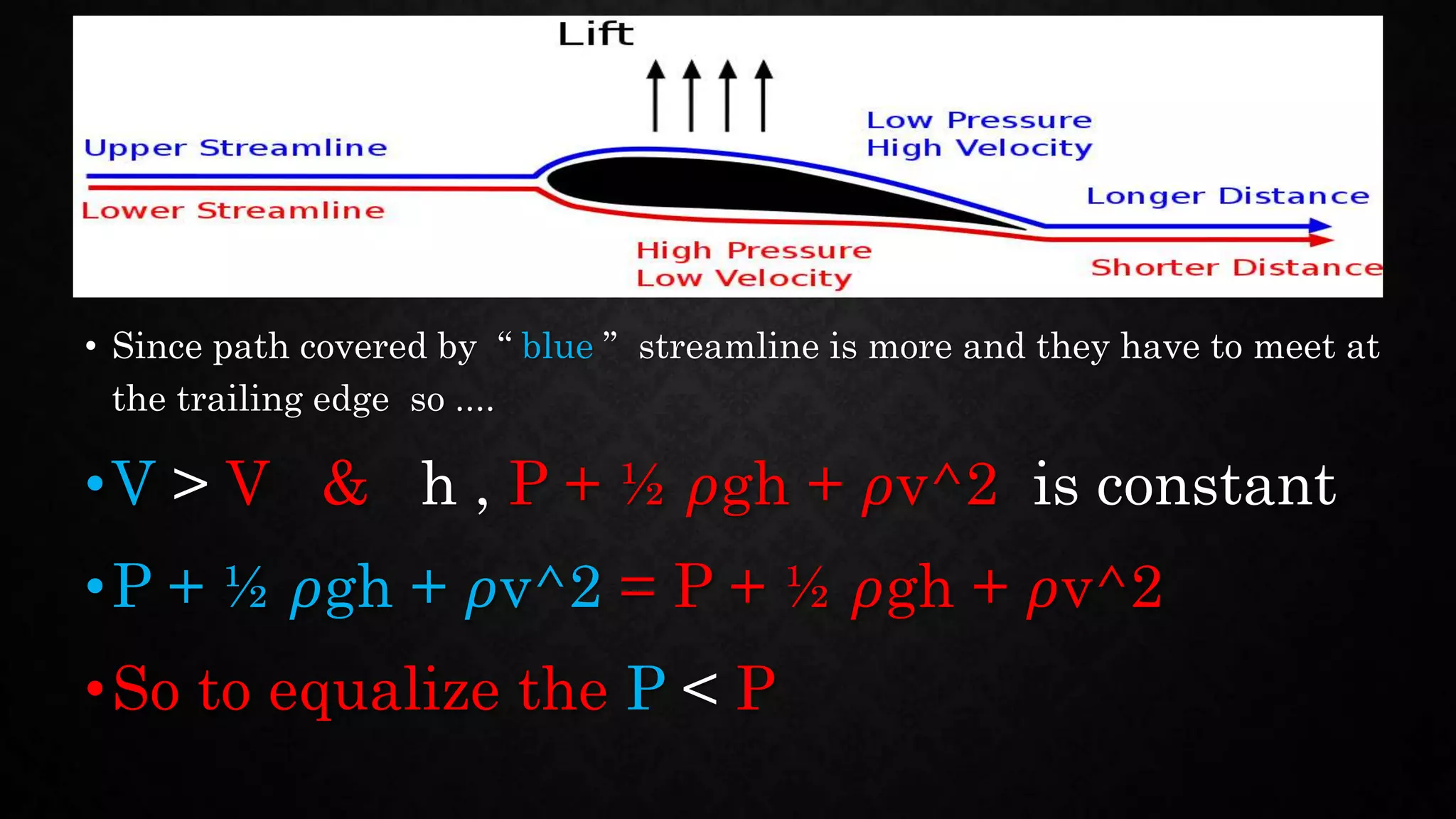
Equal Transit" theory, also known as the "Longer Path" theory, states that
because aerofoils are shaped with the upper surface longer than the bottom, air
molecules that pass over the top of the aerofoil have further to travel than
underneath.
 The theory states that the air molecules have to reach the trailing edge at the
same time, and in order to do that the molecules going over the top of the wing
must travel faster than the molecules moving under the wing.
 Because the upper flow is faster, the pressure is lower, as known by Bernoulli's
equation, and thus the difference in pressure across the aerofoil produces the
lift.
• Since path covered by “ blue ” streamline is more and they have to meet at
the trailing edge so ....
•V > V & h , P + ½ 𝜌gh + 𝜌v^2 is constant
•P + ½ 𝜌gh + 𝜌v^2 = P + ½ 𝜌gh + 𝜌v^2
•So to equalize the P < P
WHY IT FAILED …
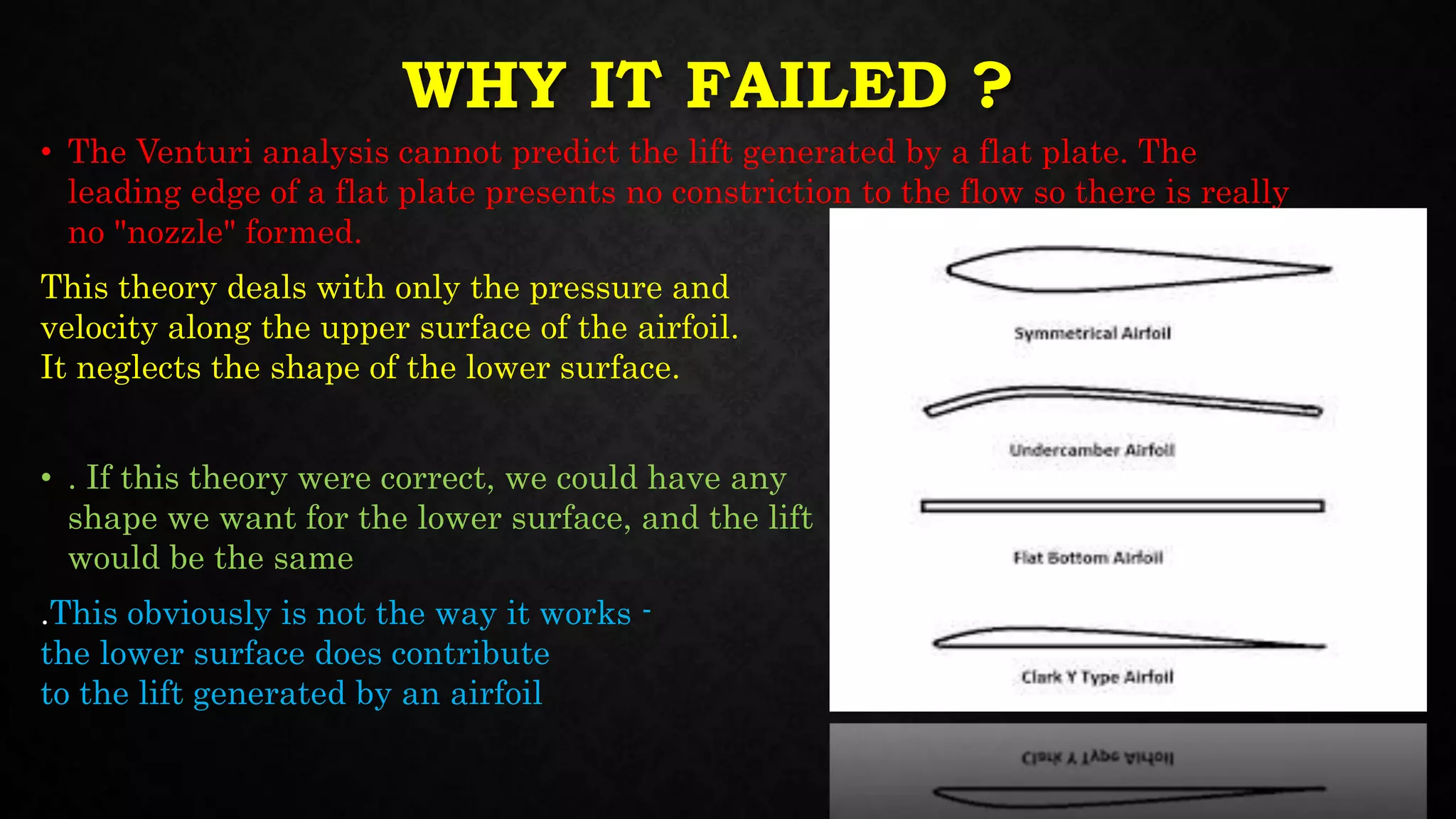
• This is not always correct. The symmetric airfoil in our
experiment generates plenty of lift and its upper surface is the
same length as the lower surface.
Think of a paper airplane. Its airfoil is a flat plate --> top and
bottom exactly the same length and shape and yet they fly just
fine.
Experiment shows us that the flow over the top of a lifting airfoil does travel
faster than the flow beneath the airfoil. But the flow is much faster than the
speed required to have the molecules meet up at the trailing edge. Two
molecules near each other at the leading edge will not end up next to each
other at the trailing edge .
VENTURIS
• The theory is based on the idea that the airfoil upper surface is shaped to
act as a nozzle which accelerates the flow. Such a nozzle configuration is
called a Venturi nozzle and it can be analyzed classically.
• This airfoil theory, the top of the airfoil is curved, which constricts the flow.
Since the area is decreased, the velocity over the top of the foil is increased.
Then from Bernoulli's equation, higher velocity produces a lower pressure
on the upper surface. The low pressure over the upper surface of the airfoil
produces the lift.
WHY IT FAILED ?
• The Venturi analysis cannot predict the lift generated by a flat plate. The
leading edge of a flat plate presents no constriction to the flow so there is really
no "nozzle" formed.
This theory deals with only the pressure and
velocity along the upper surface of the airfoil.
It neglects the shape of the lower surface.
• . If this theory were correct, we could have any
shape we want for the lower surface, and the lift
would be the same
.This obviously is not the way it works -
the lower surface does contribute
to the lift generated by an airfoil
THE EXISTING THEORY
• Lift generates due to :-
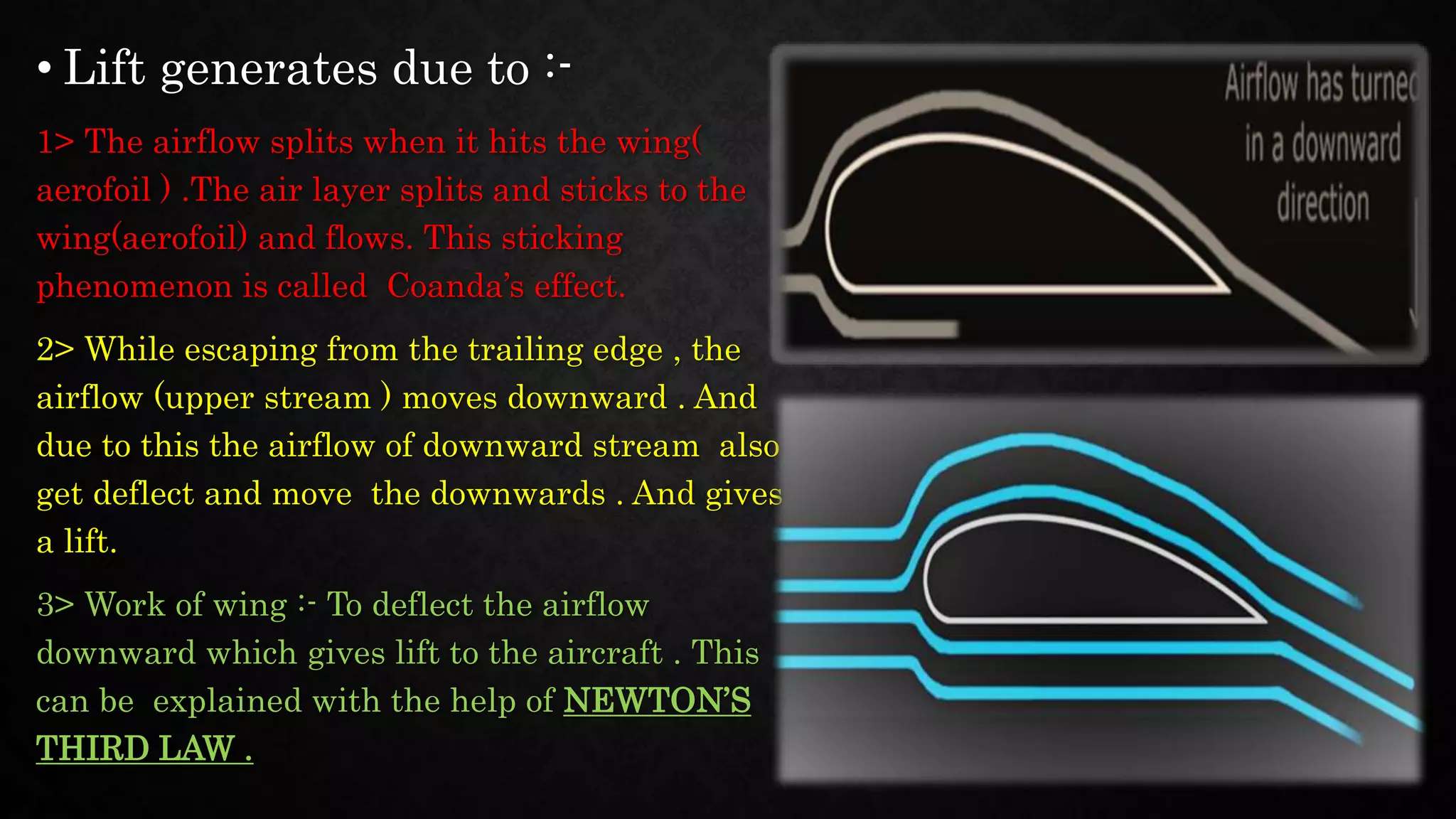
1> The airflow splits when it hits the wing(
aerofoil ) .The air layer splits and sticks to the
wing(aerofoil) and flows. This sticking
phenomenon is called Coanda’s effect.
2> While escaping from the trailing edge , the
airflow (upper stream ) moves downward . And
due to this the airflow of downward stream also
get deflect and move the downwards . And gives
a lift.
3> Work of wing :- To deflect the airflow
downward which gives lift to the aircraft . This
can be explained with the help of NEWTON’S
THIRD LAW .
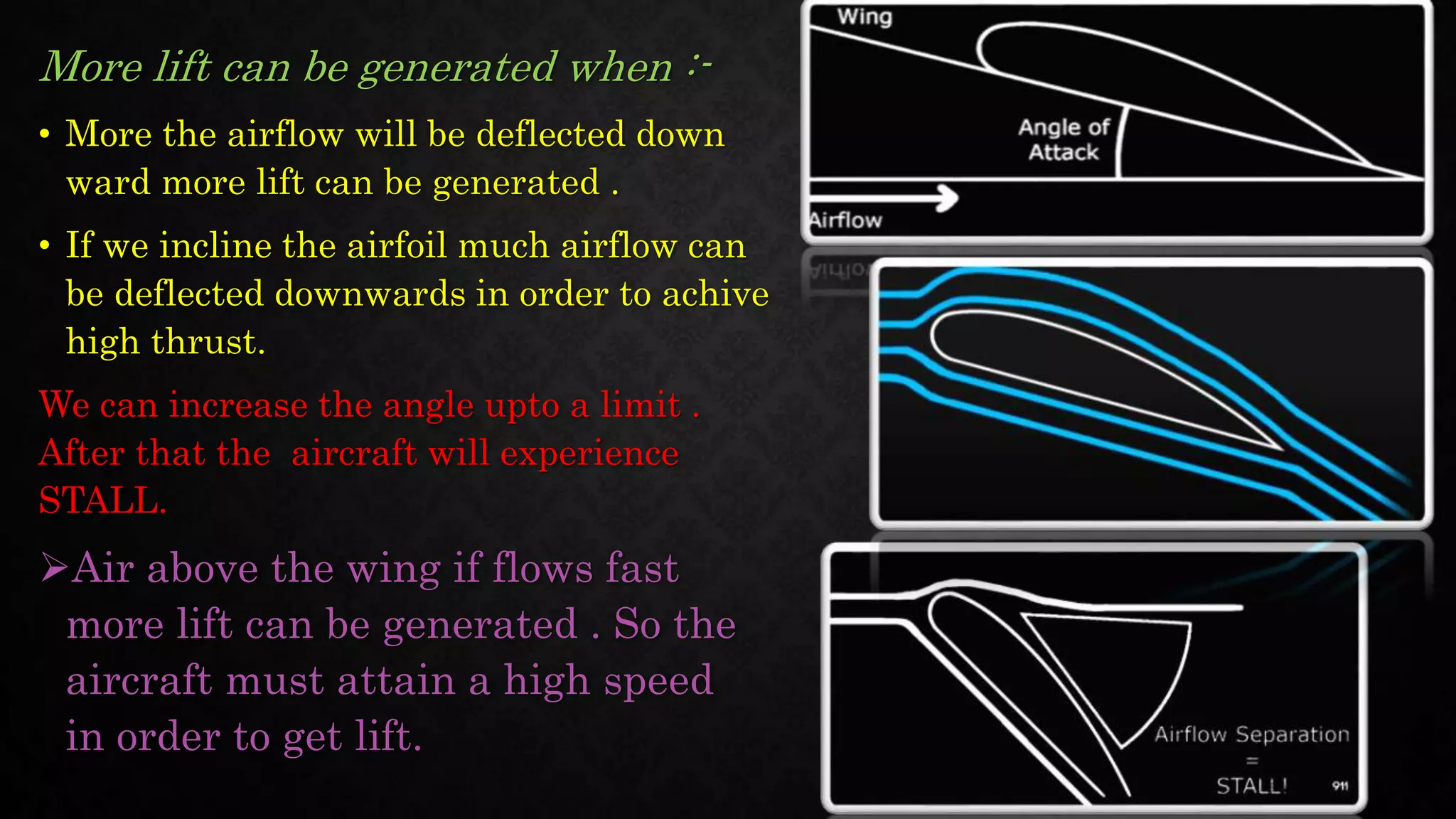
More lift can be generated when :-
• More the airflow will be deflected down
ward more lift can be generated .
• If we incline the airfoil much airflow can
be deflected downwards in order to achive
high thrust.
We can increase the angle upto a limit .
After that the aircraft will experience
STALL.
Air above the wing if flows fast
more lift can be generated . So the
aircraft must attain a high speed
in order to get lift.
Any
question
THANK YOU

Lift principles

  • 1.
  • 2.
    LIFT Lift generation phenomenonin wings has been explained correctly by the principle are as follows :- • Cayle’s Principle • Conda’s Effect • Newton’s third law • Equal Transit theory X • Bernoulli’s Principle X • Venturi’s Principle X
  • 3.
    LIFT GENERATION INAIRCRAFT • Lift is the component of this force that is perpendicular to the oncoming flow direction.[1] Lift is always accompanied by a drag force, which is the component of the surface force parallel to the flow direction.
  • 4.
    P1+ ½ 𝜌gh+ 𝜌v1 ^2 = P2+ ½ 𝜌gh + 𝜌v2^2  P1+ ½ 𝜌gh + 𝜌v1 ^2 = P2+ ½ 𝜌gh + 𝜌v2^2 { h is same , 𝜌 constant } => P1+ 𝜌v1 ^2 = P2 + 𝜌v2^2 but v1 < v2 P1 > P2 By Bernouli’s Theorm
  • 5.
    EQUAL TRANSIT THEORY EqualTransit" theory, also known as the "Longer Path" theory, states that because aerofoils are shaped with the upper surface longer than the bottom, air molecules that pass over the top of the aerofoil have further to travel than underneath.  The theory states that the air molecules have to reach the trailing edge at the same time, and in order to do that the molecules going over the top of the wing must travel faster than the molecules moving under the wing.  Because the upper flow is faster, the pressure is lower, as known by Bernoulli's equation, and thus the difference in pressure across the aerofoil produces the lift.
  • 6.
    • Since pathcovered by “ blue ” streamline is more and they have to meet at the trailing edge so .... •V > V & h , P + ½ 𝜌gh + 𝜌v^2 is constant •P + ½ 𝜌gh + 𝜌v^2 = P + ½ 𝜌gh + 𝜌v^2 •So to equalize the P < P
  • 7.
    WHY IT FAILED… • This is not always correct. The symmetric airfoil in our experiment generates plenty of lift and its upper surface is the same length as the lower surface. Think of a paper airplane. Its airfoil is a flat plate --> top and bottom exactly the same length and shape and yet they fly just fine. Experiment shows us that the flow over the top of a lifting airfoil does travel faster than the flow beneath the airfoil. But the flow is much faster than the speed required to have the molecules meet up at the trailing edge. Two molecules near each other at the leading edge will not end up next to each other at the trailing edge .
  • 8.
    VENTURIS • The theoryis based on the idea that the airfoil upper surface is shaped to act as a nozzle which accelerates the flow. Such a nozzle configuration is called a Venturi nozzle and it can be analyzed classically. • This airfoil theory, the top of the airfoil is curved, which constricts the flow. Since the area is decreased, the velocity over the top of the foil is increased. Then from Bernoulli's equation, higher velocity produces a lower pressure on the upper surface. The low pressure over the upper surface of the airfoil produces the lift.
  • 9.
    WHY IT FAILED? • The Venturi analysis cannot predict the lift generated by a flat plate. The leading edge of a flat plate presents no constriction to the flow so there is really no "nozzle" formed. This theory deals with only the pressure and velocity along the upper surface of the airfoil. It neglects the shape of the lower surface. • . If this theory were correct, we could have any shape we want for the lower surface, and the lift would be the same .This obviously is not the way it works - the lower surface does contribute to the lift generated by an airfoil
  • 10.
  • 11.
    • Lift generatesdue to :- 1> The airflow splits when it hits the wing( aerofoil ) .The air layer splits and sticks to the wing(aerofoil) and flows. This sticking phenomenon is called Coanda’s effect. 2> While escaping from the trailing edge , the airflow (upper stream ) moves downward . And due to this the airflow of downward stream also get deflect and move the downwards . And gives a lift. 3> Work of wing :- To deflect the airflow downward which gives lift to the aircraft . This can be explained with the help of NEWTON’S THIRD LAW .
  • 12.
    More lift canbe generated when :- • More the airflow will be deflected down ward more lift can be generated . • If we incline the airfoil much airflow can be deflected downwards in order to achive high thrust. We can increase the angle upto a limit . After that the aircraft will experience STALL. Air above the wing if flows fast more lift can be generated . So the aircraft must attain a high speed in order to get lift.
  • 13.
  • 14.