Cybersecurity for the IoT in Facility Energy Distribution
Andrew E. Taylor, PE Applied Power Technologies
12/02/2020 AEE Technical Session - Cybersecurity for IoT 1
The Problem
• The specific IoT devices involved in the delivery of energy and utilities
facilities and outside in the grid) are especially problematic.
• The devices can control the flow of these utilities which make the impact of
much more dangerous.
• Your plant’s diesel generator requires a higher level of security than
thermostat.
New regulatory requirements (led by California) require security features for all
devices
12/02/2020 AEE Technical Session - Cybersecurity for IoT 2
Background
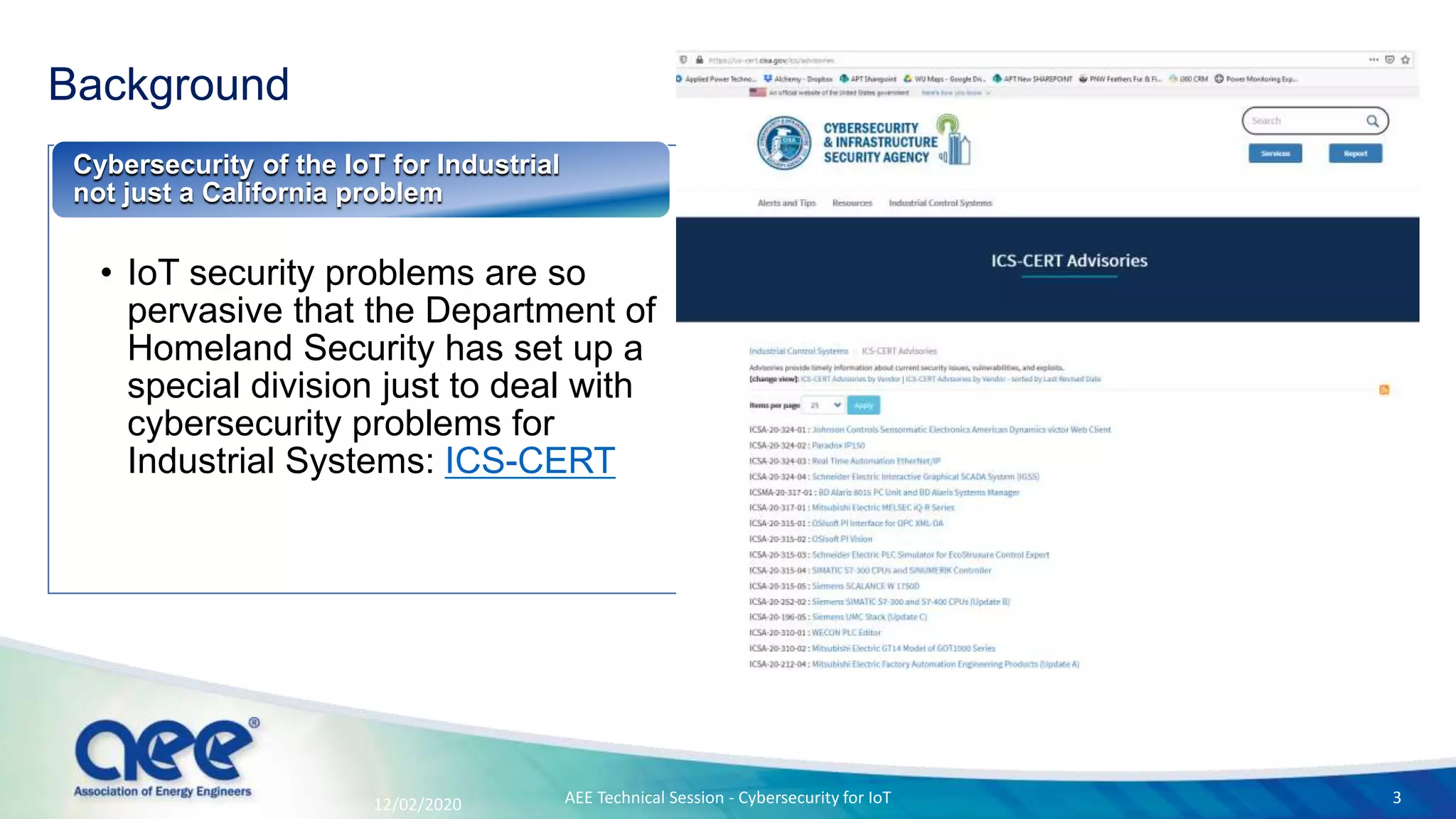
• IoT security problems are so
pervasive that the Department of
Homeland Security has set up a
special division just to deal with
cybersecurity problems for
Industrial Systems: ICS-CERT
Cybersecurity of the IoT for Industrial
not just a California problem
12/02/2020 AEE Technical Session - Cybersecurity for IoT 3
CA Senate Bill 327 - Security of Connected Devices became law on January 1, 2020
In order to sell a connected device in the state of CA, manufacturers must:
Background Detail
• Appropriate to the nature and function of
the device.
• Appropriate to the information it may
collect, contain, or transmit.
• Designed to protect the device and any
information contained therein from
unauthorized access, destruction, use,
modification, or disclosure, as specified.
Equip the device with a reasonable
security feature or features that are:
• The preprogrammed password is unique to each device
manufactured.
• The device contains a security feature that requires a user to generate
a new means of authentication before access is granted to the device
for the first time.
If a connected device is equipped with a means for
authentication outside a local area network, it shall be deemed
a reasonable security feature if either of the following
requirements are met:
12/02/2020 AEE Technical Session - Cybersecurity for IoT 4
If you are thinking you can define ‘reasonable security’ on your own, let me share guidance from California
Energy Department for solar inverters:
Reasonable Security
• Use a hash algorithm for all communications to
them private.
• Authenticate the Master to eliminate Man in the
Middle (MiM) spoofing.
• Use time stamps to eliminate the possibility of
schemes.
•California Rule 21 (not to mention IEEE 2030.5)
requires the following for smart inverters sold in
California:
• Circuit Breakers
• Trip Units
• UPS
• Generators
• Automatic Transfer Switches
• Relays
• Inverters
•CA Rule 21 sets the legal precedent for the
security of any network connected power device in
California.
12/02/2020 AEE Technical Session - Cybersecurity for IoT 5
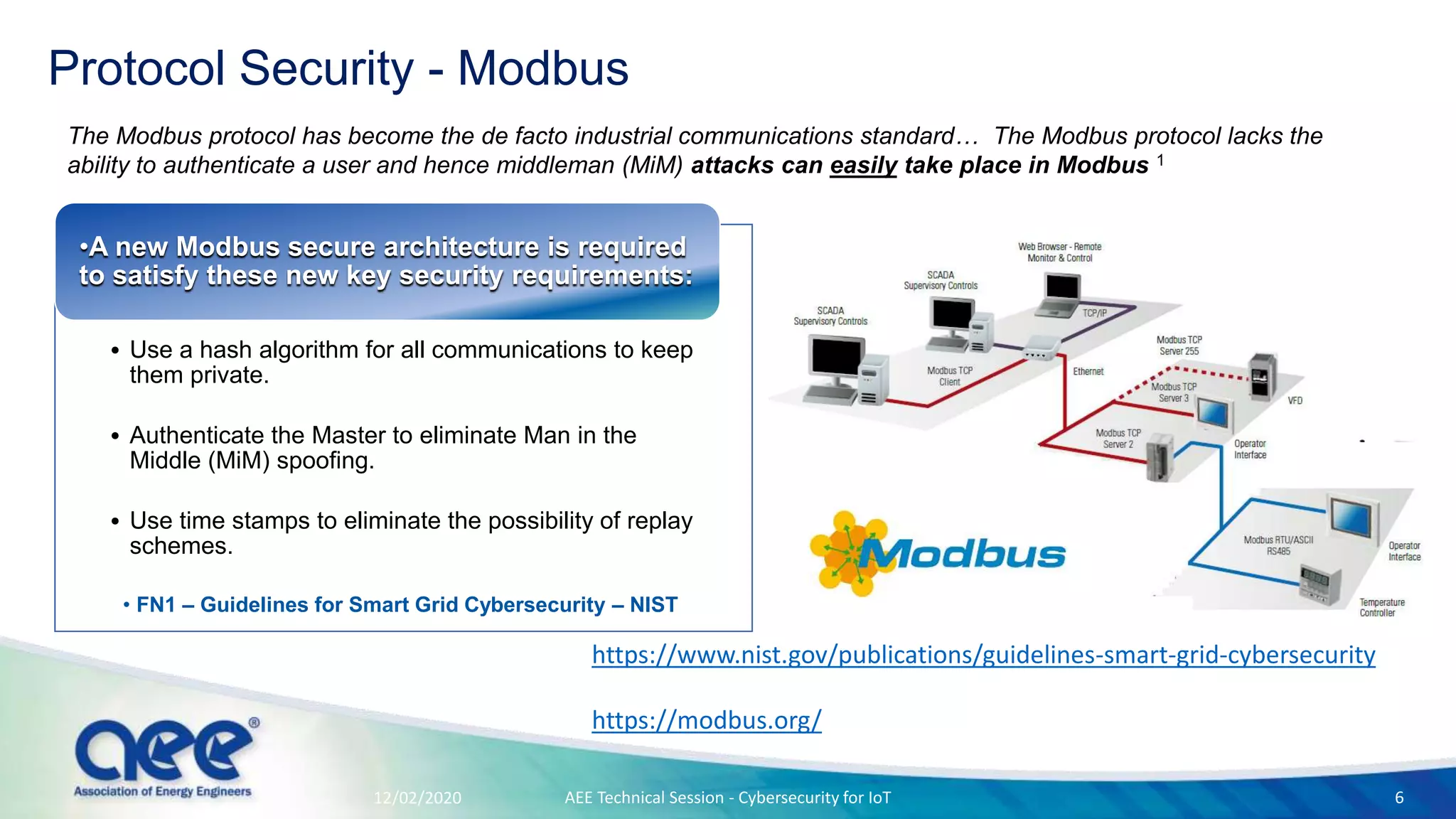
The Modbus protocol has become the de facto industrial communications standard… The Modbus protocol lacks the
ability to authenticate a user and hence middleman (MiM) attacks can easily take place in Modbus 1
Protocol Security - Modbus
• Use a hash algorithm for all communications to keep
them private.
• Authenticate the Master to eliminate Man in the
Middle (MiM) spoofing.
• Use time stamps to eliminate the possibility of replay
schemes.
• FN1 – Guidelines for Smart Grid Cybersecurity – NIST
•A new Modbus secure architecture is required
to satisfy these new key security requirements:
12/02/2020
https://www.nist.gov/publications/guidelines-smart-grid-cybersecurity
https://modbus.org/
AEE Technical Session - Cybersecurity for IoT 6
Protocol Security- BACnet
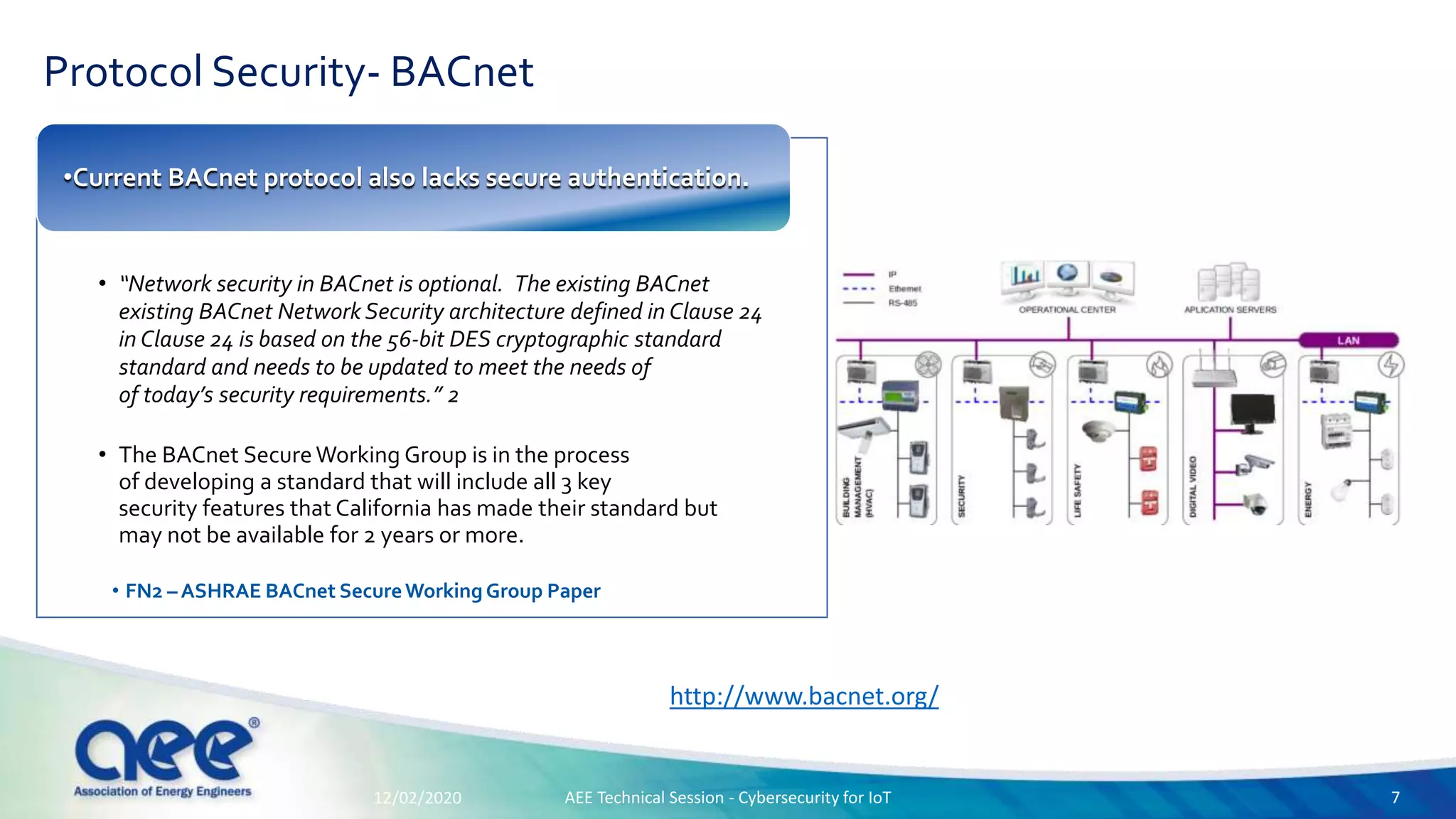
• “Network security in BACnet is optional. The existing BACnet
existing BACnet Network Security architecture defined in Clause 24
in Clause 24 is based on the 56-bit DES cryptographic standard
standard and needs to be updated to meet the needs of
of today’s security requirements.” 2
• The BACnet SecureWorking Group is in the process
of developing a standard that will include all 3 key
security features that California has made their standard but
may not be available for 2 years or more.
• FN2 – ASHRAE BACnet SecureWorkingGroup Paper
•Current BACnet protocol also lacks secure authentication.
12/02/2020
http://www.bacnet.org/
AEE Technical Session - Cybersecurity for IoT 7
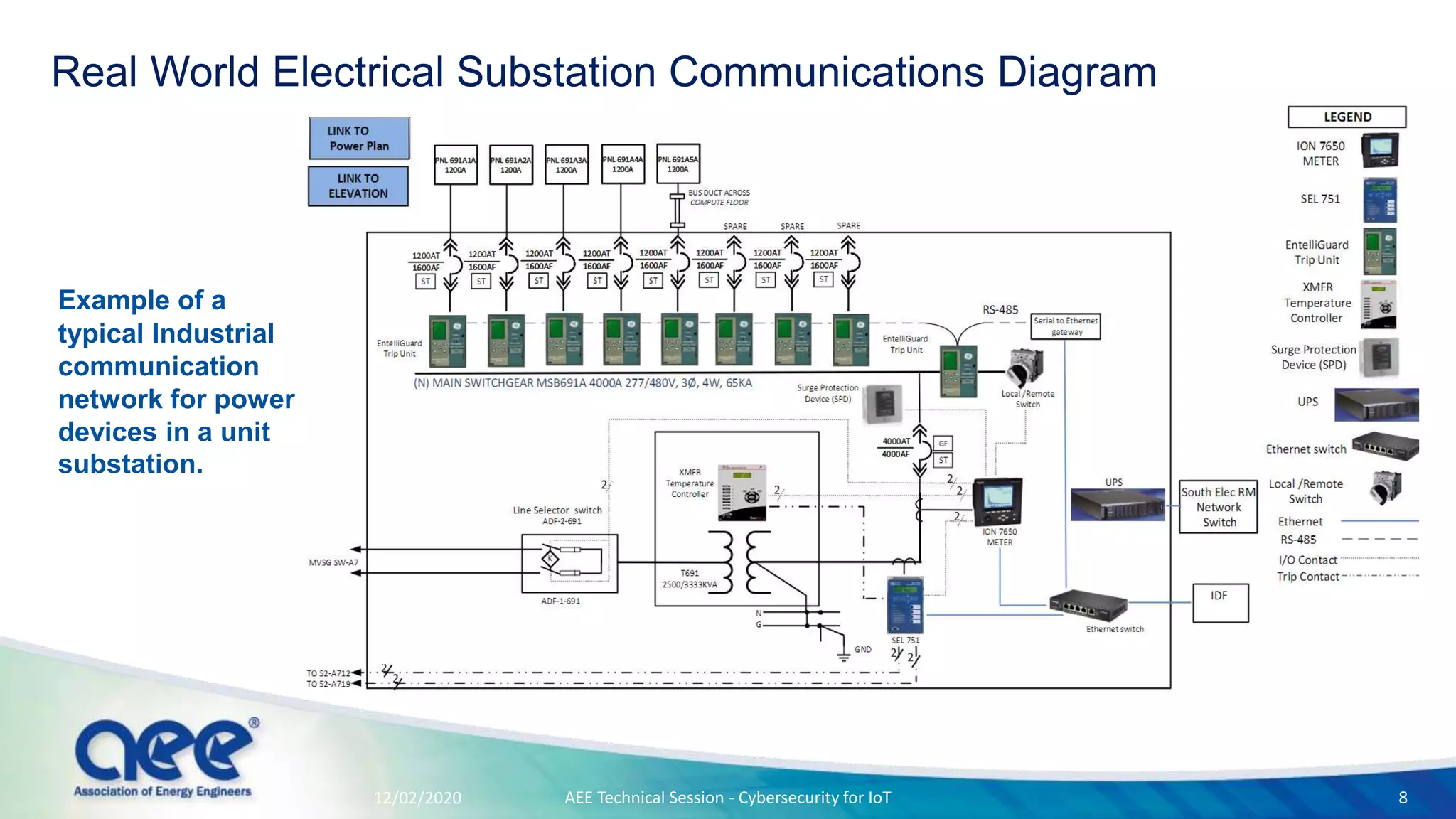
Example of a
typical Industrial
communication
network for power
devices in a unit
substation.
12/02/2020
Real World Electrical Substation Communications Diagram
AEE Technical Session - Cybersecurity for IoT 8
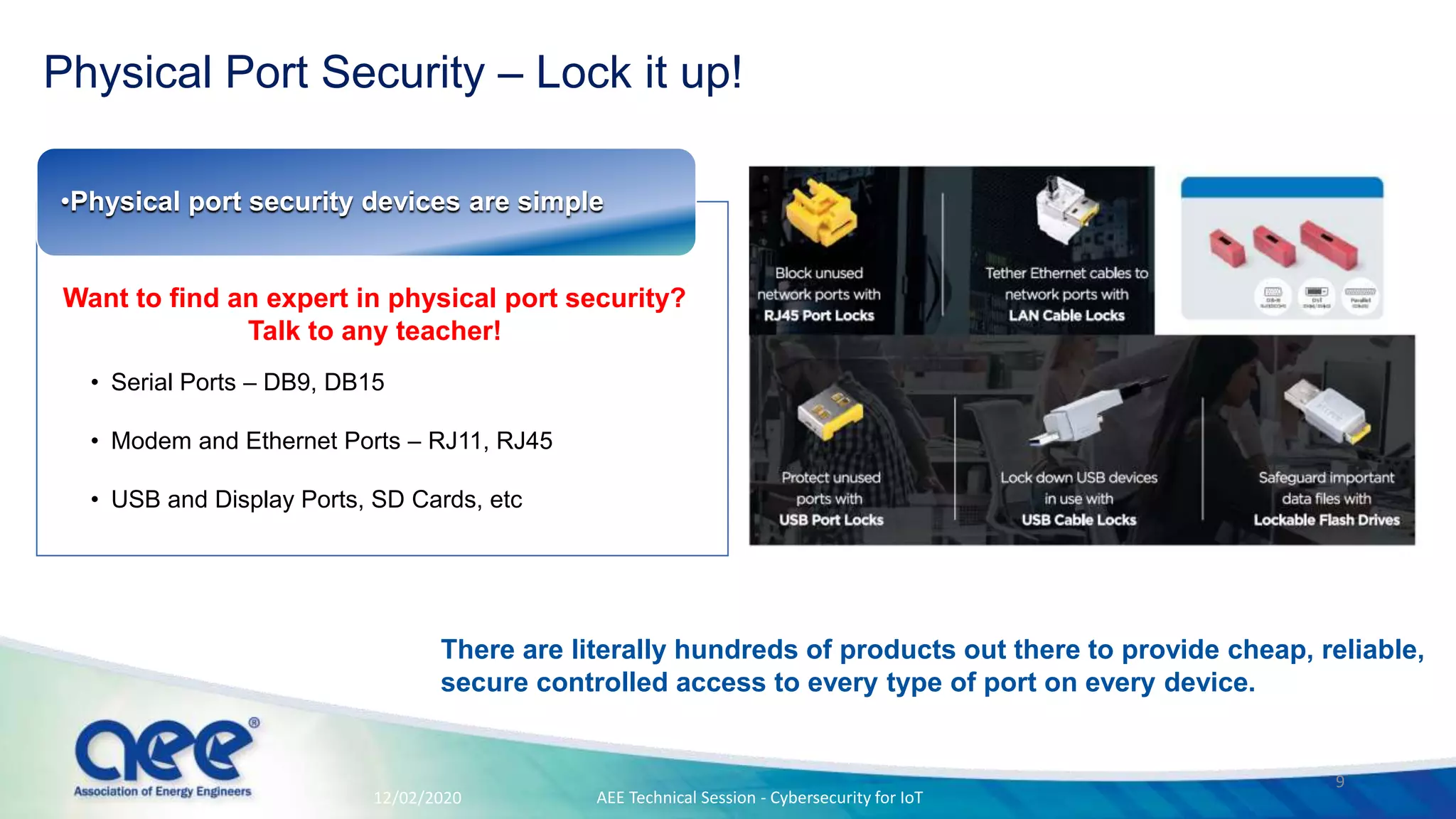
Physical Port Security – Lock it up!
• Serial Ports – DB9, DB15
• Modem and Ethernet Ports – RJ11, RJ45
• USB and Display Ports, SD Cards, etc
•Physical port security devices ​are simple
12/02/2020
Want to find an expert in physical port security?
Talk to any teacher!
There are literally hundreds of products out there to provide cheap, reliable,
secure controlled access to every type of port on every device.
AEE Technical Session - Cybersecurity for IoT
9
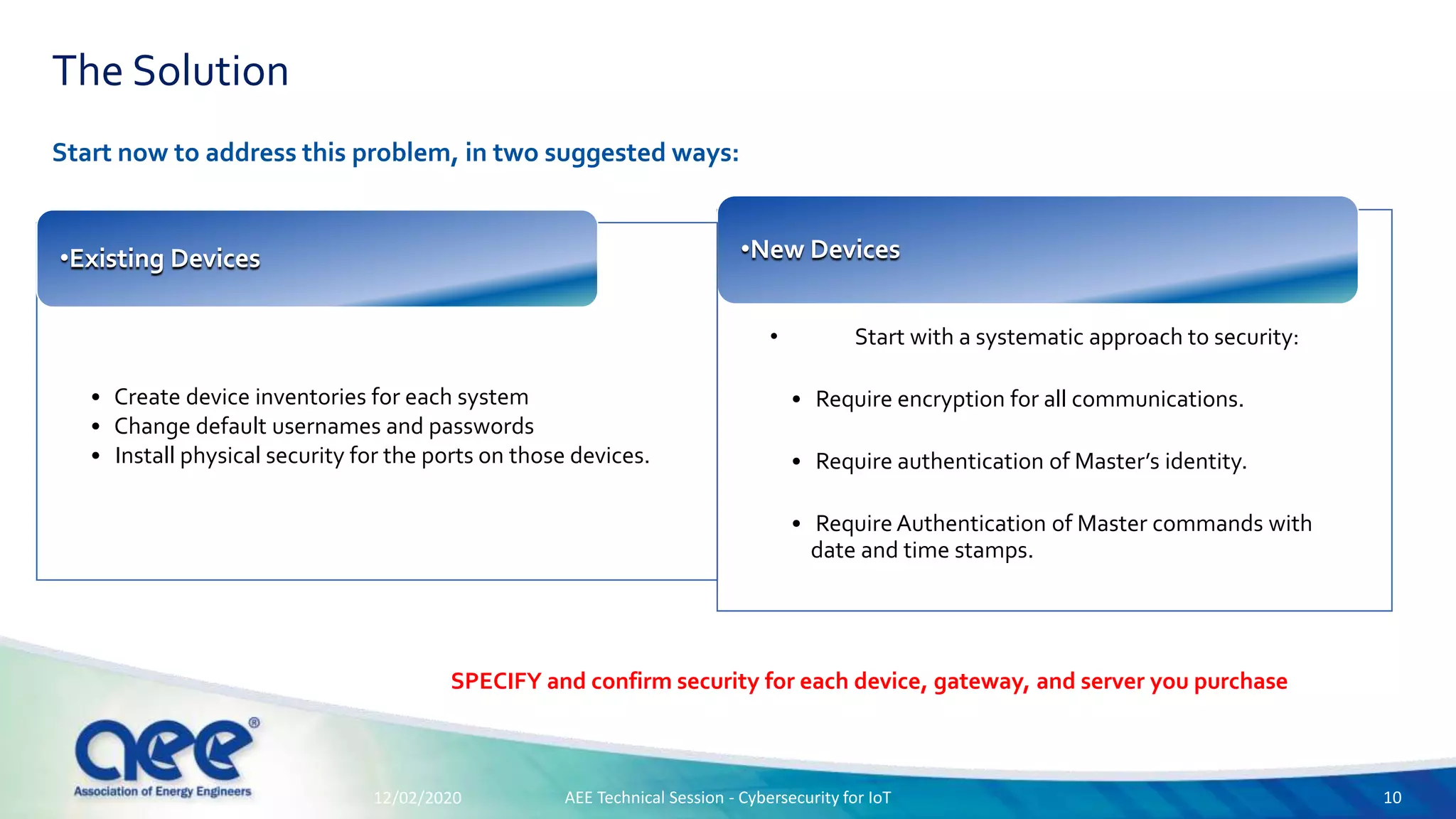
The Solution
Start now to address this problem, in two suggested ways:
• Start with a systematic approach to security:
• Require encryption for all communications.
• Require authentication of Master’s identity.
• Require Authentication of Master commands with
date and time stamps.
•New Devices
• Create device inventories for each system
• Change default usernames and passwords
• Install physical security for the ports on those devices.
•Existing Devices
SPECIFY and confirm security for each device, gateway, and server you purchase
12/02/2020 AEE Technical Session - Cybersecurity for IoT 10
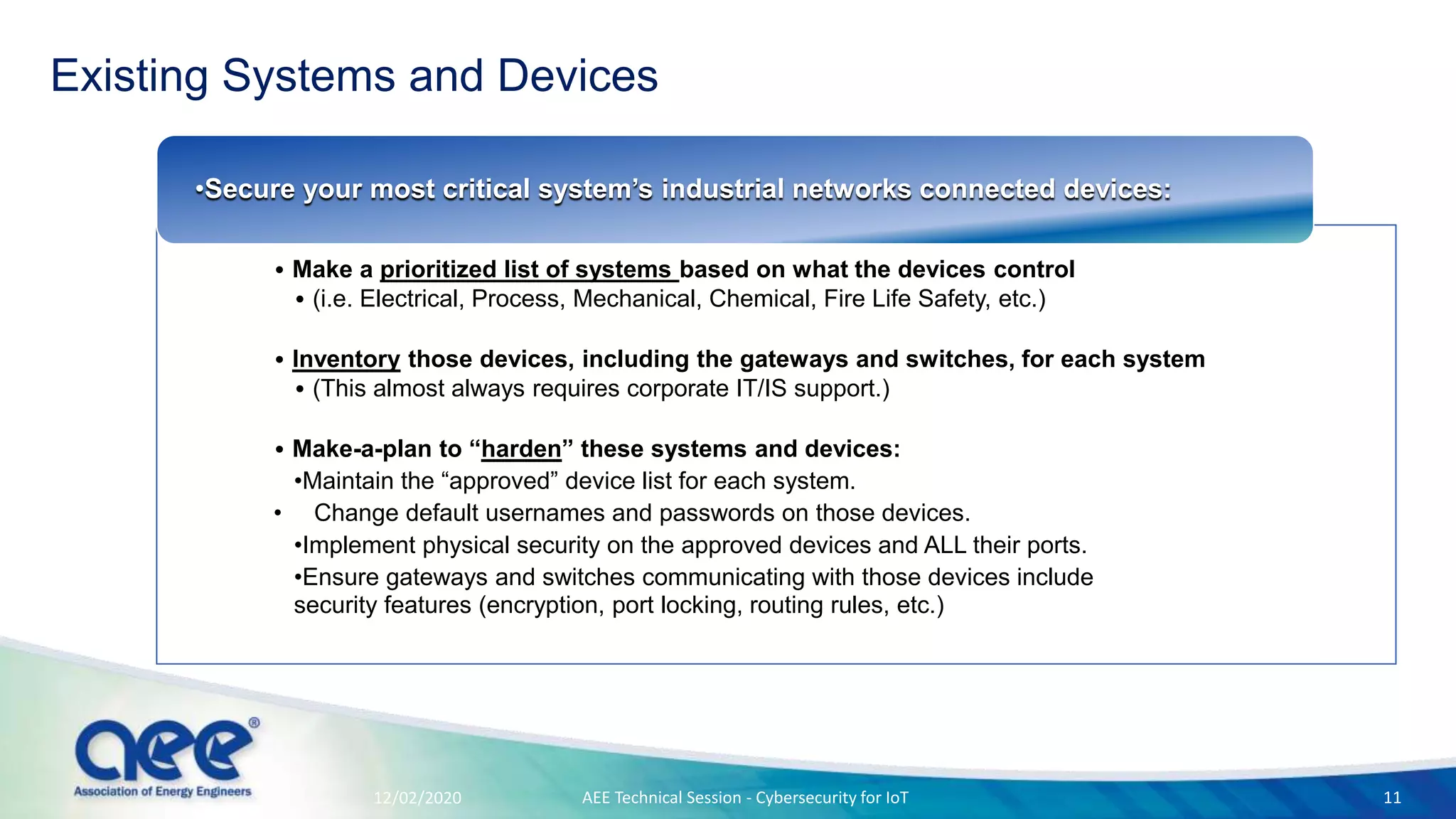
Existing Systems and Devices
• Make a prioritized list of systems based on what the devices control
• (i.e. Electrical, Process, Mechanical, Chemical, Fire Life Safety, etc.)
• Inventory those devices, including the gateways and switches, for each system
• (This almost always requires corporate IT/IS support.)
• Make-a-plan to “harden” these systems and devices:
•Maintain the “approved” device list for each system.
• Change default usernames and passwords on those devices.
•Implement physical security on the approved devices and ALL their ports.
•Ensure gateways and switches communicating with those devices include
security features (encryption, port locking, routing rules, etc.)
•Secure your most critical system’s industrial networks connected devices:
12/02/2020 AEE Technical Session - Cybersecurity for IoT 11
New Equipment
• Update purchase specifications for approved systems and devices
• Update installation details for approved systems and devices for their communications connections to verify
that physical ports are secured.
• Update IT/IS procedures for gateways and switches to ensure Cyber Security features are configured. Then
test each one.
Don’t make the problem worse – start requiring Cybersecurity for new equipment
12/02/2020 AEE Technical Session - Cybersecurity for IoT 12
Conclusion
• Prioritize existing systems and devices.
• Inventory and harden those systems and devices.
• Don’t hide it – just ‘disconnecting’ is NOT a solution.
• Don’t make it worse – change specs and details for new systems and devices
• Use resources available to you to rise to this challenge (and stay out of the news!)
Cybersecurity challenges are real and require you to engage NOW!
12/02/2020 AEE Technical Session - Cybersecurity for IoT 13
Questions & Answers
•Department of Homeland Security Cybersecurity for Industrial Systems: ICS-CERT
•Cyber Resilience Review and other Resources
•https://us-cert.cisa.gov/resources
•NIST Guidelines
•https://www.nist.gov/publications/guidelines-smart-grid-cybersecurity
•Modbus Protocol
•https://modbus.org/
•BacNet Protocol
•http://www.bacnet.org/
More information available at these links
12/02/2020 AEE Technical Session - Cybersecurity for IoT 14
Thank you
Andrew E. Taylor, P.E.,
Applied Power Technologies, Inc.
1550 The Alameda, Suite 305 San Jose, CA 95126
direct: 408 340-7116 mobile: 408 218-3548
www.apt4power.com
ataylor@apt4power.com
12/02/2020 AEE Technical Session - Cybersecurity for IoT 1512/02/2020

AEE Cybersecurity for the IOT in Facility Energy Distribution Slides

  • 1.
    Cybersecurity for theIoT in Facility Energy Distribution Andrew E. Taylor, PE Applied Power Technologies 12/02/2020 AEE Technical Session - Cybersecurity for IoT 1
  • 2.
    The Problem • Thespecific IoT devices involved in the delivery of energy and utilities facilities and outside in the grid) are especially problematic. • The devices can control the flow of these utilities which make the impact of much more dangerous. • Your plant’s diesel generator requires a higher level of security than thermostat. New regulatory requirements (led by California) require security features for all devices 12/02/2020 AEE Technical Session - Cybersecurity for IoT 2
  • 3.
    Background • IoT securityproblems are so pervasive that the Department of Homeland Security has set up a special division just to deal with cybersecurity problems for Industrial Systems: ICS-CERT Cybersecurity of the IoT for Industrial not just a California problem 12/02/2020 AEE Technical Session - Cybersecurity for IoT 3
  • 4.
    CA Senate Bill327 - Security of Connected Devices became law on January 1, 2020 In order to sell a connected device in the state of CA, manufacturers must: Background Detail • Appropriate to the nature and function of the device. • Appropriate to the information it may collect, contain, or transmit. • Designed to protect the device and any information contained therein from unauthorized access, destruction, use, modification, or disclosure, as specified. Equip the device with a reasonable security feature or features that are: • The preprogrammed password is unique to each device manufactured. • The device contains a security feature that requires a user to generate a new means of authentication before access is granted to the device for the first time. If a connected device is equipped with a means for authentication outside a local area network, it shall be deemed a reasonable security feature if either of the following requirements are met: 12/02/2020 AEE Technical Session - Cybersecurity for IoT 4
  • 5.
    If you arethinking you can define ‘reasonable security’ on your own, let me share guidance from California Energy Department for solar inverters: Reasonable Security • Use a hash algorithm for all communications to them private. • Authenticate the Master to eliminate Man in the Middle (MiM) spoofing. • Use time stamps to eliminate the possibility of schemes. •California Rule 21 (not to mention IEEE 2030.5) requires the following for smart inverters sold in California: • Circuit Breakers • Trip Units • UPS • Generators • Automatic Transfer Switches • Relays • Inverters •CA Rule 21 sets the legal precedent for the security of any network connected power device in California. 12/02/2020 AEE Technical Session - Cybersecurity for IoT 5
  • 6.
    The Modbus protocolhas become the de facto industrial communications standard… The Modbus protocol lacks the ability to authenticate a user and hence middleman (MiM) attacks can easily take place in Modbus 1 Protocol Security - Modbus • Use a hash algorithm for all communications to keep them private. • Authenticate the Master to eliminate Man in the Middle (MiM) spoofing. • Use time stamps to eliminate the possibility of replay schemes. • FN1 – Guidelines for Smart Grid Cybersecurity – NIST •A new Modbus secure architecture is required to satisfy these new key security requirements: 12/02/2020 https://www.nist.gov/publications/guidelines-smart-grid-cybersecurity https://modbus.org/ AEE Technical Session - Cybersecurity for IoT 6
  • 7.
    Protocol Security- BACnet •“Network security in BACnet is optional. The existing BACnet existing BACnet Network Security architecture defined in Clause 24 in Clause 24 is based on the 56-bit DES cryptographic standard standard and needs to be updated to meet the needs of of today’s security requirements.” 2 • The BACnet SecureWorking Group is in the process of developing a standard that will include all 3 key security features that California has made their standard but may not be available for 2 years or more. • FN2 – ASHRAE BACnet SecureWorkingGroup Paper •Current BACnet protocol also lacks secure authentication. 12/02/2020 http://www.bacnet.org/ AEE Technical Session - Cybersecurity for IoT 7
  • 8.
    Example of a typicalIndustrial communication network for power devices in a unit substation. 12/02/2020 Real World Electrical Substation Communications Diagram AEE Technical Session - Cybersecurity for IoT 8
  • 9.
    Physical Port Security– Lock it up! • Serial Ports – DB9, DB15 • Modem and Ethernet Ports – RJ11, RJ45 • USB and Display Ports, SD Cards, etc •Physical port security devices ​are simple 12/02/2020 Want to find an expert in physical port security? Talk to any teacher! There are literally hundreds of products out there to provide cheap, reliable, secure controlled access to every type of port on every device. AEE Technical Session - Cybersecurity for IoT 9
  • 10.
    The Solution Start nowto address this problem, in two suggested ways: • Start with a systematic approach to security: • Require encryption for all communications. • Require authentication of Master’s identity. • Require Authentication of Master commands with date and time stamps. •New Devices • Create device inventories for each system • Change default usernames and passwords • Install physical security for the ports on those devices. •Existing Devices SPECIFY and confirm security for each device, gateway, and server you purchase 12/02/2020 AEE Technical Session - Cybersecurity for IoT 10
  • 11.
    Existing Systems andDevices • Make a prioritized list of systems based on what the devices control • (i.e. Electrical, Process, Mechanical, Chemical, Fire Life Safety, etc.) • Inventory those devices, including the gateways and switches, for each system • (This almost always requires corporate IT/IS support.) • Make-a-plan to “harden” these systems and devices: •Maintain the “approved” device list for each system. • Change default usernames and passwords on those devices. •Implement physical security on the approved devices and ALL their ports. •Ensure gateways and switches communicating with those devices include security features (encryption, port locking, routing rules, etc.) •Secure your most critical system’s industrial networks connected devices: 12/02/2020 AEE Technical Session - Cybersecurity for IoT 11
  • 12.
    New Equipment • Updatepurchase specifications for approved systems and devices • Update installation details for approved systems and devices for their communications connections to verify that physical ports are secured. • Update IT/IS procedures for gateways and switches to ensure Cyber Security features are configured. Then test each one. Don’t make the problem worse – start requiring Cybersecurity for new equipment 12/02/2020 AEE Technical Session - Cybersecurity for IoT 12
  • 13.
    Conclusion • Prioritize existingsystems and devices. • Inventory and harden those systems and devices. • Don’t hide it – just ‘disconnecting’ is NOT a solution. • Don’t make it worse – change specs and details for new systems and devices • Use resources available to you to rise to this challenge (and stay out of the news!) Cybersecurity challenges are real and require you to engage NOW! 12/02/2020 AEE Technical Session - Cybersecurity for IoT 13
  • 14.
    Questions & Answers •Departmentof Homeland Security Cybersecurity for Industrial Systems: ICS-CERT •Cyber Resilience Review and other Resources •https://us-cert.cisa.gov/resources •NIST Guidelines •https://www.nist.gov/publications/guidelines-smart-grid-cybersecurity •Modbus Protocol •https://modbus.org/ •BacNet Protocol •http://www.bacnet.org/ More information available at these links 12/02/2020 AEE Technical Session - Cybersecurity for IoT 14
  • 15.
    Thank you Andrew E.Taylor, P.E., Applied Power Technologies, Inc. 1550 The Alameda, Suite 305 San Jose, CA 95126 direct: 408 340-7116 mobile: 408 218-3548 www.apt4power.com ataylor@apt4power.com 12/02/2020 AEE Technical Session - Cybersecurity for IoT 1512/02/2020

Editor's Notes

  • #2 Andrew Taylor, PE, CEO, Applied Power Technologies, Inc. Wednesday December 2nd 2020 11:00 am - 11:40 am Cybersecurity for the Internet of Things (IoT) in Facility Energy Distribution
  • #3 My handful of takeaways from this technical session are simple: Cyber Security for connected devices is a real and pervasive problem in our industry. Government regulations are placing the burden for compliance on both the manufacturers and the customers. That means you. Waiting will not make the problem go away; or get smaller – the longer you wait the worse this will get. This is not just about hackers – Cyber Security vulnerabilities are exploited by disgruntled employees, your competitors, organized groups, and even other governments. There are lots of resources out there for your use to start addressing Cyber Security problems, so please use them!
  • #4 Don’t believe this is a problem? Check this out – there are literally hundreds of vulnerabilities and case studies of exploitation (only some of which make the news). The Department of Homeland Security (DHS) offers the Cyber Resilience Review (CRR) on a voluntary, no-cost basis for critical infrastructure organizations. There are two options for the CRR: (1) a downloadable self-assessment or (2) a facilitated six-hour session with trained DHS representatives at your location. This Cyber Resilience Review helps your organization will develop an understanding of its operational resilience and ability to manage cyber risk during normal operations and times of operational stress and crisis. No manufacturer, no product, no communication protocol, no software is excluded.
  • #5 APT saw the CA state law SB-327 requiring CyberSecurity for all Internet connected devices coming for 2020 and started to prepare for it after it passed in late 2018. Though the bill does not require protection of existing infrastructure, we believe customers will want to address the CyberSecurity concerns with the purchase of ANY new electrical meter, gateway, trip unit, relay, or connected electrical device. This is an early example of legislation attempting to resolve this problem – you can expect more regulation to come from other states and the US. I’ll let you read and think about the security requirements – I don’t know of manufacturers who generate unique passwords for each device yet. Nor do I know of manufacturers who require the user to generate a unique password when they configure a new device. Every device my company has configured for the past 25 years has a default user name and password – and almost every one of them stayed that way. This is a huge problem to start addressing now.
  • #6 California’s Rule 21 governs CPUC-jurisdictional interconnections, which include the interconnection of all net energy metering (NEM) facilities, "Non-Export" facilities, and qualifying facilities intending to sell power at avoided cost to the host utility. IEEE 2030.5-2018 - IEEE Standard for Smart Energy Profile Application Protocol. The application layer with TCP/IP providing functions in the transport and Internet layers to enable utility management of the end user energy environment, including demand response, load control, time of day pricing, management of distributed generation, electric vehicles, etc. is defined in this standard. This standard defines the mechanisms for exchanging application messages, the exact messages exchanged including error messages, and the security features used to protect the application messages. And this is just for a solar inverter – why? Because it is connected to electrical (so a life safety and fire hazard danger) and there are a lot of them out there in the marketplace. I’m no lawyer, just a professional electrical engineer – but this sounds a lot like what lawyers like to call a “legal precedent”.
  • #7 Modbus is one of the most widespread industrial protocols, used both for serial communications (RS-232 and RS-485) over a twisted pair of wires as well as Modbus TCP for use over Ethernet and Fiber networks. Unfortunately – Modbus is not a secure protocol, and does not contain even basic security features – No encryption for communications​ No authentication the Master’s identity​ 3. No Authentication of the Master/Slave’s commands with time stamps
  • #8 Next most prevalent is BacNet – another widespread industrial protocols, used both for serial communications (RS-232 and RS-485) over a twisted pair of wires as well as BacNet over TCP/IP for use over Ethernet and Fiber networks. Unfortunately – BacNet is also not a secure protocol, and does not contain even basic security features – No encryption for communications​ No authentication the Master’s identity​ 3. No Authentication of the Master/Slave’s commands with time stamps
  • #9 We just discussed two of the most common industrial communication protocols and decided they were not secure – and won’t be soon. Now I want to show you a real world example of an electrical substation. High risk if any of these devices is breached, or even used accidentally – the trip units on the circuit breakers are capable of controlling the breakers (open and closing) The transformer temperature controller runs the fans and can trip the main if it detects a high temperature on the transformer. But what about something even simpler – physical port security Your IT organization physically secures every port on the Ethernet switches they control (hopefully they know about this one in a substation) What about the serial to Ethernet gateway? The UPS supplying control power to all these control devices? The additional serial ports on the meter and the protective relay? Is there any way to prevent physical access to these unsecured ports out in the field? The answer might surprise you – unless you have children attending school from home due to COVID.
  • #10 The public school system has just endured one of the toughest stress tests ever due to COVID on their network bandwidth; and the physical security of the devices they provide their students to attend school remotely. How do they prevent those students from accessing unauthorized content and changing their Chromebook configuration? They lock up EVERY port with port locks! Every port on every device connected to your industrial network needs to start with physical security – this is the fastest and easiest thing you can do to secure your existing devices.
  • #11 First, we’ll address the problem you already have with your installed base of devices connected to your industrial networks. Then we’ll go look at strategies for not making the problem worse when you buy new equipment and new products for your facility.
  • #12 Here’s how APT is assisting our customers on the west coast secure their existing devices: We start with making a prioritized list of the systems – as you can imagine, the electrical system is usually one of the top priorities, but in general the FACILITY systems are a known headache for your corporate IT or IS department and nobody wants to go after it. For those of you old enough – think of how organizations dealt with the Year 2000 bug back in 1999. With attention comes funding, the actions we’re recommending are simple, effective, and low cost. You can build a career on this specialty because it is so pervasive across all industries, all systems, all equipment. Start with an inventory, then address the simplest items first. Remember that Department of Homeland Security (DHS) Cyber Resilience Review (CRR) you rolled your eyes at back at the beginning of this session. This is what the self assessment is going to focus on first.
  • #13 Here’s how APT is assisting our customers on the west coast purchase new devices: We help customers (this usually starts with owners and operators but also includes Architectural Engineering firms and contractors) update their specifications. You would be amazed at hos hard it is to change a specification at many organizations, ESPECIALLY when the specs are not being provided by the equipment manufacturer themselves. Then we focus on the install configuration and commissioning testing process to ensure the new equipment meets these new specifications – this can include simple port security, changing default passwords, and updating the approved system device list to include the new equipment. Finally, we go to the team that owns Cyber Security now – your corporate IT and IS organizations. In the past, these organizations treated the facility networks as a necessary evil. They knew there was a network out there connected to the corporate network, but they ignored it or delegated responsibility for that network to the operations or corporate real estate organization. When an operations support organization like APT comes to corporate IT with a prioritized list of devices and a plan to help reduce CyberSecurity vulnerability of these facilities industrial networks most IT organizations welcome the help with open arms and funding support.
  • #14 I’ll remind you again of those five takeaways from this technical session that we started with - Cyber Security for connected devices is a real and pervasive problem in our industry. Government regulations are placing the burden for compliance on both the manufacturers and the customers. That means you. Waiting will not make the problem go away; or get smaller – the longer you wait the worse this will get. This is not just about hackers – Cyber Security vulnerabilities are exploited by disgruntled employees, your competitors, organized groups, and even other governments. There are lots of resources out there for your use to start addressing Cyber Security problems, so please use them!