
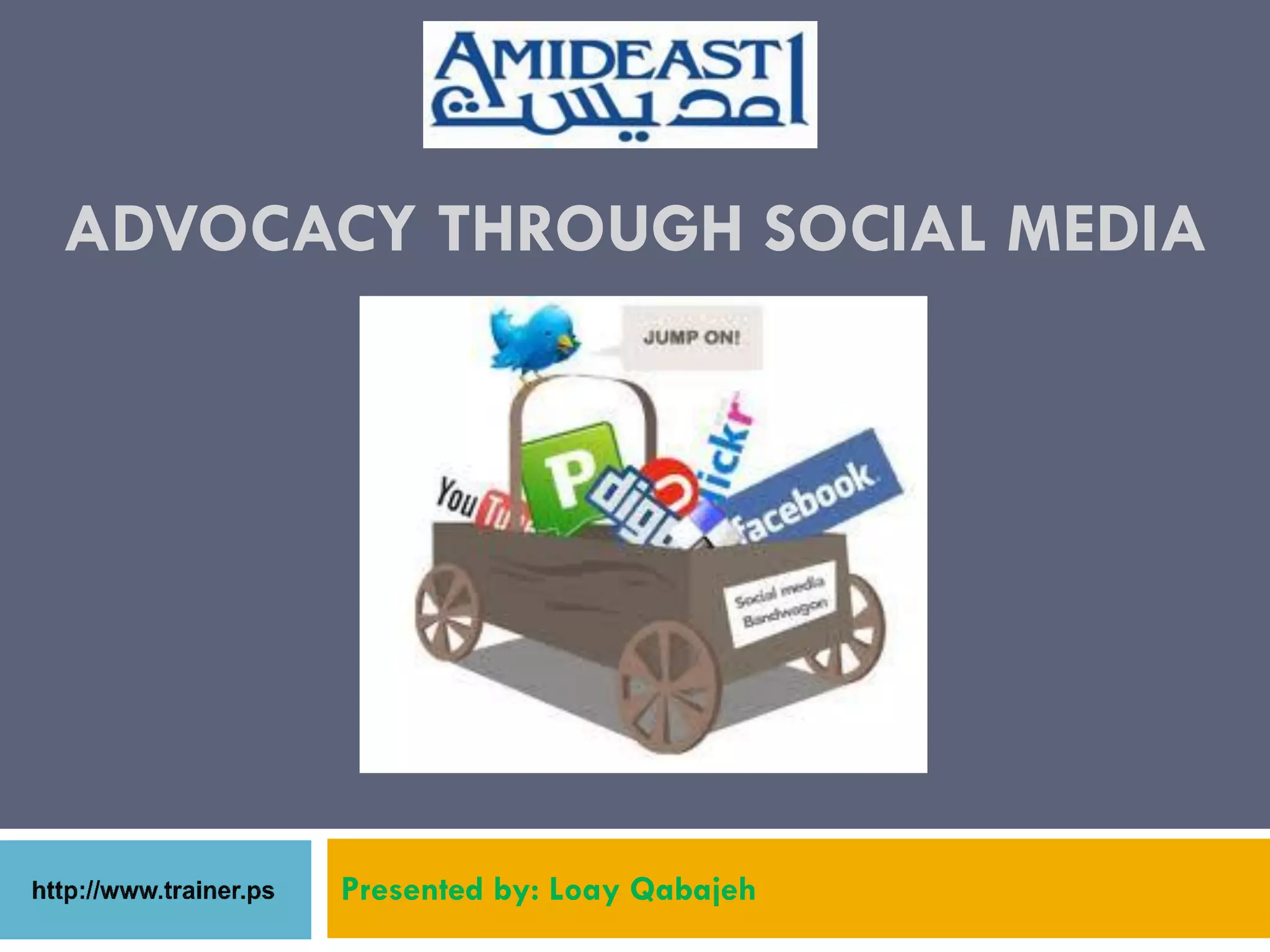

ADVOCACY THROUGH SOCIAL MEDIA


       Presented by: Loay Qabajeh
2   Expectations
Course outline …
3


       Advocacy Skills for Youth.

       What IS Social media and It importance.

       How to run an advocacy campaign through SM.

       Practicing common SM platforms and tools.

       Media authoring tools.
4    Group Exercise
What is Advocacy?
Why do youth need Advocacy skills?
How to plan and run an advocacy campaign?
What are the characteristics of an effective
advocacy campaigns?
What IS Advocacy?
5


       Advocacy is a process of influencing key decision
        makers and opinion formers for changes to policies
        and practices that will work in poor people’s favor.
       Advocacy is the act or process of supporting a
        cause or issue. It is a set of targeted actions in
        support of a cause or an issue.
       Advocacy is speaking up, drawing a community’s
        attention to an important issue, and directing
        decision makers towards a solution
What IS Advocacy? … cont.
6


       Advocacy is an organized, systematic and intentional
        process of influencing matters of public interest and
        changing power relations to improve the lives of the
        disenfranchised . ‫محرومين من الحقوق‬
       “A set of targeted actions in support of a
        cause or an issue, to build support for
        that cause or issue, influence others to
        support it; or try to influence or change
        legislation that affects it.”
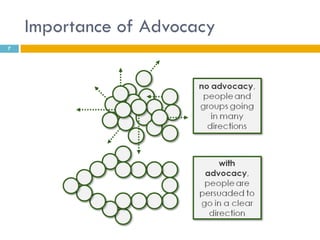
Importance of Advocacy
7
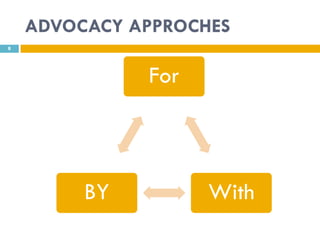
ADVOCACY APPROCHES
8


              For


         BY         With
ADVOCACY APPROCHES
9


    Advocacy for:
    This is advocacy done by an organization, institution
    on behalf of the people or community.
    This approach often fails as the community tends to be left behind.


    Advocacy with:
    This is where the community or people advocate for
    a cause together with the organizations or
    institutions. The community is involved in the actual
    advocacy work.
ADVOCACY APPROCHES
10


 Advocacy by:
 This is where the community champions a cause on their own.
 The community’s capacities are built and empowered to
 advocate for a cause with the help of the organizations .

 This approach tends to succeed because:
  The communities may have expert knowledge of their problems
  They can suggest workable solutions based on direct experience of the
     problems.
  The cause is legitimized as the community’s voices is heard.
  They are often highly motivated because they are directly affected by
     the issue
Time to Break.
11
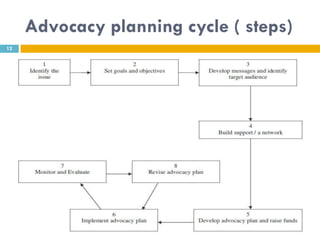
Advocacy planning cycle ( steps)
12
Identify and analyze the problem/ Issue:
13


        Advocacy begins with an issue or a problem a group
         decides to support in order to promote a policy
         change. The issue should meet the group’s agreed-
         upon criteria and support the organization overall
         visions.
        The exact nature of the problem to be addressed
         needs to be identified as clearly as possible.
        The advocate needs to identify exactly what the issue
         is and wherever possible a range of potential
         acceptable solutions or desired outcomes.
Analyse and Research the issue ..Questions
14


        Has this issue arisen elsewhere? If so how was it
         handled and what was the outcome?
        Are there any policies, guidelines or laws relating to
         this?
        Are there any organisations that might give you advice
         and guidance?
        What is the plan of action for addressing this issue?
            Who should we contact?
            What is the most likely avenue of communication to be
             successful?
            From whom else do we need help?
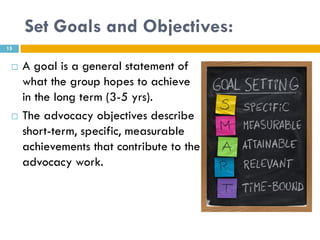
Set Goals and Objectives:
15


    A goal is a general statement of
     what the group hopes to achieve
     in the long term (3-5 yrs).
    The advocacy objectives describe
     short-term, specific, measurable
     achievements that contribute to the
     advocacy work.
Identify Target Audience:
16


     •   The primary target audience includes the decision
         makers who have the authority to bring about the
         desired policy change.
     •   The secondary target audience includes persons who
         have access to and are able to influence the primary
         audience e.g. other policy makers, friends or relatives,
         the media, religious leaders etc.
     •    Must identify individuals in the target audience, their
         positions, and relative power base and then determine
         whether the various individuals support, oppose, or are
         neutral to the advocacy issue.
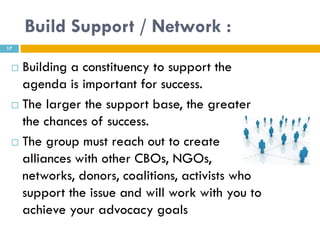
Build Support / Network :
17


  Building a constituency to support the
   agenda is important for success.
  The larger the support base, the greater

   the chances of success.
  The group must reach out to create

   alliances with other CBOs, NGOs,
   networks, donors, coalitions, activists who
   support the issue and will work with you to
   achieve your advocacy goals
Develop the Message:
18


     5 Elements of a Message to Consider
      Content/Ideas
      Appropriate Language
      Messenger/Source (credible/trusted)
      Format/Medium to Convey Message
      Time/Place
Select Channels of Communication:
19


        Selection of appropriate medium for
         advocacy messages depends on the
         target audience.
        Some of the more common channels
         includes; press kits and press release,
         press conferences, fact sheets, a
         public debate, a conference for
         policy makers etc.

         SOCIAL MEDIA is a good channel
Raise Funds:
20


    Advocacy campaigns can always benefit from outside
     funds and other resources.
    Resources can help the development and dissemination
     of materials, cover network members travel to meet the
     various decision makers and generate support,
     underwrite meetings, seminars, etc.
    advocacy groups should develop a fundraising strategy
     at the outset of the campaign to identify potential
     contributors of financial and other resources.
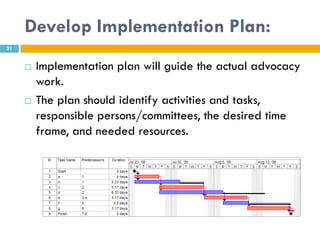
Develop Implementation Plan:
21


        Implementation plan will guide the actual advocacy
         work.
        The plan should identify activities and tasks,
         responsible persons/committees, the desired time
         frame, and needed resources.
Guidelines for Advocacy Experiences
Sharing and Reflection
22


      What were you advocating for and why, what
       did you want to change and for whom?
       (Objectives)
      Had you tried other options in addressing the
       problem? (Alternatives)
      Who else was involved in this agenda?
       (Stakeholders)
      What were the major highlights of this

       campaign or agenda? (Successes)
Guidelines for Advocacy Experiences
Sharing and Reflection
23


        If you were to repeat the campaign and you had
         the power and opportunity, what would you do
         differently? (Weaknesses)
        What would you do the same way as your
         previous campaign? (Strength)
        If you were picked as an advisor to an advocacy
         grouping intending to carry out advocacy
         activities similar to the ones you had participated
         in, what would be your key advice? (Lessons
         learnt)
24
     What skills and qualities does an
     advocate need?
What skills and qualities does an advocate need?
25


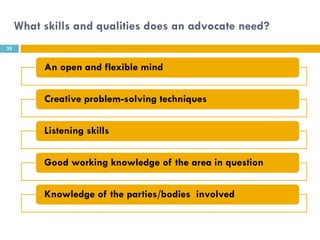
          An open and flexible mind

          Creative problem-solving techniques

          Listening skills

          Good working knowledge of the area in question

          Knowledge of the parties/bodies involved
What skills and qualities does an advocate need?
26


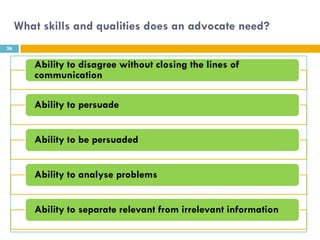
        Ability to disagree without closing the lines of
        communication

        Ability to persuade


        Ability to be persuaded


        Ability to analyse problems


        Ability to separate relevant from irrelevant information
What skills and qualities does an advocate need?
27


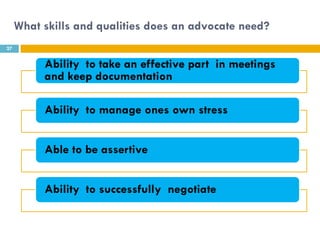
          Ability to take an effective part in meetings
          and keep documentation

          Ability to manage ones own stress


          Able to be assertive


          Ability to successfully negotiate
Barriers to effective advocacy
28


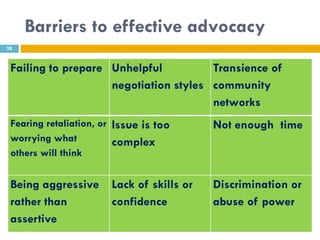
 Failing to prepare Unhelpful          Transience of
                    negotiation styles community
                                       networks
 Fearing retaliation, or Issue is too      Not enough time
 worrying what           complex
 others will think


 Being aggressive      Lack of skills or   Discrimination or
 rather than           confidence          abuse of power
 assertive
Barriers to effective advocacy
29


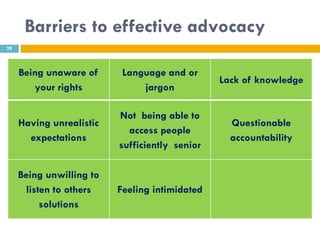
     Being unaware of      Language and or
                                                Lack of knowledge
        your rights            jargon

                          Not being able to
     Having unrealistic                           Questionable
                            access people
       expectations                               accountability
                          sufficiently senior

     Being unwilling to
       listen to others   Feeling intimidated
           solutions
30
     Thank You

Advocacy - Amdieast

  • 1.
    ADVOCACY THROUGH SOCIALMEDIA Presented by: Loay Qabajeh
  • 2.
    2 Expectations
  • 3.
    Course outline … 3  Advocacy Skills for Youth.  What IS Social media and It importance.  How to run an advocacy campaign through SM.  Practicing common SM platforms and tools.  Media authoring tools.
  • 4.
    4 Group Exercise What is Advocacy? Why do youth need Advocacy skills? How to plan and run an advocacy campaign? What are the characteristics of an effective advocacy campaigns?
  • 5.
    What IS Advocacy? 5  Advocacy is a process of influencing key decision makers and opinion formers for changes to policies and practices that will work in poor people’s favor.  Advocacy is the act or process of supporting a cause or issue. It is a set of targeted actions in support of a cause or an issue.  Advocacy is speaking up, drawing a community’s attention to an important issue, and directing decision makers towards a solution
  • 6.
    What IS Advocacy?… cont. 6  Advocacy is an organized, systematic and intentional process of influencing matters of public interest and changing power relations to improve the lives of the disenfranchised . ‫محرومين من الحقوق‬  “A set of targeted actions in support of a cause or an issue, to build support for that cause or issue, influence others to support it; or try to influence or change legislation that affects it.”
  • 7.
  • 8.
  • 9.
    ADVOCACY APPROCHES 9 Advocacy for: This is advocacy done by an organization, institution on behalf of the people or community. This approach often fails as the community tends to be left behind. Advocacy with: This is where the community or people advocate for a cause together with the organizations or institutions. The community is involved in the actual advocacy work.
  • 10.
    ADVOCACY APPROCHES 10 Advocacyby: This is where the community champions a cause on their own. The community’s capacities are built and empowered to advocate for a cause with the help of the organizations . This approach tends to succeed because:  The communities may have expert knowledge of their problems  They can suggest workable solutions based on direct experience of the problems.  The cause is legitimized as the community’s voices is heard.  They are often highly motivated because they are directly affected by the issue
  • 11.
  • 12.
  • 13.
    Identify and analyzethe problem/ Issue: 13  Advocacy begins with an issue or a problem a group decides to support in order to promote a policy change. The issue should meet the group’s agreed- upon criteria and support the organization overall visions.  The exact nature of the problem to be addressed needs to be identified as clearly as possible.  The advocate needs to identify exactly what the issue is and wherever possible a range of potential acceptable solutions or desired outcomes.
  • 14.
    Analyse and Researchthe issue ..Questions 14  Has this issue arisen elsewhere? If so how was it handled and what was the outcome?  Are there any policies, guidelines or laws relating to this?  Are there any organisations that might give you advice and guidance?  What is the plan of action for addressing this issue?  Who should we contact?  What is the most likely avenue of communication to be successful?  From whom else do we need help?
  • 15.
    Set Goals andObjectives: 15  A goal is a general statement of what the group hopes to achieve in the long term (3-5 yrs).  The advocacy objectives describe short-term, specific, measurable achievements that contribute to the advocacy work.
  • 16.
    Identify Target Audience: 16 • The primary target audience includes the decision makers who have the authority to bring about the desired policy change. • The secondary target audience includes persons who have access to and are able to influence the primary audience e.g. other policy makers, friends or relatives, the media, religious leaders etc. • Must identify individuals in the target audience, their positions, and relative power base and then determine whether the various individuals support, oppose, or are neutral to the advocacy issue.
  • 17.
    Build Support /Network : 17  Building a constituency to support the agenda is important for success.  The larger the support base, the greater the chances of success.  The group must reach out to create alliances with other CBOs, NGOs, networks, donors, coalitions, activists who support the issue and will work with you to achieve your advocacy goals
  • 18.
    Develop the Message: 18 5 Elements of a Message to Consider  Content/Ideas  Appropriate Language  Messenger/Source (credible/trusted)  Format/Medium to Convey Message  Time/Place
  • 19.
    Select Channels ofCommunication: 19  Selection of appropriate medium for advocacy messages depends on the target audience.  Some of the more common channels includes; press kits and press release, press conferences, fact sheets, a public debate, a conference for policy makers etc. SOCIAL MEDIA is a good channel
  • 20.
    Raise Funds: 20  Advocacy campaigns can always benefit from outside funds and other resources.  Resources can help the development and dissemination of materials, cover network members travel to meet the various decision makers and generate support, underwrite meetings, seminars, etc.  advocacy groups should develop a fundraising strategy at the outset of the campaign to identify potential contributors of financial and other resources.
  • 21.
    Develop Implementation Plan: 21  Implementation plan will guide the actual advocacy work.  The plan should identify activities and tasks, responsible persons/committees, the desired time frame, and needed resources.
  • 22.
    Guidelines for AdvocacyExperiences Sharing and Reflection 22  What were you advocating for and why, what did you want to change and for whom? (Objectives)  Had you tried other options in addressing the problem? (Alternatives)  Who else was involved in this agenda? (Stakeholders)  What were the major highlights of this campaign or agenda? (Successes)
  • 23.
    Guidelines for AdvocacyExperiences Sharing and Reflection 23  If you were to repeat the campaign and you had the power and opportunity, what would you do differently? (Weaknesses)  What would you do the same way as your previous campaign? (Strength)  If you were picked as an advisor to an advocacy grouping intending to carry out advocacy activities similar to the ones you had participated in, what would be your key advice? (Lessons learnt)
  • 24.
    24 What skills and qualities does an advocate need?
  • 25.
    What skills andqualities does an advocate need? 25 An open and flexible mind Creative problem-solving techniques Listening skills Good working knowledge of the area in question Knowledge of the parties/bodies involved
  • 26.
    What skills andqualities does an advocate need? 26 Ability to disagree without closing the lines of communication Ability to persuade Ability to be persuaded Ability to analyse problems Ability to separate relevant from irrelevant information
  • 27.
    What skills andqualities does an advocate need? 27 Ability to take an effective part in meetings and keep documentation Ability to manage ones own stress Able to be assertive Ability to successfully negotiate
  • 28.
    Barriers to effectiveadvocacy 28 Failing to prepare Unhelpful Transience of negotiation styles community networks Fearing retaliation, or Issue is too Not enough time worrying what complex others will think Being aggressive Lack of skills or Discrimination or rather than confidence abuse of power assertive
  • 29.
    Barriers to effectiveadvocacy 29 Being unaware of Language and or Lack of knowledge your rights jargon Not being able to Having unrealistic Questionable access people expectations accountability sufficiently senior Being unwilling to listen to others Feeling intimidated solutions
  • 30.
    30 Thank You