WHAT REALLY HAPPENS IN AN
NIH STUDY REVIEW
Paul J. Martin, MD
ITHS
2
Dr. Martin is a medical
oncologist who specializes in
treating patients with bone
marrow transplantation. Dr.
Martin is Co-PI of ITHS, a
member of the Clinical
Research Division at Fred
Hutch, Director of the Fred
Hutch Research Trials Office,
and a professor in the Medical
Oncology Division at the
University of Washington
School of Medicine.
Paul J. Martin, MD
3
Overview
• What happens at the meeting
• Summary of recent changes
• Review criteria
• “Impact” vs. “Significance”
• Review scoring
• Advice from NIH
• Important writing tips
• Frequent mistakes
• Advice from retired study section chairs
• Where to get more information
4
• Welcome and call to order by chair
• Panel members introduce themselves
• Introductory remarks and instruction by SRO
• Order of review
• New investigator R01 applications
• Other R01 applications
• R21 applications
• Order determined by average of preliminary
overall scores from assigned reviewers
• ~ 50% of applications are discussed
Overview of the Meeting
5
• Conflicted members leave the room
• Applicant and title announced by chair
• Preliminary overall scores from reviewers
• Discussion by primary reviewer
• Additional comments by other reviewers
• Human subjects and animal welfare concerns
• Panel discussion
• Summary by chair
• Revised overall scores announced
• Voting outside range
• Budget recommendations
• Conflicted members called back
How Reviews are Discussed
6
Summary of Recent Changes
►Emphasis on “impact”
►Bullet point format of reviews
►Tutorial comments not
encouraged
►Discussion ordered by preliminary
score
►New investigator applications
separated
7
Scored Review Criteria
►Impact
►Significance
►Investigators
►Innovation
►Approach
►Environment
8
• Summarize significant overall strengths and
weaknesses
• Assess the likelihood that the project will
exert a sustained powerful influence on the
field
• Feasibility is an important consideration
Impact
9
• Does the project address an important problem
or a critical barrier to progress in
the field?
• If the aims of the project are achieved, how will
scientific knowledge, technical capability or
clinical practice be improved?
• How will successful completion of the aim change
the concepts, methods, technologies, treatments,
services or preventive interventions that drive
this field?
Significance
10
Investigator
• Are the researchers well suited to the project?
• If Early Stage or New Investigators (only R01), do they
have appropriate experience and training?
• If established, have they demonstrated an ongoing
record of accomplishments that have advanced their
fields?
• If the project is collaborative or multi-PI, do the
investigators have complementary and integrated
expertise; are their leadership approach, governance
and organizational structure appropriate for the
project?
11
• Does the application challenge and seek to shift
current research or clinical practice paradigms by
utilizing novel theoretical concepts, approaches or
methodologies, instrumentation, or interventions?
• Are the concepts, approaches or methodologies,
instrumentation, or interventions novel to one field
or novel in a broad sense?
• Is it a refinement, improvement, or new application
of theoretical concepts, approaches or
methodologies, instrumentation or interventions
proposed?
Innovation
12
• Are the overall strategy, methodology, and
analyses well-reasoned and appropriate to
accomplish the specific aims of the project?
• Are potential problems, alternative strategies,
and benchmarks for success presented?
• If the project is in the early stages of
development, will the strategy establish
feasibility and will particularly risky aspects be
managed?
Approach
13
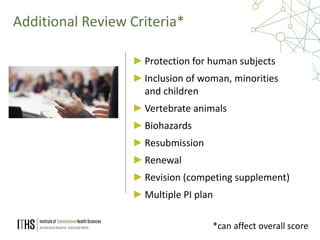
Additional Review Criteria*
►Protection for human subjects
►Inclusion of woman, minorities
and children
►Vertebrate animals
►Biohazards
►Resubmission
►Renewal
►Revision (competing supplement)
►Multiple PI plan
*can affect overall score
14
• Evaluate risks as acceptable or unacceptable
• Evaluate protections as adequate or inadequate
• Items for evaluation
• Risk to subjects
• Adequacy of protection against risks
• Potential benefits to subjects and others
• Importance of the knowledge to be gained
• Data and safety monitoring for clinical trials
• Data and Safety Monitoring Plan
• Justification for exempt status
Protection for Human Subjects*
*can affect overall score via “approach”
15
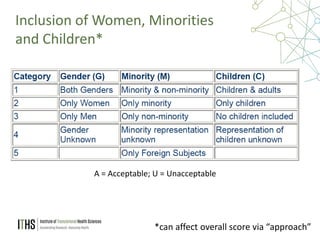
Inclusion of Women, Minorities
and Children*
A = Acceptable; U = Unacceptable
*can affect overall score via “approach”
16
• Evaluate as acceptable or unacceptable
• Proposed use of animals
• Species, strains, ages, sex and numbers
• Justification for use of animals and for appropriateness
of the species and numbers proposed
• Adequacy of veterinary care
• Procedures to limit discomfort, distress, pain and
injury
• Methods of euthanasia
• Worksheet available from CSR website
Vertebrate Animals*
*can affect overall score via “approach”
17
• Application from foreign organizations
• Select agents
• Resource sharing plans
• Data sharing
• Model organisms
• Genome-wide association studies
• Budget and period of support
Additional Review Considerations*
*do NOT affect overall score
18
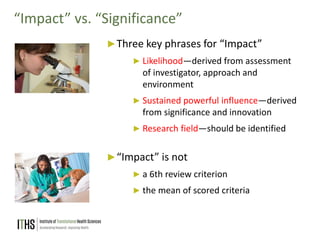
“Impact” vs. “Significance”
►Three key phrases for “Impact”
► Likelihood—derived from assessment
of investigator, approach and
environment
► Sustained powerful influence—derived
from significance and innovation
► Research field—should be identified
►“Impact” is not
► a 6th review criterion
► the mean of scored criteria
19
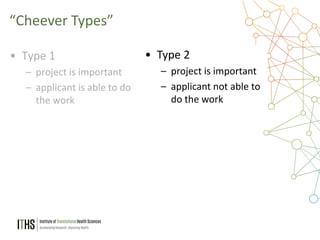
• Type 1
• project is important
• applicant is able to do
the work
“Cheever Types”
20
• Type 1
– project is important
– applicant is able to do
the work
“Cheever Types”
• Type 2
– project is important
– applicant not able to
do the work
21
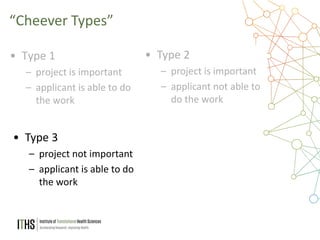
• Type 1
– project is important
– applicant is able to do
the work
“Cheever Types”
• Type 3
– project not important
– applicant is able to do
the work
• Type 2
– project is important
– applicant not able to
do the work
22
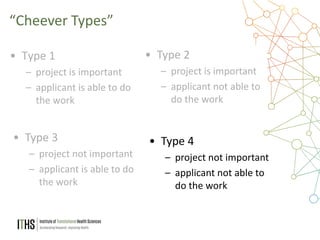
• Type 1
– project is important
– applicant is able to do
the work
“Cheever Types”
• Type 2
– project is important
– applicant not able to
do the work
• Type 3
– project not important
– applicant is able to do
the work
• Type 4
– project not important
– applicant not able to
do the work
23
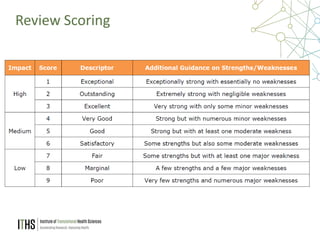
Review Scoring
24
• Minor
• An easily addressable weakness that does not
substantially lessen impact
• Moderate
• A weakness that lessens impact
• Major
• A weakness that severely limits impact
Categories of Weakness
25
• Is the budget realistic?
• Reductions can be recommended
• Insufficient budget justification
• Insufficient information about work in later years
• Project can be completed in fewer years or with
smaller budget
• Panel recommendation summarized by SRO
• Budget does not affect overall priority score
• Overlap concerns noted in written comments
(not discussed)
Budget and Period of Support
26
• Elaboration of ideas that are too complex for
bullet points
• Further explain deficiencies in the application
• Avoid “tutorial” suggestions for improvement
Additional Comments to Applicant
27
• “Play to the house”
• Strong potential to have high impact
• Logical and innovative approach
• Institutional support
• Personal and team expertise
• Project is a worthy investment
• “Write for your assigned reviewers”
• Aims do not duplicate other work
• Aims and significance clearly state impact
• Work will add significantly to existing knowledge
• Expertise documented in biosketches
• Resources well documented
Advice from NIH:
Write to Your Audience
28
• “Don’t neglect others”
• Abstract, Specific Aims, Significance
• Written like a Scientific American article
• “Investigate committees and members”
• Committee with people who will appreciate the
work
• Examine their publications
• Understand their perspective
Advice from NIH:
Write to Your Audience
29
• Show how research is new and unique
• Challenge an existing paradigm
• Data to support an innovative approach
• Evidence that approach is feasible
Advice from NIH:
Caution with Innovation
30
• Show how research is new and unique
• Challenge an existing paradigm
• Data to support an innovative approach
• Evidence that approach is feasible
Advice from NIH:
Caution with Innovation
• Existing concept or method
• Refined
• Improved
• New application or use
31
• Page limits, formats
• Write, Edit and Proof like a professional
• User-friendly format
• Well organized
• Visually appealing
• Make a positive first impression
• Divide into sections
• Guide concepts with graphics
• Label all materials clearly
• Edit and proofread
Advice from NIH:
Master the Application
32
• Read and follow instructions
• Feedback from colleagues
• Work from an outline
• Must have adequate data
• Leave enough time to write application
• Review examples from successful applicants
• Make sure that the idea is original
• Assess the competition
• Refine ideas to ensure that the work is feasible
Advice from NIH: Get Prepared
33
Important Writing Tips
►A topic sentence for each
main point
►One point for each paragraph
►Keep it short and simple
►Progress from basic to complex
►Use nontechnical language, where
feasible
►Use short sentences (20 words or
less)
►Use transitions to link points
together
34
• Study not likely to produce useful information
• Hypothesis or data not well founded
• Alternative hypotheses not considered
• Methods not appropriate
• No significant impact on health
• Too little detail
• Over-ambitious research plan
• Direction and priorities not well defined
• Lack of focus in hypothesis, aims or plan
• Lack of original or new ideas
Frequent Mistakes
35
• Investigator not sufficiently experienced
• Problem more complex than PI realizes
• Experiments or model not relevant to hypothesis
• Topic scientifically premature
• Fishing expedition lacking scientific basis
• A method in search of a problem
• Interdependent aims (one fails, all fail)
• Inadequate controls
• Feasibility not demonstrated
• Insufficient consideration of statistical needs
Frequent Mistakes—Continued
36
• Propose something significant
• Make it exciting
• Probe for mechanisms and seek new models
• Don’t just “collect more data”
• Be very clear and concise
• What you want to do
• Why it’s important
• What you expect to get out of it
• Don’t assume too much expertise in reviewers
• Be brief with stuff everyone knows
Advice from Retired Study Section
Chairs
37
• Aim each aim
• Expected outcomes
• Data interpretation
• Pitfalls and alternatives
• Summarize the take-home message at the end
• Start the writing with Specific Aims
• Submit best effort first
• Don’t cram the application like a suitcase
• Proofread your application
• Be persistent
Advice from Retired Study Section
Chairs
38
Where to Get More
Information
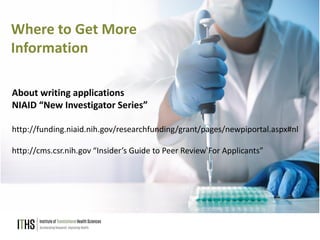
About writing applications
NIAID “New Investigator Series”
http://funding.niaid.nih.gov/researchfunding/grant/pages/newpiportal.aspx#nl
http://cms.csr.nih.gov “Insider’s Guide to Peer Review For Applicants”
39
CONNECT WITH ITHS
/InstituteofTranslationalHealthSciences
@ITHS_UW
/ithsuw
www.iths.org

What Really Happens in an NIH Study Review?

  • 1.
    WHAT REALLY HAPPENSIN AN NIH STUDY REVIEW Paul J. Martin, MD ITHS
  • 2.
    2 Dr. Martin isa medical oncologist who specializes in treating patients with bone marrow transplantation. Dr. Martin is Co-PI of ITHS, a member of the Clinical Research Division at Fred Hutch, Director of the Fred Hutch Research Trials Office, and a professor in the Medical Oncology Division at the University of Washington School of Medicine. Paul J. Martin, MD
  • 3.
    3 Overview • What happensat the meeting • Summary of recent changes • Review criteria • “Impact” vs. “Significance” • Review scoring • Advice from NIH • Important writing tips • Frequent mistakes • Advice from retired study section chairs • Where to get more information
  • 4.
    4 • Welcome andcall to order by chair • Panel members introduce themselves • Introductory remarks and instruction by SRO • Order of review • New investigator R01 applications • Other R01 applications • R21 applications • Order determined by average of preliminary overall scores from assigned reviewers • ~ 50% of applications are discussed Overview of the Meeting
  • 5.
    5 • Conflicted membersleave the room • Applicant and title announced by chair • Preliminary overall scores from reviewers • Discussion by primary reviewer • Additional comments by other reviewers • Human subjects and animal welfare concerns • Panel discussion • Summary by chair • Revised overall scores announced • Voting outside range • Budget recommendations • Conflicted members called back How Reviews are Discussed
  • 6.
    6 Summary of RecentChanges ►Emphasis on “impact” ►Bullet point format of reviews ►Tutorial comments not encouraged ►Discussion ordered by preliminary score ►New investigator applications separated
  • 7.
  • 8.
    8 • Summarize significantoverall strengths and weaknesses • Assess the likelihood that the project will exert a sustained powerful influence on the field • Feasibility is an important consideration Impact
  • 9.
    9 • Does theproject address an important problem or a critical barrier to progress in the field? • If the aims of the project are achieved, how will scientific knowledge, technical capability or clinical practice be improved? • How will successful completion of the aim change the concepts, methods, technologies, treatments, services or preventive interventions that drive this field? Significance
  • 10.
    10 Investigator • Are theresearchers well suited to the project? • If Early Stage or New Investigators (only R01), do they have appropriate experience and training? • If established, have they demonstrated an ongoing record of accomplishments that have advanced their fields? • If the project is collaborative or multi-PI, do the investigators have complementary and integrated expertise; are their leadership approach, governance and organizational structure appropriate for the project?
  • 11.
    11 • Does theapplication challenge and seek to shift current research or clinical practice paradigms by utilizing novel theoretical concepts, approaches or methodologies, instrumentation, or interventions? • Are the concepts, approaches or methodologies, instrumentation, or interventions novel to one field or novel in a broad sense? • Is it a refinement, improvement, or new application of theoretical concepts, approaches or methodologies, instrumentation or interventions proposed? Innovation
  • 12.
    12 • Are theoverall strategy, methodology, and analyses well-reasoned and appropriate to accomplish the specific aims of the project? • Are potential problems, alternative strategies, and benchmarks for success presented? • If the project is in the early stages of development, will the strategy establish feasibility and will particularly risky aspects be managed? Approach
  • 13.
    13 Additional Review Criteria* ►Protectionfor human subjects ►Inclusion of woman, minorities and children ►Vertebrate animals ►Biohazards ►Resubmission ►Renewal ►Revision (competing supplement) ►Multiple PI plan *can affect overall score
  • 14.
    14 • Evaluate risksas acceptable or unacceptable • Evaluate protections as adequate or inadequate • Items for evaluation • Risk to subjects • Adequacy of protection against risks • Potential benefits to subjects and others • Importance of the knowledge to be gained • Data and safety monitoring for clinical trials • Data and Safety Monitoring Plan • Justification for exempt status Protection for Human Subjects* *can affect overall score via “approach”
  • 15.
    15 Inclusion of Women,Minorities and Children* A = Acceptable; U = Unacceptable *can affect overall score via “approach”
  • 16.
    16 • Evaluate asacceptable or unacceptable • Proposed use of animals • Species, strains, ages, sex and numbers • Justification for use of animals and for appropriateness of the species and numbers proposed • Adequacy of veterinary care • Procedures to limit discomfort, distress, pain and injury • Methods of euthanasia • Worksheet available from CSR website Vertebrate Animals* *can affect overall score via “approach”
  • 17.
    17 • Application fromforeign organizations • Select agents • Resource sharing plans • Data sharing • Model organisms • Genome-wide association studies • Budget and period of support Additional Review Considerations* *do NOT affect overall score
  • 18.
    18 “Impact” vs. “Significance” ►Threekey phrases for “Impact” ► Likelihood—derived from assessment of investigator, approach and environment ► Sustained powerful influence—derived from significance and innovation ► Research field—should be identified ►“Impact” is not ► a 6th review criterion ► the mean of scored criteria
  • 19.
    19 • Type 1 •project is important • applicant is able to do the work “Cheever Types”
  • 20.
    20 • Type 1 –project is important – applicant is able to do the work “Cheever Types” • Type 2 – project is important – applicant not able to do the work
  • 21.
    21 • Type 1 –project is important – applicant is able to do the work “Cheever Types” • Type 3 – project not important – applicant is able to do the work • Type 2 – project is important – applicant not able to do the work
  • 22.
    22 • Type 1 –project is important – applicant is able to do the work “Cheever Types” • Type 2 – project is important – applicant not able to do the work • Type 3 – project not important – applicant is able to do the work • Type 4 – project not important – applicant not able to do the work
  • 23.
  • 24.
    24 • Minor • Aneasily addressable weakness that does not substantially lessen impact • Moderate • A weakness that lessens impact • Major • A weakness that severely limits impact Categories of Weakness
  • 25.
    25 • Is thebudget realistic? • Reductions can be recommended • Insufficient budget justification • Insufficient information about work in later years • Project can be completed in fewer years or with smaller budget • Panel recommendation summarized by SRO • Budget does not affect overall priority score • Overlap concerns noted in written comments (not discussed) Budget and Period of Support
  • 26.
    26 • Elaboration ofideas that are too complex for bullet points • Further explain deficiencies in the application • Avoid “tutorial” suggestions for improvement Additional Comments to Applicant
  • 27.
    27 • “Play tothe house” • Strong potential to have high impact • Logical and innovative approach • Institutional support • Personal and team expertise • Project is a worthy investment • “Write for your assigned reviewers” • Aims do not duplicate other work • Aims and significance clearly state impact • Work will add significantly to existing knowledge • Expertise documented in biosketches • Resources well documented Advice from NIH: Write to Your Audience
  • 28.
    28 • “Don’t neglectothers” • Abstract, Specific Aims, Significance • Written like a Scientific American article • “Investigate committees and members” • Committee with people who will appreciate the work • Examine their publications • Understand their perspective Advice from NIH: Write to Your Audience
  • 29.
    29 • Show howresearch is new and unique • Challenge an existing paradigm • Data to support an innovative approach • Evidence that approach is feasible Advice from NIH: Caution with Innovation
  • 30.
    30 • Show howresearch is new and unique • Challenge an existing paradigm • Data to support an innovative approach • Evidence that approach is feasible Advice from NIH: Caution with Innovation • Existing concept or method • Refined • Improved • New application or use
  • 31.
    31 • Page limits,formats • Write, Edit and Proof like a professional • User-friendly format • Well organized • Visually appealing • Make a positive first impression • Divide into sections • Guide concepts with graphics • Label all materials clearly • Edit and proofread Advice from NIH: Master the Application
  • 32.
    32 • Read andfollow instructions • Feedback from colleagues • Work from an outline • Must have adequate data • Leave enough time to write application • Review examples from successful applicants • Make sure that the idea is original • Assess the competition • Refine ideas to ensure that the work is feasible Advice from NIH: Get Prepared
  • 33.
    33 Important Writing Tips ►Atopic sentence for each main point ►One point for each paragraph ►Keep it short and simple ►Progress from basic to complex ►Use nontechnical language, where feasible ►Use short sentences (20 words or less) ►Use transitions to link points together
  • 34.
    34 • Study notlikely to produce useful information • Hypothesis or data not well founded • Alternative hypotheses not considered • Methods not appropriate • No significant impact on health • Too little detail • Over-ambitious research plan • Direction and priorities not well defined • Lack of focus in hypothesis, aims or plan • Lack of original or new ideas Frequent Mistakes
  • 35.
    35 • Investigator notsufficiently experienced • Problem more complex than PI realizes • Experiments or model not relevant to hypothesis • Topic scientifically premature • Fishing expedition lacking scientific basis • A method in search of a problem • Interdependent aims (one fails, all fail) • Inadequate controls • Feasibility not demonstrated • Insufficient consideration of statistical needs Frequent Mistakes—Continued
  • 36.
    36 • Propose somethingsignificant • Make it exciting • Probe for mechanisms and seek new models • Don’t just “collect more data” • Be very clear and concise • What you want to do • Why it’s important • What you expect to get out of it • Don’t assume too much expertise in reviewers • Be brief with stuff everyone knows Advice from Retired Study Section Chairs
  • 37.
    37 • Aim eachaim • Expected outcomes • Data interpretation • Pitfalls and alternatives • Summarize the take-home message at the end • Start the writing with Specific Aims • Submit best effort first • Don’t cram the application like a suitcase • Proofread your application • Be persistent Advice from Retired Study Section Chairs
  • 38.
    38 Where to GetMore Information About writing applications NIAID “New Investigator Series” http://funding.niaid.nih.gov/researchfunding/grant/pages/newpiportal.aspx#nl http://cms.csr.nih.gov “Insider’s Guide to Peer Review For Applicants”
  • 39.