Advertising
What is advertising?
• A paid for communication promoting a
product or service.
How Advertising Works
• Advertising is persuasive not coercive -
it can not make people do what it wants
them to do.
• Advertising has to be seen by its
intended audience so using appropriate
medium is important.
• The audience has to be receptive they
must have an interest in the message
• The message has to be driven home - a
single advertisement maybe lost or
forgotten
• Competitors advertise too - your offer
must be better or different, if not why
choose you.
• Reasons why people remember them
are:-
• They recognise the company or its
products/services.
• They have company or product loyalty.
• cathcy/clever
Audiences Often Ignore Adverts
• They are actively seeking to purchase
• They are in the market
• the offer is attractive
• The Press
• Television
• Radio
• Direct mail
• Leaflet distribution
• Point of Sale
• Cinema
• Posters
Where Do We See Ads
Overt Advertising
★ Repetition : Slogans, images and brand names can be
repeated and will offer greater credibility to a campaign.
★ Shock Tactics : Shock tactics grab the attention, not only of
the consumer but also of the media increasing the coverage
and knowledge of the campaign.
★ Sex : One of the basic human needs, and a very persuasive
advertising tool. Sexy images of men and women are
incorporated into many aspects of media.
★ Stereotypes : These are useful because audiences are able to
recognise these quickly, they also connote many meaning and
messages that are attached to their representations.
Stereotypes tend to be accepted without much questioning.
This could allow the adverts to be consumed allowing only the
preferred reading.
★ Needs, Fears and Aspirations : The audience theory of uses
and gratifications applies in this area. Advertiser’s play on
the idea of audiences needs, for example to feel safe and
secure, part of a group etc.
★ Intertextual References : The inclusion of intertextual
references allow advertisers to tap in to history’s, ideas and
ideology’s that are attached to particular films, television
programmes etc. This allows identification and a quicker
understanding for audiences.
★ Music : Is utilised for a variety of reasons including an
attention grabber, as a narrative short hand or an emotive
device. Advertisers will use nostalgia to lure mature
audiences, including music from the target audiences
childhood to evoke emotions, memories from their pasts.
★ Reward and Punishment : These are probably the most
important persuasive devices in advertising. Physical rewards
are offered, ‘buy on get one free’, ‘3 for 2’ or, an actual physical
reward, a face cream that will keep you young and healthy.
Another example is Whiskers cat food with added vitamins, this
suggest that if you feed your cat this it will be fit and healthy.
This though does have a flip side, if you don’t buy this for your
cat it will be unhealthy.
★ Enigma and Paradox : Adverts can appear ambiguous or unclear
to what they are or what they are advertising, this can create
‘buzz’ around what the product is, or focus attention as
audiences attempt to decipher the ad.
★ Problem and resolution : This is when a problem is raised and
the product acts as the resolution. ‘My sink is blocked, use Mr
Muscle sink unblocker’, ‘My teeth are unclean.’ ‘Well use this
toothpaste.’
★ Utopia : Translates as the perfect world. The product is sold
as appearing within this idealised world or a way of reaching
it.
★ Dystopia : Opposite of utopia, the world is nightmarish - the
product is often sold as a way out of this situation.
★ Devise an overt advertising campaign for the
product that you have selected.
★ Include at least two overt techniques within
your campaign.
★ Remember to consider your target audience.
Who would purchase the product? Create a
profile for that person. How much money would
they have? What would they do? How old are
they? Are they single or married? Think about
where you might situate the advertisement,
which newspapers would you include, why?
Task
Covert Advertising
Covert Techniques
★ We have discussed overt advertising
techniques, please explore what is meant by
covert advertising.
★ List the features of covert advertising that
you think are apparent. Please give
examples.
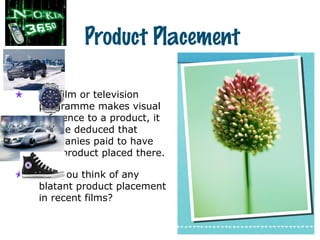
★ If a film or television
programme makes visual
reference to a product, it
can be deduced that
companies paid to have
that product placed there.
★ Can you think of any
blatant product placement
in recent films?
Product Placement
The Advantages of Product
Placement
★ You have a captive audience.
★ It is cheaper than overt advertising or
sponsorship.
★ If the programme or film is a success your
product reaches a wide audience.
★ The product becomes linked to the film or
programme and the ideology/lifestyle
inherent in the text.
Sponsorship
★ Sponsorship is a covert advertising technique because it
is not overtly advertising a particular product. The
sponsorship advert is usually entertaining and not a hard
sell or very informative.
★ Sponsorship hopes to link the product more directly to
the programme or film. It is more expensive than
product placement but arguably more effective.
Plugging
★ In supermarkets, reps plug products by getting you to
try them before you buy.
★ Free gifts are offered when you buy other products.
Think about the latest gifts given away with the ‘happy
meal’ or Burger King equivalent.
★ Cinemas, restaurants and pubs often use this type of
promotion.
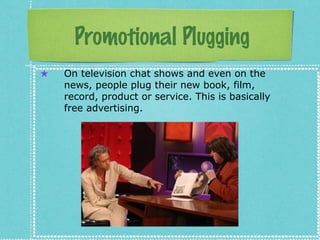
Promotional Plugging
★ On television chat shows and even on the
news, people plug their new book, film,
record, product or service. This is basically
free advertising.
Advantages of Plugging
★ Consumers feel happy because they get a
free or cheap product. They do not always
realise that it can have an effect on the retail
price.
★ It is a quick way of getting people thinking or
talking about a product.
★ Plugging is hands on advertising, it is more
difficult to ignore than overt advertising.
• Using the product that you previously
selected, please now add at least one
covert advertising technique.
• Consider the ways in which the
technique targets your audience. Does
this addition broaden your audience or
merely ensure you reach your target?
Task

Advertising The basics

  • 1.
  • 2.
    What is advertising? •A paid for communication promoting a product or service.
  • 3.
    How Advertising Works •Advertising is persuasive not coercive - it can not make people do what it wants them to do. • Advertising has to be seen by its intended audience so using appropriate medium is important. • The audience has to be receptive they must have an interest in the message
  • 4.
    • The messagehas to be driven home - a single advertisement maybe lost or forgotten • Competitors advertise too - your offer must be better or different, if not why choose you.
  • 5.
    • Reasons whypeople remember them are:- • They recognise the company or its products/services. • They have company or product loyalty. • cathcy/clever Audiences Often Ignore Adverts
  • 6.
    • They areactively seeking to purchase • They are in the market • the offer is attractive
  • 7.
    • The Press •Television • Radio • Direct mail • Leaflet distribution • Point of Sale • Cinema • Posters Where Do We See Ads
  • 8.
  • 9.
    ★ Repetition :Slogans, images and brand names can be repeated and will offer greater credibility to a campaign. ★ Shock Tactics : Shock tactics grab the attention, not only of the consumer but also of the media increasing the coverage and knowledge of the campaign. ★ Sex : One of the basic human needs, and a very persuasive advertising tool. Sexy images of men and women are incorporated into many aspects of media. ★ Stereotypes : These are useful because audiences are able to recognise these quickly, they also connote many meaning and messages that are attached to their representations. Stereotypes tend to be accepted without much questioning. This could allow the adverts to be consumed allowing only the preferred reading.
  • 10.
    ★ Needs, Fearsand Aspirations : The audience theory of uses and gratifications applies in this area. Advertiser’s play on the idea of audiences needs, for example to feel safe and secure, part of a group etc. ★ Intertextual References : The inclusion of intertextual references allow advertisers to tap in to history’s, ideas and ideology’s that are attached to particular films, television programmes etc. This allows identification and a quicker understanding for audiences. ★ Music : Is utilised for a variety of reasons including an attention grabber, as a narrative short hand or an emotive device. Advertisers will use nostalgia to lure mature audiences, including music from the target audiences childhood to evoke emotions, memories from their pasts.
  • 11.
    ★ Reward andPunishment : These are probably the most important persuasive devices in advertising. Physical rewards are offered, ‘buy on get one free’, ‘3 for 2’ or, an actual physical reward, a face cream that will keep you young and healthy. Another example is Whiskers cat food with added vitamins, this suggest that if you feed your cat this it will be fit and healthy. This though does have a flip side, if you don’t buy this for your cat it will be unhealthy. ★ Enigma and Paradox : Adverts can appear ambiguous or unclear to what they are or what they are advertising, this can create ‘buzz’ around what the product is, or focus attention as audiences attempt to decipher the ad. ★ Problem and resolution : This is when a problem is raised and the product acts as the resolution. ‘My sink is blocked, use Mr Muscle sink unblocker’, ‘My teeth are unclean.’ ‘Well use this toothpaste.’
  • 12.
    ★ Utopia :Translates as the perfect world. The product is sold as appearing within this idealised world or a way of reaching it. ★ Dystopia : Opposite of utopia, the world is nightmarish - the product is often sold as a way out of this situation.
  • 13.
    ★ Devise anovert advertising campaign for the product that you have selected. ★ Include at least two overt techniques within your campaign. ★ Remember to consider your target audience. Who would purchase the product? Create a profile for that person. How much money would they have? What would they do? How old are they? Are they single or married? Think about where you might situate the advertisement, which newspapers would you include, why? Task
  • 14.
  • 15.
    Covert Techniques ★ Wehave discussed overt advertising techniques, please explore what is meant by covert advertising. ★ List the features of covert advertising that you think are apparent. Please give examples.
  • 16.
    ★ If afilm or television programme makes visual reference to a product, it can be deduced that companies paid to have that product placed there. ★ Can you think of any blatant product placement in recent films? Product Placement
  • 17.
    The Advantages ofProduct Placement ★ You have a captive audience. ★ It is cheaper than overt advertising or sponsorship. ★ If the programme or film is a success your product reaches a wide audience. ★ The product becomes linked to the film or programme and the ideology/lifestyle inherent in the text.
  • 18.
    Sponsorship ★ Sponsorship isa covert advertising technique because it is not overtly advertising a particular product. The sponsorship advert is usually entertaining and not a hard sell or very informative. ★ Sponsorship hopes to link the product more directly to the programme or film. It is more expensive than product placement but arguably more effective.
  • 19.
    Plugging ★ In supermarkets,reps plug products by getting you to try them before you buy. ★ Free gifts are offered when you buy other products. Think about the latest gifts given away with the ‘happy meal’ or Burger King equivalent. ★ Cinemas, restaurants and pubs often use this type of promotion.
  • 20.
    Promotional Plugging ★ Ontelevision chat shows and even on the news, people plug their new book, film, record, product or service. This is basically free advertising.
  • 21.
    Advantages of Plugging ★Consumers feel happy because they get a free or cheap product. They do not always realise that it can have an effect on the retail price. ★ It is a quick way of getting people thinking or talking about a product. ★ Plugging is hands on advertising, it is more difficult to ignore than overt advertising.
  • 22.
    • Using theproduct that you previously selected, please now add at least one covert advertising technique. • Consider the ways in which the technique targets your audience. Does this addition broaden your audience or merely ensure you reach your target? Task