INTRODUCTION
•   The basic idea of our work: Advertising is a form of communication used to
    encourage or persuade an audience (viewers, readers or listeners) to continue
    or take some new action. The principle problem of my work is:
      Does the widespread use of advertising contributes to ordinary life of people?
•    The aim of our research was to analyze the existing system of modern
    advertising.
•   To achieve the aim of the research, we have analyzed different types of the
    advertisement .
•    The objectives are:
•   to interview the classmates
•   to study features of the advertisement
•   to identify functions of advertising.
•   to define the main goals of using advertisement
•    to analyze the language means used in advertising
THE PRINCIPLE OF
                                     ADVERTISEMENT
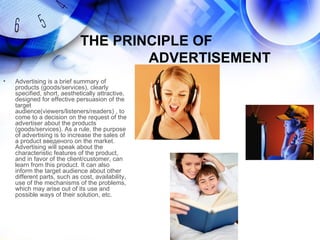
•   Advertising is a brief summary of
    products (goods/services), clearly
    specified, short, aesthetically attractive,
    designed for effective persuasion of the
    target
    audience(viewers/listeners/readers) , to
    come to a decision on the request of the
    advertiser about the products
    (goods/services). As a rule, the purpose
    of advertising is to increase the sales of
    a product введеного on the market.
    Advertising will speak about the
    characteristic features of the product,
    and in favor of the client/customer, can
    learn from this product. It can also
    inform the target audience about other
    different parts, such as cost, availability,
    use of the mechanisms of the problems,
    which may arise out of its use and
    possible ways of their solution, etc.
HISTORY
ADVERTISING THEORY
•   It clarifies the objectives of an
    advertising campaign and for each
    individual advertisement. The model
    suggests that there are six steps a
    consumer or a business buyer moves
    through when making a purchase. The
    steps are:
•   Awareness
•   Knowledge
•   Liking
•   Preference
•   Conviction
•   Purchase
•   Means-End Theory
•   This approach suggests that an
    advertisement should contain a
    message or means that leads the
    consumer to a desired end state.
•   Leverage Points
•   It is designed to move the consumer
    from understanding a product's
    benefits to linking those benefits with
    personal values.
•   Verbal and Visual Images
TYPES OF ADVERTISING
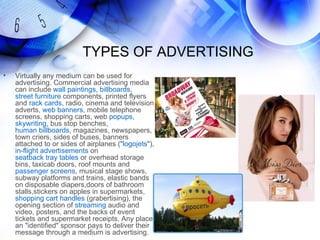
•   Virtually any medium can be used for
    advertising. Commercial advertising media
    can include wall paintings, billboards,
    street furniture components, printed flyers
    and rack cards, radio, cinema and television
    adverts, web banners, mobile telephone
    screens, shopping carts, web popups,
    skywriting, bus stop benches,
    human billboards, magazines, newspapers,
    town criers, sides of buses, banners
    attached to or sides of airplanes ("logojets"),
    in-flight advertisements on
    seatback tray tables or overhead storage
    bins, taxicab doors, roof mounts and
    passenger screens, musical stage shows,
    subway platforms and trains, elastic bands
    on disposable diapers,doors of bathroom
    stalls,stickers on apples in supermarkets,
    shopping cart handles (grabertising), the
    opening section of streaming audio and
    video, posters, and the backs of event
    tickets and supermarket receipts. Any place
    an "identified" sponsor pays to deliver their
    message through a medium is advertising.
TV ADVERTUSING/MUSIC IN
ADVERTISING
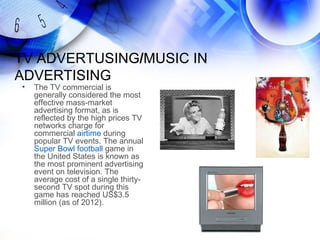
•   The TV commercial is
    generally considered the most
    effective mass-market
    advertising format, as is
    reflected by the high prices TV
    networks charge for
    commercial airtime during
    popular TV events. The annual
    Super Bowl football game in
    the United States is known as
    the most prominent advertising
    event on television. The
    average cost of a single thirty-
    second TV spot during this
    game has reached US$3.5
    million (as of 2012).
INFORMERCIALS

•    An infomercial is a long-
    format television
    commercial, typically five
    minutes or longer. The word
    "infomercial" combining the
    words "information" &
    "commercial". The main
    objective in an infomercial is
    to create an
    impulse purchase, so that
    the consumer sees the
    presentation and then
    immediately buys the
    product through the
    advertised
    toll-free telephone number
    or website. Infomercials
    describe, display, and often
    demonstrate products and
    their features, and
    commonly have testimonials
    from consumers and
    industry professionals.
RADIO ADVERTISING
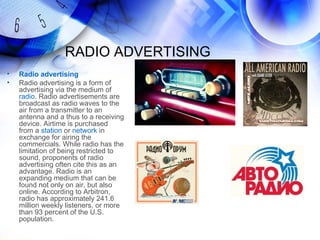
•   Radio advertising
•   Radio advertising is a form of
    advertising via the medium of
    radio. Radio advertisements are
    broadcast as radio waves to the
    air from a transmitter to an
    antenna and a thus to a receiving
    device. Airtime is purchased
    from a station or network in
    exchange for airing the
    commercials. While radio has the
    limitation of being restricted to
    sound, proponents of radio
    advertising often cite this as an
    advantage. Radio is an
    expanding medium that can be
    found not only on air, but also
    online. According to Arbitron,
    radio has approximately 241.6
    million weekly listeners, or more
    than 93 percent of the U.S.
    population.
ONLINE ADVERTISING

•   Online advertising
    Online advertising is a form of
    promotion that uses the Internet
    and
•   World Wide Web for the expressed
    purpose of delivering marketing
    messages to attract customers.
    Online ads are delivered by an ad
    server. Examples of online
    advertising include contextual ads
    that appear on search engine
    results pages, banner ads, in text
    ads, Rich Media Ads, Social
    network advertising, online
    classified advertising, advertising
    networks and e-mail marketing,
    including e-mail spam.
PRODUCT PLACEMENTS


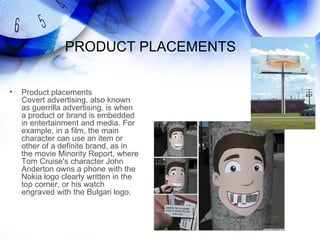
•   Product placements
    Covert advertising, also known
    as guerrilla advertising, is when
    a product or brand is embedded
    in entertainment and media. For
    example, in a film, the main
    character can use an item or
    other of a definite brand, as in
    the movie Minority Report, where
    Tom Cruise's character John
    Anderton owns a phone with the
    Nokia logo clearly written in the
    top corner, or his watch
    engraved with the Bulgari logo.
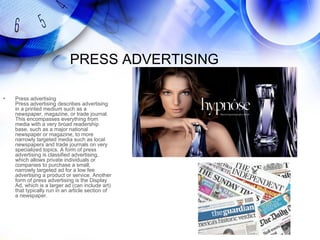
PRESS ADVERTISING

•   Press advertising
    Press advertising describes advertising
    in a printed medium such as a
    newspaper, magazine, or trade journal.
    This encompasses everything from
    media with a very broad readership
    base, such as a major national
    newspaper or magazine, to more
    narrowly targeted media such as local
    newspapers and trade journals on very
    specialized topics. A form of press
    advertising is classified advertising,
    which allows private individuals or
    companies to purchase a small,
    narrowly targeted ad for a low fee
    advertising a product or service. Another
    form of press advertising is the Display
    Ad, which is a larger ad (can include art)
    that typically run in an article section of
    a newspaper.
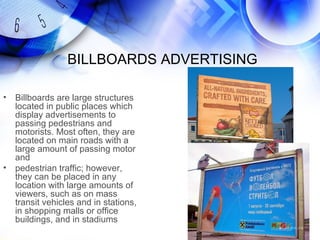
BILLBOARDS ADVERTISING

•   Billboards are large structures
    located in public places which
    display advertisements to
    passing pedestrians and
    motorists. Most often, they are
    located on main roads with a
    large amount of passing motor
    and
•   pedestrian traffic; however,
    they can be placed in any
    location with large amounts of
    viewers, such as on mass
    transit vehicles and in stations,
    in shopping malls or office
    buildings, and in stadiums
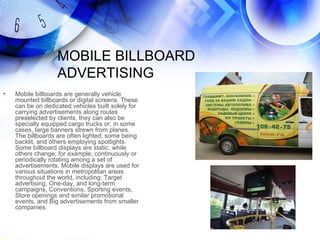
MOBILE BILLBOARD
                   ADVERTISING
•   Mobile billboards are generally vehicle
    mounted billboards or digital screens. These
    can be on dedicated vehicles built solely for
    carrying advertisements along routes
    preselected by clients, they can also be
    specially equipped cargo trucks or, in some
    cases, large banners strewn from planes.
    The billboards are often lighted; some being
    backlit, and others employing spotlights.
    Some billboard displays are static, while
    others change; for example, continuously or
    periodically rotating among a set of
    advertisements. Mobile displays are used for
    various situations in metropolitan areas
    throughout the world, including: Target
    advertising, One-day, and long-term
    campaigns, Conventions, Sporting events,
    Store openings and similar promotional
    events, and Big advertisements from smaller
    companies.
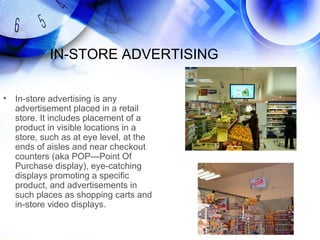
IN-STORE ADVERTISING

•   In-store advertising is any
    advertisement placed in a retail
    store. It includes placement of a
    product in visible locations in a
    store, such as at eye level, at the
    ends of aisles and near checkout
    counters (aka POP—Point Of
    Purchase display), eye-catching
    displays promoting a specific
    product, and advertisements in
    such places as shopping carts and
    in-store video displays.
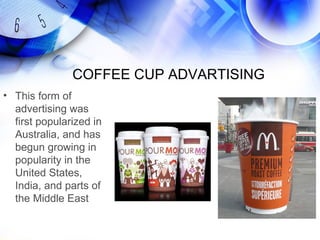
COFFEE CUP ADVARTISING
• This form of
  advertising was
  first popularized in
  Australia, and has
  begun growing in
  popularity in the
  United States,
  India, and parts of
  the Middle East
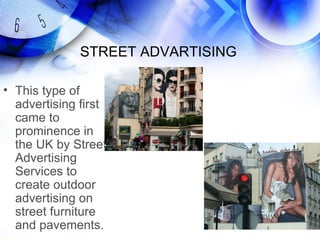
STREET ADVARTISING

• This type of
  advertising first
  came to
  prominence in
  the UK by Street
  Advertising
  Services to
  create outdoor
  advertising on
  street furniture
  and pavements.
CELEBRITY BRANDING

•   This type of advertising
    focuses upon using celebrity
    power, fame, money,
    popularity to gain
    recognition for their
    products and promote
    specific stores or products.
    Advertisers often advertise
    their products, for example,
    when celebrities share their
    favorite products or wear
    clothes by specific brands or
    designers
GLOBAL ADVANTISING

•   Advertising has gone
    through five major stages of
    development: domestic,
    export, international, multi-
    national, and global. For
    global advertisers , there are
    four, potentially competing,
    business objectives that
    must be balanced when
    developing worldwide
    advertising: building a brand
    while speaking with one
    voice, developing
    economies of scale in the
    creative process,
    maximizing local
    effectiveness of ads, and
    increasing the company’s
    speed of implementation.
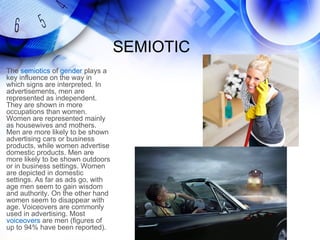
SEMIOTIC
The semiotics of gender plays a
key influence on the way in
which signs are interpreted. In
advertisements, men are
represented as independent.
They are shown in more
occupations than women.
Women are represented mainly
as housewives and mothers.
Men are more likely to be shown
advertising cars or business
products, while women advertise
domestic products. Men are
more likely to be shown outdoors
or in business settings. Women
are depicted in domestic
settings. As far as ads go, with
age men seem to gain wisdom
and authority. On the other hand
women seem to disappear with
age. Voiceovers are commonly
used in advertising. Most
voiceovers are men (figures of
up to 94% have been reported).
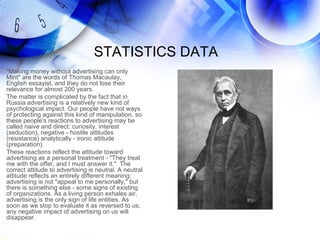
STATISTICS DATA
"Making money without advertising can only
Mint" are the words of Thomas Macaulay,
English essayist, and they do not lose their
relevance for almost 200 years.
The matter is complicated by the fact that in
Russia advertising is a relatively new kind of
psychological impact. Our people have not ways
of protecting against this kind of manipulation, so
these people's reactions to advertising may be
called naive and direct: curiosity, interest
(seduction), negative - hostile attitudes
(resistance) analytically - ironic attitude
(preparation).
These reactions reflect the attitude toward
advertising as a personal treatment - "They treat
me with the offer, and I must answer it." The
correct attitude to advertising is neutral. A neutral
attitude reflects an entirely different meaning:
advertising is not "appeal to me personally," but
there is something else - some signs of existing
of organizations. As a living person exhales air,
advertising is the only sign of life entities. As
soon as we stop to evaluate it as reversed to us,
any negative impact of advertising on us will
disappear.
summarize:
A. Advertising, as a rule has
two effects - short-term
effects of emotional arousal
(in order to sell the goods)
and long-term effect, which
leads to the formation in the
long term behavior addict.
B. To avoid the negative
effects of advertising can
help a neutral attitude
towards it.
Table 1. The ratio of children of different
age groups to television advertising (%)
Table 2. The proportion of children in
different age groups, trust advertising (%)
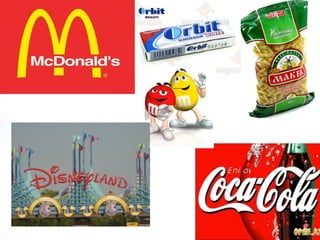
Table 3. Advertising and thematic
             preferences.
of children of different age groups (%)
CONCLUSION
In conclusion, we would like to
quote the words of the recent
advertisement - there were
remarkable words: "You can
advertise whatever you want." .
Advertising was the following:
under the pleasant melody a
yellowish liquid was poured
into a glass - that is, just like in
any normal commercial of
some juice. Then the camera
slowly played and the process
of pouring of fish oil in a glass
out of cans appeared in front of
the audience.

Reklama (1)

  • 2.
    INTRODUCTION • The basic idea of our work: Advertising is a form of communication used to encourage or persuade an audience (viewers, readers or listeners) to continue or take some new action. The principle problem of my work is: Does the widespread use of advertising contributes to ordinary life of people? • The aim of our research was to analyze the existing system of modern advertising. • To achieve the aim of the research, we have analyzed different types of the advertisement . • The objectives are: • to interview the classmates • to study features of the advertisement • to identify functions of advertising. • to define the main goals of using advertisement • to analyze the language means used in advertising
  • 3.
    THE PRINCIPLE OF ADVERTISEMENT • Advertising is a brief summary of products (goods/services), clearly specified, short, aesthetically attractive, designed for effective persuasion of the target audience(viewers/listeners/readers) , to come to a decision on the request of the advertiser about the products (goods/services). As a rule, the purpose of advertising is to increase the sales of a product введеного on the market. Advertising will speak about the characteristic features of the product, and in favor of the client/customer, can learn from this product. It can also inform the target audience about other different parts, such as cost, availability, use of the mechanisms of the problems, which may arise out of its use and possible ways of their solution, etc.
  • 4.
  • 5.
    ADVERTISING THEORY • It clarifies the objectives of an advertising campaign and for each individual advertisement. The model suggests that there are six steps a consumer or a business buyer moves through when making a purchase. The steps are: • Awareness • Knowledge • Liking • Preference • Conviction • Purchase • Means-End Theory • This approach suggests that an advertisement should contain a message or means that leads the consumer to a desired end state. • Leverage Points • It is designed to move the consumer from understanding a product's benefits to linking those benefits with personal values. • Verbal and Visual Images
  • 6.
    TYPES OF ADVERTISING • Virtually any medium can be used for advertising. Commercial advertising media can include wall paintings, billboards, street furniture components, printed flyers and rack cards, radio, cinema and television adverts, web banners, mobile telephone screens, shopping carts, web popups, skywriting, bus stop benches, human billboards, magazines, newspapers, town criers, sides of buses, banners attached to or sides of airplanes ("logojets"), in-flight advertisements on seatback tray tables or overhead storage bins, taxicab doors, roof mounts and passenger screens, musical stage shows, subway platforms and trains, elastic bands on disposable diapers,doors of bathroom stalls,stickers on apples in supermarkets, shopping cart handles (grabertising), the opening section of streaming audio and video, posters, and the backs of event tickets and supermarket receipts. Any place an "identified" sponsor pays to deliver their message through a medium is advertising.
  • 7.
    TV ADVERTUSING/MUSIC IN ADVERTISING • The TV commercial is generally considered the most effective mass-market advertising format, as is reflected by the high prices TV networks charge for commercial airtime during popular TV events. The annual Super Bowl football game in the United States is known as the most prominent advertising event on television. The average cost of a single thirty- second TV spot during this game has reached US$3.5 million (as of 2012).
  • 8.
    INFORMERCIALS • An infomercial is a long- format television commercial, typically five minutes or longer. The word "infomercial" combining the words "information" & "commercial". The main objective in an infomercial is to create an impulse purchase, so that the consumer sees the presentation and then immediately buys the product through the advertised toll-free telephone number or website. Infomercials describe, display, and often demonstrate products and their features, and commonly have testimonials from consumers and industry professionals.
  • 9.
    RADIO ADVERTISING • Radio advertising • Radio advertising is a form of advertising via the medium of radio. Radio advertisements are broadcast as radio waves to the air from a transmitter to an antenna and a thus to a receiving device. Airtime is purchased from a station or network in exchange for airing the commercials. While radio has the limitation of being restricted to sound, proponents of radio advertising often cite this as an advantage. Radio is an expanding medium that can be found not only on air, but also online. According to Arbitron, radio has approximately 241.6 million weekly listeners, or more than 93 percent of the U.S. population.
  • 10.
    ONLINE ADVERTISING • Online advertising Online advertising is a form of promotion that uses the Internet and • World Wide Web for the expressed purpose of delivering marketing messages to attract customers. Online ads are delivered by an ad server. Examples of online advertising include contextual ads that appear on search engine results pages, banner ads, in text ads, Rich Media Ads, Social network advertising, online classified advertising, advertising networks and e-mail marketing, including e-mail spam.
  • 11.
    PRODUCT PLACEMENTS • Product placements Covert advertising, also known as guerrilla advertising, is when a product or brand is embedded in entertainment and media. For example, in a film, the main character can use an item or other of a definite brand, as in the movie Minority Report, where Tom Cruise's character John Anderton owns a phone with the Nokia logo clearly written in the top corner, or his watch engraved with the Bulgari logo.
  • 12.
    PRESS ADVERTISING • Press advertising Press advertising describes advertising in a printed medium such as a newspaper, magazine, or trade journal. This encompasses everything from media with a very broad readership base, such as a major national newspaper or magazine, to more narrowly targeted media such as local newspapers and trade journals on very specialized topics. A form of press advertising is classified advertising, which allows private individuals or companies to purchase a small, narrowly targeted ad for a low fee advertising a product or service. Another form of press advertising is the Display Ad, which is a larger ad (can include art) that typically run in an article section of a newspaper.
  • 13.
    BILLBOARDS ADVERTISING • Billboards are large structures located in public places which display advertisements to passing pedestrians and motorists. Most often, they are located on main roads with a large amount of passing motor and • pedestrian traffic; however, they can be placed in any location with large amounts of viewers, such as on mass transit vehicles and in stations, in shopping malls or office buildings, and in stadiums
  • 14.
    MOBILE BILLBOARD ADVERTISING • Mobile billboards are generally vehicle mounted billboards or digital screens. These can be on dedicated vehicles built solely for carrying advertisements along routes preselected by clients, they can also be specially equipped cargo trucks or, in some cases, large banners strewn from planes. The billboards are often lighted; some being backlit, and others employing spotlights. Some billboard displays are static, while others change; for example, continuously or periodically rotating among a set of advertisements. Mobile displays are used for various situations in metropolitan areas throughout the world, including: Target advertising, One-day, and long-term campaigns, Conventions, Sporting events, Store openings and similar promotional events, and Big advertisements from smaller companies.
  • 15.
    IN-STORE ADVERTISING • In-store advertising is any advertisement placed in a retail store. It includes placement of a product in visible locations in a store, such as at eye level, at the ends of aisles and near checkout counters (aka POP—Point Of Purchase display), eye-catching displays promoting a specific product, and advertisements in such places as shopping carts and in-store video displays.
  • 16.
    COFFEE CUP ADVARTISING •This form of advertising was first popularized in Australia, and has begun growing in popularity in the United States, India, and parts of the Middle East
  • 17.
    STREET ADVARTISING • Thistype of advertising first came to prominence in the UK by Street Advertising Services to create outdoor advertising on street furniture and pavements.
  • 18.
    CELEBRITY BRANDING • This type of advertising focuses upon using celebrity power, fame, money, popularity to gain recognition for their products and promote specific stores or products. Advertisers often advertise their products, for example, when celebrities share their favorite products or wear clothes by specific brands or designers
  • 19.
    GLOBAL ADVANTISING • Advertising has gone through five major stages of development: domestic, export, international, multi- national, and global. For global advertisers , there are four, potentially competing, business objectives that must be balanced when developing worldwide advertising: building a brand while speaking with one voice, developing economies of scale in the creative process, maximizing local effectiveness of ads, and increasing the company’s speed of implementation.
  • 20.
    SEMIOTIC The semiotics ofgender plays a key influence on the way in which signs are interpreted. In advertisements, men are represented as independent. They are shown in more occupations than women. Women are represented mainly as housewives and mothers. Men are more likely to be shown advertising cars or business products, while women advertise domestic products. Men are more likely to be shown outdoors or in business settings. Women are depicted in domestic settings. As far as ads go, with age men seem to gain wisdom and authority. On the other hand women seem to disappear with age. Voiceovers are commonly used in advertising. Most voiceovers are men (figures of up to 94% have been reported).
  • 21.
    STATISTICS DATA "Making moneywithout advertising can only Mint" are the words of Thomas Macaulay, English essayist, and they do not lose their relevance for almost 200 years. The matter is complicated by the fact that in Russia advertising is a relatively new kind of psychological impact. Our people have not ways of protecting against this kind of manipulation, so these people's reactions to advertising may be called naive and direct: curiosity, interest (seduction), negative - hostile attitudes (resistance) analytically - ironic attitude (preparation). These reactions reflect the attitude toward advertising as a personal treatment - "They treat me with the offer, and I must answer it." The correct attitude to advertising is neutral. A neutral attitude reflects an entirely different meaning: advertising is not "appeal to me personally," but there is something else - some signs of existing of organizations. As a living person exhales air, advertising is the only sign of life entities. As soon as we stop to evaluate it as reversed to us, any negative impact of advertising on us will disappear.
  • 22.
    summarize: A. Advertising, asa rule has two effects - short-term effects of emotional arousal (in order to sell the goods) and long-term effect, which leads to the formation in the long term behavior addict. B. To avoid the negative effects of advertising can help a neutral attitude towards it.
  • 23.
    Table 1. Theratio of children of different age groups to television advertising (%)
  • 24.
    Table 2. Theproportion of children in different age groups, trust advertising (%)
  • 25.
    Table 3. Advertisingand thematic preferences. of children of different age groups (%)
  • 27.
    CONCLUSION In conclusion, wewould like to quote the words of the recent advertisement - there were remarkable words: "You can advertise whatever you want." . Advertising was the following: under the pleasant melody a yellowish liquid was poured into a glass - that is, just like in any normal commercial of some juice. Then the camera slowly played and the process of pouring of fish oil in a glass out of cans appeared in front of the audience.