GROUP MEMBERS NAME:
ABDUL HANAN
M KAMRAN
TAHIR UZ ZAMAN
M AFZAL
QASIM WASIM
AZRAR UL HASSAN
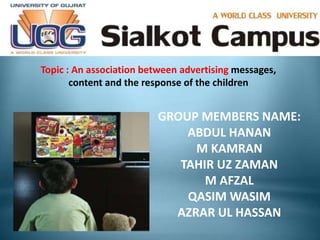
Topic : An association between advertising messages,
content and the response of the children
Advertisement
Advertising is the way of
communication.
Persuade customers to purchase
particular brand of product.
They know more people will eager to
by the product after watching the
advertisement so that they will get
more profit.
Advertisement can be found in
magazines, radio program, newspaper.
It can be easily understand by every
person.
Purpose of Ad's Focusing on Children
• The main purpose of advertising is to attract people and
make money.
• Children are targeted because they are easy to manipulate.
• Ad's make and impression on children, what children see and
hear they believe.
• Advertising to children has been a long successful way to
build a solid consumer base that will win the minds of
children in order to secure a lifetime of consumer purchasing.
• "Advertising at it's best is making people feel that they are
without their product, you're a loser. Kids are very sensitive to
that."(Nancy Shalek)
IMPACT OF ADVERTISEMENT
Science has given us a lot and one of
the gifts of science is mass-media
which includes television, radio etc.
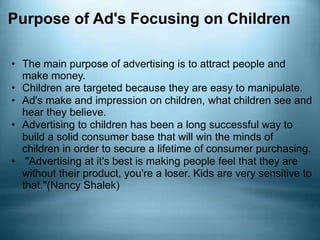
Nowadays, we find that children pay
more attention towards television
than to study.
Today, advertisement has become a
media for making a product popular in
a short period of time and this is the
only reason for the impact of new
products in the mind of children.
Today, when parents go to market
with their children they ask for those
products which have not even reached
the market.
Conti…
Today, if any advertisement is shown, then
even before the actor or actress speaks, the child
starts pronouncing the lines of the advertisement
much before the advertises.
Thus we can see that children know all the
names of the performers, color of their dresses
and the product they advertise.
What are the different advertising
strategies ?
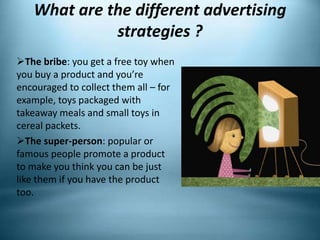
The bribe: you get a free toy when
you buy a product and you’re
encouraged to collect them all – for
example, toys packaged with
takeaway meals and small toys in
cereal packets.
The super-person: popular or
famous people promote a product
to make you think you can be just
like them if you have the product
too.
Conti..
The game: you can play a
game and win a prize if you buy
a product.
The music: catchy tunes or
popular songs make you like an
advertisement – and the
product it advertises – more.
The cartoon character: a
cartoon character you know
and like tells you about a
product to make it more
attractive.
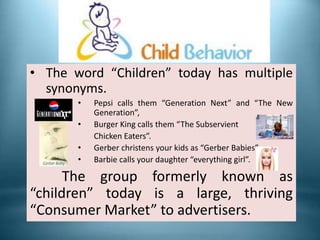
• The word “Children” today has multiple
synonyms.
• Pepsi calls them “Generation Next” and “The New
Generation”,
• Burger King calls them “The Subservient
Chicken Eaters”.
• Gerber christens your kids as “Gerber Babies”,
• Barbie calls your daughter “everything girl”.
The group formerly known as
“children” today is a large, thriving
“Consumer Market” to advertisers.
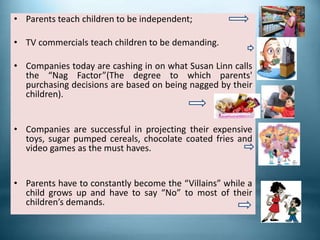
• Parents teach children to be independent;
• TV commercials teach children to be demanding.
• Companies today are cashing in on what Susan Linn calls
the “Nag Factor”(The degree to which parents'
purchasing decisions are based on being nagged by their
children).
• Companies are successful in projecting their expensive
toys, sugar pumped cereals, chocolate coated fries and
video games as the must haves.
• Parents have to constantly become the “Villains” while a
child grows up and have to say “No” to most of their
children’s demands.
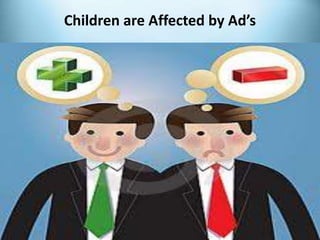
Children are Affected by Ad’s
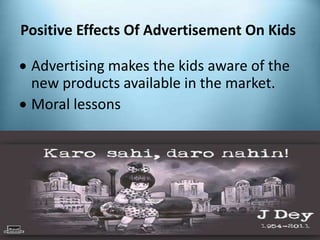
Positive Effects Of Advertisement On Kids
 Advertising makes the kids aware of the
new products available in the market.
 Moral lessons
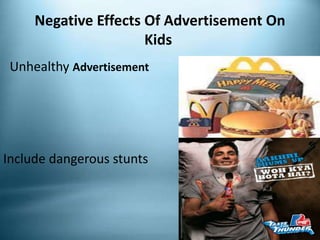
Negative Effects Of Advertisement On
Kids
Unhealthy Advertisement
Include dangerous stunts
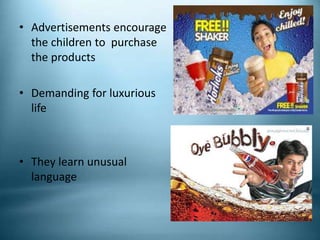
• Advertisements encourage
the children to purchase
the products
• Demanding for luxurious
life
• They learn unusual
language
Advertising associated with children

Advertising associated with children

  • 1.
    GROUP MEMBERS NAME: ABDULHANAN M KAMRAN TAHIR UZ ZAMAN M AFZAL QASIM WASIM AZRAR UL HASSAN Topic : An association between advertising messages, content and the response of the children
  • 2.
    Advertisement Advertising is theway of communication. Persuade customers to purchase particular brand of product. They know more people will eager to by the product after watching the advertisement so that they will get more profit. Advertisement can be found in magazines, radio program, newspaper. It can be easily understand by every person.
  • 3.
    Purpose of Ad'sFocusing on Children • The main purpose of advertising is to attract people and make money. • Children are targeted because they are easy to manipulate. • Ad's make and impression on children, what children see and hear they believe. • Advertising to children has been a long successful way to build a solid consumer base that will win the minds of children in order to secure a lifetime of consumer purchasing. • "Advertising at it's best is making people feel that they are without their product, you're a loser. Kids are very sensitive to that."(Nancy Shalek)
  • 4.
    IMPACT OF ADVERTISEMENT Sciencehas given us a lot and one of the gifts of science is mass-media which includes television, radio etc. Nowadays, we find that children pay more attention towards television than to study. Today, advertisement has become a media for making a product popular in a short period of time and this is the only reason for the impact of new products in the mind of children. Today, when parents go to market with their children they ask for those products which have not even reached the market.
  • 5.
    Conti… Today, if anyadvertisement is shown, then even before the actor or actress speaks, the child starts pronouncing the lines of the advertisement much before the advertises. Thus we can see that children know all the names of the performers, color of their dresses and the product they advertise.
  • 6.
    What are thedifferent advertising strategies ? The bribe: you get a free toy when you buy a product and you’re encouraged to collect them all – for example, toys packaged with takeaway meals and small toys in cereal packets. The super-person: popular or famous people promote a product to make you think you can be just like them if you have the product too.
  • 7.
    Conti.. The game: youcan play a game and win a prize if you buy a product. The music: catchy tunes or popular songs make you like an advertisement – and the product it advertises – more. The cartoon character: a cartoon character you know and like tells you about a product to make it more attractive.
  • 8.
    • The word“Children” today has multiple synonyms. • Pepsi calls them “Generation Next” and “The New Generation”, • Burger King calls them “The Subservient Chicken Eaters”. • Gerber christens your kids as “Gerber Babies”, • Barbie calls your daughter “everything girl”. The group formerly known as “children” today is a large, thriving “Consumer Market” to advertisers.
  • 9.
    • Parents teachchildren to be independent; • TV commercials teach children to be demanding. • Companies today are cashing in on what Susan Linn calls the “Nag Factor”(The degree to which parents' purchasing decisions are based on being nagged by their children). • Companies are successful in projecting their expensive toys, sugar pumped cereals, chocolate coated fries and video games as the must haves. • Parents have to constantly become the “Villains” while a child grows up and have to say “No” to most of their children’s demands.
  • 10.
  • 11.
    Positive Effects OfAdvertisement On Kids  Advertising makes the kids aware of the new products available in the market.  Moral lessons
  • 12.
    Negative Effects OfAdvertisement On Kids Unhealthy Advertisement Include dangerous stunts
  • 13.
    • Advertisements encourage thechildren to purchase the products • Demanding for luxurious life • They learn unusual language