A Reflection on a future role for the creative
communications business. Arguing the case:
ADVERTISING
meets
INNOVATION
MARCOS BENDRAO & ROSA OLIVEIRA | UNIVERSIDADE EUROPEIA > EXEC. MASTER MARKETING MANAGEMENT
The Creative Communications industry has been in crisis during
most of the last decade. Part of it is caused by the current
economic crisis. But the biggest cause has arguably been it’s
incapability to adapt and keep up with the evolutions in society.
This presentation explores a possible solution through
a convergence of the Advertising and Innovation areas.
01.
02.
03.
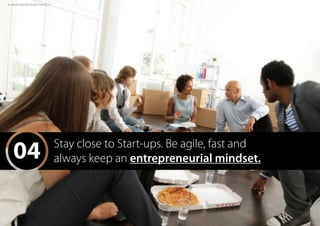
04.
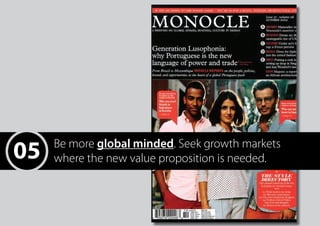
05.
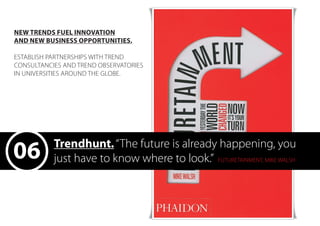
06.
Context
Proposed Solution
Reaching the Solution
Ten Resolutions
Making It Happen
final Thoughts
01.Context
The systemic problems of
the communications business
and how they came to be
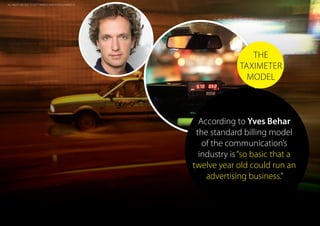
According to Yves Behar
the standard billing model
of the communication’s
industry is“so basic that a
twelve year old could run an
advertising business.”
THE
TAXIMETER
MODEL
ALL RIGHTS BELONG TO GETTyIMAGES AND GOOGLE IMAGES ©
Ever since the separation
between advertising and
media agencies that there’s
been a need to work on a new
business model to charge for
creative services.
The current economic crisis
only made matters worse.
AD
AGENCIES
MEDIA
AGENCIES
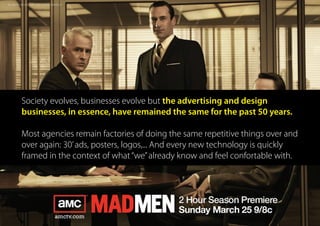
Society evolves, businesses evolve but the advertising and design
businesses, in essence, have remained the same for the past 50 years.
Most agencies remain factories of doing the same repetitive things over and
over again: 30’ads, posters, logos,... And every new technology is quickly
framed in the context of what“we”already know and feel confortable with.
ALL RIGHTS BELONG AMC AND GOOGLE IMAGES ©
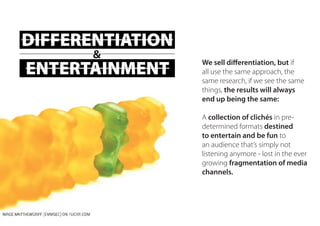
DIFFERENTIATION
ENTERTAINMENT
&
We sell differentiation, but if
all use the same approach, the
same research, if we see the same
things, the results will always
end up being the same:
A collection of clichés in pre-
determined formats destined
to entertain and be fun to
an audience that’s simply not
listening anymore - lost in the ever
growing fragmentation of media
channels.
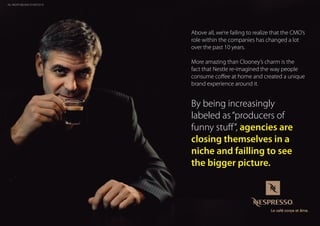
Above all, we’re failing to realize that the CMO’s
role within the companies has changed a lot
over the past 10 years.
More amazing than Clooney’s charm is the
fact that Nestle re-imagined the way people
consume coffee at home and created a unique
brand experience around it.
By being increasingly
labeled as“producers of
funny stuff”, agencies are
closing themselves in a
niche and failling to see
the bigger picture.
ALL RIGHTS BELONG TO NESTLE ©
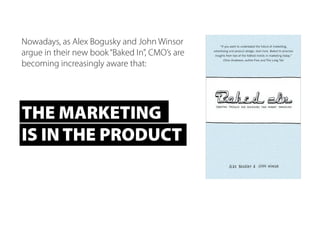
Nowadays, as Alex Bogusky and John Winsor
argue in their new book“Baked In”, CMO’s are
becoming increasingly aware that:
THE MARKETING
IS IN THE PRODUCT
In the most innovative companies the walls between
the marketing and r&d departments are being
overthrown.
This is a huge
opportunity for
creative companies
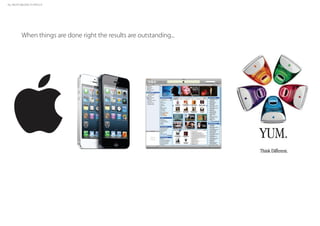
When things are done right the results are outstanding...
ALL RIGHTS BELONG TO APPLE ©
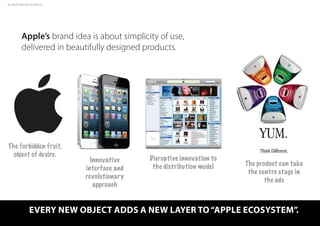
Apple’s brand idea is about simplicity of use,
delivered in beautifully designed products.
The forbidden fruit,
object of desire.
everY new obJeCt adds a new laYer to“apple eCosYsteM”.
Innovative
interface and
revolutionary
approach
The product can take
the centre stage in
the ads
Disruptive innovation to
the distribution model
ALL RIGHTS BELONG TO APPLE ©
02.Proposed Solution
“Getting on the boat”early on
“The Brand as a driver for
innovation is different from
the brand in marketing
communication.”
in“Brand-Driven Innovation”
IT’s different in process, people, roles but also
in the opportunities it uncovers for the CREATIVE
agency of the 21ST CENTURY.
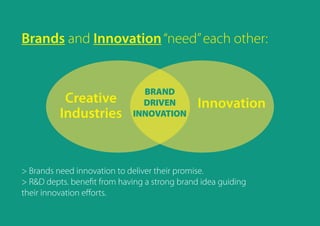
Brands and Innovation“need”each other:
> Brands need innovation to deliver their promise.
> R&D depts. benefit from having a strong brand idea guiding
their innovation efforts.
Creative
Industries
BRAND
DRIVEN
INNOVATION
Innovation
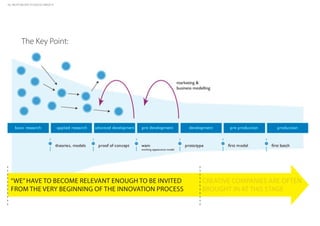
The Key Point
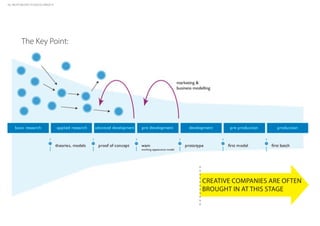
The Key Point:
Creative companies are often
brought in at this stage
ALL RIGHTS BELONG TO GOOGLE IMAGES ©
The Key Point:
CREATIVE COMPANIES ARE OfTEN
BROUGhT IN AT ThIS STAGE
“WE”hAVE TO BECOME RELEVANT ENOUGh TO BE INVITED
fROM ThE VERy BEGINNING Of ThE INNOVATION PROCESS
ALL RIGHTS BELONG TO GOOGLE IMAGES ©
This makes perfect sense:
> Creativity is the magic ingredient for innovation;
> We’re naturals at divergent and lateral thinking;
> Design thinking should be applied to challenges other
than communication;
> Our business is/should be about creating true and
compelling brand narratives that start with the product;
> Some of the most visionary creative companies are
already following this route(Wolff Olins, IDEO, WK, Sid Lee, Moving Brands,...)
The marketing departments have the mission
of constantly breaking the mold and bringing
disruptions to the market.
The creative industries can be the perfect
partners in the quest for Disruptive and
Exploratory forms of Innovation particularly
in the design of services and experiences.
If the marketing is in the product, then we
must be in the process right from the start.
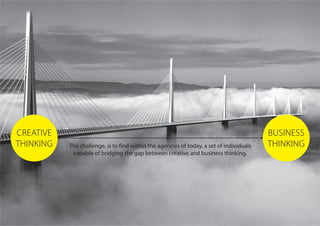
CREATIvE
THINKING
BuSINESS
THINKINGThe challenge, is to find within the agencies of today, a set of individuals
capable of bridging the gap between creative and business thinking.
We believe the key to solving the challenge lies within
the strategy and planning departments.
Planners are naturals at combining creative and analytical
thinking. They have knowledge like no other of consumer
trends and motivations.
The next logical steps is going beyond consumer insights
applied to communication to insights applied to the
creation and development of new business opportunities.
This will provide the agencies with new revenue
streams and, more importantly, set a new role for the
creative industries in society.
03.Reaching the Solution
Unfortunately, this kind of
profound change just wont
come falling from the sky.
It will force“us”to re-think
our mission and value
proposition.
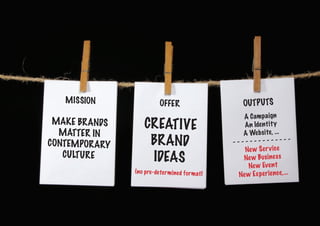
MAKE BRANDS
MATTER IN
CONTEMPORARY
CULTURE
CREATIVE
BRAND
IDEAS
A Campaign
An Identity
A Website, ...
- - - - - - - - - - - - - -
New Service
New Business
New Event
New Experience,...
OUTPUTSOFFER
(no pre-determined format)
MISSION
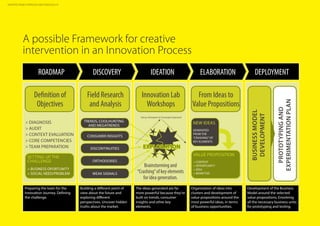
A possible Framework for creative
intervention in an Innovation Process
DISCOVERY ELABORATION DEPLOYMENTROADMAP IDEATION
> DIAGNOSIS
> AUDIT
> CONTEXT EVALUATION
> CORE COMPETENCIES
> TEAM PREPARATION
Building a different point of
view about the future and
exploring different
perspectives. Uncover hidden
truths about the market.
The ideas generated are far
more powerful because they’re
built on trends, consumer
insights and other key
elements.
Organization of ideas into
clusters and development of
value propositions around the
most powerful ideas, in terms
of business opportunities.
Development of the Business
Model around the selected
value propositions. Envolving
all the necessary business units
for prototyping and testing.
Preparing the team for the
Innovation Journey. Defining
the challenge.
Definition of
Objectives
Field Research
and Analysis
Innovation Lab
Workshops
From Ideas to
Value Propositions
Brainstorming and
“Crashing”of key elements
for idea generation.
TRENDS, COOLHUNTING
AND MEGATRENDS
NEW IDEAS
generated
from the
“crashing”of
key elements
VALUE PROPOSITION
> CONTEXT
> OPPORTUNITY
> IDEA
> MONETIZE
SETTING up the
CHALLENGE
> business oportunity
> social need/problem
Using a Divergent to Convergent Approach
CONSUMER INSIGHTS
DISCONTINUITIES
ORTHODOXIES
WEAK SIGNALS
BUSINESSMODEL
DEVELOPMENT
PROTOTYPINGAND
EXPERIMENTATIONPLAN
exploration
ADAPTED FROM STRATEGOS METHODOLOGY ©
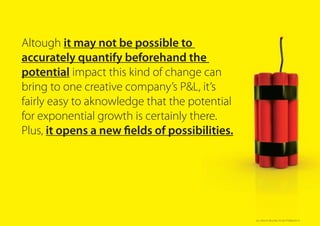
Altough it may not be possible to
accurately quantify beforehand the
potential impact this kind of change can
bring to one creative company’s P&L, it’s
fairly easy to aknowledge that the potential
for exponential growth is certainly there.
Plus, it opens a new fields of possibilities.
accurately quantify beforehand theaccurately quantify beforehand the
impact this kind of change can
bring to one creative company’s P&L, it’s
fairly easy to aknowledge that the potential
for exponential growth is certainly there.
it opens a new fields of possibilities.it opens a new fields of possibilities.
ALL RIGHTS BELONG TO GETTyIMAGES ©
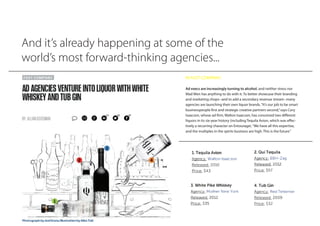
And it’s already happening at some of the
world’s most forward-thinking agencies...
IN fAST COMPANy:
Ad execs are increasingly turning to alcohol, and neither stress nor
Mad Men has anything to do with it. To better showcase their branding
and marketing chops--and to add a secondary revenue stream--many
agencies are launching their own liquor brands.“It’s our job to be smart
businesspeople first and strategic creative partners second,”says Cory
Isaacson, whose ad firm, Walton Isaacson, has conceived two different
liquors in its six-year history (including Tequila Avion, which was effec-
tively a recurring character on Entourage).“We have all this expertise,
and the multiples in the spirits business are high. This is the future.”
04.Ten Resolutions
“Yesterday the world changed.
Now it’s your turn.”
Mike Walsh(in Futuretainment)
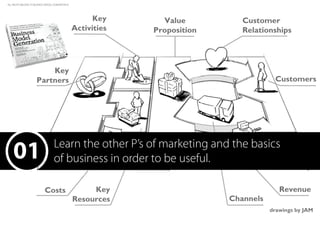
01 Learn the other P’s of marketing and the basics
of business in order to be useful.
ALL RIGHTS BELONG TO BuSINESS MODEL GENERATION ©
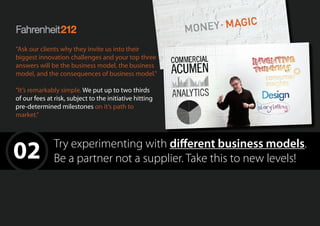
02 Try experimenting with different business models.
Be a partner not a supplier. Take this to new levels!
“Ask our clients why they invite us into their
biggest innovation challenges and your top three
answers will be the business model, the business
model, and the consequences of business model.”
“It’s remarkably simple. We put up to two thirds
of our fees at risk, subject to the initiative hitting
pre-determined milestones on it’s path to
market.”
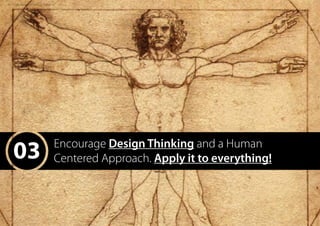
03 Encourage Design Thinking and a Human
Centered Approach. Apply it to everything!
ALL RIGHTS BELONG TO GOOGLE IMAGES ©
04 Stay close to Start-ups. Be agile, fast and
always keep an entrepreneurial mindset.
ALL RIGHTS BELONG TO GETTYIMAGES ©
05 Be more global minded. Seek growth markets
where the new value proposition is needed.
06 Trendhunt.“The future is already happening, you
just have to know where to look.” FUTURETAINMENT, MIKE WALSH
New trends fuel innovation
and new business opportunities.
establish partnerships with trend
consultancies and trenD observatories
in UNIVERSITIES around the globe.
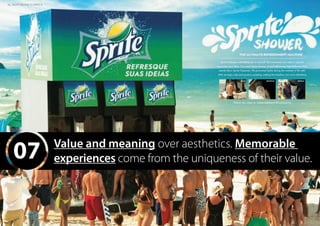
07 Value and meaning over aesthetics. Memorable
experiences come from the uniqueness of their value.
ALL RIGHTS BELONG TO SPRITE ©
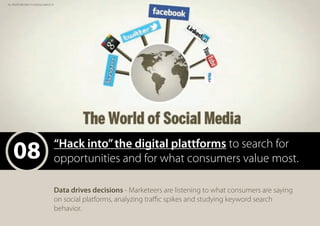
08 “Hack into”the digital plattforms to search for
opportunities and for what consumers value most.
Data drives decisions - Marketeers are listening to what consumers are saying
on social platforms, analyzing traffic spikes and studying keyword search
behavior.
ALL RIGHTS BELONG TO GOOGLE IMAGES ©
09
People talk about their positive consumption experiences as a form of
social currency. It defines their social personas.“We”need to develop
experiences that add value and drive conversational capital.
Conversational Capital is a concept and book writen by advertising agency Sid Lee. <www.sidlee.com>
BRANDS AS IGNITERS
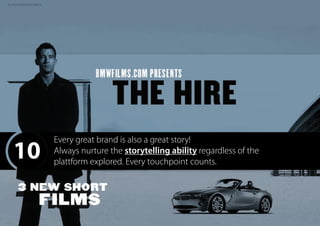
10
Every great brand is also a great story!
Always nurture the storytelling ability regardless of the
plattform explored. Every touchpoint counts.
ALL RIGHTS BELONG TO BMW ©
05.Making it happen
ALL RIGHTS BELONG TO HAVAS SPORTS AND ENTERTAINMENT ©
Keeping up with trends and turning them into business opportunities
and unique service/product experiences requires a deep change in the
mindset of creative companies.
Everyone in the organization needs to be on the same page for this kind
of transformation take place and not stay on a mere aspirational level.
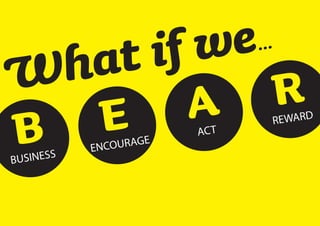
What if we...
BBUSINESS
REWARD
ENCOURAGE
ACTE A R
in the Business
BBUSINESS
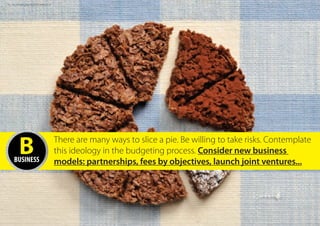
There are many ways to slice a pie. Be willing to take risks. Contemplate
this ideology in the budgeting process. Consider new business
models: partnerships, fees by objectives, launch joint ventures...
ALL RIGHTS BELONG TO GETTYIMAGES ©
Encourage and Stimulate
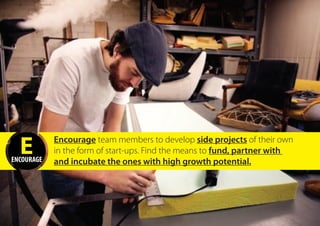
EENCOURAGE
Encourage team members to develop side projects of their own
in the form of start-ups. Find the means to fund, partner with
and incubate the ones with high growth potential.
ALL RIGHTS BELONG TO GETTYIMAGES ©
EENCOURAGE
Invest in the continuing education of the team.
Provide regular workshops in topics such as creativity,
innovation, service design and entrepreneurship.
ALL RIGHTS BELONG TO GETTYIMAGES ©
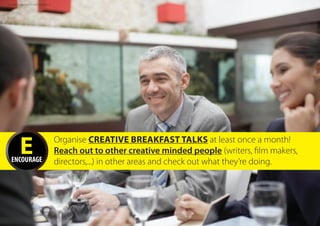
EENCOURAGE
Organise Creative Breakfast Talks at least once a month!
Reach out to other creative minded people (writers, film makers,
directors,...) in other areas and check out what they’re doing.
ALL RIGHTS BELONG TO GETTYIMAGES ©
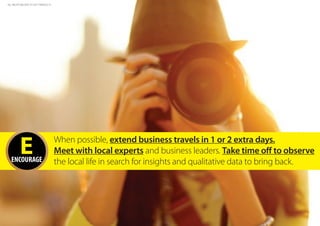
EENCOURAGE
When possible, extend business travels in 1 or 2 extra days.
Meet with local experts and business leaders. Take time off to observe
the local life in search for insights and qualitative data to bring back.
ALL RIGHTS BELONG TO GETTYIMAGES ©
Act
AACT
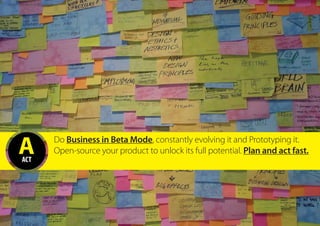
Do Business in Beta Mode, constantly evolving it and Prototyping it.
Open-source your product to unlock its full potential. Plan and act fast.
ALL RIGHTS BELONG TO GOOGLE IMAGES ©
Reward
RREWARD
Re-adapt the performance reviews to the new business models.
Encourage risk taking and reward top performance.
ALL RIGHTS BELONG TO GETTYIMAGES ©
06.Final Thoughts
Change!
Change is the key word here. We live in an age defined accelerated change and great ambiguity where the
foundations that hold our ground are being shaken. The rules are being re-written. By the end of this decade,
the way we build brands will have transformed significantly.
Most of the advertising we know today will become contextual to our actions and designed to encourage a
specific transaction. According to Karl Heiselman of Wolff Olins, by 2020, the winning advertising methods will be
those that compress the time between the advertising impression and the transaction being made, and do it in a
highly measurable and predictable way.
On the other hand, true brand builders have a great set new tools to work with and much to be confident about.
New technologies will be giving marketers and business leaders a more sophisticated understanding of their
customers. The knowledge and insights thus generated turning marketers into key actors in the delivery of
innovation and the creation of new layers of brand value. We believe that by 2020 we will see three major areas
of brand building innovation take over the role that advertising plays today: Total Experience Management,
Marketing and New Product Development, Content Ecosystem. (1)
The route we argued in this presentation is just one possibility.
There will certainly be others. But evolution is unavoidable.
And it’s up to you to decide which kind of agency do you want to
lead!
(1) in“The New Brand Building Reality”, Wolff Olins blog
“A revolution doesn’t happen
when society adopts a new
technology.
It happens when society
adopts a new behavior.”
Clay Shirky
Thank You!

Advertising and innovation2

  • 1.
    A Reflection ona future role for the creative communications business. Arguing the case: ADVERTISING meets INNOVATION MARCOS BENDRAO & ROSA OLIVEIRA | UNIVERSIDADE EUROPEIA > EXEC. MASTER MARKETING MANAGEMENT
  • 2.
    The Creative Communicationsindustry has been in crisis during most of the last decade. Part of it is caused by the current economic crisis. But the biggest cause has arguably been it’s incapability to adapt and keep up with the evolutions in society. This presentation explores a possible solution through a convergence of the Advertising and Innovation areas.
  • 3.
    01. 02. 03. 04. 05. 06. Context Proposed Solution Reaching theSolution Ten Resolutions Making It Happen final Thoughts
  • 4.
    01.Context The systemic problemsof the communications business and how they came to be
  • 5.
    According to YvesBehar the standard billing model of the communication’s industry is“so basic that a twelve year old could run an advertising business.” THE TAXIMETER MODEL ALL RIGHTS BELONG TO GETTyIMAGES AND GOOGLE IMAGES ©
  • 6.
    Ever since theseparation between advertising and media agencies that there’s been a need to work on a new business model to charge for creative services. The current economic crisis only made matters worse. AD AGENCIES MEDIA AGENCIES
  • 7.
    Society evolves, businessesevolve but the advertising and design businesses, in essence, have remained the same for the past 50 years. Most agencies remain factories of doing the same repetitive things over and over again: 30’ads, posters, logos,... And every new technology is quickly framed in the context of what“we”already know and feel confortable with. ALL RIGHTS BELONG AMC AND GOOGLE IMAGES ©
  • 8.
    DIFFERENTIATION ENTERTAINMENT & We sell differentiation,but if all use the same approach, the same research, if we see the same things, the results will always end up being the same: A collection of clichés in pre- determined formats destined to entertain and be fun to an audience that’s simply not listening anymore - lost in the ever growing fragmentation of media channels.
  • 10.
    Above all, we’refailing to realize that the CMO’s role within the companies has changed a lot over the past 10 years. More amazing than Clooney’s charm is the fact that Nestle re-imagined the way people consume coffee at home and created a unique brand experience around it. By being increasingly labeled as“producers of funny stuff”, agencies are closing themselves in a niche and failling to see the bigger picture. ALL RIGHTS BELONG TO NESTLE ©
  • 11.
    Nowadays, as AlexBogusky and John Winsor argue in their new book“Baked In”, CMO’s are becoming increasingly aware that: THE MARKETING IS IN THE PRODUCT
  • 12.
    In the mostinnovative companies the walls between the marketing and r&d departments are being overthrown. This is a huge opportunity for creative companies
  • 13.
    When things aredone right the results are outstanding... ALL RIGHTS BELONG TO APPLE ©
  • 14.
    Apple’s brand ideais about simplicity of use, delivered in beautifully designed products. The forbidden fruit, object of desire. everY new obJeCt adds a new laYer to“apple eCosYsteM”. Innovative interface and revolutionary approach The product can take the centre stage in the ads Disruptive innovation to the distribution model ALL RIGHTS BELONG TO APPLE ©
  • 15.
  • 16.
    “The Brand asa driver for innovation is different from the brand in marketing communication.” in“Brand-Driven Innovation” IT’s different in process, people, roles but also in the opportunities it uncovers for the CREATIVE agency of the 21ST CENTURY.
  • 17.
    Brands and Innovation“need”eachother: > Brands need innovation to deliver their promise. > R&D depts. benefit from having a strong brand idea guiding their innovation efforts. Creative Industries BRAND DRIVEN INNOVATION Innovation
  • 18.
  • 19.
    The Key Point: Creativecompanies are often brought in at this stage ALL RIGHTS BELONG TO GOOGLE IMAGES ©
  • 20.
    The Key Point: CREATIVECOMPANIES ARE OfTEN BROUGhT IN AT ThIS STAGE “WE”hAVE TO BECOME RELEVANT ENOUGh TO BE INVITED fROM ThE VERy BEGINNING Of ThE INNOVATION PROCESS ALL RIGHTS BELONG TO GOOGLE IMAGES ©
  • 21.
    This makes perfectsense: > Creativity is the magic ingredient for innovation; > We’re naturals at divergent and lateral thinking; > Design thinking should be applied to challenges other than communication; > Our business is/should be about creating true and compelling brand narratives that start with the product; > Some of the most visionary creative companies are already following this route(Wolff Olins, IDEO, WK, Sid Lee, Moving Brands,...)
  • 22.
    The marketing departmentshave the mission of constantly breaking the mold and bringing disruptions to the market. The creative industries can be the perfect partners in the quest for Disruptive and Exploratory forms of Innovation particularly in the design of services and experiences. If the marketing is in the product, then we must be in the process right from the start.
  • 23.
    CREATIvE THINKING BuSINESS THINKINGThe challenge, isto find within the agencies of today, a set of individuals capable of bridging the gap between creative and business thinking.
  • 24.
    We believe thekey to solving the challenge lies within the strategy and planning departments. Planners are naturals at combining creative and analytical thinking. They have knowledge like no other of consumer trends and motivations. The next logical steps is going beyond consumer insights applied to communication to insights applied to the creation and development of new business opportunities. This will provide the agencies with new revenue streams and, more importantly, set a new role for the creative industries in society.
  • 25.
  • 26.
    Unfortunately, this kindof profound change just wont come falling from the sky. It will force“us”to re-think our mission and value proposition.
  • 27.
    MAKE BRANDS MATTER IN CONTEMPORARY CULTURE CREATIVE BRAND IDEAS ACampaign An Identity A Website, ... - - - - - - - - - - - - - - New Service New Business New Event New Experience,... OUTPUTSOFFER (no pre-determined format) MISSION
  • 28.
    A possible Frameworkfor creative intervention in an Innovation Process DISCOVERY ELABORATION DEPLOYMENTROADMAP IDEATION > DIAGNOSIS > AUDIT > CONTEXT EVALUATION > CORE COMPETENCIES > TEAM PREPARATION Building a different point of view about the future and exploring different perspectives. Uncover hidden truths about the market. The ideas generated are far more powerful because they’re built on trends, consumer insights and other key elements. Organization of ideas into clusters and development of value propositions around the most powerful ideas, in terms of business opportunities. Development of the Business Model around the selected value propositions. Envolving all the necessary business units for prototyping and testing. Preparing the team for the Innovation Journey. Defining the challenge. Definition of Objectives Field Research and Analysis Innovation Lab Workshops From Ideas to Value Propositions Brainstorming and “Crashing”of key elements for idea generation. TRENDS, COOLHUNTING AND MEGATRENDS NEW IDEAS generated from the “crashing”of key elements VALUE PROPOSITION > CONTEXT > OPPORTUNITY > IDEA > MONETIZE SETTING up the CHALLENGE > business oportunity > social need/problem Using a Divergent to Convergent Approach CONSUMER INSIGHTS DISCONTINUITIES ORTHODOXIES WEAK SIGNALS BUSINESSMODEL DEVELOPMENT PROTOTYPINGAND EXPERIMENTATIONPLAN exploration ADAPTED FROM STRATEGOS METHODOLOGY ©
  • 29.
    Altough it maynot be possible to accurately quantify beforehand the potential impact this kind of change can bring to one creative company’s P&L, it’s fairly easy to aknowledge that the potential for exponential growth is certainly there. Plus, it opens a new fields of possibilities. accurately quantify beforehand theaccurately quantify beforehand the impact this kind of change can bring to one creative company’s P&L, it’s fairly easy to aknowledge that the potential for exponential growth is certainly there. it opens a new fields of possibilities.it opens a new fields of possibilities. ALL RIGHTS BELONG TO GETTyIMAGES ©
  • 30.
    And it’s alreadyhappening at some of the world’s most forward-thinking agencies... IN fAST COMPANy: Ad execs are increasingly turning to alcohol, and neither stress nor Mad Men has anything to do with it. To better showcase their branding and marketing chops--and to add a secondary revenue stream--many agencies are launching their own liquor brands.“It’s our job to be smart businesspeople first and strategic creative partners second,”says Cory Isaacson, whose ad firm, Walton Isaacson, has conceived two different liquors in its six-year history (including Tequila Avion, which was effec- tively a recurring character on Entourage).“We have all this expertise, and the multiples in the spirits business are high. This is the future.”
  • 31.
  • 32.
    “Yesterday the worldchanged. Now it’s your turn.” Mike Walsh(in Futuretainment)
  • 33.
    01 Learn theother P’s of marketing and the basics of business in order to be useful. ALL RIGHTS BELONG TO BuSINESS MODEL GENERATION ©
  • 34.
    02 Try experimentingwith different business models. Be a partner not a supplier. Take this to new levels! “Ask our clients why they invite us into their biggest innovation challenges and your top three answers will be the business model, the business model, and the consequences of business model.” “It’s remarkably simple. We put up to two thirds of our fees at risk, subject to the initiative hitting pre-determined milestones on it’s path to market.”
  • 35.
    03 Encourage DesignThinking and a Human Centered Approach. Apply it to everything! ALL RIGHTS BELONG TO GOOGLE IMAGES ©
  • 36.
    04 Stay closeto Start-ups. Be agile, fast and always keep an entrepreneurial mindset. ALL RIGHTS BELONG TO GETTYIMAGES ©
  • 37.
    05 Be moreglobal minded. Seek growth markets where the new value proposition is needed.
  • 38.
    06 Trendhunt.“The futureis already happening, you just have to know where to look.” FUTURETAINMENT, MIKE WALSH New trends fuel innovation and new business opportunities. establish partnerships with trend consultancies and trenD observatories in UNIVERSITIES around the globe.
  • 39.
    07 Value andmeaning over aesthetics. Memorable experiences come from the uniqueness of their value. ALL RIGHTS BELONG TO SPRITE ©
  • 40.
    08 “Hack into”thedigital plattforms to search for opportunities and for what consumers value most. Data drives decisions - Marketeers are listening to what consumers are saying on social platforms, analyzing traffic spikes and studying keyword search behavior. ALL RIGHTS BELONG TO GOOGLE IMAGES ©
  • 41.
    09 People talk abouttheir positive consumption experiences as a form of social currency. It defines their social personas.“We”need to develop experiences that add value and drive conversational capital. Conversational Capital is a concept and book writen by advertising agency Sid Lee. <www.sidlee.com> BRANDS AS IGNITERS
  • 42.
    10 Every great brandis also a great story! Always nurture the storytelling ability regardless of the plattform explored. Every touchpoint counts. ALL RIGHTS BELONG TO BMW ©
  • 43.
  • 44.
    ALL RIGHTS BELONGTO HAVAS SPORTS AND ENTERTAINMENT © Keeping up with trends and turning them into business opportunities and unique service/product experiences requires a deep change in the mindset of creative companies. Everyone in the organization needs to be on the same page for this kind of transformation take place and not stay on a mere aspirational level.
  • 45.
  • 46.
  • 47.
    BBUSINESS There are manyways to slice a pie. Be willing to take risks. Contemplate this ideology in the budgeting process. Consider new business models: partnerships, fees by objectives, launch joint ventures... ALL RIGHTS BELONG TO GETTYIMAGES ©
  • 48.
  • 49.
    EENCOURAGE Encourage team membersto develop side projects of their own in the form of start-ups. Find the means to fund, partner with and incubate the ones with high growth potential. ALL RIGHTS BELONG TO GETTYIMAGES ©
  • 50.
    EENCOURAGE Invest in thecontinuing education of the team. Provide regular workshops in topics such as creativity, innovation, service design and entrepreneurship. ALL RIGHTS BELONG TO GETTYIMAGES ©
  • 51.
    EENCOURAGE Organise Creative BreakfastTalks at least once a month! Reach out to other creative minded people (writers, film makers, directors,...) in other areas and check out what they’re doing. ALL RIGHTS BELONG TO GETTYIMAGES ©
  • 52.
    EENCOURAGE When possible, extendbusiness travels in 1 or 2 extra days. Meet with local experts and business leaders. Take time off to observe the local life in search for insights and qualitative data to bring back. ALL RIGHTS BELONG TO GETTYIMAGES ©
  • 53.
  • 54.
    AACT Do Business inBeta Mode, constantly evolving it and Prototyping it. Open-source your product to unlock its full potential. Plan and act fast. ALL RIGHTS BELONG TO GOOGLE IMAGES ©
  • 55.
  • 56.
    RREWARD Re-adapt the performancereviews to the new business models. Encourage risk taking and reward top performance. ALL RIGHTS BELONG TO GETTYIMAGES ©
  • 57.
  • 58.
    Change! Change is thekey word here. We live in an age defined accelerated change and great ambiguity where the foundations that hold our ground are being shaken. The rules are being re-written. By the end of this decade, the way we build brands will have transformed significantly. Most of the advertising we know today will become contextual to our actions and designed to encourage a specific transaction. According to Karl Heiselman of Wolff Olins, by 2020, the winning advertising methods will be those that compress the time between the advertising impression and the transaction being made, and do it in a highly measurable and predictable way. On the other hand, true brand builders have a great set new tools to work with and much to be confident about. New technologies will be giving marketers and business leaders a more sophisticated understanding of their customers. The knowledge and insights thus generated turning marketers into key actors in the delivery of innovation and the creation of new layers of brand value. We believe that by 2020 we will see three major areas of brand building innovation take over the role that advertising plays today: Total Experience Management, Marketing and New Product Development, Content Ecosystem. (1) The route we argued in this presentation is just one possibility. There will certainly be others. But evolution is unavoidable. And it’s up to you to decide which kind of agency do you want to lead! (1) in“The New Brand Building Reality”, Wolff Olins blog
  • 59.
    “A revolution doesn’thappen when society adopts a new technology. It happens when society adopts a new behavior.” Clay Shirky
  • 60.