Welcome Into the world Of
Advertisement
Presented by:BMS ADVERTISER
What is ADVERTISING ?
• “ the action of calling something to
the attention of public”.
• “ ADVERTISING is the delivery of the
most persuasive product message at
the right time, in the right place, to
the right person, at the lowest
possible cost”
Today’s Product/Brand Manager
DEFINITION FROM BOOK
Paid form of non-personal
communication about an organization,
product, service or idea from an
identified sponsor, using mass media to
persuade or influence an audience.
History
• Ancient times. Egyptians wrote sales messages on papyrus wall posters. Political campaign ads
were on the walls of Pompeii. Rudimentary commercial advertising existed in Greece, Rome,
Arabia, Asia, Africa and South America.
• The Middle Ages. Most people were unable to read, but images of clothing, shoes, horse shoes or
bags of flour on signs pointed out the tailor, cobbler, blacksmith or miller.
• 17th century. As reading spread, advertising was printed on handbills. Advertisements promoting
medicines and books were printed in weekly newspapers.
• 19th century Advertising grew as the relative wealth of nations expanded. Advertising developed
with the rise of mass production from the late 19th century
• In 1836 in France, the newspaper La Presse printed paid advertising on its pages. Because of the
money it received for advertising, the paper was able to lower the price it charged readers for a
copy. That let it extend its readership which increased its profitability.
The beginnings of an advertising agency was conceived by Volney B. Palmer in Philadelphia. In
1842, he bought quantities of space in newspapers at a discounted rate, then resold the space at
higher rates to advertisers. Palmer was only a space broker – the ad copy, artwork and layout were
prepared by the company that had something to advertise.
• 20th century. Advertising became a profession with agencies as the focal point of creative planning.
• 21st century. Advertising continues in all mass media including newspapers, magazines, radio,
television, billboards, classified advertising in print and online, in-store advertising and websites.
to give the company a “personality” which sets it apart from the others.
to remind customers about their brands at the
right time and right place
to tell the public about improvements in products
to help their sales force to be more effective
to reinforce customer confidence in his/her purchase
Advertising use to:
inform people about products and services
 to make brand names familiar to the public
Importance of Advertising
 It is very cost effective method to communicate to a large
audience.
 It helps create brand image and symbolic appeal for the
brand which is a very important for companies selling
product/services that are difficult to differentiate on
functional attributes.
 Advertising creates awareness, interest, desire and drives
the consumer to the shop.
Role of Advertising in Brand Promotion
 Information and persuasion
 Introduction of new brand or brand extensions
 Building and maintaining brand loyalty among consumers
 Creating an image and meaning for a brand
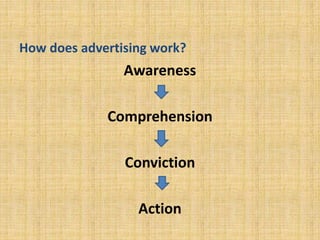
How does advertising work?
Awareness
Comprehension
Conviction
Action
Some do’s
 Advertising should be informative.
 Advertising should be entertaining.
 Advertising should be involving.
Some don’ts
 Advertising should never over claim any benefit in a product
or a brand.
 Never try to put down or talk down your consumers in
manner that will insult them.
 Try not to compare your brand with a competitor and try
not to show your competitor in bad light.
 In case you do any comparison with your competitor or
show your competitor it should be done in a intelligent and
tactful manner that such that it is memorable and not in bad
taste.
Why We Need Ads ?
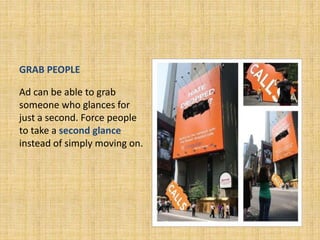
GRAB PEOPLE
Ad can be able to grab
someone who glances for
just a second. Force people
to take a second glance
instead of simply moving on.
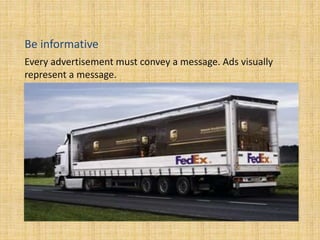
Be informative
Every advertisement must convey a message. Ads visually
represent a message.
Major advertising media
• Magazine
• Word of mouth
• Television
• Newspaper
• Yellow Pages
• Radio
• Outdoors
• Cinema
• Internet
What Is Car Advertisement ?
• Wrap advertising or a vehicle wrap describe
the marketing practice of completely or
partially covering (wrapping) a vehicle in
anadvertisement or livery. The result of this
process is essentially a mobile billboard.
Benefits
Reach a Wider Audience
• Depending on how many vehicles you own, how often they are on
the road and how far they travel; you can reach tens of thousands
to over a hundred thousand viewers per month. You can reach a
larger audience with a vehicle wrap than almost any other form of
advertising. Many businesses gain more customers from their
vehicle wraps than their websites.
Non-Aggressive Advertising
• Unlike radio ads or print ads that interrupt a person’s reading,
vehicle wraps attract attention without disturbance. Potential
customers can easily spot your message without significant
distraction from what they’re doing. Customers respond better to
advertising that doesn’t take an “in-your-face” approach. Many
people enjoy striking vehicle wraps and don’t mind the advertising.
……….
Get Mobile
• Vehicle wraps travel into the view of potential customers instead of you
waiting for them to see your television commercial or run across your
newspaper advertisement. As a business, you can non-intrusively reach
out to customers over all the roads your vehicle or vehicles travel. The
lead possibilities from mobile exposure are nearly endless.
Cost Effective
• Unlike billboards and advertisements that have consistent reoccurring
costs for as long as you advertise, you can change your vehicle wrap as
little or as often as you like for less money. You can make an initial
investment for a fraction of the cost of other long term advertising
campaigns and generate results for years.
Local Advertising
• Vehicle wrap advertising is targeted because you are advertising to your
local market. The people who will see your vehicle wrap the most are the
people in your area. Local marketing produces outstanding results because
people like to deal with nearby businesses.
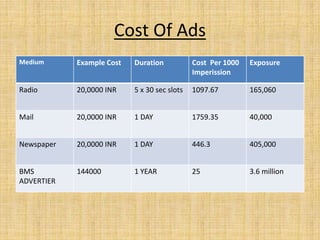
Cost Of Ads
Medium Example Cost Duration Cost Per 1000
Imperission
Exposure
Radio 20,0000 INR 5 x 30 sec slots 1097.67 165,060
Mail 20,0000 INR 1 DAY 1759.35 40,000
Newspaper 20,0000 INR 1 DAY 446.3 405,000
BMS
ADVERTIER
144000 1 YEAR 25 3.6 million
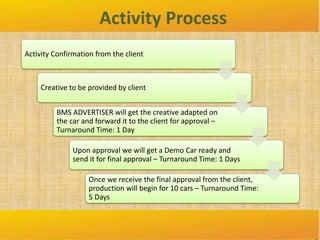
Activity Process
Activity Confirmation from the client
Creative to be provided by client
BMS ADVERTISER will get the creative adapted on
the car and forward it to the client for approval –
Turnaround Time: 1 Day
Upon approval we will get a Demo Car ready and
send it for final approval – Turnaround Time: 1 Days
Once we receive the final approval from the client,
production will begin for 10 cars – Turnaround Time:
5 Days
THANK YOU
Thank you all and
best of luck

Welcome Into the world Advertisement

  • 1.
    Welcome Into theworld Of Advertisement Presented by:BMS ADVERTISER
  • 2.
    What is ADVERTISING? • “ the action of calling something to the attention of public”.
  • 3.
    • “ ADVERTISINGis the delivery of the most persuasive product message at the right time, in the right place, to the right person, at the lowest possible cost” Today’s Product/Brand Manager
  • 4.
    DEFINITION FROM BOOK Paidform of non-personal communication about an organization, product, service or idea from an identified sponsor, using mass media to persuade or influence an audience.
  • 5.
    History • Ancient times.Egyptians wrote sales messages on papyrus wall posters. Political campaign ads were on the walls of Pompeii. Rudimentary commercial advertising existed in Greece, Rome, Arabia, Asia, Africa and South America. • The Middle Ages. Most people were unable to read, but images of clothing, shoes, horse shoes or bags of flour on signs pointed out the tailor, cobbler, blacksmith or miller. • 17th century. As reading spread, advertising was printed on handbills. Advertisements promoting medicines and books were printed in weekly newspapers. • 19th century Advertising grew as the relative wealth of nations expanded. Advertising developed with the rise of mass production from the late 19th century • In 1836 in France, the newspaper La Presse printed paid advertising on its pages. Because of the money it received for advertising, the paper was able to lower the price it charged readers for a copy. That let it extend its readership which increased its profitability. The beginnings of an advertising agency was conceived by Volney B. Palmer in Philadelphia. In 1842, he bought quantities of space in newspapers at a discounted rate, then resold the space at higher rates to advertisers. Palmer was only a space broker – the ad copy, artwork and layout were prepared by the company that had something to advertise. • 20th century. Advertising became a profession with agencies as the focal point of creative planning. • 21st century. Advertising continues in all mass media including newspapers, magazines, radio, television, billboards, classified advertising in print and online, in-store advertising and websites.
  • 6.
    to give thecompany a “personality” which sets it apart from the others. to remind customers about their brands at the right time and right place to tell the public about improvements in products to help their sales force to be more effective to reinforce customer confidence in his/her purchase Advertising use to: inform people about products and services  to make brand names familiar to the public
  • 7.
    Importance of Advertising It is very cost effective method to communicate to a large audience.  It helps create brand image and symbolic appeal for the brand which is a very important for companies selling product/services that are difficult to differentiate on functional attributes.  Advertising creates awareness, interest, desire and drives the consumer to the shop.
  • 8.
    Role of Advertisingin Brand Promotion  Information and persuasion  Introduction of new brand or brand extensions  Building and maintaining brand loyalty among consumers  Creating an image and meaning for a brand
  • 9.
    How does advertisingwork? Awareness Comprehension Conviction Action
  • 10.
    Some do’s  Advertisingshould be informative.  Advertising should be entertaining.  Advertising should be involving.
  • 11.
    Some don’ts  Advertisingshould never over claim any benefit in a product or a brand.  Never try to put down or talk down your consumers in manner that will insult them.  Try not to compare your brand with a competitor and try not to show your competitor in bad light.  In case you do any comparison with your competitor or show your competitor it should be done in a intelligent and tactful manner that such that it is memorable and not in bad taste.
  • 12.
  • 13.
    GRAB PEOPLE Ad canbe able to grab someone who glances for just a second. Force people to take a second glance instead of simply moving on.
  • 14.
    Be informative Every advertisementmust convey a message. Ads visually represent a message.
  • 15.
    Major advertising media •Magazine • Word of mouth • Television • Newspaper • Yellow Pages • Radio • Outdoors • Cinema • Internet
  • 16.
    What Is CarAdvertisement ? • Wrap advertising or a vehicle wrap describe the marketing practice of completely or partially covering (wrapping) a vehicle in anadvertisement or livery. The result of this process is essentially a mobile billboard.
  • 18.
    Benefits Reach a WiderAudience • Depending on how many vehicles you own, how often they are on the road and how far they travel; you can reach tens of thousands to over a hundred thousand viewers per month. You can reach a larger audience with a vehicle wrap than almost any other form of advertising. Many businesses gain more customers from their vehicle wraps than their websites. Non-Aggressive Advertising • Unlike radio ads or print ads that interrupt a person’s reading, vehicle wraps attract attention without disturbance. Potential customers can easily spot your message without significant distraction from what they’re doing. Customers respond better to advertising that doesn’t take an “in-your-face” approach. Many people enjoy striking vehicle wraps and don’t mind the advertising.
  • 19.
    ………. Get Mobile • Vehiclewraps travel into the view of potential customers instead of you waiting for them to see your television commercial or run across your newspaper advertisement. As a business, you can non-intrusively reach out to customers over all the roads your vehicle or vehicles travel. The lead possibilities from mobile exposure are nearly endless. Cost Effective • Unlike billboards and advertisements that have consistent reoccurring costs for as long as you advertise, you can change your vehicle wrap as little or as often as you like for less money. You can make an initial investment for a fraction of the cost of other long term advertising campaigns and generate results for years. Local Advertising • Vehicle wrap advertising is targeted because you are advertising to your local market. The people who will see your vehicle wrap the most are the people in your area. Local marketing produces outstanding results because people like to deal with nearby businesses.
  • 20.
    Cost Of Ads MediumExample Cost Duration Cost Per 1000 Imperission Exposure Radio 20,0000 INR 5 x 30 sec slots 1097.67 165,060 Mail 20,0000 INR 1 DAY 1759.35 40,000 Newspaper 20,0000 INR 1 DAY 446.3 405,000 BMS ADVERTIER 144000 1 YEAR 25 3.6 million
  • 21.
    Activity Process Activity Confirmationfrom the client Creative to be provided by client BMS ADVERTISER will get the creative adapted on the car and forward it to the client for approval – Turnaround Time: 1 Day Upon approval we will get a Demo Car ready and send it for final approval – Turnaround Time: 1 Days Once we receive the final approval from the client, production will begin for 10 cars – Turnaround Time: 5 Days
  • 22.
    THANK YOU Thank youall and best of luck