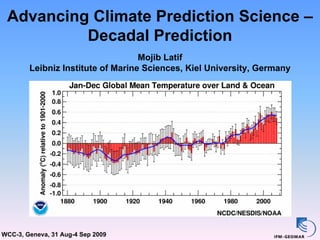
Advancing Climate Prediction Science –
          Decadal Prediction
                                   Mojib Latif
        Leibniz Institute of Marine Sciences, Kiel University, Germany


WCC-3, Geneva, 31 Aug-4 Sep 2009
Outline
    • Why decadal prediction
    • Mechanisms of decadal
      variability
    • What is the decadal
      predictability potential
    • Challenges
WCC-3, Geneva, 31 Aug-4 Sep 2009
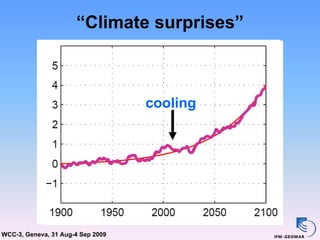
“Climate surprises”


                                   cooling


WCC-3, Geneva, 31 Aug-4 Sep 2009
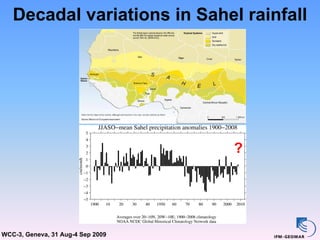
Decadal variations in Sahel rainfall


                                   ?


WCC-3, Geneva, 31 Aug-4 Sep 2009
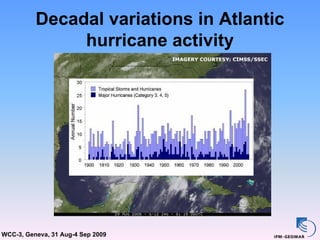
Decadal variations in Atlantic
               hurricane activity


WCC-3, Geneva, 31 Aug-4 Sep 2009
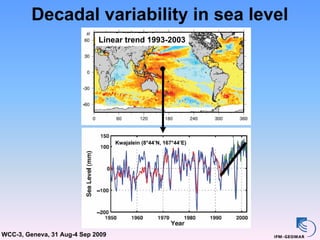
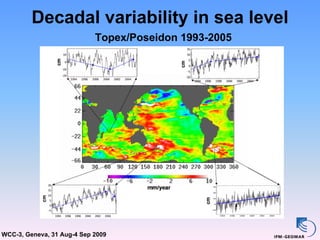
Decadal variability in sea level
                             Linear trend 1993-2003


                                   Kwajalein (8°44’N, 167°44’E)


WCC-3, Geneva, 31 Aug-4 Sep 2009
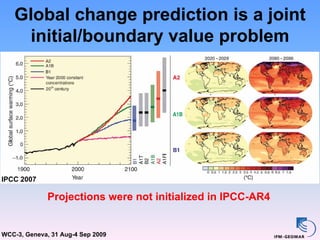
Global change prediction is a joint
    initial/boundary value problem


IPCC 2007

              Projections were not initialized in IPCC-AR4


WCC-3, Geneva, 31 Aug-4 Sep 2009
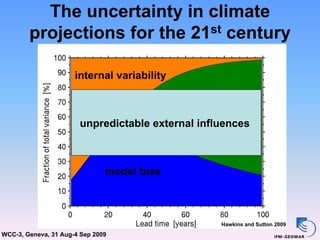
The uncertainty in climate
        projections for the 21st century

                      internal variability


                                          scenario
                       unpredictable external influences


                               model bias


                                                  Hawkins and Sutton 2009
WCC-3, Geneva, 31 Aug-4 Sep 2009
Outline
    • Why decadal prediction
    • Mechanisms of decadal
      variability
    • What is the decadal
      predictability potential
    • Challenges
WCC-3, Geneva, 31 Aug-4 Sep 2009
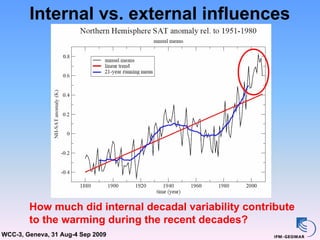
Internal vs. external influences


        How much did internal decadal variability contribute
        to the warming during the recent decades?
WCC-3, Geneva, 31 Aug-4 Sep 2009
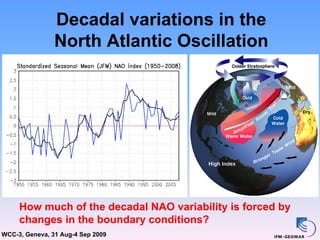
Decadal variations in the
                North Atlantic Oscillation


     How much of the decadal NAO variability is forced by
     changes in the boundary conditions?
WCC-3, Geneva, 31 Aug-4 Sep 2009
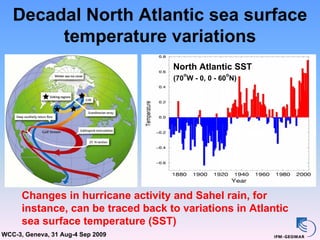
Decadal North Atlantic sea surface
        temperature variations
                                    North Atlantic SST
                                       o            o
                                    (70 W - 0, 0 - 60 N)


      Changes in hurricane activity and Sahel rain, for
      instance, can be traced back to variations in Atlantic
      sea surface temperature (SST)
WCC-3, Geneva, 31 Aug-4 Sep 2009
Outline
    • Why decadal prediction
    • Mechanisms of decadal
      variability
    • What is the decadal
      predictability potential
    • Challenges
WCC-3, Geneva, 31 Aug-4 Sep 2009
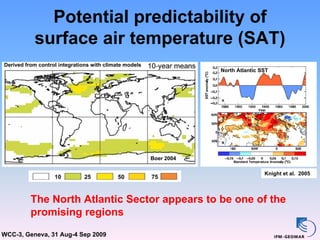
Potential predictability of
           surface air temperature (SAT)
Derived from control integrations with climate models
                                                                    North Atlantic SST


                                                        Boer 2004

                                                                                    Knight et al. 2005


          The North Atlantic Sector appears to be one of the
          promising regions
WCC-3, Geneva, 31 Aug-4 Sep 2009
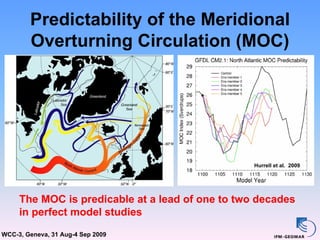
Predictability of the Meridional
        Overturning Circulation (MOC)


                                                  Hurrell et al. 2009


     The MOC is predicable at a lead of one to two decades
     in perfect model studies
WCC-3, Geneva, 31 Aug-4 Sep 2009
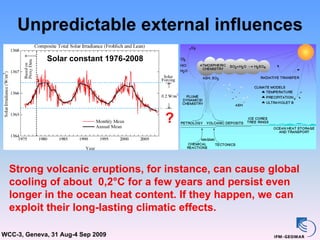
Unpredictable external influences
             Solar constant 1976-2008


                                        ?


  Strong volcanic eruptions, for instance, can cause global
  cooling of about 0,2°C for a few years and persist even
  longer in the ocean heat content. If they happen, we can
  exploit their long-lasting climatic effects.

WCC-3, Geneva, 31 Aug-4 Sep 2009
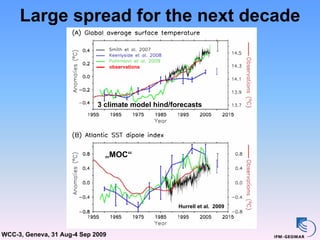
Large spread for the next decade

                                   observations


                             3 climate model hind/forecasts


                               „MOC“


                                                    Hurrell et al. 2009


WCC-3, Geneva, 31 Aug-4 Sep 2009
Outline
    • Why decadal prediction
    • Mechanisms of decadal
      variability
    • What is the decadal
      predictability potential
    • Challenges
WCC-3, Geneva, 31 Aug-4 Sep 2009
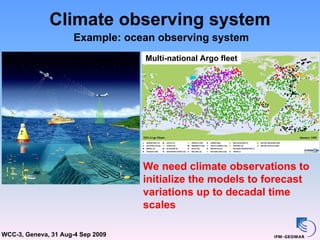
Climate observing system
                      Example: ocean observing system
                                   Multi-national Argo fleet


                                   We need climate observations to
                                   initialize the models to forecast
                                   variations up to decadal time
                                   scales

WCC-3, Geneva, 31 Aug-4 Sep 2009
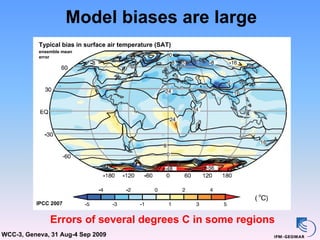
Model biases are large
           Typical bias in surface air temperature (SAT)
           ensemble mean
           error


          IPCC 2007


               Errors of several degrees C in some regions
WCC-3, Geneva, 31 Aug-4 Sep 2009
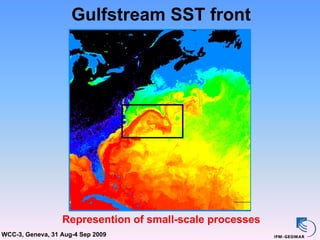
Gulfstream SST front


                  Represention of small-scale processes
WCC-3, Geneva, 31 Aug-4 Sep 2009
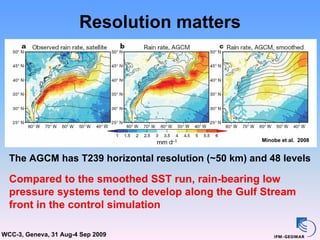
Resolution matters


                                                     Minobe et al. 2008


  The AGCM has T239 horizontal resolution (~50 km) and 48 levels

  Compared to the smoothed SST run, rain-bearing low
  pressure systems tend to develop along the Gulf Stream
  front in the control simulation

WCC-3, Geneva, 31 Aug-4 Sep 2009
Where are we today?
   • A decadal predictability potential for a number
     of societal relevant quantities is well
     established.
   • We need a better understanding of the
     mechanisms of decadal variability
   • We need a suitable climate observing system
     (ocean, land surface, sea ice...)
   • We need „good“ models! We know from NWP
     that reduction of systematic bias helps. Biases
     in climate models are still large

WCC-3, Geneva, 31 Aug-4 Sep 2009
To realize the full decadal
     predictability potential we need
     a coordinated scientific
     programme under the auspices
     of the World Climate Research
     Programme (WCRP)

    Thank you for your attention
WCC-3, Geneva, 31 Aug-4 Sep 2009
Decadal variability in sea level
                            Topex/Poseidon 1993-2005


WCC-3, Geneva, 31 Aug-4 Sep 2009

Advancing Climate Prediction Science – Decadal Prediction

  • 1.
    Advancing Climate PredictionScience – Decadal Prediction Mojib Latif Leibniz Institute of Marine Sciences, Kiel University, Germany WCC-3, Geneva, 31 Aug-4 Sep 2009
  • 2.
    Outline • Why decadal prediction • Mechanisms of decadal variability • What is the decadal predictability potential • Challenges WCC-3, Geneva, 31 Aug-4 Sep 2009
  • 3.
    “Climate surprises” cooling WCC-3, Geneva, 31 Aug-4 Sep 2009
  • 4.
    Decadal variations inSahel rainfall ? WCC-3, Geneva, 31 Aug-4 Sep 2009
  • 5.
    Decadal variations inAtlantic hurricane activity WCC-3, Geneva, 31 Aug-4 Sep 2009
  • 6.
    Decadal variability insea level Linear trend 1993-2003 Kwajalein (8°44’N, 167°44’E) WCC-3, Geneva, 31 Aug-4 Sep 2009
  • 7.
    Global change predictionis a joint initial/boundary value problem IPCC 2007 Projections were not initialized in IPCC-AR4 WCC-3, Geneva, 31 Aug-4 Sep 2009
  • 8.
    The uncertainty inclimate projections for the 21st century internal variability scenario unpredictable external influences model bias Hawkins and Sutton 2009 WCC-3, Geneva, 31 Aug-4 Sep 2009
  • 9.
    Outline • Why decadal prediction • Mechanisms of decadal variability • What is the decadal predictability potential • Challenges WCC-3, Geneva, 31 Aug-4 Sep 2009
  • 10.
    Internal vs. externalinfluences How much did internal decadal variability contribute to the warming during the recent decades? WCC-3, Geneva, 31 Aug-4 Sep 2009
  • 11.
    Decadal variations inthe North Atlantic Oscillation How much of the decadal NAO variability is forced by changes in the boundary conditions? WCC-3, Geneva, 31 Aug-4 Sep 2009
  • 12.
    Decadal North Atlanticsea surface temperature variations North Atlantic SST o o (70 W - 0, 0 - 60 N) Changes in hurricane activity and Sahel rain, for instance, can be traced back to variations in Atlantic sea surface temperature (SST) WCC-3, Geneva, 31 Aug-4 Sep 2009
  • 13.
    Outline • Why decadal prediction • Mechanisms of decadal variability • What is the decadal predictability potential • Challenges WCC-3, Geneva, 31 Aug-4 Sep 2009
  • 14.
    Potential predictability of surface air temperature (SAT) Derived from control integrations with climate models North Atlantic SST Boer 2004 Knight et al. 2005 The North Atlantic Sector appears to be one of the promising regions WCC-3, Geneva, 31 Aug-4 Sep 2009
  • 15.
    Predictability of theMeridional Overturning Circulation (MOC) Hurrell et al. 2009 The MOC is predicable at a lead of one to two decades in perfect model studies WCC-3, Geneva, 31 Aug-4 Sep 2009
  • 16.
    Unpredictable external influences Solar constant 1976-2008 ? Strong volcanic eruptions, for instance, can cause global cooling of about 0,2°C for a few years and persist even longer in the ocean heat content. If they happen, we can exploit their long-lasting climatic effects. WCC-3, Geneva, 31 Aug-4 Sep 2009
  • 17.
    Large spread forthe next decade observations 3 climate model hind/forecasts „MOC“ Hurrell et al. 2009 WCC-3, Geneva, 31 Aug-4 Sep 2009
  • 18.
    Outline • Why decadal prediction • Mechanisms of decadal variability • What is the decadal predictability potential • Challenges WCC-3, Geneva, 31 Aug-4 Sep 2009
  • 19.
    Climate observing system Example: ocean observing system Multi-national Argo fleet We need climate observations to initialize the models to forecast variations up to decadal time scales WCC-3, Geneva, 31 Aug-4 Sep 2009
  • 20.
    Model biases arelarge Typical bias in surface air temperature (SAT) ensemble mean error IPCC 2007 Errors of several degrees C in some regions WCC-3, Geneva, 31 Aug-4 Sep 2009
  • 21.
    Gulfstream SST front Represention of small-scale processes WCC-3, Geneva, 31 Aug-4 Sep 2009
  • 22.
    Resolution matters Minobe et al. 2008 The AGCM has T239 horizontal resolution (~50 km) and 48 levels Compared to the smoothed SST run, rain-bearing low pressure systems tend to develop along the Gulf Stream front in the control simulation WCC-3, Geneva, 31 Aug-4 Sep 2009
  • 23.
    Where are wetoday? • A decadal predictability potential for a number of societal relevant quantities is well established. • We need a better understanding of the mechanisms of decadal variability • We need a suitable climate observing system (ocean, land surface, sea ice...) • We need „good“ models! We know from NWP that reduction of systematic bias helps. Biases in climate models are still large WCC-3, Geneva, 31 Aug-4 Sep 2009
  • 24.
    To realize thefull decadal predictability potential we need a coordinated scientific programme under the auspices of the World Climate Research Programme (WCRP) Thank you for your attention WCC-3, Geneva, 31 Aug-4 Sep 2009
  • 25.
    Decadal variability insea level Topex/Poseidon 1993-2005 WCC-3, Geneva, 31 Aug-4 Sep 2009