1
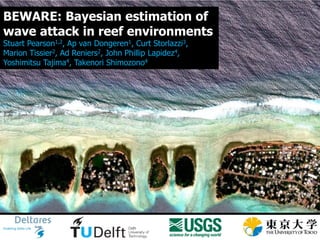
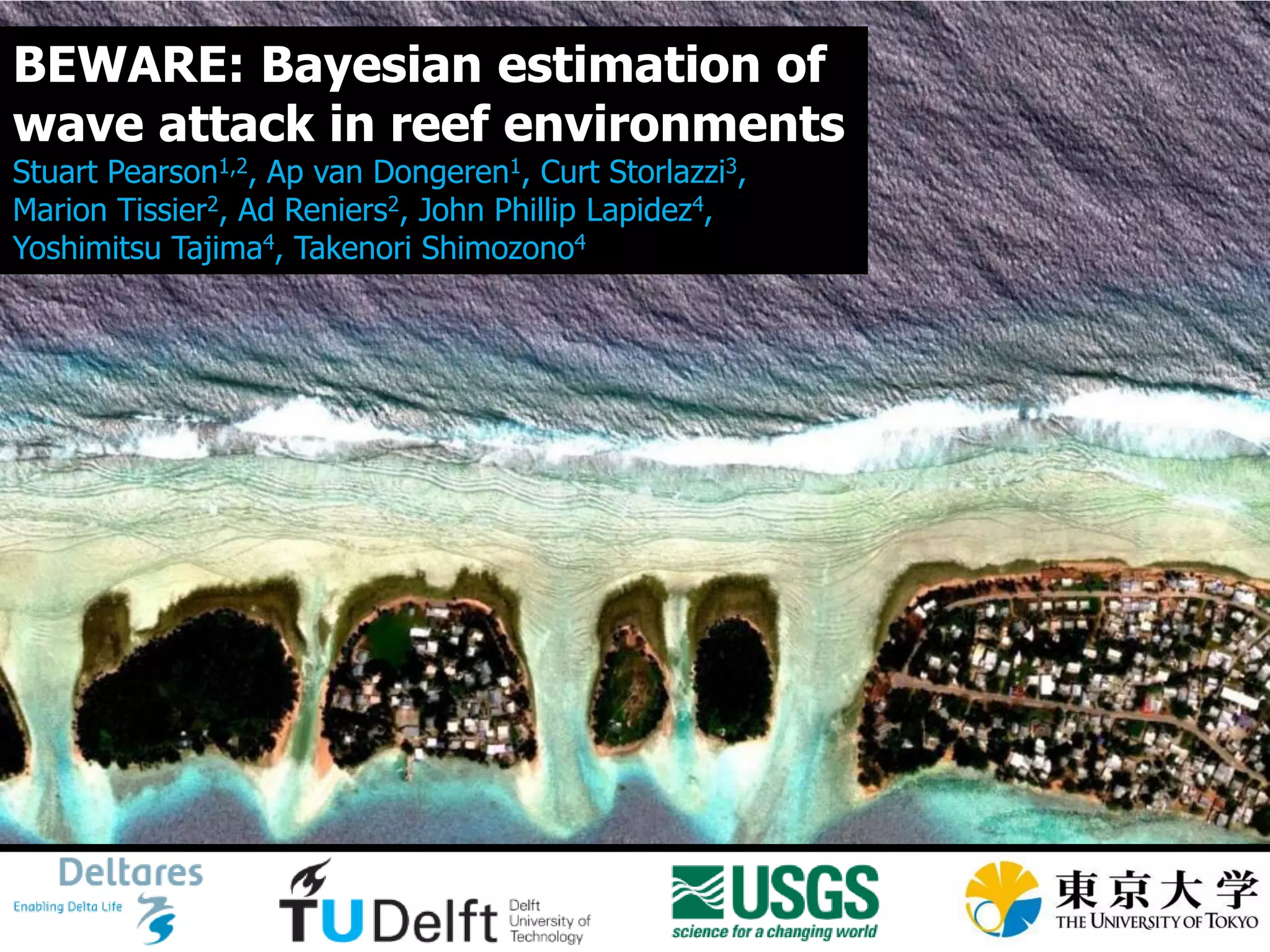
BEWARE: Bayesian estimation of
wave attack in reef environments
Stuart Pearson1,2, Ap van Dongeren1, Curt Storlazzi3,
Marion Tissier2, Ad Reniers2, John Phillip Lapidez4,
Yoshimitsu Tajima4, Takenori Shimozono4
Background
2
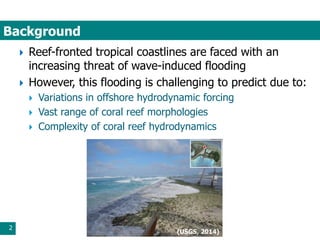
 Reef-fronted tropical coastlines are faced with an
increasing threat of wave-induced flooding
 However, this flooding is challenging to predict due to:
 Variations in offshore hydrodynamic forcing
 Vast range of coral reef morphologies
 Complexity of coral reef hydrodynamics
(USGS, 2014)
Methodology: XBeach Non-Hydrostatic
3
 Limited field data available!
 Need to generate synthetic dataset
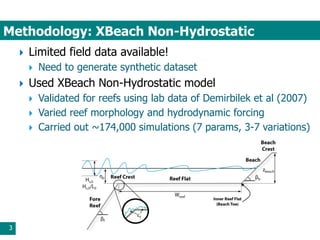
 Used XBeach Non-Hydrostatic model
 Validated for reefs using lab data of Demirbilek et al (2007)
 Varied reef morphology and hydrodynamic forcing
 Carried out ~174,000 simulations (7 params, 3-7 variations)
Idealized Reef
Profile
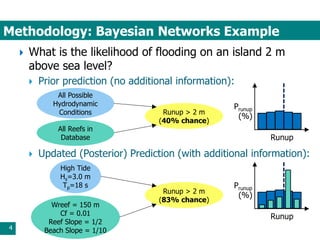
Methodology: Bayesian Networks Example
4
 What is the likelihood of flooding on an island 2 m
above sea level?
 Prior prediction (no additional information):
 Updated (Posterior) Prediction (with additional information):
High Tide
Hs=3.0 m
Tp=18 s
Wreef = 150 m
Cf = 0.01
Reef Slope = 1/2
Beach Slope = 1/10
Runup > 2 m
(83% chance)
All Possible
Hydrodynamic
Conditions
All Reefs in
Database
Runup > 2 m
(40% chance)
Prunup
(%)
Runup
Prunup
(%)
Runup
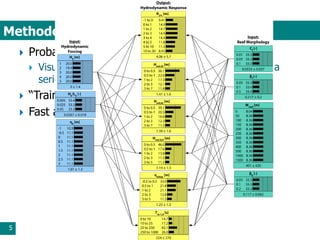
 Probabilistic graphical model
 Visually represents conditional probabilities through a
series of nodes and connections
 “Trained” using real or synthetic dataset
 Fast and proven in other coastal contexts
Methodology: Bayesian Network
5
𝐻 𝑉𝐿𝐹
Hydrodynamic
Forcing
Reef
Morphology
Hazard Outputs
𝜂0
𝜂
𝛽𝑓
𝛽 𝑏
𝑐𝑓
𝑊𝑟𝑒𝑒𝑓
𝐻0
𝐻0 𝐿0
𝐻 𝑆𝑆
𝐻IG
𝑅2
%
𝑇 𝑚−1,0
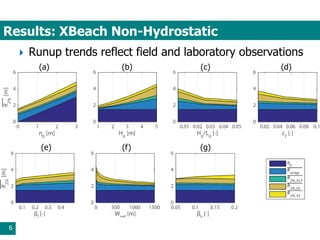
Results: XBeach Non-Hydrostatic
6
 Runup trends reflect field and laboratory observations
(a) (b) (c) (d)
(e) (f) (g)
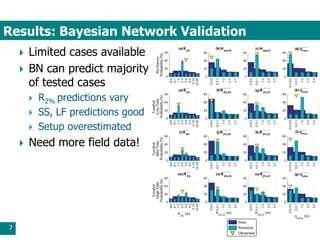
Results: Bayesian Network Validation
7
 Limited cases available
 BN can predict majority
of tested cases
 R2% predictions vary
 SS, LF predictions good
 Setup overestimated
 Need more field data!
Ongoing: Application to Typhoon Meranti in Philippines
8
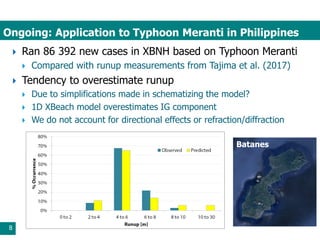
 Ran 86 392 new cases in XBNH based on Typhoon Meranti
 Compared with runup measurements from Tajima et al. (2017)
 Tendency to overestimate runup
 Due to simplifications made in schematizing the model?
 1D XBeach model overestimates IG component
 We do not account for directional effects or refraction/diffraction
Batanes
Results: Bayesian Network Predictive Skill
9
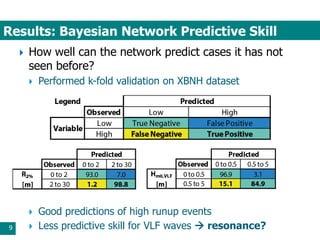
 How well can the network predict cases it has not
seen before?
 Performed k-fold validation on XBNH dataset
 Good predictions of high runup events
 Less predictive skill for VLF waves  resonance?
Results: Log-Likelihood Ratios
10
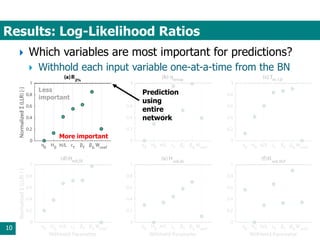
 Which variables are most important for predictions?
 Withhold each input variable one-at-a-time from the BN
More complex
process?
Less
important
More important
Prediction
using
entire
network
Conclusions
11
 XBNH can reproduce wave transformation processes on
fringing reefs, including resonant reef flat amplification
 BEWARE shows high predictive skill for flooding
conditions from the XBNH model
 Validated for a limited number of case studies
 Offshore wave conditions, water level, and reef width are
the most important parameters to estimate flood hazards
 Having knowledge of the reef roughness or beach slope
appears less important
 BEWARE can form the basis for early-warning systems
and scenario assessment applications on reef-lined coasts
 e.g. SLR, wave climate, reef restoration scenarios
 Couple with 2D inundation models and damage estimators
Recommendations
12
 Collect more validation data
 Small-Scale
 Field measurements of hydrodynamics (especially runup)
 e.g. Estimates of storm impacts and flooding
 Large-Scale
 Need more data on reef morphology & offshore forcing
 e.g. Remote sensing of reef flats, offshore waves
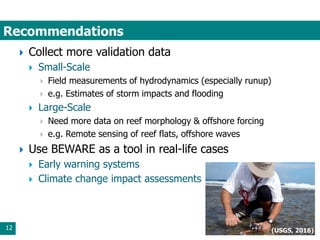
 Use BEWARE as a tool in real-life cases
 Early warning systems
 Climate change impact assessments
(USGS, 2016)
Further Information
13
 BEWARE Database:
 Available online soon (or by request: s.g.pearson@tudelft.nl)
 Related Publications:
 Pearson, S. G.; C.D. Storlazzi; A.R. van Dongeren; M.F.S. Tissier; and
A.J.H.M. Reniers. 2017. “A Bayesian-Based System to Assess Wave-
Driven Flooding Hazards on Coral Reef-Lined Coasts.” Journal of
Geophysical Research: Oceans (In Press).
 Tajima, Y.; J.P. Lapidez; J. Camelo; M. Saito; Y. Matsuba; T. Shimozono;
D. Bautista; M. Turiano; and E Cruz. 2017. “Post-Disaster Survey of
Storm Surge and Waves Along the Coast of Batanes, the
Philippines, Caused by Super Typhoon Meranti/Ferdie.” Coastal
Engineering Journal 59 (1): 1750009.
Thank you for your time!

DSD-INT 2017 Beware: Bayesian Estimation Of Wave Attack In Reef Environments - Pearson

  • 1.
    1 BEWARE: Bayesian estimationof wave attack in reef environments Stuart Pearson1,2, Ap van Dongeren1, Curt Storlazzi3, Marion Tissier2, Ad Reniers2, John Phillip Lapidez4, Yoshimitsu Tajima4, Takenori Shimozono4
  • 2.
    Background 2  Reef-fronted tropicalcoastlines are faced with an increasing threat of wave-induced flooding  However, this flooding is challenging to predict due to:  Variations in offshore hydrodynamic forcing  Vast range of coral reef morphologies  Complexity of coral reef hydrodynamics (USGS, 2014)
  • 3.
    Methodology: XBeach Non-Hydrostatic 3 Limited field data available!  Need to generate synthetic dataset  Used XBeach Non-Hydrostatic model  Validated for reefs using lab data of Demirbilek et al (2007)  Varied reef morphology and hydrodynamic forcing  Carried out ~174,000 simulations (7 params, 3-7 variations) Idealized Reef Profile
  • 4.
    Methodology: Bayesian NetworksExample 4  What is the likelihood of flooding on an island 2 m above sea level?  Prior prediction (no additional information):  Updated (Posterior) Prediction (with additional information): High Tide Hs=3.0 m Tp=18 s Wreef = 150 m Cf = 0.01 Reef Slope = 1/2 Beach Slope = 1/10 Runup > 2 m (83% chance) All Possible Hydrodynamic Conditions All Reefs in Database Runup > 2 m (40% chance) Prunup (%) Runup Prunup (%) Runup
  • 5.
     Probabilistic graphicalmodel  Visually represents conditional probabilities through a series of nodes and connections  “Trained” using real or synthetic dataset  Fast and proven in other coastal contexts Methodology: Bayesian Network 5 𝐻 𝑉𝐿𝐹 Hydrodynamic Forcing Reef Morphology Hazard Outputs 𝜂0 𝜂 𝛽𝑓 𝛽 𝑏 𝑐𝑓 𝑊𝑟𝑒𝑒𝑓 𝐻0 𝐻0 𝐿0 𝐻 𝑆𝑆 𝐻IG 𝑅2 % 𝑇 𝑚−1,0
  • 6.
    Results: XBeach Non-Hydrostatic 6 Runup trends reflect field and laboratory observations (a) (b) (c) (d) (e) (f) (g)
  • 7.
    Results: Bayesian NetworkValidation 7  Limited cases available  BN can predict majority of tested cases  R2% predictions vary  SS, LF predictions good  Setup overestimated  Need more field data!
  • 8.
    Ongoing: Application toTyphoon Meranti in Philippines 8  Ran 86 392 new cases in XBNH based on Typhoon Meranti  Compared with runup measurements from Tajima et al. (2017)  Tendency to overestimate runup  Due to simplifications made in schematizing the model?  1D XBeach model overestimates IG component  We do not account for directional effects or refraction/diffraction Batanes
  • 9.
    Results: Bayesian NetworkPredictive Skill 9  How well can the network predict cases it has not seen before?  Performed k-fold validation on XBNH dataset  Good predictions of high runup events  Less predictive skill for VLF waves  resonance?
  • 10.
    Results: Log-Likelihood Ratios 10 Which variables are most important for predictions?  Withhold each input variable one-at-a-time from the BN More complex process? Less important More important Prediction using entire network
  • 11.
    Conclusions 11  XBNH canreproduce wave transformation processes on fringing reefs, including resonant reef flat amplification  BEWARE shows high predictive skill for flooding conditions from the XBNH model  Validated for a limited number of case studies  Offshore wave conditions, water level, and reef width are the most important parameters to estimate flood hazards  Having knowledge of the reef roughness or beach slope appears less important  BEWARE can form the basis for early-warning systems and scenario assessment applications on reef-lined coasts  e.g. SLR, wave climate, reef restoration scenarios  Couple with 2D inundation models and damage estimators
  • 12.
    Recommendations 12  Collect morevalidation data  Small-Scale  Field measurements of hydrodynamics (especially runup)  e.g. Estimates of storm impacts and flooding  Large-Scale  Need more data on reef morphology & offshore forcing  e.g. Remote sensing of reef flats, offshore waves  Use BEWARE as a tool in real-life cases  Early warning systems  Climate change impact assessments (USGS, 2016)
  • 13.
    Further Information 13  BEWAREDatabase:  Available online soon (or by request: s.g.pearson@tudelft.nl)  Related Publications:  Pearson, S. G.; C.D. Storlazzi; A.R. van Dongeren; M.F.S. Tissier; and A.J.H.M. Reniers. 2017. “A Bayesian-Based System to Assess Wave- Driven Flooding Hazards on Coral Reef-Lined Coasts.” Journal of Geophysical Research: Oceans (In Press).  Tajima, Y.; J.P. Lapidez; J. Camelo; M. Saito; Y. Matsuba; T. Shimozono; D. Bautista; M. Turiano; and E Cruz. 2017. “Post-Disaster Survey of Storm Surge and Waves Along the Coast of Batanes, the Philippines, Caused by Super Typhoon Meranti/Ferdie.” Coastal Engineering Journal 59 (1): 1750009. Thank you for your time!