http://www.free-powerpoint-templates-design.com
Zirconia Based
Ceramics
By:
Radwa Ibrahim El-Tahawi
Contents
1 Introduction
2
3 Yttria-Stabilized Zirconia
4
ZrO2 Properties
Manufacturing
Contents
5 Monolithic Zirconia
6
7 Monolithic Vs. Veneered Zirconia
8
Veneered Zirconia
Zirconia Implant Surface Treatments
Introduction
Ceramics
What does it mean?
• The word ‘ceramic’ is derived from the Greek word keramos, which means pottery or
burnt article.
• Today, the word ‘ceramic’ has a more expansive meaning; they are generally
inorganic, nonmetallic solids synthesized by proper heat treatment and subsequent
cooling. They are related to a combination of covalent, ionic, and seldom metallic
bonding.
• Ceramic materials may be crystalline, partly crystalline or non-crystalline.
• Crystalline ceramics are composed of either pure or glass ceramics.
• ZrO2 based ceramics have been considered to be very important materials for
medical device applications.
Evolution of ZrO2
What does it mean?
• Zirconium is a transition metal element.
• Zirconia (ZrO2) is an oxidized form of the zirconium metal, just as alumina (Al2O3)
is an oxidized form of aluminum metal.
• It has a pure crystalline form as a white and ductile metal and it has an
amorphous form as a blue-black powder.
• Even it is the 18-th element in earth crust as spreading, zirconium may be found in
nature only combined with silicate oxides or as a free oxide.
ZrO2 Transformation
Stress-Induced Transformation
• Zirconia may exist in several crystal types (phases), depending on the addition of
minor components such as calcia (CaO), magnesia (MgO), yttria (Y2O3), or ceria
(CeO2).
• These phases are stabilized at room temperature by the minor components.
• If the right amount of component is added, one can produce a fully stabilized cubic
phase—the infamous cubic zirconia jewelry.
• If smaller amounts are added, 3 wt% to 5 wt%, a partially stabilized zirconia is
produced.
Evolution of ZrO2
What does it mean?
• ZrO2 is a bioceramic material that was first investigated by the German chemist
Martin Heinrich Klaproth in 1789.
• The first research paper on the use of ZrO2 as a biomaterial was published by
Helmer and Driskel in 1969.
• The use of ZrO2 in dental restoration applications has been a practice since 1998.
• Recently, the use of ZrO2 based ceramics as a biomaterial for implants and dental
crowns in dentistry has risen significantly, due to its superior mechanical
properties, biocompatibility, and its very high wear resistance and friction.
• Therefore, ZrO2 takes a remarkable place amongst the various oxide ceramics.
Evolution of ZrO2
What does it mean?
• Zirconia occurs in three phases: monoclinic (m), cubic (c), and tetragonal (t).
• In pure ZrO2 the monoclinic phase is stable up to 1170°C;
• but the transformation on cooling appear 100°C below 1170°C.
• When it cools down it has a volumetric expansion of 3-4%.
• The cracks may appear as this volume change is sufficient to exceed the elastic
limit of the ZrO2.
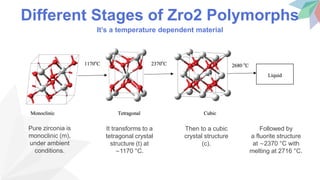
Different Stages of Zro2 Polymorphs
It’s a temperature dependent material
Pure zirconia is
monoclinic (m),
under ambient
conditions.
It transforms to a
tetragonal crystal
structure (t) at
∼1170 °C.
Then to a cubic
crystal structure
(c).
Followed by
a fluorite structure
at ∼2370 °C with
melting at 2716 °C.
ZrO2 Transformation
Stress-Induced Transformation
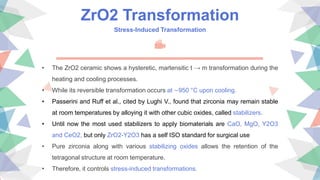
• The ZrO2 ceramic shows a hysteretic, martensitic t → m transformation during the
heating and cooling processes.
• While its reversible transformation occurs at ∼950 °C upon cooling.
• Passerini and Ruff et al., cited by Lughi V., found that zirconia may remain stable
at room temperatures by alloying it with other cubic oxides, called stabilizers.
• Until now the most used stabilizers to apply biomaterials are CaO, MgO, Y2O3
and CeO2, but only ZrO2-Y2O3 has a self ISO standard for surgical use
• Pure zirconia along with various stabilizing oxides allows the retention of the
tetragonal structure at room temperature.
• Therefore, it controls stress-induced transformations.
Transformation Toughening
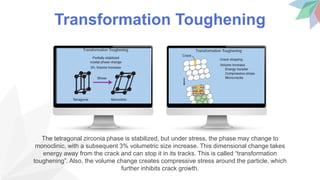
The tetragonal zirconia phase is stabilized, but under stress, the phase may change to
monoclinic, with a subsequent 3% volumetric size increase. This dimensional change takes
energy away from the crack and can stop it in its tracks. This is called “transformation
toughening”. Also, the volume change creates compressive stress around the particle, which
further inhibits crack growth.
Transformation Toughening
• It helps give zirconia its excellent
mechanical properties:
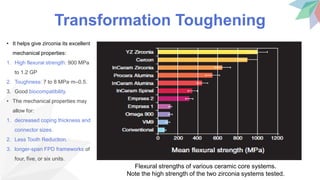
1. High flexural strength: 900 MPa
to 1.2 GP
2. Toughness: 7 to 8 MPa·m–0.5.
3. Good biocompatibility.
• The mechanical properties may
allow for:
1. decreased coping thickness and
connector sizes.
2. Less Tooth Reduction.
3. longer-span FPD frameworks of
four, five, or six units.
Flexural strengths of various ceramic core systems.
Note the high strength of the two zirconia systems tested.
ZrO2 Properties
Biocompatibility
Advantages
• After extensive evaluations of zirconia’s biocompatibility no local or systemic
cytotoxic effects or adverse reactions have been found.
• The bone response of zirconia in vivo and the inflammation adjacent to zirconia
have been shown to be acceptable. Additionally, bacteria and pathogen seem to
adhere to zirconia just as much as other materials do.
Optical Properties
Advantages
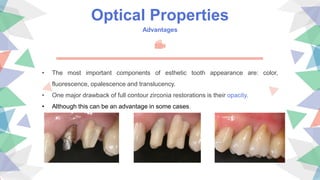
• The most important components of esthetic tooth appearance are: color,
fluorescence, opalescence and translucency.
• One major drawback of full contour zirconia restorations is their opacity.
• Although this can be an advantage in some cases.
Optical Properties
Advantages
• This opacity is due to the grain size is greater than the length of light plus that
zirconia has high refractive index, low absorption coefficient and high opacity in
the visible and infrared spectrum.
• How to solve these problems to give restorations like natural teeth?
1. Covering with translucent glassy ceramic.
2. Changes in size and distribution of grains.
3. Machining blocks.
4. Additives, stabilizers and pigments.
Translucency
Advantages
• Lately, colored zirconia with improved translucency has been developed to closely
match colors of human teeth.
• The flexural strength of this new material is 900-1400 MPa and has a fracture
resistance of up to 6 MPam 1/2.
• These conveniences have made zirconia being used more and more for crowns
and bridges in lateral applications.
• For excellent esthetics, it is important to reproduce the translucency of the natural
tooth, as it provides an enchanted natural appearance of the prosthetics.
Translucency
Advantages
• Translucency is the substance property that allows the passage of light and its
dispersion, and then the objects will not be seen clearly through the material.
• This property could be defined as a state between transparency and complete
opacity.
• Translucency can be regulated by controlling the absorption, reflection, and
transmission of light through the material.
• The translucency is higher when the reluctance is low and the transmission is high.
• In a few studies it has been reported that translucency is affected by the layer’s
thickness and by the grain size.
X-ray Opacity
Advantages
• The dental restorative materials have different degrees of opacity which provides
helpful information for diagnose.
• The zirconia can be added in dental filling composite materials because it
represents an X-ray opaque agent.
• In a study conducted in order to assess the X-ray opacity of zirconia, four different
materials (pure titanium, NANOZR, Y-TZP, alumina plates) with the same
thickness (0,2-2mm) and human tooth were tested against an X-ray agent.
• It has been found that Y-TZP and NANOZR showed increased radiopacity.
Wear Behavior
Advantages
• It is important to assess the wear behavior of monolithic zirconia restorations, but
of a bigger clinical importance is the wear of the enamel of natural antagonists
teeth opposed to the zirconia material.
• Progressive wear of teeth is a normal manifestation in the human dentition. Many
factors contribute to the dental wear such as food, bruxism, the oral muscles
forces, enamel thickness and hardness, pH and nature of the saliva and the
dental materials.
• All these factors have different wear behavior which modifies the wear process.
Wear Behavior
Advantages
• The physiological wear is altered when we use restorative materials with different
wear rates.
• A small amount of studies has tried to explain the influence of zirconia ceramic
directly on enamel wear.
• From the in vitro studies we have reached the conclusion that there seems to be
an agreement that polished full zirconia crowns have the lowest mean weight loss
values of the antagonistic human enamel and this strongly related to its very
smooth surface that increases its biologic compatibility and lowers its
abrasiveness and results in a decreased level of antagonistic wear than other
ceramics.
Wear Behavior
Advantages
• After glazing and polishing and one final glazing zirconia presented important
opposing enamel wear, and while the veneering ceramic exhibit even more
important wear on the antagonist.
• However further clinical studies are required to support the results of the in vitro
testing.
In Low Temperature
Degradation (LTD)
• Although zirconia has a lot of advantages as a dental material a process called
low temperature degradation (LTD) occurs in vivo.
• Studies conducted present LTD as an ageing process of zirconia, referring to the
surface degradation with the grain pullout and a subsequently micro cracking of
the structure mainly due to the presence of water.
In Low Temperature
Degradation (LTD)
• Usually, LTD begins at the surface of polycrystalline zirconia and then it will
develop within the depth of the material.
• The transformation of one grain is followed by an expansion in volume and will
lead to micro-cracking and modifications to the other grains.
• This process of surface degradation is emphasized by the penetration of water
and this transformation progresses from one grain to the next.
• This progression of the conversion zone determines severe micro-cracking, grain
pullout and, in the end, surface roughening, which finally determine a lower
strength of the entire piece.
In Low Temperature
Degradation (LTD)
• Any factor like the grain size, the stabilizer quantity or the residual stresses may
be disadvantageous to the stability of tetragonal zirconia and a certain
degradation degree may occur at low temperatures.
• Kobayashi et al. reported that a slow t→m transformation from the metastable
tetragonal phase to a more stable monoclinic phase can happen when the
humidity raises even with low temperatures and leads to potential micro cracking
and decreasing strength of zirconia.
In Low Temperature
Degradation (LTD)
• The experimental observations on ageing have been briefed by Yoshimura cited
by Lawson.
• Thus, it seems that the degradation depends on the time and occurs most rapidly
at temperatures of 200-300°C.
• Even it is caused by the tetragonal-monoclinic transformation, the phenomenon is
always accompanied by micro- and macro-cracking.
• The process develops from the exterior and continues inside the sample.
In Low Temperature
Degradation (LTD)
• In the presence of water the transformation develops faster.
• The transformation may be slowed of it is used a lower grain size and a bigger
amount of stabilizer.
• Another study conducted by Sebastian Wille et al. showed that the same ageing
process (LTD) occurs also in shaded zirconia.
• The coloring method has no significant influence on the phase transformation
proportions and the flexural strength during LTD.
• It was concluded that the ratio of the phase transformation of zirconia due to low
temperature depends on the time elapsed.
ZrO2 Properties
Advantages
• It is reported that ZrO2 has:
1. High temperature stability and melting point (2680 °C).
2. High hardness (1200–1350 HVN).
3. High thermal expansion coefficient (>10 × 10–6 K−1).
4. Low thermal conductivity (<1 W m−1 K−1).
5. High thermo-shock resistance (ΔT = 400–500 °C).
Yttria-stabilized
Zirconia (Y-TZP)
Yttria-stabilized
Zirconia (Y-TZP)
• Today, in dentistry, it is usually used a modified yttria (Y2O3) tetragonal
zirconia polycrystalline (Y-TZP), because it has great mechanical
properties and very good tear resistance than other regular ceramic mass.
• The addition of yttria is meant to stabilize the transformation of the
crystalline structure under the conditions of increased temperature, but
also to improve the physical properties of zirconium.
• Thus, the Y-TZP may reach 1000 Mpa while the fracture toughness of 4-5
MPa is also superior to the regular dental ceramics.
• One characteristic of Y-TZP zirconia is especially this high resistance to
fractures because the tetragonal beads are transformed from the
monoclinic phase, which leads to the compression of the forces around
the defects, preventing their propagation.
Yttria-stabilized
Zirconia (Y-TZP)
Yttria-stabilized
Zirconia (Y-TZP)
• While the first integral ceramic dental restorations were limited to single-
tooth restorations or small bridges, these zirconia structures may be used
in larger prosthesis both in the anterior or posterior region of the oral cavity
being one of the few aesthetic solutions that can be used in the lateral
area.
• All of which added to classical uses like posts and cores or more recently
as a material for dental implants.
Manufacturing
Manufacturing
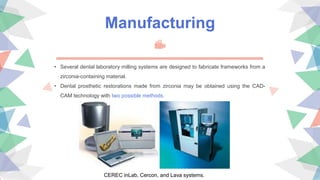
• Several dental laboratory milling systems are designed to fabricate frameworks from a
zirconia-containing material.
• Dental prosthetic restorations made from zirconia may be obtained using the CAD-
CAM technology with two possible methods.
CEREC inLab, Cercon, and Lava systems.
Manufacturing
• One is to mill 100% dense, sintered zirconia directly.
• This approach requires a rigid milling unit, which translates to a large,
heavy machine, as it is difficult to machine dense zirconia.
• Milling time for a coping range from about 2 to 4 hours.
• This approach has an advantage in that no post-milling sintering is
required.
• There is no shrinkage; what you see is what you get.
• The obvious drawback is the extended milling time and wear of the milling
burs.
Manufacturing
• But there are some disadvantages such as:
1. Reduced life-time of the burs, due to their great wear.
2. Numerous flaws that occur during the machining that may diminish the
mechanical properties of the final prosthesis.
• In this method the Y-TZP blocks are subjected to a first sinterisation at
temperatures below 15000C increase their density.
• Then the blocks are subjected to a high pressure at the same
temperatures in an inert gas atmosphere, which allow the obtaining of a
very high density of more than 99% of the the oretical one.
Manufacturing
• Another approach is to mill a partially fired zirconia block.
• The blocks are about 50% dense.
• Because they are only partially fired, the blocks are weak but easy to mill.
• However, the milled framework must be fired for 6 to 8 hours to increase
the density of the restoration.
• A large amount of shrinkage occurs, and this must be compensated for
during the milling process.
Manufacturing
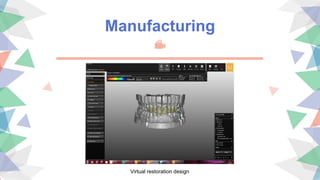
Virtual restoration design
Manufacturing
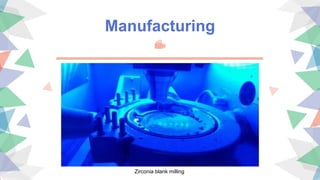
Zirconia blank milling
Manufacturing
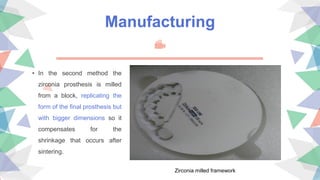
• In the second method the
zirconia prosthesis is milled
from a block, replicating the
form of the final prosthesis but
with bigger dimensions so it
compensates for the
shrinkage that occurs after
sintering.
Zirconia milled framework
Manufacturing
• Oversized frameworks are fabricated, relying on a computer to enlarge the
pattern correctly to compensate for shrinkage and provide a reliable fit.
• Each block has a barcode containing the density for that block.
• The milling system then computes the proper degree of oversizing needed
to compensate for the shrinkage to full density.
• Thus, the homogeneity of the block and density measurement is a key to
the success of this approach.
Manufacturing
• Then, the ceramic is fired and the framework contracts to the final
dimension.
• The non-sintered zirconia blanks result following a cold pressing process
that compacts the zirconia powders.
• In this way we obtain a very small pore size and a good distribution of the
components within the blank.
• The next step is machining by immersion in solutions of various metal
(cerium, bismuth, iron or a combination) and the coloring of the
restorations.
• As it goes through the last sintering phase the color is developed.
Manufacturing
• As it goes through the last sintering phase the color is developed.
• The solution concentration has a direct impact on the final shade.
• A satisfactory coloration can be obtained using concentrations as low as
0.01mol%.
• For a good result we must follow the manufacturer’s instructions as the
final sintering temperature influences the color obtained.
• The zirconia framework acquires its final mechanical properties at the end
of the sintering process when it suffers a contraction at about 25%, which
means it returns to its correct dimensions.
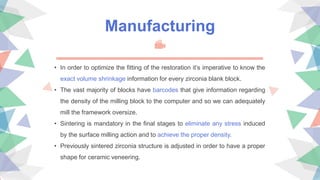
• In order to optimize the fitting of the restoration it’s imperative to know the
exact volume shrinkage information for every zirconia blank block.
• The vast majority of blocks have barcodes that give information regarding
the density of the milling block to the computer and so we can adequately
mill the framework oversize.
• Sintering is mandatory in the final stages to eliminate any stress induced
by the surface milling action and to achieve the proper density.
• Previously sintered zirconia structure is adjusted in order to have a proper
shape for ceramic veneering.
Manufacturing
• Vita YZ, Cercon, and Lava take this approach, which is somewhat similar
to the Procera technique in that compensation for shrinkage of the
oversized framework must be performed.
• All of these materials are about 95% zirconia, with the rest made up of
yttria and some natural impurities.
Manufacturing
Portfolio Presentation
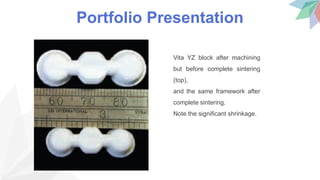
Vita YZ block after machining
but before complete sintering
(top),
and the same framework after
complete sintering.
Note the significant shrinkage.
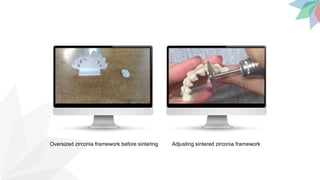
Oversized zirconia framework before sintering Adjusting sintered zirconia framework
Layering Ceramics on
Zirconia Framework
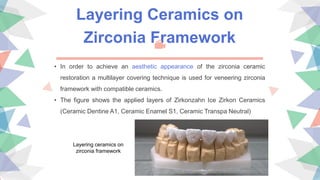
• In order to achieve an aesthetic appearance of the zirconia ceramic
restoration a multilayer covering technique is used for veneering zirconia
framework with compatible ceramics.
• The figure shows the applied layers of Zirkonzahn Ice Zirkon Ceramics
(Ceramic Dentine A1, Ceramic Enamel S1, Ceramic Transpa Neutral)
Layering ceramics on
zirconia framework
Zirconia Ceramics
Final Restoration
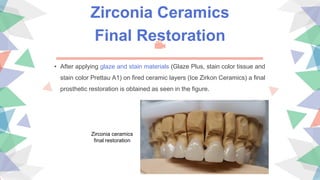
• After applying glaze and stain materials (Glaze Plus, stain color tissue and
stain color Prettau A1) on fired ceramic layers (Ice Zirkon Ceramics) a final
prosthetic restoration is obtained as seen in the figure.
Zirconia ceramics
final restoration
• The manufacturing process took a few days due to specificity of materials
used and fabrication.
• Through CAD/CAM implementation this final dental restoration was done
in an effective way due to prompt framework digital design, precise milling
and adjustment of zirconia framework.
• After veneering, the obtained zirconia ceramic restoration met all aesthetic
requirements mainly thanks to zirconia framework properties.
Manufacturing
• Compared to the alternative methods, milling full blocks of sintered
zirconia takes a lot of time.
• This is costlier because requires a more frequent change of the diamond
burs.
• That is why non-sintered zirconia can be considered a more convenient
solution.
Manufacturing
Monolithic Zirconia
Monolithic Zirconia
• It is full zirconia (crown, bridge, implant, inlay, only) with no porcelain
overlay
• Used in cases of bruxism and grinding
• N.B:
• As the restoration after milling appear chalky white blocks that need
staining by two ways:
• 1- Monochrome tech.
• 2- Gradient shading tech.
Monolithic Zirconia
1. Monochrome tech.
• As the restoration porous can absorb the stain when it soaked in it for 2
min
2. Gradient shading tech.
 Three zones:
a. The unstained restoration is first brushed with the desired final color
around the cervical zone
b. The body of the crown brushed with desired shade
c. Effect shade used in the occlusal surface of the crown
Veneered Zirconia
Zirconia Veneering Techniques
• How to improve bond between core and veneer?
• Sandblasting or laser surface treatment of zirconia surface to increase
mechanical interlocking
• Zirconia veneering techniques:
1. Layering
2. Rapid layering
3. Press on
4. CAD on
Zirconia Veneering Techniques
1. Layering:
• Application of slurry of porcelain by condensation technique.
• Excellent esthetic and high bond strength
• Firing affect the crystalline structure
Zirconia Veneering Techniques
2- Press- on:
• Fabrication of wax pattern on top of the framework, spruing, investing,
pressing thin divesting, despruing, finishing and staining.
• Advantages:
1. Easy shaping, allow desired tooth anatomy
2. Decrease firing shrinkage and high tensile strength
3. Superior bond quality.
Zirconia Veneering Techniques
2- Press- on:
• Disadvantages:
1. This technique allow single color monochromatic restoration
• NB.
1. Solve this problem a double veneer technique.
2. Coefficient of thermal expansion of veneering ceramic must be slight
lower the zirconia to prevent residual stress on the crown
Zirconia Veneering Techniques
3- CAD - on technique:
• Using IPS e. max CAD veneering structure to IPS e. max Zir CAD
framework utilizing IPS e. max CAD crystall ∕ connect (fusion glass
ceramic) required for bond
• High fracture strength and bond strength
Zirconia Veneering Techniques
4- Rapid layering technique:
• Using adhesive resin cement to make the bond between the zirconia
framework and veneering porcelain
• The veneer and zirconia are milled
• Framework sandblasted and the veneer stained, glazed, acid etched and
Silanization
Pretreatments Techniques
I. Chemical surface treatments
II. Mechanical surface treatments
III. Alternative treatments
• NB: as high crystalline content and limited vitreous phase acid etching
and silanization is not effective.
I- Chemical Surface Treatments
1- Hot Chemical Etching Solution:
• Using hot etching solution (1000 ºc) for 10 min to create micro- retention
on the surface by modifying the grain boundaries as removal of less
arranged high energy peripheral atoms.
I- Chemical Surface Treatments
2- Silane Coupling Agents
• Using ceramic primer containing functional monomers such as MDP
which has chemical affinity for metal oxides to increase bonding between
zirconia and resin cement.
I- Chemical Surface Treatments
3- Nanostructured Alumina Coating
• As precipitating on surface of zirconia result in nanostructured coating
consist of interconnected polycrystalline lamellas that grow perpendicular
to zirconia surface.
II- Mechanical Surface Treatment
1- Air Abrasion With Aluminum Oxide Particles
• Cleaning, roughening and activation the surface by air abrasion with 50-
100 μm at 0.25 MPa
II- Mechanical Surface Treatment
2- Silica Coating Techniques
a. Tribochemical silica coating
b. A solution- gelation (sol- Gel) process
c. Vapor- phase deposition technique
d. In situ silica nanoparticle surface deposition
e. Plasma spray technique
f. Thermal silicatization
2- Silica Coating Techniques
A. Tribochemical Silica Coating
• 30—110 μm silica- coating aluminum oxide application to zirconia
surface
2- Silica Coating Techniques
B. Sol- Gel Process
• A layer of silica film is formed by brushing a layer of nano silica solution
then adding a drop of hydroxide which air dried for a few seconds and
thermal treated at 400 ºc
• Advantages:
1. Low processing temperature
2. Homogeneity of coating
3. Control of coating thickness
4. Easy to make coat on solid with complex shape
2- Silica Coating Techniques
c. Vapor phase deposition technique
• Combination of a chloro- silane gas with water vapor to form a SixOy-
functionalized surface on zirconia surface
• Using molecular vapor deposition (MVD) to deposit ultra thin uniform
coating on surface by using in situ surface plasma treatment
2- Silica Coating Techniques
d. In Situ Silica Nanoparticle Deposition Process
• Using organic silica and zirconia at different concentrations
• Two types:
1. Silica coating before zirconia sintering (INF method)
• Pre- sintered zirconia blocks were immersed in the experimental solution
for 5 min and fully sintered at 100 ºc one hour and 1350 ºc for 2
2. Silica coating after zirconia sintering (COA method)
• Zirconia blocks were fully sintered then coated with solution followed by
heating at 800 ºc for 10 min 10 degree for each min and then maintain
heat for 2 h
2- Silica Coating Techniques
d. Plasma Spray Technique
• Plasma: it is a partially stabilized gas containing ions, electrons, atoms
and neutral species
• Steps
1. Activitation of the surface with oxygen
2. Deposition of hexamethyldisilicosane
3. Activation of polymer with oxygen
2- Silica Coating Techniques
e. Thermal Silicatization
• Application of silane- containing solution followed by thermal treatment to
allow deposition of reactive siloxane network in the ceramic surface
• Advantage: simple technique, less cost and high bond strength
III- Alternative Treatments
1. Fusing glass (porcelain) pearls:
2. Glaze on technique
3. Zirconia ceramic powder coating
4. Selective infiltration technique
5. Gas- phase fluorination process
6. Laser treatment
III- Alternative Treatments
1- Fusing Glass (Porcelain) Pearls:
• Plasma spraying or micro- pearls is painted on zirconia surface and fired
in furnace using butane gas burned with atmospheric oxygen to deposit
siloxane on surface
• It can be used with silane
III- Alternative Treatments
2- Glaze On Technique
• Glaze on a thin layer of a thermal- matched etchable ceramic on to the
inner surface of zirconia restoration and then etch this layer with HF acid
III- Alternative Treatments
3- Zirconia Ceramic Powder Coating
• Using Nobel bond (slurry containing zirconia ceramic powder and a pore
former) at the fitting surface of zirconia
• The porosities of the surface can be modified by using different sizes of
pore former or repeating coating process
• It is very successful with veneers and resin bonded retainers that relying
on bonding
III- Alternative Treatments
4- Selective Infiltration Technique
• Using conditioning agent contains glass then heated, after that washing
the surface with hydrofluoric acid 5% for 15 min to remove traces
• SIE cause zirconia crystal rearrangement as formation of nano porosities
interlock with resin cement
III- Alternative Treatments
5- Gas- phase fluorination process
• Chemically modifying zirconia by formation of oxyfluoride (ZrO3F4) layer
that can attach silane
6- Laser treatment
• Using Co2 and Er:YAG to make etching and roughness by micro
expulsion and vaporization
Monolithic Vs.
Veneered Zirconia
Monolithic Vs. Veneered Zirconia
Chipping and Fracturing
• In the beginning, the application of high-crystalline zirconia in dental
restoration was limited to substructures because of its high opacity.
• Veneering is usually applied over zirconia cores to instate a more natural
appearance.
• Regarding veneered-zirconia restorations porcelain compatibility is a
concern.
• The latest studies regarding ceramic restorations report a large amount of
porcelain chipping, cracking, delamination and fractures.
Monolithic Vs. Veneered Zirconia
Chipping and Fracturing
• The most important downsides reported on zirconia by most studies refer
to the wear and even clinical failure of the coating material and not so
much to the resistance of the supporting structure.
• The fractures of the coating material also known as chipping are reported
as the most frequent clinical problem, regardless of the applied zirconia
veneer system.
• The fracture rates of the coating (veneer) are at 2-9% for crowns after 2 to
3 years and at 3-36% for dental bridges after 1 to 5 years.
• It is very important that the whole system zirconia core with ceramic
coating to have a good stability in time.
Monolithic Vs. Veneered Zirconia
Chipping and Fracturing
• The chipping of veneering porcelain on zirconia-based ceramic
frameworks can be attributed to the influence of many factors:
1. The difference between the thermal expansion coefficient between the
zirconia and ceramics,
2. The absence of humidity within the material after the ceramic coating,
3. The ceramic firing process,
4. The phase transformation of zirconia at core-veneer interface due to
thermal or mechanical stress influences,
Monolithic Vs. Veneered Zirconia
Chipping and Fracturing
• The chipping of veneering porcelain on zirconia-based ceramic
frameworks can be attributed to the influence of many factors:
1. The occurrence of defects during the different procedures a correct base
conception to support the applied ceramics,
2. Unsuitable handling in the dental laboratory, the deficiency of uniform
support of the veneering ceramic due to the shape of the zirconia core,
3. The connector shape and some less frequent biological complications.
Monolithic Vs. Veneered Zirconia
Chipping and Fracturing
• The bonding mechanism between zirconia and veneering ceramics
remains unascertained.
• There are no clear arguments regarding the existence of chemical bonding
between the two materials.
• The strength of the bonding connection between porcelain and zirconia is
lower than that between porcelain and metal.
• Prosthesis fracture at the connector area is another drawback that studies
refer to.
• For fixed dental prostheses in the posterior region a connector of at least
4mm diameter was recommended.
Monolithic Vs. Veneered Zirconia
• By modifying the firing procedures, the occurrence of chipping can be
effectively decreased and we can make full zirconia fixed dental
prosthetics, with no ceramic coating.
Monolithic Vs. Veneered Zirconia
• CAD/CAM manufactured monolithic zirconia restorations have a superior
translucency hence their increased reputation.
• As its popularity continues to rise there are some worries regarding the
monolithic or full-contour zirconia in dental applications, such as, the
matching color to the other teeth, long-term chemical stability, clinical wear
behavior, the surface porosity.
Monolithic Vs. Veneered Zirconia
• The one-piece zirconia restorations may be reliable clinical solution
especially in the molar areas with big occlusal forces.
• They exclude the complication of veneering material chipping and offer
good biological and mechanical properties and on the other hand in the
presence of a reduced prosthetic space seems that the one material
restorations have the first clinical option.
Zirconia Implant
Surface Treatments
Zirconia Implant Surface Treatments
Chipping and Fracturing
• Using zirconia in implant with good mechanical properties, tooth colored
like, machined and low plaque retention
• This affect quality of peri-implant bone healing.
Zirconia Implant Surface Treatments
Chipping and Fracturing
• Surface Treatments:
1. Sandblasting with alumina particles
2. Zirconia powder coating
3. Selective infiltration etching techniques
4. Sol- gel method
5. Laser treatments
6. UV- photo functionalization one-piece zirconia restorations may be
reliable clinical solution especially in the molar areas with big occlusal
forces.
Conclusion
Conclusion
• After its discovery as a dental material, zirconia, under various forms, is
used worldwide in order to replace metal-ceramic restorations.
• It is obvious that the usage of ceramic-zirconia versus metal-ceramic
restorations it is more suitable due to biocompatibility, the appearance as
close as possible to the natural teeth.
• Monolithic zirconia restorations proved better mechanical properties, but
they offer a limited tooth color reproduction, while the final surface state
and wear behavior still raise some questions.
Thank you

Zirconia Based Ceramics PDF.pdf

  • 1.
  • 2.
    Contents 1 Introduction 2 3 Yttria-StabilizedZirconia 4 ZrO2 Properties Manufacturing
  • 3.
    Contents 5 Monolithic Zirconia 6 7Monolithic Vs. Veneered Zirconia 8 Veneered Zirconia Zirconia Implant Surface Treatments
  • 4.
  • 5.
    Ceramics What does itmean? • The word ‘ceramic’ is derived from the Greek word keramos, which means pottery or burnt article. • Today, the word ‘ceramic’ has a more expansive meaning; they are generally inorganic, nonmetallic solids synthesized by proper heat treatment and subsequent cooling. They are related to a combination of covalent, ionic, and seldom metallic bonding. • Ceramic materials may be crystalline, partly crystalline or non-crystalline. • Crystalline ceramics are composed of either pure or glass ceramics. • ZrO2 based ceramics have been considered to be very important materials for medical device applications.
  • 6.
    Evolution of ZrO2 Whatdoes it mean? • Zirconium is a transition metal element. • Zirconia (ZrO2) is an oxidized form of the zirconium metal, just as alumina (Al2O3) is an oxidized form of aluminum metal. • It has a pure crystalline form as a white and ductile metal and it has an amorphous form as a blue-black powder. • Even it is the 18-th element in earth crust as spreading, zirconium may be found in nature only combined with silicate oxides or as a free oxide.
  • 7.
    ZrO2 Transformation Stress-Induced Transformation •Zirconia may exist in several crystal types (phases), depending on the addition of minor components such as calcia (CaO), magnesia (MgO), yttria (Y2O3), or ceria (CeO2). • These phases are stabilized at room temperature by the minor components. • If the right amount of component is added, one can produce a fully stabilized cubic phase—the infamous cubic zirconia jewelry. • If smaller amounts are added, 3 wt% to 5 wt%, a partially stabilized zirconia is produced.
  • 8.
    Evolution of ZrO2 Whatdoes it mean? • ZrO2 is a bioceramic material that was first investigated by the German chemist Martin Heinrich Klaproth in 1789. • The first research paper on the use of ZrO2 as a biomaterial was published by Helmer and Driskel in 1969. • The use of ZrO2 in dental restoration applications has been a practice since 1998. • Recently, the use of ZrO2 based ceramics as a biomaterial for implants and dental crowns in dentistry has risen significantly, due to its superior mechanical properties, biocompatibility, and its very high wear resistance and friction. • Therefore, ZrO2 takes a remarkable place amongst the various oxide ceramics.
  • 9.
    Evolution of ZrO2 Whatdoes it mean? • Zirconia occurs in three phases: monoclinic (m), cubic (c), and tetragonal (t). • In pure ZrO2 the monoclinic phase is stable up to 1170°C; • but the transformation on cooling appear 100°C below 1170°C. • When it cools down it has a volumetric expansion of 3-4%. • The cracks may appear as this volume change is sufficient to exceed the elastic limit of the ZrO2.
  • 10.
    Different Stages ofZro2 Polymorphs It’s a temperature dependent material Pure zirconia is monoclinic (m), under ambient conditions. It transforms to a tetragonal crystal structure (t) at ∼1170 °C. Then to a cubic crystal structure (c). Followed by a fluorite structure at ∼2370 °C with melting at 2716 °C.
  • 11.
    ZrO2 Transformation Stress-Induced Transformation •The ZrO2 ceramic shows a hysteretic, martensitic t → m transformation during the heating and cooling processes. • While its reversible transformation occurs at ∼950 °C upon cooling. • Passerini and Ruff et al., cited by Lughi V., found that zirconia may remain stable at room temperatures by alloying it with other cubic oxides, called stabilizers. • Until now the most used stabilizers to apply biomaterials are CaO, MgO, Y2O3 and CeO2, but only ZrO2-Y2O3 has a self ISO standard for surgical use • Pure zirconia along with various stabilizing oxides allows the retention of the tetragonal structure at room temperature. • Therefore, it controls stress-induced transformations.
  • 12.
    Transformation Toughening The tetragonalzirconia phase is stabilized, but under stress, the phase may change to monoclinic, with a subsequent 3% volumetric size increase. This dimensional change takes energy away from the crack and can stop it in its tracks. This is called “transformation toughening”. Also, the volume change creates compressive stress around the particle, which further inhibits crack growth.
  • 13.
    Transformation Toughening • Ithelps give zirconia its excellent mechanical properties: 1. High flexural strength: 900 MPa to 1.2 GP 2. Toughness: 7 to 8 MPa·m–0.5. 3. Good biocompatibility. • The mechanical properties may allow for: 1. decreased coping thickness and connector sizes. 2. Less Tooth Reduction. 3. longer-span FPD frameworks of four, five, or six units. Flexural strengths of various ceramic core systems. Note the high strength of the two zirconia systems tested.
  • 14.
  • 15.
    Biocompatibility Advantages • After extensiveevaluations of zirconia’s biocompatibility no local or systemic cytotoxic effects or adverse reactions have been found. • The bone response of zirconia in vivo and the inflammation adjacent to zirconia have been shown to be acceptable. Additionally, bacteria and pathogen seem to adhere to zirconia just as much as other materials do.
  • 16.
    Optical Properties Advantages • Themost important components of esthetic tooth appearance are: color, fluorescence, opalescence and translucency. • One major drawback of full contour zirconia restorations is their opacity. • Although this can be an advantage in some cases.
  • 17.
    Optical Properties Advantages • Thisopacity is due to the grain size is greater than the length of light plus that zirconia has high refractive index, low absorption coefficient and high opacity in the visible and infrared spectrum. • How to solve these problems to give restorations like natural teeth? 1. Covering with translucent glassy ceramic. 2. Changes in size and distribution of grains. 3. Machining blocks. 4. Additives, stabilizers and pigments.
  • 18.
    Translucency Advantages • Lately, coloredzirconia with improved translucency has been developed to closely match colors of human teeth. • The flexural strength of this new material is 900-1400 MPa and has a fracture resistance of up to 6 MPam 1/2. • These conveniences have made zirconia being used more and more for crowns and bridges in lateral applications. • For excellent esthetics, it is important to reproduce the translucency of the natural tooth, as it provides an enchanted natural appearance of the prosthetics.
  • 19.
    Translucency Advantages • Translucency isthe substance property that allows the passage of light and its dispersion, and then the objects will not be seen clearly through the material. • This property could be defined as a state between transparency and complete opacity. • Translucency can be regulated by controlling the absorption, reflection, and transmission of light through the material. • The translucency is higher when the reluctance is low and the transmission is high. • In a few studies it has been reported that translucency is affected by the layer’s thickness and by the grain size.
  • 20.
    X-ray Opacity Advantages • Thedental restorative materials have different degrees of opacity which provides helpful information for diagnose. • The zirconia can be added in dental filling composite materials because it represents an X-ray opaque agent. • In a study conducted in order to assess the X-ray opacity of zirconia, four different materials (pure titanium, NANOZR, Y-TZP, alumina plates) with the same thickness (0,2-2mm) and human tooth were tested against an X-ray agent. • It has been found that Y-TZP and NANOZR showed increased radiopacity.
  • 21.
    Wear Behavior Advantages • Itis important to assess the wear behavior of monolithic zirconia restorations, but of a bigger clinical importance is the wear of the enamel of natural antagonists teeth opposed to the zirconia material. • Progressive wear of teeth is a normal manifestation in the human dentition. Many factors contribute to the dental wear such as food, bruxism, the oral muscles forces, enamel thickness and hardness, pH and nature of the saliva and the dental materials. • All these factors have different wear behavior which modifies the wear process.
  • 22.
    Wear Behavior Advantages • Thephysiological wear is altered when we use restorative materials with different wear rates. • A small amount of studies has tried to explain the influence of zirconia ceramic directly on enamel wear. • From the in vitro studies we have reached the conclusion that there seems to be an agreement that polished full zirconia crowns have the lowest mean weight loss values of the antagonistic human enamel and this strongly related to its very smooth surface that increases its biologic compatibility and lowers its abrasiveness and results in a decreased level of antagonistic wear than other ceramics.
  • 23.
    Wear Behavior Advantages • Afterglazing and polishing and one final glazing zirconia presented important opposing enamel wear, and while the veneering ceramic exhibit even more important wear on the antagonist. • However further clinical studies are required to support the results of the in vitro testing.
  • 24.
    In Low Temperature Degradation(LTD) • Although zirconia has a lot of advantages as a dental material a process called low temperature degradation (LTD) occurs in vivo. • Studies conducted present LTD as an ageing process of zirconia, referring to the surface degradation with the grain pullout and a subsequently micro cracking of the structure mainly due to the presence of water.
  • 25.
    In Low Temperature Degradation(LTD) • Usually, LTD begins at the surface of polycrystalline zirconia and then it will develop within the depth of the material. • The transformation of one grain is followed by an expansion in volume and will lead to micro-cracking and modifications to the other grains. • This process of surface degradation is emphasized by the penetration of water and this transformation progresses from one grain to the next. • This progression of the conversion zone determines severe micro-cracking, grain pullout and, in the end, surface roughening, which finally determine a lower strength of the entire piece.
  • 26.
    In Low Temperature Degradation(LTD) • Any factor like the grain size, the stabilizer quantity or the residual stresses may be disadvantageous to the stability of tetragonal zirconia and a certain degradation degree may occur at low temperatures. • Kobayashi et al. reported that a slow t→m transformation from the metastable tetragonal phase to a more stable monoclinic phase can happen when the humidity raises even with low temperatures and leads to potential micro cracking and decreasing strength of zirconia.
  • 27.
    In Low Temperature Degradation(LTD) • The experimental observations on ageing have been briefed by Yoshimura cited by Lawson. • Thus, it seems that the degradation depends on the time and occurs most rapidly at temperatures of 200-300°C. • Even it is caused by the tetragonal-monoclinic transformation, the phenomenon is always accompanied by micro- and macro-cracking. • The process develops from the exterior and continues inside the sample.
  • 28.
    In Low Temperature Degradation(LTD) • In the presence of water the transformation develops faster. • The transformation may be slowed of it is used a lower grain size and a bigger amount of stabilizer. • Another study conducted by Sebastian Wille et al. showed that the same ageing process (LTD) occurs also in shaded zirconia. • The coloring method has no significant influence on the phase transformation proportions and the flexural strength during LTD. • It was concluded that the ratio of the phase transformation of zirconia due to low temperature depends on the time elapsed.
  • 29.
    ZrO2 Properties Advantages • Itis reported that ZrO2 has: 1. High temperature stability and melting point (2680 °C). 2. High hardness (1200–1350 HVN). 3. High thermal expansion coefficient (>10 × 10–6 K−1). 4. Low thermal conductivity (<1 W m−1 K−1). 5. High thermo-shock resistance (ΔT = 400–500 °C).
  • 30.
  • 31.
    Yttria-stabilized Zirconia (Y-TZP) • Today,in dentistry, it is usually used a modified yttria (Y2O3) tetragonal zirconia polycrystalline (Y-TZP), because it has great mechanical properties and very good tear resistance than other regular ceramic mass. • The addition of yttria is meant to stabilize the transformation of the crystalline structure under the conditions of increased temperature, but also to improve the physical properties of zirconium.
  • 32.
    • Thus, theY-TZP may reach 1000 Mpa while the fracture toughness of 4-5 MPa is also superior to the regular dental ceramics. • One characteristic of Y-TZP zirconia is especially this high resistance to fractures because the tetragonal beads are transformed from the monoclinic phase, which leads to the compression of the forces around the defects, preventing their propagation. Yttria-stabilized Zirconia (Y-TZP)
  • 33.
    Yttria-stabilized Zirconia (Y-TZP) • Whilethe first integral ceramic dental restorations were limited to single- tooth restorations or small bridges, these zirconia structures may be used in larger prosthesis both in the anterior or posterior region of the oral cavity being one of the few aesthetic solutions that can be used in the lateral area. • All of which added to classical uses like posts and cores or more recently as a material for dental implants.
  • 34.
  • 35.
    Manufacturing • Several dentallaboratory milling systems are designed to fabricate frameworks from a zirconia-containing material. • Dental prosthetic restorations made from zirconia may be obtained using the CAD- CAM technology with two possible methods. CEREC inLab, Cercon, and Lava systems.
  • 36.
    Manufacturing • One isto mill 100% dense, sintered zirconia directly. • This approach requires a rigid milling unit, which translates to a large, heavy machine, as it is difficult to machine dense zirconia. • Milling time for a coping range from about 2 to 4 hours. • This approach has an advantage in that no post-milling sintering is required. • There is no shrinkage; what you see is what you get. • The obvious drawback is the extended milling time and wear of the milling burs.
  • 37.
    Manufacturing • But thereare some disadvantages such as: 1. Reduced life-time of the burs, due to their great wear. 2. Numerous flaws that occur during the machining that may diminish the mechanical properties of the final prosthesis. • In this method the Y-TZP blocks are subjected to a first sinterisation at temperatures below 15000C increase their density. • Then the blocks are subjected to a high pressure at the same temperatures in an inert gas atmosphere, which allow the obtaining of a very high density of more than 99% of the the oretical one.
  • 38.
    Manufacturing • Another approachis to mill a partially fired zirconia block. • The blocks are about 50% dense. • Because they are only partially fired, the blocks are weak but easy to mill. • However, the milled framework must be fired for 6 to 8 hours to increase the density of the restoration. • A large amount of shrinkage occurs, and this must be compensated for during the milling process.
  • 39.
  • 40.
  • 41.
    Manufacturing • In thesecond method the zirconia prosthesis is milled from a block, replicating the form of the final prosthesis but with bigger dimensions so it compensates for the shrinkage that occurs after sintering. Zirconia milled framework
  • 42.
    Manufacturing • Oversized frameworksare fabricated, relying on a computer to enlarge the pattern correctly to compensate for shrinkage and provide a reliable fit. • Each block has a barcode containing the density for that block. • The milling system then computes the proper degree of oversizing needed to compensate for the shrinkage to full density. • Thus, the homogeneity of the block and density measurement is a key to the success of this approach.
  • 43.
    Manufacturing • Then, theceramic is fired and the framework contracts to the final dimension. • The non-sintered zirconia blanks result following a cold pressing process that compacts the zirconia powders. • In this way we obtain a very small pore size and a good distribution of the components within the blank. • The next step is machining by immersion in solutions of various metal (cerium, bismuth, iron or a combination) and the coloring of the restorations. • As it goes through the last sintering phase the color is developed.
  • 44.
    Manufacturing • As itgoes through the last sintering phase the color is developed. • The solution concentration has a direct impact on the final shade. • A satisfactory coloration can be obtained using concentrations as low as 0.01mol%. • For a good result we must follow the manufacturer’s instructions as the final sintering temperature influences the color obtained. • The zirconia framework acquires its final mechanical properties at the end of the sintering process when it suffers a contraction at about 25%, which means it returns to its correct dimensions.
  • 45.
    • In orderto optimize the fitting of the restoration it’s imperative to know the exact volume shrinkage information for every zirconia blank block. • The vast majority of blocks have barcodes that give information regarding the density of the milling block to the computer and so we can adequately mill the framework oversize. • Sintering is mandatory in the final stages to eliminate any stress induced by the surface milling action and to achieve the proper density. • Previously sintered zirconia structure is adjusted in order to have a proper shape for ceramic veneering. Manufacturing
  • 46.
    • Vita YZ,Cercon, and Lava take this approach, which is somewhat similar to the Procera technique in that compensation for shrinkage of the oversized framework must be performed. • All of these materials are about 95% zirconia, with the rest made up of yttria and some natural impurities. Manufacturing
  • 47.
    Portfolio Presentation Vita YZblock after machining but before complete sintering (top), and the same framework after complete sintering. Note the significant shrinkage.
  • 48.
    Oversized zirconia frameworkbefore sintering Adjusting sintered zirconia framework
  • 49.
    Layering Ceramics on ZirconiaFramework • In order to achieve an aesthetic appearance of the zirconia ceramic restoration a multilayer covering technique is used for veneering zirconia framework with compatible ceramics. • The figure shows the applied layers of Zirkonzahn Ice Zirkon Ceramics (Ceramic Dentine A1, Ceramic Enamel S1, Ceramic Transpa Neutral) Layering ceramics on zirconia framework
  • 50.
    Zirconia Ceramics Final Restoration •After applying glaze and stain materials (Glaze Plus, stain color tissue and stain color Prettau A1) on fired ceramic layers (Ice Zirkon Ceramics) a final prosthetic restoration is obtained as seen in the figure. Zirconia ceramics final restoration
  • 51.
    • The manufacturingprocess took a few days due to specificity of materials used and fabrication. • Through CAD/CAM implementation this final dental restoration was done in an effective way due to prompt framework digital design, precise milling and adjustment of zirconia framework. • After veneering, the obtained zirconia ceramic restoration met all aesthetic requirements mainly thanks to zirconia framework properties. Manufacturing
  • 52.
    • Compared tothe alternative methods, milling full blocks of sintered zirconia takes a lot of time. • This is costlier because requires a more frequent change of the diamond burs. • That is why non-sintered zirconia can be considered a more convenient solution. Manufacturing
  • 53.
  • 54.
    Monolithic Zirconia • Itis full zirconia (crown, bridge, implant, inlay, only) with no porcelain overlay • Used in cases of bruxism and grinding • N.B: • As the restoration after milling appear chalky white blocks that need staining by two ways: • 1- Monochrome tech. • 2- Gradient shading tech.
  • 55.
    Monolithic Zirconia 1. Monochrometech. • As the restoration porous can absorb the stain when it soaked in it for 2 min 2. Gradient shading tech.  Three zones: a. The unstained restoration is first brushed with the desired final color around the cervical zone b. The body of the crown brushed with desired shade c. Effect shade used in the occlusal surface of the crown
  • 56.
  • 57.
    Zirconia Veneering Techniques •How to improve bond between core and veneer? • Sandblasting or laser surface treatment of zirconia surface to increase mechanical interlocking • Zirconia veneering techniques: 1. Layering 2. Rapid layering 3. Press on 4. CAD on
  • 58.
    Zirconia Veneering Techniques 1.Layering: • Application of slurry of porcelain by condensation technique. • Excellent esthetic and high bond strength • Firing affect the crystalline structure
  • 59.
    Zirconia Veneering Techniques 2-Press- on: • Fabrication of wax pattern on top of the framework, spruing, investing, pressing thin divesting, despruing, finishing and staining. • Advantages: 1. Easy shaping, allow desired tooth anatomy 2. Decrease firing shrinkage and high tensile strength 3. Superior bond quality.
  • 60.
    Zirconia Veneering Techniques 2-Press- on: • Disadvantages: 1. This technique allow single color monochromatic restoration • NB. 1. Solve this problem a double veneer technique. 2. Coefficient of thermal expansion of veneering ceramic must be slight lower the zirconia to prevent residual stress on the crown
  • 61.
    Zirconia Veneering Techniques 3-CAD - on technique: • Using IPS e. max CAD veneering structure to IPS e. max Zir CAD framework utilizing IPS e. max CAD crystall ∕ connect (fusion glass ceramic) required for bond • High fracture strength and bond strength
  • 62.
    Zirconia Veneering Techniques 4-Rapid layering technique: • Using adhesive resin cement to make the bond between the zirconia framework and veneering porcelain • The veneer and zirconia are milled • Framework sandblasted and the veneer stained, glazed, acid etched and Silanization
  • 63.
    Pretreatments Techniques I. Chemicalsurface treatments II. Mechanical surface treatments III. Alternative treatments • NB: as high crystalline content and limited vitreous phase acid etching and silanization is not effective.
  • 64.
    I- Chemical SurfaceTreatments 1- Hot Chemical Etching Solution: • Using hot etching solution (1000 ºc) for 10 min to create micro- retention on the surface by modifying the grain boundaries as removal of less arranged high energy peripheral atoms.
  • 65.
    I- Chemical SurfaceTreatments 2- Silane Coupling Agents • Using ceramic primer containing functional monomers such as MDP which has chemical affinity for metal oxides to increase bonding between zirconia and resin cement.
  • 66.
    I- Chemical SurfaceTreatments 3- Nanostructured Alumina Coating • As precipitating on surface of zirconia result in nanostructured coating consist of interconnected polycrystalline lamellas that grow perpendicular to zirconia surface.
  • 67.
    II- Mechanical SurfaceTreatment 1- Air Abrasion With Aluminum Oxide Particles • Cleaning, roughening and activation the surface by air abrasion with 50- 100 μm at 0.25 MPa
  • 68.
    II- Mechanical SurfaceTreatment 2- Silica Coating Techniques a. Tribochemical silica coating b. A solution- gelation (sol- Gel) process c. Vapor- phase deposition technique d. In situ silica nanoparticle surface deposition e. Plasma spray technique f. Thermal silicatization
  • 69.
    2- Silica CoatingTechniques A. Tribochemical Silica Coating • 30—110 μm silica- coating aluminum oxide application to zirconia surface
  • 70.
    2- Silica CoatingTechniques B. Sol- Gel Process • A layer of silica film is formed by brushing a layer of nano silica solution then adding a drop of hydroxide which air dried for a few seconds and thermal treated at 400 ºc • Advantages: 1. Low processing temperature 2. Homogeneity of coating 3. Control of coating thickness 4. Easy to make coat on solid with complex shape
  • 71.
    2- Silica CoatingTechniques c. Vapor phase deposition technique • Combination of a chloro- silane gas with water vapor to form a SixOy- functionalized surface on zirconia surface • Using molecular vapor deposition (MVD) to deposit ultra thin uniform coating on surface by using in situ surface plasma treatment
  • 72.
    2- Silica CoatingTechniques d. In Situ Silica Nanoparticle Deposition Process • Using organic silica and zirconia at different concentrations • Two types: 1. Silica coating before zirconia sintering (INF method) • Pre- sintered zirconia blocks were immersed in the experimental solution for 5 min and fully sintered at 100 ºc one hour and 1350 ºc for 2 2. Silica coating after zirconia sintering (COA method) • Zirconia blocks were fully sintered then coated with solution followed by heating at 800 ºc for 10 min 10 degree for each min and then maintain heat for 2 h
  • 73.
    2- Silica CoatingTechniques d. Plasma Spray Technique • Plasma: it is a partially stabilized gas containing ions, electrons, atoms and neutral species • Steps 1. Activitation of the surface with oxygen 2. Deposition of hexamethyldisilicosane 3. Activation of polymer with oxygen
  • 74.
    2- Silica CoatingTechniques e. Thermal Silicatization • Application of silane- containing solution followed by thermal treatment to allow deposition of reactive siloxane network in the ceramic surface • Advantage: simple technique, less cost and high bond strength
  • 75.
    III- Alternative Treatments 1.Fusing glass (porcelain) pearls: 2. Glaze on technique 3. Zirconia ceramic powder coating 4. Selective infiltration technique 5. Gas- phase fluorination process 6. Laser treatment
  • 76.
    III- Alternative Treatments 1-Fusing Glass (Porcelain) Pearls: • Plasma spraying or micro- pearls is painted on zirconia surface and fired in furnace using butane gas burned with atmospheric oxygen to deposit siloxane on surface • It can be used with silane
  • 77.
    III- Alternative Treatments 2-Glaze On Technique • Glaze on a thin layer of a thermal- matched etchable ceramic on to the inner surface of zirconia restoration and then etch this layer with HF acid
  • 78.
    III- Alternative Treatments 3-Zirconia Ceramic Powder Coating • Using Nobel bond (slurry containing zirconia ceramic powder and a pore former) at the fitting surface of zirconia • The porosities of the surface can be modified by using different sizes of pore former or repeating coating process • It is very successful with veneers and resin bonded retainers that relying on bonding
  • 79.
    III- Alternative Treatments 4-Selective Infiltration Technique • Using conditioning agent contains glass then heated, after that washing the surface with hydrofluoric acid 5% for 15 min to remove traces • SIE cause zirconia crystal rearrangement as formation of nano porosities interlock with resin cement
  • 80.
    III- Alternative Treatments 5-Gas- phase fluorination process • Chemically modifying zirconia by formation of oxyfluoride (ZrO3F4) layer that can attach silane 6- Laser treatment • Using Co2 and Er:YAG to make etching and roughness by micro expulsion and vaporization
  • 81.
  • 82.
    Monolithic Vs. VeneeredZirconia Chipping and Fracturing • In the beginning, the application of high-crystalline zirconia in dental restoration was limited to substructures because of its high opacity. • Veneering is usually applied over zirconia cores to instate a more natural appearance. • Regarding veneered-zirconia restorations porcelain compatibility is a concern. • The latest studies regarding ceramic restorations report a large amount of porcelain chipping, cracking, delamination and fractures.
  • 83.
    Monolithic Vs. VeneeredZirconia Chipping and Fracturing • The most important downsides reported on zirconia by most studies refer to the wear and even clinical failure of the coating material and not so much to the resistance of the supporting structure. • The fractures of the coating material also known as chipping are reported as the most frequent clinical problem, regardless of the applied zirconia veneer system. • The fracture rates of the coating (veneer) are at 2-9% for crowns after 2 to 3 years and at 3-36% for dental bridges after 1 to 5 years. • It is very important that the whole system zirconia core with ceramic coating to have a good stability in time.
  • 84.
    Monolithic Vs. VeneeredZirconia Chipping and Fracturing • The chipping of veneering porcelain on zirconia-based ceramic frameworks can be attributed to the influence of many factors: 1. The difference between the thermal expansion coefficient between the zirconia and ceramics, 2. The absence of humidity within the material after the ceramic coating, 3. The ceramic firing process, 4. The phase transformation of zirconia at core-veneer interface due to thermal or mechanical stress influences,
  • 85.
    Monolithic Vs. VeneeredZirconia Chipping and Fracturing • The chipping of veneering porcelain on zirconia-based ceramic frameworks can be attributed to the influence of many factors: 1. The occurrence of defects during the different procedures a correct base conception to support the applied ceramics, 2. Unsuitable handling in the dental laboratory, the deficiency of uniform support of the veneering ceramic due to the shape of the zirconia core, 3. The connector shape and some less frequent biological complications.
  • 86.
    Monolithic Vs. VeneeredZirconia Chipping and Fracturing • The bonding mechanism between zirconia and veneering ceramics remains unascertained. • There are no clear arguments regarding the existence of chemical bonding between the two materials. • The strength of the bonding connection between porcelain and zirconia is lower than that between porcelain and metal. • Prosthesis fracture at the connector area is another drawback that studies refer to. • For fixed dental prostheses in the posterior region a connector of at least 4mm diameter was recommended.
  • 87.
    Monolithic Vs. VeneeredZirconia • By modifying the firing procedures, the occurrence of chipping can be effectively decreased and we can make full zirconia fixed dental prosthetics, with no ceramic coating.
  • 88.
    Monolithic Vs. VeneeredZirconia • CAD/CAM manufactured monolithic zirconia restorations have a superior translucency hence their increased reputation. • As its popularity continues to rise there are some worries regarding the monolithic or full-contour zirconia in dental applications, such as, the matching color to the other teeth, long-term chemical stability, clinical wear behavior, the surface porosity.
  • 89.
    Monolithic Vs. VeneeredZirconia • The one-piece zirconia restorations may be reliable clinical solution especially in the molar areas with big occlusal forces. • They exclude the complication of veneering material chipping and offer good biological and mechanical properties and on the other hand in the presence of a reduced prosthetic space seems that the one material restorations have the first clinical option.
  • 90.
  • 91.
    Zirconia Implant SurfaceTreatments Chipping and Fracturing • Using zirconia in implant with good mechanical properties, tooth colored like, machined and low plaque retention • This affect quality of peri-implant bone healing.
  • 92.
    Zirconia Implant SurfaceTreatments Chipping and Fracturing • Surface Treatments: 1. Sandblasting with alumina particles 2. Zirconia powder coating 3. Selective infiltration etching techniques 4. Sol- gel method 5. Laser treatments 6. UV- photo functionalization one-piece zirconia restorations may be reliable clinical solution especially in the molar areas with big occlusal forces.
  • 93.
  • 94.
    Conclusion • After itsdiscovery as a dental material, zirconia, under various forms, is used worldwide in order to replace metal-ceramic restorations. • It is obvious that the usage of ceramic-zirconia versus metal-ceramic restorations it is more suitable due to biocompatibility, the appearance as close as possible to the natural teeth. • Monolithic zirconia restorations proved better mechanical properties, but they offer a limited tooth color reproduction, while the final surface state and wear behavior still raise some questions.

  • 95.