Potential Causes and Treatment
Options for Knee Pain
Vic Goradia, MD
Orthopedic Surgeon
G2 Orthopedics and Sports Medicine
www.g2orthopedics.com 1
About My Practice
❑Expertise
❑Personalized Care
❑Convenience
www.g2orthopedics.com
My Background
❑Board Certified w/ CAQ in Sports Med
❑Fellowship- Union Memorial Sports Med Clinic,
Baltimore
❑In practice since 1999
❑Chair - Online CME for Arthroscopy Assoc. of N. Am
❑Past Associate Editor for Journal of Arthroscopy
❑Regularly teach advanced knee and shoulder surgery
courses to orthopedists around the U.S.
www.g2orthopedics.com
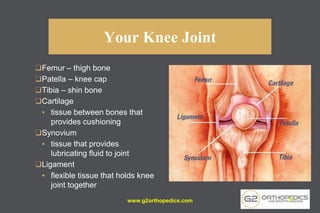
Your Knee Joint
❑Femur – thigh bone
❑Patella – knee cap
❑Tibia – shin bone
❑Cartilage
▪ tissue between bones that
provides cushioning
❑Synovium
▪ tissue that provides
lubricating fluid to joint
❑Ligament
▪ flexible tissue that holds knee
joint together
www.g2orthopedics.com 4
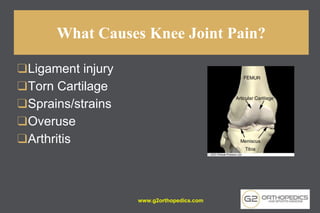
What Causes Knee Joint Pain?
❑Ligament injury
❑Torn Cartilage
❑Sprains/strains
❑Overuse
❑Arthritis
www.g2orthopedics.com
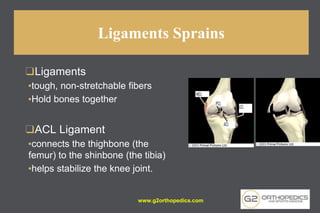
Ligaments Sprains
❑Ligaments
▪tough, non-stretchable fibers
▪Hold bones together
❑ACL Ligament
▪connects the thighbone (the
femur) to the shinbone (the tibia)
▪helps stabilize the knee joint.
www.g2orthopedics.com
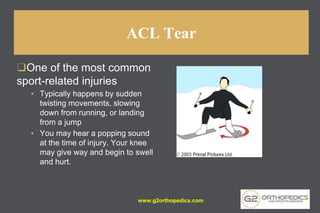
ACL Tear
❑One of the most common
sport-related injuries
▪ Typically happens by sudden
twisting movements, slowing
down from running, or landing
from a jump
▪ You may hear a popping sound
at the time of injury. Your knee
may give way and begin to swell
and hurt.
www.g2orthopedics.com 7
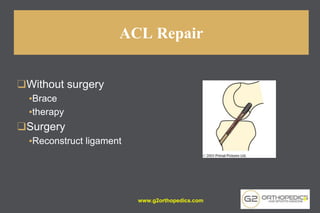
ACL Repair
❑Without surgery
▪Brace
▪therapy
❑Surgery
▪Reconstruct ligament
www.g2orthopedics.com 8
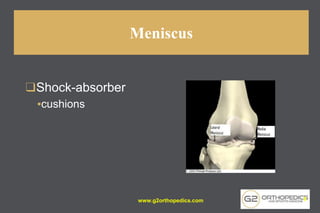
Meniscus
❑Shock-absorber
▪cushions
www.g2orthopedics.com 9
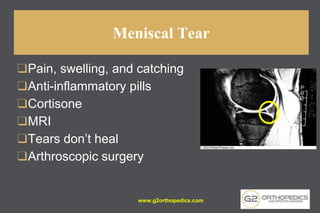
Meniscal Tear
❑Pain, swelling, and catching
❑Anti-inflammatory pills
❑Cortisone
❑MRI
❑Tears don’t heal
❑Arthroscopic surgery
www.g2orthopedics.com
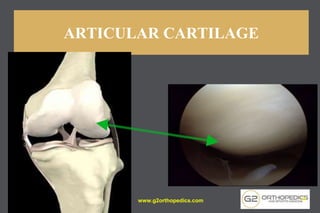
ARTICULAR CARTILAGE
www.g2orthopedics.com 11
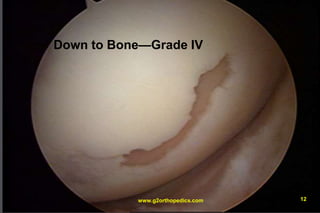
Down to Bone—Grade IV
www.g2orthopedics.com 12
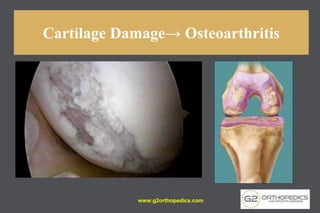
Cartilage Damage→ Osteoarthritis
www.g2orthopedics.com
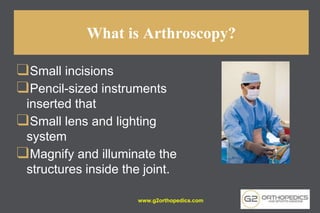
What is Arthroscopy?
❑Small incisions
❑Pencil-sized instruments
inserted that
❑Small lens and lighting
system
❑Magnify and illuminate the
structures inside the joint.
www.g2orthopedics.com
Arthroscopy
❑Rotator cuff repair
❑Repair or remove torn cartilage (meniscus)
❑Reconstruct knee or shoulder ligaments
❑Removal of loose bone or cartilage in knee, shoulder,
elbow, ankle, wrist.
www.g2orthopedics.com
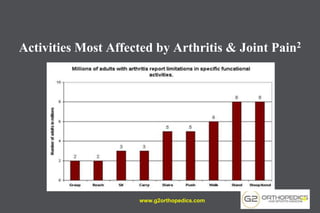
Activities Most Affected by Arthritis & Joint Pain2
www.g2orthopedics.com 16
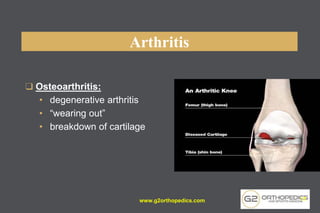
Arthritis
❑ Osteoarthritis:
• degenerative arthritis
• “wearing out”
• breakdown of cartilage
www.g2orthopedics.com 17
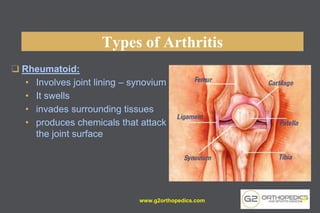
Types of Arthritis
❑ Rheumatoid:
• Involves joint lining – synovium
• It swells
• invades surrounding tissues
• produces chemicals that attack
the joint surface
www.g2orthopedics.com 18
Osteoarthritis Symptoms
❑ May develop suddenly or very slowly
❑ Pain and stiffness
❑ Swelling
❑ Simple tasks may be difficult to do
www.g2orthopedics.com 19
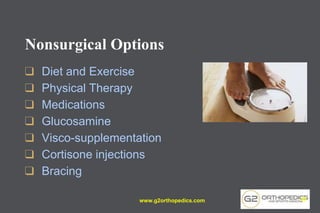
Nonsurgical Options
❑ Diet and Exercise
❑ Physical Therapy
❑ Medications
❑ Glucosamine
❑ Visco-supplementation
❑ Cortisone injections
❑ Bracing
www.g2orthopedics.com 20
Knee Replacement
www.g2orthopedics.com
Myths and Truths
about
Joint Replacement
Surgery
www.g2orthopedics.com 22
Myth
Knee replacement
implants are only good
for about 10 years.
www.g2orthopedics.com 23
Currently, more than 90% of
modern total knee
replacements are still
functioning with a high level of
satisfaction after 15 years. (1)
Truth www.g2orthopedics.com 24
I’ll have to stay in the
hospital a long time
after joint replacement
surgery
Myth www.g2orthopedics.com 25
Today, patients put weight on
their new hip or knee hours
after their surgery and many
go home after 2-3 days. (4)
Truth www.g2orthopedics.com 26
You can't really
exercise or participate
in sports activities after
joint replacement
surgery
Myth www.g2orthopedics.com 27
Actually being active is
encouraged after joint
replacement surgery. Your
doctor will advise you on what is
appropriate (5)
Truth www.g2orthopedics.com 28
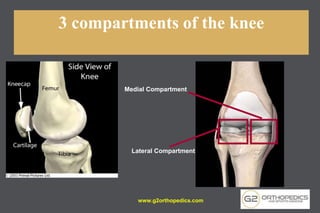
3 compartments of the knee
Medial Compartment
Lateral Compartment
www.g2orthopedics.com
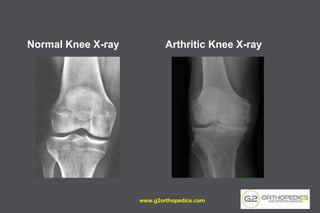
Normal Knee X-ray Arthritic Knee X-ray
www.g2orthopedics.com 30
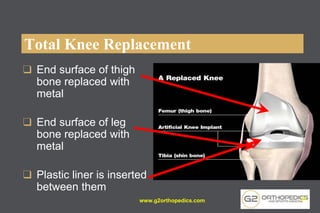
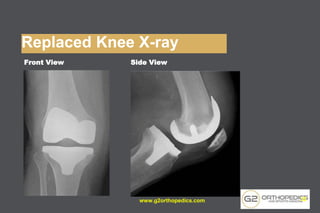
Total Knee Replacement
❑ End surface of thigh
bone replaced with
metal
❑ End surface of leg
bone replaced with
metal
❑ Plastic liner is inserted
between them
www.g2orthopedics.com 31
Replaced Knee X-ray
Front View Side View
www.g2orthopedics.com 32
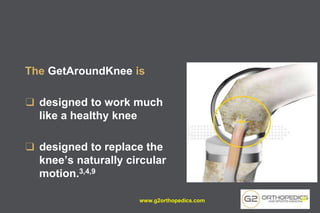
The GetAroundKnee is
❑ designed to work much
like a healthy knee
❑ designed to replace the
knee’s naturally circular
motion.3,4,9
www.g2orthopedics.com 33
www.g2orthopedics.com 34
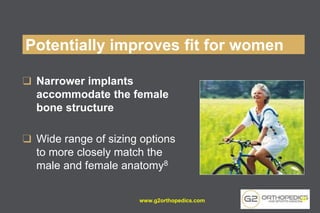
Potentially improves fit for women
❑ Narrower implants
accommodate the female
bone structure
❑ Wide range of sizing options
to more closely match the
male and female anatomy8
www.g2orthopedics.com 35
Computer Navigation
www.g2orthopedics.com 36
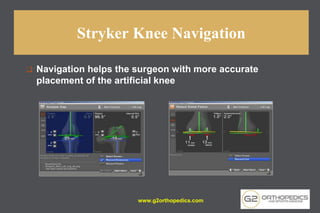
Stryker Knee Navigation
❑ Navigation helps the surgeon with more accurate
placement of the artificial knee
www.g2orthopedics.com
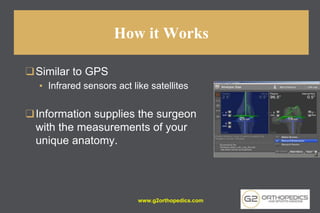
How it Works
❑Similar to GPS
▪ Infrared sensors act like satellites
❑Information supplies the surgeon
with the measurements of your
unique anatomy.
www.g2orthopedics.com
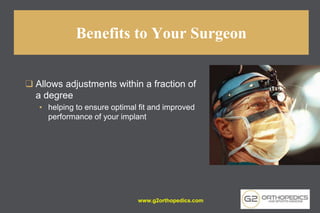
Benefits to Your Surgeon
❑ Allows adjustments within a fraction of
a degree
▪ helping to ensure optimal fit and improved
performance of your implant
www.g2orthopedics.com
Potential Benefits to Patient
❑Reduced bleeding
immediately after surgery
❑Easier to regain knee
motion
www.g2orthopedics.com
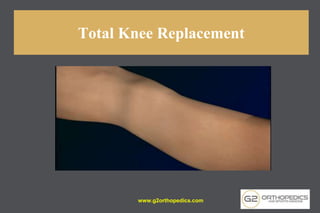
Total Knee Replacement
www.g2orthopedics.com
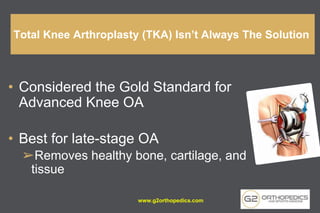
• Considered the Gold Standard for
Advanced Knee OA
• Best for late-stage OA
➢Removes healthy bone, cartilage, and
tissue
Total Knee Arthroplasty (TKA) Isn’t Always The Solution
www.g2orthopedics.com
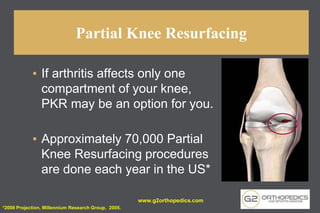
Partial Knee Resurfacing
▪ If arthritis affects only one
compartment of your knee,
PKR may be an option for you.
▪ Approximately 70,000 Partial
Knee Resurfacing procedures
are done each year in the US*
*2008 Projection, Millennium Research Group, 2005.
www.g2orthopedics.com
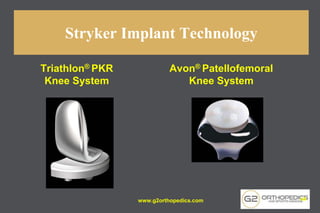
Stryker Implant Technology
Triathlon® PKR
Knee System
Avon® Patellofemoral
Knee System
www.g2orthopedics.com 44
www.g2orthopedics.com
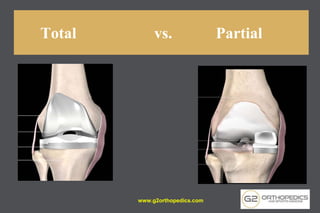
Total vs. Partial
www.g2orthopedics.com
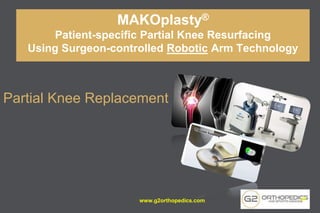
MAKOplasty®
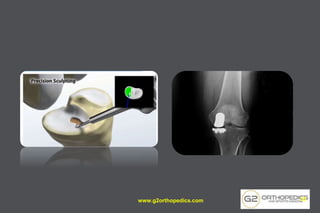
Patient-specific Partial Knee Resurfacing
Using Surgeon-controlled Robotic Arm Technology
Partial Knee Replacement
www.g2orthopedics.com 47
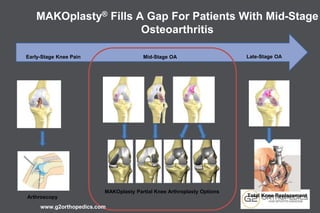
MAKOplasty® Fills A Gap For Patients With Mid-Stage
Osteoarthritis
Early-Stage Knee Pain Mid-Stage OA Late-Stage OA
MAKOplasty Partial Knee Arthroplasty Options
Total Knee ReplacementArthroscopy
www.g2orthopedics.com
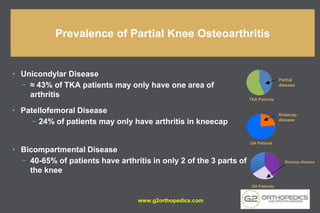
Prevalence of Partial Knee Osteoarthritis
• Unicondylar Disease
− ≈ 43% of TKA patients may only have one area of
arthritis
• Patellofemoral Disease
− 24% of patients may only have arthritis in kneecap
• Bicompartmental Disease
− 40-65% of patients have arthritis in only 2 of the 3 parts of
the knee
Bicomp disease
TKA Patients
Partial
disease
Kneecap
disease
OA Patients
OA Patients
www.g2orthopedics.com
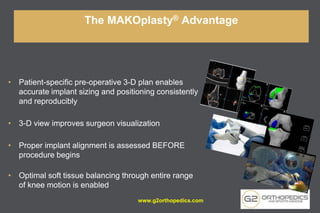
Before surgery a 3-D plan is created
from a CAT scan of your knee
The MAKOplasty® Advantage
www.g2orthopedics.com
• Patient-specific pre-operative 3-D plan enables
accurate implant sizing and positioning consistently
and reproducibly
• 3-D view improves surgeon visualization
• Proper implant alignment is assessed BEFORE
procedure begins
• Optimal soft tissue balancing through entire range
of knee motion is enabled
The MAKOplasty® Advantage
www.g2orthopedics.com
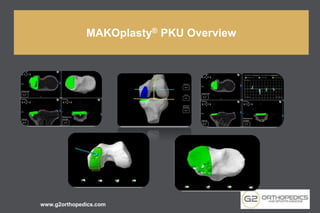
MAKOplasty® PKU Overview
www.g2orthopedics.com 53
MAKOplasty® PKR Surgery Overview
www.g2orthopedics.com
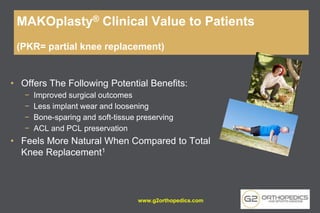
• Offers The Following Potential Benefits:
− Improved surgical outcomes
− Less implant wear and loosening
− Bone-sparing and soft-tissue preserving
− ACL and PCL preservation
• Feels More Natural When Compared to Total
Knee Replacement1
MAKOplasty® Clinical Value to Patients
(PKR= partial knee replacement)
www.g2orthopedics.com
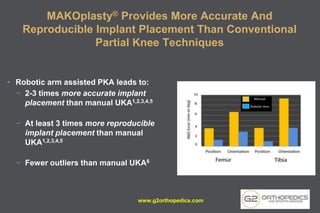
MAKOplasty® Provides More Accurate And
Reproducible Implant Placement Than Conventional
Partial Knee Techniques
• Robotic arm assisted PKA leads to:
− 2-3 times more accurate implant
placement than manual UKA1,2,3,4,5
− At least 3 times more reproducible
implant placement than manual
UKA1,2,3,4,5
− Fewer outliers than manual UKA6
www.g2orthopedics.com
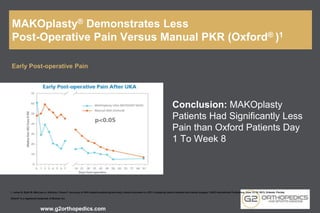
Conclusion: MAKOplasty
Patients Had Significantly Less
Pain than Oxford Patients Day
1 To Week 8
MAKOplasty® Demonstrates Less
Post-Operative Pain Versus Manual PKR (Oxford® )1
Early Post-operative Pain
1. Jones B, Blyth M, MacLean A, Anthony I, Rowe P. Accuracy of UKA implant positioning and early clinical outcomes in a RCT comparing robotic assisted and manual surgery. CAOS International Conference, June 13-15, 2013, Orlando, Florida.
Oxford® is a registered trademark of Biomet, Inc.
www.g2orthopedics.com
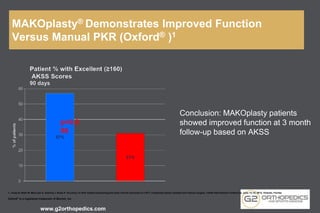
Conclusion: MAKOplasty patients
showed improved function at 3 month
follow-up based on AKSS
MAKOplasty® Demonstrates Improved Function
Versus Manual PKR (Oxford® )1
1. Jones B, Blyth M, MacLean A, Anthony I, Rowe P. Accuracy of UKA implant positioning and early clinical outcomes in a RCT comparing robotic assisted and manual surgery. CAOS International Conference, June 13-15, 2013, Orlando, Florida.
Oxford® is a registered trademark of Biomet, Inc.
p=0.0
06
www.g2orthopedics.com
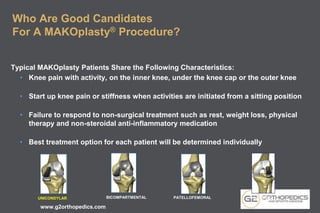
Who Are Good Candidates
For A MAKOplasty® Procedure?
Typical MAKOplasty Patients Share the Following Characteristics:
• Knee pain with activity, on the inner knee, under the knee cap or the outer knee
• Start up knee pain or stiffness when activities are initiated from a sitting position
• Failure to respond to non-surgical treatment such as rest, weight loss, physical
therapy and non-steroidal anti-inflammatory medication
• Best treatment option for each patient will be determined individually
BICOMPARTMENTAL PATELLOFEMORALUNICONDYLAR LATERAL
www.g2orthopedics.com
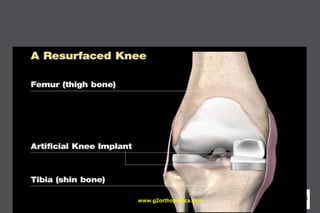
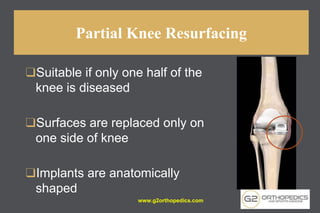
Partial Knee Resurfacing
❑Suitable if only one half of the
knee is diseased
❑Surfaces are replaced only on
one side of knee
❑Implants are anatomically
shaped
www.g2orthopedics.com
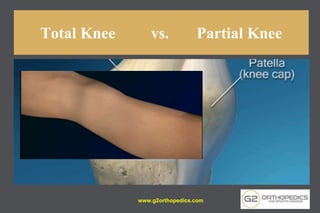
Total Knee vs. Partial Knee
www.g2orthopedics.com
Benefits of Partial Knee Resurfacing
(PKR)
❑Recovery period may be shorter than total knee
replacement*
❑Post-operative pain may be reduced*
❑Smaller implants mean the surgical incision may
be smaller
* Newman, John H., Unicompartmental Knee Replacement, The Knee, 7 (2000), pp. 63-70.
www.g2orthopedics.com
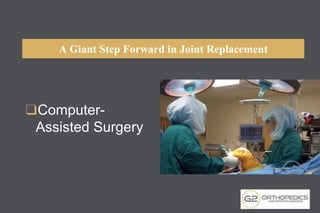
A Giant Step Forward in Joint Replacement
❑Computer-
Assisted Surgery
What are the potential risks?
❑Risks which are normally encountered in
conventional TKA remain
❑Individual results and post-op activity levels
vary
www.g2orthopedics.com
Knee Implants
❑Longevity of knee implants is affected by many
factors including:
▪ Patient weight
▪ Activity level
▪ Bearing surface
www.g2orthopedics.com
Knee Rehabilitation
❑Performing rehabilitative exercises may
gradually return full flexibility and stability to
your knee
❑Building strength in your thigh and calf
muscles to support the reconstructed knee is a
primary goal of rehabilitation
www.g2orthopedics.com
Conclusion
❑I start with non-operative options
❑When pain and activity limitations effect the
patient then a replacement is discussed
❑The use of technology permits me to more
accurately and reproducibly perform the
surgery
www.g2orthopedics.com
❑I like to offer the least invasive procedure
that will provide the desired outcomes
❑Robotic technology permits accurate and
reproducible outcomes
❑Future
Conclusion
www.g2orthopedics.com
Thank You
Vic Goradia, MD
Office: 804-678-9000
www.G2orthopedics.com
www.g2orthopedics.com

Advances in knee replacement 2015.pptx

  • 1.
    Potential Causes andTreatment Options for Knee Pain Vic Goradia, MD Orthopedic Surgeon G2 Orthopedics and Sports Medicine www.g2orthopedics.com 1
  • 2.
    About My Practice ❑Expertise ❑PersonalizedCare ❑Convenience www.g2orthopedics.com
  • 3.
    My Background ❑Board Certifiedw/ CAQ in Sports Med ❑Fellowship- Union Memorial Sports Med Clinic, Baltimore ❑In practice since 1999 ❑Chair - Online CME for Arthroscopy Assoc. of N. Am ❑Past Associate Editor for Journal of Arthroscopy ❑Regularly teach advanced knee and shoulder surgery courses to orthopedists around the U.S. www.g2orthopedics.com
  • 4.
    Your Knee Joint ❑Femur– thigh bone ❑Patella – knee cap ❑Tibia – shin bone ❑Cartilage ▪ tissue between bones that provides cushioning ❑Synovium ▪ tissue that provides lubricating fluid to joint ❑Ligament ▪ flexible tissue that holds knee joint together www.g2orthopedics.com 4
  • 5.
    What Causes KneeJoint Pain? ❑Ligament injury ❑Torn Cartilage ❑Sprains/strains ❑Overuse ❑Arthritis www.g2orthopedics.com
  • 6.
    Ligaments Sprains ❑Ligaments ▪tough, non-stretchablefibers ▪Hold bones together ❑ACL Ligament ▪connects the thighbone (the femur) to the shinbone (the tibia) ▪helps stabilize the knee joint. www.g2orthopedics.com
  • 7.
    ACL Tear ❑One ofthe most common sport-related injuries ▪ Typically happens by sudden twisting movements, slowing down from running, or landing from a jump ▪ You may hear a popping sound at the time of injury. Your knee may give way and begin to swell and hurt. www.g2orthopedics.com 7
  • 8.
  • 9.
  • 10.
    Meniscal Tear ❑Pain, swelling,and catching ❑Anti-inflammatory pills ❑Cortisone ❑MRI ❑Tears don’t heal ❑Arthroscopic surgery www.g2orthopedics.com
  • 11.
  • 12.
    Down to Bone—GradeIV www.g2orthopedics.com 12
  • 13.
  • 14.
    What is Arthroscopy? ❑Smallincisions ❑Pencil-sized instruments inserted that ❑Small lens and lighting system ❑Magnify and illuminate the structures inside the joint. www.g2orthopedics.com
  • 15.
    Arthroscopy ❑Rotator cuff repair ❑Repairor remove torn cartilage (meniscus) ❑Reconstruct knee or shoulder ligaments ❑Removal of loose bone or cartilage in knee, shoulder, elbow, ankle, wrist. www.g2orthopedics.com
  • 16.
    Activities Most Affectedby Arthritis & Joint Pain2 www.g2orthopedics.com 16
  • 17.
    Arthritis ❑ Osteoarthritis: • degenerativearthritis • “wearing out” • breakdown of cartilage www.g2orthopedics.com 17
  • 18.
    Types of Arthritis ❑Rheumatoid: • Involves joint lining – synovium • It swells • invades surrounding tissues • produces chemicals that attack the joint surface www.g2orthopedics.com 18
  • 19.
    Osteoarthritis Symptoms ❑ Maydevelop suddenly or very slowly ❑ Pain and stiffness ❑ Swelling ❑ Simple tasks may be difficult to do www.g2orthopedics.com 19
  • 20.
    Nonsurgical Options ❑ Dietand Exercise ❑ Physical Therapy ❑ Medications ❑ Glucosamine ❑ Visco-supplementation ❑ Cortisone injections ❑ Bracing www.g2orthopedics.com 20
  • 21.
  • 22.
    Myths and Truths about JointReplacement Surgery www.g2orthopedics.com 22
  • 23.
    Myth Knee replacement implants areonly good for about 10 years. www.g2orthopedics.com 23
  • 24.
    Currently, more than90% of modern total knee replacements are still functioning with a high level of satisfaction after 15 years. (1) Truth www.g2orthopedics.com 24
  • 25.
    I’ll have tostay in the hospital a long time after joint replacement surgery Myth www.g2orthopedics.com 25
  • 26.
    Today, patients putweight on their new hip or knee hours after their surgery and many go home after 2-3 days. (4) Truth www.g2orthopedics.com 26
  • 27.
    You can't really exerciseor participate in sports activities after joint replacement surgery Myth www.g2orthopedics.com 27
  • 28.
    Actually being activeis encouraged after joint replacement surgery. Your doctor will advise you on what is appropriate (5) Truth www.g2orthopedics.com 28
  • 29.
    3 compartments ofthe knee Medial Compartment Lateral Compartment www.g2orthopedics.com
  • 30.
    Normal Knee X-rayArthritic Knee X-ray www.g2orthopedics.com 30
  • 31.
    Total Knee Replacement ❑End surface of thigh bone replaced with metal ❑ End surface of leg bone replaced with metal ❑ Plastic liner is inserted between them www.g2orthopedics.com 31
  • 32.
    Replaced Knee X-ray FrontView Side View www.g2orthopedics.com 32
  • 33.
    The GetAroundKnee is ❑designed to work much like a healthy knee ❑ designed to replace the knee’s naturally circular motion.3,4,9 www.g2orthopedics.com 33
  • 34.
  • 35.
    Potentially improves fitfor women ❑ Narrower implants accommodate the female bone structure ❑ Wide range of sizing options to more closely match the male and female anatomy8 www.g2orthopedics.com 35
  • 36.
  • 37.
    Stryker Knee Navigation ❑Navigation helps the surgeon with more accurate placement of the artificial knee www.g2orthopedics.com
  • 38.
    How it Works ❑Similarto GPS ▪ Infrared sensors act like satellites ❑Information supplies the surgeon with the measurements of your unique anatomy. www.g2orthopedics.com
  • 39.
    Benefits to YourSurgeon ❑ Allows adjustments within a fraction of a degree ▪ helping to ensure optimal fit and improved performance of your implant www.g2orthopedics.com
  • 40.
    Potential Benefits toPatient ❑Reduced bleeding immediately after surgery ❑Easier to regain knee motion www.g2orthopedics.com
  • 41.
  • 42.
    • Considered theGold Standard for Advanced Knee OA • Best for late-stage OA ➢Removes healthy bone, cartilage, and tissue Total Knee Arthroplasty (TKA) Isn’t Always The Solution www.g2orthopedics.com
  • 43.
    Partial Knee Resurfacing ▪If arthritis affects only one compartment of your knee, PKR may be an option for you. ▪ Approximately 70,000 Partial Knee Resurfacing procedures are done each year in the US* *2008 Projection, Millennium Research Group, 2005. www.g2orthopedics.com
  • 44.
    Stryker Implant Technology Triathlon®PKR Knee System Avon® Patellofemoral Knee System www.g2orthopedics.com 44
  • 45.
  • 46.
  • 47.
    MAKOplasty® Patient-specific Partial KneeResurfacing Using Surgeon-controlled Robotic Arm Technology Partial Knee Replacement www.g2orthopedics.com 47
  • 48.
    MAKOplasty® Fills AGap For Patients With Mid-Stage Osteoarthritis Early-Stage Knee Pain Mid-Stage OA Late-Stage OA MAKOplasty Partial Knee Arthroplasty Options Total Knee ReplacementArthroscopy www.g2orthopedics.com
  • 49.
    Prevalence of PartialKnee Osteoarthritis • Unicondylar Disease − ≈ 43% of TKA patients may only have one area of arthritis • Patellofemoral Disease − 24% of patients may only have arthritis in kneecap • Bicompartmental Disease − 40-65% of patients have arthritis in only 2 of the 3 parts of the knee Bicomp disease TKA Patients Partial disease Kneecap disease OA Patients OA Patients www.g2orthopedics.com
  • 50.
    Before surgery a3-D plan is created from a CAT scan of your knee The MAKOplasty® Advantage www.g2orthopedics.com
  • 51.
    • Patient-specific pre-operative3-D plan enables accurate implant sizing and positioning consistently and reproducibly • 3-D view improves surgeon visualization • Proper implant alignment is assessed BEFORE procedure begins • Optimal soft tissue balancing through entire range of knee motion is enabled The MAKOplasty® Advantage www.g2orthopedics.com
  • 52.
  • 53.
  • 54.
    MAKOplasty® PKR SurgeryOverview www.g2orthopedics.com
  • 55.
    • Offers TheFollowing Potential Benefits: − Improved surgical outcomes − Less implant wear and loosening − Bone-sparing and soft-tissue preserving − ACL and PCL preservation • Feels More Natural When Compared to Total Knee Replacement1 MAKOplasty® Clinical Value to Patients (PKR= partial knee replacement) www.g2orthopedics.com
  • 56.
    MAKOplasty® Provides MoreAccurate And Reproducible Implant Placement Than Conventional Partial Knee Techniques • Robotic arm assisted PKA leads to: − 2-3 times more accurate implant placement than manual UKA1,2,3,4,5 − At least 3 times more reproducible implant placement than manual UKA1,2,3,4,5 − Fewer outliers than manual UKA6 www.g2orthopedics.com
  • 57.
    Conclusion: MAKOplasty Patients HadSignificantly Less Pain than Oxford Patients Day 1 To Week 8 MAKOplasty® Demonstrates Less Post-Operative Pain Versus Manual PKR (Oxford® )1 Early Post-operative Pain 1. Jones B, Blyth M, MacLean A, Anthony I, Rowe P. Accuracy of UKA implant positioning and early clinical outcomes in a RCT comparing robotic assisted and manual surgery. CAOS International Conference, June 13-15, 2013, Orlando, Florida. Oxford® is a registered trademark of Biomet, Inc. www.g2orthopedics.com
  • 58.
    Conclusion: MAKOplasty patients showedimproved function at 3 month follow-up based on AKSS MAKOplasty® Demonstrates Improved Function Versus Manual PKR (Oxford® )1 1. Jones B, Blyth M, MacLean A, Anthony I, Rowe P. Accuracy of UKA implant positioning and early clinical outcomes in a RCT comparing robotic assisted and manual surgery. CAOS International Conference, June 13-15, 2013, Orlando, Florida. Oxford® is a registered trademark of Biomet, Inc. p=0.0 06 www.g2orthopedics.com
  • 59.
    Who Are GoodCandidates For A MAKOplasty® Procedure? Typical MAKOplasty Patients Share the Following Characteristics: • Knee pain with activity, on the inner knee, under the knee cap or the outer knee • Start up knee pain or stiffness when activities are initiated from a sitting position • Failure to respond to non-surgical treatment such as rest, weight loss, physical therapy and non-steroidal anti-inflammatory medication • Best treatment option for each patient will be determined individually BICOMPARTMENTAL PATELLOFEMORALUNICONDYLAR LATERAL www.g2orthopedics.com
  • 60.
    Partial Knee Resurfacing ❑Suitableif only one half of the knee is diseased ❑Surfaces are replaced only on one side of knee ❑Implants are anatomically shaped www.g2orthopedics.com
  • 61.
    Total Knee vs.Partial Knee www.g2orthopedics.com
  • 62.
    Benefits of PartialKnee Resurfacing (PKR) ❑Recovery period may be shorter than total knee replacement* ❑Post-operative pain may be reduced* ❑Smaller implants mean the surgical incision may be smaller * Newman, John H., Unicompartmental Knee Replacement, The Knee, 7 (2000), pp. 63-70. www.g2orthopedics.com
  • 63.
    A Giant StepForward in Joint Replacement ❑Computer- Assisted Surgery
  • 64.
    What are thepotential risks? ❑Risks which are normally encountered in conventional TKA remain ❑Individual results and post-op activity levels vary www.g2orthopedics.com
  • 65.
    Knee Implants ❑Longevity ofknee implants is affected by many factors including: ▪ Patient weight ▪ Activity level ▪ Bearing surface www.g2orthopedics.com
  • 66.
    Knee Rehabilitation ❑Performing rehabilitativeexercises may gradually return full flexibility and stability to your knee ❑Building strength in your thigh and calf muscles to support the reconstructed knee is a primary goal of rehabilitation www.g2orthopedics.com
  • 67.
    Conclusion ❑I start withnon-operative options ❑When pain and activity limitations effect the patient then a replacement is discussed ❑The use of technology permits me to more accurately and reproducibly perform the surgery www.g2orthopedics.com
  • 68.
    ❑I like tooffer the least invasive procedure that will provide the desired outcomes ❑Robotic technology permits accurate and reproducible outcomes ❑Future Conclusion www.g2orthopedics.com
  • 69.
    Thank You Vic Goradia,MD Office: 804-678-9000 www.G2orthopedics.com www.g2orthopedics.com